Best Dog Harness: Vet-Reviewed Picks for Everyday Walks, Pullers, and Small Dogs
Vet-reviewed guide to the best dog harness for your dog: front-clip versus back-clip designs, how to measure chest girth, and how a harness should fit. Picks for steady walkers, large dogs, puppies, and long-backed breeds.

BVMS MRCVS

This article contains affiliate links. Webvet may earn a commission when you buy through them, at no extra cost to you.
The best dog harness is the one that fits your dog's chest without pressing on the throat or the shoulders. A front clip helps with a dog that pulls, a back clip suits a calm walker, and the size comes from a chest measurement taken around the widest part of the rib cage.
The right harness is the one that matches the dog in front of you. For everyday walks, our top pick is the Ruffwear Front Range Reflective Front-Clip Dog Harness, which carries a back V-ring for calm walks and a front clip for a dog that pulls. The picks below cover other dogs, from large active dogs to budget buyers.
Our editorial team compared six harnesses listed from $15.95 to $59.99 on Chewy when we checked in October 2026. We did not obtain or test them; each verdict rests on the maker's published specifications, the Chewy listing text, and veterinary guidance from VCA Animal Hospitals, the American Kennel Club, PetMD, and peer-reviewed studies.
| Harness | Best fit | Clip position | Chewy listing, October 2026 | Main tradeoff |
|---|---|---|---|---|
| Ruffwear Front Range Reflective Front-Clip Dog Harness, Red Canyon, Medium: 27 to 32-in chest | Everyday walks for a dog that sometimes pulls | Aluminum V-ring on the back plus a reinforced front clip | $59.99 | The highest price of the six |
| Embark Harness Co. Adventure No Pull Dog Harness, Black, Large | Active large dogs on runs, hikes, and camping trips | Reinforced D rings on the front and back | $29.99 | Embark publishes its chest ranges only as an image chart |
| Halti Walking Dog Harness, Black, Medium | Busy streets and road crossings | Lead clip rings on the chest and back, plus a traffic handle | $35.99 | The Medium chest range is not given in the listing text |
| Kurgo Journey Air Polyester Reflective No Pull Dog Harness, Coral, Large | Running, hiking, and active walking | Front and back leash attachments | $37.49 | Chewy calls the fabric polyester while Kurgo describes a ripstop outer |
| Doggy Tales Step In V Dog Harness, Blue, Medium | Dogs that are easier to dress by stepping in | Double D rings | $26.95 | The listing does not publish a chest range for the Medium |
| Red Dingo No Pull Dog Harness, Blue, Medium | Budget buyers who want a simple, adjustable harness | The maker's page does not say where the leash clips | $15.95 | Sized by body loop and armpit width rather than chest girth |
 Sponsored
Want a vet's help with your dog's anxiety or behavior?
Talk to a licensed vet at Dutch over video, often the same day. They can recommend treatment and prescribe it when it's appropriate.
Use code Pets60
Plans start at $12/month · covers up to 5 pets
- Licensed vets in most states
- Rx for 150+ conditions
- 4.7 on Trustpilot
What makes a good dog harness: fit, clip position, and comfort
A good dog harness spreads the force of the leash across the chest instead of the neck, lets the front legs swing freely, and does not pinch when the dog stands or sits. Clip position then decides how the leash steers the dog: a front clip on the chest for pulling, a back clip for a calm walker.

VCA Animal Hospitals says a body harness puts minimal pressure on delicate tissue and is less likely to cause injury. VCA calls it an excellent choice for dogs with tracheal disease or neck pain, and warns that a dog pulling hard against a flat collar may put too much pressure on delicate structures in the neck.
A veterinarian quoted by the American Kennel Club explains the mechanism: a harness secures the dog with multiple contact points, which helps distribute pressure around the chest and shoulders. That only holds when the straps sit where they should.
- 1A front clip for a dog that pulls, a back clip for a calm walker, and both rings when you want the option of extra control.
- 2Size comes from a tape wrapped around the widest part of the rib cage, just behind the front legs, snug but not tight.
- 3A harness fits when you can slide about two fingers under every strap and nothing pinches when the dog stands or sits.
- 4The neck opening should rest near the top of the breastbone, not across the throat, and the girth strap should sit around the rib cage, clear of the back of the front legs (elbows).
- 5If your dog is between sizes, both Ruffwear and Kurgo say to choose the larger size.
What a well-fitted harness does
VCA sets out a clear standard for fit. A well-fitted harness:
- Does not limit how the front legs move.
- Is adjustable in every dimension, so you can tune the neck and chest separately.
- Does not rub behind the elbow or cause discomfort.
The AKC's fit guidance, which also quotes a veterinarian, adds two placement checks:
- The girth strap should not sit behind the rib cage toward the stomach, and it should not squeeze into the back of the front legs at the elbows.
- The neck opening should ideally be adjustable and sit closer to the top of the sternum than around the throat.
Those two checks are the practical meaning of "not pressing on the throat or shoulders". Two failure signs follow from them:
- If the front loop rides up into the throat when the leash goes tight, the harness is loading the neck the way a collar would.
- If the girth strap slides back toward the belly, the harness is loose enough that VCA's warning about dogs backing out applies.
Why no single harness wins for every dog
Two research groups reached the same conclusion from different directions. A gait study of four dogs published in PLoS One in 2022 concluded there is no absolute superior harness, and that the best fit depends on the specific dog and how the harness is used.
A 2025 review of collars, harnesses, and head collars by Cavalli and Protopopova in Animals came to the same place: no single device works best for every dog, and the right choice depends on both the dog and the person walking it.
Strap shape matters too. A systematic review posted as a bioRxiv preprint, which has not been peer reviewed, reports two findings:
- A chest-strap harness reduced shoulder extension by up to 8 degrees at walk and trot.
- A Y-shaped harness marketed as non-restrictive reduced it by up to 10 degrees.
Read that as a fit and design caution, not a reason to avoid harnesses. The evidence base is small, and veterinary guidance still favors harnesses over collars for neck-sensitive dogs. It does suggest that a harness crowding the shoulder joint can change how a dog moves, so watch your dog's stride after fitting a new one.
A quick checklist before you buy
Before you order any harness, run it past five questions drawn from the veterinary fit guidance:
- Does the maker publish a chest girth range for the size you need, in text or in a chart you can read?
- Does it adjust at both the neck and the chest, so you can set the neck loop low and the girth strap around the rib cage, clear of the back of the front legs (elbows)? VCA's standard is adjustable in every dimension.
- Does the clip position match your dog: a front ring for pulling, a back ring for a calm walker, both if you want the option?
- Does the chest piece stay clear of the shoulder joints, the placement VCA warns about on some front-clip designs?
- Can the straps sit clear of the armpits, where PetMD says to watch for rubbing?
How to match the harness to your dog
Start with the dog, then choose the clip position, then measure.
| Dog profile | Clip position to start with | Adjustment points to check | Chest girth fit rule | Matching pick |
|---|---|---|---|---|
| Steady walker who rarely pulls | Back clip | Girth strap around the rib cage, clear of the back of the front legs (elbows); neck loop at the top of the breastbone | Measure the widest part of the rib cage; two fingers under every strap | Ruffwear Front Range on its back V-ring |
| Dog that pulls | Front clip on a non-tightening harness | Chest strap must not rest over the shoulder joints | Snug fit so the chest piece cannot slide down when the leash is tight | Ruffwear Front Range on its front clip |
| Large or strong dog | Front clip first, or both rings for extra control | Every strap; deep-chested dogs need the slack between shoulder and chest taken up | Measure, and choose the larger size if between sizes | Embark Adventure or Halti Walking |
| Growing puppy | Adjusted as the puppy grows | All straps, rechecked a few times a week | Re-measure as the puppy grows; size up when the straps run out | Red Dingo No Pull, which adjusts fully |
| Long-backed dog such as a dachshund | Back clip | Girth strap around the rib cage, clear of the back of the front legs (elbows); no rubbing in the armpits | Measure the chest, not the length of the back | A harness with a back ring, such as the Ruffwear Front Range |
| Flat-faced breed such as a bulldog | Back clip on a harness that does not tug at the neck | Neck opening low on the breastbone; armpits free of rubbing | Measure the barrel chest carefully; check for pinching under the front legs | Kurgo Journey Air, with a padded chest plate and a back attachment |
| Busy streets or a handler who needs quick control | Both rings, plus a handle | Traffic handle within easy reach | Two fingers under every strap | Halti Walking, with its traffic handle |
Are dog harnesses safe for dogs?
Yes, when it suits the dog's build and fits well. VCA says a body harness puts minimal pressure on delicate tissue and is less likely to cause injury. VCA's listed risks are a style that does not suit the dog's body, a poor fit that lets the dog back out and escape, and entanglement, so supervise your dog in one.
On whether vets prefer a collar or a harness, VCA favors a body harness for dogs with tracheal disease or neck pain, and the 2025 review in Animals says a flat collar suits a dog that walks without pulling; our guide on how to choose the right dog collar covers the collar side of that decision.
If you keep a collar on your dog for tags, it carries its own risks. Our guide to preventing dog collar accidents covers the checks that keep a collar safe alongside a harness.
What is the absolute best dog harness?
There isn't one. The PLoS One gait study found no absolute superior harness, and the 2025 review in Animals found no single device works best for every dog. For everyday walks our top pick is the Ruffwear Front Range, with a back ring, a front clip, foam padding, and four adjustment points. For tracheal disease, VCA advises a body harness over a collar.
Our picks: the best dog harnesses
By the evidence above, a good harness is one that fits your dog's chest and suits how your dog walks. We chose these six from Chewy's harness range and judged each on what the maker and the listing actually publish:
- The clip positions it offers: front, back, or both.
- The number of adjustment points the maker lists.
- Padding, linings, and reflective features named in the listing.
- Whether the maker publishes chest girth sizing in text, as an image chart, or not at all.
- The Chewy listing price for the named color and size when we checked in October 2026; other sizes and colors are priced separately.
A dog harness for collapsed trachea is the same decision in a different order: pick the harness that keeps every strap off the windpipe first, then fit it by chest measurement like any other dog.
Every harness here is a walking tool. Car travel needs a restraint built for the car, and a harness works best paired with a well-chosen lead from our best dog leash guide.
| Pick | Chest range (as listed) | Clip position | Adjustment points | Chewy price (October 2026) |
|---|---|---|---|---|
| Ruffwear Front Range Reflective Front-Clip Dog Harness, Red Canyon, Medium | Medium: 27 to 32 in | Aluminum V-ring on the back and a reinforced front clip | Four, per Ruffwear | $59.99 |
| Embark Harness Co. Adventure No Pull Dog Harness, Black, Large | Not stated in the listing (Embark's chart is an image) | Front and back reinforced D rings | Not stated in the listing | $29.99 |
| Halti Walking Dog Harness, Black, Medium | Not stated in the listing (Halti's chart is an image) | Lead clip rings on the chest and back | Five | $35.99 |
| Kurgo Journey Air Polyester Reflective No Pull Dog Harness, Coral, Large | Large: 24 to 34 in chest and 18 to 30 in neck, per Kurgo's chart | Front and back leash attachments | Four | $37.49 |
| Doggy Tales Step In V Dog Harness, Blue, Medium | Not stated in the listing | Double D rings; position not stated in the listing | Adjustable clasp; count not stated in the listing | $26.95 |
| Red Dingo No Pull Dog Harness, Blue, Medium | Medium: body loop 19.5 to 27.5 in and chest width 9.75 to 14.5 in, per Red Dingo's chart (not chest girth) | Not stated in the listing | Completely adjustable; count not stated in the listing | $15.95 |
Ruffwear Front Range Reflective Front-Clip Dog Harness: best overall everyday harness
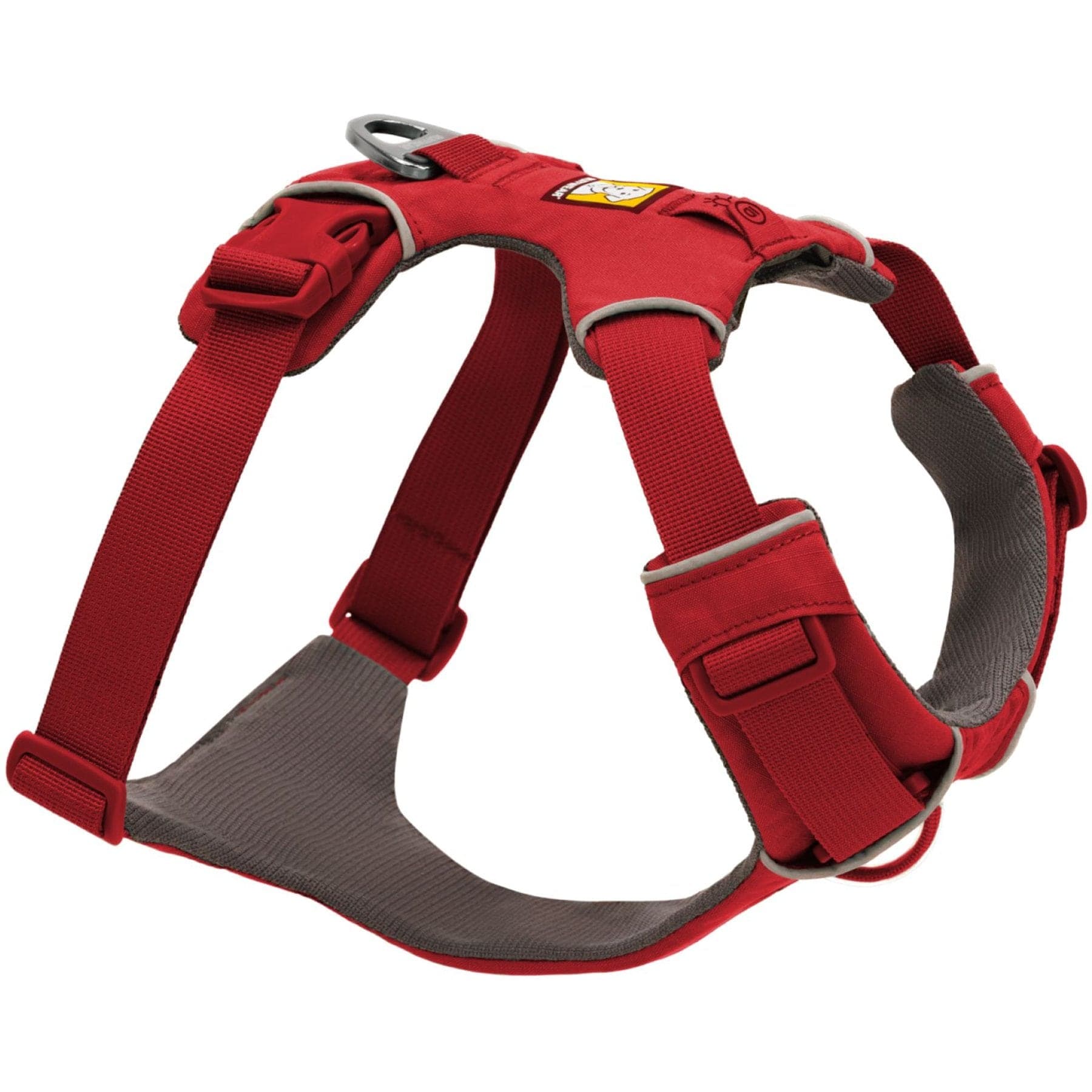
Two leash points, an aluminum back V-ring and a reinforced front clip, with foam padding and four adjustment points.
Webvet may earn a commission when you click through to Chewy, at no extra cost to you.
The Ruffwear Front Range is our everyday pick: it carries both clip positions and foam padding, and Ruffwear publishes a written chest girth chart for every size. Chewy's listing describes an aluminum V-ring on the back for daily walks and a reinforced front clip for dogs that tend to pull, so one harness covers a calm stroll and a distracted, pulling dog.
Ruffwear lists foam-padded construction for comfortable extended wear and four points of adjustment. That adjustability matters for the fit checks above: you can set the neck loop low on the breastbone and the girth strap around the rib cage, clear of the back of the front legs (elbows), rather than accepting whatever shape the harness arrives in.
Other details from the listing:
- An ID pocket that keeps your dog's tags quiet and within reach.
- Reflective trim for low light.
- A light loop for The Beacon, a light Ruffwear sells separately.
- Who it suits: owners who want one harness for everyday walks, a dog that sometimes pulls, and anyone who wants to start on the front clip and move to the back ring as walking improves, the progression an AKC-quoted veterinarian describes.
- Fit rule: Ruffwear sizes the Front Range by chest girth measured around the widest part of the rib cage. Its chart runs XXS 13 to 17 in, XS 17 to 22 in, S 22 to 27 in, M 27 to 32 in (69 to 81 cm), and L/XL 32 to 42 in. Ruffwear says to choose the larger size if your dog is in between.
- The tradeoff: it is the most expensive harness of the six, listed at $59.99 on Chewy when we checked in October 2026 for the Red Canyon Medium. As with any front-clip design, check that the chest piece does not rest over the shoulder joints when you fit it, a risk VCA flags for some front-clip harnesses.
Embark Harness Co. Adventure No Pull Dog Harness: best rugged harness for active large dogs
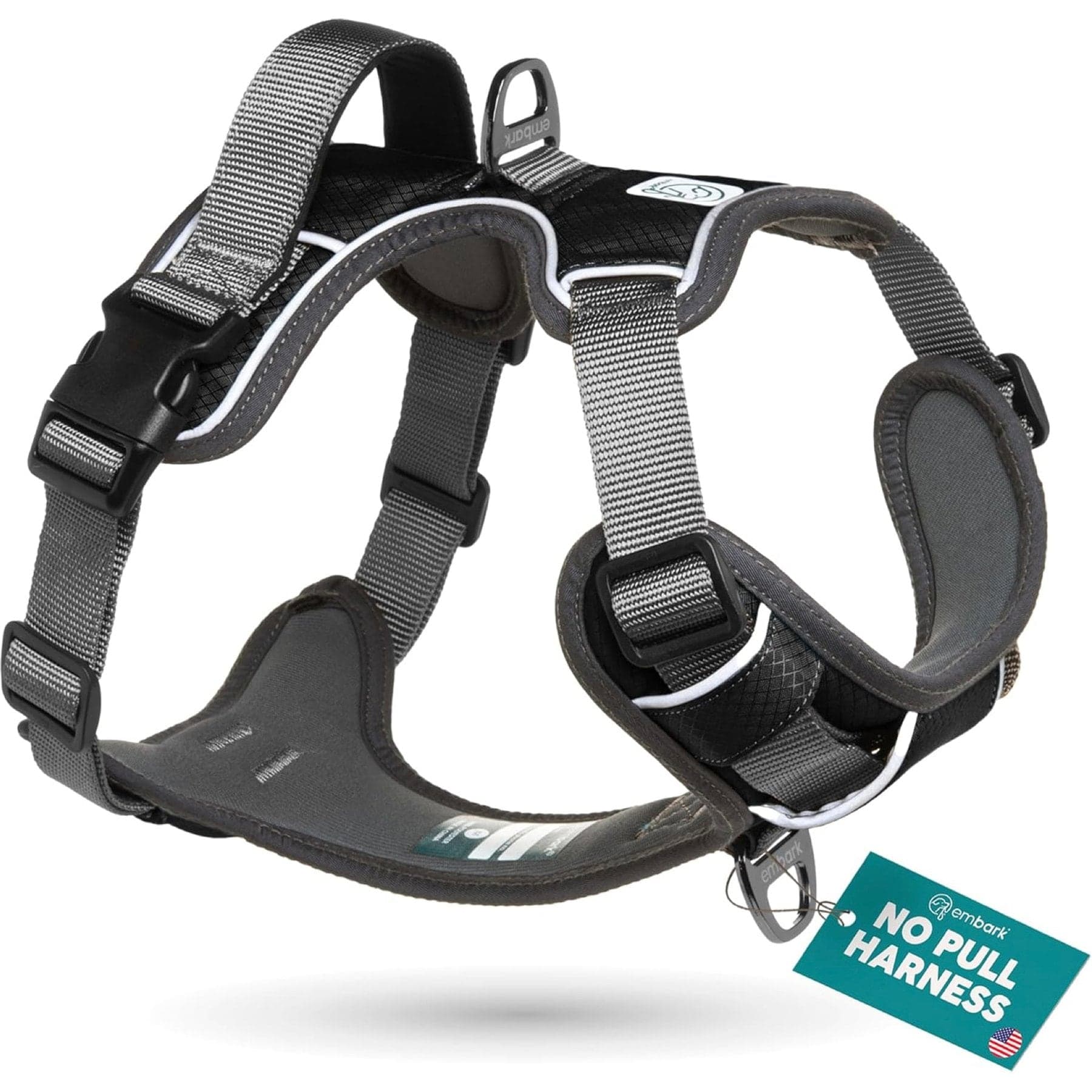
Military-grade ripstop nylon, reinforced double stitching, extra-soft padding, and front and back reinforced D rings.
Webvet may earn a commission when you click through to Chewy, at no extra cost to you.
The Embark Adventure is built for dogs that do more than walk around the block. Chewy's listing names walks, runs, hikes, swims, and camping trips, and describes military-grade ripstop nylon with reinforced double stitching, extra-soft padding to prevent chafing or rubbing, and front and back reinforced D rings.
Embark's own product page adds reflective safety trim, a control handle, and a maker's figure of over 750 lb of pull strength. Embark also says the front leash attachment deters pulling. Treat that as the maker's claim: the 2025 review says front-clip designs seem to balance comfort and pulling, but no single device suits every dog.
- Who it suits: large, active dogs whose owners want a tough harness with a handle and two leash points, for trail days as well as street walks. The listing describes it as suitable for dogs of all sizes; the Large is the size we feature.
- Fit rule: Embark publishes its chest ranges only as an image chart, so the Large range is not in the listing text. Measure your dog's chest girth first, check it against Embark's chart, and choose the larger size if you fall between two.
- The tradeoff: the sizing information takes an extra step compared with Ruffwear's or Kurgo's written charts. It is listed at $29.99 on Chewy when we checked in October 2026 for the Black Large, half the listed price of the Ruffwear.
Halti Walking Dog Harness: best dual-clip harness with a traffic handle
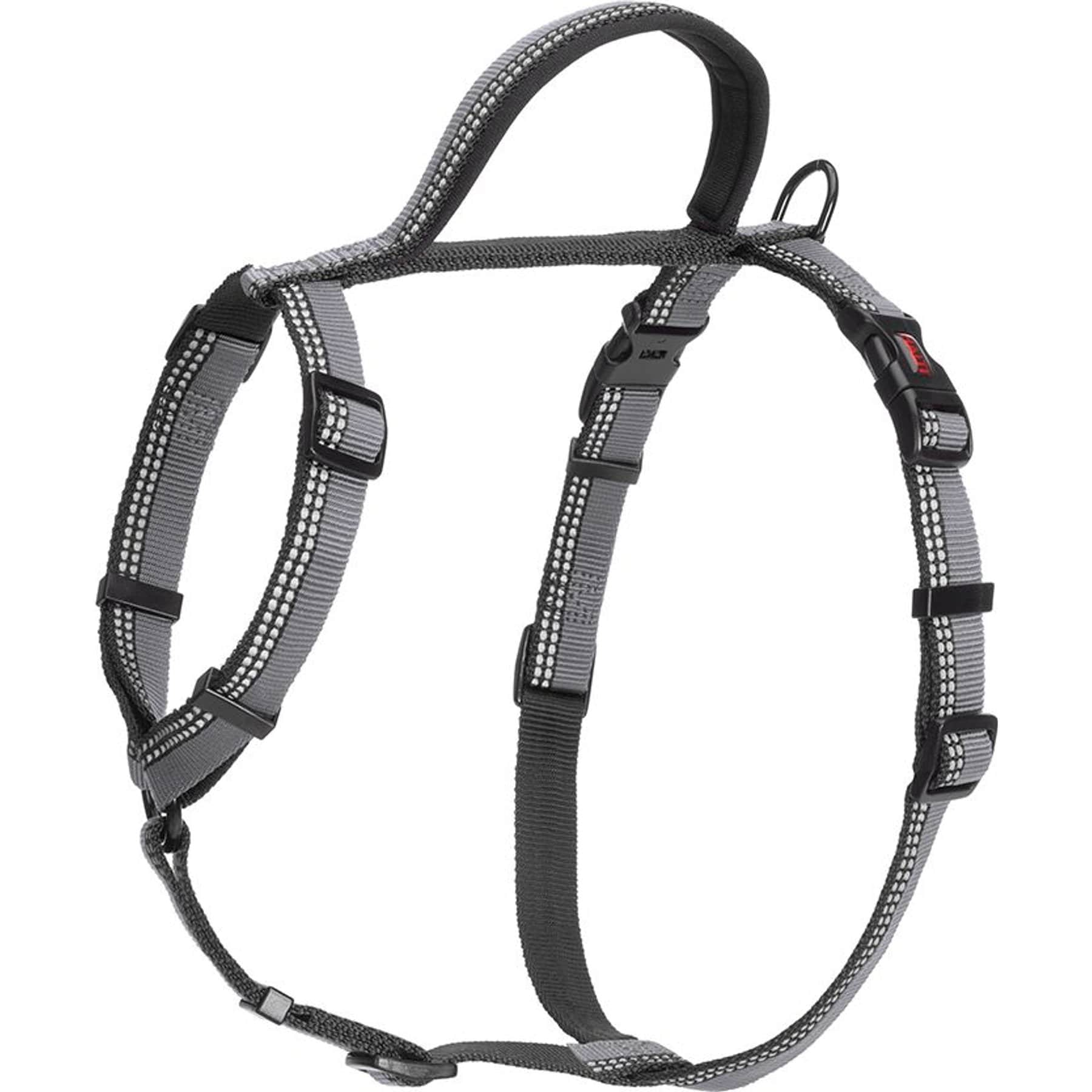
Chest and back lead clip rings, a close-control traffic handle, five adjustment points, and a reflective 3M Scotchlite strip.
Webvet may earn a commission when you click through to Chewy, at no extra cost to you.
The Halti Walking Harness is the pick for city walking. Chewy's listing describes five points of adjustment, two lead clip rings on the chest and back for additional control, a close-control traffic handle, three-point button release side clips, and a reflective 3M Scotchlite strip.
The handle is the reason to choose it. The Company of Animals Halti page describes the close control traffic handle as ideal for road crossing in busy places, or for moments when instant control is required. The maker also says the side clips mean no leg lifting is required to put it on.
The two rings line up with VCA's advice on dual-clip harnesses: attaching the lead to both the chest and back clips gives additional control in urgent circumstances.
- Who it suits: dogs walked on busy pavements, energetic dogs that need close control at crossings, and dogs that resist lifting a leg to step into a harness. Halti describes it as suitable for small and large dogs.
- Fit rule: Halti says size is determined by chest measurement, but its size chart is an image, so the Medium chest range is not confirmed in text. Measure the chest girth and confirm the range on the maker's chart before you order.
- The tradeoff: like the Embark, the sizing takes an extra step because the chart is not written out. It is listed at $35.99 on Chewy when we checked in October 2026 for the Black Medium.
Kurgo Journey Air Polyester Reflective No Pull Dog Harness: best breathable harness for running and hiking
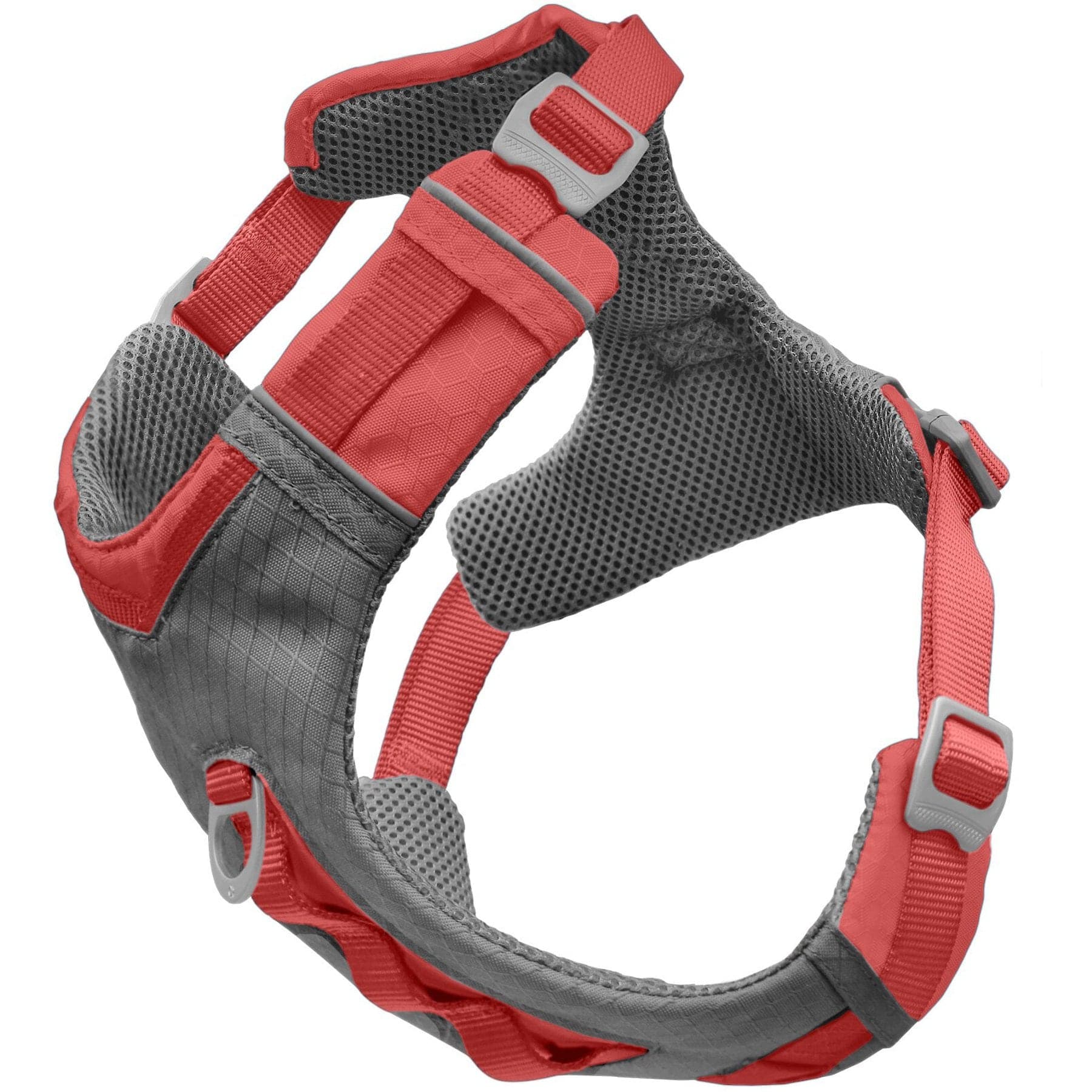
A breathable harness with a padded chest plate, back handle, four adjustment points, and front and back leash attachments.
Webvet may earn a commission when you click through to Chewy, at no extra cost to you.
The Kurgo Journey Air is built around breathability for active dogs. Chewy's listing calls it ideal for running, hiking, and walking, made with breathable material, with a deep V-neck design and a padded chest plate to help reduce strain on the neck.
Kurgo's product page describes a durable ripstop fabric outer with a breathable mesh inner, aluminum hardware, and a weight of 8 oz. Chewy's product name says polyester while Kurgo's page says ripstop fabric, so take the material description from the maker. Between them, the listing and the maker describe:
- A back handle that Kurgo says is there to extract or assist dogs.
- Four adjustment points for a near custom fit.
- Front and back leash attachments.
- Reflective trim for walks after dark.
- Four quick-release buttons, per the Chewy listing, for putting it on and taking it off.
- Who it suits: dogs that run or hike with their owners, and owners who want a handle for helping a dog when it needs assistance.
- Fit rule: Kurgo sizes by both chest and neck and says the fit should be snug but not restrictive. The Large fits a chest of 24 to 34 in and a neck of 18 to 30 in, for dogs of 50 to 80 lb. The Medium fits a chest of 18 to 28 in and a neck of 16 to 25 in, for dogs of 25 to 50 lb.
- The tradeoff: the AKC notes mesh harnesses are less durable and have less padding than other designs, which can lead to chafing; the padded chest plate covers the front, but check under the legs after long outings. It is listed at $37.49 on Chewy when we checked in October 2026 for the Coral Large.
Doggy Tales Step In V Dog Harness: best step-in harness
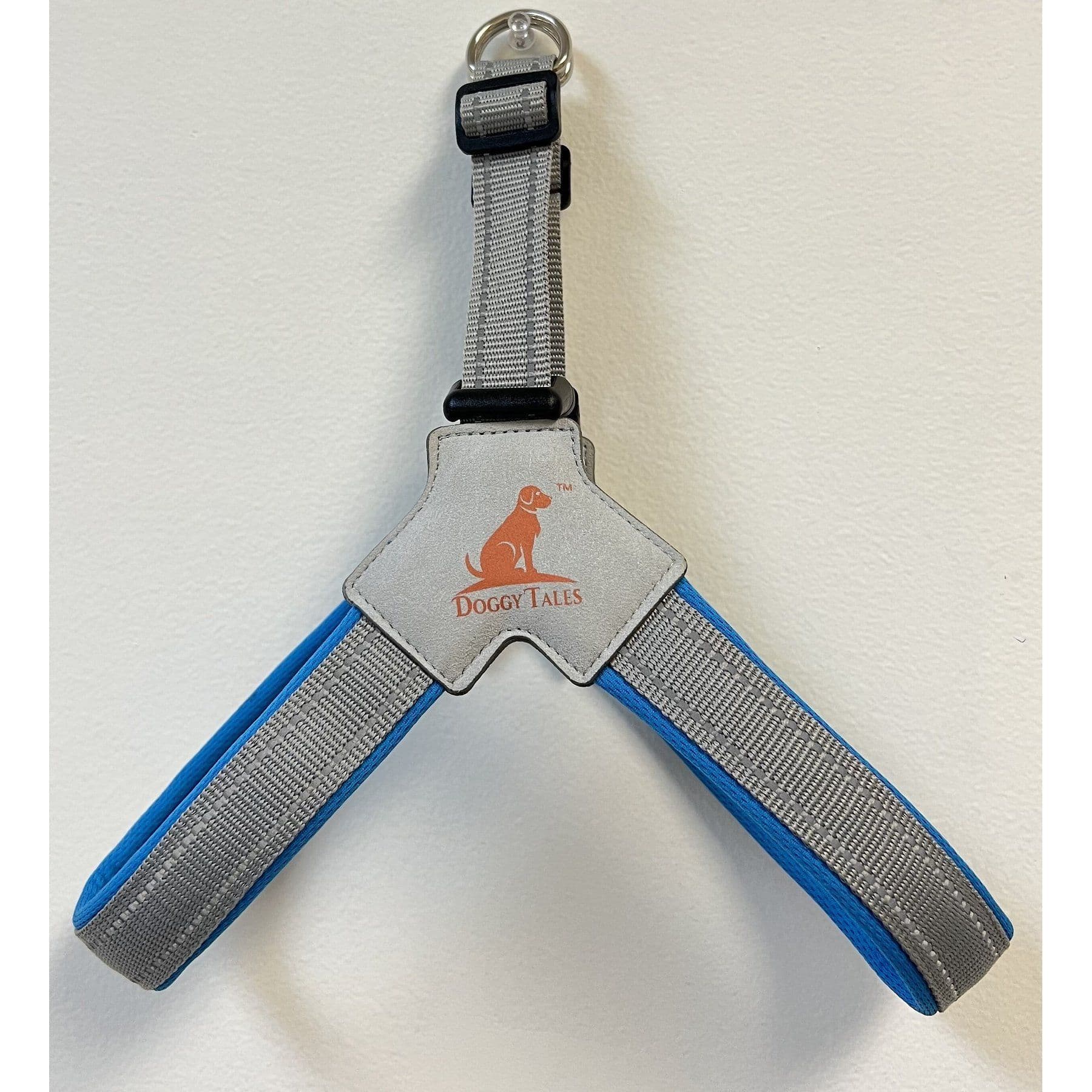
A soft nylon step-in harness with fast-drying padding, a breathable mesh lining, double D rings, and reflective threading.
Webvet may earn a commission when you click through to Chewy, at no extra cost to you.
The Doggy Tales Step In V suits dogs that are easier to dress from the feet up than over the head. A step-in harness, as the 2025 review in Animals defines it, is slid up the legs and then fastened at the back.
Chewy's listing describes soft yet sturdy nylon webbing and a no-rub design with fast-drying padding and a breathable mesh lining. It also lists double D rings, an easy-release buckle, an adjustable clasp, and reflective threading for night walks.
The AKC's veterinarian source notes that step-in harnesses work well for dogs that are escape artists, because they are harder to get out of if they fit properly. That condition matters: any harness a dog can back out of has failed the fit check, whatever its style.
- Who it suits: dogs that dislike having anything pulled over the head, and owners who want a padded everyday harness for a dog that walks well.
- Fit rule: the listing does not publish a chest range for the Medium. Measure your dog's chest girth and confirm the range with the seller before you order.
- The tradeoff: the missing size information is the main gap. It is listed at $26.95 on Chewy when we checked in October 2026 for the Blue Medium. If you are new to step-in designs, our guide on how to put on a dog harness walks through the steps.
Red Dingo No Pull Dog Harness: best budget harness
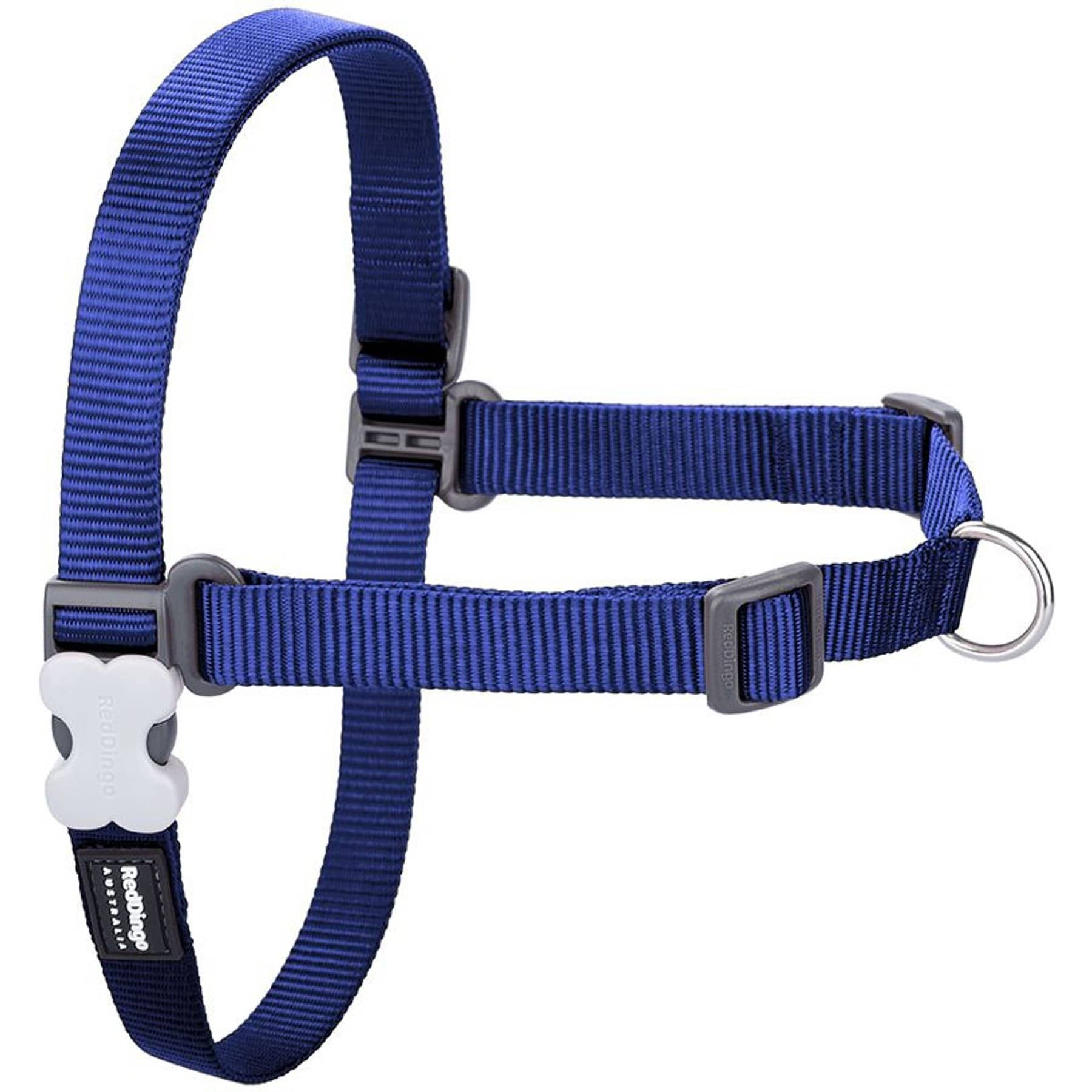
A fully adjustable webbing harness with a single side buckle and connectors that move away from the armpit.
Webvet may earn a commission when you click through to Chewy, at no extra cost to you.
The Red Dingo No Pull is the least expensive harness here. Chewy's listing describes durable, abrasion-resistant webbing that is gentle on sensitive areas like the armpits, a single side buckle that makes it simple to slip on and off, and full adjustability so you can fix it quickly to avoid chafing.
Red Dingo describes soft nylon webbing, a Bucklebone side-release buckle, and adjustable T-connectors that can be moved away from the armpit to reduce chafing. That armpit adjustment is a useful detail, because rubbing under the front legs is the fit problem PetMD singles out.
Red Dingo's page says the harness stops dogs from pulling. That is the maker's claim rather than a measured result, and Red Dingo's page does not state where the leash clips, so treat the name as a design goal rather than a promise.
- Who it suits: budget buyers, growing dogs whose owners expect to adjust or replace a harness, and dogs that need the straps kept clear of the armpits.
- Fit rule: Red Dingo sizes by body loop and by chest width from armpit to armpit, not by chest girth alone. The Medium has a body loop of 50 to 70 cm (19.5 to 27.5 in) and a chest width of 25 to 37 cm (9.75 to 14.5 in), on 20 mm webbing.
- The tradeoff: a different measuring system from the other five, so measure both dimensions before you buy. It is listed at $15.95 on Chewy when we checked in October 2026 for the Blue Medium.
 Sponsored
Vet care that's always there
Unlimited video calls and messaging with licensed vets for less than a typical vet visit. One membership covers up to five pets.
Use code Pets60
Plans start at $12/month · covers up to 5 pets
- Licensed vets in most states
- Rx for 150+ conditions
- 4.7 on Trustpilot
Back-clip vs front-clip vs dual-clip: which harness type fits your dog
Front-clip versus back-clip versus dual-clip harnesses differ in where the leash attaches: a back clip on top of the dog's back, a front clip on the chest, or rings in both places. The body of the harness also varies, and the research names chest-strap and Y-shaped designs separately.

VCA's puppy guide frames the main choice as front clip versus back clip. A front clip reduces the dog's ability to pull you forward, while a back clip can suit flat-faced puppies such as bulldogs and dogs with sensitive backs such as dachshunds.
Front-clip harnesses
With the leash on the chest ring, VCA explains, gentle leash pressure can turn the dog away from a distraction or back toward the handler. That turning effect is why a front clip is the usual first choice for a dog that pulls.
The 2025 review in Animals reaches a similar conclusion: for dogs that pull, non-tightening front-clip harnesses seem to offer a good balance between discomfort and prevention of pulling. If pulling is the main problem, our best no pull dog harness roundup goes deeper on designs built around that front ring.
Front clips have two caveats from the veterinary sources:
- VCA says some front-clip designs rest directly over the shoulder joints, restricting movement and putting pressure on delicate tissue.
- The 2025 review reports that one study found using the front clip on a Y-shaped harness significantly reduced all four joint-motion measures the researchers took, which raised concerns about its suitability.
Back-clip harnesses
A back clip puts the leash attachment on top of the dog, away from the chest and throat. The 2025 review says back-clip harnesses are suitable for brachycephalic dogs, or when pulling is not a concern, especially chest-strap or Y-shaped designs.
For a large dog that walks calmly, a back clip is the option the review describes as suitable. On a dog that pulls, a back clip gives the leash nothing to turn the dog with, and research on shelter dogs suggests it may increase pulling in some situations.
Dual-clip harnesses
A dual-clip harness carries both rings. VCA says some body harnesses have clips on both the chest and the back, and attaching the lead to both clips provides additional control under urgent circumstances.
A veterinarian quoted by the AKC suggests a simple progression on this kind of harness: start by clipping the leash to the front for better control, then switch to the rear clip as your dog improves with regular walks. The Ruffwear Front Range Reflective Front-Clip Dog Harness, Halti Walking Dog Harness, Kurgo Journey Air Polyester Reflective No Pull Dog Harness, and Embark Harness Co. Adventure No Pull Dog Harness all list front and back leash points.
Which clip for which walk
Putting the sources together, the clip choice follows the walk you actually take:
- A calm walk with a dog that does not pull: a back clip, which the 2025 review describes as suitable when pulling is not a concern.
- A dog that pulls toward people, dogs, or food: a front clip on a non-tightening harness, the review's first recommendation alongside training.
- A dog in training: start on the front clip and move to the back clip as walking improves, the progression an AKC-quoted veterinarian describes.
- A busy crossing or a sudden distraction: the lead on both rings, which VCA says gives additional control in urgent circumstances.
- A flat-faced dog or one with airway trouble: a back clip, per VCA's puppy guide and the 2025 review, after checking with your veterinarian because sources differ on dogs with tracheal problems.
Step-in, side-clip, and vest-style body harnesses
Beyond clip position, harnesses differ in how they go on:
- Step-in harnesses are slid up the legs and fastened at the back, according to the 2025 review. The AKC's veterinarian source describes the shape as resembling a figure eight around the neck and torso.
- Side-clip harnesses, such as the Halti Walking with its button release side clips, go on without the dog lifting a leg, according to Halti.
- Single-buckle harnesses, such as the Red Dingo No Pull Dog Harness, slip on and off with one buckle on the side.
- Vest-style chest harnesses use a wide padded panel at the front; Kurgo says the Journey Air's wide, padded chest plate helps cut down on strain to the neck.
Why do dog trainers not recommend harnesses?
The objection usually concerns back-clip harnesses on dogs that pull. A University of Queensland study of shelter dogs in Frontiers in Veterinary Science notes that the belief that dogs pull more in a back-connection harness had no scientific evidence behind it.
The study then found higher leash tension and more pulling with a back harness than a neck collar when dogs were tempted with food treats, though not with a toy.
That result covers one back-connection harness in one setting. It does not test front-clip designs, and the 2025 review still recommends non-tightening front-clip harnesses for pullers. Equipment also does not replace training; our guide to off leash dog training covers the recall and focus work that makes any harness easier to use.
What dog harness to avoid?
The veterinary sources point to a short list of designs to avoid or use with care:
- Tightening harnesses. The 2025 review says tightening harnesses, martingale collars, and head collars may be less comfortable and should be used with caution.
- Front pieces that sit over the shoulder joints. VCA says some designs rest directly over the shoulders, restricting movement and putting pressure on delicate tissue.
- No-pull harnesses whose chest piece slips. A veterinarian quoted by PetMD warns that on some no-pull designs the chest piece slips down when the leash is taut, so a determined puller can slip free.
- Any harness that does not fit. VCA notes a poorly fitted harness lets a dog back up and escape.
Sources disagree on clip position for dogs with tracheal problems:
- A PetMD-quoted veterinarian says a back clip may be better for flat-faced breeds, small breeds, and dogs with tracheal collapse (a collapsed trachea), because a front clip may press on the throat when the dog pulls.
- VCA and the 2025 review favor a front clip for dogs that pull.
If your dog has a tracheal or airway condition, ask your veterinarian which clip position to use.
Sizing a dog harness: how to measure and how it should fit
Dog harness sizes are not standard from brand to brand, so the chest measurement, not the size label, decides which harness fits. PetMD explains that harness sizing nearly always includes girth: the circumference of the widest part of the rib cage.

A Medium shows how far labels drift. The Ruffwear Front Range Reflective Front-Clip Dog Harness Medium fits a 27 to 32 in chest, the Kurgo Journey Air Polyester Reflective No Pull Dog Harness Medium fits an 18 to 28 in chest, and the Red Dingo No Pull Dog Harness Medium is sized by a 19.5 to 27.5 in body loop. A medium-sized dog could land in a different size with each of those brands.
The same is true at the small end. Ruffwear's XXS covers a 13 to 17 in chest, which may or may not match another maker's XXS. Measure first, then read each chart.
How to measure chest girth
Measuring chest girth for the right size is the same basic method at PetMD and in Kurgo's fitting guide:
- Stand your dog squarely on a level surface.
- Wrap a soft measuring tape around the body an inch or so behind the front legs, at the widest part of the rib cage.
- Kurgo's version: start at the bottom of the rib cage, go up and over the back, and come back down to where you started.
- Keep the tape snug but not tight, and read the number where the tape meets.
- For harnesses sized by neck as well, such as the Kurgo Journey Air, measure the neck too.
- For Red Dingo, measure the body loop and the chest width from armpit to armpit instead.
Ruffwear's chart says its measurement is around the widest part of the rib cage. Kurgo's Journey Air chart says to measure chest and neck, and that the fit should be snug but not restrictive.
How do I pick the right size harness for my dog?
Measure the chest girth around the widest part of the rib cage, just behind the front legs, and compare it with the chart for that exact harness. If your dog falls within two sizes, Kurgo and Ruffwear both say to choose the larger one, then tighten the straps. Weight ranges, where given, are a secondary check.
One dog, three size charts
Take a dog with a 28 in chest and read that one figure against the three charts our picks publish in text:
| Harness | Size for a 28 in chest | Chart range | What the chart says |
|---|---|---|---|
| Ruffwear Front Range | Medium | Medium 27 to 32 in | 28 in sits inside the Medium and in no other size, so the Medium is the one |
| Kurgo Journey Air | Medium or Large, decided by the neck measurement | Medium 18 to 28 in chest; Large 24 to 34 in chest | 28 in sits at the top of the Medium and inside the Large; Kurgo says to choose the larger size when a dog falls within both sizes on both neck and chest |
| Red Dingo No Pull | Medium chart cannot be read from chest girth | Medium body loop 19.5 to 27.5 in; chest width 9.75 to 14.5 in | The chart uses a body loop and an armpit-to-armpit chest width, so a 28 in girth does not map to it; take those two measurements instead |
The other three picks take another step:
- Embark Adventure and Halti Walking: read the maker's image chart against the 28 in figure.
- Doggy Tales Step In V: confirm the range with the seller, because the listing gives none.
The same dog could need a Medium from one brand and a Large from another. That is why the size label on a harness you already own tells you little about the next one.
Which picks publish usable sizing
Before you order, it helps to know how much sizing detail each maker gives:
- Written chest girth chart: Ruffwear lists every size from XXS to L/XL by chest girth in inches.
- Written chest and neck chart with weights: Kurgo gives chest, neck, and weight ranges for the Journey Air.
- Written chart on a different system: Red Dingo gives body loop and chest width.
- Image chart only: Embark and Halti publish their ranges as images, so the figures are not in the listing text.
- No chart in the listing: the Doggy Tales Step In V listing gives no chest range.
How should a dog harness fit once it is on?
After adjusting the straps, the two-finger check is the standard test. Kurgo says to adjust the sides until the harness fits snugly with two, and only two, fingers between your dog and the harness at any point.
The AKC's fit guide says the harness should not be tight or pinching anywhere when your dog is standing or sitting, and that you should be able to fit two fingers under the straps.

Sources disagree on how loose two fingers is. A veterinarian quoted on the AKC's harness-choice page says two fingers may be slightly too loose, and that you should have to squeeze two fingers underneath, without the fit being uncomfortable. In practice, aim for two fingers that slide in with a little resistance rather than with room to spare. Then check the placement points:
- The neck opening sits low, near the top of the breastbone, not across the throat.
- The girth strap sits around the rib cage, clear of the back of the front legs (elbows), not back toward the belly.
- The straps do not press into the back of the front legs.
- The back piece stays centered when the dog walks.
Signs the harness is the wrong size
Kurgo lists five signs that a harness does not fit:
- Bare spots or loss of fur around the harness area.
- Chafing around the harness area.
- Your dog is able to wiggle free.
- The back piece rotates to either side.
- Your dog strongly resists walking.
If you see any of these, re-measure the chest before deciding whether to adjust the straps or change sizes. Each size covers a wide span, such as the 24 to 34 in chest of Kurgo's Journey Air Large, so the right size can still look wrong until the straps are set.
Then match the symptom to the adjustment that fixes it:
| Fit problem | Likely cause | Adjustment that fixes it |
|---|---|---|
| Rubbing behind the elbow or in the armpit | The girth strap is squeezing into the back of the front legs, or a strap sits in the armpit; VCA says a well-fitted harness should not rub behind the elbow | Adjust the girth strap so it sits around the rib cage, clear of the back of the front legs (elbows); on the Red Dingo, move the T-connectors away from the armpit; recheck for rubbing a few times a week, as PetMD advises |
| Slipping backward, or the dog backing out | The harness is too loose: the girth strap has slid behind the rib cage toward the stomach, or a deep-chested dog has too much slack between shoulder and chest; VCA and a PetMD-quoted veterinarian both say this lets a dog back out or wiggle free, and Kurgo lists wiggling free and chafing from rubbing as wrong-size signs | Adjust every strap until two fingers fit under each with a little resistance, and redo the check after the first walk; if the straps run out before the fit is snug, re-measure the chest and change sizes |
| Restricted shoulder or a shortened stride | The chest piece rests over the shoulder joints, a placement VCA says restricts movement and presses on delicate tissue | Adjust the neck loop so the chest piece sits low on the breastbone, clear of the shoulder joints; if no adjustment moves it clear, or rubbing appears there, the style does not suit your dog's body, VCA's first fit risk |
The remaining signs point to size rather than straps:
- Bare spots or chafing: treat them as Kurgo does, as a sign of the wrong size, and re-measure.
- Strong resistance to walking: check for pinching with the dog standing and sitting, the AKC's test.
- A puppy at the end of the adjustment: size up, as the AKC advises for growing dogs.
Harnesses for large and strong dogs
A harness for a large dog has to give the handler control without loading the dog's neck. A veterinarian quoted by the AKC says no-pull harnesses are helpful for dogs that are larger than the person walking them, for someone pushing a stroller, and for a handler with a mobility issue.

For a big dog that pulls, the 2025 review in Animals recommends, alongside training, that owners first consider non-tightening front-clip harnesses, with tightening harnesses, martingale collars, and head collars as a last resort. For a large dog that walks calmly, the same review says a back-clip harness, especially a chest-strap or Y-shaped model, is suitable.
How much control a front clip gives a strong dog
A veterinarian quoted by the AKC describes how a no-pull harness works: it has a D-shaped ring at the front, and when the dog starts to pull, the D ring constricts the harness a little and discourages pulling. That design tightens slightly by intent, which is the type the 2025 review says to use with caution.
The evidence on how much any harness reduces pulling in big dogs is thin. A PeerJ study of 23 dogs found pulling impulse differed significantly among a martingale collar, a front-connection harness, and two prong collars.
The harness in that study was also clipped to a collar for safety, so it was not a pure front-clip test, and no published figure shows that a front clip stops a strong puller.
Heavy duty build and handles for big dogs
What the sources do support is extra control when it matters. VCA says harnesses with clips on both the chest and back let you attach the lead to both for additional control in urgent situations.
For a heavy dog, look at what the maker publishes about materials and hardware:
- Embark Harness Co. Adventure No Pull Dog Harness: military-grade ripstop nylon, reinforced double stitching, front and back reinforced D rings, a control handle, and a maker's figure of over 750 lb of pull strength.
- Halti Walking Dog Harness: two lead clip rings on the chest and back, a close-control traffic handle, and five adjustment points.
- Kurgo Journey Air Polyester Reflective No Pull Dog Harness: aluminum hardware, a back handle, and front and back leash attachments.
- Ruffwear Front Range Reflective Front-Clip Dog Harness: an aluminum back V-ring and a reinforced front clip.
Halti's own use case for its traffic handle is road crossing in busy places, where a close grip gives instant control. For a strong dog, a handle and two leash points together give you more ways to hold on than a single ring.
A first-walk check for a big, strong dog
A strong dog loads every strap harder, so look closely after the first real walk:
- Shoulders: the chest piece should sit clear of the shoulder joints, the placement VCA warns can restrict movement.
- Elbows: the girth strap should not squeeze into the back of the front legs, the AKC's placement check.
- Armpits: look for rubbing, which a PetMD-quoted veterinarian says is a particular problem for barrel-chested dogs.
- Stride: a harness crowding the shoulder can shorten shoulder extension, according to the bioRxiv preprint.
- Slack: a deep-chested dog can wiggle out of a harness that leaves too much room between shoulder and chest, so redo the two-finger check.
XL and XXL sizes for big dog breeds
Size labels such as XL and XXL do not mean the same chest range across brands. Ruffwear's L/XL Front Range covers a 32 to 42 in chest. Kurgo's Journey Air Large covers a 24 to 34 in chest and dogs of 50 to 80 lb. Embark publishes its Large range only as an image chart.
Whatever the breed, the sizing rule is the same: measure the chest and compare it with the chart. If the measurement is above the top of a brand's largest size, that harness is not the one, whatever the label says.
Deep-chested and barrel-chested dogs
Body shape matters as much as size for large dogs:
- Deep-chested dogs. A PetMD-quoted veterinarian notes that dogs with a deep chest, such as Great Danes or Dobermans, can wiggle out if the harness's shoulder-to-chest ratio creates too much slack.
- Barrel-chested dogs. The same source says English Bulldogs, Boxers, and Pitbulls can have a tougher time finding a harness, because some fit too tightly around the chest or shoulders or rub under the arms as the dog walks.
- Escape artists. The AKC says three-point harnesses with a neck, chest, and belly strap, such as Ruffwear's Webmaster model, are ideal for dogs that slip out.
For a big, deep-chested dog, more adjustment points give you more ways to close the gap between shoulder and chest. Halti lists five adjustment points on its Walking Harness, and Ruffwear and Kurgo list four each.
Harnesses for puppies, dachshunds, and flat-faced breeds
Puppies, small breeds, and flat-faced dogs are the groups veterinary sources most often steer toward a harness rather than a collar. VCA calls a harness probably the best starting tool for puppy leash training, because a puppy will not accidentally injure its neck when pulling and you keep good control.

Choosing a puppy harness
A harness is a good option for puppies, the AKC says, so long as you adjust the size or buy a bigger harness as the puppy grows. A harness with a wide adjustment range is the sensible first buy, rather than one the puppy soon outgrows.
Growth is the reason to keep checking:
- RSPCA Australia says puppies grow extremely quickly, so check the fit of a collar or harness at least a few times a week.
- A PetMD-quoted veterinarian recommends checking the fit frequently on a young, growing dog to be sure it has not outgrown the harness.
- Re-measure the chest girth when the straps are near the end of their adjustment, and size up then.
A fully adjustable, inexpensive harness such as the Red Dingo No Pull Dog Harness fits that stage well, because the listing describes it as completely adjustable and the price makes replacing it easier.
What to look for in a harness for a growing dog
None of our six listings is sold as a puppy harness, so judge them on adjustability and size range:
- Red Dingo No Pull: the listing calls it completely adjustable and available in a wide variety of sizes.
- Halti Walking Dog Harness: five points of adjustment, and Halti describes it as suitable for small and large dogs.
- Ruffwear Front Range Reflective Front-Clip Dog Harness: four adjustment points and a chart that starts at XXS, for a 13 to 17 in chest.
- Doggy Tales Step In V Dog Harness: an adjustable clasp, though the listing gives no chest range.
Early walks are also part of a puppy's wider education about the world. Our puppy socialization checklist covers the people, places, and sounds to introduce while your puppy learns to walk on a lead.
Dachshunds and other long-backed dogs
VCA says back-clip harnesses can be good options for dogs with sensitive backs, like dachshunds. For a dachshund, the practical goals are:
- A girth strap that sits around the rib cage, clear of the back of the front legs (elbows).
- No rubbing in the armpits.
- A leash attachment on the back rather than the chest.
Back problems are the concern behind that advice. In the DachsLife study published in Canine Genetics and Epidemiology, the disc causing intervertebral disc disease was thought to be in the thoracolumbar region, the middle and lower back, in 88.1 percent of cases, and in the neck in 7.7 percent.
That study is cross-sectional and does not test harnesses or collars. Its authors also warn that associations between lifestyle factors and disc disease may reflect reverse causality. Nothing in that research shows that choosing a harness over a collar causes or prevents disc disease, so choose a harness for comfort and control, not as a back treatment.
Bulldogs, French Bulldogs, and other flat-faced breeds
For brachycephalic dogs, the veterinary advice is consistent: keep pressure off the neck.
- VCA's page on brachycephalic airway syndrome says affected dogs should wear a harness that does not tug at the neck, and that a regular neck collar is not advisable because it can put undue pressure on the neck.
- The Cornell University Riney Canine Health Center lists using a harness instead of a neck collar among its conservative management steps for BOAS, alongside keeping weight down, minimizing panting, avoiding heat and humidity, controlled activity, and minimizing stress.
- The 2025 review in Animals and VCA's puppy guide both describe back-clip harnesses as suitable for flat-faced dogs.
A 2025 study in Veterinary Medicine and Science adds one measured difference:
- In both flat-faced and long-nosed dogs, exercising in a collar raised the pressure inside the eye, while exercising in a harness did not.
- Breathing rate rose with exercise in flat-faced dogs in both a collar and a harness, with no difference between them.
So the harness advantage in that study is eye pressure, not breathing.
Barrel-chested builds bring their own fit problem. As the PetMD-quoted veterinarian notes, English Bulldogs can find some harnesses too tight around the chest or shoulders, or rubbing under the arms. For a bulldog or a Frenchie, measure the chest carefully and check under the front legs after the first few walks.

Small breeds and dogs with tracheal problems
VCA's guide to choosing leashes and collars says a harness attaches around the chest rather than the neck, making it ideal for dogs that may be harmed by neck pressure, such as small breeds and dogs with short snouts.
VCA's page on tracheal collapse says it is advisable to use a harness rather than a collar for affected dogs. For very small dogs, our best harness for small dogs roundup covers sizes and designs built for toy breeds.
Handles, padding, and reflective trim: features worth paying for
Extra features are worth paying for when they solve a problem your dog actually has. A handle helps with control and assistance, padding helps with comfort, and reflective trim helps with being seen; each has limits the sources spell out.
Harness handles
A handle does different jobs depending on where it sits:
- Traffic handle. Halti describes the close control traffic handle on the Halti Walking Dog Harness as ideal for road crossing in busy places or when instant control is required.
- Back handle for assistance. Kurgo lists a back handle on the Kurgo Journey Air Polyester Reflective No Pull Dog Harness to extract or assist dogs.
- Control handle. Embark lists a control handle on the Embark Harness Co. Adventure No Pull Dog Harness.
A handle on a walking harness is not a mobility aid. VCA says a harness with handles is helpful to give a boost to dogs who struggle getting up; for a dog that needs regular lifting support, our guides to the best dog lift harness and to mobility aids for dogs, from harnesses to ramps cover purpose-built options.
Padding and soft linings
Padding is meant to stop rubbing where the straps meet skin. The six picks describe their padding differently:
- Ruffwear Front Range Reflective Front-Clip Dog Harness: foam-padded construction for comfortable extended wear.
- Kurgo Journey Air: a wide, padded chest plate that Kurgo says helps cut down on strain to the neck.
- Embark Adventure: extra-soft padding to prevent chafing or rubbing, per the Chewy listing.
- Doggy Tales Step In V Dog Harness: fast-drying padding and a breathable mesh lining.
- Red Dingo No Pull Dog Harness: soft webbing that is gentle on the armpits, with T-connectors you can move away from the armpit.
Lighter and softer is not automatically better. The AKC notes mesh harnesses are less durable and have less padding, which can cause chafing or rubbing. Nor is padding a guarantee: a pressure study in the 2025 review found a padded double-weave collar exerted the highest contact pressure of the collars tested, a result about collars, not harnesses.
Fit decides comfort more than padding thickness. Kurgo lists bare spots and loss of fur around the harness as a sign of a wrong size, and a PetMD-quoted veterinarian advises checking the armpits and under the chest a few times a week for skin irritation. A soft harness that fits poorly will still rub.
Reflective trim
Reflective trim earns its place on early-morning and evening walks. Five of the six picks list a reflective feature:
- The Halti Walking Harness uses reflective 3M Scotchlite stitching, which Halti says gives high visibility in low light or on night-time walks.
- Ruffwear lists reflective trim and a light loop for The Beacon light, sold separately.
- Kurgo and Embark list reflective trim.
- Doggy Tales lists reflective threading, and Red Dingo's listing has no reflective claim in its description.
The AKC notes that some harnesses have reflective stitching or material that can be seen in low light. No published figure shows how much reflective trim improves a dog's visibility, so treat it as a helpful extra rather than a substitute for a light and a short leash near traffic.
ID pockets, escape resistance, and the rest
A few smaller features make a real difference day to day:
- Tag storage. The Ruffwear Front Range has an ID pocket that keeps your dog's tags quiet and within reach.
- Escape resistance. Fit, not a label, decides whether a dog can slip out. The AKC says step-in harnesses are harder to get out of if they fit properly, and that three-point harnesses with a belly strap are ideal for escape artists.
- Quick-release fastenings. The Kurgo Journey Air lists four quick-release buttons, the Halti three-point button release side clips, and the Red Dingo a single side buckle.
Matching features to your dog
Features earn their price when they fit the dog and the walk:
- Growing puppy: adjustability first, because the AKC says to adjust the size or buy bigger as the puppy grows.
- Large or strong dog: two leash points and a handle, for the extra control VCA describes and the instant control Halti designs its traffic handle for.
- Early-morning or night walks: reflective trim, plus a light; Ruffwear's light loop takes its separately sold Beacon light.
- Escape artist: a well-fitted step-in or a three-point harness with a belly strap, the designs the AKC names.
- Long walks and hikes: padding and a breathable lining, with armpit checks a few times a week as PetMD advises.
- A dog that struggles to get up: a handle, which VCA says helps give a boost, or a purpose-built lift harness for regular support.
Dog harness questions
Frequently Asked Questions
How should a dog harness fit?
Snug, with about two fingers of room under every strap. The AKC says the harness should not pinch anywhere when your dog stands or sits. The neck opening should sit near the top of the breastbone rather than the throat, and the girth strap should sit around the rib cage, clear of the back of the front legs (elbows), not back toward the belly.
Is a front-clip or back-clip harness better?
It depends on how your dog walks. A front clip suits a dog that pulls, because leash pressure turns the dog back toward you, and the 2025 review in Animals favors non-tightening front-clip designs for pullers. A back clip suits a dog that walks calmly and is the option VCA and the review describe for flat-faced breeds.
Can a dog wear a harness all day?
It is better not to. A PetMD-quoted veterinarian says a harness worn 24/7 can be uncomfortable, and sleeping in one is risky because it could catch on a crate and become a choking hazard. VCA says to remove the harness when you cannot supervise your dog, and PetMD advises adjusting it so it causes no chafing under the front legs.
What harness is best for a large dog?
For a large dog that pulls, the 2025 review in Animals recommends a non-tightening front-clip harness first, alongside training. For a large dog that walks calmly, a back-clip design with a chest strap or a Y-shaped front is suitable. Either way, fit matters: a deep-chested dog can slip a loose harness.
Are step-in harnesses good for dogs?
They can be. A step-in harness is slid up the legs and fastened at the back with a buckle, and the AKC's veterinarian source says step-in designs are harder for escape artists to get out of when they fit properly. They suit dogs that dislike things going over the head; measure the chest first, because a loose step-in can still be backed out of.

Editor
The Webvet Editorial Team is the in-house group of pet-care editors and writers behind Webvet, operated by Smart Pet Collective. The team researches, writes, and maintains Webvet's pet health, behavior, and medication content. Every article follows a defined editorial process: research from reputable veterinary and scientific sources, careful drafting, mandatory review of medical content by a credentialed veterinarian, and dated publication. Health and medication articles are medically reviewed by a licensed veterinary professional before they go live and are kept current over time.
Veterinarian · BVMS MRCVS
Dr. Pippa Elliott, BVMS, MRCVS, is a veterinarian with nearly 30 years of experience in companion animal practice. Dr. Elliott earned her Bachelor of Veterinary Medicine and Surgery from the University of Glasgow. She was also designated a Member of the Royal College of Veterinary Surgeons. Married with 2 grown-up kids, Dr. Elliott has a naughty Puggle named Poggle, 3 cats and a bearded dragon.
Related reading

Best Retractable Dog Leash: Safer Picks, Locking Brakes, and When Not to Use One

Best Dog Leash: Vet-Reviewed Picks by Walking Style, Dog Size, and Material

Best Dog Harness for Small Dogs: Lightweight, Secure Picks That Protect the Trachea
