Best No Pull Dog Harness: Front-Clip Picks That Stop Pulling Without Hurting the Neck
Vet-reviewed guide to the best no pull dog harness: how front-clip, dual-clip, and martingale designs redirect a pulling dog, and how to keep the straps off the shoulders. It works best alongside reward-based leash training.

BVMS MRCVS

This article contains affiliate links. Webvet may earn a commission when you buy through them, at no extra cost to you.
A no pull dog harness moves the leash from the neck to the chest. When the dog surges ahead, tension on a front clip redirects its movement instead of pressing on the throat. That makes walks easier to manage, but the harness only manages pulling. Reward-based leash training is what changes the habit.
Our top pick is the Ruffwear Front Range Reflective Front-Clip Dog Harness: its listing describes a reinforced front clip, which Ruffwear places at the chest and a back V-ring, with no tightening loop mentioned, which is the design a 2025 research review suggests trying first. Chewy listed the Medium at $59.99 when we checked in October 2026.
Which harness suits your dog depends on how it pulls: a steady leaner, a lunger, and a strong, heavy puller need different designs, and every one must leave the shoulders free. We have not tested these six on our own dogs; each pick rests on its Chewy listing, the maker's specifications, and the veterinary research cited throughout.
| Harness | Best fit | Clip design in the listing | Standout listed feature | Main tradeoff |
|---|---|---|---|---|
| Ruffwear Front Range Reflective Front-Clip Dog Harness, Red Canyon, Medium: 27 to 32-in chest | Steady pullers and everyday walks | Reinforced front clip at the chest plus aluminum V-ring on the back | Reflective trim, ID pocket, light loop; listed at $59.99 on Chewy in October 2026 | Highest price of the six |
| WildHound No-Pull Premium Martingale Dog Harness, Azalea, Medium | Strong pullers that need two points of control | Front connection plus a martingale back loop that gently tightens | Ripstop polyester outer, 400g airmesh inner; listed at $34.99 on Chewy in October 2026 | Back loop tightens by design |
| JWalker Dog Harness, Black Bear, Small/Medium | Owners actively teaching loose-leash walking | Patented side attachment | Metal attachments, double-folded seams, reflective top strap; listed at $39.99 on Chewy in October 2026 | Side attachment is less studied than front clips |
| HDP Big Dog No Pull Dog Harness, Black, Large | Big hard pullers and senior dogs | No-choke design with one D-ring, position not stated | Wide padded chest and built-in handle; listed at $22.99 on Chewy in October 2026 | Listing gives no chest range or clip position |
| BARKBAY AirLift No-Pull Dog Harness with Control Handle, Black, Medium: 25 to 28.5-in chest | Warm-weather walks and dogs that need a grab handle | Chest-based design, clip position not stated | Breathable mesh, back handle, reflective stitching; listed at $22.99 on Chewy in October 2026 | Clip position not published |
| Copatchy No-Pull Reflective Adjustable Dog Harness, Black, Medium | Tight budgets | Clip position not stated | Fully adjustable, reflective, pull-back handle; listed at $14.99 on Chewy in October 2026 | Materials and size range not published |
 Sponsored
Want a vet's help with your dog's anxiety or behavior?
Talk to a licensed vet at Dutch over video, often the same day. They can recommend treatment and prescribe it when it's appropriate.
Use code Pets60
Plans start at $12/month · covers up to 5 pets
- Licensed vets in most states
- Rx for 150+ conditions
- 4.7 on Trustpilot
Do no-pull harnesses work? How front-clip designs reduce pulling
A no-pull harness puts the leash attachment on the front clip at the chest, close to the breastbone. When the dog pulls, the leash redirects its direction of movement and turns the dog rather than letting it lean straight into the pull. Fit decides whether the straps restrict the shoulders. The harness reduces pulling while training fixes it.

That summary comes from the strongest evidence available. A 2025 review of 21 full-text studies by Cavalli and Protopopova in Animals, from the University of British Columbia, concluded that for dogs that pull, non-tightening front-clip harnesses appear to offer the best balance between discomfort and reduction in pulling.
- 1Here is how front-clip harnesses reduce pulling: the leash clips at the chest, so a pull redirects the dog instead of pressing on its neck.
- 2Choosing among front-clip, dual-clip, and martingale designs comes down to how your dog pulls and how strong it is.
- 3A non-tightening front clip is the first design to try for most pullers, according to a 2025 research review.
- 4Whatever you buy, no strap should cross the front of the shoulder joint, and the dog should move freely.
- 5The harness manages pulling on the day; reward-based leash training is what fixes it over several months.
The same review is clear about how the design works. Front-clip harnesses reduce pulling by introducing slight discomfort when the dog pulls and by redirecting the direction of movement. In other words, the harness manages the behavior. It does not teach the dog to walk on a loose leash by itself.
Do no pull dog harnesses actually work?
Yes, as a management tool. The 2025 Cavalli and Protopopova review found non-tightening front-clip harnesses gave the best balance of comfort and pulling reduction for dogs that pull. None of the studies we found gives a figure for how much less a dog pulls, so the honest answer is that they help, by an amount that varies with the dog and with training.
Several studies help explain what the evidence does and does not show:
- Strain-gauge testing: in a 23-dog study published in PeerJ, Johnson and Wynne measured leash force and found dogs pulled hardest on a martingale collar, compared with a front-connection harness and two prong-type collars, which we do not recommend.
- No front-versus-back trial: the same study did not compare the front-connection harness with a back-clip harness, so it does not prove a front clip beats a back clip.
- Small samples: Johnson and Wynne caution that their findings are not broadly generalizable and call for testing in real-life walks.
- Back-clip harnesses and food: a 52-dog shelter study by Shih and colleagues in Frontiers in Veterinary Science notes there was no scientific evidence for the belief that back-connection harnesses make dogs pull more in general, but leash tension was higher on the back-clip harness than a collar when the dogs were lured with food treats.
That last finding matters if your dog drags you toward dropped food. A clip on the back gives the dog a straight line to lean into. A clip at the chest turns that lean to the side.
The research gaps are real too. The 2025 review says more work is needed on devices that act through discomfort or redirection, and none of the studies we found directly compared front-clip and back-clip harnesses.
What a no-pull harness will not do matters as much as what it will:
- It will not teach loose-leash walking. The 2025 review describes front-clip harnesses as managing pulling, not training it.
- It will not stop lunging on its own. VCA's behaviorists say a dog that lunges or barks at the end of the leash needs individualized help from a behavior professional.
- It will not be free of discomfort. The same review notes that any device used to inhibit pulling is likely to add some aversiveness to the walk.
- It will not suit every dog. The review found no one-size-fits-all device.
What the behavior specialists agree on is the training side: VCA Animal Hospitals, in guidance written with two board-certified veterinary behaviorists, says most pulling can be prevented or reversed with positive-reinforcement training.
For dogs that react to other dogs or people, the American Animal Hospital Association says harnesses that clip in the front help you redirect a reactive dog's attention, guide it away, and keep its focus on you. That makes the front clip a practical choice for a reactive walker as well as a steady puller.
Match the design to your dog's pulling style, then check shoulder clearance before you commit:
| Pulling style | Design to consider first | Clip position | Shoulder clearance check | Matching pick |
|---|---|---|---|---|
| Steady puller that leans into the leash | Non-tightening front clip, ideally with a back ring for easy walks | Chest, below the neck between the front legs | No strap across the front of the shoulder joint | Ruffwear Front Range |
| Lunger that surges at dogs, people, or wildlife | Front clip to redirect, plus a behavior plan | Chest | Chest strap stays level, not riding up toward the neck | Ruffwear Front Range |
| Reactive walker that needs its focus brought back | Front clip, with a vet-guided training plan | Chest | Shoulder joints move freely when the dog turns | Ruffwear Front Range |
| Large or strong dog that can pull you off balance | Two connection points for more control | Chest and back | Wide chest pieces must not sit on the front of the shoulder | WildHound Martingale |
| Dog that coughs or breathes noisily when pulling on a collar | Any well-fitted harness instead of a collar | Chest or back | One to two fingers under the shoulder strap | BARKBAY AirLift |
| Senior or hard puller that needs a steadying hand | Padded no-choke harness with a handle | Not stated in the listing | Padding sits behind the shoulder joint, not across it | HDP Big Dog |
| Learner on a tight budget | Adjustable harness; confirm the clip position on arrival | Not stated in the listing | Adjust so every strap clears the shoulders | Copatchy |
Each pairing is a starting point, not a guarantee. The 2025 review stresses that there is no one-size-fits-all device, so watch your own dog's gait on the first few walks and adjust from there.
What is the best no pull dog harness in 2026?
None of the sources we reviewed names a single best harness, and the 2025 Cavalli and Protopopova review says selection should fit the individual dog and guardian.
Our top pick is the Ruffwear Front Range Reflective Front-Clip Dog Harness because its listing describes a reinforced front clip, which Ruffwear places at the chest plus a back ring, with no tightening loop mentioned. That matches the non-tightening front-clip design the review recommends trying first.
Our picks: the best no-pull dog harnesses
No primary source ranks no-pull harnesses, so we chose these six by matching each listing's clip design and features to how a dog pulls. All six are sold on Chewy, and prices are what Chewy listed when we checked in October 2026.
None of the six listings says a leash is included, so a no-pull harness and leash are separate purchases; our best dog leash roundup covers that half. None states where the harness is made, so country of origin cannot guide the choice. Here is what each listing publishes about chest range, clip position, and tightening:
| Pick | Chest range (as listed) | Front clip? | Tightens under tension? | Chewy price (October 2026) |
|---|---|---|---|---|
| Ruffwear Front Range Reflective Front-Clip Dog Harness, Medium | 27 to 32-in chest | Yes: a reinforced front clip at the chest, plus an aluminum V-ring on the back | No tightening loop described in the listing | $59.99 as listed |
| WildHound No-Pull Premium Martingale Dog Harness, Medium | Not stated in the listing | Yes: a front connection that redirects the dog | Yes: the martingale back loop gently tightens around the chest | $34.99 as listed |
| JWalker Dog Harness, Small/Medium | Not stated in the listing | No: a patented side attachment instead of a front clip | Not stated in the listing | $39.99 as listed |
| HDP Big Dog No Pull Dog Harness, Large | Not stated in the listing | Not stated in the listing: one D-ring, position not given | Not stated in the listing; described as a no-choke design | $22.99 as listed |
| BARKBAY AirLift No-Pull Dog Harness with Control Handle, Medium | 25 to 28.5-in chest | Not stated in the listing: described as a chest-based design | Not stated in the listing | $22.99 as listed |
| Copatchy No-Pull Reflective Adjustable Dog Harness, Medium | Not stated in the listing | Not stated in the listing | Not stated in the listing | $14.99 as listed |
Ruffwear Front Range Reflective Front-Clip Dog Harness: best overall front-clip harness
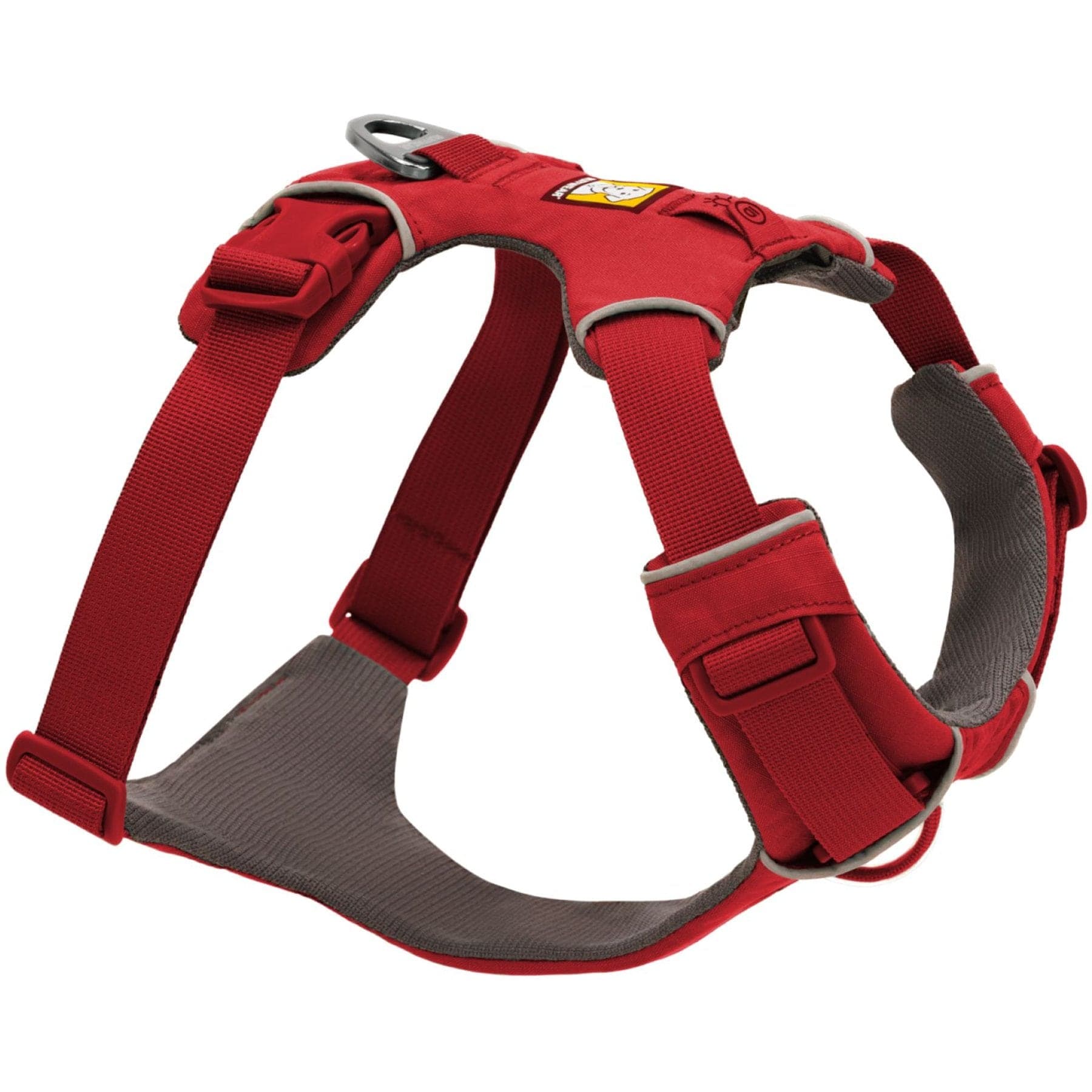
Dual-clip everyday harness with a reinforced chest clip for pullers and a back V-ring for relaxed walks.
Webvet may earn a commission when you click through to Chewy, at no extra cost to you.
The Ruffwear Front Range is a dual-clip harness. Its Chewy listing describes two leash attachment options: an aluminum V-ring on the back for daily walks and a reinforced front clip for dogs that tend to pull. The Medium covers a 27 to 32-inch chest and was listed at $59.99 on Chewy when we checked in October 2026.
It suits a steady puller or a reactive walker whose owner wants one harness for both training walks and relaxed ones. You clip to the chest while the dog is learning, then move to the back ring as loose-leash walking improves.
What the listing and Ruffwear's own product page describe:
- Reinforced front clip at the chest to redirect dogs that pull, plus an aluminum V-ring centered on the back.
- Foam-padded construction and four points of adjustment, per Ruffwear's product page.
- Reflective trim and a light loop for The Beacon light, which is sold separately.
- An ID pocket that keeps tags quiet and easy to reach.
- Ruffwear sizes the harness by girth, measured around the widest part of the rib cage.
The tradeoff is price: it is the most expensive harness here. The listing also does not describe the strap shape across the chest, so check shoulder clearance on your dog the first time it wears it.
WildHound No-Pull Premium Martingale Dog Harness: best two-point control for strong pullers
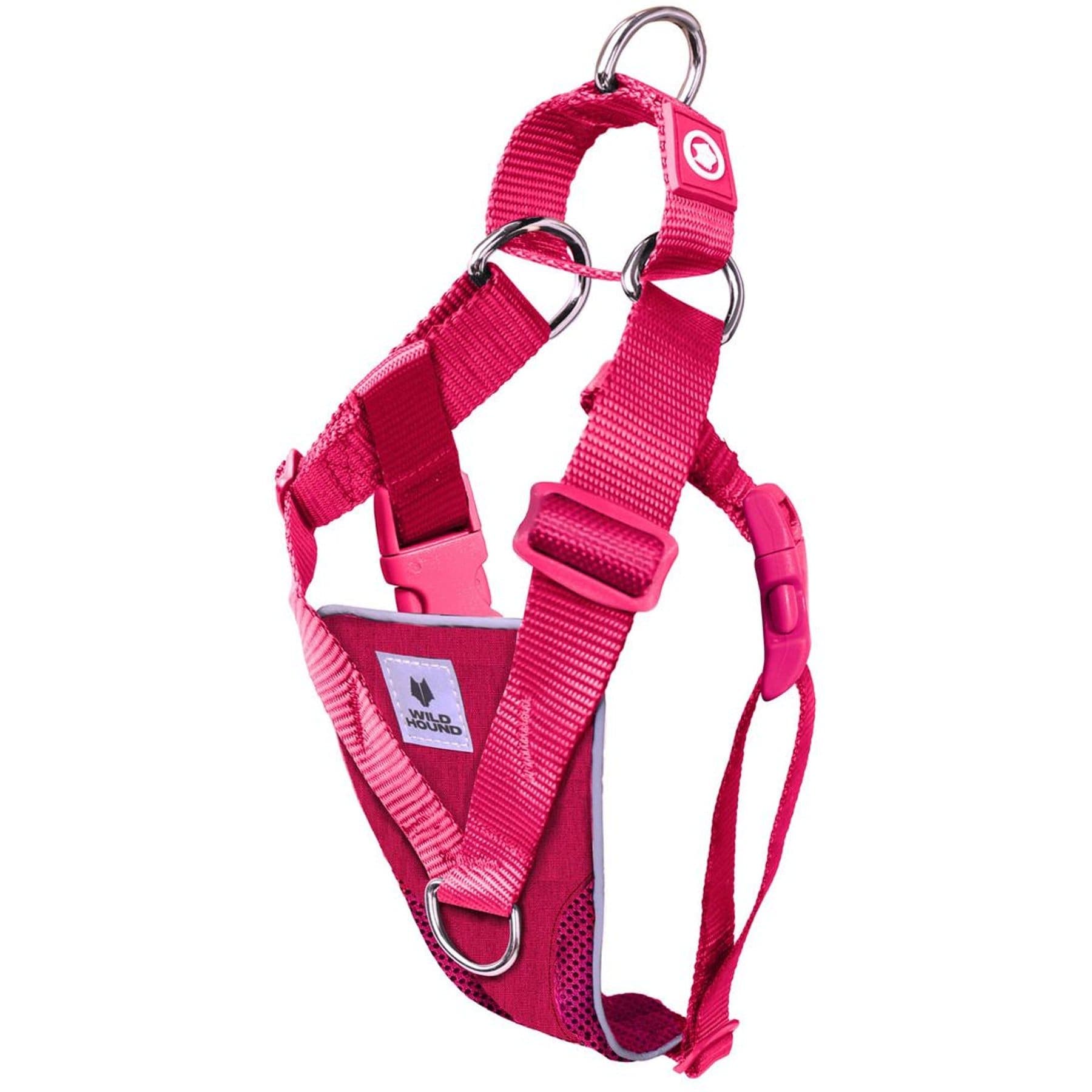
Two connection points: a front clip that redirects and a martingale back loop for strong pullers.
Webvet may earn a commission when you click through to Chewy, at no extra cost to you.
The WildHound No-Pull Premium Martingale Dog Harness gives you two connection points. Its Chewy listing says the front connection redirects the dog and keeps it on the right path, while a martingale back loop gently tightens when the dog pulls, applying pressure evenly around the chest. The Medium was listed at $34.99 on Chewy when we checked in October 2026.
It suits a large or strong puller whose owner wants more control than a single chest clip gives, particularly on busy streets where a sudden surge could pull you off balance.
The listing's construction details:
- Outer layer of ripstop polyester that the listing describes as tear-resistant and weather-resistant.
- Inner layer of 400g airmesh for breathability and airflow.
- Straps of nylon webbing.
- A lightweight build, per the listing.
The tradeoff is the tightening loop. The 2025 Cavalli and Protopopova review separates non-tightening front-clip harnesses from tightening harnesses and recommends trying non-tightening front clips first. If you buy this one, use the front connection as your main attachment. The listing also does not publish the chest range for the Medium, so measure first.
JWalker Dog Harness: best side-attachment harness for leash training
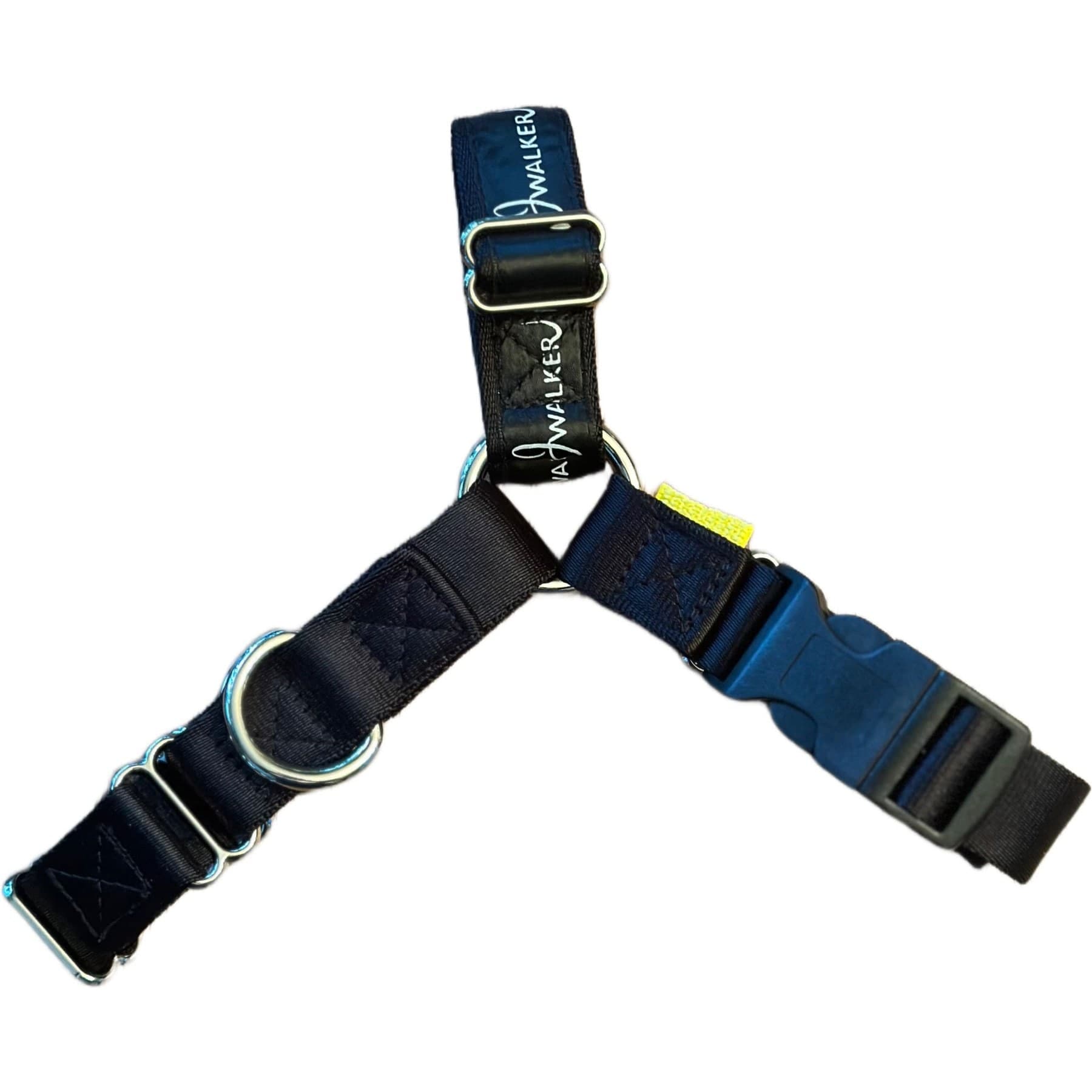
Patented side attachment that redirects movement rather than restricting it, built for reward-based leash training.
Webvet may earn a commission when you click through to Chewy, at no extra cost to you.
The JWalker Dog Harness uses a patented side attachment rather than a front clip or a martingale loop. Its Chewy listing says the side attachment redirects the dog's focus and movement, and the maker says it focuses on redirecting movement rather than restricting it. The Small/Medium was listed at $39.99 on Chewy when we checked in October 2026.
It suits an owner who is actively teaching loose-leash walking. The listing frames the harness around rewarding good behavior and avoiding punishment, which lines up with the reward-based approach veterinary behavior groups recommend.
Construction details from the listing and JWalker's site:
- Military-grade side release buckles and heavy-duty metal attachments.
- Round edges and double-folded seams for comfort, per the listing.
- A reflective top strap; JWalker describes the ribbon as fade-resistant and washable.
- A limited lifetime warranty, per the maker.
The tradeoff is evidence. The studies cited here looked at front-clip, back-clip, chest-strap, and Y-shaped designs, not side attachments, so none of them tells you how this design compares. The listing does not publish a chest range for the Small/Medium.
HDP Big Dog No Pull Dog Harness: best padded no-choke harness for big pullers and seniors
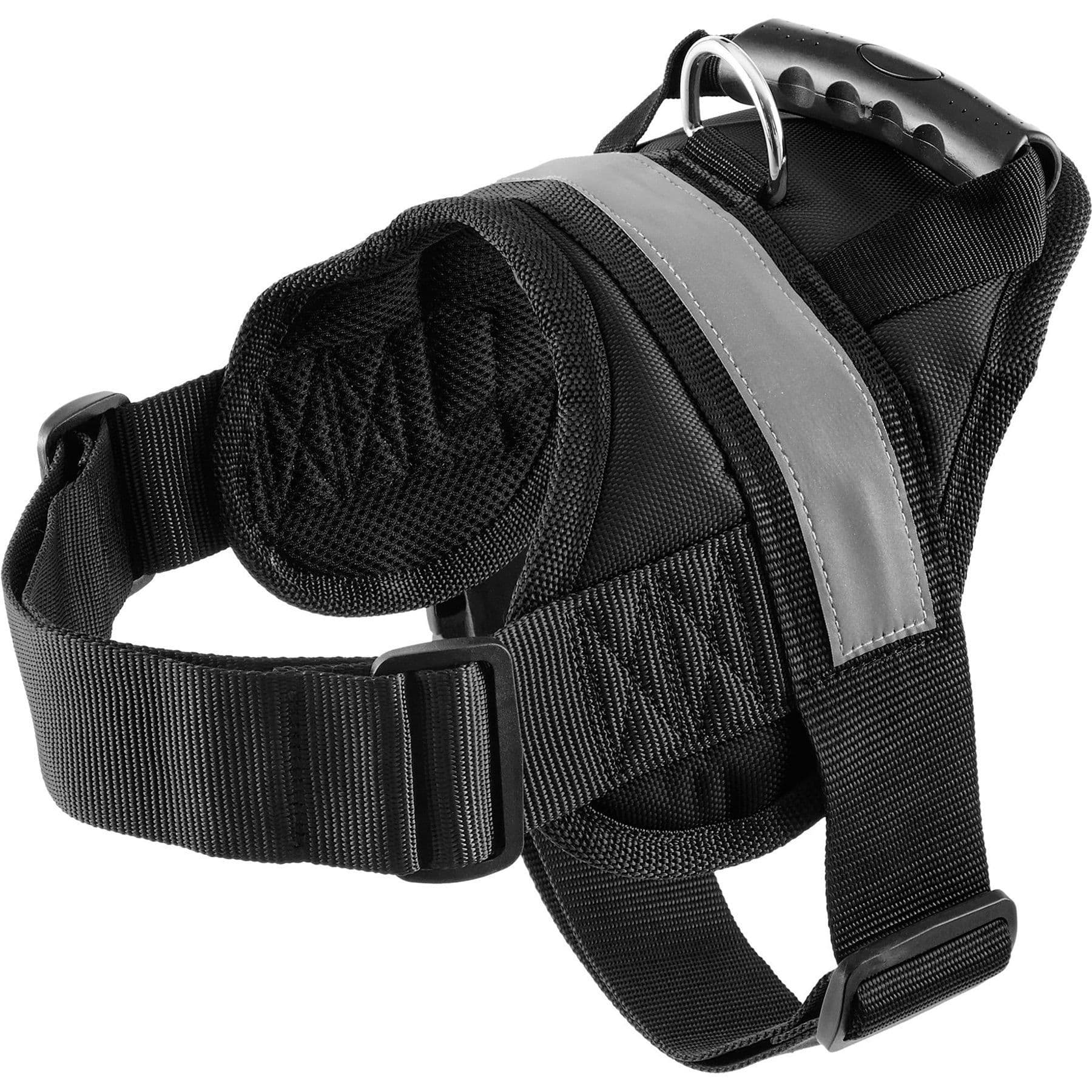
No-choke padded harness with a wide chest piece and built-in handle for big pullers and older dogs.
Webvet may earn a commission when you click through to Chewy, at no extra cost to you.
The HDP Big Dog No Pull Dog Harness is a no-choke design that its Chewy listing pitches at hard pullers and at senior dogs that need a gentler option. The Large was listed at $22.99 on Chewy when we checked in October 2026, and it is the only one of our six listed in a Large.
It suits a big dog that pulls hard, or an older dog that needs a steadying hand on steps and rough ground. The listing says a built-in handle lets you keep the dog close and help it over rougher terrain.
What the listing describes:
- A no-choke design aimed at hard pullers.
- A wide chest piece that spreads the load across the chest and shoulders.
- Extra padding for comfort.
- A D-ring placed, the listing says, to give the dog freedom of motion.
- A built-in handle.
The tradeoff is missing detail. The listing does not say where the D-ring sits, and it does not publish a chest range for the Large. Because the listing says the wide chest piece spreads weight across the chest and shoulders, check on your dog that nothing crosses the front of the shoulder joint, the point VCA's behaviorists flag.
BARKBAY AirLift No-Pull Dog Harness with Control Handle: best breathable no-pull harness with a handle
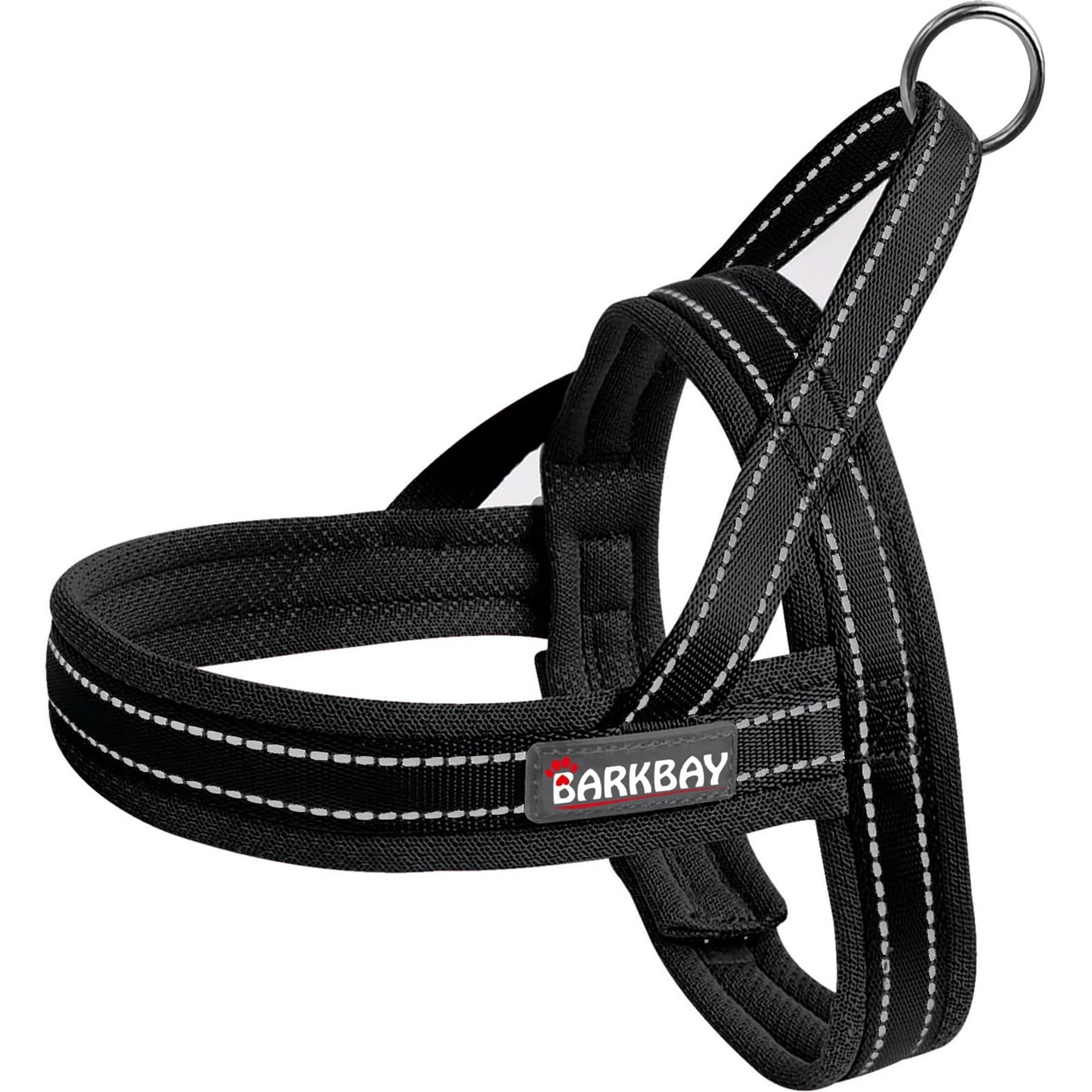
Breathable mesh no-pull harness with a sturdy back handle and reflective stitching for everyday walks.
Webvet may earn a commission when you click through to Chewy, at no extra cost to you.
The BARKBAY AirLift No-Pull Dog Harness with Control Handle is built for everyday walks and light outdoor activity, according to its Chewy listing. The Medium fits a 25 to 28.5-inch chest and was listed at $22.99 on Chewy when we checked in October 2026.
It suits a dog that runs warm on walks, or an owner who wants a grab handle for crowded sidewalks and training sessions. The listing says the chest-based design spreads pulling pressure more evenly to reduce strain on the neck.
What the listing describes:
- Soft, breathable mesh with durable nylon webbing.
- A lightweight design that the maker says allows natural movement without restricting stride.
- A sturdy back handle for crowded spaces or training.
- Adjustable straps to shape the fit to the dog's body.
- Reflective stitching for early morning and evening walks.
The tradeoff is that the listing does not state where the leash clips, so you cannot confirm a front clip until it arrives. The movement claim is the maker's, not a study result.
Copatchy No-Pull Reflective Adjustable Dog Harness: best budget no-pull harness
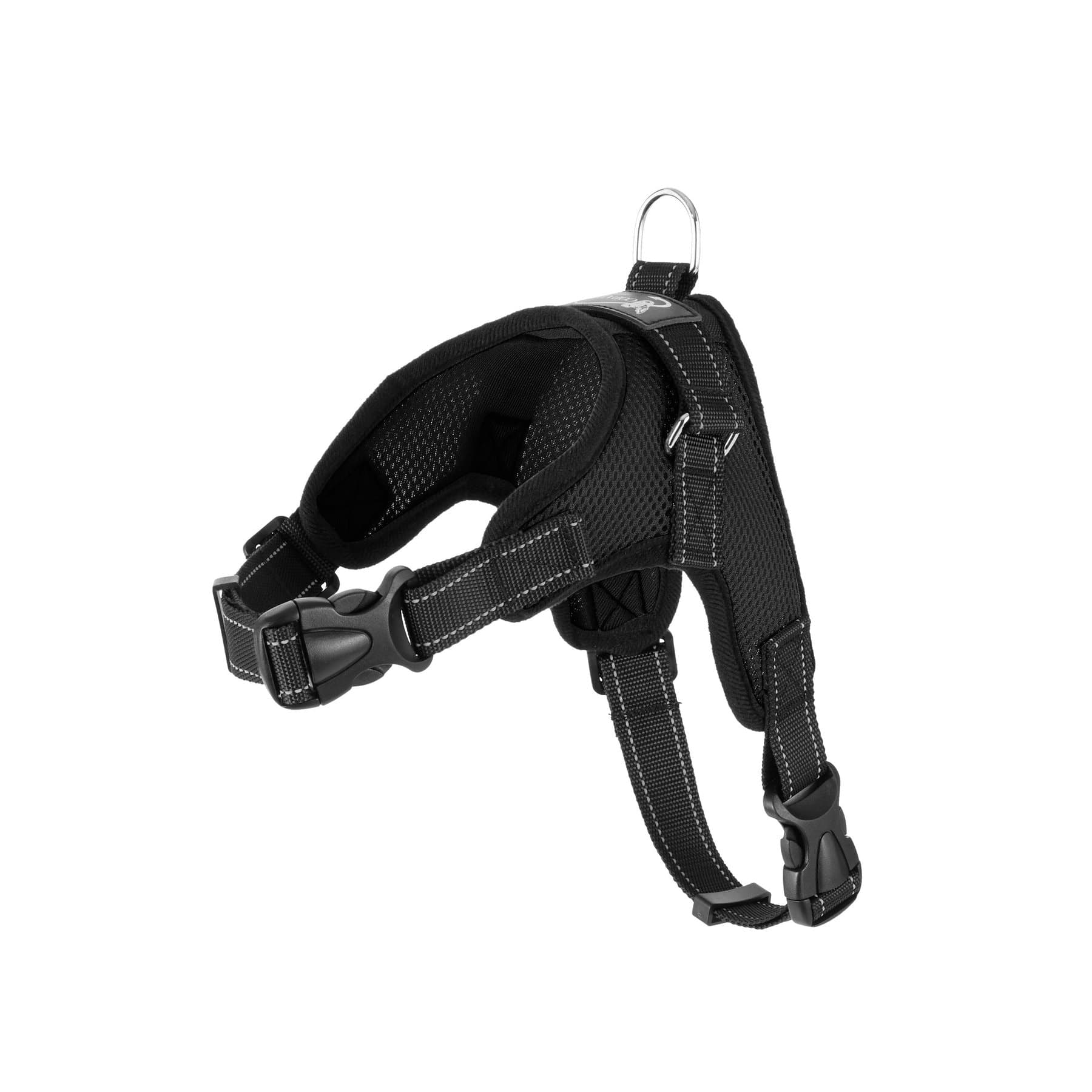
Low-cost, fully adjustable reflective harness with a pull-back handle for owners on a tight budget.
Webvet may earn a commission when you click through to Chewy, at no extra cost to you.
The Copatchy No-Pull Reflective Adjustable Dog Harness is the budget pick, listed at $14.99 on Chewy for the Medium when we checked in October 2026. Its listing describes a fully adjustable harness that is reflective for early morning and nighttime walks.
It suits an owner who wants to try a no-pull harness before spending more, or who needs a spare. The listing says that when a leashed dog suddenly pulls, the harness spreads the pressure evenly to help protect the dog from injury, and it includes a pull-back handle for grabbing your dog quickly.
The tradeoff is how little the listing publishes. It does not give the clip position, the materials, or the chest range for the Medium. Measure your dog, then check the clip position and shoulder clearance as soon as it arrives.
 Sponsored
Vet care that's always there
Unlimited video calls and messaging with licensed vets for less than a typical vet visit. One membership covers up to five pets.
Use code Pets60
Plans start at $12/month · covers up to 5 pets
- Licensed vets in most states
- Rx for 150+ conditions
- 4.7 on Trustpilot
Front-clip vs dual-clip vs martingale-style: how each no-pull design works
Every no-pull harness works by moving where the leash pulls. The design you choose decides where that force lands and how much the harness tightens. VCA's behaviorists describe at least two places a leash can clip on a harness: on the back between the shoulder blades, and in front below the neck between the front legs.

Front-clip harnesses
A front-clip harness has its attachment point at the front, close to the sternum, and the 2025 review notes that some of these are sold as no-pull harnesses. On the PetSafe Easy Walk, for example, that attachment is a D-ring on the chest strap.
When the dog pulls, the force turns its front end rather than giving it a straight line to lean into. The review's recommendation for pullers is to consider non-tightening front-clip harnesses first, after training itself.
It says they offer better control without being as restrictive as tightening harnesses, martingale collars, and head collars, which it calls a last resort. A no-choke label, like the one on the HDP Big Dog No Pull Dog Harness listing, is the maker's description: that listing says the wide chest piece spreads the load across the chest and shoulders.
Dual-clip harnesses
A dual-clip harness carries a front clip and a back ring. The Ruffwear Front Range Reflective Front-Clip Dog Harness is an example: its listing pairs a reinforced chest clip for dogs that pull with an aluminum V-ring on the back for daily walks.
The advantage is flexibility. You use the chest clip while pulling is a problem and move to the back ring once your dog walks well.
Martingale-style harnesses
A martingale-style harness adds a loop that tightens under tension. On the Easy Walk, PetSafe's fit guidance says the martingale loop helps prevent pulling when the leash is connected to the D-ring on the chest strap.
On the WildHound No-Pull Premium Martingale Dog Harness, the martingale loop sits on the back and gently tightens around the chest when the dog pulls, while a separate front connection redirects.
Here is how the three designs compare at a glance:
- Front clip, non-tightening: redirects at the chest; the design the 2025 review suggests trying first.
- Dual clip: chest clip for pullers plus a back ring for relaxed walks; lets one harness follow your dog's progress.
- Martingale-style: adds a tightening loop; the review notes that harnesses that tighten under pressure are usually marketed as training aids, and ranks them after non-tightening front clips.
- Side attachment: a less common design, such as the JWalker Dog Harness, that redirects from the side; none of the studies cited here has evaluated it.
The review's martingale finding concerns collars, not harnesses. Whether a martingale-style harness belongs in the tightening group depends on whether it tightens under tension, and the WildHound listing says its loop does.
Step-in designs are a separate question of how the harness goes on, not how it controls pulling. None of our six listings describes itself as a step-in. For fitting steps on any style, see how to put on a dog harness.
Why are dog trainers against harnesses?
The objection in the research is not to harnesses themselves but to relying on any device instead of training. The 2025 review notes that any device used to inhibit pulling likely adds some aversiveness to the walk, and VCA's behaviorists warn that some no-pull styles can injure by pressing on the front of the shoulder joint.
There is also a movement concern behind the debate:
- Joint range: a 30-dog study of six harness types by Dowdeswell and Churchill in the Reinvention journal found the front-clip setup allowed the least elbow and shoulder flexion and extension, and a straight-front harness allowed the most.
- Y-shaped front clips: the 2025 review, summarizing that study, says the front clip on a Y-shaped harness significantly reduced all four joint measures, raising concerns about its suitability.
- Chest-strap designs: the same summary notes the chest-strap harness did not affect three of the four measures, despite its restrictive reputation.
- Strength of evidence: the study is small and appeared in a university-centre journal, so treat it as a caution rather than a verdict.
That evidence is a reason to fit carefully and watch your dog's gait, not a reason to abandon a front clip that the larger review still ranks first for pullers. If you want a back-clip harness for a dog that already walks nicely, our best dog harness guide covers everyday designs.
No-pull harnesses by dog size: medium, large, and strong pullers
Size changes how a dog pulls. In a 111-dog shelter study cited by the 2025 review, larger and heavier dogs put more tension on the leash but pulled less often than smaller dogs. A big dog may pull less often, but each pull lands harder on your arm.
VCA's behaviorists say a plain collar is not the right choice when a dog pulls very hard, pulls until it coughs or breathes noisily, or pulls hard enough to unbalance or overpower you. Those are the dogs for whom a harness is the better tool.
Tufts University's Cummings School of Veterinary Medicine goes further: in Tufts' guidance on collars and harnesses, a board-certified behaviorist says well-fitted harnesses are much preferable to collars for leash walking and that collars are best used for holding tags. Whether vets recommend collars or harnesses for everyday wear is covered in our guide on how to choose the right dog collar.

Large and extra-large dogs
For a large dog that pulls, the two picks whose listings are written around control are the two-point WildHound No-Pull Premium Martingale Dog Harness and the HDP Big Dog No Pull Dog Harness, which its listing pitches at hard pullers. The HDP Big Dog is listed in a Large with a wide padded chest piece and a built-in handle.
For extra-large dogs, measure the chest first and confirm the listing offers a size whose range covers that number. Two of our six listings publish a chest range for the size shown; the others do not, which is worth checking before you order.
Medium dogs
For a medium dog, only two of our picks publish a chest range for the size listed. Here is how the medium sizes are listed:
- Ruffwear Front Range Reflective Front-Clip Dog Harness: the Medium fits a 27 to 32-inch chest.
- BARKBAY AirLift No-Pull Dog Harness with Control Handle: the Medium fits a 25 to 28.5-inch chest.
- JWalker Dog Harness: sold in a Small/Medium with no published chest range.
- WildHound: a Medium with no published chest range.
- Copatchy No-Pull Reflective Adjustable Dog Harness: a Medium with no published chest range.
Strong pullers, muscular breeds, and why breed is not a size chart
A pit bull type or a husky can be a very strong puller, but breed alone will not tell you which harness fits. A 2023 study of 66 dogs by Williams and colleagues in the Journal of Applied Animal Welfare Science found harnesses changed nearly all gait measures, with differences that varied across breed types.
The authors' recommendation is to fit each dog individually. For a strong, deep-chested puller, that means:
- Measuring the chest at its widest point rather than relying on a breed size guide.
- Choosing a harness with enough adjustment points to fit both the neck opening and the girth.
- Watching the dog walk and trot in it, checking for a visibly shortened stride.
- Picking two connection points, such as a front clip and a back loop, if the dog can pull you off balance.
When a harness is not enough for a very strong dog
VCA's guidance on head halter training says a head halter can help walk a strong dog that gets excited and pulls, and can keep a powerful dog from pulling its handler to the ground.
VCA describes a head halter as a loop high on the neck behind the ears plus a loop around the snout, and says it should be paired with a body harness or flat collar using a safety clip.
The 2025 review ranks head collars as a last resort after non-tightening front-clip harnesses, so a halter is a step to discuss with your veterinarian or a qualified trainer, not a first purchase.
Small dogs that pull
Small dogs are a different case. Tufts notes that neck pressure can dangerously impair breathing in flat-faced dogs and aggravate a collapsing trachea in small dogs, which is why harnesses are preferred for them. Our best harness for small dogs guide covers toy and small breeds that pull.
Fitting a no-pull harness so it does not rub or restrict the shoulders
Fit decides whether a no-pull harness helps or harms. VCA's behaviorists give a three-point checklist for any harness, and it is the best starting point:
- It is easy to put on and take off.
- It does not cause chafing.
- The shoulder joints move freely, with no straps across the front of the shoulder.
PetSafe's fit instructions for its Easy Walk harness add measurable checks worth borrowing for any front-clip design:
- Tighten the straps until only one to two fingers fit between the shoulder strap and the dog.
- Position the side rings so they sit above and behind the front legs.
- Keep the chest strap horizontal, neither drooping nor riding up toward the neck.
- Snug the girth strap so the harness does not slide, rub, or chafe.

Measuring before you buy
Ruffwear sizes its harness by girth, measured around the widest part of the rib cage, and three of our six Chewy listings open with a reminder to measure for the right fit.
Use a soft tape and compare the number with the listing's published chest range where one exists. Where a listing publishes no range, ask the seller for one before ordering.
How much do harnesses restrict movement?
Every harness affects movement to some degree. A nine-dog treadmill study by Lafuente, Provis and Schmalz in Veterinary Record found harnesses limit shoulder extension at walk and trot compared with no harness, though perhaps not in the way the authors expected.
The 2025 review's summary is that all harnesses affect gait, and chest-strap and Y-shaped harnesses are likely the least restrictive.
That gives you a practical rule. Choose a front-clip design whose straps run behind the shoulder joint or along the breastbone, not across the point of the shoulder, then watch your dog walk. A shorter stride or a change in how the front legs swing is a sign to readjust or try another design.
Padded and mesh harnesses
Four of our picks list padding or mesh:
- Ruffwear Front Range Reflective Front-Clip Dog Harness: foam-padded construction, per Ruffwear's product page.
- HDP Big Dog No Pull Dog Harness: extra padding on a wide chest piece.
- WildHound No-Pull Premium Martingale Dog Harness: a 400g airmesh inner layer.
- BARKBAY AirLift No-Pull Dog Harness with Control Handle: soft, breathable mesh.
No veterinary study shows that padding prevents rubbing or injury. The 2025 review says future studies should look at strap width and padding.
Treat padding as a comfort feature, not a substitute for fit. A padded strap across the front of the shoulder still sits in the wrong place.
What dog harness to avoid?
Per VCA's checklist, avoid:
- Any harness with a strap across the front of the shoulder joint.
- Any harness that rubs or causes chafing.
- Any harness that is hard to get on and off.
The 2025 review also ranks tightening harnesses after non-tightening front clips, and AVSAB's position is that aversive methods, including leash corrections, should not be used, so do not add prong, choke, or shock equipment.
Signs your current harness needs refitting or replacing:
- The chest strap droops or rides up toward the neck instead of sitting level, per PetSafe's fit guidance.
- You can fit more than two fingers under the shoulder strap, or none at all.
- The skin under a strap looks rubbed or chafed, which fails VCA's checklist.
- A strap sits across the front of the shoulder joint when the dog stands or walks.
- Your dog's stride looks shorter in the harness than without it, a sign of the shoulder-extension limit the Lafuente study measured.
After the walk
VCA's behaviorists say harnesses should only be worn when the dog is on a leash. Take the harness off when you get home and check under the straps for rubbed skin. Collars left on carry their own risks, covered in our guide to preventing dog collar accidents.
Using a no-pull harness with leash training
A no-pull harness can make training walks easier to manage, but it is not the training. The 2025 review says the real fix is humane, reward-based training, which reduces the need for devices that prevent pulling through tightening or redirection. Think of the harness as the safety net while the new habit forms.
The American Veterinary Society of Animal Behavior agrees on method. In its position statements, AVSAB recommends that only reward-based training be used for all dog training and behavior modification, and says aversive methods, including leash corrections, should not be used. A no-pull harness used for training walks is never the place for leash corrections.

What is the #1 trick to stop your dog from pulling on the leash?
Reward slack. VCA's behaviorists say to wait for even a second of loose leash, say "Yes!", and quickly give one or two treats, then take a step or two and repeat. When the dog pulls, stand still or step away from the distraction, wait for any slack, then reward. Most dogs need several months of regular practice.
Here is how that method looks on a walk with a front-clip harness:
- Clip the leash to the chest ring.
- Wait for even a moment of slack, mark it with "Yes!", and quickly hand over one or two treats.
- Take a step or two, and reward again the moment the leash is loose.
- If the dog pulls, stand still or step away from whatever it wants, wait for any slack, then reward before moving on.
That several-month timeline is normal, and it is why the harness stays on for training walks long after the first good day.
Choosing a harness for training walks
Any well-fitted front-clip harness works with the slack-and-reward method, but two of our picks are built around a training routine. The JWalker Dog Harness listing frames its side attachment around rewarding good behavior rather than punishment, and the Ruffwear Front Range Reflective Front-Clip Dog Harness lets you start on the chest clip and move to the back V-ring as your dog improves.
Whichever you use, keep the leash loose and the treats ready. The harness should make it easier to reward slack, not replace the reward.
Puppies and young dogs
With a puppy, harness walks are part of meeting new people, dogs, and places, and our puppy socialization checklist covers the experiences to plan. Measure a growing puppy often, since a harness that fit last month may now press on the shoulders.
If your puppy grabs the leash or mouths the harness straps on walks, redirecting that mouthing is its own skill, and our guide on how to stop a puppy from biting explains the reward-based approach.
Lunging, fear, and reactivity
A dog that lunges or barks at the end of the leash needs more than a harness. VCA's behaviorists advise talking to your veterinarian for a referral to a professional behavior consultant and trainer for individualized coaching. A front-clip harness helps you redirect the dog in the moment, as AAHA notes, but it does not address why the dog reacts.
If your dog seems frightened on walks, shaking or trying to get away, read our guide to dog shaking from fear and anxiety and talk with your veterinarian before blaming the harness or the training.
Where training goes next
Once your dog walks reliably on a no-pull walking harness, the same reward-based approach carries into recall and off-leash dog training in safe, legal spaces.
Handles, padding, and reflective features on no-pull harnesses
Features are where no-pull harness listings differ most, and where the evidence is thinnest. Handles, padding, and reflective trim can all be useful, but none of them changes how the harness controls pulling. Choose the clip design and fit first, then the extras.
Handles
Three of our six picks list a handle:
- HDP Big Dog No Pull Dog Harness: a built-in handle for keeping the dog close and helping it over rougher terrain.
- BARKBAY AirLift No-Pull Dog Harness with Control Handle: a sturdy back handle for crowded spaces or training sessions.
- Copatchy No-Pull Reflective Adjustable Dog Harness: a pull-back handle for getting hold of the dog quickly.
The handle research that exists is on working dogs. The 2025 review reports that guide dogs wearing harnesses with handles showed differences in stride length and joint range of motion compared with collars. None of the studies cited here looks at top handles on pet no-pull harnesses, so the best handle choice comes down to how you will actually use it.
The Ruffwear, WildHound, and JWalker listings do not mention a handle. If a handle is a must, the BARKBAY AirLift and the HDP Big Dog say the most about how their handles are meant to be used.
Padding and materials
Padding sits in the same evidence gap. The 2025 review calls for future research on strap width and padding, and no veterinary study shows that padding reduces harm. What the listings do tell you is what each harness is made of:
- WildHound No-Pull Premium Martingale Dog Harness: ripstop polyester outer, 400g airmesh inner, and nylon webbing straps.
- BARKBAY AirLift: soft, breathable mesh with durable nylon webbing.
- Ruffwear Front Range Reflective Front-Clip Dog Harness: foam-padded construction, per the maker.
- HDP Big Dog: extra padding across a wide chest piece.
- JWalker Dog Harness: round edges, double-folded seams, and heavy-duty metal attachments.
None of the six is a leather, rope, or tactical-style harness, and none of the studies cited here compares those styles for pulling. Metal hardware is thin on the listings too: JWalker's describes heavy-duty metal attachments and military-grade side release buckles, Ruffwear's an aluminum V-ring, and the others do not describe their hardware.
Reflective trim
Reflective features are manufacturer claims only; no veterinary study evaluates them. Four of the six listings describe a reflective element:
- Ruffwear Front Range: reflective trim and a light loop for The Beacon, sold separately.
- JWalker: a reflective top strap, which the maker calls fade-resistant and washable.
- BARKBAY AirLift: reflective stitching for early morning and evening walks.
- Copatchy: a reflective harness for low-light walks.
- WildHound and HDP Big Dog: no reflective feature is described in their listings.
If you walk before dawn or after dark, the Ruffwear Front Range, with both reflective trim and a light loop, offers the most visibility features of the group.
Personalized, custom, and color options
A personalized harness with your dog's name, a custom color, or a cute pattern changes nothing about how it handles pulling. None of our six listings offers name personalization. The Ruffwear has an ID pocket that keeps tags quiet and easy to reach, which serves the same ID purpose. Choose color last, after clip design, fit, and shoulder clearance are settled.
No-pull dog harness questions
Frequently Asked Questions
Do no-pull harnesses hurt dogs?
They can if the design or fit is wrong. VCA's behaviorists warn that some styles injure by pressing on the front of the shoulder joint, and studies show all harnesses change gait to some degree. Choose a design with no strap across the shoulder and watch your dog's stride after fitting.
The 2025 Cavalli and Protopopova review adds that any device used to stop pulling likely brings some discomfort, which is one more reason to pair it with reward-based training rather than rely on it.
How does a no-pull harness work?
The leash attaches to a front clip at the chest. When the dog pulls, the tension redirects its movement and turns it instead of letting it lean forward, and the 2025 review notes it also adds slight discomfort to pulling. Ruffwear describes its chest clip as made to redirect dogs that pull.
The effect lasts only while the harness is on, so the habit still has to be trained.
What size no-pull harness does my dog need?
Measure the chest with a soft tape around the widest part of the rib cage and match that number to the listing's chest range. If a listing publishes no range, check before buying. Fit by your dog's measurement, not its breed, since a 2023 study found harness effects on gait varied across breed types.
Recheck the straps after the first few walks, keeping one to two fingers of room under the shoulder strap.
Can a dog wear a no-pull harness all day?
VCA's behaviorists say harnesses should only be worn when the dog is on a leash, so remove it after walks. Tufts says a harness can stay on during closely supervised play. There is no published safe wear time, so check under the straps for chafing whenever it comes off.
Is a no-pull harness better than a head halter?
For most pullers, the 2025 review suggests trying a non-tightening front-clip harness before a head halter, which it ranks as a last resort. VCA notes a head halter is not a muzzle and a dog can still bite in one, and it should never be jerked because of the risk of neck injury.
An earlier study cited by Shih and colleagues in 2021 found that dogs pawed at their noses and lowered their heads and ears more often in a head collar. A harness is the gentler place to start, with a halter reserved for dogs a veterinarian or trainer thinks need it.

Editor
The Webvet Editorial Team is the in-house group of pet-care editors and writers behind Webvet, operated by Smart Pet Collective. The team researches, writes, and maintains Webvet's pet health, behavior, and medication content. Every article follows a defined editorial process: research from reputable veterinary and scientific sources, careful drafting, mandatory review of medical content by a credentialed veterinarian, and dated publication. Health and medication articles are medically reviewed by a licensed veterinary professional before they go live and are kept current over time.
Veterinarian · BVMS MRCVS
Dr. Pippa Elliott, BVMS, MRCVS, is a veterinarian with nearly 30 years of experience in companion animal practice. Dr. Elliott earned her Bachelor of Veterinary Medicine and Surgery from the University of Glasgow. She was also designated a Member of the Royal College of Veterinary Surgeons. Married with 2 grown-up kids, Dr. Elliott has a naughty Puggle named Poggle, 3 cats and a bearded dragon.
Related reading

Best Retractable Dog Leash: Safer Picks, Locking Brakes, and When Not to Use One

Best Dog Leash: Vet-Reviewed Picks by Walking Style, Dog Size, and Material

Best Dog Harness for Small Dogs: Lightweight, Secure Picks That Protect the Trachea
