How to Put On a Dog Harness: Step-by-Step for Every Harness Type, With a Fit Check
How to put on a dog harness, step by step, for step-in, overhead vest, and front-clip designs: which way round it goes, where the clips sit, and the two-finger fit check. Plus how to harness a puppy, a small dog, or a dog that backs away.

BVMS MRCVS

This article contains affiliate links. Webvet may earn a commission when you buy through them, at no extra cost to you.
Here is how to put on a dog harness in brief: lay it out so the D-ring will sit on your dog's back, as the American Kennel Club (AKC) describes, and check that no strap is twisted, which Orvis warns causes chafing. Step the front legs in or slip the loop over the head, close the buckle, then make sure two fingers slip under every strap and try to pull the harness over the head to confirm it is secure.
The finer points of how to put on a dog harness depend on which kind you are holding. AKC notes that different types of harnesses need to be put on in different ways, so steps written for a step-in design will not work on an overhead vest or a front-clip harness.
 Sponsored
Want a vet's help with your dog's anxiety or behavior?
Talk to a licensed vet at Dutch over video, often the same day. They can recommend treatment and prescribe it when it's appropriate.
Use code Pets60
Plans start at $12/month · covers up to 5 pets
- Licensed vets in most states
- Rx for 150+ conditions
- 4.7 on Trustpilot
How to put on a dog harness: the quick steps for any harness
Before any harness goes on, AKC suggests standing, sitting, or squatting behind your dog with the dog standing or sitting, and doing it when your dog is calm. Then work through these steps, whatever the harness type:
- Identify the harness type: step-in (the dog steps into two leg openings), overhead (a neck loop slips over the head), or front-clip (the leash ring sits on the chest).
- Lay it out with the D-ring, the metal ring the leash clips to, on top, and check that no strap is twisted. Orvis warns that a twisted strap causes chafing.
- Step the front legs in, or slip the neck loop over the head.
- Close the buckle at the side or over the back, depending on the design.
- Check that two fingers fit under every strap, then try to pull the harness over the head to make sure it stays on.
- 1Identify the harness type first, because step-in, overhead, and front-clip harnesses each go on differently.
- 2Step-in harness steps: lay it flat with the buckles on top of the D-rings, set the front paws in the two triangles, then clip the ends together over the back.
- 3Overhead vest harness steps: slip the neck loop over the head with the D-ring on the back, guide one front leg through, then buckle the girth strap.
- 4On a front-clip harness, the leash ring sits at the center of the chest.
- 5Finish every fitting with two fingers under each strap and a gentle pull toward the head to make sure it stays on.
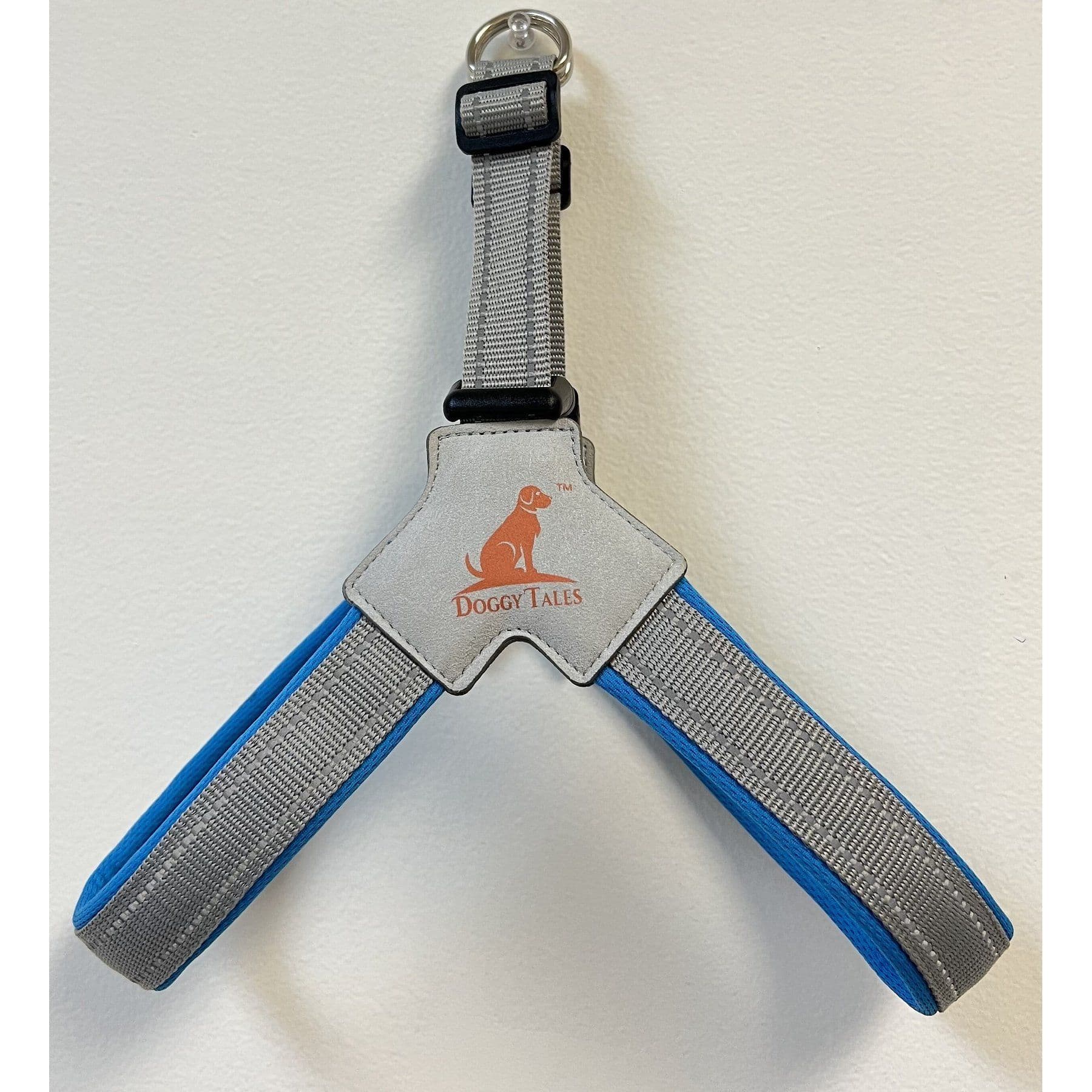
A padded step-in harness with a breathable mesh lining, double D-rings, and an easy-release buckle.
Webvet may earn a commission when you click through to Chewy, at no extra cost to you.

| Harness type | How it goes on | Where the leash clip sits | Fit check |
|---|---|---|---|
| Step-in | Lay it flat with the buckles on top of the D-rings, place the front feet in the two triangles, clip the two ends together on the back | D-ring on the back | Two fingers under each strap; try to pull it over the head |
| Overhead or vest | Slip the neck loop over the head with the D-ring on the back, put one leg through, buckle so the other leg lands in its hole | D-ring on the back | Two fingers under each strap; girth strap behind the armpits without digging in |
| Front-clip, single chest strap | Loop over the head with the label on the left shoulder, then fasten the belly strap | Ring at the center of the chest, over the breastbone | Chest strap rests on the breastbone with no gap; from the side the straps look like a sideways T |
| Side-clip, no leg lifting | Fasten the clips at the sides, so no paw has to be lifted | Chest ring, back ring, or both, depending on the model | Adjust each point evenly, then two fingers under each strap |
On a standard harness the leash clips to the D-ring on the back; on a front-clip design it clips to a ring on the chest, and some harnesses carry both. The Ruffwear Front Range listing on Chewy describes an aluminum V-ring on the back, a reinforced front clip, and an ID pocket that keeps tags quiet.
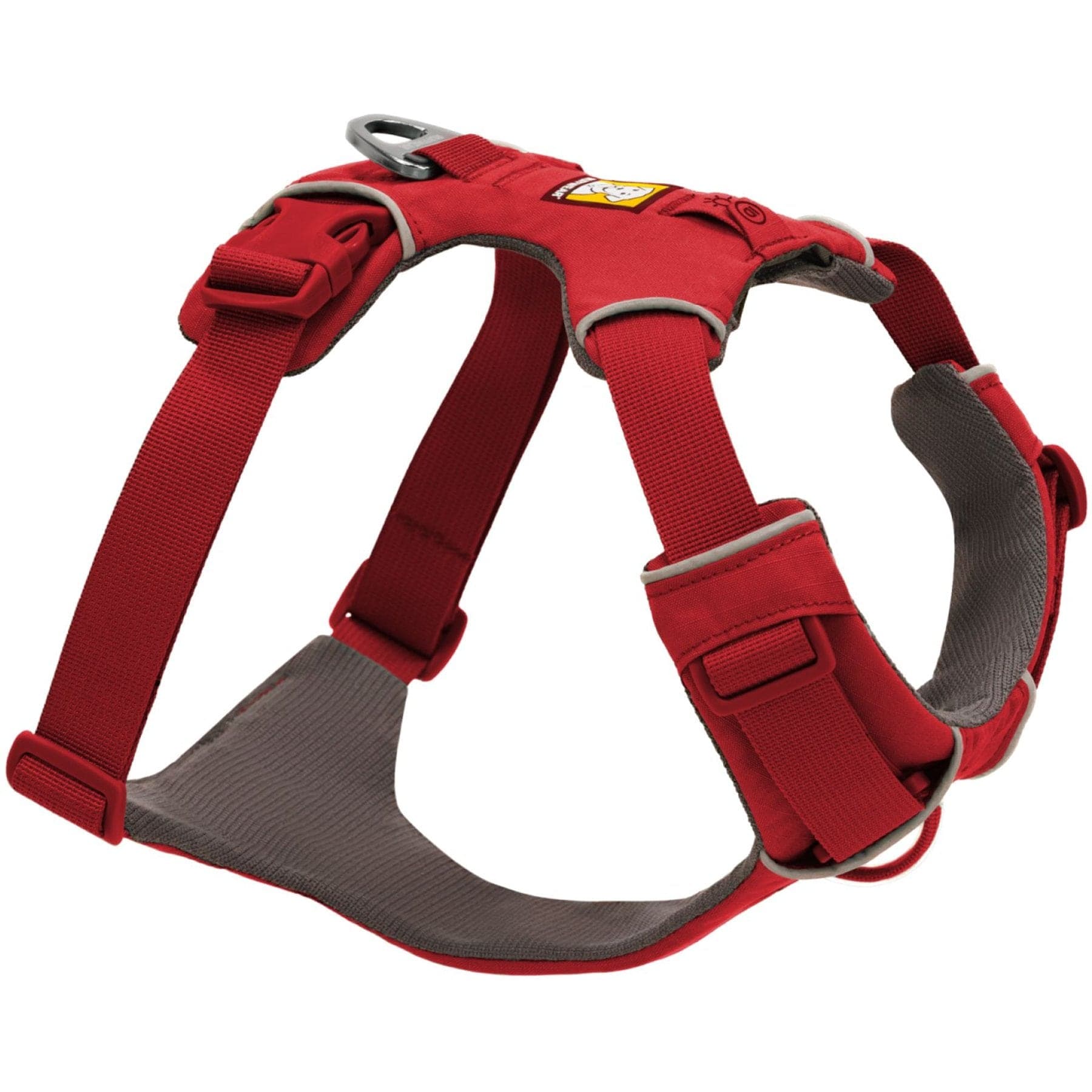
A front clip at the chest and a back V-ring on one harness, with four points of adjustment for fine-tuning the fit.
Webvet may earn a commission when you click through to Chewy, at no extra cost to you.
Most fitting instructions assume you know the parts of a harness by name:
- Neck loop: the loop around the neck. AKC describes a standard harness as one loop around the neck, one around the ribs, and a D-ring on the back.
- Girth strap: the loop around the ribs, which sits behind the front legs.
- Chest strap: on front-clip and Y-shaped designs, the strap that crosses the breastbone.
- D-ring: the metal ring the leash clips to.
- Side-release buckle: the plastic clip you squeeze to open, usually at the side or on the back.
With a large dog, the same AKC position works: stand or squat behind the dog while it stands or sits. AKC's collar and harness guide gives two fingers of space under the straps as the right fit for large-breed dogs.
If you are still choosing between designs, our best dog harness picks compare everyday walking models. A support harness for a dog with weak legs is a different tool; see our mobility aids for dogs overview and the best dog lift harness guide.
How to put an easy harness on a dog?
The easiest harness to put on is one that skips the step your dog dislikes. Company of Animals says its Halti Walking Harness needs no leg lifting because it fastens with side clips, and step-in designs avoid anything passing over the head.
The Edmonton Humane Society adds a simple trick for any design: have a helper feed tasty treats so your dog stands still while you put the harness on and adjust the size.
Step-in harnesses: how to put one on
A step-in harness forms triangles around the front legs, while a standard overhead harness forms rectangles, which is AKC's quick way to tell them apart. Nothing has to pass over the dog's head.
The Doggy Tales Step In V listing on Chewy describes nylon webbing with padding, a breathable mesh lining, double D-rings, and an easy-release buckle; it was listed at $26.95 on Chewy when we checked in October 2026. Whatever the brand, AKC's steps are the same:
- Lay the harness flat on the ground so you can clearly see the two triangles, with the buckles on top of the D-rings.
- Hold your dog from behind and place the front feet in the two triangles.
- Pick up the two ends of the harness and clip them together on your dog's back.
- Adjust the straps, then try to pull the harness over your dog's head to make sure it is secure.
Orvis describes the same motion as walking your dog's front paws into the leg openings and pulling the harness up. EzyDog's fitting guide gives the same order: paws into the two loops on the ground, then pull it up and fasten it over the back.
Step-in designs suit a dog that is skittish when touched around the head, Orvis notes. The Edmonton Humane Society makes the same point: if a dog is nervous of overhead movement or of having its legs and feet handled, choose the design that makes it easier to put on and take off.

If a step-in harness slides over the head during AKC's pull test, it is too loose. Tighten the straps until it stays put, while two fingers still fit under each one.
Overhead and vest harnesses: how to put one on
An overhead harness, which AKC calls a standard harness, has one loop around the ribs, one loop around the neck, and a D-ring on the back. Vest-style harnesses are typically padded and give more coverage across the chest and body.
AKC's steps for a standard overhead harness:
- Slip the harness over your dog's head so the D-ring sits on the back. The wider loop, the one with the buckle, goes on first, and the narrower loop second.
- Slip one front leg through the first leg hole, so the leg sits between the rib loop and the neck loop.
- Buckle the harness so the other leg lands in its own leg hole. If the buckle will not reach, loosen the strap.
- Adjust until you can slip two fingers under any strap.
Kurgo's three-step method starts with the harness loose: slide your dog's head through the neck piece, arrange the bottom straps between the front legs under the belly, then bring the buckles up behind the front legs and snap them into the back piece.
The fabric does not change the method. EzyDog notes that padded vest designs come as either step-in or slip-over, so a padded, mesh, or cloth vest goes on by whichever of those two methods it uses. Orvis suggests an over-the-head model may work better for a dog that goes into a happy dance before walks.

Which way round does a dog harness go?
The D-ring goes on your dog's back. AKC's overhead steps start by positioning the harness so the D-ring is on the back, and a step-in harness laid flat should show its buckles sitting on top of the D-rings.
Front-clip designs are the exception for the leash ring. On a single-chest-strap harness, AKC says the label sits on the dog's left shoulder and the metal ring for the leash at the center of the chest.
How to put on a dog harness with 4 clips?
Multi-clip harnesses close around the body with clips instead of asking the dog to step in. The Kurgo Journey Air Polyester Reflective No Pull Dog Harness, Coral, Large is described on its Chewy listing as easy to put on and take off with four quick-release buttons and four adjustment points. The order follows Kurgo's own fitting steps:
- Open the clips and loosen the straps before you start.
- Slide your dog's head through the neck piece, with the back piece on top.
- Bring the belly straps up behind the front legs and snap each clip into the back piece.
- Adjust the straps evenly at each adjustment point until two fingers, and only two, fit between the harness and your dog.
Two-clip and three-clip designs follow the same pattern with fewer buckles. The Halti Walking Harness, for instance, uses three-point button release side clips, so no leg lifting is needed.
 Sponsored
Vet care that's always there
Unlimited video calls and messaging with licensed vets for less than a typical vet visit. One membership covers up to five pets.
Use code Pets60
Plans start at $12/month · covers up to 5 pets
- Licensed vets in most states
- Rx for 150+ conditions
- 4.7 on Trustpilot
Front-clip and no-pull harnesses: getting the straps in the right place
A front-clip harness puts the leash clip at the front, over the chest, and AKC says it is designed to discourage pulling. Placing the front clip correctly on the chest is what makes it work as intended:
- Put the loop of the harness over your dog's head.
- Turn it so the label sits on the left shoulder and the metal ring is at the center of the chest (AKC).
- Fasten the belly strap behind the front legs.
- Check that the chest strap rests directly over the breastbone, not hanging loose or with a gap, and that the D-ring is centered (Edmonton Humane Society).
- If the ring drifts off center, move each chest strap slider the same amount until it sits in the middle again.
Some harnesses carry two rings, one on the chest and one on the back, so the same harness works for training walks and relaxed ones. The Halti Walking Dog Harness listing on Chewy describes lead clip rings on the chest and back, five points of adjustment, and a close-control traffic handle.
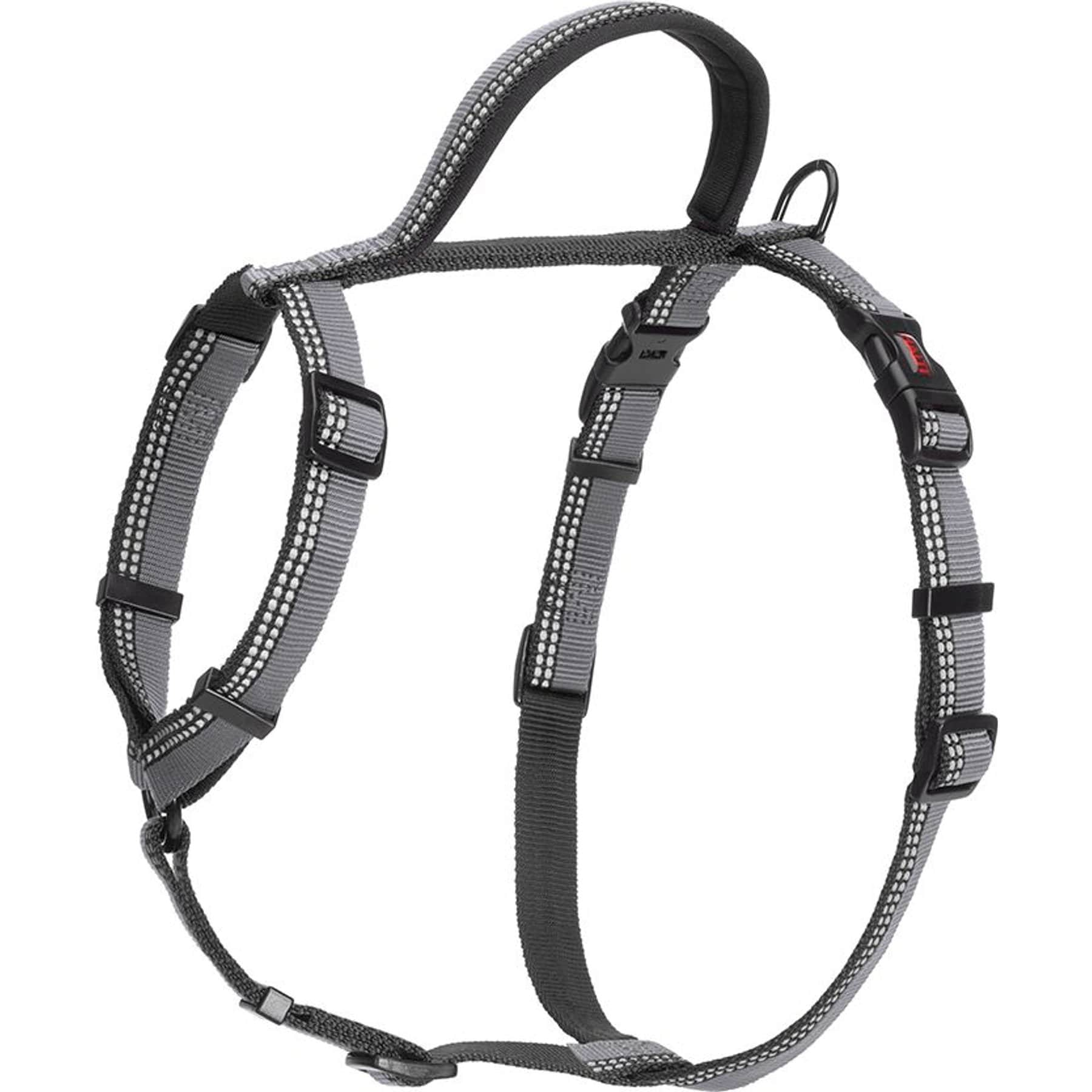
Lead rings on the chest and back, five adjustment points, and side clips that fasten without lifting a paw.
Webvet may earn a commission when you click through to Chewy, at no extra cost to you.
For a lower-cost single-buckle design, the Red Dingo No Pull Dog Harness, Blue, Medium was listed at $15.95 on Chewy when we checked in October 2026. Its listing says the single buckle on the side makes it simple to slip on and off, and that the webbing is gentle on sensitive areas like the armpits.
Our best no-pull dog harness roundup compares more front-clip designs.
Should you clip a dog harness on the front or back?
Clip to the front if pulling is the problem, and to the back for relaxed walks. The Edmonton Humane Society guide says a back clip does not reduce the effects of pulling the way a front clip does, but the leash is less likely to tangle in the feet or drag on the ground.
Either way, a clip is not training. The same guide notes that front-clip harnesses can seemingly reduce pulling, but loose-leash walking is a learned skill that must be taught. The Pet Professional Guild cautions that many harnesses sold as no-pull work by applying pressure or discomfort when the dog pulls.
Strap shape is where the sources disagree:
- Edmonton Humane Society: a Y- or H-shaped harness does not restrict shoulder movement, while the across-the-chest style does and is not for long-term use.
- [Veterinary Record](https://pubmed.ncbi.nlm.nih.gov/30455191/) (Lafuente, Provis, and Schmalz, 2019): harnesses did limit shoulder extension, but the non-restrictive harnesses reduced it more than the restrictive ones, at walk and trot.
- [PLoS One](https://pmc.ncbi.nlm.nih.gov/articles/PMC8906618) (Palya and colleagues, 2022): defines non-restrictive harnesses as a Y-shaped chest strap above the shoulder blade, and restrictive ones as a strap crossing at or below it.
Fit check: how a harness should sit and how snug it should be
To put on a dog harness correctly, finish with the two-finger rule. The Edmonton Humane Society says you should be able to slip two fingers under the strap, and AKC applies that to any strap. Orvis adds that the fingers should fit without forcing them through and without excessive wiggle room.
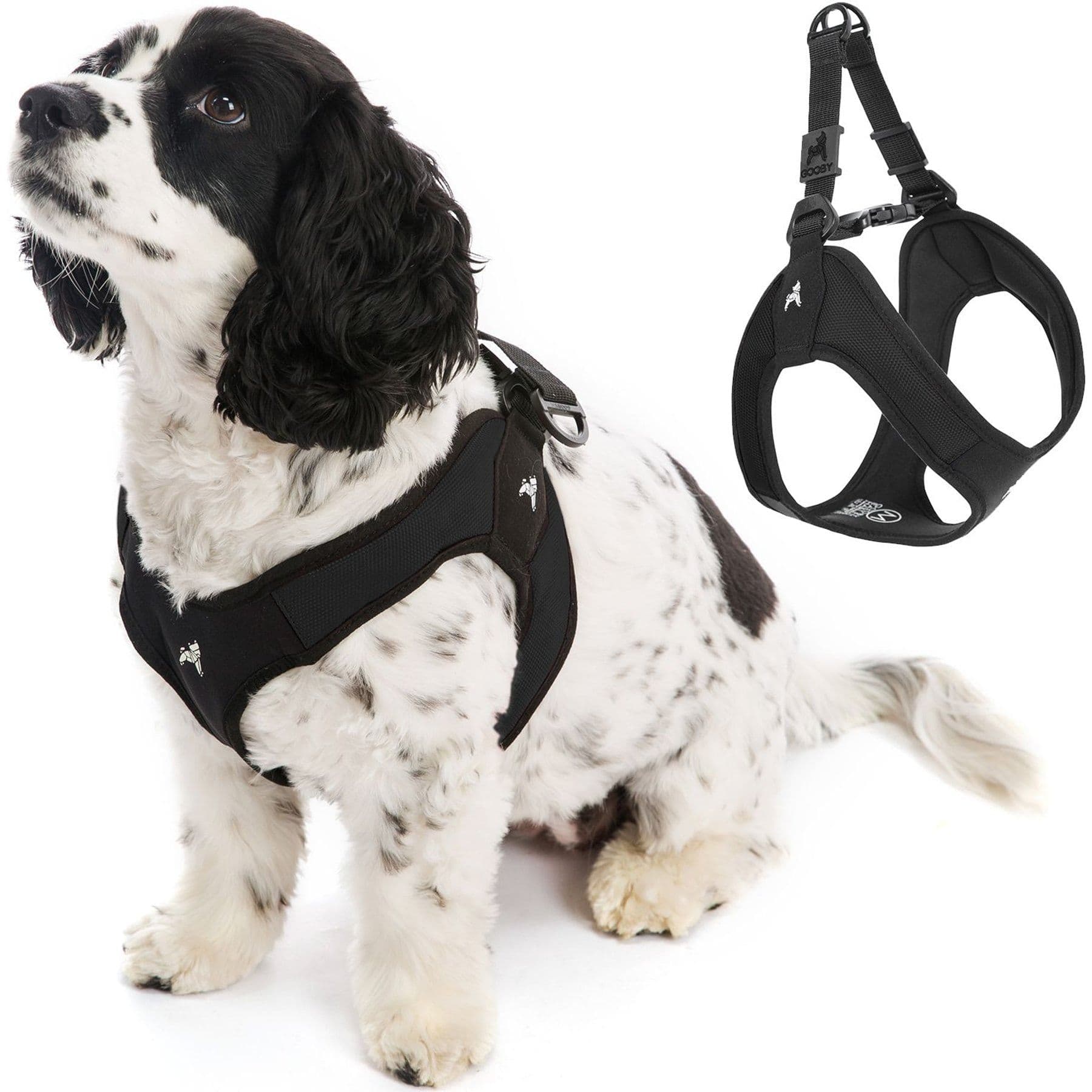
A step-in harness made for small breeds, sized by chest measurement, with a no-pull design that reduces space around the back.
Webvet may earn a commission when you click through to Chewy, at no extra cost to you.
To tighten a dog harness, use the adjusters on the neck and girth straps until two fingers fit. AKC calls this the most important step: the harness should be snug, but not too tight, so your dog is safe and secure.
The finger count is the one place the sources differ. AKC's collar and harness guide says one finger for small dogs and two for large-breed dogs, while the Edmonton Humane Society, Orvis, and AKC's own fitting article give two fingers for every dog.

With an adjustable harness, sizing starts before it goes on. Ruffwear sizes by girth around the widest part of the rib cage, and the Gooby Escape Free listing on Chewy asks you to measure your dog's chest before buying and to check for a snug fit to help prevent escaping.
How to correctly put a dog harness on?
Correct fitting is the steps for your harness type plus three checks: two fingers under every strap, no twisted straps, and a pull test. Orvis warns that a twisted strap causes chafing, and AKC says to try pulling the harness over the head. Orvis also advises adjusting the harness each time it goes on.
How should a dog harness look on a dog?
From the side, a chest-strap harness should look like a sideways T, says the Edmonton Humane Society, with the chest strap resting on the breastbone rather than drooping or pulled up. The girth strap sits behind the front legs without digging into the armpits, and the D-ring sits centered.
Then watch your dog walk. The same guide says to look at your dog's walk and posture and adjust anything that digs in or restricts movement. Orvis singles out the straps behind the elbow, where the harness moves the most and risks chafing.
What are the common problems with dog harnesses?
Most problems trace back to fit. Orvis lists these signs that a harness does not fit:
- Fur loss around the straps
- Chafing around the straps
- Wiggling free
- The harness rotating to one side
- Your dog starting to resist walks
Too loose, and a dog can slip out and the straps can snag; too tight, and the straps limit movement and cause pressure that leads to chafing and sores, Orvis says. AKC adds that a tight harness can be painful, especially in hot weather. The Edmonton Humane Society advises checking regularly for frayed fabric and cracked plastic buckles.
Small dogs and puppies: putting on a harness without a struggle
A small dog or a puppy goes into a harness the same way a large dog does: squat behind your dog with the dog standing or sitting, then follow the step-in or overhead steps for your harness type. Keep treats within reach so a small dog stays still while you work.
AKC says a standard body harness with a back attachment is a popular choice for small dogs. It can prevent potential throat damage if your dog pulls and makes it less likely that the leash gets caught under the legs. EzyDog points to padded vest styles for smaller dogs, puppies, and dogs with sensitive skin.
Puppies need a few extra habits:
- Start before the first walk. The Pet Professional Guild says many puppies first wear a harness on their first walk, and that this shouldn't be the case. Show the harness, give a treat, and practice for a few sessions before you try putting it on. This fits well alongside the handling work on our puppy socialization checklist.
- Check the fit as they grow. Crown Town Veterinary Hospital warns that puppies can grow incredibly fast and that an embedded harness can have painful and dangerous consequences, so monitor growth and adjust or replace the harness.
- Use it only when needed. The same hospital says harnesses should be worn only for walks or trips to the vet or dog park.
- Choose a harness that fits well. The Pet Professional Guild says it should not restrict movement or dig in.
Not every source starts puppies in a harness. AKC says puppies just learning to walk on a leash do best with a standard collar; our guide on how to choose the right dog collar covers that route.
The Pet Professional Guild, by contrast, teaches puppies to accept a harness, and Company of Animals says all its Halti walking products are suitable for puppies.
The Gooby Escape Free Easy Fit Dog Harness, Black, Small: 16 to 19.25-in chest is designed for small breed dogs, with its largest size fitting dogs up to 35 lbs, per its Chewy listing; paws go in the arm holes, then you pull it up and fasten. Our best harness for small dogs picks compare more options.
Dogs that resist the harness: building a calm routine
When a dog backs away, spins, or hides at the sight of the harness, forcing it on is the wrong move. VCA Animal Hospitals, in an article by board-certified veterinary behaviorists, says punishment can increase stress and make fear worse.
The approach VCA describes for pets fearful of handling is desensitization, gradual exposure that starts low enough that the pet shows no fear, paired with counterconditioning, which links the trigger to something good. Tasty treats are the usual choice.

To get your dog to accept the harness, build the routine in small steps:
- Introduce the harness a few times while your dog is calm, before trying to put it on (Orvis).
- Show the harness and give a treat, and repeat over a few sessions (Pet Professional Guild).
- Teach your dog to put its head through the harness on its own, which gives your dog choice and control.
- Run short on-and-off sessions with plenty of treats, without going anywhere yet.
- Scatter food on the floor while you do up the clips, since noisy clips can cause a startle response.
- Once the harness is on, offer a special treat or head straight out for a fun walk (EzyDog).
Move to the next step only while your dog stays relaxed. VCA describes raising the intensity over several sessions as long as there is no sign of fear, and there is no fixed timeline. If your dog trembles or hides, go back a step; our guide to why a dog shakes when scared explains those signals.
A hyper dog that dances around before walks may be easier to harness with an over-the-head design, Orvis suggests, while a head-shy or scared dog may do better stepping in. If your dog growls, snaps, or bites when you reach toward it with the harness, stop the session and talk to your vet before trying again.
How to put on a harness for the first time?
Make the first fitting a short session at home, not the start of a walk. Start with the straps loose, as Kurgo advises, and have a helper feed treats while you fasten and adjust, which the Edmonton Humane Society says keeps a dog standing still. Then run the fit check and take it off while things are going well.
Putting on a dog harness questions
Frequently Asked Questions
How tight should a dog harness be?
Snug, but not tight. Kurgo puts it as two fingers, and only two fingers, between the harness and your dog at any point. If you have to force two fingers in, loosen it, especially before a walk in hot weather, when AKC notes a tight harness can be painful.
Which side of the harness goes on top?
The side with the D-ring goes on top, on your dog's back. AKC's overhead steps start by positioning the harness so the D-ring sits on the back. The one exception is the front ring of a front-clip harness, which belongs at the center of the chest.
How do I put a harness on a puppy?
Start before the puppy needs it for walks. Show the harness and give treats for a few sessions, then put it on loose, fasten the clips while scattering food, and finish with the two-finger check. Recheck the fit often, because Crown Town Veterinary Hospital warns that a fast-growing puppy's harness can become embedded.
How do I adjust the harness straps?
Tighten the straps once the harness is buckled. On a chest strap with two sliders, the Edmonton Humane Society says to move each slider the same amount so the D-ring stays at the center of the chest. Then adjust the neck and girth straps until two fingers fit, and recheck them each time it goes on.
How do I put a harness on a nervous dog?
Keep sessions short and calm, with plenty of treats. Introduce the harness while your dog is relaxed, pair it with food, and choose a design that skips whatever your dog dislikes: step-in if head handling is the problem, side clips if paw handling is. If fear persists or your dog snaps, ask your vet for help.

Editor
The Webvet Editorial Team is the in-house group of pet-care editors and writers behind Webvet, operated by Smart Pet Collective. The team researches, writes, and maintains Webvet's pet health, behavior, and medication content. Every article follows a defined editorial process: research from reputable veterinary and scientific sources, careful drafting, mandatory review of medical content by a credentialed veterinarian, and dated publication. Health and medication articles are medically reviewed by a licensed veterinary professional before they go live and are kept current over time.
Veterinarian · BVMS MRCVS
Dr. Pippa Elliott, BVMS, MRCVS, is a veterinarian with nearly 30 years of experience in companion animal practice. Dr. Elliott earned her Bachelor of Veterinary Medicine and Surgery from the University of Glasgow. She was also designated a Member of the Royal College of Veterinary Surgeons. Married with 2 grown-up kids, Dr. Elliott has a naughty Puggle named Poggle, 3 cats and a bearded dragon.
Related reading

Best Retractable Dog Leash: Safer Picks, Locking Brakes, and When Not to Use One

Best Dog Leash: Vet-Reviewed Picks by Walking Style, Dog Size, and Material

Best Dog Harness for Small Dogs: Lightweight, Secure Picks That Protect the Trachea
