Best Dog Leash: Vet-Reviewed Picks by Walking Style, Dog Size, and Material
Vet-reviewed guide to the best dog leash for how you walk: the right length, nylon versus leather versus rope versus biothane, and when a slip lead, long line, or hands-free leash makes sense. Picks for pullers, runners, and new puppies.

BVMS MRCVS

This article contains affiliate links. Webvet may earn a commission when you buy through them, at no extra cost to you.
The right dog leash depends on how you walk, not on what sells most. For most everyday walks, a 6-foot fixed leash is the sensible default, and our top pick for that walk is the Leash Boss Two Handle Dog Leash, 6-ft long, Orange, 1-inch nylon with a padded traffic handle at 18 inches.
Six feet is where the 6-to-10-foot walking range from VCA Animal Hospitals overlaps the 4-to-6-foot range the American Kennel Club and Consumer Reports describe. Material changes grip, weight, care, and durability more than it changes safety, and no veterinary source ranks one dog leash material as safer for the dog.
What really changes the setup is the dog and the walk. A strong puller, a running partner, a new puppy, and two dogs at once each call for a different length, handle, or harness pairing.
| Leash | Best fit | Material and length | Standout feature | Main tradeoff |
|---|---|---|---|---|
| Leash Boss Two Handle Dog Leash, 6-ft long, Orange | City and suburban walks, crowded sidewalks | Nylon, 1-inch webbing, 6 feet | Traffic handle at 18 inches, two padded handles | More leash than a toy breed needs |
| Ruffwear Knot-a-Leash Reflective Dog Leash, Obsidian Black, Large | Trail walks and low-light outings | Reflective kernmantle rope, 5 feet | Auto-locking carabiner that swivels | Shorter than 6 feet; rope held up poorly in an independent fraying test |
| Euro-Dog Leather Dog Leash, Black, 6-ft long, 3/4-in wide | Owners who prefer leather in the hand | Full-grain leather, 6 feet | Forged steel hardware, made in the USA | Wipe clean only; no water bath |
| Mad Dog Products Biothane Waterproof Training Dog Leash, 6-ft long, 0.75-in wide, Pink | Wet walks, mud, and training sessions | Biothane, 6 feet by 0.75 inch | Wipes clean, carabiner-style clip with 360-degree swivel | No padding or second handle described |
| Tuff Mutt Hands-Free Bungee Leash, Gray & Coral | Running and hiking with a dog that stays at your side | Bungee leash on a reflective waist belt | Both hands free, built-in control handles | Listing gives no length, belt range, or dog-weight range |
| PetSafe Nylon Dog Leash, Black, 6-ft long, 1-in wide | Budget basic, spare leash, growing puppies | Nylon, 4 or 6 feet, three widths | Lowest price of the six | Single loop handle, no padding or reflective trim listed |
 Sponsored
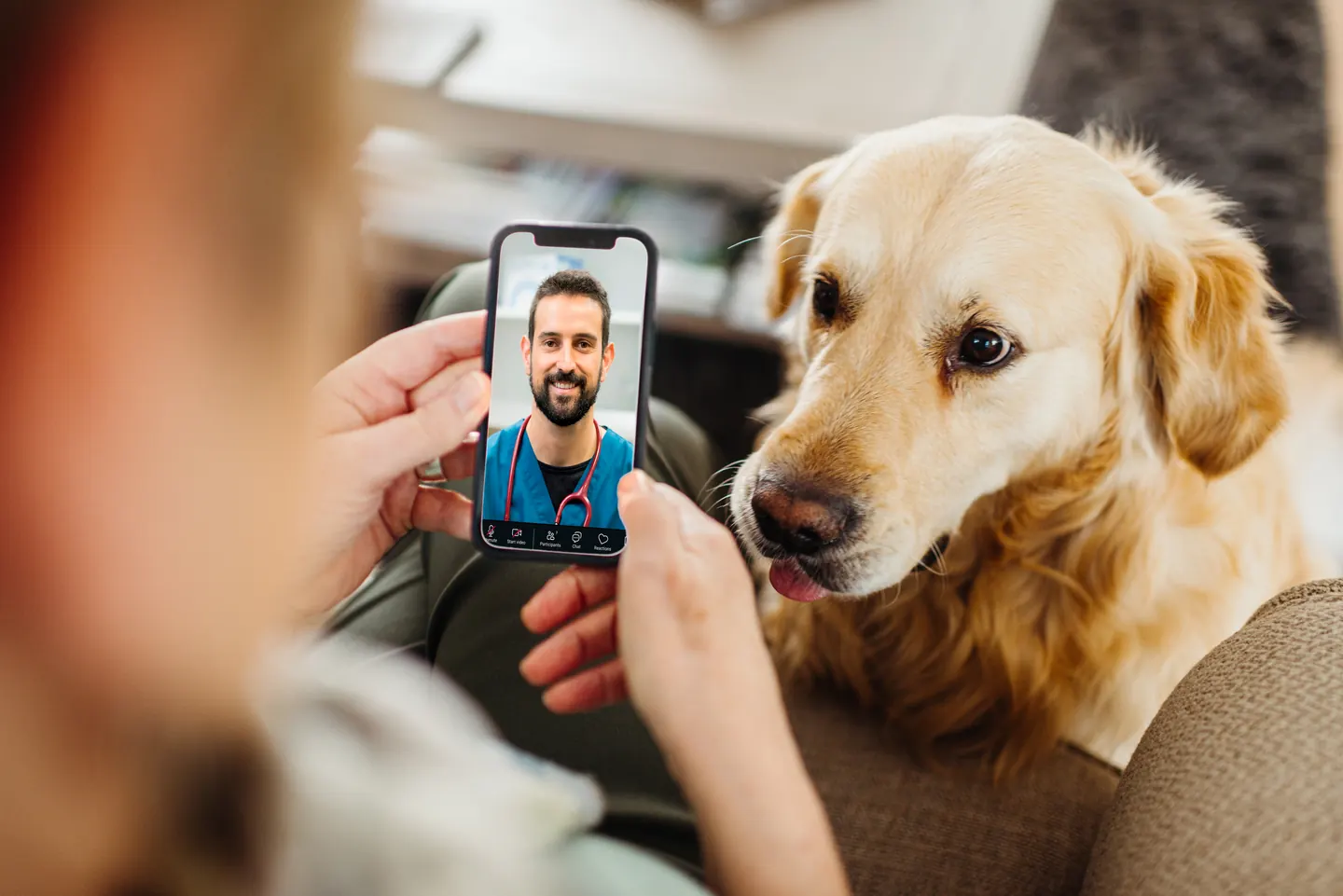
Want a vet's help with your dog's anxiety or behavior?
Talk to a licensed vet at Dutch over video, often the same day. They can recommend treatment and prescribe it when it's appropriate.
Use code Pets60
Plans start at $12/month · covers up to 5 pets
- Licensed vets in most states
- Rx for 150+ conditions
- 4.7 on Trustpilot
How to choose a dog leash: length, material, and handle
- 1When choosing leash length for everyday walks, a 6-foot fixed leash suits most dogs and most routes.
- 2Nylon versus leather versus rope versus biothane changes grip, care, and durability more than safety.
- 3A traffic handle near the clip gives you a short grip for crossings and crowds without switching leashes.
- 4Strong pullers, runners, and new puppies each need a different setup, and pullers and puppies do best on a harness rather than a collar.
Start with your walking style, then choose leash length, material, and handle in that order. A leash that suits a calm sidewalk stroller can be the wrong tool for a large puller or a dog that runs beside you, even when both leashes are well made.

On leash length, the sources agree on a band rather than a single number. VCA Animal Hospitals recommends a walking leash of 6 to 10 feet, wide enough that a pulling dog will not give you a friction burn but narrow enough to stay light for the dog.
The American Kennel Club describes the standard flat leash as usually 4 to 6 feet of tough nylon weave, and Consumer Reports quotes a trainer who suggests 4 to 6 feet for most urban and suburban settings. A 6-foot leash sits where all three ranges meet, which is why it is the everyday default.
Leash length by situation
The right length shifts with where you walk and what the dog is doing:
- Everyday walks: 6 feet, the overlap of VCA's 6-to-10-foot range and the 4-to-6-foot range from AKC and Consumer Reports.
- Running: 4 to 6 feet, which VCA says gives the dog enough freedom of movement and you enough control.
- A dog that pulls: PetSafe's sizing guidance says a 4-foot leash gives more control, while a 6-foot leash gives more length to explore.
- Toy breeds: AKC says a very short leash is hard to use with a toy breed.
- Exploring open, safe ground: a long line of 15 to 50 feet, which VCA recommends over a retractable leash.
Width, handle, and clip
The handle and hardware matter as much as the length. These are the points the AKC, VCA, and Consumer Reports raise:
- Width for the dog's size: Consumer Reports says a very big or very strong dog may need a 1-inch-wide flat leash or a rope leash at least half an inch thick. AKC says a narrow, lightweight leash is strong enough for a small dog.
- A padded handle for big or untrained dogs: AKC says big dogs and dogs not yet leash trained need a thicker, wider, heavier leash with a padded handle to prevent leash burn.
- A traffic handle: AKC says a standard leash with an extra handle closer to the dog is useful in traffic or in areas crowded with people and other dogs.
- A sturdy metal clip: whatever leash type you pick, AKC says it should have a sturdy metal clip for the collar or harness.
What the leash clips to matters too. Our guide on how to choose the right dog collar covers fit, and VCA's walking guidance favors a well-fitted harness for many dogs, especially pullers and puppies. Our roundup of the best dog harness options pairs with any leash here.
Why the handle and control matter more than the material
Leash-walking injuries are common, and pulling is the leading cause. A 2023 analysis in Medicine & Science in Sports & Exercise estimated 422,659 US emergency department visits by adults for injuries tied to leash-dependent dog walking from 2001 to 2020, with the yearly rate rising more than fourfold over that period.
A 2024 review in the Journal of the American Veterinary Medical Association found the most common cause of these injuries is a dog pulling, leading to tripping or tangling, with or without a fall. The data do not record the dog's size, training status, or the type of leash in use.
That gap is why no one can honestly say nylon is safer than leather or rope is safer than biothane. What the evidence does support is control: a length you can manage, a handle you can grip when the dog lunges, and a harness or training plan for a dog that pulls.
Leash type by walking style
Find the walking style closest to yours to see the leash length, material, handle, and pick that fit it.
| Walking style | Leash length | Material | Handle | Matching pick |
|---|---|---|---|---|
| City sidewalks and crowded streets | 6 feet | Nylon or leather | Traffic handle near the clip | Leash Boss Two Handle Dog Leash |
| Strong puller or large dog | 4 to 6 feet, 1 inch wide or half-inch rope | Wide nylon or thick rope, with a harness | Padded handle plus traffic handle | Leash Boss Two Handle or PetSafe Nylon, 6 ft by 1 in |
| Runner or hiker | 4 to 6 feet | Bungee section on a waist belt | Hands-free belt plus control handle | Tuff Mutt Hands-Free Bungee Leash (length not published) |
| Puppy in leash training | 6 feet | Narrow, lightweight nylon or biothane | Loop handle on the PetSafe; not described for the Mad Dog | PetSafe Nylon, 3/8 in, or Mad Dog Biothane |
| Rain, mud, and beach walks | 6 feet | Biothane | Handle not described; 360-degree swivel clip | Mad Dog Products Biothane Leash |
| Trails and low light | 5 feet | Reflective kernmantle rope | Webbing handle, locking carabiner | Ruffwear Knot-a-Leash |
| Owner who prefers a soft leather grip | 6 feet | Full-grain leather | Leather handle | Euro-Dog Leather Dog Leash |
| Two dogs at once | Coupler leads that adjust from 11 to 20 inches | Nylon webbing with reflective stitching | One neoprene-padded handle shared by two dogs | Leash Boss Duo Reflective Double Dog Leash Coupler with Handle |
Our picks: the best dog leashes
WebVet did not handle these leashes. Each pick rests on the maker's published specifications, the Chewy listing, independent testing where it exists, and the veterinary walking guidance cited throughout. Prices are the Chewy listings when we checked in October 2026, and Chewy showed all six in stock.
Each pick was weighed against the points the veterinary and consumer sources raise:
- A sturdy metal clip, which AKC says every leash should have.
- A width matched to the dog, from narrow and light for small dogs to 1 inch for very big or very strong dogs, per AKC and Consumer Reports.
- A handle that protects your hands, padded for big or untrained dogs, as AKC advises.
- A clear job, whether that is crowded sidewalks, wet weather, trails, running, or a tight budget.
| Pick | Length | Width | Material | Handle style | Chewy listed price (October 2026) |
|---|---|---|---|---|---|
| Leash Boss Two Handle Dog Leash, Orange | 6 feet | 1 inch | Nylon webbing with reflective stitching | Two neoprene-padded handles, traffic handle at 18 inches | $19.98 |
| Ruffwear Knot-a-Leash Reflective Dog Leash, Large | 5 feet rope length | 11 mm rope diameter | Reflective polypropylene kernmantle rope | Soft tubular webbing handle with accessory loop | $49.99 |
| Euro-Dog Leather Dog Leash, Black, 3/4 inch | 6 feet | 3/4 inch | Full-grain leather with forged steel hardware | Leather handle; no padding or second handle listed | $35.94 |
| Mad Dog Products Biothane Waterproof Training Dog Leash, Pink | 6 feet | 0.75 inch | Biothane | Not stated in the listing | $19.99 |
| Tuff Mutt Hands-Free Bungee Leash, Gray & Coral | Not stated in the listing | Not stated in the listing | Bungee leash; material not stated in the listing | Reflective waist belt with built-in control handles | $27.97 |
| PetSafe Nylon Dog Leash, Black, 6 feet by 1 inch | 6 feet (4 feet also sold) | 1 inch (3/8 and 3/4 inch also sold) | Nylon | Loop handle; no padding listed | $5.29 |
Leash Boss Two Handle Dog Leash: best everyday leash with a traffic handle
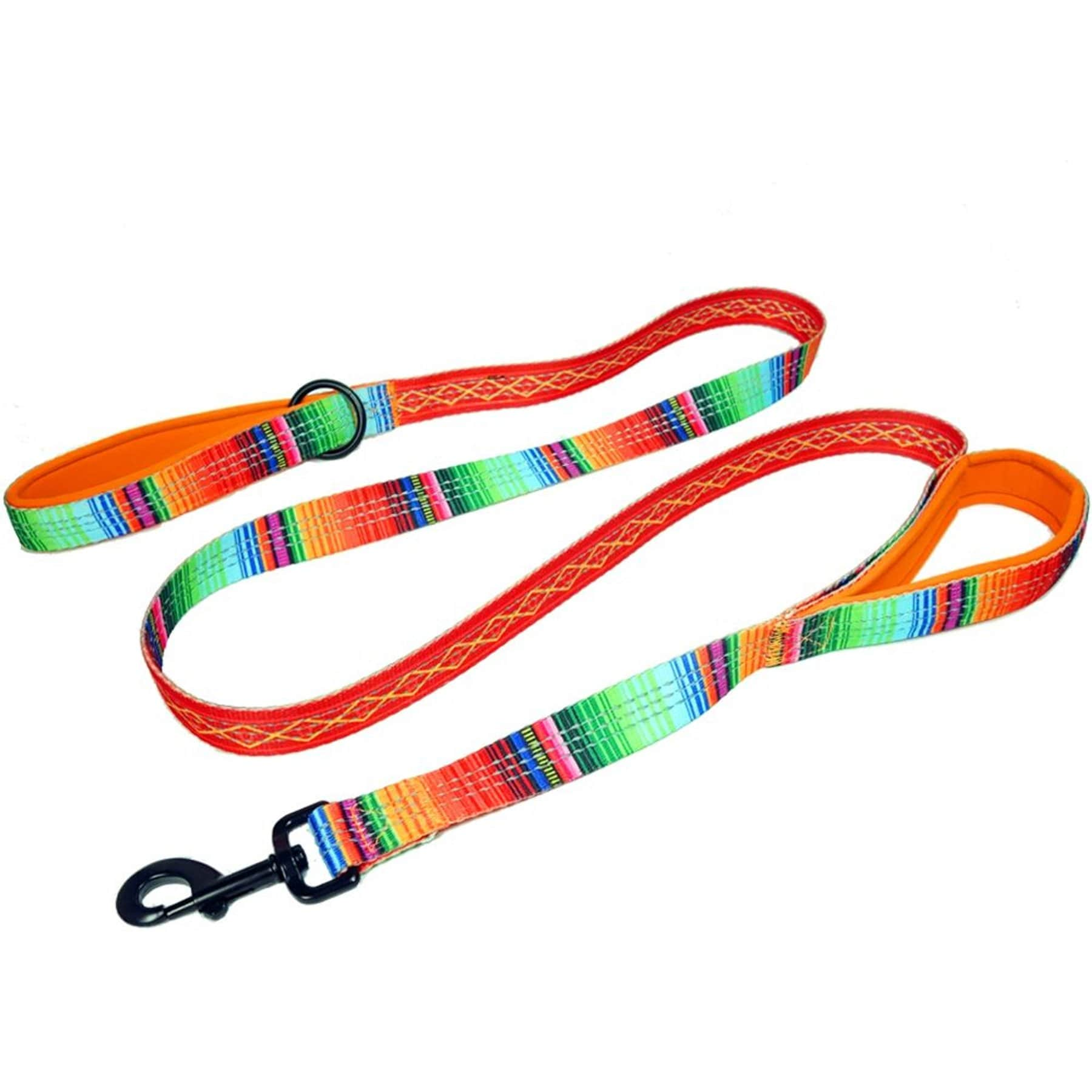
A 6-foot reflective nylon leash with two padded handles, including a traffic handle 18 inches from the clip.
Webvet may earn a commission when you click through to Chewy, at no extra cost to you.
The Leash Boss Two Handle Dog Leash is a 6-foot nylon leash with a second grip built in at 18 inches from the clip, the traffic handle AKC describes as useful in traffic and crowded areas. Chewy listed the orange version at $19.98 when we checked in October 2026.
- Build: Leash Boss's product page lists 1-inch nylon webbing with reflective stitching and piping and a 6-foot length.
- Handles: the Chewy listing describes two neoprene-padded handles.
- Visibility: three lines of reflective thread, per the listing.
- Extras: a D-ring for keys or a poop bag dispenser; matching collars are sold separately.
Who it suits: city and suburban walkers who want the full 6 feet on quiet stretches and a short grip at crossings and when passing other dogs. The 1-inch width matches the Consumer Reports suggestion for a very big or very strong dog, and the padding answers AKC's advice to protect your hands from leash burn.
The tradeoff: a 1-inch leash with two padded handles is more leash than a toy breed needs, since AKC says a narrow, lightweight leash is strong enough for a small dog. For a large dog that pulls, it still works best clipped to a harness rather than a flat collar.
Ruffwear Knot-a-Leash Reflective Dog Leash: best rope leash with a locking carabiner
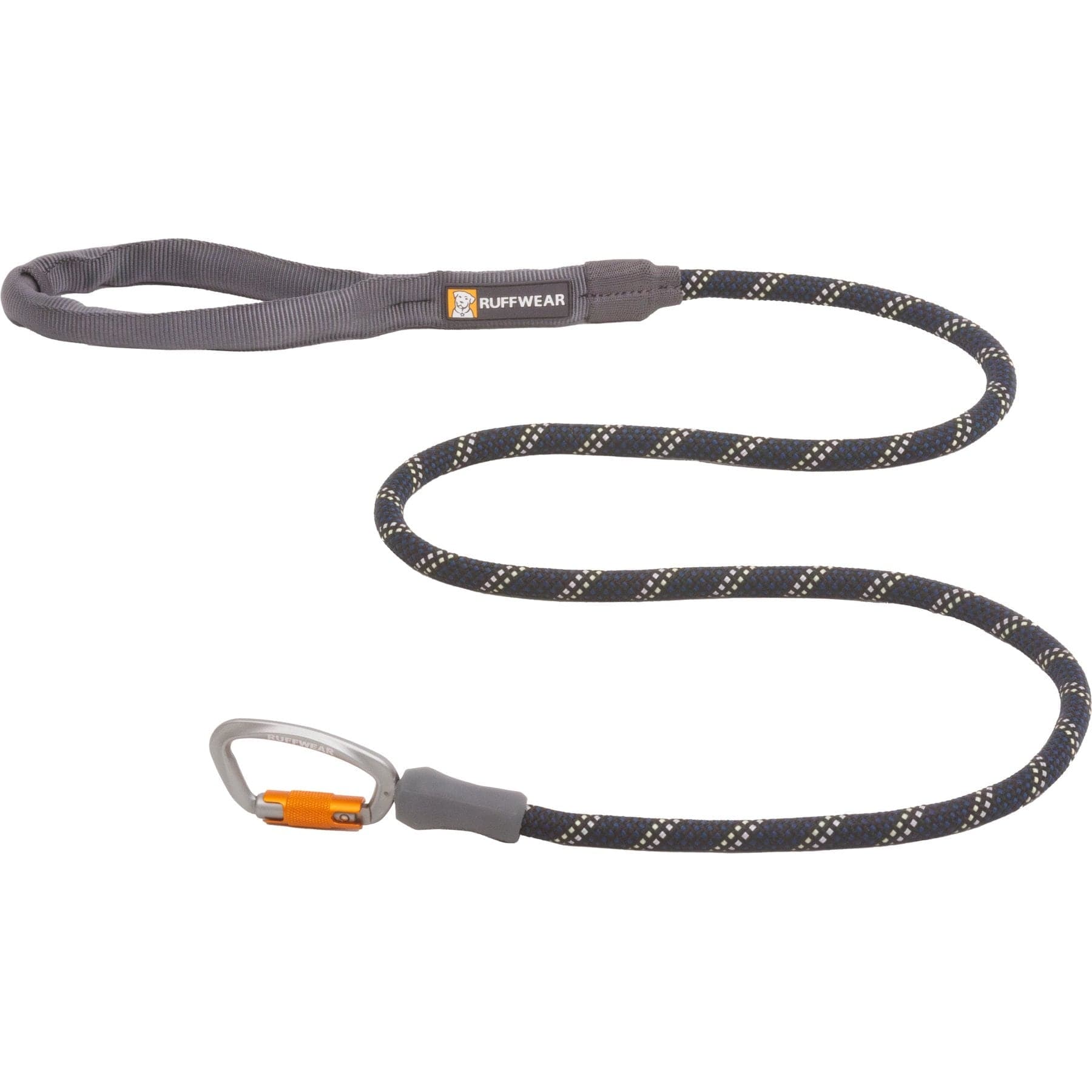
Reflective climbing-style rope with a tri-action auto-locking carabiner that swivels to limit twists and tangles.
Webvet may earn a commission when you click through to Chewy, at no extra cost to you.
The Ruffwear Knot-a-Leash is a climbing-inspired rope leash. The Chewy listing describes a strong, supple kernmantle rope with reflective threading, a soft tubular webbing handle with a loop for pick-up bags, and a tri-action auto-locking carabiner that swivels to prevent twists and tangles.
Ruffwear's product page adds the hard numbers:
- Rope length: 5 feet in both sizes.
- Rope diameter: 7 mm for Small and 11 mm for Large.
- Hardware: an anodized 6061-T6 aluminum carabiner with a silicone swivel cover, on reflective polypropylene kernmantle rope.
Chewy listed the Large in Obsidian Black at $49.99 when we checked in October 2026, the highest price of the six. Ruffwear's own page showed a $34.99 sale price against the same $49.99 original at the time, so it is worth comparing before you buy.
Who it suits: a trail hiker or a walker heading out at dusk who values a locking clip and reflective rope. The 11 mm Large rope works out to about 0.43 inch, just under the half-inch thickness Consumer Reports suggests for a very big or very strong dog.
The tradeoff: in TechGearLab testing, this leash's rope held up poorly in fraying tests while the carabiner held firm in all situations, and the testers rated it lightweight and reflective but short and flimsy. At 5 feet it is also shorter than the 6-foot default.
Euro-Dog Leather Dog Leash: best leather leash
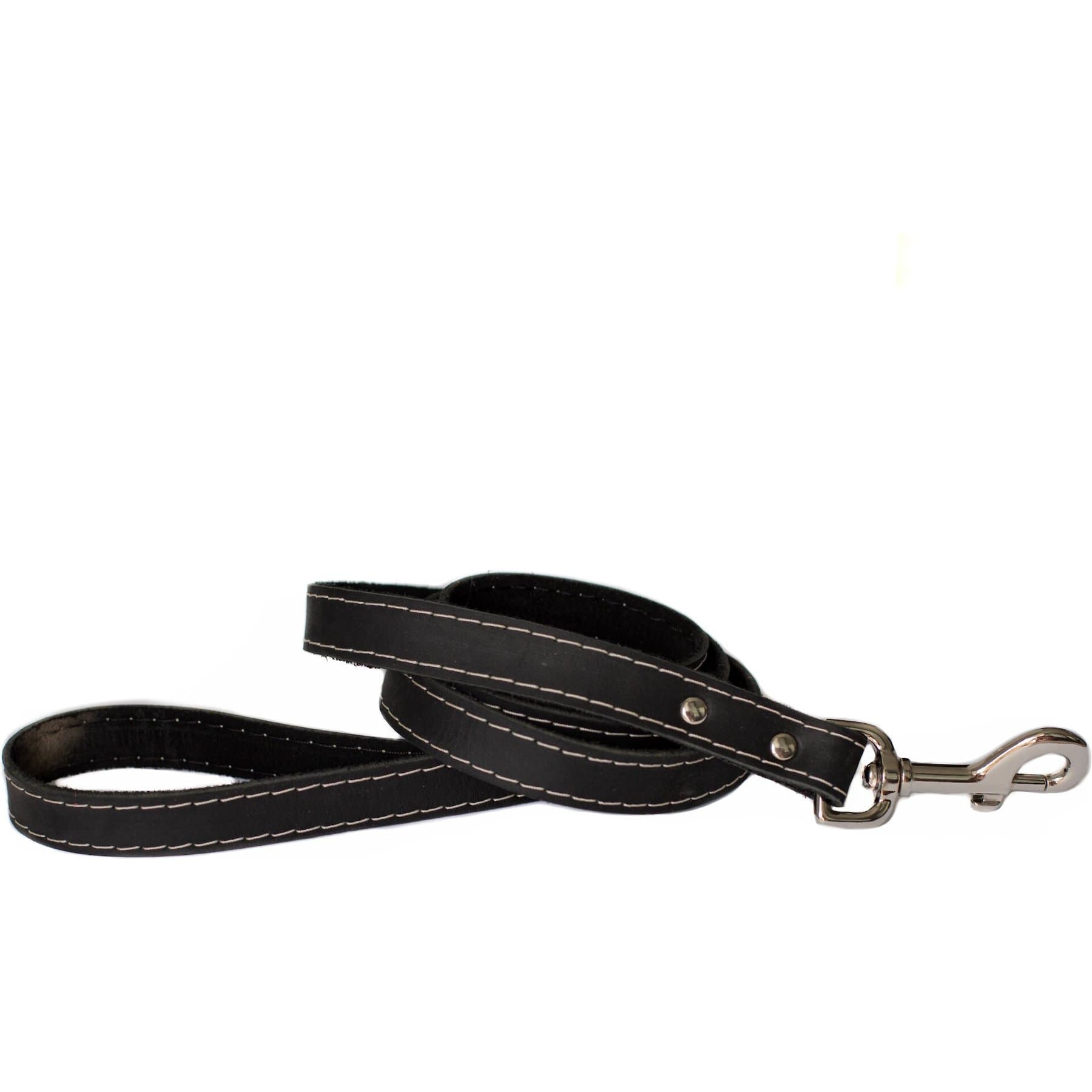
A 6-foot full-grain leather leash with forged European steel hardware, crafted in Colorado.
Webvet may earn a commission when you click through to Chewy, at no extra cost to you.
The Euro-Dog Leather Dog Leash is the pick for leather in the hand. The Chewy listing calls it a high-quality leash crafted in Colorado from genuine American full-grain leather, with polyester stitching and forged European steel hardware. Chewy listed the black 3/4-inch, 6-foot version at $35.94 when we checked in October 2026.
- Sizes: Euro-Dog's product page lists a Medium at 5/8 inch wide and a Large at 3/4 inch wide, both 6 feet long.
- Origin: made in the USA of American full-grain leather and European steel, per the maker.
- Feel: the listing describes the leather as soft and comfortable on the hands.
Who it suits: everyday walkers who like the feel of leather. AKC notes that some people find leather the most comfortable type of leash to handle, while others prefer padded nylon or neoprene grips, so this is a preference call rather than a safety upgrade.
The tradeoff is care. AKC says leather should not get a water bath; wipe dirt off with a damp, soft sponge instead, so biothane or nylon suits wet, muddy routines better. At 3/4 inch, it is also narrower than the 1-inch width Consumer Reports suggests for a very big or very strong dog.
Mad Dog Products Biothane Waterproof Training Dog Leash: best waterproof leash for wet walks and training
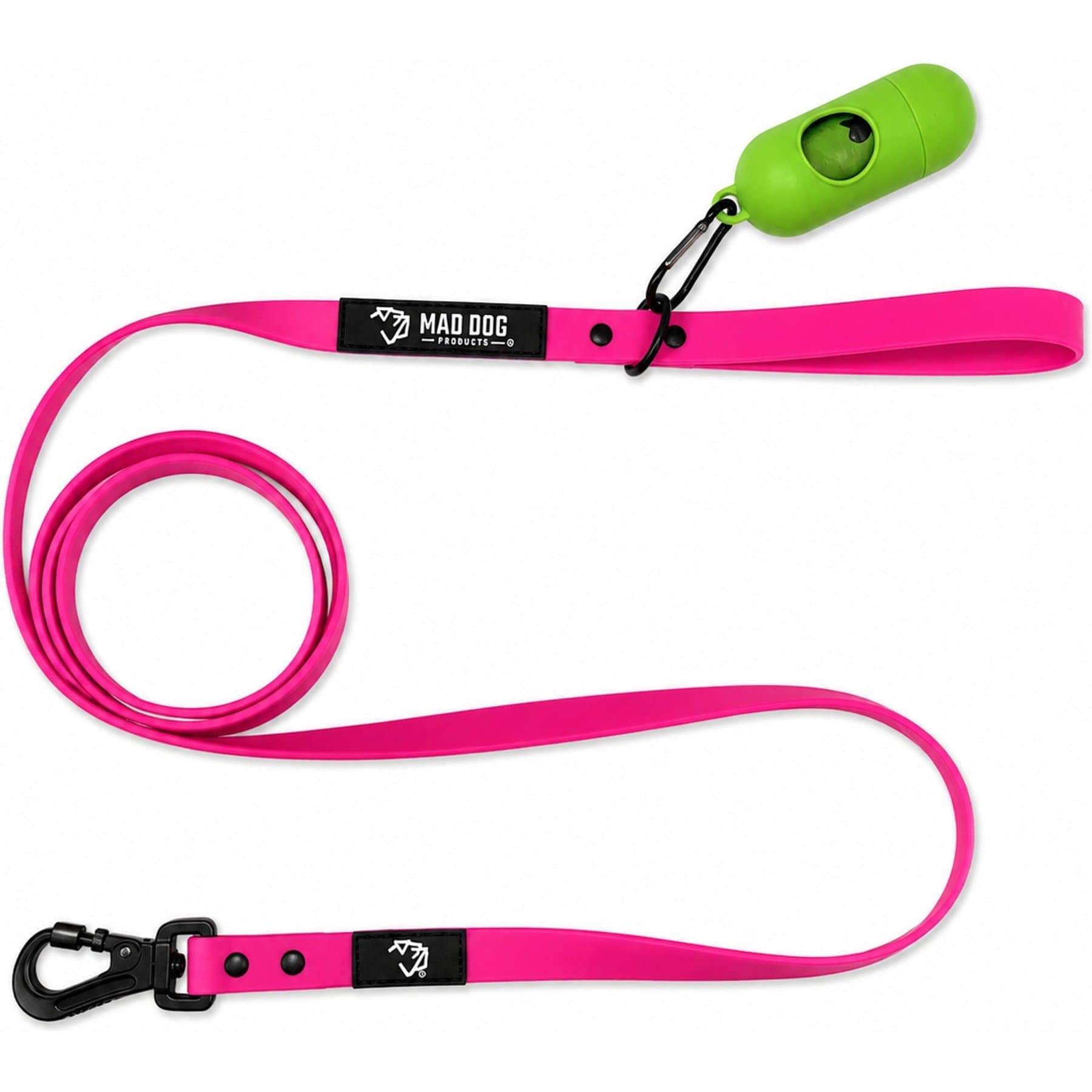
A 6-foot waterproof biothane leash that wipes clean, with a carabiner-style clip on a 360-degree swivel.
Webvet may earn a commission when you click through to Chewy, at no extra cost to you.
The Mad Dog Products Biothane Waterproof Training Dog Leash is 6 feet long and 0.75 inch wide. The Chewy listing says it is designed for everyday walks and training, stands up to rain, mud, and regular use, and cleans with a towel or wipe. Chewy listed the pink version at $19.99 when we checked in October 2026.
- Material: biothane, which Mad Dog Products describes as soft on the hands, extremely durable, and easy to clean.
- Clip: a carabiner-style clip with a 360-degree swivel that locks to the collar or harness.
- Origin: made in the USA and handcrafted, per the listing, which also says trainers and breeders favor it.
Who it suits: dogs that walk in rain, on beaches, or through muddy fields, and owners running training sessions who want a leash that does not soak up water. JJ Dog, another biothane leash maker, describes the material as impervious to water and ice, mildew resistant, and a durable leather alternative.
The tradeoff: the listing does not describe a padded handle or a second traffic handle, and at 0.75 inch it is narrower than the 1-inch width suggested for very strong dogs. For a very strong dog, the 1-inch options fit the Consumer Reports guidance better.
Tuff Mutt Hands-Free Bungee Leash: best hands-free leash for running
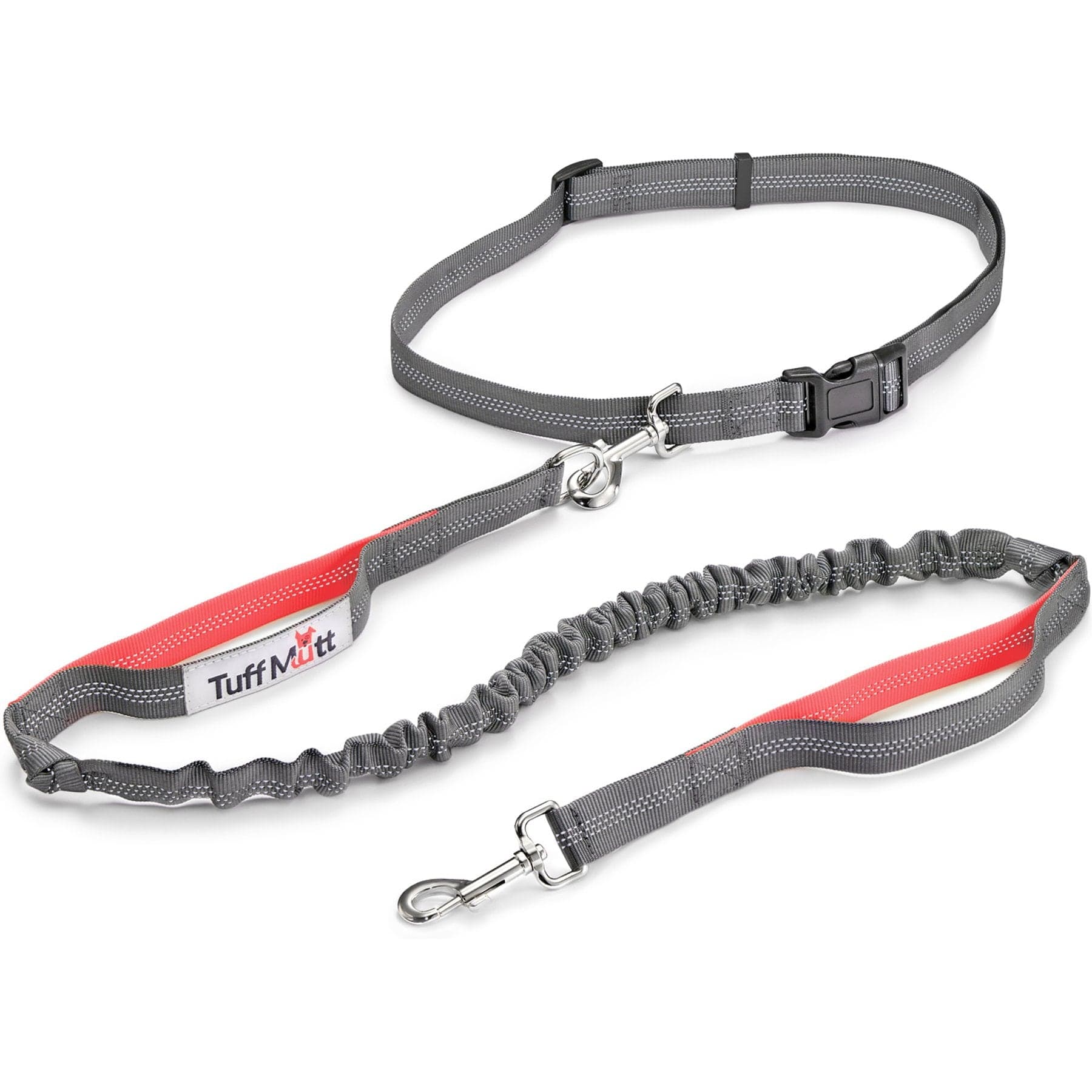
A bungee leash on a lightweight reflective waist belt, with built-in control handles for crowded stretches.
Webvet may earn a commission when you click through to Chewy, at no extra cost to you.
The Tuff Mutt Hands-Free Bungee Leash clips to a lightweight, reflective waist belt so both hands are free. The Chewy listing pitches it for running, hiking, or taking a call mid-walk. Chewy listed the Gray & Coral version at $27.97 when we checked in October 2026.
- Bungee: the listing says the spring of the bungee helps absorb some of the shock if the dog takes off after a squirrel.
- Control handles: built-in handles you can grab to keep the dog close in crowded situations.
- Belt: lightweight and reflective, per the listing.
Who it suits: runners and hikers whose dog already trots calmly at their side. VCA's running guidance asks for a dog that stays beside you and sits, stays, and comes on request, and a waist leash suits that dog far better than one still learning not to pull.
The tradeoff: the listing does not publish the leash length, the belt size range, how far the bungee stretches, or a dog-weight range. Stretchy bungees also cost some control: TechGearLab found a long, very stretchy bungee loses control when you need to correct the dog's direction quickly.
PetSafe Nylon Dog Leash: best budget basic leash
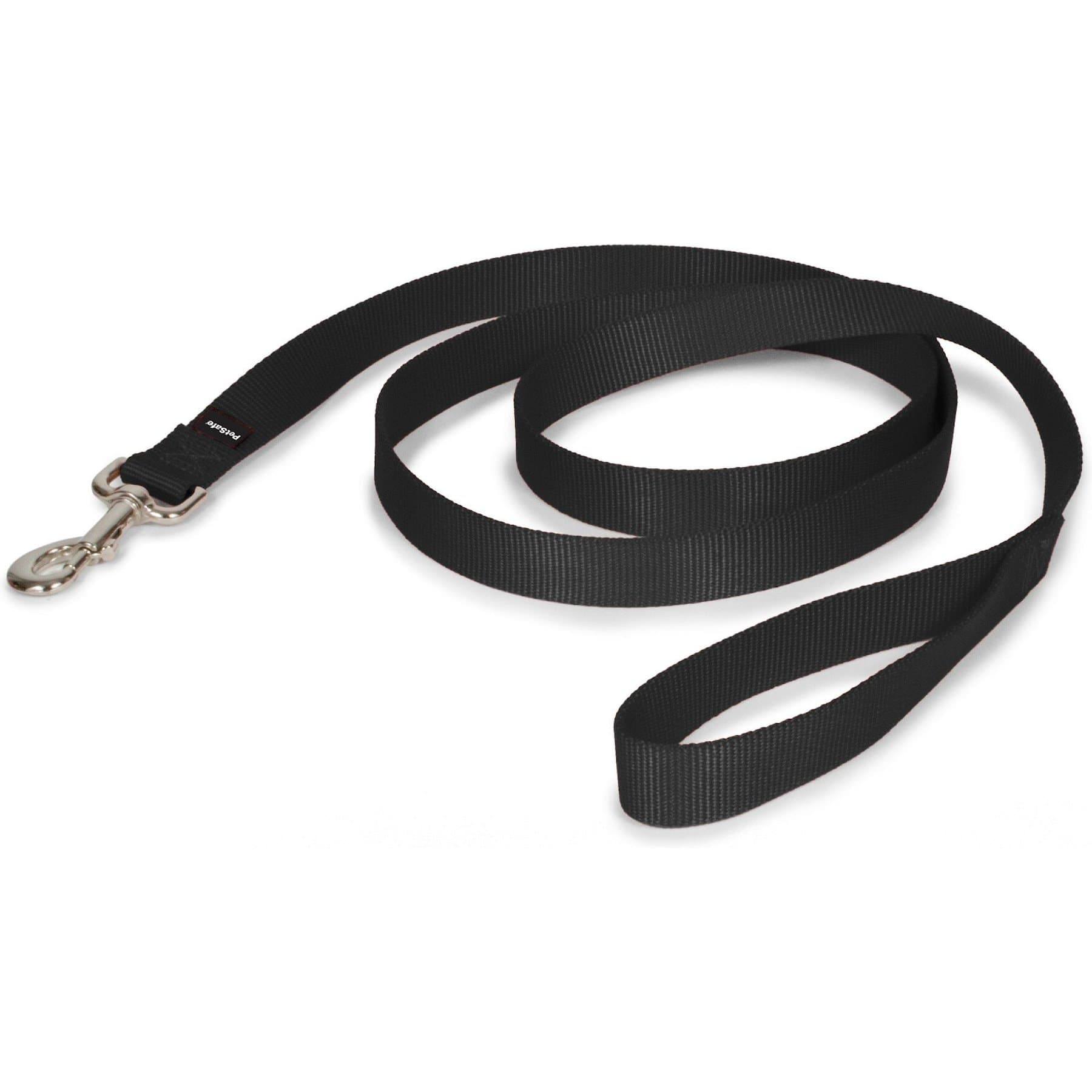
A basic nylon leash in 4- or 6-foot lengths and three widths, with a swiveling snap bolt clip.
Webvet may earn a commission when you click through to Chewy, at no extra cost to you.
The PetSafe Nylon Dog Leash is the inexpensive basic: soft, durable nylon with a loop handle at one end and a snap bolt clip that twists and turns. Chewy listed the black 6-foot, 1-inch version at $5.29 when we checked in October 2026, the lowest price of the six.
- Lengths and widths: 4 or 6 feet, in 3/8, 3/4, or 1 inch widths, per the listing.
- Clasp: PetSafe's product page says the clasp is nickel-plated zinc alloy.
- Sizing: PetSafe's chart pairs the 6-foot by 1-inch leash with large dogs over 75 pounds, says 6-foot leashes give more length to explore, and says 4-foot leashes give more control for pulling dogs.
- Colors: six on the maker's page.
Who it suits: anyone who wants a cheap spare for the car or the door hook, and owners of growing puppies who will size up more than once. The 3/8-inch width fits AKC's advice that a narrow, lightweight leash is strong enough for a small dog.
The tradeoff: a single unpadded loop handle, and neither the listing nor the maker's page mentions reflective trim. PetSafe's own page showed a lowest option price of $4.24 when we checked.
 Sponsored
Vet care that's always there
Unlimited video calls and messaging with licensed vets for less than a typical vet visit. One membership covers up to five pets.
Use code Pets60
Plans start at $12/month · covers up to 5 pets
- Licensed vets in most states
- Rx for 150+ conditions
- 4.7 on Trustpilot
Leash types: standard, slip lead, long line, double, and traffic leashes
Slip leads, long lines, double leashes, and traffic-handle leashes each solve a different problem. Here is how the AKC and VCA describe each type.
- Standard leash: a flat leash, usually 4 to 6 feet of tough nylon weave, which AKC calls inexpensive, strong, waterproof, and washable.
- Traffic leash: a standard leash with an extra handle near the dog, which AKC says helps in traffic and crowds. A leash with two handles, like the Leash Boss Two Handle Dog Leash, 6-ft long, Orange with its grip at 18 inches, gives you both lengths in one.
- Slip lead: a loop collar and leash in one piece that slips on and off easily. AKC says it should only be used with well-trained dogs that are unlikely to duck out of it.
- Long line: a fixed-length leash 15 to 50 feet long, which VCA recommends for vigorous exercise or exploring in a safe area.
- Double leash or coupler: one leash for the handler and a coupler with two separate sections that clip to two dogs, per AKC.
Slip leads and the neck
A slip lead has no stop, so it tightens as far as the dog pulls. VCA groups slip collars with choke, prong, and electronic collars as devices that rely on pain to stop pulling, causing pain around the neck when the leash is tight.
VCA also warns that some training collars do not limit how tightly they close, which risks strangulation if the dog becomes entangled.
Even well-designed collars carry load when a dog pulls. A 2020 study in Veterinary Record concluded that no single collar it tested produced a pressure low enough to mitigate the risk of injury when the dog pulls on the lead. Our guide to preventing dog collar accidents covers the entanglement side of the same risk.
A martingale is a limited-slip collar that tightens only so far. VCA's harness versus collar guidance calls it a valid option for walking but not the best leash-training tool, because it works by punishing pulling.

Head halters and the backup leash
A head halter, such as a Gentle Leader headcollar, guides the dog from the head. VCA says a head collar can add control for a strong dog with a smaller or infirm handler, but a second leash should connect to a harness or neck collar as a backup.
Long lines versus retractable leashes
A long line is the safer way to give a dog room. AKC notes that a nylon long line does not extend based on the dog's pull; you let it out and loop it back in, so you always set the length.
VCA's guidance on exercise is to use a fenced area or a 15-to-50-foot long line and to avoid retractable leashes.
A 15-foot line sits at the short end of that range. The Leash Boss Padded Handle Long Dog Leash, 15-ft, Black is one, listed at $22.95 on Chewy in October 2026. Per the listing:
- Handle: neoprene-padded.
- D-ring: a place to attach a poop bag.
- Uses: pitched for training, camping, and walking.
If you are still weighing a retractable for open spaces, our best retractable dog leash roundup lays out where it fits and where it does not.
Walking two or more dogs
A double leash, or coupler, lets one hand walk two dogs: AKC describes one handler leash with a coupler that splits into two sections for the dogs' collars. Because both dogs share one handle, a coupler suits a pair that already walks well together.
The Leash Boss Duo Reflective Double Dog Leash Coupler with Handle is built that way, and Chewy listed it at $44.99 in October 2026. Per the listing:
- Coupler leads: two leads that adjust from 11 to 20 inches, so you can walk two dogs of different sizes.
- Handle: an extra-thick neoprene-padded handle.
- Build: nylon webbing, heavy-duty metal clasps, and reflective stitching along the length.
Which dogs are best off leash?
VCA's off-leash guidance names no breed list. Not every dog is a candidate; those that are need a solid recall around tempting distractions such as food, moving toys, and moving people, practiced first in a secure area. Its test: if a squirrel ran across your dog's path and you could not stop the dog, keep the leash on.
VCA adds that it is never acceptable to walk a dog off leash near cars, roads, playgrounds, or construction areas, and that even the best trained dog can fail to come when called. Until your dog passes that test, a long line in a safe area gives it room, and our guide to off leash dog training walks through the steps.
Leash material: nylon vs leather vs rope vs biothane
No primary veterinary source ranks nylon versus leather versus rope versus biothane for your dog's safety, so the choice comes down to grip, weight, care, and how the leash handles wear. Here is what each material offers, based on AKC guidance, independent testing, and the makers.
Nylon
Nylon is the default for good reasons. AKC says standard nylon leashes are inexpensive, strong, waterproof, and washable, and some can go in a mesh laundry bag in the washing machine, but only if the manufacturer's tag says so.
Nylon comes in a range of widths, which makes it easy to match to the dog: the PetSafe Nylon Dog Leash, Black, 6-ft long, 1-in wide comes in widths from 3/8 to 1 inch.
Leather
Leather is about feel. AKC reports that some people find leather the most comfortable leash to handle, while others prefer padded nylon or neoprene grips. Leather should not get a water bath; AKC says to wipe it with a damp, soft sponge. The Euro-Dog Leather Dog Leash, Black, 6-ft long, 3/4-in wide uses full-grain leather and forged steel hardware.
Rope and braided leashes
Climbing-style rope leashes are not all alike in the hand. Consumer Reports found the finish of one polypropylene and polyester rope leash more than slightly rough to the touch, so grip comfort varies.
In TechGearLab's testing, one rock-climbing-rope leash frayed a decent amount in a friction test but otherwise held up well and did not collect much dirt, while the Ruffwear Knot-a-Leash Reflective Dog Leash, Obsidian Black, Large rope held up poorly for fraying.
Biothane
Biothane is sold as a durable leather alternative. JJ Dog describes it as impervious to water and ice, easy to clean, and mildew resistant, and Mad Dog Products describes its biothane as soft on the hands and easy to clean.
For a waterproof leash that wipes clean after a muddy walk, the Mad Dog Products Biothane Waterproof Training Dog Leash, 6-ft long, 0.75-in wide, Pink is the pick.
Bungee and reflective features
Two features cut across materials:
- Bungee or stretchy sections absorb some shock, but TechGearLab found a long, very stretchy bungee costs control when you need a quick correction.
- Reflective thread or piping helps on dark walks. The Leash Boss Two Handle Dog Leash, 6-ft long, Orange and the Tuff Mutt Hands-Free Bungee Leash, Gray & Coral list reflective elements, as does the Ruffwear rope.
Matching material to your routine
Pick the material by the walk you take most often:
- Wet grass, rain, beach, or mud: biothane, which wipes clean, or nylon, which AKC calls waterproof and washable.
- Daily walks where feel matters most: leather, wiped rather than washed.
- Trails and walks at dusk: reflective rope or reflective-stitched nylon with a secure clip.
- A strong puller: 1-inch nylon or rope at least half an inch thick, per Consumer Reports, with a padded handle.
- A tight budget or a spare by the door: basic nylon.

Leashes for large dogs and strong pullers
Leashes for large dogs that pull need two things: a leash your hands can hold through a lunge, and a harness that keeps the force off the neck. The leash alone does not stop pulling, and VCA explains why: many dogs naturally lean in and strain forward when they feel pressure on the collar.
A heavy-duty leash is defined by its build, not the label on the package. Look for two things:
- a wide, thick lead in nylon, leather, or biothane
- solid metal hardware at the clip and handle
Compare the listed width and material for each pick rather than the marketing phrase.
For a large dog, start with width and handle. Consumer Reports suggests a 1-inch flat leash or a rope at least half an inch thick for a very big or strong dog. AKC calls for a thicker, wider, heavier leash with a padded handle against leash burn, and a traffic handle shortens your grip at once.
On length, PetSafe's sizing guidance says a 4-foot leash gives more control for a pulling dog, while VCA's walking range starts at 6 feet. For a strong puller on busy streets, a 6-foot leash with a traffic handle gives you both. Save extra length for open, safe areas, where a long line does that job.
Collar or harness for a dog that pulls
VCA's collar and harness guidance is direct about collars, and its pulling guidance adds the harness detail:
- A collar is the wrong choice if the dog pulls very hard, pulls until it coughs or breathes noisily, or pulls hard enough to unbalance or overpower you.
- A flat collar can injure the neck: if the dog pulls hard against it, it may put too much pressure on delicate neck structures.
- A body harness puts minimal pressure on delicate tissue and is an excellent choice for dogs with tracheal disease or neck pain.
- A well-fitted H-style or Y-style harness can be a wonderful tool for many dogs, worn only while the dog is on a leash.
- Two clip points help: VCA describes one on the back between the shoulder blades and one in front, below the neck between the front legs.
The neck matters beyond the trachea. Texas A&M's veterinary college advises a harness for a dog that pulls, to ease stress off the neck, in its guidance on disc disease.
A harness does not train the dog, though. In a 2021 study of 52 shelter dogs in Frontiers in Veterinary Science, leash tension and pulling time were greater with a back-connection harness than with a neck collar when the dogs were drawn by food.
Our roundup of the best no pull dog harness options covers designs built for pullers.
Durable and chew-resistant leashes
Strength against pulling and resistance to chewing are separate questions. None of the six listings claims its leash is chew-proof or indestructible, so there is no pick here for a dog that chews its leash.
For a large dog, the Leash Boss Two Handle Dog Leash, 6-ft long, Orange combines the 1-inch width, padded handles, and traffic handle in one. On a budget, the PetSafe Nylon Dog Leash, Black, 6-ft long, 1-in wide is the size PetSafe pairs with dogs over 75 pounds.
Hands-free and running leashes

Hands-free leashes for running free both hands, but they only work with a dog that already runs at your side. AKC describes a hands-free leash as an adjustable loop worn around the handler's waist, with the other end clipped to the dog's collar or harness, and says it helps during running or hiking when you need both hands.
The Tuff Mutt Hands-Free Bungee Leash, Gray & Coral is that style, so the leash attaches at your hips rather than in your hand.
How to run with a dog on a leash
VCA's running guidance sets out the basics:
- Length: a 4-to-6-foot leash gives the dog enough freedom of movement and you enough control.
- Position: the dog stays by your side, nose even with your knees, with your arm straight down if you hold the leash.
- Control: you must be in complete control at all times, and the dog should sit, stay, and come on request.
- Age: dogs reach skeletal maturity between 7 and 20 months, with small breeds maturing faster than giant breeds, so wait for growth plates to close before strenuous running.
- Heat: dogs overheat more easily than people because they wear heavy fur coats and do not perspire.
The risks to plan around
AKC's guidance on running with your dog says a dog that pulls is frustrating when walking but downright dangerous at faster speeds, and a dog that runs in front or weaves side to side can trip you or tangle your legs in the leash. Teach the dog to hold position before you run attached.
No veterinary source compares waist-worn hands-free leashes with hand-held leashes for falls or injuries, and the JAVMA review notes the type of leash in use is not recorded in injury data. With no safety figure to lean on, VCA's control standard is the plan.
A stretchy bungee section adds give but costs precision. TechGearLab found a long, very stretchy bungee gives elasticity when running but loses control when quick corrections to the dog's direction are needed. The Tuff Mutt adds control handles you can grab to keep the dog close in crowded stretches.
Surfaces, gear, and two dogs
Check the ground before you run: VCA's test is a hand or bare foot on the path for 10 seconds, and if it is too hot for you, it is too hot for your dog. Our guide to hot pavement and dog paws covers burns, and our roundup of the best dog boots covers paw protection.
Bike towing is a different activity: none of these leashes is sold for biking or towing, and VCA's running guidance assumes a dog trotting at your side. Two dogs on one waist leash add to the weaving and tangling AKC warns can trip you, so keep that for dogs that already hold position well.
VCA also notes a waist or belt leash can help wean you and your dog off leash-based cues as part of off-leash training, which makes a hands-free leash useful beyond running.
Leashes for puppies, small dogs, and leash training
First leashes for puppies should be light, simple, and paired with a harness rather than a flat collar. VCA's puppy guidance says flat collars may not be best during training because pulling can injure the neck, and that harnesses are probably the best starting tool because a pulling puppy won't hurt its neck.
For a small dog or toy breed, AKC says a very short leash is hard to use, but a narrow, lightweight leash is strong enough. The PetSafe Nylon Dog Leash, Black, 6-ft long, 1-in wide listing also offers a 3/8-inch width for exactly that.
The Mad Dog Products Biothane Waterproof Training Dog Leash, 6-ft long, 0.75-in wide, Pink is sold as a training leash and wipes clean after wet grass.

How to leash train a puppy
VCA's leash training guidance starts indoors and keeps it positive:
- Attach the leash for short periods at home while you play together.
- Give treats when the leash comes out, so the puppy links it with good things.
- Move outside once the puppy is relaxed wearing it, keeping walks short.
- Teach the puppy to stop and sit at street corners so it does not pull you into the road.
The same order works for an adult dog: start somewhere calm, make the leash predict good things, and use a harness so pulling does not load the neck while the habit forms.
At what age should I leash my puppy?
VCA's puppy training schedule says you can introduce a puppy to leashes and harnesses at 10 to 12 weeks, though it is not yet time for long walks outside. Start with short indoor sessions with treats, then short outdoor outings. There is no single age for a first walk; timing follows the vaccine series and your veterinarian's advice.
Can I take my 9 week old puppy for a walk outside?
Yes, with precautions. VCA's socialization guidance says a very young puppy can safely go out in public if you avoid unvaccinated dogs and groups of unknown dogs, such as dog parks. At 9 weeks the vaccine series has only begun (it runs from 6 to 8 weeks to at least 16 weeks), so keep outings short.
Socialization and the vaccine series
Leash time and socialization overlap, and the veterinary sources balance them carefully:
- The window: VCA says puppies are ideal candidates for socialization between 3 and 16 weeks of age.
- Classes: the American Veterinary Society of Animal Behavior says puppies can start socialization classes as early as 7 to 8 weeks, with at least one set of vaccines at least 7 days before the first class and a first deworming.
- Before full vaccination: AVSAB says socialization before puppies are fully vaccinated should be the standard of care, and AAHA's life stage guidance says there is no medical reason to delay puppy classes or social exposure until the series is complete, as long as exposure to sick animals is prohibited, basic hygiene is practiced, and diets are high quality.
- Close contact: VCA's vaccine guidance says reasonable protection takes 10 to 14 days and advises waiting until the full course is done before close access to dogs of unknown vaccination history.
- The schedule: the 2022 AAHA canine vaccination guidelines start the primary series at 6 to 8 weeks, repeat it every 2 to 4 weeks until after 16 weeks, and prefer 18 to 20 weeks in high-risk areas.
Our puppy socialization checklist turns that window into planned outings. Keep runs and long hikes for later: VCA's puppy exercise guidance says growth plates are sensitive to strenuous exercise, and maturity comes at a little over 6 months for small dogs and closer to 1.5 years for giant breeds.
Dog leash questions
Frequently Asked Questions
What length leash is best for everyday walks?
A 6-foot leash is the practical middle. VCA recommends 6 to 10 feet for walking, while AKC and a trainer quoted by Consumer Reports put most urban walking at 4 to 6 feet. Six feet leaves room to sniff while you keep control at curbs, and a traffic handle shortens your grip when needed.
Is a leather or nylon leash better?
Neither has been shown to be safer for the dog, and no veterinary source ranks them. Nylon is inexpensive, strong, waterproof, and often washable, per AKC. Leather is the most comfortable leash to hold for some people but needs wiping with a damp sponge rather than washing. Choose nylon for wet, muddy routines and leather if you value the feel.
What leash is best for a dog that pulls?
A 1-inch leash with a padded grip and a traffic handle, clipped to a well-fitted harness rather than a collar. VCA says a collar is the wrong choice for a dog that pulls very hard, coughs, or unbalances you. A harness alone does not stop pulling, though, so pair the gear with loose-leash training.
Are hands-free leashes safe?
They can be, with the right dog. No veterinary source compares waist leashes with hand-held leashes for falls, so there is no safety figure. AKC warns that a pulling or weaving dog can trip you at speed, and a long bungee costs some control for quick corrections. Use one only with a dog that already stays at your side.
Are slip leads safe for dogs?
A slip lead is a quick tool for a well-trained dog that is unlikely to slip out, which is how AKC frames it. It is a poor choice for a dog that pulls: VCA says slip collars work through pain around the neck, and some tighten without limit, which risks strangulation if the dog gets tangled.

Editor
The Webvet Editorial Team is the in-house group of pet-care editors and writers behind Webvet, operated by Smart Pet Collective. The team researches, writes, and maintains Webvet's pet health, behavior, and medication content. Every article follows a defined editorial process: research from reputable veterinary and scientific sources, careful drafting, mandatory review of medical content by a credentialed veterinarian, and dated publication. Health and medication articles are medically reviewed by a licensed veterinary professional before they go live and are kept current over time.
Veterinarian · BVMS MRCVS
Dr. Pippa Elliott, BVMS, MRCVS, is a veterinarian with nearly 30 years of experience in companion animal practice. Dr. Elliott earned her Bachelor of Veterinary Medicine and Surgery from the University of Glasgow. She was also designated a Member of the Royal College of Veterinary Surgeons. Married with 2 grown-up kids, Dr. Elliott has a naughty Puggle named Poggle, 3 cats and a bearded dragon.
Related reading

Best Retractable Dog Leash: Safer Picks, Locking Brakes, and When Not to Use One

Best Dog Harness for Small Dogs: Lightweight, Secure Picks That Protect the Trachea

How to Put On a Dog Harness: Step-by-Step for Every Harness Type, With a Fit Check
