Best Dog Harness for Small Dogs: Lightweight, Secure Picks That Protect the Trachea
Vet-reviewed guide to the best dog harness for small dogs: step-in versus vest styles, a snug fit that stops backing out, and why a harness keeps pressure off the trachea. Picks for tiny dogs, small pullers, and puppies.

BVMS MRCVS

This article contains affiliate links. Webvet may earn a commission when you buy through them, at no extra cost to you.
The best dog harness for small dogs does three jobs at once. It is light on a tiny frame, it keeps leash pressure off the neck, and it fits the chest snugly enough that the dog cannot back out of it. The right size comes from a tape measure around the chest, not from the dog's weight or breed.
That fit matters most for toy breeds. A dog harness for small dogs that runs a size too big is easy to reverse out of, and one that presses on the neck undoes the reason most owners leave the collar behind. So we start from the dog: toy breed, escape artist, small puller, flat-faced breed, or growing puppy.
Our six picks rest on the published Chewy listings, the makers' own descriptions, and veterinary guidance from VCA Animal Hospitals, the Merck Veterinary Manual, the Animal Medical Center, and a veterinarian quoted by the American Kennel Club. WebVet did not obtain or test these harnesses. For a mid-sized or large dog, our best dog harness roundup covers the bigger sizes.
| Harness | Best for | Style and fastening | Size on the Chewy listing | Main tradeoff |
|---|---|---|---|---|
| Gooby Escape Free Easy Fit Dog Harness, Black, X-Small: 15 to 17.25-in chest | Small dogs that back out of harnesses | Step-in; paws through the arm holes, pull up to fasten | X-Small, 15 to 17.25 in chest | X-Small starts at a 15 in chest, too big for the tiniest toy breeds |
| Curli Air-Mesh Small Dog Harness, Black, X-Small | Toy breeds and warm days | Air-mesh step-in vest; Velcro plus a back buckle | X-Small; Curli's chart starts at 3XS (26.7 to 30.1 cm chest) | Mesh is less durable and less padded |
| Hip Doggie EZ Step-In Dog Harness Vest, X-Small | Growing puppies and evening walks | Mesh step-in vest; quick release buckle, adjustable chest strap | X-Small; retailer charts disagree on its chest range | Measure carefully against the size chart |
| Puppia Vivien Step-In No-Pull Dog Harness, Orange, Small | Owners who want a dressy harness | Step-in; hook-and-loop back closure plus quick-release buckle | Small; no chest range in the listing | Listing does not explain how the no-pull feature works |
| Red Dingo No Pull Dog Harness, Blue, X-Small | Small pullers on a budget | Adjustable webbing straps; single side buckle | X-Small; no chest range in the listing | Listing does not say where the leash clips |
| EzyDog Quick Fit Dog Harness, Black, Small | Dogs that wriggle while you fasten | Straps set once, then one-click buckle | Small; no chest range in the listing | Highest listed price of the six |
 Sponsored
Want a vet's help with your dog's anxiety or behavior?
Talk to a licensed vet at Dutch over video, often the same day. They can recommend treatment and prescribe it when it's appropriate.
Use code Pets60
Plans start at $12/month · covers up to 5 pets
- Licensed vets in most states
- Rx for 150+ conditions
- 4.7 on Trustpilot
What makes a harness right for a small dog: weight, trachea, and escape risk
A small dog does best in a light harness that keeps pressure off the neck, fits the chest snugly enough that it cannot back out, and is sized from a chest measurement. A harness for a 2 kg Yorkshire terrier is not a shrunken Labrador harness, and each of those three points changes what you should buy.

Here is what the veterinary sources say about each, plus the one point no veterinary body has settled:
- Neck pressure. A harness applies less pressure to the neck than a collar, according to the American Kennel Club. Veterinarian Dr. Amy Attas explains there that a harness secures the dog at several contact points, spreading pressure around the chest and shoulders.
- The trachea. The Merck Veterinary Manual says tracheal collapse is most common in toy and miniature breeds. VCA Animal Hospitals names Chihuahuas, Pomeranians, Shih Tzus, Lhasa Apsos, toy poodles, and Yorkshire terriers among the breeds it often affects.
- Escape risk. VCA warns that a loose collar lets a dog escape easily, and Dr. Attas tells AKC readers to choose a harness that fits so there is no chance of the dog wiggling out.
- The weight of the harness itself. Curli's size chart lists its air-mesh harness at 33 g in 3XS, 37 g in 2XS, and 42 g in XS. Curli is the only maker among our picks that publishes a harness weight.
We found no published veterinary limit on how heavy a toy dog's harness should be, so treat those figures as a comparison, not a rule. For scale, 33 g works out to a little over 2 percent of a 1.5 kg dog, the bottom of Curli's 3XS weight guide, and 42 g to about 1.4 percent of a 3 kg dog.
Gooby and EzyDog call their harnesses lightweight without giving a number, and the Hip Doggie, Puppia, and Red Dingo listings do not mention weight. That is why material and the amount of strapping are worth a look: AKC notes that mesh harnesses tend to be breathable and lightweight, while padded materials such as neoprene are not breathable and may trap heat and moisture.
- 1A small dog does best in a light harness that keeps pressure off the neck and fits the chest snugly enough that it cannot back out.
- 2On trachea pressure from collars versus harnesses, VCA and the Animal Medical Center both advise a harness rather than a collar for a dog with a fragile windpipe.
- 3Among step-in versus vest versus overhead styles, a snug step-in harness is the veterinarian-backed choice for escape artists and head-shy dogs.
- 4For a small dog that pulls, a front clip reduces the pull, but training does the real work.
- 5Measure the widest part of the rib cage, buy by chest size, and recheck the fit after grooming or a weight change.
Match the harness to the dog you have. Each small dog profile points to a different starting style, and the smallest size a harness comes in decides whether it fits a toy breed at all.
| Small dog profile | Harness style to start with | Why | Smallest size listed for the matching pick | Matching pick |
|---|---|---|---|---|
| Toy breed with a tiny chest | Lightweight mesh step-in vest | Toy and miniature breeds are most prone to tracheal collapse (Merck); mesh is light | 3XS: 26.7 to 30.1 cm chest (about 10.5 to 11.9 in), 33 g | Curli Air-Mesh Small Dog Harness |
| Escape artist that backs out | Snug step-in harness | A step-in is harder to get out of when it fits properly (Dr. Attas, AKC) | X-Small: 15 to 17.25 in chest | Gooby Escape Free Easy Fit Dog Harness |
| Small puller | Front clip or no-pull harness | A front clip reduces the dog's ability to pull you forward (VCA) | X-Small; the listing gives no chest range | Red Dingo No Pull Dog Harness |
| Flat-faced (brachycephalic) small breed | Back-clip harness | VCA suggests back-clip harnesses for flat-faced puppies; harness exercise did not raise eye pressure the way a collar did (Bailey 2025) | 3XS: 26.7 to 30.1 cm chest | Curli Air-Mesh Small Dog Harness (closes at the back) |
| Growing puppy | Adjustable step-in vest, resized as it grows | Harnesses suit puppies if you adjust or size up as they grow (Dr. Attas, AKC) | XXS on Hip Doggie's PetSmart listing | Hip Doggie EZ Step-In Dog Harness Vest |
| Dog that wriggles while you fasten | One-click buckle harness | Straps are set once, then the harness buckles on in one click (EzyDog listing) | Small; the listing gives no chest range | EzyDog Quick Fit Dog Harness |
The smallest size is the first filter for a toy breed. Curli's chart starts at a 26.7 cm chest, about 10.5 inches, while the Gooby X-Small starts at 15 inches. A dog with an 11-inch chest fits the first and would swim in the second, however good its other features are.
Flat-faced breeds need a word of their own. VCA suggests back-clip harnesses for flat-faced puppies such as bulldogs and for dogs with sensitive backs such as dachshunds. A 2025 study in Veterinary Medicine and Science of 20 healthy dogs, 10 of them flat-faced, found that exercising in a harness did not raise eye pressure the way a collar did.
Puppies change the rule only slightly. Dr. Attas tells AKC that harnesses are a good option for puppies as long as you adjust the size or buy a bigger harness as the puppy grows. VCA calls a harness probably the best starting tool for leash training, because a puppy will not accidentally injure its neck when it pulls.
What is a cute harness for a small dog?
A cute harness for a small dog still has to fit like a working harness. The Puppia Vivien is the dressiest here, with frills, ribbons, and buttons, and Hip Doggie calls its vest stylish. Choose on chest size and neck pressure first, then looks: a designer or fancy harness that gaps at the chest is easy to back out of.
Our picks: the best dog harnesses for small dogs
We chose these six by reading each Chewy listing and maker description against the veterinary guidance on fit, neck pressure, and escape. We did not rank by star ratings or customer reviews. A harness made the list when its published details met most of these tests:
- A chest-based size chart, with a smallest size that suits a toy breed or a clearly stated chest range
- Contact on the chest and shoulders, so the leash pulls on the body rather than the neck
- A fastening that holds a snug fit: step-in loops, a buckle, or hook-and-loop adjustment
- A light build, stated in the listing or backed by a published weight
None of the six listings describes a lift handle or a leash in the box, so a small dog harness with a handle, or a harness and leash set, means checking the listing for a handle and buying the lead separately. None is leather: the listings describe polyester mesh (Curli, Hip Doggie) and abrasion-resistant webbing (Red Dingo).
If you want a collar and harness set mainly to carry an ID tag, EzyDog says its harness can replace the collar and includes an ID tag holder, and Curli's listing includes a DogFinder ID. For a household with small to medium dogs, Gooby says its largest size fits dogs up to 35 lbs.
Gooby Escape Free Easy Fit Dog Harness: best step-in harness for small dogs that back out
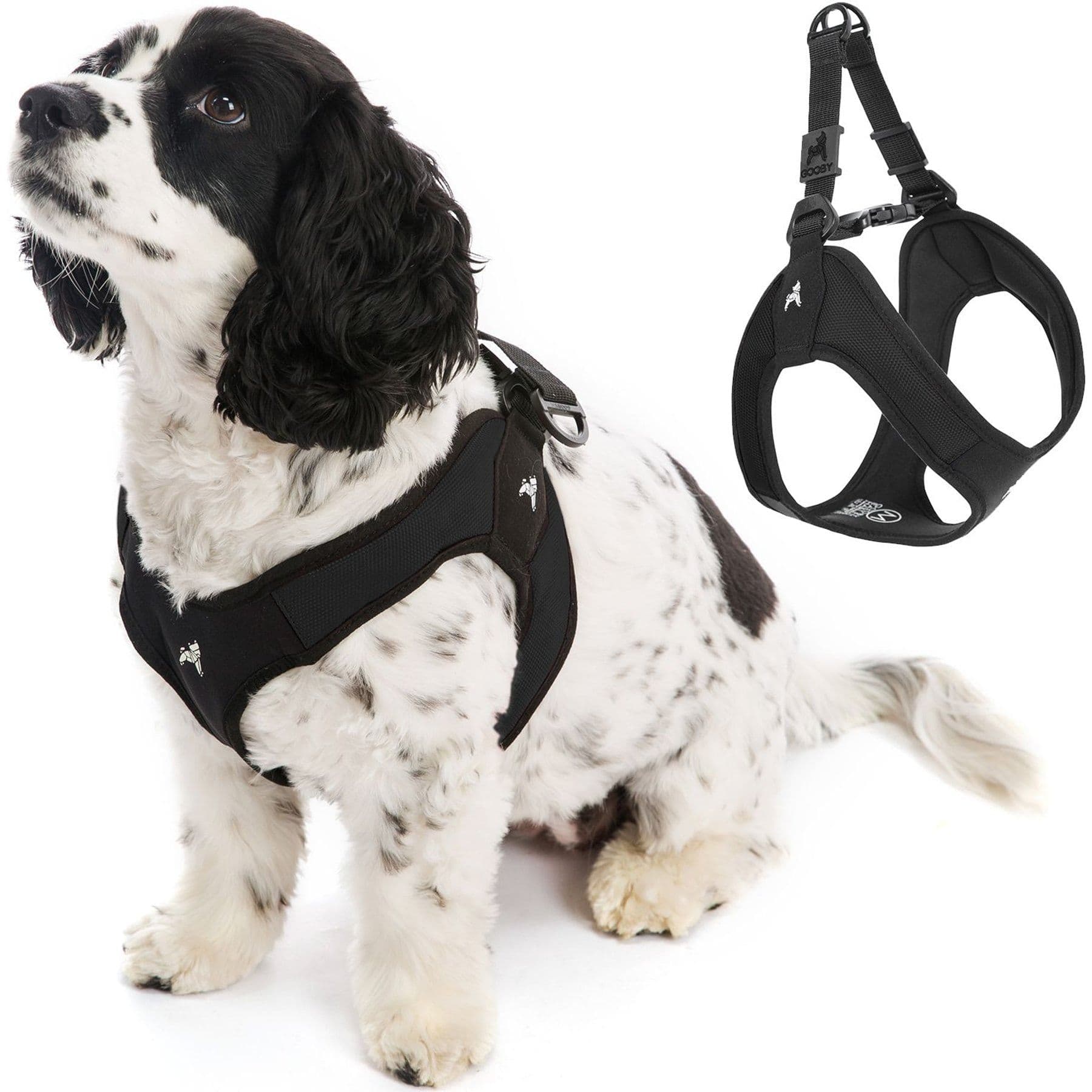
A step-in harness for small breeds, built to reduce space around the back so a snug fit is harder to slip.
Webvet may earn a commission when you click through to Chewy, at no extra cost to you.
The Gooby Escape Free Easy Fit is a step-in harness made for small breeds, listed at $32.99 on Chewy when we checked in October 2026 in X-Small, which fits a 15 to 17.25 inch chest. Its selling point is security: Gooby says the design reduces the space around the back, making it harder for a dog to escape on walks.
What the Chewy listing describes:
- Step-in fitting: place the dog's paws in the arm holes and pull up to fasten
- A no-pull design that reduces the space around the back
- A lightweight build with a POM plastic leash ring
- Machine washable fabric
- A size run whose largest size fits dogs up to 35 lbs
It suits the small dog that reverses out of everything. Dr. Attas tells AKC that step-in harnesses suit escape artists because they are harder to get out of when they fit properly, and Gooby's own listing tells owners to check for a snug fit to help prevent escaping. The security depends on the fit, not the name.
The tradeoff is size. The X-Small starts at a 15-inch chest, so a toy breed measuring 12 or 13 inches is below it; check Gooby's size chart for a smaller size before ordering. The leash ring is plastic, where EzyDog's is stainless steel.
Curli Air-Mesh Small Dog Harness: best lightweight mesh harness for toy breeds
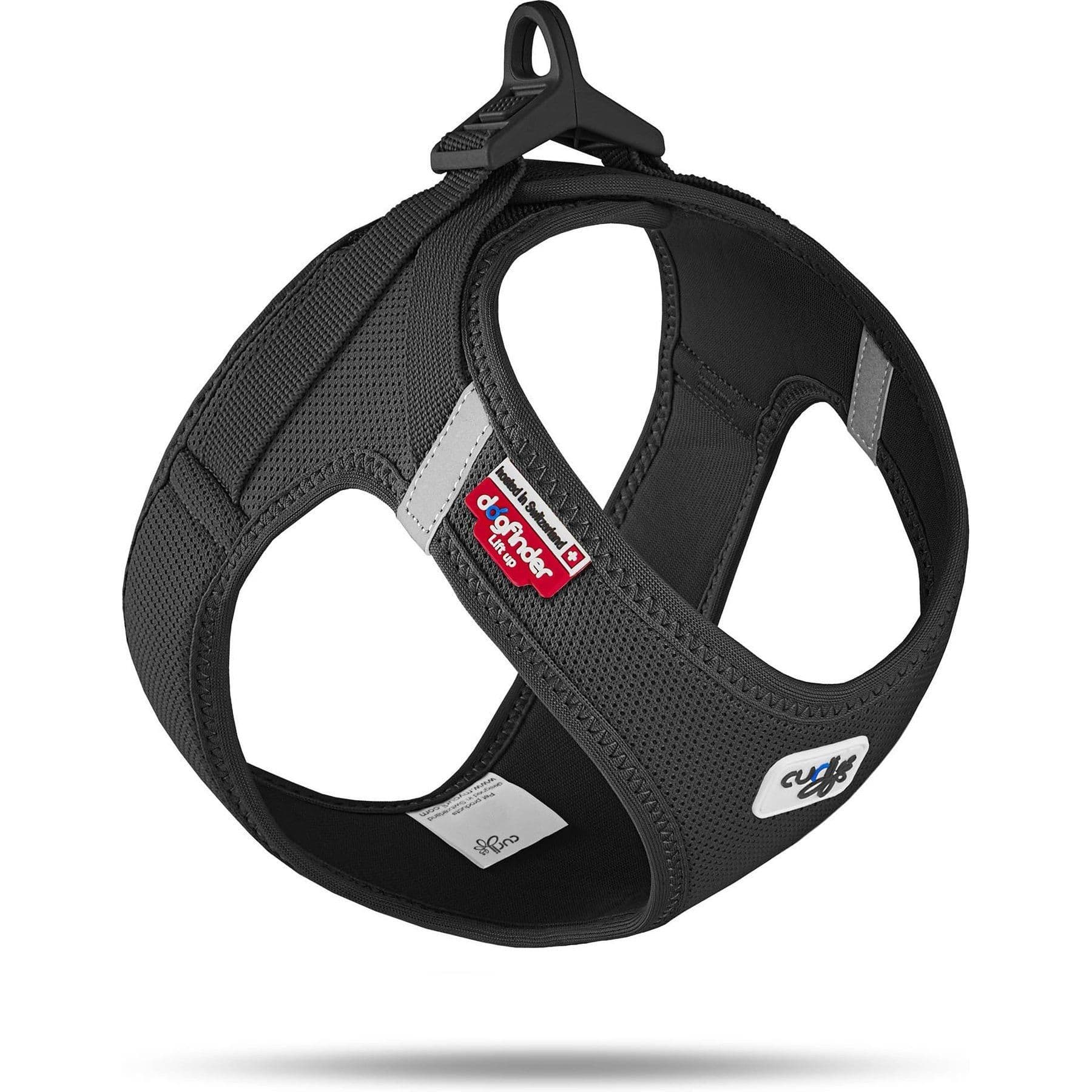
An air-mesh step-in vest with Velcro adjustment; Curli lists its XS at 42 g and sizes down to a 3XS chest.
Webvet may earn a commission when you click through to Chewy, at no extra cost to you.
The Curli Air-Mesh is a step-in vest in polyester air mesh, listed at $25.07 on Chewy when we checked in October 2026 in X-Small. It is the only pick whose maker publishes the harness weight: Curli's chart gives 33 g for 3XS, 37 g for 2XS, and 42 g for XS.
What the listings describe:
- Front-leg entry with the closure and buckle at the back, which Curli says makes it quick to put on
- A Velcro fastener that adjusts to different body shapes
- Single-hand attachment for the leash and the harness
- An ergonomic cut with tension spread evenly
- Air mesh you can soak in cold water for a cooling effect
- A DogFinder ID for added safety
The size range is why it leads for toy breeds. Curli's chart runs 3XS for a 26.7 to 30.1 cm chest (1.5 to 3 kg), 2XS for 30.2 to 33.8 cm (2 to 4 kg), and XS for 33.9 to 38.2 cm (3 to 5 kg). In inches, the 3XS starts at about 10.5, the smallest published chest range we could confirm among our picks.
Mesh has a cost. AKC notes that mesh harnesses are less durable and less padded than other materials, which can mean chafing or rubbing, so check the armpits after the first few walks. On hot days the cold-water soak helps, and our guide to hot pavement and dog paws covers what is under those small feet.
Hip Doggie EZ Step-In Dog Harness Vest: best step-in vest harness
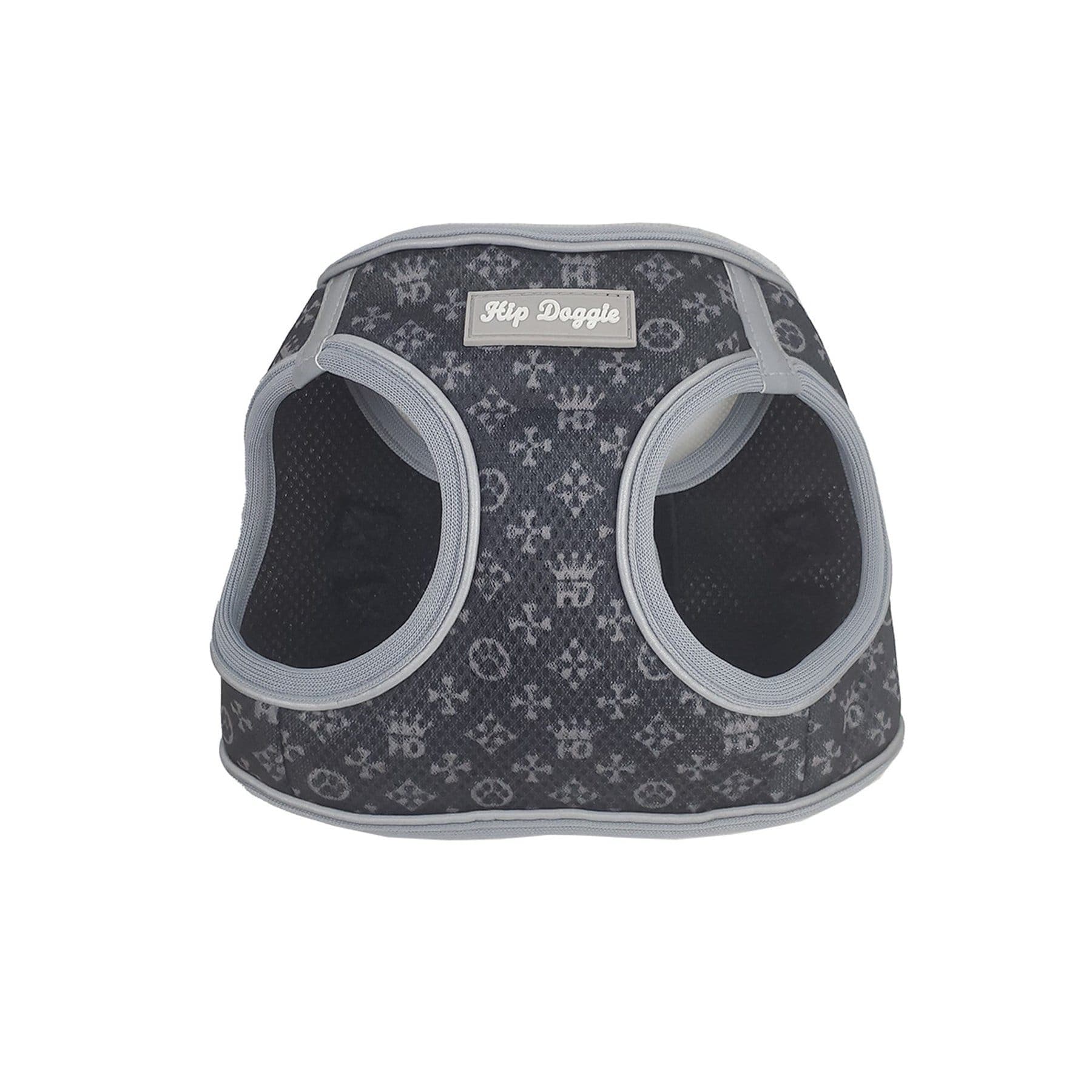
Soft mesh step-in vest with a quick release buckle, an adjustable chest strap, and reflective piping for evening walks.
Webvet may earn a commission when you click through to Chewy, at no extra cost to you.
The Hip Doggie EZ Step-In Dog Harness Vest is a soft polyester mesh vest, listed at $23.50 on Chewy when we checked in October 2026 in X-Small. The Chewy listing pairs the step-in design with a quick release buckle and an adjustable chest strap, plus reflective piping for walks after dark.
What the listings describe:
- Soft, breathable polyester mesh
- An easy step-in design
- A quick release buckle and an adjustable chest strap
- Reflective piping for nighttime visibility
- A size run from XXS to XL on Hip Doggie's PetSmart listing
The adjustable chest strap and a size run that starts at XXS make it a sensible vest for a growing puppy you plan to resize. That matches Dr. Attas's advice to adjust the size or buy a bigger harness as a puppy grows.
Two cautions. Hip Doggie's mesh vest listing at PetSmart calls it a no-choke design, a maker's term with no veterinary definition; fit still decides whether anything presses on the neck. Retailer listings also disagree on the X-Small chest range, so measure and use the size chart on the Chewy listing.
Puppia Vivien Step-In No-Pull Dog Harness: best dressy step-in harness for small pullers
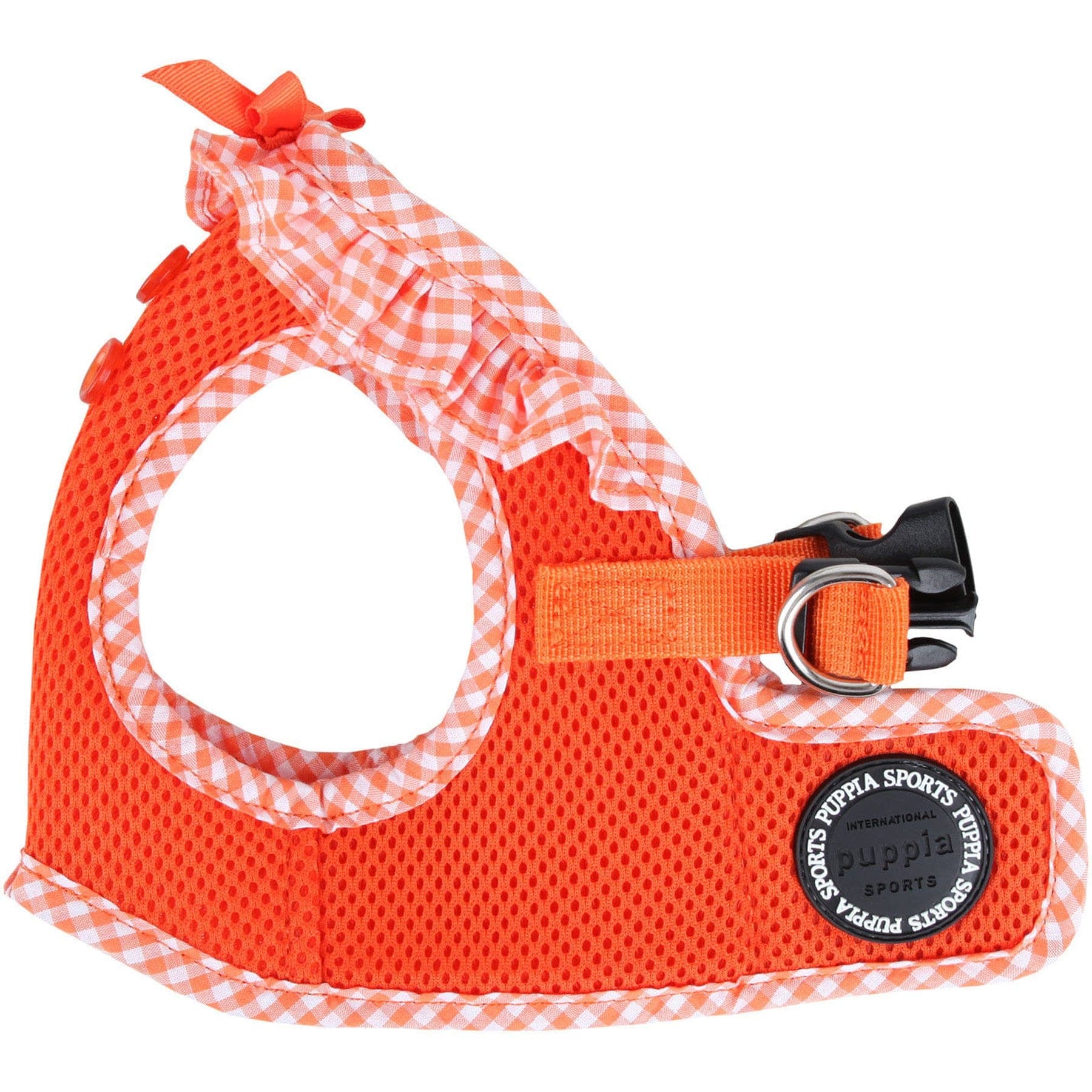
A frilled step-in harness with a hook-and-loop back closure and a quick-release buckle for warm-weather walks.
Webvet may earn a commission when you click through to Chewy, at no extra cost to you.
The Puppia Vivien Step-In No-Pull is the dressiest pick, listed at $20.73 on Chewy when we checked in October 2026 in Small. Puppia sells it as a warm-weather harness with frills, ribbons, and buttons, built for a spring and summer wardrobe.
What the Chewy listing describes:
- A step-in style meant to keep dressing stress free
- A hook-and-loop closure on the back
- A quick-release buckle for easy on and off
- Frills, ribbons, and buttons as decoration
It earns its place for the owner who wants a pretty harness that still keeps the leash off a small dog's neck. The No-Pull name signals it is meant for dogs that pull, but the Chewy listing does not say where the leash attaches or how the no-pull feature works.
AKC, quoting Dr. Attas, describes a no-pull harness as one with a D-shaped ring at the front that tightens the harness a little when the dog pulls. Look for that front ring in the product photos before relying on this harness for a determined puller. The listing gives no chest range for the Small, so measure first.
Red Dingo No Pull Dog Harness: best budget no-pull harness in extra-small sizes
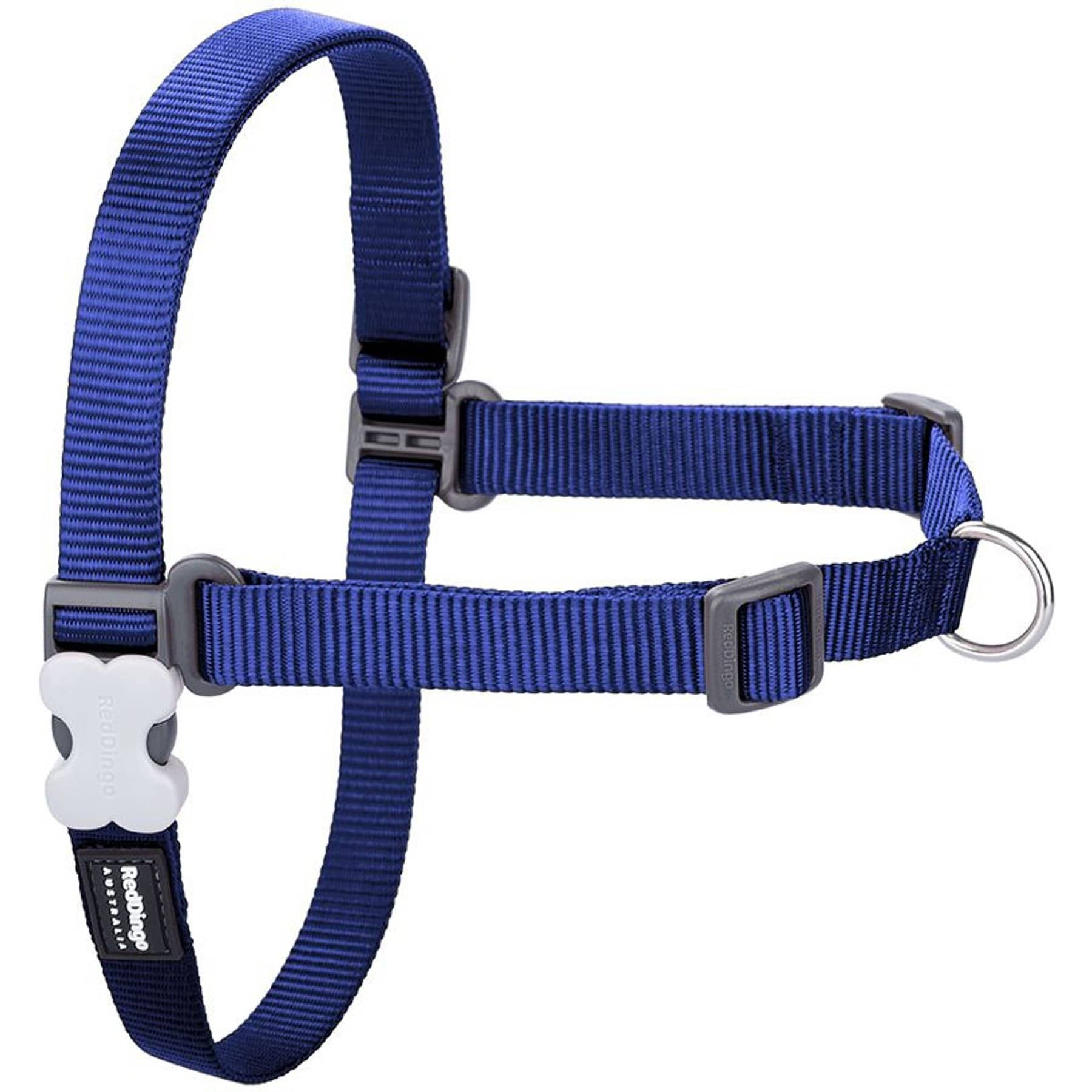
An adjustable webbing no-pull harness with a single side buckle, sold in a wide range of sizes including X-Small.
Webvet may earn a commission when you click through to Chewy, at no extra cost to you.
The Red Dingo No Pull is the budget pick, listed at $7.99 on Chewy when we checked in October 2026 in X-Small. It is a strap harness in abrasion-resistant webbing that the listing describes as gentle on sensitive areas such as the armpits.
What the Chewy listing describes:
- A single buckle on the side to slip it on and off
- Full adjustability, so you can correct the fit to avoid chafing
- A design meant to restrain the dog without harmful pulling
- A wide variety of sizes
For a small puller on a budget, it is an inexpensive way to move the leash off the collar. The listing does not say where the leash clips or publish a chest range for the X-Small, so check the photos for a front ring if pulling is the problem and measure against the size chart on the listing.
EzyDog Quick Fit Dog Harness: best one-click harness for quick on and off
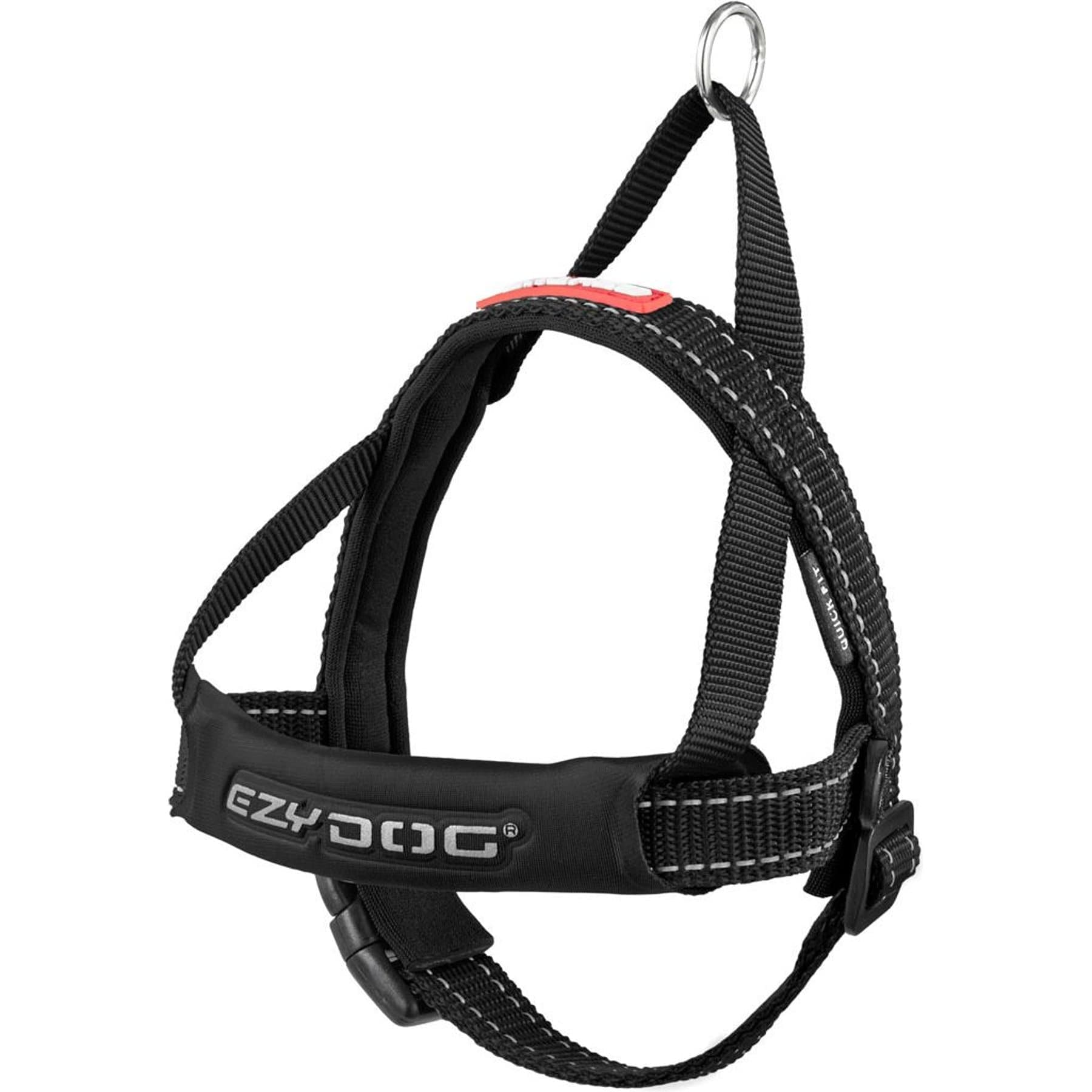
Set the straps once, then buckle on with one click; includes an ID tag holder and a stainless steel leash ring.
Webvet may earn a commission when you click through to Chewy, at no extra cost to you.
The EzyDog Quick Fit is the speed pick, listed at $42.00 on Chewy when we checked in October 2026 in Small, the highest listed price of our six. The idea is simple: adjust each strap once, then buckle the harness on with one click on every walk after that.
What the listings describe:
- A lightweight one-click harness
- A design meant to minimize pinching or chafing
- An ID tag holder, with EzyDog saying the harness can replace the collar
- Reflective stitching and a stainless steel leash ring, per an Animates NZ listing
It is a buckle harness rather than a step-in. That suits a small dog that will stand still for one click but not for having its legs threaded through loops. The size on the listing is Small with no chest range published, so confirm that EzyDog's size chart covers your dog's chest before ordering.
 Sponsored
Vet care that's always there
Unlimited video calls and messaging with licensed vets for less than a typical vet visit. One membership covers up to five pets.
Use code Pets60
Plans start at $12/month · covers up to 5 pets
- Licensed vets in most states
- Rx for 150+ conditions
- 4.7 on Trustpilot
Step-in vs vest vs overhead: which style suits toy breeds
Harness styles differ in how they go on and how much of the body they cover. VCA puts the biggest decision elsewhere: whether the leash clips in front of the chest or on the back. Style still matters for a toy breed, because it decides how much handling the dog tolerates and how easily you can get a snug fit.

The main styles, and what the sources say about each:
- Step-in harness. AKC describes it as resembling a figure eight: you help the dog step in and clip it at the back. Dr. Attas says it never has to slip over the head, which helps dogs with ear or neck pain or head sensitivity, and that it suits escape artists when fitted properly.
- Vest harness. A fabric vest, often mesh, that covers more of the chest. AKC notes mesh is breathable and lightweight but less durable and less padded. The Curli and Hip Doggie vests are step-in vests, so they combine both styles.
- Overhead harness. It slips over the dog's head before it fastens. For a head-shy toy breed, the step-in is the alternative Dr. Attas points to.
- Buckle strap harness. Straps that fasten with a buckle, such as the EzyDog one-click design and Red Dingo's single side buckle.
Comfort comes down to material and fit. AKC lists neoprene as padded for comfort but not breathable, so it may trap heat and moisture. Mesh is the light, cool option with less padding, and soft fabric needs checking for rubbing either way. A padded harness is not automatically the most comfortable on a tiny dog that runs warm.
If you are after a full body harness that spreads contact widely, a vest comes closest. The benefit Dr. Attas describes for any harness is contact at several points around the chest and shoulders rather than at the neck. Adjustability matters as much as coverage, and each pick handles it differently:
- Velcro that adjusts to different body shapes on the Curli
- A hook-and-loop closure on the back of the Puppia Vivien
- An adjustable chest strap on the Hip Doggie
- Fully adjustable webbing straps on the Red Dingo
- Straps you set once, then a one-click buckle, on the EzyDog
Design labels do not settle comfort. A 2019 study in The Veterinary Record put nine dogs on a treadmill and found both a restrictive and a non-restrictive harness reduced shoulder extension compared with no harness. Surprisingly, extension was 2.6 degrees lower at a walk and 4.4 degrees lower at a trot in the non-restrictive design than in the restrictive one.
It is a small study, but the lesson holds: watch your dog move. AKC's practical version is to walk your dog around after fitting and make sure the legs move freely. For the rest of a small dog's walking kit, see our picks for dog boots.
What type of harness is best for a small dog?
For most small dogs, a lightweight step-in harness or step-in vest, sized by chest girth and fitted snugly, is the best place to start. Dr. Attas tells AKC that step-ins suit escape artists and head-shy dogs. VCA suggests a back clip for flat-faced breeds and sensitive backs, and a front clip for dogs that pull.
What is the easiest harness to put on and off for my dog?
A step-in harness is usually the easiest: the dog steps its front paws into the loops and you fasten it on the back, with nothing over the head. The Gooby Escape Free Easy Fit Dog Harness, Black, X-Small: 15 to 17.25-in chest works that way, with paws in the arm holes and a pull up to fasten.
For a dog that will not lift its paws, the EzyDog Quick Fit Dog Harness, Black, Small buckles on in one click once its straps are set. Our guide on how to put on a dog harness walks through each style.
Easy on and off also depends on the fastening. The Puppia Vivien and Hip Doggie both add a quick-release buckle to their step-in designs, and the Red Dingo uses a single buckle on the side. One buckle and no overhead loop means the least handling for a small dog that dislikes being dressed.
A secure fit: stopping a small dog from backing out
Small dogs are good at backing out of harnesses, and a loose fit makes it easy. Escape free in a product name is a design goal, not a guarantee: Gooby's listing says its design makes escape harder, then tells owners to check for a snug fit. No harness here is escape-proof on its own.

What keeps a small dog secure is a fit you check on the dog. Dr. Attas tells AKC that the usual two-finger rule may be slightly too loose. These are the checks she and AKC describe:
- Slide two fingers under the straps. You should have to squeeze them in, but the harness should not be so tight that it is uncomfortable.
- Tighten a little more on a fluffy dog, as Dr. Attas advises for thick coats.
- Do the back-out test. As your dog moves forward, go backward and see whether the harness has room to go over the head. If it does, tighten it.
- Pull the harness gently in different directions to see whether it shifts enough to slip.
- Walk the dog around and make sure the legs move freely.
- Watch for rubbing or chafing after the first few walks.
- Recheck the fit after a groomer visit or any weight loss or gain.
The back-out test matters most. A small dog that plants its feet and reverses pulls the harness toward its head, the direction a loose fit gives way. If the straps pass over the head when you step backward, the dog can do the same on a walk.
A safe harness also beats a loose collar on this point. VCA warns that a collar that is too loose lets a dog escape easily, and a collar tightened to stop that puts the leash load back on the neck. Our guide to preventing dog collar accidents covers the collar side of the problem.

What is the best secure dog harness for small dogs?
The most secure option is a step-in harness fitted snugly enough to pass the back-out test; Dr. Attas tells AKC that step-ins are harder to escape when they fit properly. The Gooby Escape Free Easy Fit Dog Harness, Black, X-Small: 15 to 17.25-in chest is built around that idea. For a chest under 15 inches, the Curli starts smaller.
Whatever you buy, the label never replaces the check. A secure fit today can loosen after a haircut, a growth spurt, or weight loss, which is why AKC tells owners to recheck the fit after a groomer visit or a weight change.
Protecting the trachea: why small dogs do better in a harness
The trachea is the windpipe, and in small dogs it is the reason the collar question is a health question. The Merck Veterinary Manual says tracheal collapse is most common in toy and miniature breeds, the cause is unknown, and affected dogs have a dry, honking, chronic cough and labored breathing.
VCA says tracheal collapse occurs most often in dogs aged 4 to 14 years, but some younger dogs are affected too, so a small puppy is not automatically exempt. The Animal Medical Center lists Chihuahuas, Pomeranians, Poodles, Pugs, Lhasa Apsos, Shih Tzus, and Yorkshire Terriers among the toy and small breeds most affected.
Collars matter because of where the pressure lands. VCA says the cough of tracheal collapse can worsen with pressure on the trachea, such as from a collar. The authors of the 2025 Veterinary Medicine and Science study note that collars are thought to concentrate leash pressure, damaging a dog's trachea, larynx, neck, and eyes.

What the veterinary sources advise for a small dog with a fragile airway:
- Swap the collar for a harness. The Animal Medical Center advises it to avoid pressure on the trachea, adding that less pulling generally means less coughing.
- Use a harness and keep excitement down. VCA advises a harness rather than a collar, and preventing overexcitement, for dogs with tracheal collapse.
- Manage weight. Merck calls weight loss critical for overweight dogs with tracheal collapse, alongside exercise restriction and reduced excitement.
- Protect an injured neck. VCA says dogs with neck injuries should wear a body harness, not a collar or a halter around the neck or snout.
The eyes are part of the neck-pressure picture too, and two studies point the same way:
- A study in the Journal of the American Animal Hospital Association of 26 dogs (51 eyes) found eye pressure rose significantly when pressure was applied through a collar but not through a harness. The authors advised a harness for dogs in which raised eye pressure could be harmful.
- The 2025 Veterinary Medicine and Science study found that in 20 healthy dogs, exercising in a harness did not raise eye pressure the way a collar did.
Neither study measured the trachea directly, so read them as evidence about neck pressure in general, not proof about windpipes.
No-choke and choke-free are maker labels, not veterinary terms; Hip Doggie's mesh vest listing uses one. What VCA does describe is the opposite: choke, pinch, and prong collars tighten around the neck, so the more the dog pulls, the greater the discomfort. A well-fitted harness keeps the leash load on the chest and shoulders instead.
If your dog keeps a flat collar for its ID tag, clip the leash to the harness rather than the collar. Our guide on how to choose the right dog collar covers collar fit. If your veterinarian restricts exercise for a dog with tracheal collapse, a dog stroller lets it come along without the full walk.
Small dogs that pull: front-clip options sized for toy breeds
A small dog that pulls is still pulling against its own neck if the leash is on a collar. Dr. Attas tells AKC that a harness can help prevent a dog that pulls from straining or injuring its neck if it tugs too hard, and VCA says a puppy in a harness will not accidentally injure its neck when pulling.
Where the leash attaches changes how much a harness discourages pulling. VCA says front clip harnesses reduce a dog's ability to pull you forward, and that some dogs find it easier to pull in a back-clip harness. VCA also notes that harnesses designed to stop pulling attach the leash at the center of the chest.

Dr. Attas explains the mechanism to AKC: as the dog moves forward, a front-clip harness turns it back toward the person holding the leash. She recommends back-clip harnesses for well-trained dogs, and dual-clip harnesses let you start on the front clip and move to the back clip as training improves.
Among our picks, two carry the no-pull name in extra-small and small sizes:
- The Red Dingo No Pull Dog Harness, Blue, X-Small, listed at $7.99 on Chewy when we checked in October 2026, is the budget way to try a no-pull harness on an x-small dog.
- The Puppia Vivien Step-In No-Pull Dog Harness, Orange, Small, listed at $20.73 on Chewy when we checked in October 2026, is the dressier step-in option.
- Neither listing says where the leash ring sits, so check the product photos for a front ring at the center of the chest before buying for a strong puller.
For a fuller range of front-clip designs, our best no-pull dog harness roundup compares them across sizes.
What kind of no-pull dog harness is recommended by veterinarians?
Veterinary sources point to front-clip harnesses. Dr. Attas tells AKC that a front clip turns a pulling dog back toward you, and that a no-pull harness's D-shaped front ring tightens the harness a little when the dog pulls. VCA says these harnesses attach the leash at the center of the chest.
Why are dog trainers against harnesses?
Some trainers object because a back-clip harness can make pulling easier. In a 2021 study of 52 shelter dogs in Frontiers in Veterinary Science, dogs pulled harder and longer in a back-connection harness than in a neck collar when a food treat was the lure, though not for a toy. VCA notes the same back-clip effect.
That is an argument for the right harness, not against harnesses. A 2024 study of 23 dogs in PeerJ found significant differences in pulling force between a martingale collar and a front-connection harness, and no clear evidence that any of the equipment led to poorer welfare. Both studies are small. Equipment is also only half of the answer:
- Start a puller on a front clip and move to a back clip once the dog walks well, as Dr. Attas suggests.
- Train with motivation, positive reinforcement, and shaping, which VCA calls the most effective and humane approach; the harness buys a calmer walk while training does the lasting work.
- Treat a head halter as a different tool. VCA warns never to snap or jerk the leash on one, because doing so could cause neck injury.
Sizing a tiny dog: measuring chest girth from XXS to small
Chest girth is the measurement that decides harness size. Chewy's harness measuring guide calls it the circumference of the widest part of the rib cage and the most important measurement you will take. Dr. Attas tells AKC to take two: the base of the neck where it meets the shoulders, and the widest part of the chest, usually behind the front legs.
How to measure an extra small dog:
- Use a soft tape measure. PetMD says to wrap it around the widest part of the rib cage.
- Keep the tape taut but not pressing in. Chewy's guide says you should be able to slide two fingers between the tape and the body.
- Measure the base of the neck where it meets the shoulders, as Dr. Attas suggests.
- PetMD suggests adding 1 or 2 inches to the measurement for a snug but unrestricting fit. Where a brand's chart gives its own instructions, follow the chart.
- Compare the chest number with the maker's size chart, not the weight column or the size letter.

Weight is only a guide, and Curli's chart shows why. Its three smallest sizes overlap on weight but not on chest:
- 3XS: 26.7 to 30.1 cm chest (about 10.5 to 11.9 in), dogs of 1.5 to 3 kg, harness weight 33 g
- 2XS, the XXS size: 30.2 to 33.8 cm chest (about 11.9 to 13.3 in), dogs of 2 to 4 kg, harness weight 37 g
- XS: 33.9 to 38.2 cm chest (about 13.3 to 15.0 in), dogs of 3 to 5 kg, harness weight 42 g
A 3 kg dog sits inside all three weight bands, so only the chest measurement picks the size. Size letters also differ between brands: Curli's XS tops out near 15 inches, which is where the Gooby X-Small begins. An X-Small from one maker can be a full size away from another's.
Published sizing for the other picks is thinner:
- Gooby Escape Free Easy Fit: X-Small fits a 15 to 17.25 inch chest.
- Hip Doggie EZ Step-In Vest: its PetSmart listing runs from XXS to XL, but retailer listings give different X-Small chest ranges.
- Puppia Vivien, Red Dingo, and EzyDog: the listing descriptions give no chest range, so the size chart on each listing is the one to check.
For a toy breed, the Curli Air-Mesh Small Dog Harness, Black, X-Small line has the smallest published chest range we could confirm among our picks; order its 3XS or 2XS instead if your tape says so. None of our picks' listings describes a carry handle, so for an extra small dog harness with a handle, check the photos first.
An extra small puppy harness needs rechecking more often than any other. Dr. Attas tells AKC to adjust the size or buy a bigger harness as the puppy grows, and AKC says to recheck any harness after a groomer visit or weight change. Getting a puppy used to the harness fits naturally into the handling work in our puppy socialization checklist.
Small dog harness questions
Frequently Asked Questions
How do I measure a small dog for a harness?
Wrap a soft tape around the widest part of the rib cage, just behind the front legs. That chest girth is the number harness charts use. Keep the tape taut, with room for two fingers underneath, then match the figure to the maker's chart rather than buying by weight or by the size letter.
Is a harness better than a collar for a small dog?
For most small dogs, yes. A harness spreads leash pressure across the chest and shoulders instead of the neck, and VCA advises a harness rather than a collar for dogs with tracheal collapse, which is most common in toy and miniature breeds. A collar can still carry the ID tag; clip the leash to the harness.
Can a small dog slip out of a harness?
Yes, if it is loose. A small dog that plants its feet and reverses can back out of a harness that has room to pass over its head. Fit it snug enough that you have to squeeze two fingers under the straps, test it by stepping backward with the dog, and tighten if it shifts toward the ears.
What harness is best for a small dog that pulls?
A harness with a front clip at the center of the chest, which VCA says reduces a dog's ability to pull you forward. Check that the ring sits on the chest before you buy a no-pull model, and pair it with positive reinforcement training, which VCA calls the most effective and humane approach.
Are step-in harnesses good for small dogs?
Yes, for many. A step-in harness goes on as the dog steps its front paws into the loops, and you close it with a buckle or clip on the back, with nothing slipped over the head. Dr. Attas tells AKC that this helps head-shy dogs and escape artists, provided the fit is snug.

Editor
The Webvet Editorial Team is the in-house group of pet-care editors and writers behind Webvet, operated by Smart Pet Collective. The team researches, writes, and maintains Webvet's pet health, behavior, and medication content. Every article follows a defined editorial process: research from reputable veterinary and scientific sources, careful drafting, mandatory review of medical content by a credentialed veterinarian, and dated publication. Health and medication articles are medically reviewed by a licensed veterinary professional before they go live and are kept current over time.
Veterinarian · BVMS MRCVS
Dr. Pippa Elliott, BVMS, MRCVS, is a veterinarian with nearly 30 years of experience in companion animal practice. Dr. Elliott earned her Bachelor of Veterinary Medicine and Surgery from the University of Glasgow. She was also designated a Member of the Royal College of Veterinary Surgeons. Married with 2 grown-up kids, Dr. Elliott has a naughty Puggle named Poggle, 3 cats and a bearded dragon.
Related reading

Best Retractable Dog Leash: Safer Picks, Locking Brakes, and When Not to Use One

Best Dog Leash: Vet-Reviewed Picks by Walking Style, Dog Size, and Material

How to Put On a Dog Harness: Step-by-Step for Every Harness Type, With a Fit Check
