Best Dog Strollers for Senior Dogs and Limited Mobility
Compare four dog strollers for different passenger sizes and loading needs, with practical guidance on cabin fit, frame weight, folding, restraints, and everyday outings.

BVMS MRCVS
Medically reviewed by Dr. Pippa Elliott, BVMS MRCVS · Last reviewed

This article contains affiliate links. Webvet may earn a commission when you buy through them, at no extra cost to you.
The best dog strollers give your dog enough usable cabin space and a manageable way to get in, while fitting the routes and storage you actually use. Our four picks cover walk-in access, a lighter compact frame, a larger heavy-duty design, and an everyday middle option. Start with your dog's resting posture and loading needs, then check the stroller's own weight before choosing by capacity alone.

 Sponsored
Wondering why your dog seems stiff or sore?
Talk to a licensed vet at Dutch over video, often the same day. They can recommend treatment and prescribe it when it's appropriate.
Use code Pets30
Plans start at $11/month · covers up to 5 pets
- Licensed vets in most states
- Rx for 150+ conditions
- 4.7 on Trustpilot
How to choose the best dog stroller
The Gen7Pets Promenade is the selected everyday-walking option in this comparison. A high-end price does not establish a better fit, and a cheap stroller is not a saving if the cabin is too small or the brakes are difficult to use. Compare the complete setup at today’s prices, including necessary accessories. Heavy-duty capacity should be checked alongside cabin dimensions and the stroller’s own carrying weight. Airline approval is a separate question: confirm the airline’s current rules for the exact carrier and journey rather than assuming that a stroller or detachable cabin is accepted.
The best pet stroller is the one that fits both passengers: your dog inside the cabin and you behind the handle. A dog who cannot comfortably climb or be lifted needs a different entry arrangement from a small dog you can easily place in a raised cabin. An owner carrying the folded stroller upstairs has a different priority from someone rolling it straight into a garage.
For a large dog, the Pet Gear Expedition is the Pet Gear model in this shortlist to examine first because it has front and rear walk-in access. That can spare a dog from turning around inside to exit. The Happy Trails serves a smaller, lighter-stroller use case. Choose between them using the exact cabin and load specifications, rather than assuming that products from the same brand have interchangeable capacities.
- 1Check cabin fit in the posture your dog will actually use, not just the listed weight limit.
- 2Compare stroller weight with the lifting and storage tasks you face at home or in the car.
- 3Match entry access and wheels to the dog's mobility and your ordinary route before paying for extra functions.
We compared manufacturer and exact product information, including loading arrangements, published weights, care features, and optional accessories. We did not conduct a ride trial or test stability, braking, or comfort on different surfaces. There is no independently established, universally top-rated stroller in this comparison. Owner ratings can help identify questions to investigate, but a star average does not measure how a particular dog fits or how easily you can load the frame.
Write down your three hardest constraints before shopping. These might be a dog who needs walk-in entry, a narrow apartment doorway, and a stroller you can lift into a hatchback. Eliminate options that fail those constraints before comparing cup holders or color. A stroller that looks spacious online is not useful if it cannot pass through the route between your home and the sidewalk.
| Stroller | Best fit | Useful feature | Main tradeoff |
|---|---|---|---|
| Pet Gear Expedition No-Zip, Fog | Dogs needing walk-in loading | Front and rear access | Check the complete frame footprint and your storage space |
| Pet Gear Happy Trails No-Zip, Emerald | Smaller dogs and a lighter frame | No-zip opening and one-hand fold | A compact cabin can exclude a dog below the weight limit |
| Ibiyaya Hercules Heavy Duty Pro | Larger dogs within its 110-pound capacity | Large cabin and pneumatic rear tires | The stroller weighs 40 pounds; bicycle tow bar costs extra |
| Gen7Pets Promenade, Gold Nugget | Everyday use within its 50-pound capacity | Front and rear entry and washable pad | Check the dog's posture and loading route, not capacity alone |

Treat “for senior dogs” as a question about needs, not a size category. One older dog may walk comfortably for part of an outing and ride home; another may need an individually planned transfer and activity limit. If your dog's walking ability has changed, our guide to senior dog health can help you identify issues to discuss with your veterinarian. Buying transport should not postpone evaluating new pain or weakness.
 Sponsored
Vet care that's always there
Unlimited video calls and messaging with licensed vets for less than a typical vet visit. One membership covers up to five pets.
Use code Pets30
Plans start at $11/month · covers up to 5 pets
- Licensed vets in most states
- Rx for 150+ conditions
- 4.7 on Trustpilot
Four dog strollers for different needs
Pet Gear Expedition No-Zip Dog & Cat Stroller, Fog
The Pet Gear Expedition No-Zip in Fog is the access-focused choice. Its front and rear entries allow a dog to walk in from one end and leave through the other. That is a meaningful distinction if turning in a confined cabin is awkward or if lifting the dog into a higher basket is impractical. The no-zip push-button opening also changes how the owner handles the enclosure during loading.
Walk-in access still needs an individual assessment. Consider the threshold, the surface under the stroller, and whether your dog can approach and step through comfortably. A dog who cannot stand or take the necessary steps may need a supported transfer planned with the veterinary team. An opening that is convenient for an ambulatory dog does not make the stroller a lifting device.
- Choose it for: front-to-back access and a dog who benefits from avoiding a turn inside.
- Check first: the entry threshold, usable cabin, doorway clearance, and folded storage space.
- Main tradeoff: a larger frame must fit your home and vehicle as well as your dog.
Pet Gear's Expedition product information describes the dual-entry design and adjustable handle. The exact selected listing also identifies mesh panels and a liner. Look at where you can reach the dog, operate the closure, and attach the restraint without holding an opening unsecured. This matters especially when the owner is working alone.
Practice the complete loading sequence on a level surface with the brake engaged. Open the intended exit before deciding which direction to park, rather than trying to reposition an occupied stroller in a narrow hall. Once the dog is comfortable entering, close the enclosure and check that paws, tail, and bedding are clear of hinges and latches. Keep the first practice stationary and easy to end.
This is the stronger starting point here for a large-dog shopper comparing Pet Gear models, but “large” is not a sufficient measurement. Confirm the current load limit and internal dimensions for the exact Expedition version before purchase. Include any bedding in the fit assessment. If the dog cannot settle naturally, a generous weight rating does not rescue the fit.
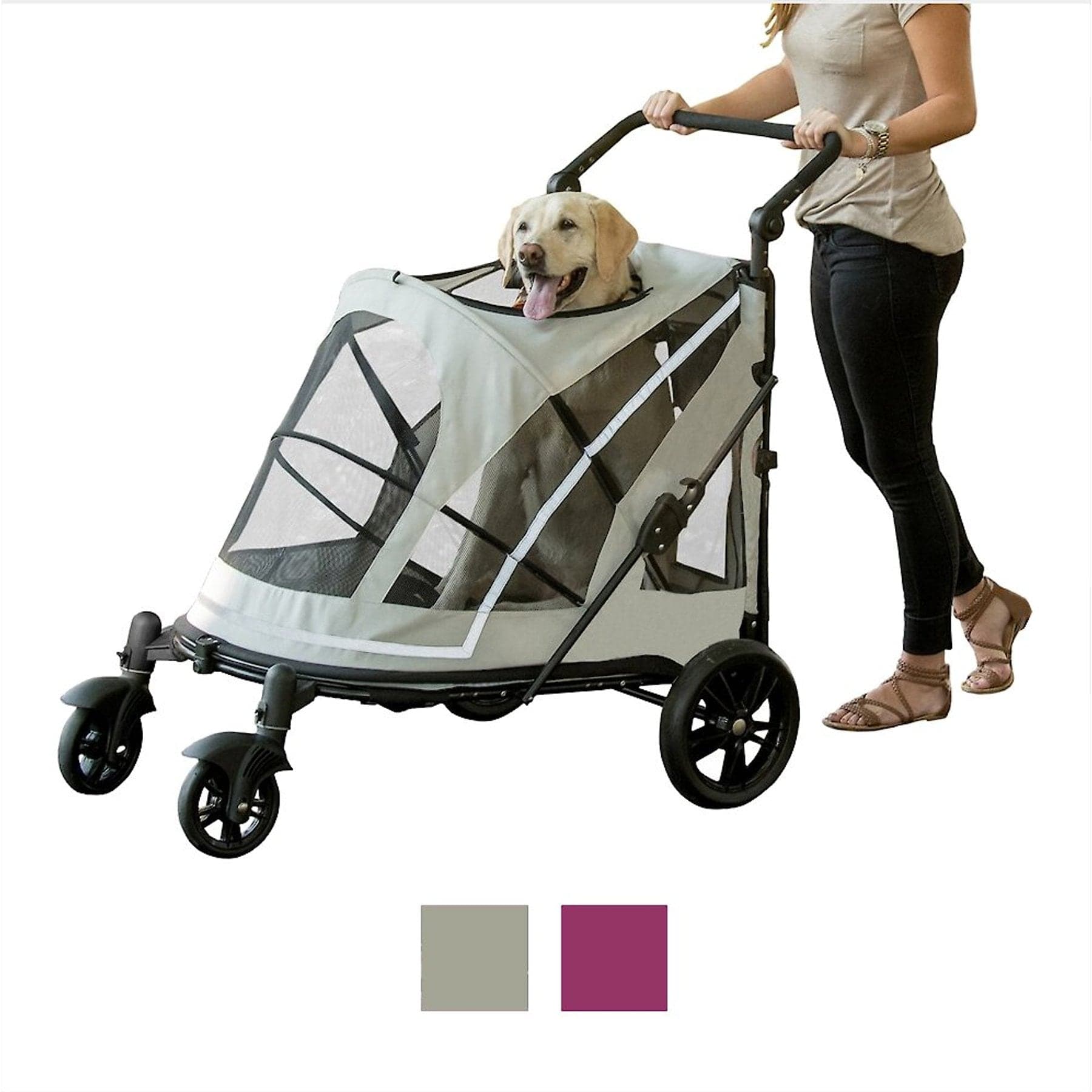
Front and rear walk-in access helps dogs enter and exit without turning inside.
Webvet may earn a commission when you click through to Chewy, at no extra cost to you.
Pet Gear Happy trails No-Zip Pet Stroller, Emerald
The Pet Gear Happy Trails No-Zip in Emerald is the compact option for a smaller dog and an owner who values a lighter stroller. Pet Gear lists a 14-pound stroller weight, a no-zip opening, and a one-hand fold. These are practical features to compare if loading the empty frame into a vehicle is part of every trip.
The cabin is the important counterweight to that convenience. A smaller dog can still have a long body, a tall sitting posture, or a preferred stretched-out resting position. Check the exact internal measurements rather than using breed or body weight as a shortcut. The elevated paw rest and panoramic window are design features, not evidence that every passenger will choose the intended position.
- Choose it for: a smaller passenger and a lighter frame for everyday transport.
- Check first: body length, comfortable headroom, entry handling, and the folded shape.
- Main tradeoff: compact storage and a lighter frame may come with less usable cabin room.
The Happy Trails manufacturer page supplies the folding and weight details. Think through how you will manage both dog and stroller while folding. A one-hand mechanism is useful only after the dog is safely out and you have stable footing. Do not assume a folding claim means it is appropriate to collapse, adjust, or carry the occupied stroller.
For a small senior dog, check whether you can lift them into the cabin comfortably and consistently. The owner's lifting ability can change the choice even when the dog is well within the stroller's limits. If lifting causes either of you pain or requires an awkward reach, compare a different loading arrangement rather than treating the lighter frame as the deciding feature.
This option is easiest to evaluate against a simple routine: a short local outing, a smooth familiar route, and an accessible place to store the folded frame. If the usual trip includes gravel, steep slopes, or many curb transitions, investigate the manufacturer's intended surfaces and wheel guidance before buying. We have not tested how this model rides on those routes.
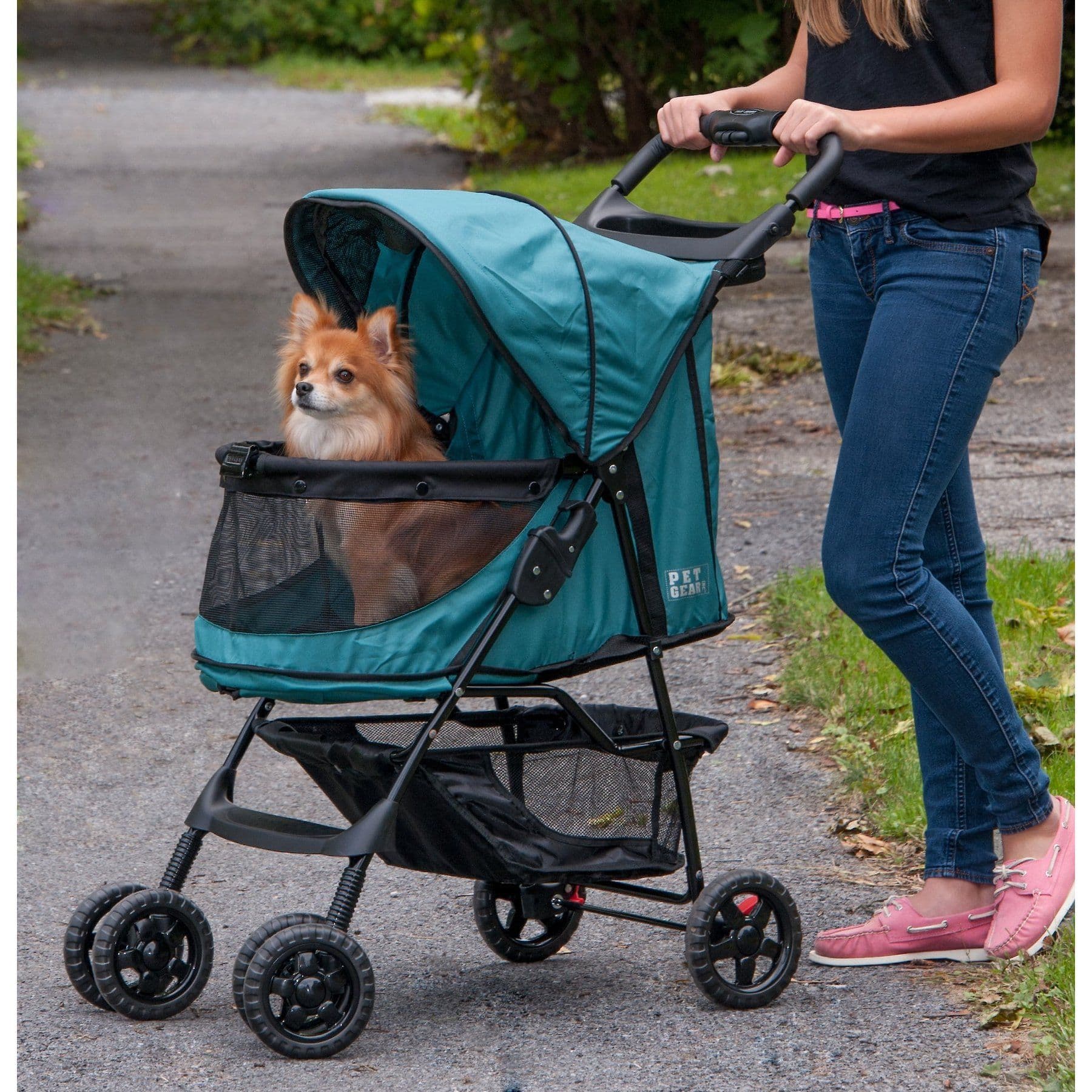
A lighter 14-pound frame with a no-zip opening and one-hand fold for smaller passengers.
Webvet may earn a commission when you click through to Chewy, at no extra cost to you.
Practice operating the brake on a level surface before loading the dog. Confirm that you can reach it comfortably while controlling the handle.

Ibiyaya The Hercules Heavy Duty Pro Dog & Cat Stroller
The Ibiyaya Hercules Heavy Duty Pro is the larger, heavy-duty choice in this group. Ibiyaya lists a 110-pound maximum load, a cabin measuring 33 by 23.5 by 24.4 inches, and a stroller weight of 40 pounds. Its pneumatic rear tires and EVA front wheel also give it a different wheel arrangement to evaluate from a compact everyday stroller.
The 40-pound frame is a major buying decision. Imagine lifting that empty shape through the opening of your vehicle, moving it up steps, and putting it away after an outing. A dog may fit comfortably while the owner finds the frame impractical. Measure the storage route and consider who will actually perform those tasks, including days when no second person is available.
- Choose it for: a larger dog whose dimensions and weight fit the published cabin and load limits.
- Check first: your ability to handle the empty frame and maintain the tires.
- Main tradeoff: size and capacity add handling demands; the bicycle tow bar is sold separately.
The Hercules manufacturer's specifications identify removable washable fabric and the optional tow bar. Do not budget for bicycle use as though the required attachment is included. If that function matters, verify the complete compatible setup, instructions, and whether your dog can appropriately use it before purchasing accessories.
Pneumatic tires require attention to their condition and inflation instructions. That is a maintenance task to include in ownership, not proof of a better ride on every surface. Check the wheels before a trip and keep the necessary maintenance information accessible. A stroller's intended terrain and the route's actual obstacles matter more than an outdoor-looking frame or a “heavy duty” name.
For a large dog with limited mobility, loading can be the harder problem than rolling. Check the opening, threshold, and space available beside the parked stroller. Plan how you would end the outing if the dog refused to reenter or could no longer manage the transfer. A larger cabin is useful, but it cannot substitute for a workable way to get the dog home.
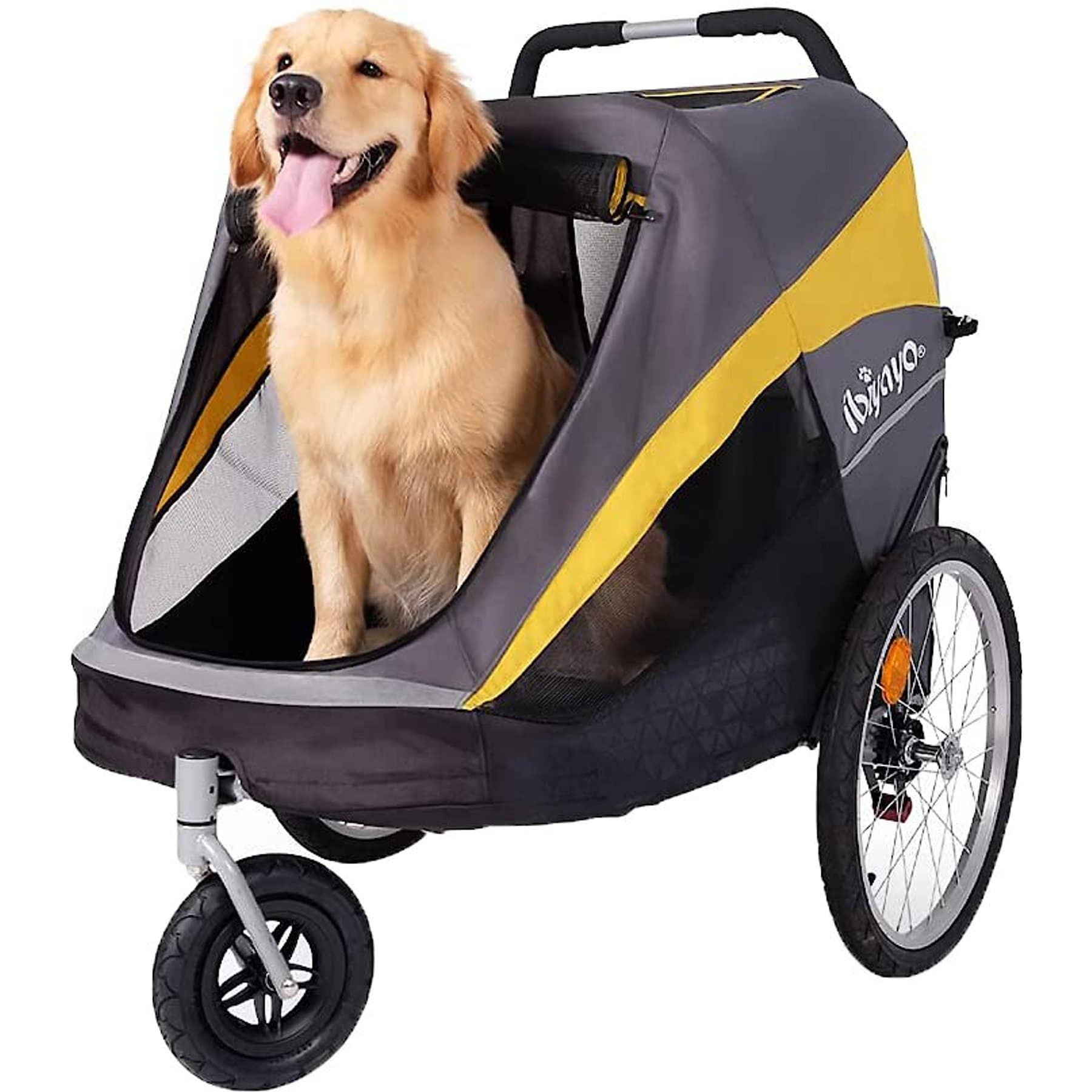
A 110-pound-capacity stroller with a large cabin; the 40-pound frame and optional tow bar need planning.
Webvet may earn a commission when you click through to Chewy, at no extra cost to you.
Gen7Pets Promenade Pet Stroller, Gold Nugget
The Gen7Pets Promenade in Gold Nugget fills the everyday middle position in this comparison. The manufacturer lists a 50-pound capacity and a 20-pound stroller weight, with front and rear entry, a washable pad, and two tethers. That combination is worth comparing if you need more than a compact small-pet cabin but do not want to handle the Hercules's heavier frame.
Two entry points can help you arrange loading around your available space. They do not automatically mean a dog can walk into the cabin from the floor. Study the height and shape of each opening and decide whether lifting is still part of the routine. If it is, include the dog's posture and your reach in the assessment, not just the number of doors.
- Choose it for: everyday outings within its capacity and a frame between the lighter and heavier options here.
- Check first: the dog's resting posture, loading height, folded space, and your lift into the car.
- Main tradeoff: a midrange weight limit still does not establish usable room for a particular dog.
The Promenade manufacturer information and selected listing describe its removable washable pad and folding design. Follow the care instructions for the pad and frame separately. A removable pad is helpful after a muddy trip or an accident, but spare bedding should not be so bulky that it crowds the dog or interferes with the restraint.
Check the rear brakes and the way you reach them while holding the handle. Practice engaging and releasing them with the empty stroller before bringing the dog into the process. Also test the folding sequence in the actual storage location. A frame that folds neatly in an open room may still be awkward beside a parked car or in a narrow entryway.
The two tethers are useful features to inspect, not a reason to assume that two dogs should share the cabin. Each dog needs adequate room, a compatible restraint arrangement, and a calm relationship with the other passenger. Their combined weight and gear must stay within the stated limit. For many owners, evaluating one dog's comfort first is the clearest starting point.
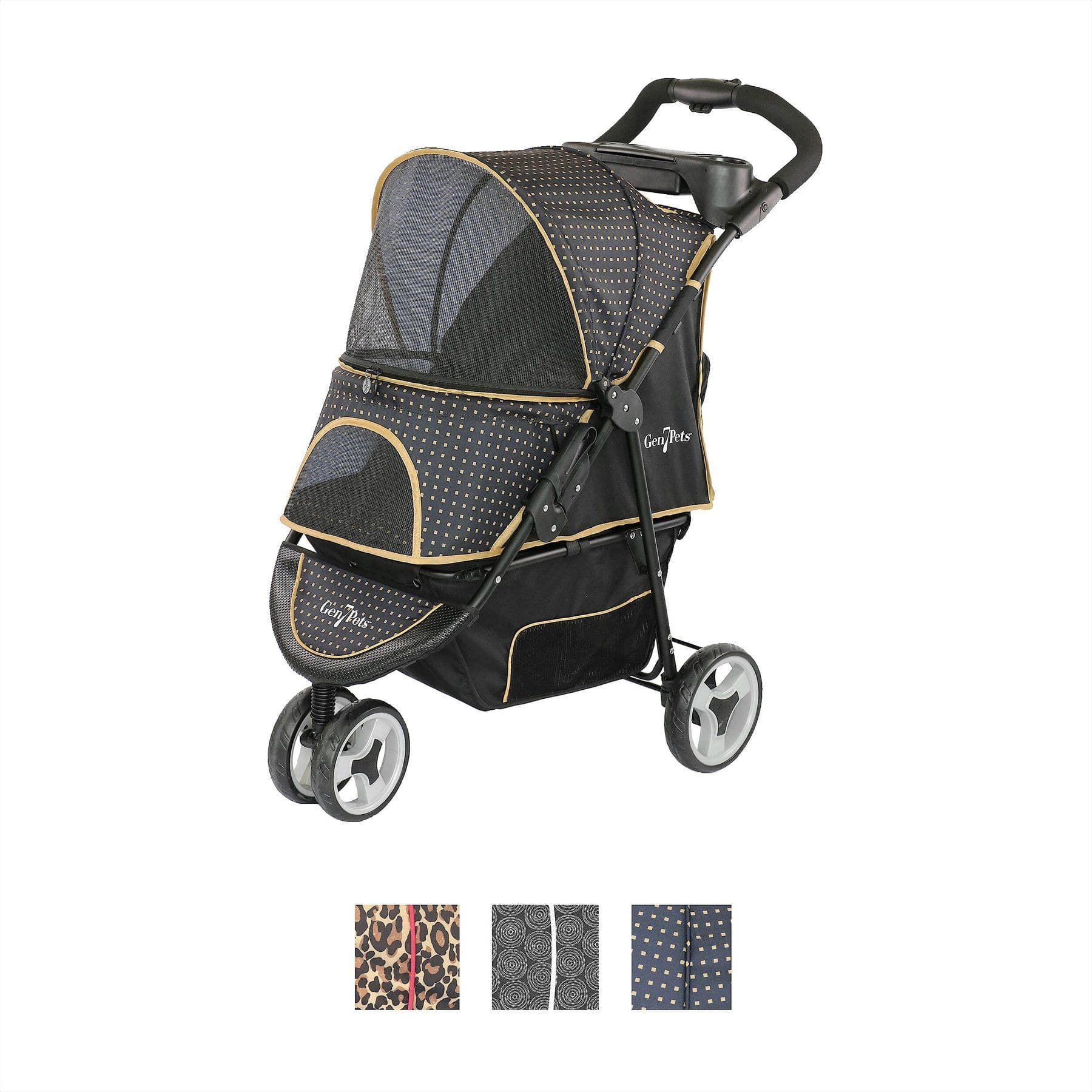
A 50-pound-capacity everyday option with front and rear entry and a removable washable pad.
Webvet may earn a commission when you click through to Chewy, at no extra cost to you.
Cabin fit, loading access, wheels, and storage
Cabin fit starts with usable resting space and entry height. Measure the dog and the exact cabin before comparing load limits or accessories.

Measure cabin space and carrying weight
For a dog over 50 pounds, check the selected model’s load capacity and usable cabin measurements together. A high capacity rating cannot make a cramped cabin suitable. For a small dog, a lower price is worth considering only after the dog can rest comfortably, entry is manageable, and the whole stroller fits your storage and transport routine.
Extra-large and large-breed labels still need a cabin fit check. A broad English Bulldog, long Basset Hound, compact Boston Terrier, or Staffordshire Bull Terrier can need different proportions at a similar weight. For two dogs, double-decker or shared cabins need separate usable-space and combined-load checks. Compare owner handle reach too, especially for tall people; a stroller that fits a medium-size dog can still be awkward to push.
Measure your dog in the position they can comfortably maintain, then compare those measurements with the manufacturer's usable internal cabin dimensions. Overall frame length includes parts your dog cannot occupy. A roof or canopy can reduce headroom, while thick bedding takes up floor and vertical space. When dimensions are unclear or conflicting, ask the seller to confirm the usable interior of the exact model before ordering.
- Observe the dog’s natural sitting or resting posture; take measurements calmly without forcing an uncomfortable pose.
- Allow room to change position, stretch, reposition a stiff limb, and lower the head. A tightly curled fit alone may be insufficient.
| Decision | What to check | Why it changes the purchase |
|---|---|---|
| Cabin fit | Usable floor, headroom, bedding, and natural posture | A dog can be under the load limit but still cramped |
| Loading access | Threshold, opening width, and room for an assisted transfer | Two doors do not necessarily eliminate lifting |
| Stroller weight | Empty weight and shape through the car or storage opening | You must manage the frame as well as the dog |
| Wheels and route | Intended surfaces, tire maintenance, brakes, and turning space | Wheel count alone cannot establish ride quality |
| Bicycle function | Hercules tow bar sold separately; confirm the compatible setup | An optional function may require additional equipment |
| Storage | Folded dimensions, doors, steps, and where wet fabric will dry | A convenient outing needs a workable return-home routine |
Add the weight of items carried in the pet compartment when checking the load limit. Follow separate basket or accessory limits where provided. Hanging heavy bags from a handle changes how the stroller is loaded and may affect stability; use only the storage arrangements permitted by the manufacturer. Keep essentials accessible without placing loose hard objects beside the dog.
A paper outline or taped rectangle on the floor can help you visualize cabin length and width, but it is only a planning aid. It does not reproduce the enclosure, entry, or wheel movement. Use the return policy and a careful indoor fit check to resolve remaining uncertainty. Keep packaging until you know the assembled stroller fits both the dog and the route out of your home.
Match the stroller to three everyday situations
For an apartment without an elevator, start with the empty frame's weight and folded shape. Work out where the dog can safely wait while you move the stroller and whether you can carry the frame without losing balance. A 14-pound model and a 40-pound model represent very different tasks even before you consider bulk. If the routine requires leaving the dog unattended or repeatedly carrying an occupied stroller, reconsider the plan before purchasing.
For a vehicle-based outing, measure the trunk opening as well as the space inside. A folded frame may fit the cargo area but be awkward to pass through a narrow opening or over a high lip. Decide where the dog will be safely contained while you unfold the stroller at the destination. The stroller cabin is not automatically a crash-tested vehicle restraint, and its ability to fit in the car does not establish an approved travel position.
For a walk that alternates walking and riding, choose a route with several level, quiet places to stop. These let you engage the brake, open the cabin, and manage the harness and leash without rushing. Plan the return distance around the dog's needs rather than the distance the owner could walk alone. A dog who happily walks away from home may need a ride sooner than expected on the way back.
- Record the dog's measurements and the exact model's internal dimensions together.
- Measure the narrowest doorway and the folded frame's storage opening.
- Identify the loading position and whether you can reach it comfortably.
- Confirm who will lift the empty stroller and where the dog will wait.
- Keep a return option for a dog who does not settle in the cabin.
These checks also help separate a useful feature from an unnecessary one. A large storage basket may matter for a longer outing with water and supplies. A compact fold may matter more for a daily trip in a small car. A bicycle attachment has little value if you only walk. Choose the features that remove a real difficulty in your routine, while keeping the dog's space and comfort as fixed requirements.
Wheels, folding mechanisms, and loading access
An easy-fold mechanism should be tested empty before relying on it beside a car. Check the folded footprint, lock, and lifting weight. A 3-in-1 stroller, carrier, and car-seat description names separate functions that each need exact instructions; the ordinary walking strollers here do not gain a vehicle-restraint rating through a detachable basket. A 3-wheel stroller advertised for a cat or dog may be intended only for a walk; wheel count alone does not establish jogger approval, even for a small pet. A baby stroller is not automatically suitable for a dog: its child restraint does not establish pet containment, usable paw space, or a permitted animal load. Use one for a dog only if its manufacturer expressly permits that use and provides compatible restraint instructions. Otherwise, choose a pet stroller with a verified cabin and restraint arrangement rather than improvising a conversion.
Wheel construction includes tire material, wheel size, and the suspension or shock-absorber design. Air tires need their specified inflation and maintenance; construction alone does not prove ride quality. A removable carrier adds attachment checks when moved on and off its frame. Low-to-ground entry can reduce a lifting demand, but inspect the actual threshold and do not attach an ordinary dog leash to the frame as an improvised tether.
Neither three nor four wheels is universally better for dogs. A three-wheel layout can offer a different turning feel, while a four-wheel layout has a different support footprint, but actual stability and handling depend on the complete design, load, surface, and operation. We have not tested these models against each other. Compare the wheel arrangement with your intended route and follow each manufacturer's terrain guidance.
- Check clearance at narrow gates and choose wheels intended for the actual path surface.
- Plan a permitted route around curb transitions; avoid carrying an occupied stroller up steps.
- Choose a more accessible destination when the route cannot accommodate safe stroller use.
Interpret owner comments in context
On Ibiyaya's own Hercules page, owner comments praise maneuverability, construction, and the ability to include larger dogs on outings. One reviewer wanted the bicycle attachment included. These are manufacturer-hosted anecdotes, not independent comparative ride tests or a consensus about every Ibiyaya model. They support checking loading and accessory details, rather than assuming an owner with a different dog and route predicts your experience.
Rehearse folding and loading
Before ordering, rehearse the empty-frame tasks conceptually: unfold it, secure the locks, load the dog, reach supplies, unload, fold, and store. Identify any step that requires setting the dog down somewhere unsuitable or briefly leaving them unsecured. A second person may solve an occasional difficult transfer, but a daily stroller should suit the help you reliably have.
Check what ownership will involve
Compare cabin fit, loading access, stroller weight, and load capacity together. Separate normal walking use from optional bicycle conversion: the Hercules tow bar is sold separately, so verify the required components before budgeting for that function. A high-end name or price does not establish that the extra function suits your dog.
Compare maintenance and replacement parts before a wheel or closure fails. Confirm which fabric sections come off, how they dry, and whether a damaged tether or tire has a model-specific replacement. Keep the frame label and receipt accessible, along with the correct manual and warranty contact information. Similar-looking parts from another stroller should not be assumed compatible with the structure, enclosure, or restraint system you have.
Think about where a wet stroller will go after rain. Folding damp fabric tightly and storing it immediately can make cleaning and drying harder. You need a place where the frame and removable parts can dry according to the instructions without blocking a doorway. If storage is very limited, that practical constraint may favor a simpler, smaller setup over a larger cabin you do not actually need.
Confirm included parts and accessories
Compare total purchase contents as well as the headline price. Confirm whether the pad, restraints, weather accessories, and any conversion hardware pictured are included. Check the instructions before adding aftermarket accessories; extra covers can affect airflow, and an incompatible attachment can interfere with operation. A low initial price is not a useful saving if the missing essentials or storage demands make the stroller unsuitable for the intended trip.
Stroller safety and comfortable outings
Monitor ventilation and heat throughout the outing. Keep air openings clear, check the dog frequently, and stop or return when conditions become uncomfortable. A rain cover or enclosed cabin can change airflow; do not assume a cover makes a hot day suitable for stroller use.
Introduce the stroller in stages. Let the dog investigate the stationary frame, then reward calm entry or a comfortable assisted placement. With the brake engaged, allow a short settled period before moving. Progress to a brief smooth indoor or quiet outdoor route only when the dog is comfortable. End before distress escalates, and avoid making a crowded event the first trial.
Use the supplied restraint according to the instructions, attached to a properly fitted harness rather than a neck collar. A tether should prevent an attempted jump without creating an entanglement or suspension hazard. It does not make an open cabin safe in every situation. Check the enclosure, latch, and restraint before moving, and supervise the dog throughout the outing.
Ventilation and heat monitoring need ongoing attention throughout the outing. A rain cover can also alter airflow; use only a compatible cover as directed and continue checking the dog. Mesh does not guarantee a comfortable temperature inside a cabin, and a cover can restrict airflow. Choose suitable weather, carry water, and check the dog frequently. A stroller does not remove heat risk or make a hot, crowded outing appropriate. Turn back if conditions or the dog's comfort change.
Jogging and all-terrain stroller claims require the exact model’s intended-use instructions. Do not assume that a stroller suitable for walking can be used for running with a small or large dog.
Use the brake when parked for loading or unloading, and keep control of the handle. Do not leave the occupied stroller unattended or rely on a brake to make an unsuitable slope safe. Move at the pace and on the surfaces permitted for the model. Do not infer permission for running, skating, or bicycle towing from the appearance of the wheels or the presence of a handlebar.
Fit outings around the activity plan
Jogging with a small dog in a stroller needs explicit manufacturer approval for that activity, not just a jogger-style appearance. Walking multiple dogs while pushing also divides your attention: use a separate capable handler when you cannot control the stroller and each leashed dog comfortably. Do not attach an ordinary dog leash to the stroller and let pulling substitute for controlled handling.
For a dog recovering from surgery or living with a mobility condition, ask the veterinary team how the stroller fits the activity plan. Riding can support participation in an outing while appropriate walking remains part of the routine when advised. It should not replace all exercise by default or conceal a worsening problem. Our guide to mobility aids for dogs explains how different tools serve different movement tasks.
Clean and check the stroller after use
After an outing, inspect the pad, closures, tethers, wheels, and frame. Clean and dry the parts as directed before storage. If a brake, latch, or wheel is damaged, stop using the stroller until the issue is resolved through the manufacturer's guidance. Keeping the manual and exact model details makes it easier to obtain the right part rather than improvising a repair that affects the dog's containment.

Make the first outing easy to end
Choose a quiet loop close to home with enough room to turn around. Bring the usual leash and supplies, check the forecast, and avoid timing the trial around an appointment you cannot miss. Watch whether the dog can settle, shift position, and remain comfortably contained as the stroller moves. If the dog persistently tries to escape or cannot relax, stop and reassess the introduction and fit before attempting a longer trip.
Record practical observations after that first trial: whether loading was comfortable, where the frame was difficult to maneuver, and which supplies were hard to reach. Change one part of the routine at a time. A calmer second attempt after shorter practice can be useful progress, but continuing distress, pain, or reduced mobility deserves individual advice rather than simply more practice in the same setup.
Dog stroller questions
Frequently Asked Questions
Are dog strollers a good idea?
They can help a dog join an outing when the full walking distance is unsuitable, provided the dog is comfortable and the activity fits any veterinary plan. Check cabin fit, loading access, ventilation, and stroller weight before buying. A stroller supports transport; it does not diagnose a decline in walking ability or automatically replace the exercise your dog can appropriately do.
What are people saying about the Pawhut dog stroller?
PawHut sells several models, so reviews need to match the exact stroller. The Aosom listing for model D00-232V00DG showed two five-star ratings when checked, but did not expose written review text. That small sample cannot establish a brand-wide verdict. Compare model-specific cabin fit and stroller weight, and look for detailed comments from owners with a similar dog and route before relying on the average.
Is the Tavo pet stroller worth it?
It depends on which parts of the system you need. The Tavo Maeve and Roscoe system combines a carrier, vehicle base, and stroller frame. That integration may be useful if all three suit your routine; it may add unnecessary components if you only want walking transport. Confirm the exact bundle, cabin fit, stroller weight, and vehicle compatibility before comparing its value with a standalone stroller.
What is the best dog stroller for heavy dogs?
The Hercules is the high-capacity option to examine here, with a published 110-pound limit, but it is suitable only if the dog also fits its usable cabin. Check cabin fit in a comfortable posture and plan the loading method. Its 40-pound stroller weight matters for the owner. For a dog beyond a model's limits, seek a correctly rated larger option rather than exceeding capacity or squeezing into the cabin.

Editor
The Webvet Editorial Team is the in-house group of pet-care editors and writers behind Webvet, operated by Smart Pet Collective. The team researches, writes, and maintains Webvet's pet health, behavior, and medication content. Every article follows a defined editorial process: research from reputable veterinary and scientific sources, careful drafting, mandatory review of medical content by a credentialed veterinarian, and dated publication. Health and medication articles are medically reviewed by a licensed veterinary professional before they go live and are kept current over time.
Veterinarian · BVMS MRCVS
Dr. Pippa Elliott, BVMS, MRCVS, is a veterinarian with nearly 30 years of experience in companion animal practice. Dr. Elliott earned her Bachelor of Veterinary Medicine and Surgery from the University of Glasgow. She was also designated a Member of the Royal College of Veterinary Surgeons. Married with 2 grown-up kids, Dr. Elliott has a naughty Puggle named Poggle, 3 cats and a bearded dragon.


