Best Dog Ramps for Cars, Beds, and Sofas
Compare four ramps for vehicles and indoor furniture, with verified dimensions, setup limits, and a practical guide to rise, length, traction, and training.

BVMS MRCVS
Medically reviewed by Dr. Pippa Elliott, BVMS MRCVS · Last reviewed

This article contains affiliate links. Webvet may earn a commission when you buy through them, at no extra cost to you.
The best dog ramps match the height your dog must reach, the space available for the slope, and the way you will set up and store the equipment. For vehicle access, compare the PetSafe Happy Ride Regular telescoping ramp with the folding Gen7Pets Natural-Step. For a fixed indoor setup, consider the PetSafe CozyUp. The Pet Gear Extra Wide freestanding design offers another approach when its fixed height fits the access point.
 Sponsored
Wondering why your dog seems stiff or sore?
Talk to a licensed vet at Dutch over video, often the same day. They can recommend treatment and prescribe it when it's appropriate.
Use code Pets30
Plans start at $11/month · covers up to 5 pets
- Licensed vets in most states
- Rx for 150+ conditions
- 4.7 on Trustpilot
How to choose the best dog ramp
Compare ramp length with entry height before considering brand or price. Pet Gear’s freestanding ramp suits a different installation from PetSafe’s telescoping design. A low advertised price is useful only when the exact size and model fit; confirm the model number before comparing a listing using an older or abbreviated product name.
Measure the actual entry height first. A vehicle’s cargo floor and its side-door opening can be different heights, with different edges available to support a ramp. A bed and sofa also need separate measurements. A ramp that reaches the destination is not necessarily suitable: the incline, walking width, footing, and transition onto the destination must work together.
For a car or SUV, the PetSafe Happy Ride Regular is a useful starting point when its manufacturer’s 19-to-30-inch entry-height guidance fits the setup. The Gen7Pets Natural-Step offers a 72-inch folding format with a poly-grass surface. A senior dog may need a gentler approach than the shortest ramp that reaches the vehicle. Ask the veterinary team about the dog’s capabilities rather than choosing by age or weight rating alone.
- 1Record entry height, available floor space, and usable walking width.
- 2Check how both ends are supported and how the ramp is secured.
- 3Compare folded dimensions and carrying weight before buying a travel ramp.
This comparison uses manufacturer specifications, not hands-on traction or load testing. We can compare dimensions, construction, and setup requirements, but cannot promise that one surface suits every dog or remains equally grippy in all conditions. The strongest weight rating does not establish the gentlest slope, and a longer ramp still needs adequate room for secure placement.
| Ramp | Best fit | Verified distinction | Main limitation |
|---|---|---|---|
| PetSafe Happy Ride, Regular | Adjustable vehicle access | Telescoping; manufacturer entry-height guidance 19–30 inches | Regular and Extra Long are different models |
| PetSafe CozyUp, Cherry | Fixed indoor bed access | 70 × 16 × 25 inches; listed capacity 120 pounds | Needs a substantial permanent footprint |
| Pet Gear Free-Standing Extra Wide, X-Large | Access without resting on a bumper | 55 × 19.25 × 23 inches; product weight 19 pounds | Fixed height must match the transition |
| Gen7Pets Natural-Step | Folding vehicle ramp | 72 × 16 inches open; 36 × 16 × 3 inches folded | Check regular-model tether attachment and storage space |

 Sponsored
Vet care that's always there
Unlimited video calls and messaging with licensed vets for less than a typical vet visit. One membership covers up to five pets.
Use code Pets30
Plans start at $11/month · covers up to 5 pets
- Licensed vets in most states
- Rx for 150+ conditions
- 4.7 on Trustpilot
Four dog ramps for different needs
PetSafe Happy Ride Telescoping Dog Car Ramp, Regular
The PetSafe Happy Ride Regular is the adjustable vehicle-access option. Its telescoping format changes the extension for setup and storage. PetSafe’s model-selection guidance places the Regular model in an entry-height range of 19 to 30 inches. Measure the intended upper support point according to its instructions: PetSafe specifies the backseat for backseat entry, or the top of the bumper where the ramp rests for rear entry. Also check the transition from that support point into the vehicle.
That guidance is a starting point for matching the equipment, not a promise that every dog can manage the resulting slope. A dog with weakness or reduced balance may need a more gradual incline and professional advice. Do not transfer the extension or entry-height guidance for PetSafe’s Extra Long model to the Regular listing here.
- Choose it for: telescoping vehicle access within the selected model’s setup guidance.
- Check first: the contact edge, actual rise, permitted extension, and storage dimensions.
- Main tradeoff: adjustable length cannot make an unsuitable landing edge or crowded parking area safe.
Practice extending and securing the empty ramp before involving your dog. Check the locking and support arrangements in the instructions, keep fingers clear of moving sections, and inspect the walking surface. A setup you can repeat confidently is more useful than one that takes improvisation every time the dog approaches the vehicle.
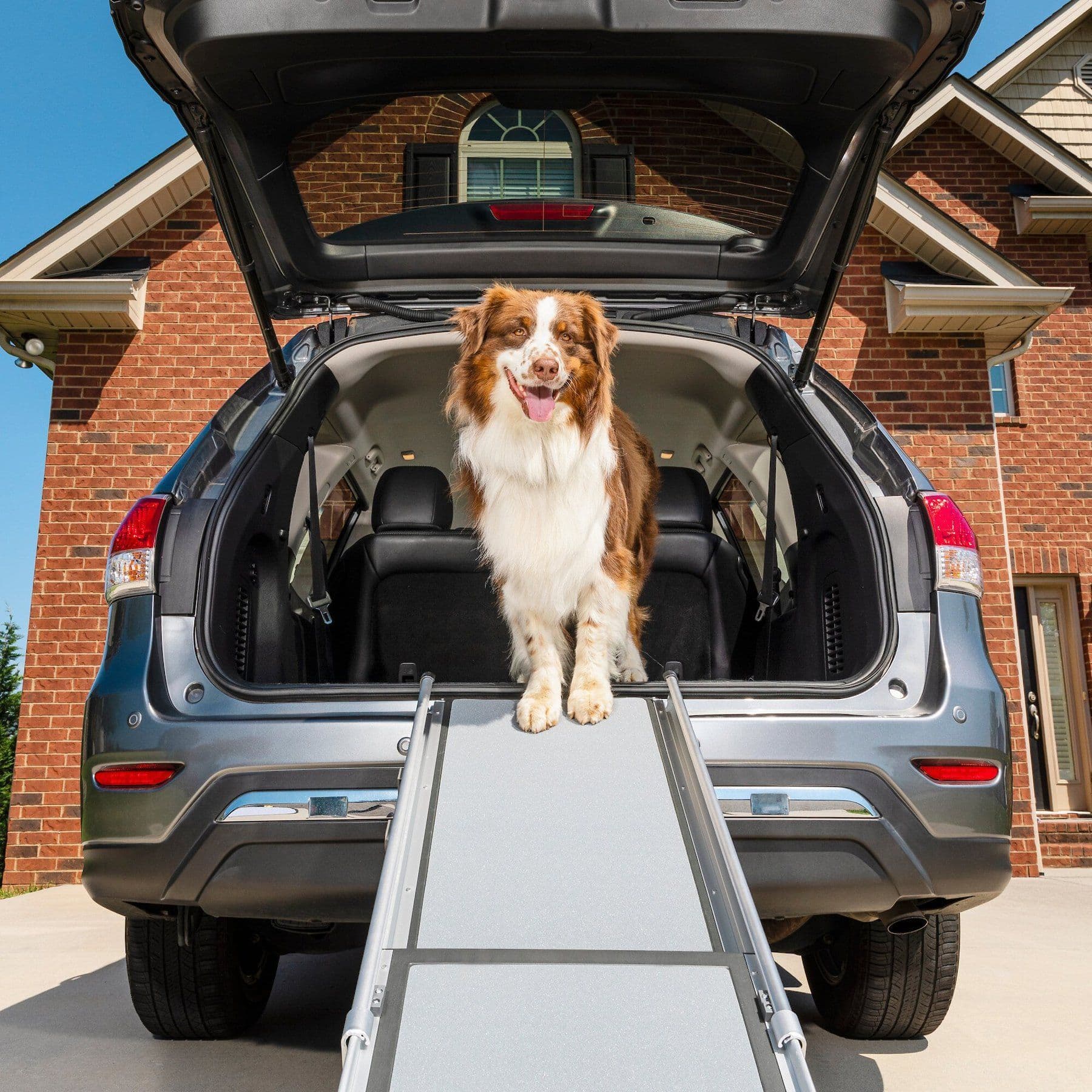
Telescoping vehicle access with manufacturer guidance for 19-to-30-inch entry heights.
Webvet may earn a commission when you click through to Chewy, at no extra cost to you.
PetSafe CozyUp Wooden Cat & Dog Ramp, Cherry
The PetSafe CozyUp Cherry is the fixed indoor option. PetSafe lists wood construction, a carpeted surface, dimensions of 70 inches long by 16 inches wide by 25 inches high, and a capacity of 120 pounds. Those measurements let you assess the room and destination before committing to a substantial piece of furniture.
The 25-inch height is especially important. A ramp that stops below the mattress or overshoots the edge can leave an awkward transition. Check the surface the dog will actually step onto, including mattress compression, bedding, and whether the dog has room to turn at the top. Do not assume every bed or sofa matches this fixed configuration.
- Choose it for: a consistent indoor location with space for the assembled ramp.
- Check first: destination height, the 70-inch length, and an unobstructed approach.
- Main tradeoff: the fixed format is less adaptable than a vehicle ramp designed for changing setups.
The CozyUp support page provides the model’s instructions. Position the ramp so that it does not create a nighttime obstacle for people or block a doorway. Keep its carpeted surface clean and inspect it for wear. A listed weight capacity describes the equipment boundary; it does not determine whether your dog is comfortable walking its slope.
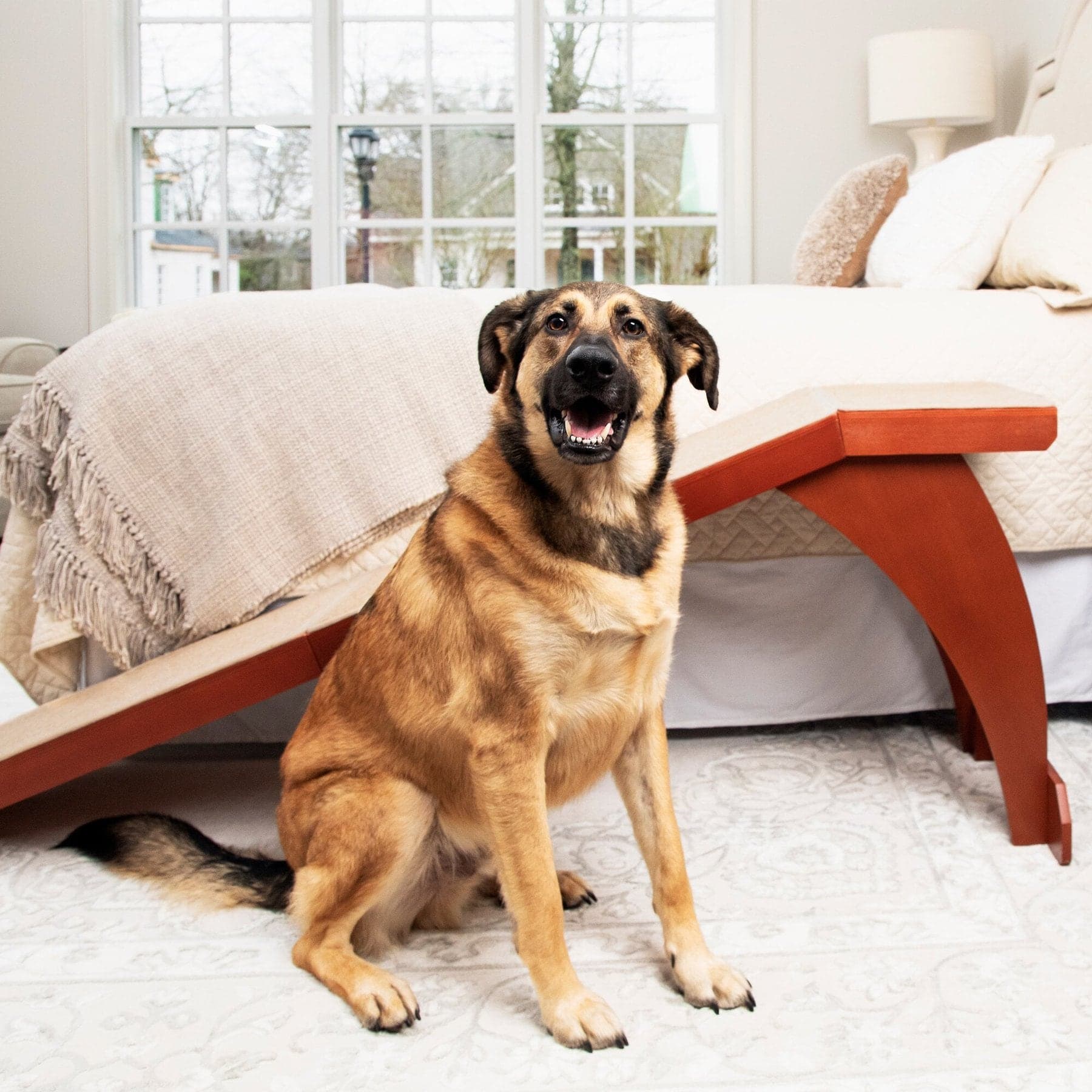
A fixed wooden indoor ramp with a carpet surface and a 25-inch height.
Webvet may earn a commission when you click through to Chewy, at no extra cost to you.
Check the entire bedside route, including firm level footing and where each end of the ramp rests, before inviting the dog onto it.

Pet Gear Free-Standing Extra Wide Dog Car Ramp, X-Large Ramp
The Pet Gear Free-Standing Extra Wide X-Large supports itself rather than needing to rest on a vehicle bumper. The manufacturer lists dimensions of 55 by 19.25 by 23 inches, a 19-pound product weight, and a capacity of 300 pounds. It also identifies a support panel, bottom grippers, raised edges, and a slip-resistant surface.
Its fixed 23-inch height changes the comparison. Measure whether the top creates a suitable transition at your intended access point. A freestanding design avoids one kind of bumper contact, but it still needs firm, level support beneath its base. Do not place it partly on a curb or uneven ground simply because it can stand independently.
- Choose it for: the wider freestanding format when the fixed height suits the destination.
- Check first: transition height, level ground, and whether you can handle a 19-pound ramp comfortably.
- Main tradeoff: the substantial carrying weight and fixed geometry may be inconvenient for frequent travel.
Use the Pet Gear model specifications to identify the exact X-Large version. Raised edges offer a boundary but are not a railing that can prevent every fall. Stay close during training and use the assistance method your veterinary team recommends if the dog needs balance support.
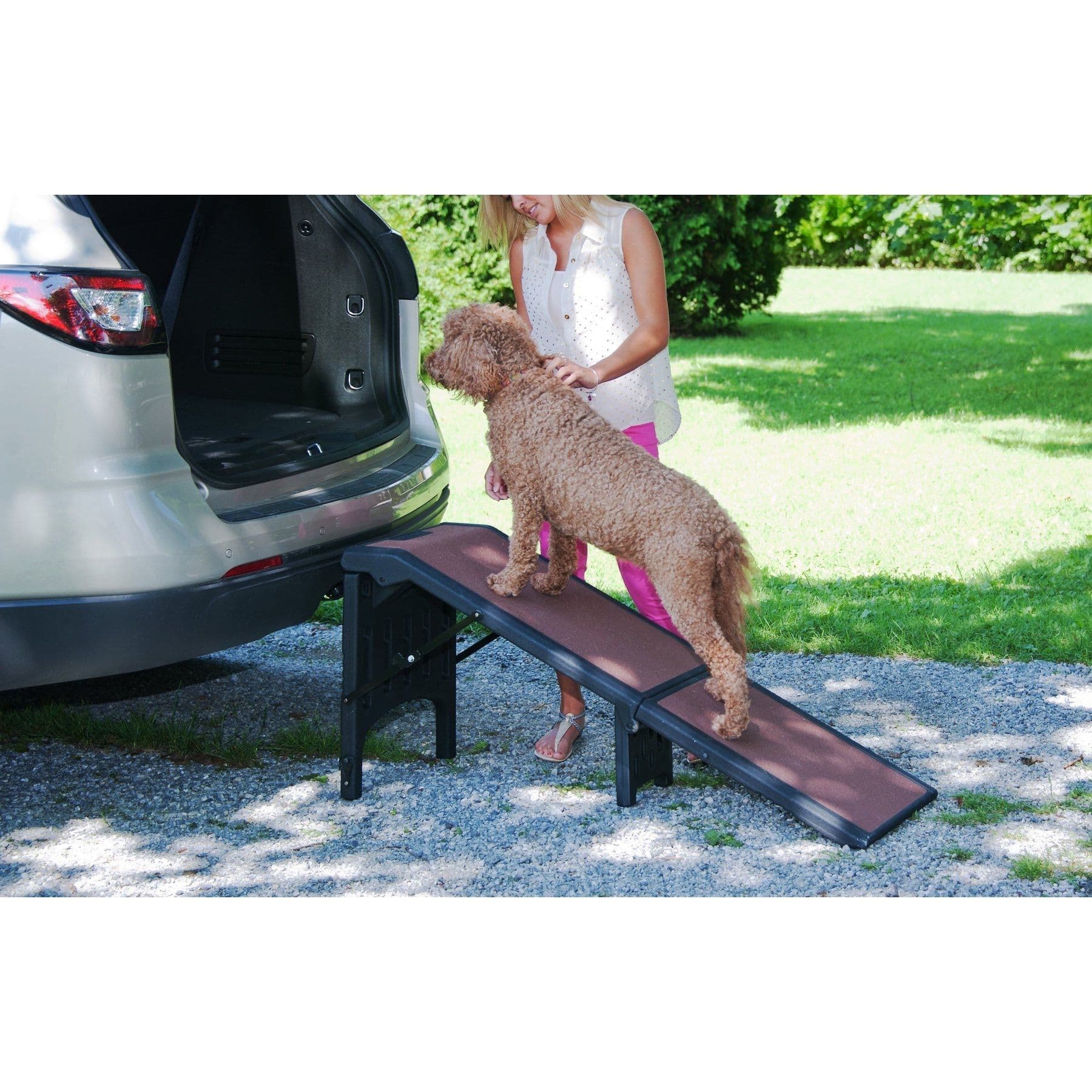
An extra-wide freestanding ramp for destinations that fit its fixed 23-inch height.
Webvet may earn a commission when you click through to Chewy, at no extra cost to you.
Gen7Pets Natural-Step Pet Ramp
The Gen7Pets Natural-Step is the folding vehicle ramp with a poly-grass walking surface. The regular model measures 72 inches long by 16 inches wide when open and 36 by 16 by 3 inches when folded. That gives you concrete dimensions for both the approach and the storage space inside the vehicle.
Gen7Pets describes rubber grippers at both ends and a safety tether that attaches to a cargo-area anchor on the regular model. Read the Natural-Step instructions for the exact installation. The Mini version has different features, including no safety tether, so keep the regular model’s details tied to this comparison.
- Choose it for: a folding ramp with a poly-grass surface and a defined folded footprint.
- Check first: end contact, tether compatibility, open length, and room to carry and store it.
- Main tradeoff: the walking surface still needs inspection and cleaning; its appearance cannot guarantee traction in every condition.
Practice folding and unfolding it away from the dog. Check that the storage lock and handle function as directed, and keep the ramp secure during the journey. A folded ramp should not become loose luggage beside the pet. Once installed, inspect the entire route from ground to vehicle before inviting the dog onto it.
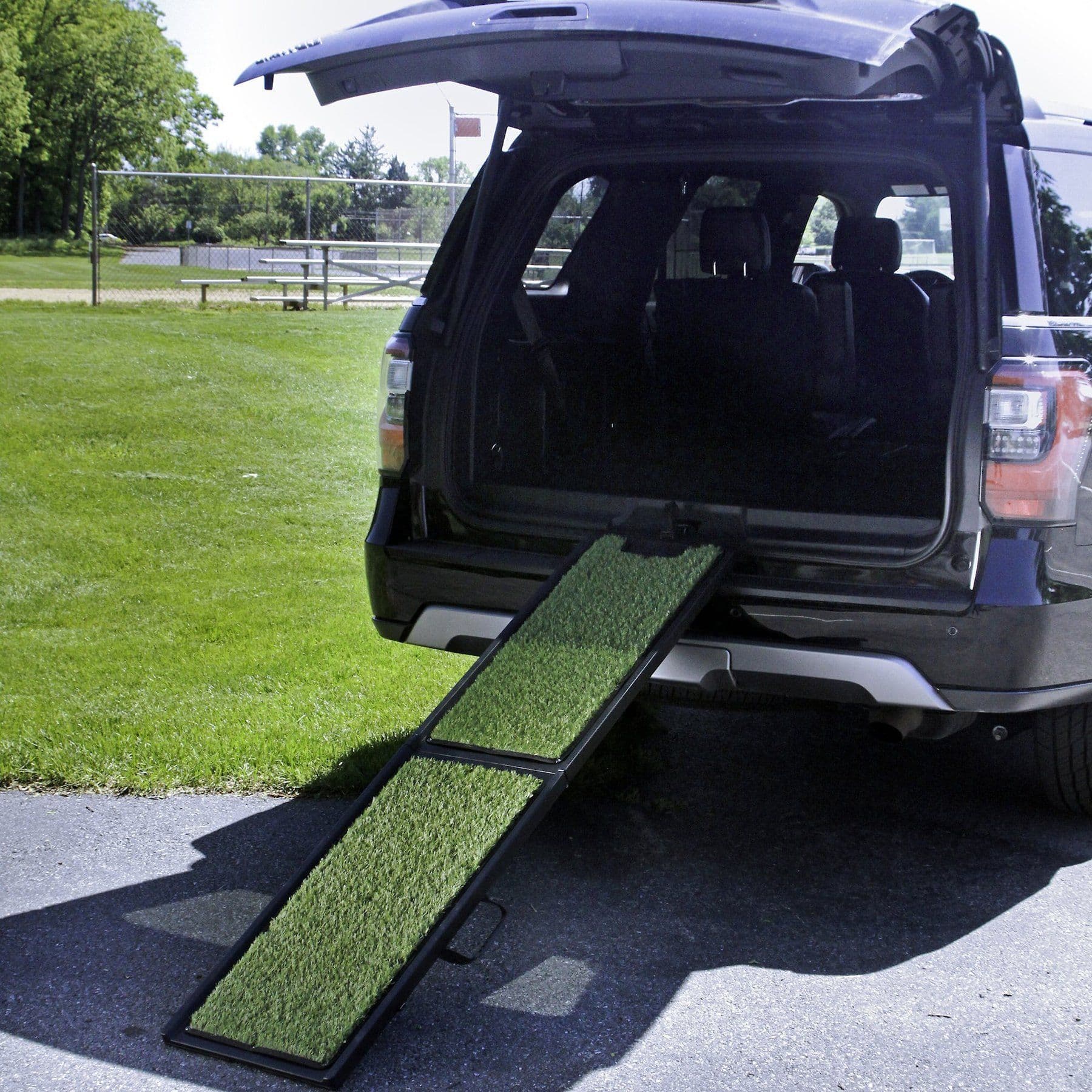
A folding vehicle ramp with a poly-grass surface and a 36-inch folded length.
Webvet may earn a commission when you click through to Chewy, at no extra cost to you.
Measure rise, ramp length, width, and storage space
Compare the assembled route and the stored equipment separately. The dog needs a usable approach and landing; you need enough space to position, carry, and store the ramp. A wide product dimension can include raised edges, so check usable walking width where the manufacturer provides it rather than assuming the whole outside width is available to paws.
| Measurement | How to use it | Common mistake |
|---|---|---|
| Entry height | Measure to the permitted upper support point and inspect the transition into the destination | Choosing a convenient measurement without checking where this ramp is permitted to rest |
| Ramp length | Compare the slope created at that rise | Assuming a higher weight rating makes a short slope comfortable |
| Walking width | Check room for the dog’s natural stance | Treating total outside width as usable path width |
| Ground space | Check the full approach and level base area | Blocking a walkway or placing one side on a curb |
| Folded dimensions | Compare with the intended storage space | Buying a ramp that fits the dog but not the car |
Calculate rise, ramp length, and walking width
A wide ramp for a car must fit both the dog’s stance and the vehicle opening. Check usable path width separately from the outside frame. Lightweight aluminum, folding construction, and a high capacity rating describe different properties; none guarantees a manageable incline for a large dog.
For a large breed such as a Newfoundland or English Mastiff, compare walking width and rated capacity together. An extra-long ramp can reduce slope at a high access point, but needs more floor space. A small dog also needs a manageable incline; small size does not make a steep ramp comfortable. Heavy-duty and extra-large labels are not substitutes for these measurements.
Compare length with the actual rise
For a straight ramp, a greater length produces a gentler angle at the same rise. As a geometry example, a 72-inch sloping length reaching a 24-inch rise makes an angle of about 19.5 degrees and needs about 68 inches of horizontal space. Those numbers describe a triangle, not a safe-angle prescription for a particular dog or product. Follow the manufacturer’s installation limits and your veterinarian’s advice.
Measure again at each new location. A sloping driveway, different vehicle, or taller mattress changes the setup. Check the space where the dog will start and finish, including whether a door opens far enough for a straight approach. Do not rely on the dog twisting sideways at the top to compensate for a poorly aligned ramp.
Check a side-door opening
For side-door vehicle access, inspect the door opening with the door fully open. The ramp may be wide enough for the dog yet unable to meet a suitable support edge without contacting the door. PetSafe specifies its Happy Ride Dog Ramp Adaptor for side-door use with its telescoping ramps. Check that accessory and the exact vehicle setup before buying. Cargo access can offer a different arrangement, but it also changes where the dog enters and how you manage the transition into the travel restraint or crate.
Carrying and storing the ramp
Consider who will handle the equipment. A person who can lift a folded ramp once in a shop may find repeated setup awkward beside a parked car. Compare the product weight, handle location, and storage position with your own reach. Rehearse taking the empty ramp from its storage place, setting it down, and securing it while the dog remains safely contained elsewhere.
- Reserve enough space behind or beside the vehicle for the full approach.
- Keep the ramp away from passing traffic and moving doors during setup.
- Confirm that the dog has somewhere stable to stand after reaching the top.
- Plan removal and storage before leaving the vehicle with the dog inside.
Telescoping, folding, and freestanding ramp formats
For portable car access, telescopic and folding dog ramps are two storage choices. A self-standing ramp supplies its own raised support and fixed transition height. A portable ramp intended for a vehicle is not automatically suitable for stairs: the manufacturer must permit that installation and the full run needs secure support.
Compare ramp length and rise first, then choose the format: a fixed-height furniture ramp, telescoping vehicle ramp, freestanding platform, or folding design. Lightweight folding ramps may be easier to carry; verify actual weight, intended surface, and secure end placement. Foam or small plastic formats are separate constructions whose capacity cannot be inferred from appearance.
Telescoping ramps change length through sliding sections. Folding ramps reduce their stored length at a hinge. Freestanding models support their own raised end but have a particular height and footprint. These are setup distinctions, not interchangeable guarantees of stability. Check the joints, locks, grippers, support legs, and attachment method that apply to the model you select. A tri-fold ramp uses two folds to shorten its stored package. Compare its actual folded size and carrying weight, and check every joint and lock; three sections do not automatically make a ramp lighter or its installed slope gentler.

An indoor wooden ramp should not automatically become an outdoor vehicle ramp. A vehicle ramp should not be balanced across household steps unless the manufacturer permits that installation. Weather, wet surfaces, an unsupported edge, or an uneven base can change how the equipment behaves. Choose the intended use before deciding which format looks most convenient.
Ramp setup, training, and alternatives
For bedside or couch access, a small dog and a large dog both need a gentle transition and room to turn. Side rails may help define the edge but cannot fix a steep slope. If the surface is too slippery, stop and check cleaning, wear, moisture, and the manufacturer’s approved traction solution. A vet-recommended plan concerns your dog’s movement needs, not a universal brand endorsement.
Ramps, steps, and lifting alternatives are not universally interchangeable. Steps require repeated rises; a ramp requires space for a suitable incline; a support harness requires the right support points and a handler who can manage the task. For a three-legged dog, hip dysplasia, or recovery after surgery, ask the veterinary team which movement is appropriate before buying equipment.
Place both ends on firm, level footing and secure them as instructed. Begin gradual flat-first training on a stable surface when the instructions allow it. Never force a fearful dog onto the ramp. Let the dog investigate, then reward voluntary steps across it. Increase the challenge gradually while keeping the setup secure. Do not pull a frightened dog up the slope or use a treat to lure them beyond their physical ability. Confidence and strength are different issues, and either can affect progress.
| Access task | What changes the choice | Stop condition |
|---|---|---|
| Car boot or SUV cargo area | Measure to the model’s permitted support point, check the cargo-floor transition, and allow a straight approach | No permitted support edge or secure landing |
| Side or rear passenger door of a sedan, SUV, or truck | Check door clearance, sill support, and the turn onto the back seat | Dog must twist across an unsupported gap |
| Bed or sofa | Match furniture height and check the top landing and room to turn | Ramp sides or rails do not compensate for a poor transition |
| Indoor house stairs or outdoor deck and patio steps | Assess the total rise, available run, weather exposure, and permanent support | Ordinary portable ramp has no approval for that installation |
| Back door or patio doorway | Account for the threshold and room to open the door | Door movement can displace the ramp |
Before each use, inspect the walking surface and both ends, confirm locks or supports, and clear the approach. Wet leaves, grit, or damaged material can affect footing. Keep other pets away during practice so the dog is not rushed from behind. If the dog slips, hesitates, or shows discomfort, stop and reassess the setup rather than repeating the same difficult attempt.
For a dog with ongoing weakness or pain, our guides to senior-dog joint pain and mobility aids for dogs explain the broader decisions. A ramp is an access tool, not a diagnosis or treatment. New inability to bear weight, marked pain, or a sudden loss of mobility needs veterinary assessment before more training.
Dog ramp questions
Frequently Asked Questions
Is a ramp or stairs better for a dog?
It depends on the dog’s strength, balance, comfort, and the available space. A ramp avoids individual steps but can be too steep; stairs create separate rises that may be difficult for some dogs. Compare entry height and walking width, then ask your veterinary team which movement suits the dog. Storage matters too, so check folded dimensions when the equipment must travel.
What is the best ramp for my dog to go up steps?
Choose equipment whose instructions permit the intended installation over or beside those steps. Check the total entry height, a firm level base, secure upper support, and sufficient walking width. Do not balance an ordinary car ramp across a staircase by guesswork. For permanent home access, a properly designed solution may be more appropriate than a portable ramp chosen mainly for folded dimensions.
What are people saying about the WeatherTech Pet Ramp?
Testimonials on WeatherTech’s PetRamp page praise folding convenience and the tread surface; one owner wanted higher sides. These are manufacturer-hosted owner accounts, not independent comparative testing or proof that every dog will manage it. If comparing that model with this shortlist, check entry height, walking width, and folded dimensions for your own setup rather than relying on praise alone.
What are some alternatives to a dog ramp?
Depending on the task, alternatives include suitable pet steps, a lower sleeping surface, a different vehicle entry point, or veterinarian-directed assistance with an appropriate support harness. Compare the movement required, entry height, and walking width. A ramp’s folded dimensions are irrelevant if there is no room to install it. Do not lift a dog by an ordinary walking harness or improvise a transfer that neither you nor the dog can manage safely.

Editor
The Webvet Editorial Team is the in-house group of pet-care editors and writers behind Webvet, operated by Smart Pet Collective. The team researches, writes, and maintains Webvet's pet health, behavior, and medication content. Every article follows a defined editorial process: research from reputable veterinary and scientific sources, careful drafting, mandatory review of medical content by a credentialed veterinarian, and dated publication. Health and medication articles are medically reviewed by a licensed veterinary professional before they go live and are kept current over time.
Veterinarian · BVMS MRCVS
Dr. Pippa Elliott, BVMS, MRCVS, is a veterinarian with nearly 30 years of experience in companion animal practice. Dr. Elliott earned her Bachelor of Veterinary Medicine and Surgery from the University of Glasgow. She was also designated a Member of the Royal College of Veterinary Surgeons. Married with 2 grown-up kids, Dr. Elliott has a naughty Puggle named Poggle, 3 cats and a bearded dragon.


