Dog Anxiety Meds: What Vets Prescribe, Over-the-Counter Options, and How to Choose
Dog anxiety meds range from a one-off trazodone dose before fireworks to daily fluoxetine for separation anxiety. Here is what vets prescribe, which OTC products have evidence, and how to choose.

BVMS MRCVS
Medically reviewed by Dr. Pippa Elliott, BVMS MRCVS · Last reviewed

This article contains affiliate links. Webvet may earn a commission when you buy through them, at no extra cost to you.
Choosing dog anxiety meds starts with one question: is your dog's fear tied to a predictable event, or is it there most days? Fast, as-needed drugs such as trazodone are given ahead of events like fireworks or a vet visit. Daily drugs such as fluoxetine treat ongoing anxiety and take weeks to work.
Every prescription option needs a vet's exam and order, and most over-the-counter calming products have thin evidence behind them. Knowing which dog anxiety meds fit which situation, how fast each one works, and which side effects to watch for helps you walk into the appointment ready to ask the right questions.

 Sponsored
Need a prescription or refill for your dog?
A licensed vet at Dutch can assess your dog over video and prescribe treatment when it's appropriate, delivered to your door.
Use code Pets60
Plans start at $12/month · covers up to 5 pets
- Licensed vets in most states
- Rx for 150+ conditions
- 4.7 on Trustpilot
Dog anxiety meds: situational vs chronic anxiety decides the drug
Situational anxiety is fear tied to a trigger you can see coming: fireworks, a thunderstorm, a vet visit, a car ride. The Merck Veterinary Manual lists trazodone, gabapentin, clonidine, and alprazolam as options that all take effect in about 90 minutes, so they can be given as-needed, shortly before the event.
Chronic anxiety, including separation anxiety, is an ongoing problem rather than a one-off event. It calls for a different drug class: daily antidepressants. Merck says fluoxetine is typically the first-choice SSRI in dogs, and its chapter on psychotropic drugs notes these drugs can take 7 to 30 days to become effective.
Over-the-counter products, from dog anxiety supplements and natural remedies to Benadryl, sit in a third and weaker tier. A review of therapy for noise fears in dogs found that most nutraceuticals in use do no better than a caregiver placebo effect. At most, OTC options support a plan for mild cases.
- 1Situational and chronic anxiety call for different drug classes: as-needed drugs that work within hours for predictable events, and daily drugs that take weeks for ongoing anxiety.
- 2The five prescription drugs vets reach for are trazodone, fluoxetine (Reconcile), Sileo, gabapentin, and clomipramine, and each is for a different job.
- 3Most calming supplements studied for noise fear perform no better than placebo, so treat OTC products as add-ons for mild stress.
- 4Medication works best alongside a behavior plan, and every prescription starts with a vet exam.
Does my dog need anxiety meds? No checklist or online quiz can settle that. The Reconcile prescribing information says a vet should do a comprehensive physical exam to rule out causes unrelated to separation anxiety before prescribing. Merck's owner guide also stresses the importance of early treatment of fears, phobias, and anxieties.
Quick answers to the other common questions about anti-anxiety meds for dogs:
- Do dog anxiety meds work? In the Reconcile field study, 73% of dogs given the drug improved significantly at 8 weeks, compared with 51% on behavior modification alone. In the Sileo field study, owners rated the effect good or excellent in 53 of 71 treated dogs versus 24 of 73 controls.
- Can I get them over the counter or online? Not the prescription drugs. The Sileo label states that federal law restricts it to use by or on the order of a licensed veterinarian. Once your vet prescribes, a pharmacy can fill it, including online pharmacies such as Chewy, which lists both generic trazodone and Reconcile.
- What about CBD or THC? The only controlled CBD data we found is a car-travel treat that also contained L-tryptophan and alpha-casozepine, and its effect was mild. No veterinary source we reviewed supports THC for dogs with anxiety.
- How much are dog anxiety meds? At Chewy's listed prices when this was written, generic trazodone (100 mg, 30 tablets) was $5.10 and Reconcile (32 mg, 60 tablets) was $64.32. The exam needed for a prescription is a separate cost; see how much a vet visit costs.
If your dog's anxiety is daily rather than event-driven, fluoxetine is the drug to ask about first. Merck calls it typically the first-choice SSRI, and it is FDA approved for canine separation anxiety as Reconcile, a chewable tablet given once a day alongside a behavior modification plan.
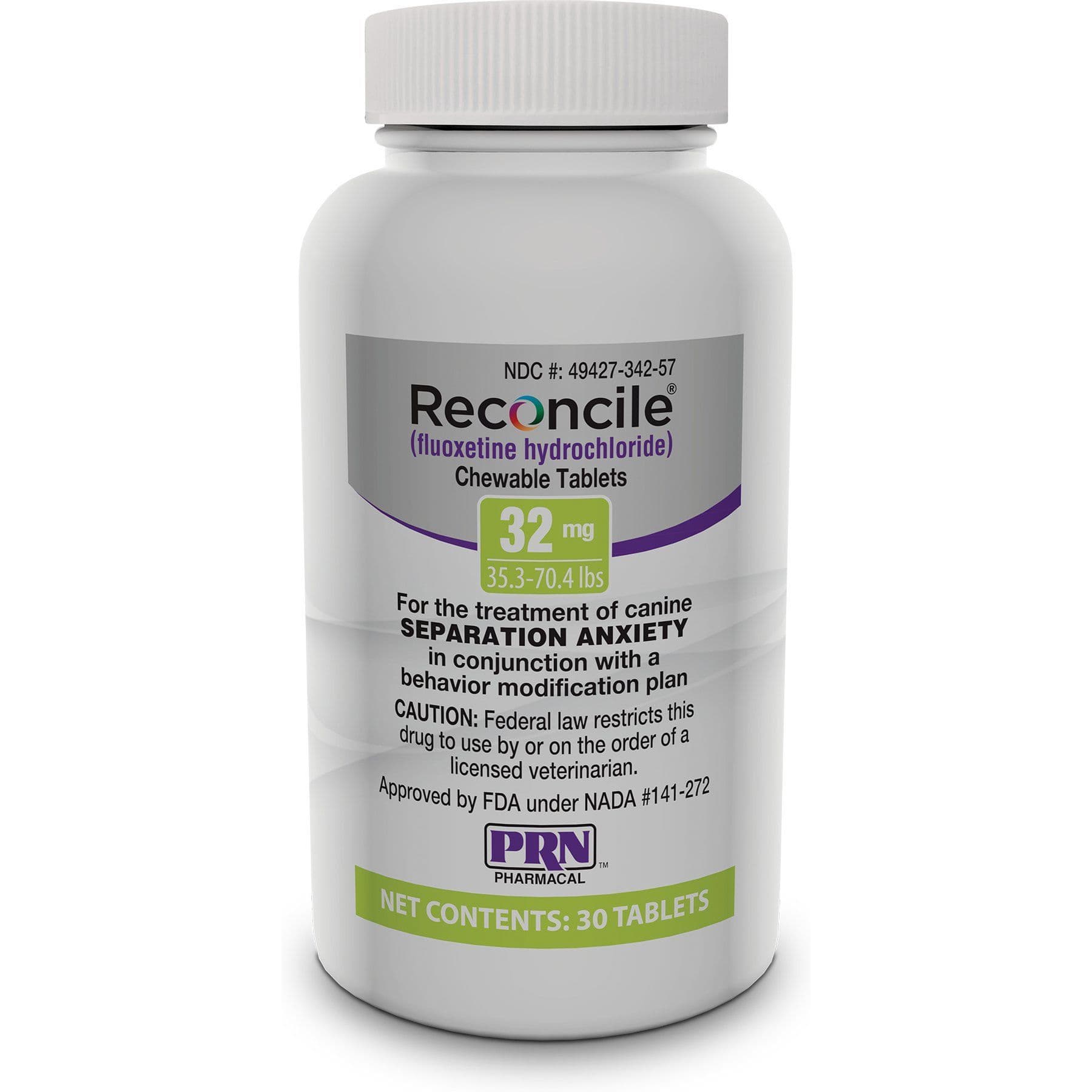
FDA-approved fluoxetine for canine separation anxiety, given once daily with a behavior plan; requires a vet prescription.
Webvet may earn a commission when you click through to Chewy, at no extra cost to you.
What will calm a dog's anxiety?
What calms an anxious dog is usually a drug matched to the type of anxiety plus a plan that changes the fear itself. Merck's guide for dog owners says drug treatment for almost any behavior change is most useful when combined with behavior modification.
As-needed drugs blunt fear within about 90 minutes of a dose. Daily drugs lower baseline anxiety over weeks, while training does the lasting work of teaching your dog that the trigger is safe.
Prescription dog anxiety meds vets use most
These are the five prescription dog anxiety meds worth knowing before your appointment, all listed in the Merck Veterinary Manual table of common drugs used to treat behavior problems in dogs:
- Trazodone: an as-needed drug for anxiety, phobias, and calming before veterinary care.
- Fluoxetine (Reconcile): a once-daily SSRI, FDA approved for canine separation anxiety.
- Sileo (dexmedetomidine): an as-needed oral gel, FDA approved for canine noise aversion.
- Gabapentin: an as-needed or regular drug for anxiety and fear that is also used for nerve pain and seizures.
- Clomipramine (Clomicalm): a daily drug, FDA approved for canine separation anxiety.

Trazodone
VCA Animal Hospitals says trazodone is used to treat behavioral disorders in dogs, especially anxiety- or phobia-related ones. Merck's table lists it for anxiety disorders, fear aggression, compulsive disorders, and sedation or anxiety relief for veterinary care.
Can anxiety meds help with dog aggression? When the aggression is fear-driven, trazodone is one of the drugs Merck lists for it. That is a decision for your vet after an exam, and any new aggression on a daily drug is worth reporting, since the Reconcile label lists aggression among fluoxetine's reported adverse events.
The practical details owners ask about most:
- Onset: about one to two hours for short-term stress relief, according to VCA.
- Duration: short acting, so it should stop working within 24 hours.
- Schedule: as-needed in Merck's table, with doses spaced 8 to 24 hours apart and a ceiling on the total in any 24-hour period.
Generic trazodone is a human-labeled tablet, so your vet sets the dog's dose and tells you how far ahead of the trigger to give it. Our guide to trazodone for dogs covers dosing questions in more depth.
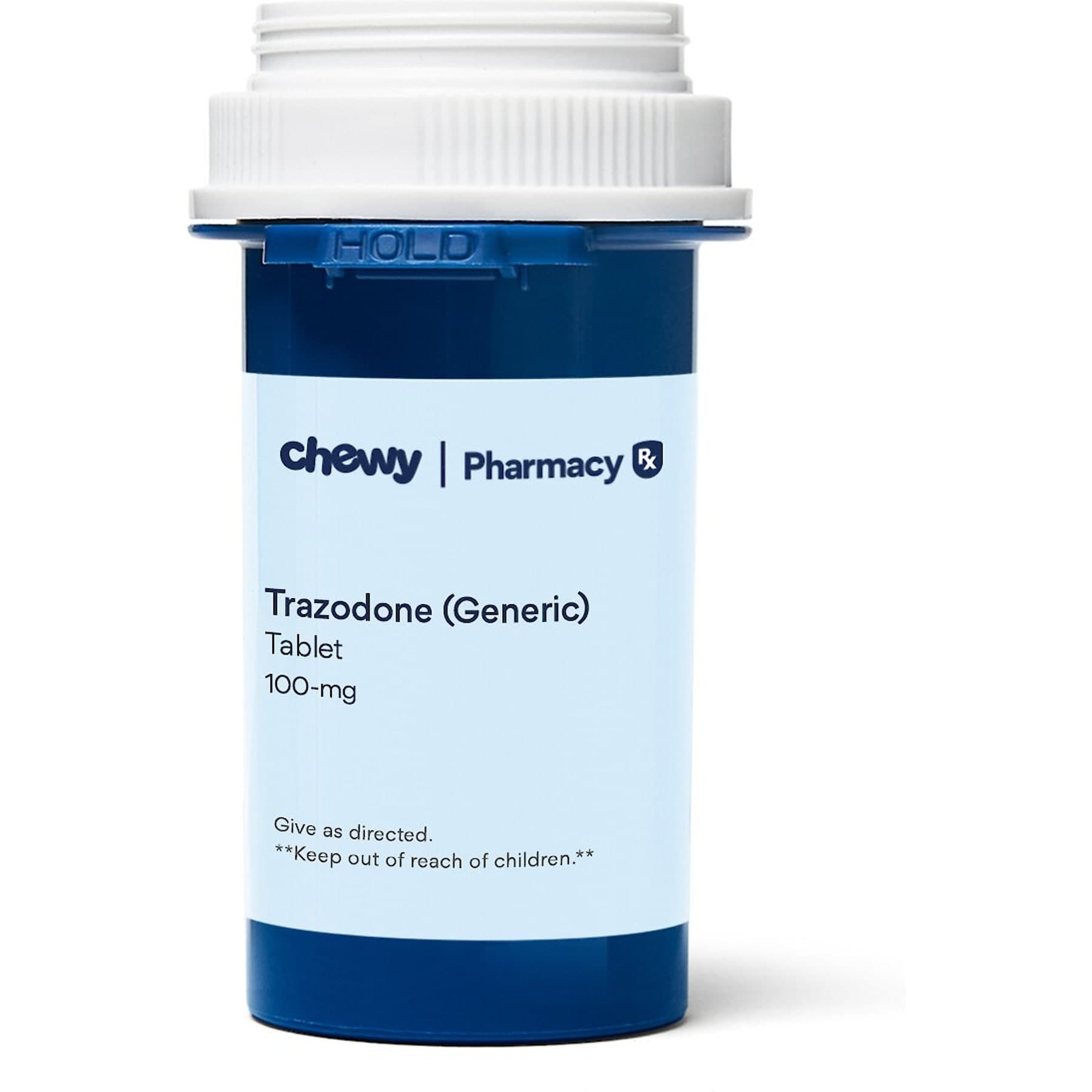
Generic trazodone tablets for as-needed situational anxiety, filled by prescription at the exact dose your vet sets.
Webvet may earn a commission when you click through to Chewy, at no extra cost to you.
Fluoxetine (Reconcile)
Fluoxetine is the daily option for chronic anxiety. Merck calls it typically the first-choice SSRI in dogs, and its drug table notes that fluoxetine is FDA approved for canine separation anxiety. The approved veterinary product is Reconcile, a chewable tablet given once daily.
The Reconcile label indicates it for canine separation anxiety in conjunction with a behavior modification plan, not on its own. That pairing matters: the label's comparison group, dogs on behavior modification alone, also improved, just less often than dogs given the drug.
Merck notes that all antidepressants have a lag time before a behavioral effect becomes evident. A slow first week on fluoxetine does not mean the drug has failed; the effect simply has not had time to build.
Sileo (dexmedetomidine)
Sileo is dexmedetomidine in an oromucosal gel, placed between the dog's cheek and gum rather than swallowed. Its FDA-approved label indicates it for the treatment of noise aversion in dogs, and Merck's table lists extralabel uses such as fear of car rides.
Because the first dose is timed to the noise itself, Sileo is an event drug for nights like New Year's Eve rather than a daily treatment.
Gabapentin
Merck's table lists gabapentin for anxiety, fear, neuropathic pain, and seizures. It gives two dosing patterns: regular dosing every 8 hours, or a single as-needed dose about 90 minutes before a stressor. VCA's gabapentin page says its effects begin in about 1 to 2 hours.
That flexibility is why gabapentin can fit either a situational or an ongoing plan. Your vet will choose the pattern based on whether your dog's fear is tied to an event or present most of the time.
Clomipramine (Clomicalm)
Clomipramine is also FDA approved for canine separation anxiety. Merck's table gives it once daily or split into two daily doses, and Merck's behavior chapter adds that it is approved for use as part of a comprehensive behavioral management program, not as a stand-alone fix.
As a tricyclic antidepressant, it shares the lag Merck describes for SSRIs and tricyclics, so expect weeks rather than hours before judging it.
Other prescription options
Merck also lists alprazolam, a benzodiazepine given as needed at intervals of about 6 hours for anxiety, fear, and phobias. It lists clonidine as well, which, like trazodone and gabapentin, takes effect in about 90 minutes. Your vet may suggest one of these when the five main drugs do not suit your dog.
Can you get dog anxiety meds without a vet prescription? Not these. Each is a prescription drug, and the Reconcile label warns that using it without a diagnosis, or without concurrent behavior modification, may expose a dog to unnecessary adverse reactions and may not provide any lasting benefit.
Daily or as-needed: how the choice is made
The pattern of your dog's fear drives the choice of drug. This is how the prescription meds for dog anxiety sort out:
- Predictable, occasional trigger: trazodone, gabapentin, Sileo, or alprazolam, timed before the event.
- Ongoing anxiety or separation anxiety: fluoxetine or clomipramine every day, together with a behavior plan.
- Both patterns at once: ask your vet before pairing a daily drug with an as-needed one, because VCA warns that serotonin syndrome is possible when trazodone is used with other serotonergic drugs.
- Pattern not clear yet: log each episode, with the date, the trigger, and how long it lasted, so your vet can see whether the fear is predictable.
Over-the-counter dog anxiety meds and supplements: what has evidence
Over-the-counter dog anxiety meds are mostly supplements, chews, and pheromone products sold without a prescription. The research picture is consistent: a few have modest data, many perform at placebo level, and none is an FDA-approved anxiety treatment.

The broadest look at the evidence comes from the noise fear therapy review in PMC. It concluded that the effect of the majority of nutraceuticals in use does not exceed that of a caregiver placebo effect. In plain terms, owners who expect a product to help tend to rate it as helping.
How to judge an OTC calming product
Because owner impressions are so easily swayed, the study behind a product tells you more than the claims on its label. Before buying, check:
- Was there a placebo group? Without one, improvement can reflect the caregiver placebo effect the noise fear review describes.
- Were owners blinded? Both the car-travel chew study and the Purina Calming Care probiotic trial covered below used blinded crossover designs.
- How many dogs, and which ones? A trial in 24 Labrador retrievers tells you less about a small, nervous terrier.
- Who reported the results? A manufacturer-reported figure deserves the same scrutiny as any marketing claim.
- How big was the effect? A mild change in one stress measure is not the same as a visibly calmer dog.
Keep a simple log of your dog's behavior before and after starting any product, so your impression is not the only measure.
Calming chews and alpha-casozepine
Alpha-casozepine appears in the best-designed chew study among these sources. In a blinded crossover study of dogs during car travel, a treat combining CBD, L-tryptophan, and alpha-casozepine produced a mild stress-reducing effect versus placebo. A smaller rise in the stress hormone cortisol was the only significant result.
That is real but modest evidence, and it applies to one combination product in one situation. For a product-by-product look at that category, see our guide to calming chews for dogs.
Pheromone diffusers
Pheromone diffusers release a calming pheromone and scent into a room. In a large owner survey cited by the noise fear review, only 28.8% of owners considered pheromones effective, which is no more than would be expected from a placebo effect.
The Tranquil Tails diffuser uses pads that each provide up to 24 hours of continuous pheromone and scent diffusion, and the company says it may help situational stress. A Vetstreet product review could not confirm a measurable drop in the reviewer's pets' anxiety and notes it is not a veterinary endorsement.
Our dog calming diffuser guide compares plug-in options for owners who want to try one as part of a broader plan.
Benadryl and other drugstore options
Benadryl (diphenhydramine) is an antihistamine, not an anxiety medication. VCA's diphenhydramine page describes it as a mild sedative and lists its uses as allergic reactions, motion sickness, and vomiting.
VCA also lists excitement as a possible effect, especially in cats, so a drowsy-making drug is not guaranteed to settle every pet. Read our Benadryl for dogs guide before reaching for it.
Homeopathic, THC, and other natural options
No veterinary source we reviewed offers evidence for homeopathic remedies or THC products for dog anxiety. Here is how the over-the-counter options rank on the evidence that does exist:
- Some controlled data: Calming Care (a small, manufacturer-reported crossover trial) and the CBD, L-tryptophan, and alpha-casozepine car-travel treat (a mild effect).
- Placebo level for noise fear: most nutraceuticals, plus pheromones in owner surveys.
- Not an anxiety treatment: Benadryl, a mild sedative.
- No supporting evidence found: homeopathic remedies and THC.
What OTC products can and cannot do
Put together, the evidence draws a clear line. Over-the-counter products can:
- Give a mild, measurable edge in a specific setting, as the car-travel treat did on cortisol.
- Fill a daily add-on role inside a vet's plan.
They cannot:
- Replace the exam that rules out other causes of the behavior.
- Match the field-trial results behind Reconcile and Sileo.
- Reliably calm noise fear, where most nutraceuticals sit at placebo level.
- Stand in for the behavior plan that Merck and the Reconcile label pair with medication.
Calming Care, a probiotic sold through vets
Purina Pro Plan Veterinary Diets Calming Care is a probiotic containing Bifidobacterium longum BL999, given as a once-daily sachet. dvm360 reported it as prescription only and described a 15-week, blinded, placebo-controlled crossover study in 24 Labrador retrievers, with Purina reporting improvement in 90% of dogs.
That is a controlled design, but a small, single-breed, manufacturer-reported one. It makes Calming Care a reasonable question for your vet as a daily add-on to an anxiety plan, rather than a replacement for a prescription drug.
The liver-flavored powder comes in 30-count packs, which is about a month's supply at one sachet a day.

Once-daily probiotic sachet with Bifidobacterium longum BL999 that your vet can add to an anxiety management plan.
Webvet may earn a commission when you click through to Chewy, at no extra cost to you.
Whichever product you try, give it a fair, logged trial and tell your vet about it, so it can be weighed alongside any prescription your dog takes.
 Sponsored
Vet care that's always there
Unlimited video calls and messaging with licensed vets for less than a typical vet visit. One membership covers up to five pets.
Use code Pets60
Plans start at $12/month · covers up to 5 pets
- Licensed vets in most states
- Rx for 150+ conditions
- 4.7 on Trustpilot
Dog anxiety meds side effects and safety
Most dog anxiety meds side effects fall into three groups: sedation, appetite changes, and stomach upset. Merck says the most common adverse effects of SSRIs are changes in appetite and GI signs, and seizures have also been reported. Here is what the label and reference sources list for each drug:
- Fluoxetine (Reconcile): Merck lists poor appetite, lethargy, sedation, vomiting, diarrhea, restlessness, and vocalization. The Reconcile label adds shaking, seizures, and aggression among reported events and contraindicates the drug in dogs with epilepsy or a history of seizures.
- Trazodone: VCA says side effects in dogs are not well documented but are generally mild, if present.
- Gabapentin: Merck lists sedation, wobbliness (ataxia), vomiting, diarrhea, increased appetite, agitation, and excitement.
- Sileo: the label warns that paradoxical excitation can occur, that other central nervous system depressants may strengthen its effects, and that it should not be used in dogs with severe heart, respiratory, liver, or kidney disease.
- Clomipramine: VCA says it should not be used in pets on monoamine oxidase inhibitors, such as amitraz flea collars.
As-needed and daily drugs differ in how side effects play out. Trazodone is short acting and should stop working within 24 hours, so effects from an event dose are brief. Daily drugs such as fluoxetine are taken for weeks, so appetite changes or stomach upset need watching over time, not just on day one.
Some reported effects look like the problem being treated: the Reconcile label lists restlessness and anxiety among its adverse events. A written log of appetite, energy, and behavior from the first dose makes it easier for your vet to tell a side effect from the original anxiety.
The Reconcile label also warns that seizures may occur even in dogs without a history of epilepsy or seizures. Any seizure on a daily drug is a reason to call your vet the same day, and any other change in dose or schedule belongs with your vet too.

Interactions are the other safety issue. Merck notes that SSRIs inhibit liver enzymes that process many drugs, so interactions are possible, and stacking serotonergic drugs raises the risk of serotonin syndrome. The Reconcile label bars use with an MAOI such as selegiline or amitraz, or within 14 days of stopping one.
If your dog takes fluoxetine for separation anxiety and you want to stop or switch, plan it with your vet. VCA's fluoxetine page says not to stop it abruptly unless your vet instructs you to.
Best dog anxiety meds by situation: fireworks, vet visits, separation, travel
The best dog anxiety meds for one situation can be the wrong choice for another. Matching the medication to the situation matters, because fireworks, vet visits, separation, and travel each call for a different approach.
A dog who panics only on fireworks night needs a fast, as-needed drug, while a dog with separation anxiety needs daily treatment and a training plan. The noise fear review adds a practical rule: trial any event medication before the event, because dogs respond individually.
Comfort measures at home can sit alongside the drug for event-driven stress. A pheromone diffuser near your dog's resting spot is one option owners try, as long as it is treated as an add-on rather than the plan itself.
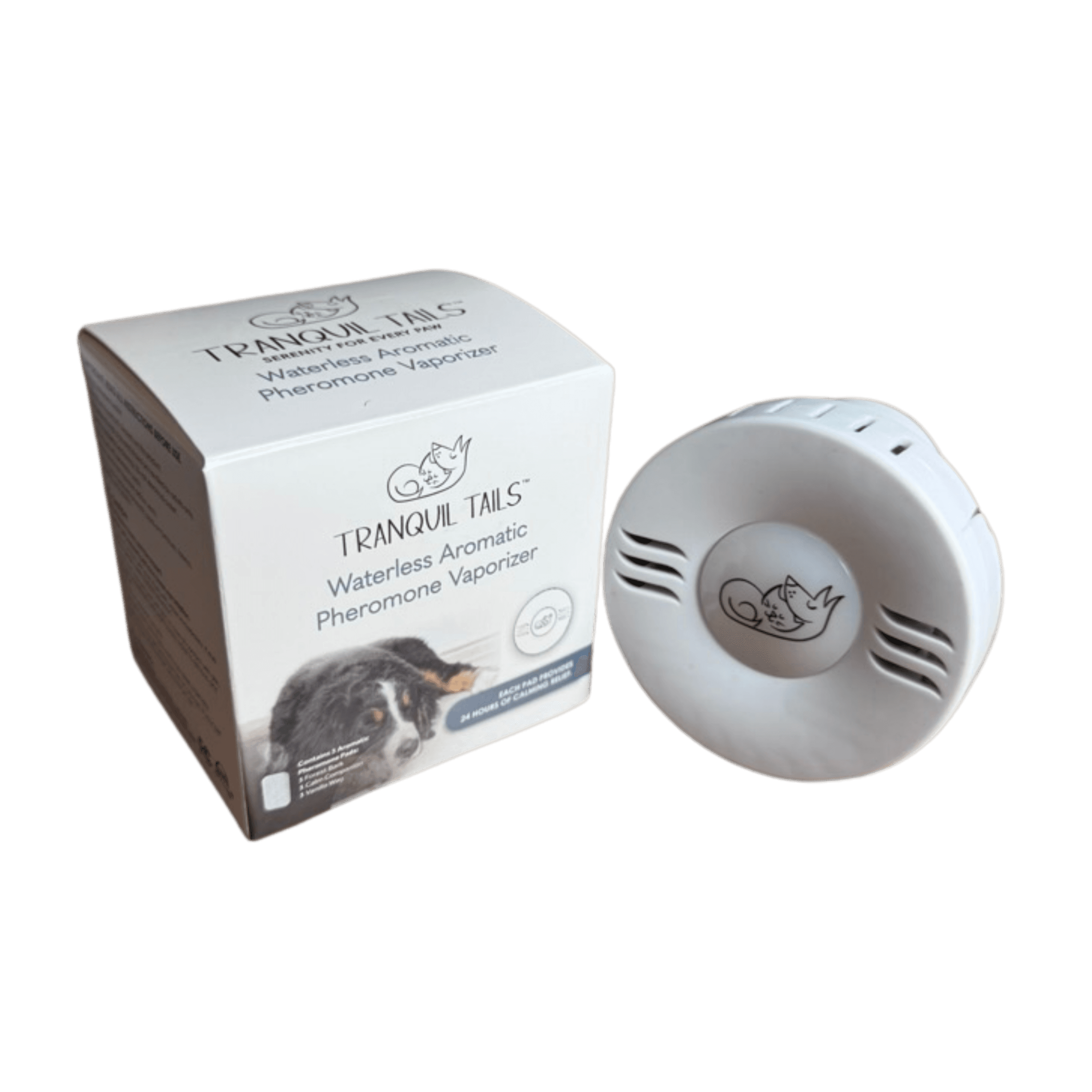
Plug-in pheromone diffuser with pads that run up to 24 hours; an add-on to your vet's plan, not a stand-in for treatment.
Webvet may earn a commission when you click through to Chewy, at no extra cost to you.
Here is how the main options line up by situation, timing, dosing pattern, and prescription status:
| Medication | Best-fit situation | Onset or timing | Dosing pattern | Prescription needed |
|---|---|---|---|---|
| Trazodone | Vet visits, fireworks, other predictable fear | About 1 to 2 hours | As-needed, doses 8 to 24 hours apart | Yes |
| Sileo (dexmedetomidine) | Fireworks and other noise aversion; car rides extralabel | First dose 30 to 60 minutes before the noise | As-needed, at least 2 hours between doses, no more than 5 per event | Yes |
| Gabapentin | Storms and other predictable stressors | About 1 to 2 hours | As-needed about 90 minutes before a stressor, or regular every 8 hours | Yes |
| Alprazolam | Noise fear and phobias | About 90 minutes | As-needed, about every 6 hours | Yes |
| Fluoxetine (Reconcile) | Separation anxiety and other chronic anxiety | 7 to 30 days; response judged at 8 weeks | Daily, once a day | Yes |
| Clomipramine (Clomicalm) | Separation anxiety | Weeks; all antidepressants have a lag | Daily, once or twice a day | Yes |
| Purina Calming Care | Daily add-on to an anxiety plan | No published onset | Daily sachet | Reported as prescription only |
| Pheromone diffuser | Situational stress at home | No published onset | Continuous; each pad lasts up to 24 hours | No |
| Benadryl (diphenhydramine) | Not an anxiety drug; mild sedative | No anxiety data | No anxiety use listed by VCA | No |
Fireworks and thunderstorms
Merck's owner guide says fear of thunderstorms is the most common noise fear, with fear of fireworks and other loud noises also common. Sileo is the drug here that is FDA approved for noise aversion, and its label is specific about timing:
- Give the first dose about 30 to 60 minutes before the noise, or right after your dog shows the first signs of fear.
- Place the gel between the cheek and gum; it should not be swallowed.
- Wait at least two hours between doses, and give no more than 5 doses during one noise event.
- Avoid food and treats for 15 minutes after each dose.
The evidence for each noise option looks like this:
- Sileo: in its field study, owners rated the effect good or excellent in 53 of 71 treated dogs versus 24 of 73 controls. The study used New Year's Eve fireworks, and the label states Sileo has not been evaluated for thunderstorm aversion.
- Trazodone: a small New Year's Eve comparison found both trazodone and Sileo effective, with owner satisfaction higher for trazodone. There was no placebo group.
- Gabapentin: it was associated with significantly lower fear scores during thunderstorms, although 3 of 18 dogs scored worse than on placebo.
- Alprazolam: an owner questionnaire reported 90.6% effectiveness for firework fears, which is a survey result, not a controlled trial.
- Daily SSRIs: the noise fear review notes they have not been tested specifically for noise fears in dogs.
If your dog trembles and hides when the sky starts booming, our guide to why a dog is shaking, scared, or anxious helps you read those signs.
Fireworks fall on known dates, which makes planning possible:
- Book the vet visit well ahead, since every drug option for noise fear needs a prescription.
- Do a trial dose on a quiet day, as the noise fear review advises.
- Time the dose: Sileo's first dose goes in 30 to 60 minutes before the noise, while trazodone and gabapentin need about 90 minutes.
- Start controlled exposure with recordings well before the season, the approach Merck recommends for noise phobias.
Vet visits and grooming
Merck's table lists trazodone for sedation or anxiety relief for veterinary care, and gabapentin can be given as a single dose about 90 minutes before a stressor. Both are oral doses given at home ahead of the appointment, so the timing is in your hands.
The same as-needed logic applies to other predictable stressors, such as a grooming appointment. Ask your vet for exact timing, and do a trial dose on a quiet day first so you know how your dog responds.
Separation anxiety
Separation anxiety is the clearest case for daily medication. Fluoxetine (Reconcile) and clomipramine are both FDA approved for it, and in the Reconcile field study, 73% of dogs on the drug improved significantly at 8 weeks, compared with 51% on behavior modification alone.
Medication does not replace management. Merck advises that dogs with separation anxiety be left alone as rarely as possible to prevent further sensitization, so arranging company during treatment is part of what to do for separation anxiety in dogs.

For puppies, prevention is a training job, and the Reconcile label notes its safety was not studied in dogs under 6 months. Our guide to separation anxiety in dogs covers how to prevent it and rebuild a dog's comfort with being alone.
Choosing between the two daily drugs is your vet's call. Reconcile is a once-daily chewable, while clomipramine is given once or twice a day, and both carry the same rule against monoamine oxidase inhibitors such as amitraz flea collars.
If separation anxiety does not improve, your vet can refer you to a dog behaviorist. Home remedies, homeopathic remedies, and dog beds marketed for separation anxiety have no supporting data in the veterinary sources we reviewed. A comfortable resting spot is worth having, but it is not a treatment.
Car rides and travel
For car anxiety in dogs, medication options are limited. Merck's table lists fear of car rides as an extralabel use of Sileo, which means a vet can prescribe it for that purpose even though the label covers noise aversion.
Over-the-counter data for the car is thin too: the CBD, L-tryptophan, and alpha-casozepine treat produced only a mild stress-reducing effect. VCA lists motion sickness among Benadryl's uses, but that is a different problem from fear of the car itself.
Whatever your vet prescribes for travel, try it on a short drive before a long trip, the same trial-first logic the noise fear review applies to fireworks medication.
How to treat a highly anxious dog?
Start with a vet exam, then combine medication with a structured plan. Merck's owner guide says many fearful dogs can be treated with behavior modification programs that focus on desensitization and counterconditioning, with medication prescribed by the veterinarian in addition.
For a dog in frequent distress, ask your vet whether a daily drug for baseline anxiety makes sense alongside a training plan built around the specific triggers.
How to get dog anxiety meds and what the vet needs to know
Dog anxiety treatment starts with an appointment, not a purchase. The Reconcile label says a comprehensive physical examination should come first to rule out other causes of the behavior, and the Sileo label restricts that drug to use by or on the order of a licensed veterinarian.
The label and reference sources point to a clear sequence from first visit to a working plan:
- Exam and history: your vet looks for medical causes before calling the problem anxiety.
- Diagnosis: separation anxiety, noise aversion, or another pattern decides between a daily and an as-needed drug.
- Behavior plan: the Reconcile label pairs the drug with behavior modification rather than using it alone.
- Trial dose: for event drugs, the noise fear review advises a trial before the event itself.
- Recheck: the Reconcile label calls for case management to be reevaluated if no improvement is seen within 8 weeks.
Bring notes to the visit. The more specific you are, the easier it is for your vet to choose between daily anxiety meds for dogs and an as-needed option. Tell your vet:
- When the anxiety happens: storms, fireworks, departures, car rides, or bedtime (our guide to dog anxiety at night covers that pattern).
- What an episode looks like and how long it lasts, plus a short video if you can safely record one.
- Every medication, supplement, and flea or tick product your dog uses, because SSRIs can interact with other drugs and amitraz collars are off-limits with fluoxetine and clomipramine.
- Any seizure history, since the Reconcile label contraindicates fluoxetine in dogs with epilepsy or past seizures.
- Any heart, breathing, liver, or kidney disease, since severe forms rule out Sileo.
- Your dog's age, since Reconcile was not studied in dogs under 6 months.
- Which over-the-counter products you have already tried, and what changed.
Then ask your own questions before you leave:
- Is this drug daily or as-needed, and how far ahead of a trigger should I give it?
- How long before we judge whether it is working?
- Which side effects are expected, and which mean I should call?
- Is it safe with my dog's other medications, supplements, and flea or tick products?
- How do we stop or switch it later?
Which is the best dog anxiety medication? The one matched to your dog's diagnosis and pattern. There is no single best choice for every dog:
- Best for chronic anxiety: a daily drug such as fluoxetine or clomipramine, paired with a behavior plan.
- Best for predictable events: an as-needed drug such as trazodone, gabapentin, or Sileo, trialled before the event.
- Best over-the-counter dog anxiety meds: the few products with controlled data, used as add-ons rather than treatment.
- Best natural dog anxiety medication: still a question for your vet, because supplements and drugs can overlap in a dog's routine.
Once your vet writes the prescription, you can fill it at a local or online pharmacy. Chewy lists Reconcile (fluoxetine hydrochloride) Tablets for Dogs, 32-mg, 60 tablets for daily separation anxiety treatment and Trazodone (Generic) Tablets, 100 mg, 30 tablets for as-needed use. Check that the strength on the order matches what your vet wrote.
Human-labeled generics such as trazodone come in fixed tablet strengths, such as 100 mg, and a tablet strength is not the same thing as your dog's dose. Your vet's written instructions decide how much to give and when.
For a dog anxiety attack, meaning a sudden panic episode, no pill works instantly. Oral as-needed drugs such as trazodone and gabapentin take about 90 minutes, and even Sileo works best given 30 to 60 minutes ahead, so the plan is to have the prescribed dose on hand and give it before the next predictable trigger.
When the first drug does not help
Not every dog responds to the first choice; even in the Reconcile field study, some treated dogs did not improve significantly. The label calls for case management to be reevaluated if there is no improvement within 8 weeks, which can mean revisiting the diagnosis, the behavior plan, or the drug itself.
Switching takes care. The Reconcile label sets a 6-week washout after stopping it before an interacting drug is started, so changes between daily drugs follow your vet's schedule rather than an overnight swap.
For an as-needed drug, check the timing before deciding it failed. Merck puts trazodone and gabapentin at about 90 minutes, so a dose given as the fireworks start may simply have been given too late.
Medication plus training: why meds alone rarely fix dog anxiety
Medication lowers the fear; training changes the response. Merck's owner guide says drug treatment for almost any behavior change is most useful when combined with behavior modification.
Merck's professional chapter goes further: only with concurrent behavior modification can new neuronal pathways be established and new behaviors learned. In practice, the drug creates a calmer window, and the behavior plan is what your dog learns inside it.

Merck also notes that antidepressants are given more commonly as adjuncts to behavior modification, and the noise fear review states that medication should not be the sole treatment component.
The Reconcile label is blunt about the alternative: using the drug without concurrent behavior modification may not provide any lasting benefit. Its own field data also show the other side, with 51% of dogs improving on behavior modification alone.
Merck's guidance points to these building blocks for a behavior plan:
- Desensitization and counterconditioning: gradual, positive exposure to the trigger, the approach Merck's owner guide says many fearful dogs can be treated with.
- Recordings for noise phobias: Merck says controlled exposure is best done with recordings, which lets you control the volume.
- Reward-based training: according to Merck, dogs trained with rewards have fewer behavioral problems and are less fearful.
- No positive punishment: Merck warns it can cause fear and anxiety toward the owner.
- Fewer alone-times for separation anxiety: to prevent further sensitization while treatment takes hold.
A small study shows how the pieces fit. In five dogs with separation-related problems given fluoxetine plus behavior modification, measured responses were consistent with a possible return toward normal by weeks 2 and 6. There was no placebo group, and the authors could not say which part of the plan caused the change.
A vet or a dog behaviorist can turn those blocks into a schedule that fits your dog's triggers. For a daily drug, the sources line up into a rough timeline:
- First weeks: the drug builds over the 7 to 30 days Merck describes, while management such as fewer alone-times starts right away.
- By week 8: the Reconcile label calls for the plan to be reevaluated if there is no improvement.
- After improvement: training continues, because the Reconcile label recommends continued behavioral modification to prevent the signs from coming back.
If your dog's nervousness started after a move, or you are wondering what the 3-3-3 rule means for an anxious dog, our guide to anxiety relief for dogs covers moving-stress signs and that adjustment timeline alongside non-drug calming steps.
How to help a nervous dog?
Start early and keep it positive. Merck's owner guide stresses the importance of early treatment of fears, phobias, and anxieties, and it notes that dogs trained with rewards are less fearful. Avoid punishment, which can make a dog afraid of you.
If nervousness is frequent or intense, book a vet exam so medication can be considered alongside training rather than instead of it.
Dog anxiety meds questions
Frequently Asked Questions
What is the most common dog anxiety medication vets prescribe?
No source ranks a single drug as the most common overall, but two names come first. For predictable events, trazodone is the first option the Merck Veterinary Manual names among drugs that take effect in about 90 minutes.
For daily treatment, Merck says fluoxetine is typically the first-choice SSRI, and it is FDA approved for separation anxiety as Reconcile. The other three fill narrower roles: Sileo for noise aversion, gabapentin for either pattern, and clomipramine as a second daily drug approved for separation anxiety.
Can I give my dog Benadryl for anxiety?
Not as an anxiety treatment. VCA describes diphenhydramine as a mild sedative, so at most it offers mild sedation; it is not an anxiety drug, and its listed uses are allergic reactions, motion sickness, and vomiting.
Ask your vet before giving it, and ask about a drug aimed at the fear itself if your dog panics during predictable events.
How long do dog anxiety meds take to work?
As-needed drugs work within hours. VCA says trazodone takes effect in about one to two hours, and Merck puts trazodone, gabapentin, clonidine, and alprazolam at about 90 minutes.
Daily drugs are slower. Merck gives 7 to 30 days for SSRIs and tricyclics. The Reconcile label reports 42% of dogs improved in the first week, with response judged at 8 weeks, so a dog four to six weeks into daily fluoxetine is still inside the normal evaluation window.
Can dogs be on anxiety meds long term?
Long-term use is a vet decision with limited label data behind it. The Reconcile label says effectiveness and clinical safety beyond 8 weeks were not evaluated, although the drug was given at the label dose for one year in a laboratory safety study.
No veterinary source we reviewed sets a monitoring schedule, so ask your vet whether they want annual bloodwork or other checks. When it is time to stop, ask whether to taper. The Reconcile label says a taper is not necessary because of the long half-life, while VCA advises against stopping fluoxetine abruptly without your vet's instruction.
Veterinarian · BVMS MRCVS
Dr. Pippa Elliott, BVMS, MRCVS, is a veterinarian with nearly 30 years of experience in companion animal practice. Dr. Elliott earned her Bachelor of Veterinary Medicine and Surgery from the University of Glasgow. She was also designated a Member of the Royal College of Veterinary Surgeons. Married with 2 grown-up kids, Dr. Elliott has a naughty Puggle named Poggle, 3 cats and a bearded dragon.
Related reading

Interceptor Plus for Dogs: What It Prevents, Dosing by Weight, Side Effects, and vs. Heartgard Plus

Heartgard Plus for Dogs: What It Prevents, Dosing by Weight, Side Effects, and Missed Doses

Can Dogs Have Tylenol? Acetaminophen Toxicity in Dogs
