Methimazole for Cats: Dosage, Side Effects, and Monitoring
Methimazole is the prescription tablet, liquid, or ear gel vets use to control an overactive thyroid in cats. This guide covers how the dose is set, the forms, side effects, when to call the vet, and the rechecks.

BVMS MRCVS
Medically reviewed by Dr. Pippa Elliott, BVMS MRCVS · Last reviewed

Drug facts
Methimazole for Cats· Methimazole
Methimazole is a prescription antithyroid drug that controls hyperthyroidism in cats. FDA-approved forms are Felimazole and generic coated tablets (2.5 mg and 5 mg) and Felanorm oral solution (5 mg/mL); compounded liquids and transdermal ear gels are made to a vet's order. The label starting dose is 2.5 mg every 12 hours, adjusted from blood tests.
 Sponsored
Is Methimazole for Cats right for your cat?
A licensed vet at Dutch can assess your cat over video and prescribe treatment when it's appropriate, delivered to your door.
Use code Pets60
Plans start at $12/month · covers up to 5 pets
- Licensed vets in most states
- Rx for 150+ conditions
- 4.7 on Trustpilot
Methimazole for cats: what it treats, prescription status, and whether today is a vet day
Methimazole for cats is a prescription antithyroid drug that controls hyperthyroidism, an overactive thyroid gland. The U.S. Food and Drug Administration (FDA) explains that it works by blocking the production of thyroid hormones. Your vet sets the dose and then adjusts it from blood test results.
Methimazole for cats comes as coated tablets, an oral solution, a compounded liquid, or a transdermal gel rubbed onto the ear flap. Today is a vet day if a cat has not been diagnosed yet, or if a cat already on the drug is vomiting, not eating, unusually tired, itchy, or yellow in the eyes or skin.
- 1What methimazole treats in cats is hyperthyroidism, where the thyroid makes too much thyroxine (T4).
- 2This is how vets set the starting dose: the Felimazole and Felanorm labels start at 2.5 mg every 12 hours, then adjust after 3 weeks from blood results.
- 3The FDA-approved forms are coated tablets and an oral solution; compounded liquids and ear gels are made to a vet's order.
- 4Recheck blood tests follow within the first weeks, then every few months for as long as the cat takes the drug.
- 5Vomiting, poor appetite, tiredness, itching, or yellow eyes or skin on methimazole mean a call to the vet.

What is methimazole prescribed for in cats?
Methimazole is prescribed to treat hyperthyroidism in cats. The Felimazole FDA approval summary states the tablets are indicated for the treatment of hyperthyroidism in cats. The Merck Veterinary Manual explains the disease means excess thyroxine (T4) and triiodothyronine (T3), most often from a benign thyroid adenoma or adenomatous hyperplasia.
The most common sign, according to the FDA, is weight loss despite an increased appetite. Methimazole controls the disease rather than curing it: VCA Animal Hospitals says it must be given for life, and Merck says treatment is lifelong when the drug is the only therapy.
The FDA lists two approved products, Felimazole oral tablets and Felanorm oral solution. In 2025 it also approved generic Methimazole Coated Tablets in 2.5 mg and 5 mg strengths, which the FDA evaluated as bioequivalent to Felimazole. Generic tablets such as Methimazole (Generic) Tablets, 5-mg, 30 tablets are filled by Chewy Pharmacy only with a veterinarian's prescription.
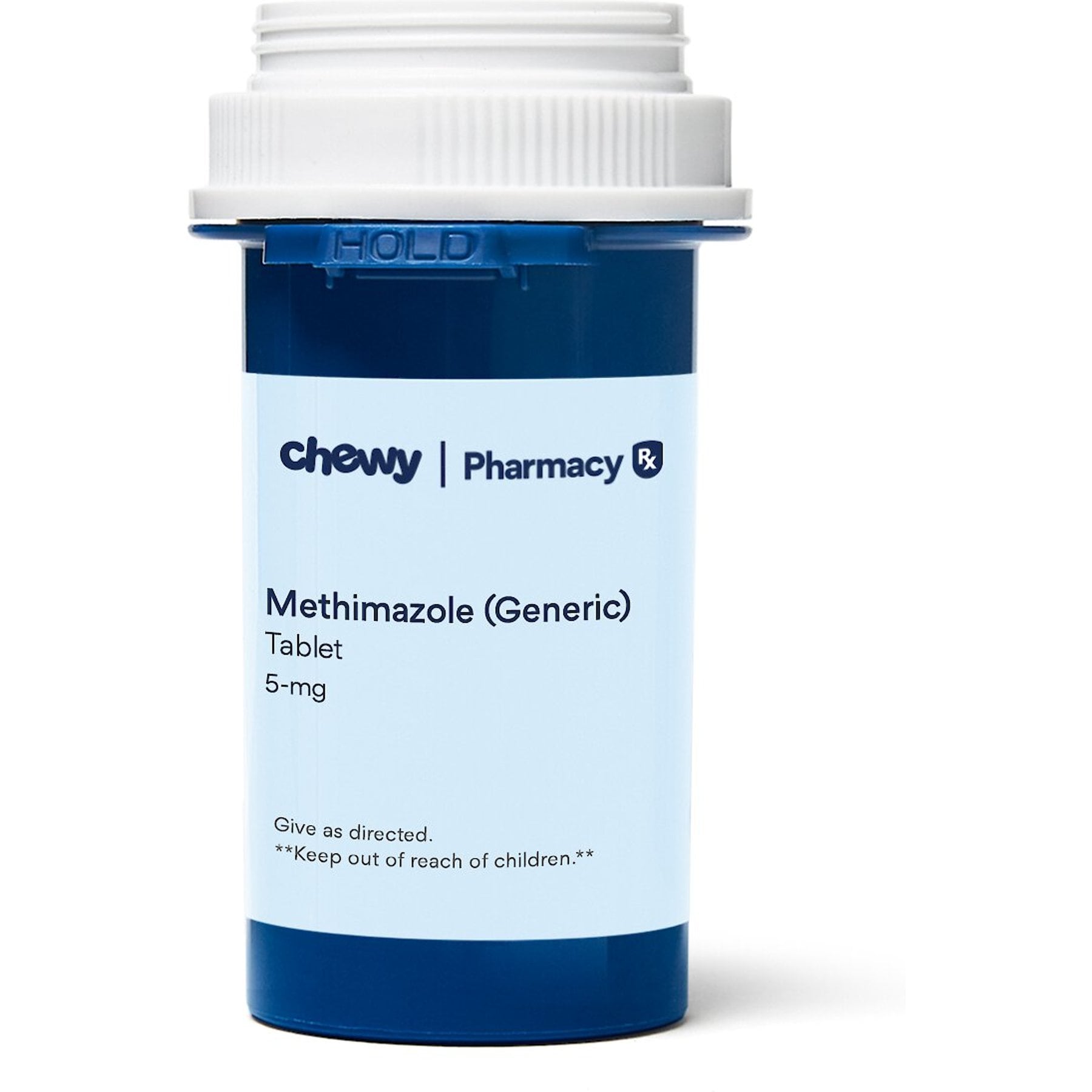
A generic 5 mg methimazole tablet a pharmacy fills against your vet's written prescription for a hyperthyroid cat.
Webvet may earn a commission when you click through to Chewy, at no extra cost to you.
Is it cruel to not treat a cat with hyperthyroidism?
Leaving it untreated lets a progressive, life-threatening disease worsen. The 2016 AAFP Guidelines for the Management of Feline Hyperthyroidism call untreated feline hyperthyroidism a progressive disease that can lead to significant illness and death, and the panel recommends treating all hyperthyroid cats. The Cornell Feline Health Center adds that untreated changes may eventually compromise the heart.
Questions about canned tuna, the best wet food, whether the disease hurts, and how long a 17-year-old cat can live with it are covered in the guide to hyperthyroidism in cats. In brief, Cornell says the prognosis is generally good with appropriate therapy, and Merck says a cat on an iodine-restricted diet must not eat other food or treats.
Methimazole dosage for cats: tablets, liquid, and transdermal gel
Methimazole dosage for cats is set by the vet within the label range: the Felimazole and Felanorm labels start at 2.5 mg every 12 hours, and the maximum is 20 mg per day divided, never more than 10 mg at once. Give exactly what your vet prescribed, and never change or stop the dose without the vet.
Liquid doses are measured in milligrams too. Felanorm is a 5 mg/mL solution, and a compounded option such as Methimazole Compounded Aqueous Oral Liquid, 2.5-mg/mL, 90 mL, Chicken is prepared to order for cats that resist tablets. Chewy Pharmacy fills it only with a veterinarian's prescription, and the vet sets the volume.
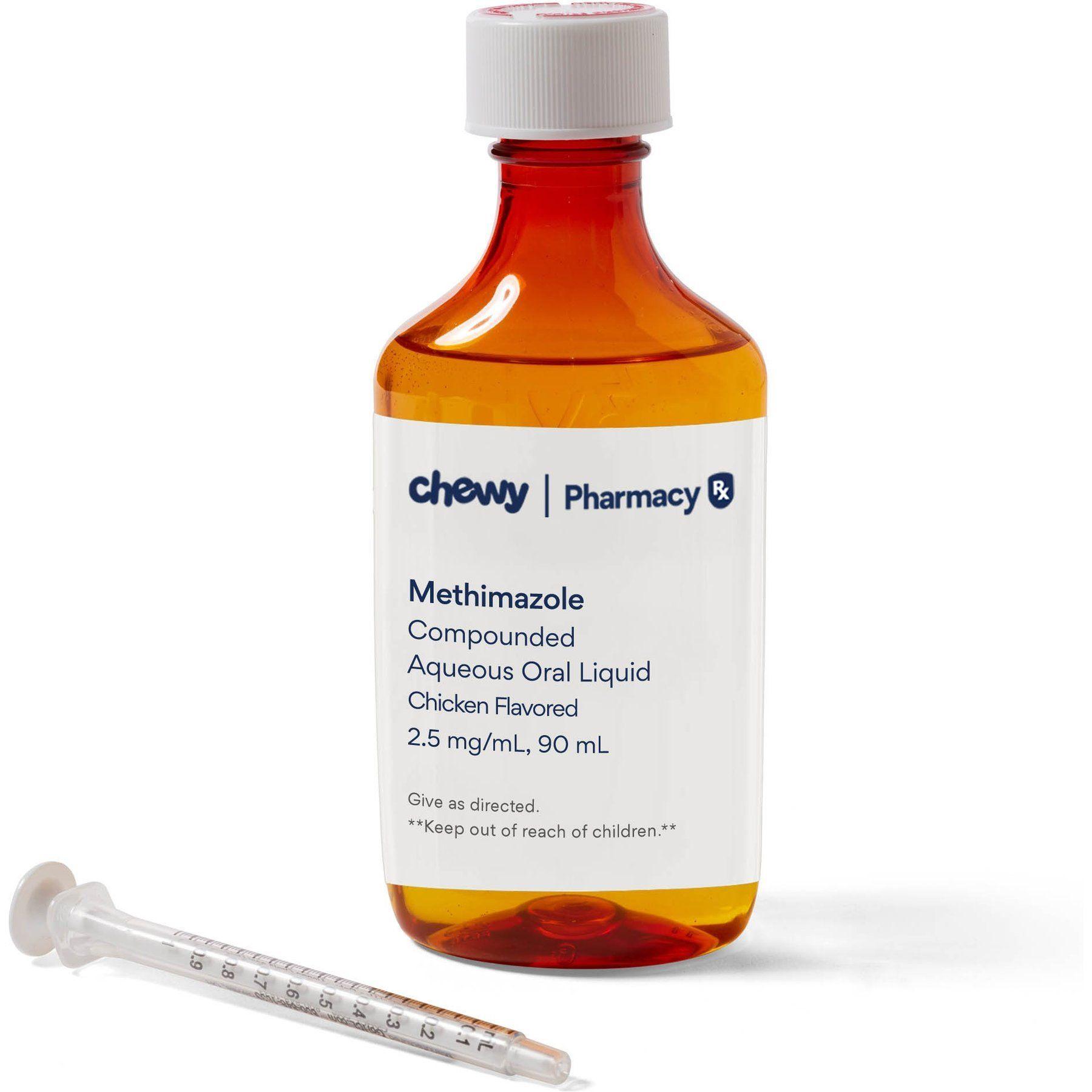
A chicken-flavored compounded methimazole liquid prepared to a vet's prescription for cats that resist tablets.
Webvet may earn a commission when you click through to Chewy, at no extra cost to you.
These label and reference figures show the range vets work within for each form, not a home dosing guide. The vet calculates the exact dose for each cat.
| Form | What the label or reference states | When vets choose it | Recheck the vet plans |
|---|---|---|---|
| Felimazole coated tablets, 2.5 mg or 5 mg (FDA-approved for cats) | Starting dose 2.5 mg every 12 hours; after three weeks, titrated in 2.5 mg increments; maximum 20 mg per day divided, not to exceed 10 mg as a single administration (FDA approval summary) | Cats that accept a whole tablet; the label says do not break or crush tablets | Blood tests at 3 and 6 weeks, then every 3 months (FDA) |
| Generic methimazole coated tablets, 2.5 mg or 5 mg (FDA-approved generic) | Bioequivalent to Felimazole; maximum 20 mg per day, not to exceed 10 mg as a single administration (FDA) | Cats that take tablets, when the vet prescribes the generic | Same recheck blood tests as the brand |
| Felanorm oral solution, 5 mg/mL (FDA-approved generic) | Starting dose 2.5 mg every 12 hours; adjustments in 2.5 mg increments; given with the enclosed 1 mL dosing syringe (Felanorm label) | Cats that are easier to dose by syringe than by pill | Hematology, biochemistry, and TT4 before starting; more frequent monitoring above 10 mg per day |
| Compounded methimazole oral liquid (made to a vet's order) | No FDA label; follow the compounding pharmacy's label and measure each dose carefully (VCA) | Cats that refuse tablets and need a liquid the vet orders compounded | Same recheck schedule the vet sets for tablets |
| Transdermal methimazole gel (compounded, applied to the inner ear flap) | Initial dose 1.25–2.5 mg/cat, PO or transdermal, every 12 hours (Merck Veterinary Manual) | Uncooperative cats; stomach upset may be less frequent (AAFP) | Blood rechecks plus a look at the ear skin for irritation |
| Tapazole and other human methimazole tablets (human drug, extra-label in cats) | No cat label; the FDA says human-approved products have not been proven safe and effective in cats | Only when the vet decides an extra-label product is needed | Same recheck blood tests |
The transdermal gel starts in the same range: Merck gives an initial dose of 1.25–2.5 mg per cat every 12 hours, by mouth or as a transdermal gel.
The sources differ on timing of the first adjustment. The Felimazole label waits three weeks before titrating, while Merck adjusts at 2-week intervals toward a T4 in the low- to mid-reference interval. The AAFP guidelines reduce the dose in decrements of 1.25–2.5 mg/day if T4 runs low and question compliance above 10 mg/day.
The approved tablets come in 2.5 mg and 5 mg strengths, so either tablet can be part of a label regimen. Methimazole (Generic) Tablets, 5-mg, 30 tablets is listed at $3.60 on Chewy when checked in November 2026, and it is dispensed only on a veterinarian's prescription.
Is 5mg of methimazole a lot?
No, 5 mg sits inside the label range: Felimazole is sold as a 5 mg tablet, starts at 2.5 mg every 12 hours, and allows up to 20 mg per day, never more than 10 mg at once. In its 71-cat field study, the mean dose at week 20 was 2.5 mg twice daily.
Starting higher is a different picture. In an early study reported in the same summary, two cats collapsed and died within 12 days at 5 mg twice daily, and adverse reactions prompted a lower starting dose. Whether 5 mg suits a cat depends on its T4 results, so only the vet makes that call.

Felimazole, generic tablets, compounded liquid, and transdermal gel: forms, cost, and alternatives
Felimazole and methimazole differ as brand and ingredient: Felimazole is the brand name and methimazole is the active ingredient. Tapazole is a human brand, and the FDA says human methimazole products have not been proven safe and effective in cats. The FDA-approved methimazole products for cats are:
- Felimazole Coated Tablets (Dechra), 2.5 mg and 5 mg, approved May 27, 2009 under NADA 141-292
- Felanorm oral solution (Norbrook Laboratories), 5 mg/mL in 30 mL or 100 mL bottles with a 1 mL dosing syringe, the first generic methimazole oral solution, covered by the Felanorm label
- Methimazole Coated Tablets (Felix Pharmaceuticals), 2.5 mg and 5 mg, the first FDA-approved generic tablets for cats, bioequivalent to Felimazole
Felimazole for cats is the original approved option. In the 113-cat field study behind its approval, 64 of 105 evaluable cats (61%) counted as treatment successes at Day 42, meaning normal TT4 plus clinical improvement. The approval summary says it may be dispensed only by or on the lawful order of a licensed veterinarian.
Several compounded products exist outside the approved list:
- A flavored oral liquid made by a compounding pharmacy (VCA). Felanorm, by contrast, is an approved oral solution.
- A topical gel rubbed onto the hairless inner ear flap (VCA).
- A chewable form is also a compounded preparation, because the FDA-approved products are coated tablets and an oral solution.
VCA notes that certain cat formulations are used off label, meaning that particular formulation has not been reviewed or approved by the FDA.
Is transdermal methimazole better than oral?
Not across the board; the transdermal gel is a trade-off. The AAFP guidelines say transdermal preparations can be useful for uncooperative cats and that gastrointestinal upset may be less frequent. They also advise switching back to oral if the ear skin becomes irritated.
A 2013 Journal of Feline Medicine and Surgery follow-up of 60 cats found transdermal methimazole a safe long-term option: two cats developed ear redness needing a switch to oral, and three had mild, passing stomach signs. Several owners admitted they did not treat regularly. VCA adds that the gel may not suit cats that groom each other.
The cost of methimazole for cats depends on form. Felimazole (methimazole) Tablets for Cats, 2.5-mg, 60 tablets is listed at $12.60 on Chewy when checked in November 2026. Methimazole Compounded Aqueous Oral Liquid, 2.5-mg/mL, 90 mL, Chicken is listed at $57.75 on Chewy when checked in November 2026. Both are filled only with a veterinarian's prescription, and Chewy Pharmacy dispenses the Felimazole pack only against one.
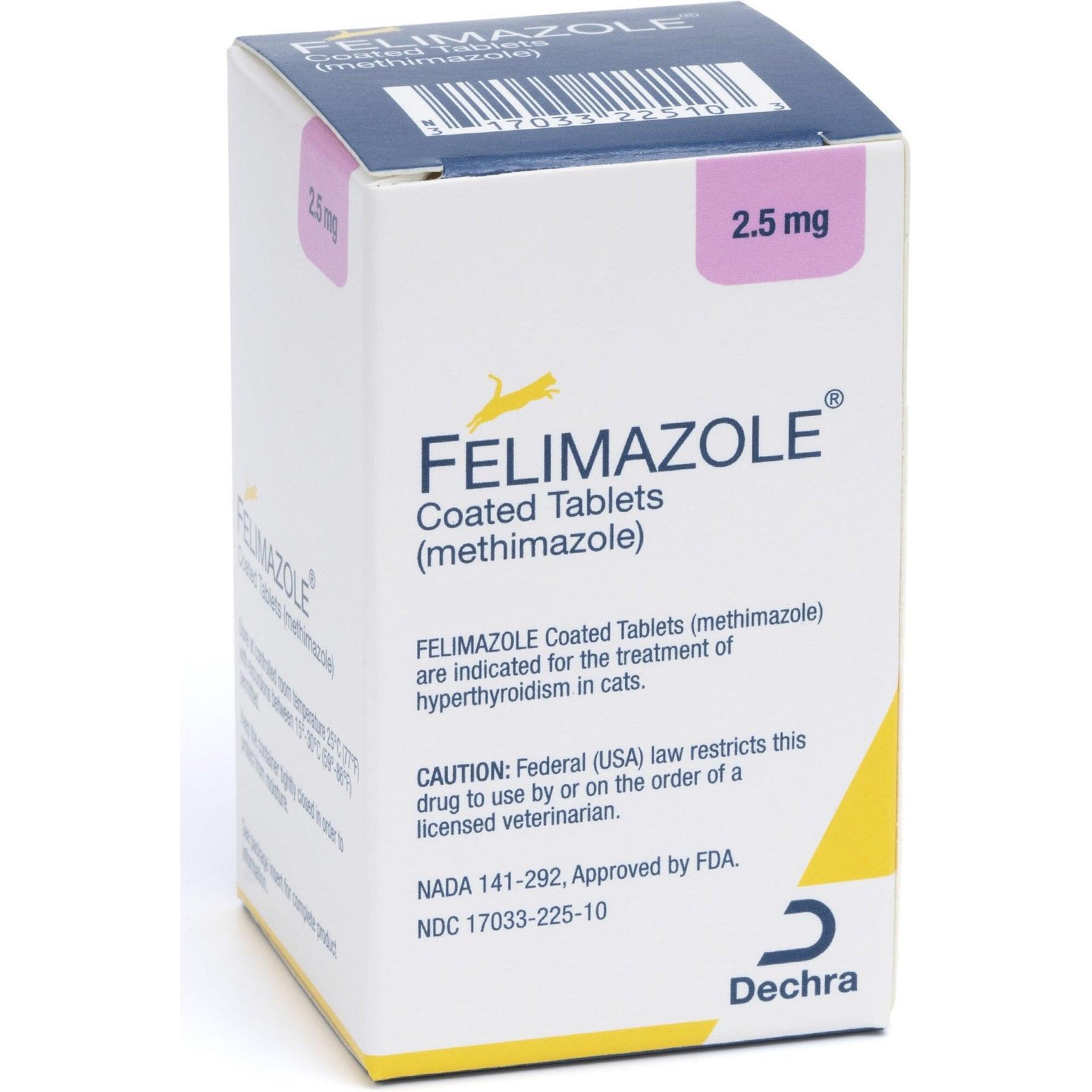
The FDA-approved brand methimazole tablet for cats, filled only against a veterinarian's prescription.
Webvet may earn a commission when you click through to Chewy, at no extra cost to you.
Owners can buy methimazole for their cats at the vet clinic or from a pharmacy that fills a vet's prescription. No non-prescription version exists, and the FDA warns about unapproved generic tablets marketed online. Any seller offering it without a vet prescription is outside the approved route.
The alternatives to methimazole are curative or dietary rather than another daily drug:
- Radioactive iodine (I-131): Merck calls radioiodine the curative treatment of choice; it requires hospitalization at a designated center. Cornell reports cure within three months in approximately 95 percent of cases.
- Surgery: Merck describes thyroidectomy as potentially curative, with the risk of anesthesia.
- Carbimazole: the AAFP guidelines say it is not currently available in the US.
- An iodine-restricted prescription diet, covered next.
What is the best food to feed a cat with hyperthyroidism?
For a cat managed by diet, the best food is the iodine-restricted prescription diet the vet chooses, fed as the only food. Merck says most hyperthyroid cats fed it exclusively become euthyroid in 8–12 weeks. The AAFP guidelines report significantly reduced T4 in 75% of cats with good compliance, but poor palatability in up to 12% of cats and difficulty in multi-cat households.
The AAFP guidelines add that diet is harder for cats on iodine-containing flavored compounded medicines or supplements, and Cornell calls iodine restriction somewhat controversial. A regular senior cat food is not iodine-restricted. Hill's Prescription Diet y/d Feline Thyroid Health Dry Cat Food, 4-lb is one iodine-restricted diet. Chewy sells it only with a veterinarian's authorization, and choosing diet instead of methimazole is the vet's decision, never a home swap.
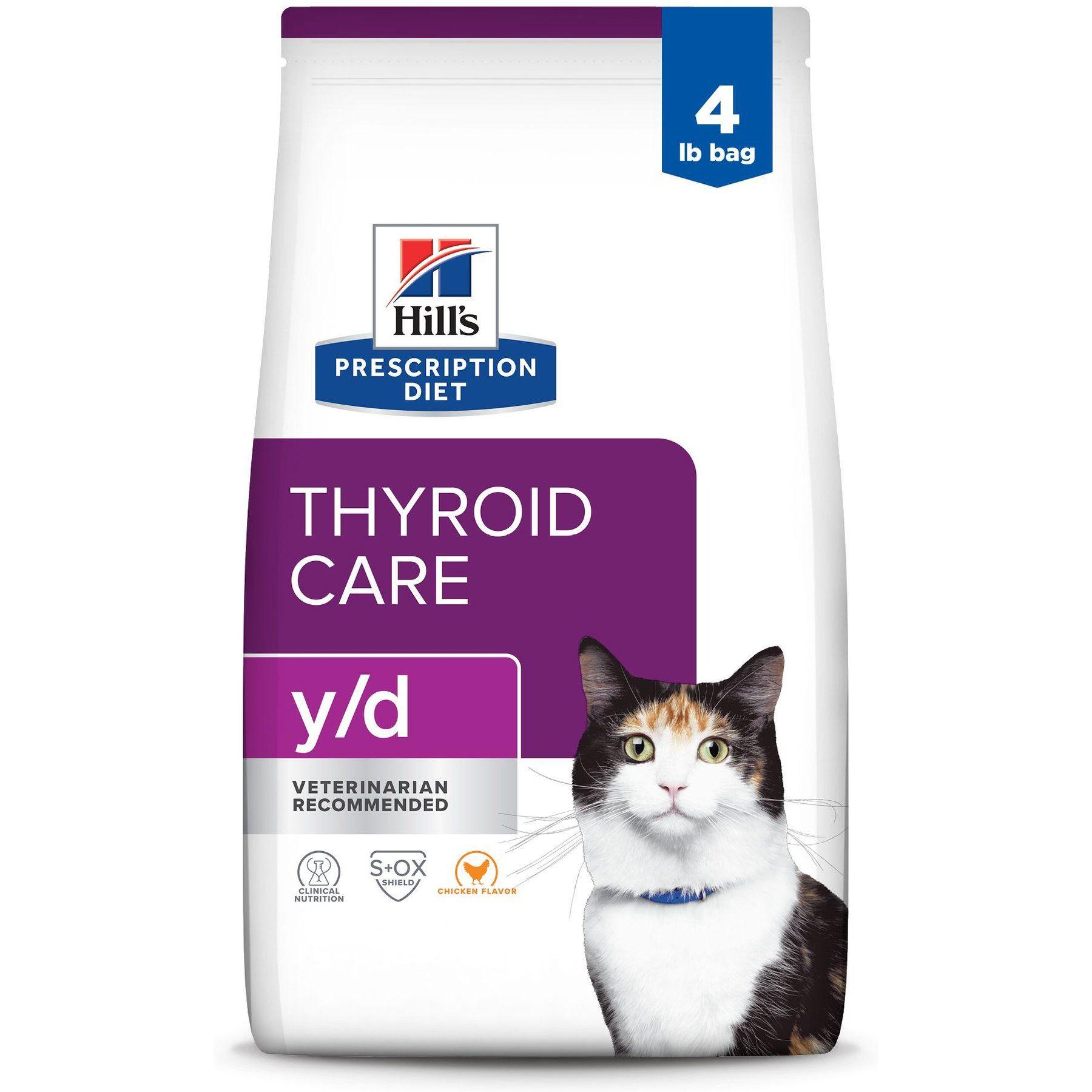
An iodine-restricted prescription cat food some vets choose as diet-only management of an overactive thyroid.
Webvet may earn a commission when you click through to Chewy, at no extra cost to you.
Methimazole side effects in cats
The common methimazole side effects in cats are vomiting, poor appetite, and tiredness, according to VCA, and most show up early. The AAFP guidelines say most appear within the first 4–6 weeks and are less common after 2 or 3 months, and they have not been shown to be dose related.
In the 113-cat Felimazole field study, the most common reactions were:
- Change in food consumption, up or down
- Lethargy
- Vomiting
- Diarrhea or loose stool
- Skin lesions, including scratches (excoriations)
- Abnormal vocalization
Diarrhea also appeared in the 101-cat long-term study, alongside withdrawn behavior, weight loss, haircoat changes, weakness, agitation, and raised blood urea nitrogen. The approval summary says most of these were transient and mild.

Merck says serious adverse effects develop in fewer than 5% of treated cats, mostly in the first 3 months:
- Agranulocytosis, a severe drop in infection-fighting white blood cells
- Thrombocytopenia, a low platelet count
- Hepatopathy, meaning liver injury
- Severe facial itching
VCA adds rare immune-mediated disorders and myasthenia gravis, a neuromuscular disease. With the transdermal gel, side effects tend to center on the ear: the 2013 follow-up saw ear-flap redness in 2 of 60 cats, and Merck says stomach upset may be eased by switching to a transdermal form.
Kidney values deserve attention. Merck explains that controlling the thyroid can unmask renal disease, and in the 101-cat long-term Felimazole study, the approval summary says four of the 18 cats that died or were euthanized may have been related to the drug through unmasked or accelerated chronic kidney failure. The Felanorm label says use in a cat with existing kidney problems should be carefully evaluated; the guide to kidney disease in cats explains the condition.
After a missed dose, VCA warns never to give two doses at once. An overdose is serious: in the Felimazole safety study, 30 mg per day (6X the starting dose) caused immune mediated anemia and low platelets. VCA says to call the vet immediately if one is suspected.
SponsoredVet care that's always there
Unlimited video calls and messaging with licensed vets for less than a typical vet visit. One membership covers up to five pets.
Use code Pets60
Plans start at $12/month · covers up to 5 pets
- Licensed vets in most states
- Rx for 150+ conditions
- 4.7 on Trustpilot
When to stop methimazole and call the vet now
Methimazole is normally never stopped without the vet. VCA makes one exception: if a cat shows tiredness, vomiting, inappetence, yellowing of the skin or eyes, or itchiness, discontinue the medication and contact your veterinarian. Merck says serious reactions require stopping the drug and supportive care.
Stop-now signs from the labels and references:
- Tiredness, vomiting, poor appetite, yellow skin or eyes, or itching (VCA)
- Bleeding or bruising, since methimazole has anti-vitamin K activity (Felanorm label)
- Dark bloody stool or collapse, seen before two deaths in an early Felimazole study
- Facial scratching from severe itching (Merck)
- A suspected overdose or any reaction to the drug (VCA)
If a person swallows a tablet, the Felimazole label says to seek medical advice immediately and show the product label to the physician.
Drug interactions, safe handling at home, and cats that should not take methimazole

VCA lists medications that may interact with methimazole and should be used with caution:
- Benzimidazole dewormers; the Felanorm label says methimazole can raise blood levels of drugs such as fenbendazole
- Beta-blockers
- Digoxin
- Phenobarbital, which the Felanorm label says may reduce methimazole's effect
- Theophylline
- Warfarin and other anticoagulants, whose effect the label says may increase
Tell the vet about every medicine and supplement the cat takes, including anything else prescribed for a senior cat such as lactulose for cats or Onsior for cats.
The Felanorm label says do not use methimazole in cats with:
- Hypersensitivity to methimazole or carbimazole
- Primary liver disease or renal failure
- Autoimmune disease
- Blood disorders such as anemia
- Pregnancy or nursing
VCA adds allergy to polyethylene glycol. The Felanorm label adds that safety has not been evaluated in male cats intended for breeding.
The Felimazole label calls methimazole a human teratogen and says pregnant women, women who may become pregnant, and nursing mothers should wear gloves when handling tablets, litter, or body fluids of treated cats. Everyone should wash hands after giving a dose or touching the litter.
The label also says do not break or crush tablets, and to wear gloves for broken or moistened tablets, vomit, urine, or feces. VCA says to store tablets in a dry, dark place at room temperature, and compounded products as the pharmacy label directs. The Felanorm label specifies 25°C (77°F), with excursions between 15°-30°C (59°-86°F) permitted.
How to give methimazole and the blood tests that follow

Give methimazole tablets whole, with or without food, exactly as the vet prescribed; liquids and gels follow the steps below. VCA says a small treat helps if the cat vomits on an empty stomach. The label says not to crush tablets, so crushing the pill into soft food is not a label method; ask the vet about a liquid.
A treat pocket such as Greenies Pill Pockets Feline Natural Salmon Flavor Soft Adult Cat Treats, 45 count, listed at $6.62 on Chewy when checked in November 2026, can help a whole tablet go down; the best pill pockets for cats compares options. A treat does not replace the prescribed treatment or the vet's rechecks.
The Dee Pet Piller for Dogs & Cats, 1 count, listed at $6.90 on Chewy when checked in November 2026, suits cats that spit tablets out; it only helps deliver the tablet the vet prescribed and does not replace the prescription or the vet's rechecks. Liquids go in with the supplied syringe, measured carefully (VCA). To apply the transdermal gel, VCA and the AAFP guidelines give this technique:
- Put on gloves before touching the gel.
- Apply the prescribed amount to the hairless skin on the inside of the ear flap.
- Keep other animals and children from touching the area for two hours.
- Check the ear skin for redness at each dose, and tell the vet if irritation appears, since the AAFP guidelines suggest switching to oral.
Giving methimazole once daily is a vet decision: the AAFP guidelines say twice daily dosing has fewer serious side effects than a higher dose once daily, though a stable cat may later stay controlled on one daily dose.
Long term, the drug is given for life. The Ezy Dose Daily AM/PM Cat Pill Case, listed at $4.99 on Chewy when checked in November 2026, keeps morning and evening doses apart but does not replace the vet's schedule. After a missed dose, VCA says to give it when remembered unless the next one is nearly due, and never to double up.
Methimazole works fast on blood tests in cats but takes longer to show at home: the AAFP guidelines say most cats reach normal thyroid levels within 2–3 weeks, though visible improvement may take 2–6 weeks longer. In a separate 71-cat Felimazole study, 54 of 68 cats tested (79.4%) had normal TT4 at 3 weeks. Recheck schedules differ between the label and the references:
- Before starting: hematology, biochemistry, and TT4 (Felanorm label).
- First rechecks: 3 and 6 weeks (FDA), every 2–3 weeks for three months (VCA), or 2–4 weeks (AAFP).
- Stable cats: every 3 months (FDA), 3–6 months (VCA), or 4–6 months with T4, CBC, chemistry, and urinalysis (AAFP).
- If T4 runs low: the vet lowers the dose.
- Kidney values, urine concentration, and blood pressure (Merck); the AAFP advises keeping T4 in the upper half of the normal range in cats with kidney concerns. Report a cat drinking a lot of water.
- If blood counts drop: the Felanorm label says a cat that becomes ill should stop the drug.
- Body weight at each visit, tracked against a cat weight chart.
Methimazole questions
Frequently Asked Questions
Can you crush methimazole for cats?
Not the approved coated tablets. The Felimazole label says do not break or crush tablets and asks people to wear gloves around broken or moistened tablets, because methimazole can harm people, especially during pregnancy. If a cat will not swallow a whole tablet, the vet can prescribe Felanorm solution or a compounded liquid or ear gel instead.
How long does methimazole take to work in cats?
Thyroid levels usually fall within a few weeks, but the cat may look better later. In the 113-cat Felimazole field study, 65 of 110 cats (59.1%) had TT4 at or below 4.0 mcg/dL at the Day 21 blood test, and the label waits three weeks before the first dose change. VCA notes the effects are sometimes not obvious at home.
What if my cat misses a dose of methimazole?
VCA's advice for a missed dose is to give it as soon as you remember and carry on with the usual schedule. If the next dose is almost due, skip the missed one. Never give two doses together. Tell your veterinarian if doses are often missed.
Can I buy methimazole for cats without a vet prescription?
No. The FDA says Felanorm and the generic coated tablets are available only by prescription from a licensed veterinarian, and the Felimazole approval summary says the same. A veterinarian has to diagnose the disease and monitor treatment, and the FDA warns against unapproved tablets sold online.
Is Felimazole the same as methimazole?
Felimazole contains methimazole; it is the FDA-approved brand of methimazole tablets for cats. The FDA approved a generic methimazole coated tablet in 2.5 mg and 5 mg as bioequivalent to Felimazole, and Felanorm is a generic oral solution. Tapazole is a human brand used extra-label.
Veterinarian · BVMS MRCVS
Dr. Pippa Elliott, BVMS, MRCVS, is a veterinarian with nearly 30 years of experience in companion animal practice. Dr. Elliott earned her Bachelor of Veterinary Medicine and Surgery from the University of Glasgow. She was also designated a Member of the Royal College of Veterinary Surgeons. Married with 2 grown-up kids, Dr. Elliott has a naughty Puggle named Poggle, 3 cats and a bearded dragon.


