Best Pill Pockets for Cats: Vet-Reviewed Picks for Cats That Spit Out Pills
Cats find pills in a way dogs never do, which is why so many pill pockets end up licked clean with the tablet on the floor. Here is how a vet chooses a pocket, paste, or capsule, how to stop the spit-out, and six Chewy picks.

BVMS MRCVS
Medically reviewed by Dr. Pippa Elliott, BVMS MRCVS · Last reviewed

This article contains affiliate links. Webvet may earn a commission when you buy through them, at no extra cost to you.
Pill pockets for cats work for many cats, but plenty of cats find the tablet by smell, lick around it, or bite into it and spit it out. The pocket that works is the one your cat swallows whole, without chewing into the pill.
The right product depends on how your cat defeats a pill. A soft pocket suits most cats, a moldable paste suits cats that bite, a flavored gelatin capsule hides bitter drugs, and a pill popper is the fallback for cats that refuse every treat.
| Product | Best fit | Format | Key fact | Main tradeoff |
|---|---|---|---|---|
| Greenies Pill Pockets Feline Chicken Flavor Natural Soft Adult Cat Treats, 3-oz bag, 85 count | Most cats that already take soft treats | Pre-formed soft pocket | About 3 kcal per treat, 85 count | Contains wheat, milk, and chicken ingredients |
| Greenies Pill Pockets Feline Natural Salmon Flavor Soft Adult Cat Treats, 45 count | Cats that prefer fish flavors | Pre-formed soft pocket | Hydrolyzed salmon flavor on a chicken base | Smaller 45 count bag; still chicken-based |
| Tomlyn Pill-Masker Bacon Flavored Paste for Cats, 4-oz canister | Cats that bite into a pocket and spit the pill | Moldable paste | Shapeable around any size or shape of pill | Current label ingredients should be checked on the package |
| Stashios Wrap-Ups Cheese Pill Wrapper Dog & Cat Treat, 30 count | Homes with both cats and dogs | Tear-off cheese wrap | Listed as grain-free | Ingredient list varies by market; check the label |
| Capsuline PetCaps Size 3 Chicken Flavored Empty Gelatin Cat Pill Capsules, 100 count | Bitter or strong-smelling pills | Flavored empty gelatin capsule | Made to mask the taste and smell of medicine | Only for pills your vet says can go in a capsule |
| Lixit Pill Popper, Purple | Cats that refuse every treat | Soft-tipped pill popper | Works with varying pill sizes | Vet groups disagree on piller gadgets |
 Sponsored
Need a prescription or refill for your cat?
A licensed vet at Dutch can assess your cat over video and prescribe treatment when it's appropriate, delivered to your door.
Use code Pets60
Plans start at $12/month · covers up to 5 pets
- Licensed vets in most states
- Rx for 150+ conditions
- 4.7 on Trustpilot
Why cats are harder to pill than dogs and when hiding a pill is unsafe
Yes, pill pockets for cats work for many cats when the wrapped pill is small enough to swallow whole. Start with a chicken pocket such as Greenies, and keep a moldable paste like Tomlyn for cats that chew. Never crush a pill to fit a treat unless your veterinarian says that drug can be crushed.

- 1Smell and taste give a pill away, and some drugs must never be crushed, split, or given dry.
- 2Start with a soft pocket, switch to a moldable paste if your cat bites, and add a flavored gelatin capsule for bitter or smelly pills.
- 3Keep each wrapped pill no larger than a big pea so the cat swallows it without biting into the medicine.
- 4Follow every pill with water or food so it does not stick in the esophagus.
- 5Cats on kidney, diabetic, or allergy diets need a vet's sign-off before any treat is used for pills.
The Merck Veterinary Manual's cat owner guide says hiding a cat's medication in a treat is often not simple. Even Greenies admits the problem in its own medication guide: a cat may not see the pill, but if it can smell it, the treat may be refused.
Taste is the second giveaway. VCA calls metronidazole very bitter, and Auburn's veterinary flyer warns that a cat that bites into a pill may reject the treat in the future. That bitter taste response is why the size and seal of the wrap matter so much.
Hiding a pill is unsafe in a few specific situations. The American Association of Feline Practitioners (AAFP) caregiver flyer says never to put medication in your cat's regular food, because the cat can start to dislike that food. That matters most for a cat on a therapeutic diet it needs to keep eating.
The AAFP nursing care handout goes further: unless your veterinarian says a drug must be given with food, do not use food as a dosing aid, since it may cause aversion and reduce intake. VCA takes a softer line and calls hiding a pill in a small amount of food the easiest method, so ask your own vet.
The dry-pill rule applies whatever method you use. VCA's clindamycin page says a cat should never get a dry pill because it can damage the esophagus, and its minocycline page warns that a lodged pill can cause ulcers. Merck lists regurgitation, drooling, and trouble swallowing as signs of an esophageal stricture.
Before you crush a tablet or open a capsule to fit a smaller wrap, check the drug itself. Our pages on amoxicillin for dogs and cats, prednisolone for dogs and cats, and gabapentin for dogs and cats cover how each is given, and your vet can confirm whether a tablet can be split.
Do pill pockets actually work for cats?
They work for many cats, not all. In a Journal of Feline Medicine and Surgery study of eight healthy cats, the authors noted that cats may take Greenies Pill Pockets spontaneously, but that some cats do not eat the treat. A pocket is a good first try, not a guarantee.
Our picks: the best pill pockets for cats
A pill pocket is a soft treat with a built-in pouch: put the medicine inside, pinch it closed, and give the treat. The AAFP describes moldable pill treats as putty-like treats that many cats will not notice a pill in. A paste or putty does the same job without the pouch: you mold it around the pill.
Pockets get the most use with routine tablets such as flea or deworming pills. See our guides to flea pills for cats, choosing a cat dewormer, and the right dewormer for cats with tapeworms for what those drugs do.
The first four picks are for cats that will eat a treat, and the last two handle bitter drugs and cats that refuse treats. Two rules apply to every pick:
- Size: Auburn University's cat medication flyer says a wrapped pill should be no larger than a big pea, or the cat may bite into the pill and reject the treat in the future.
- Practice: the AAFP suggests giving your cat a moldable treat before it needs medication, so the treat is already familiar when the first dose is due.
Greenies Pill Pockets Feline Chicken Flavor Natural Soft Adult Cat Treats: best overall
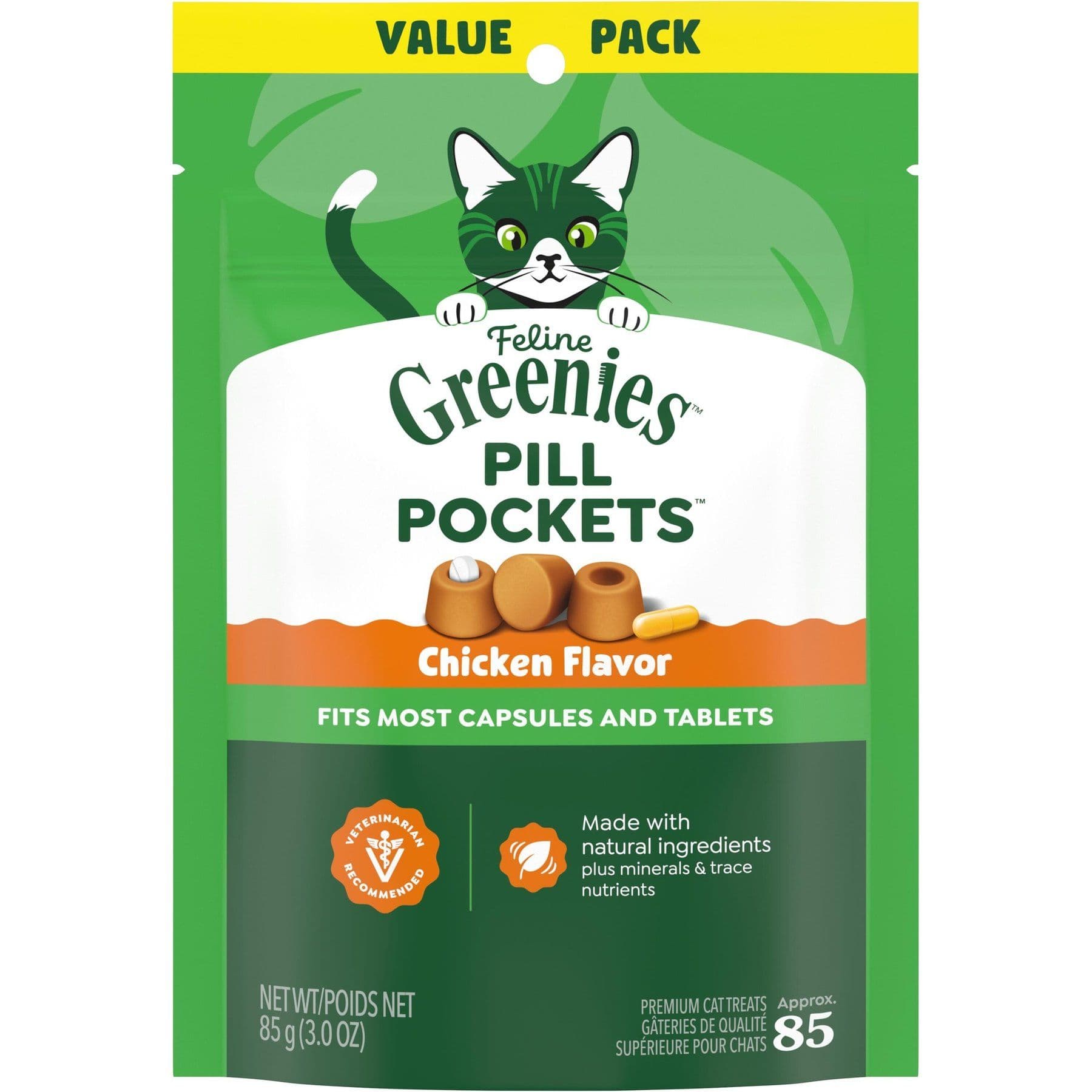
Chicken-flavored soft pockets sized for cat tablets, the standard first choice for cats that take treats.
Webvet may earn a commission when you click through to Chewy, at no extra cost to you.
This is the pocket to try first for a cat that already eats soft treats. Greenies' directions are simple: place the medicine inside the pocket, pinch it closed until the pill is hidden, and give it to your cat. Chewy listed the 3-oz, 85 count bag at $11.96 when we checked in October 2026.
Greenies Pill Pockets are also the pocket used in the JFMS study. Tablets given in Pill Pockets reached the stomach in an average of 60 seconds and capsules in 24 seconds, versus 36 and 16 seconds after a flavored-liquid pill glide.
What to know before buying:
- Ingredients: a retailer's copy of the label lists rehydrated chicken, glycerin, wheat flour, wheat gluten, vegetable oil, dried corn syrup, and dried chicken liver among the first ingredients.
- Calories: about 3 kcal per treat, per the same retailer listing.
- Allergens: it contains wheat, milk, and chicken ingredients, so it is not a fit for cats with those food allergies.
The tradeoff is size. A whole pocket can be more than a small tablet needs, so pinch off the extra and keep the wrapped pill pea-sized.
Greenies Pill Pockets Feline Natural Salmon Flavor Soft Adult Cat Treats: best for fish-loving cats
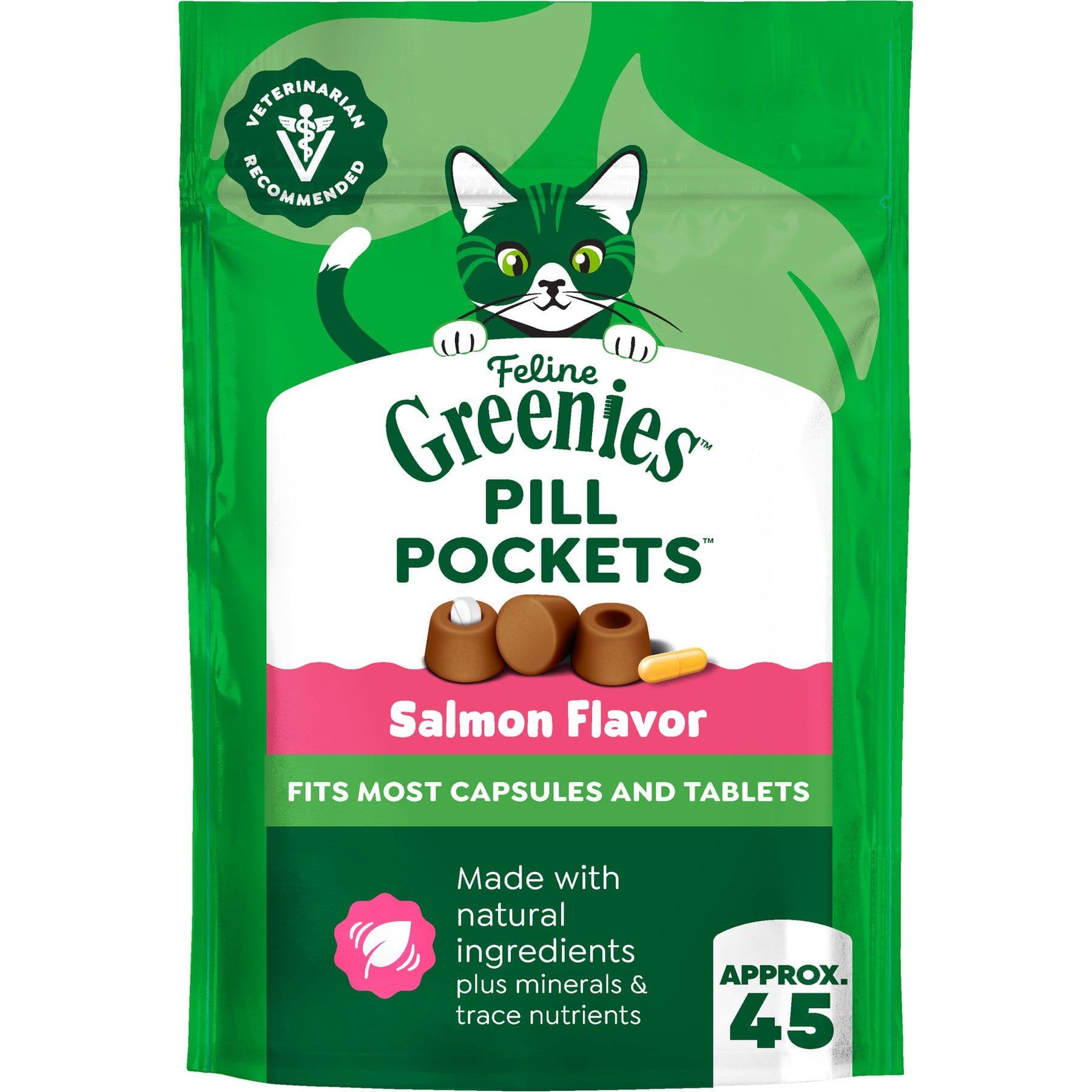
Salmon-flavored soft pockets for cats that ignore chicken treats but come running for fish.
Webvet may earn a commission when you click through to Chewy, at no extra cost to you.
This is the swap for a cat that prefers fish flavors. It uses the same pouch design, and Chewy's listing describes it as a soft treat that hides the taste of medicine with salmon flavor. Chewy listed the 45 count bag at $6.95 when we checked in October 2026.
Read the ingredients before you assume it is a fish-only treat. A retailer's copy of the label lists rehydrated chicken, glycerin, wheat flour, and wheat gluten first, with hydrolyzed salmon as the source of the salmon flavor. Calories match the chicken version at about 3 kcal per treat.
That makes it a flavor swap, not an allergy swap. If your cat has a chicken or wheat allergy, neither Greenies pocket is the answer, so ask your vet what fits the diet.
Tomlyn Pill-Masker Bacon Flavored Paste for Cats: best paste for cats that bite the pill out
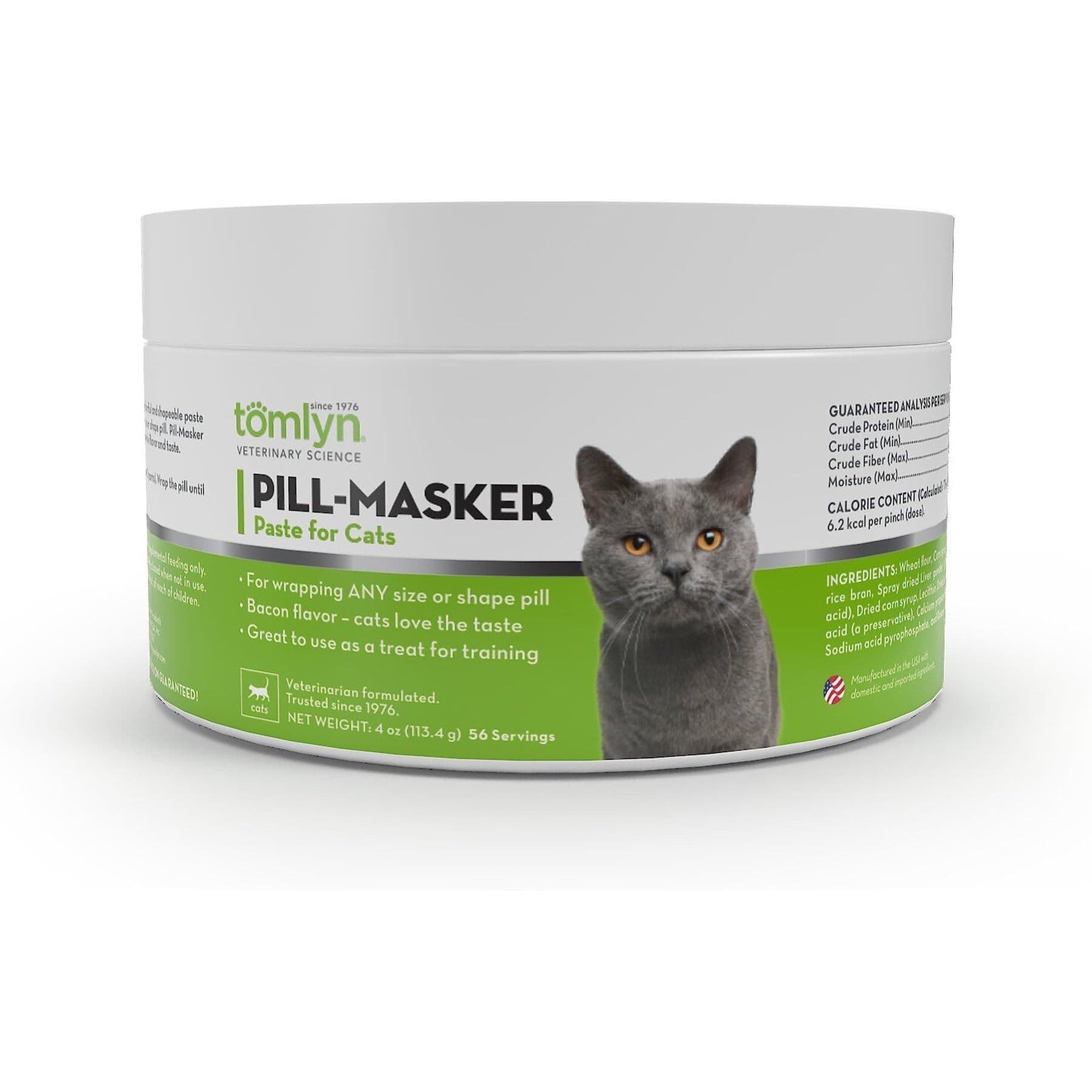
Bacon-flavored moldable paste that fully coats a pill, useful for cats that bite into a pocket and spit the tablet out.
Webvet may earn a commission when you click through to Chewy, at no extra cost to you.
A paste solves the problem a pre-formed pocket cannot: the open end. A retailer listing describes Tomlyn Pill-Masker as a moist, shapeable paste for wrapping any size or shape of pill, so you can seal the tablet completely and roll it into a small ball. Chewy listed the 4-oz canister at $13.99 when we checked in October 2026.
This is the pick for a cat that bites a pocket, finds the pill, and spits it out. Because you control how much paste you use, it is easier to keep the finished ball to the pea-sized limit Auburn recommends.
The tradeoff is ingredient certainty. Older Tomlyn listings show wheat flour, corn syrup, glycerin, vegetable oil, and spray-dried liver powder, so check the current canister label before giving it to a cat on a restricted diet.
Stashios Wrap-Ups Cheese Pill Wrapper Dog & Cat Treat: best cheese wrap for multi-pet homes
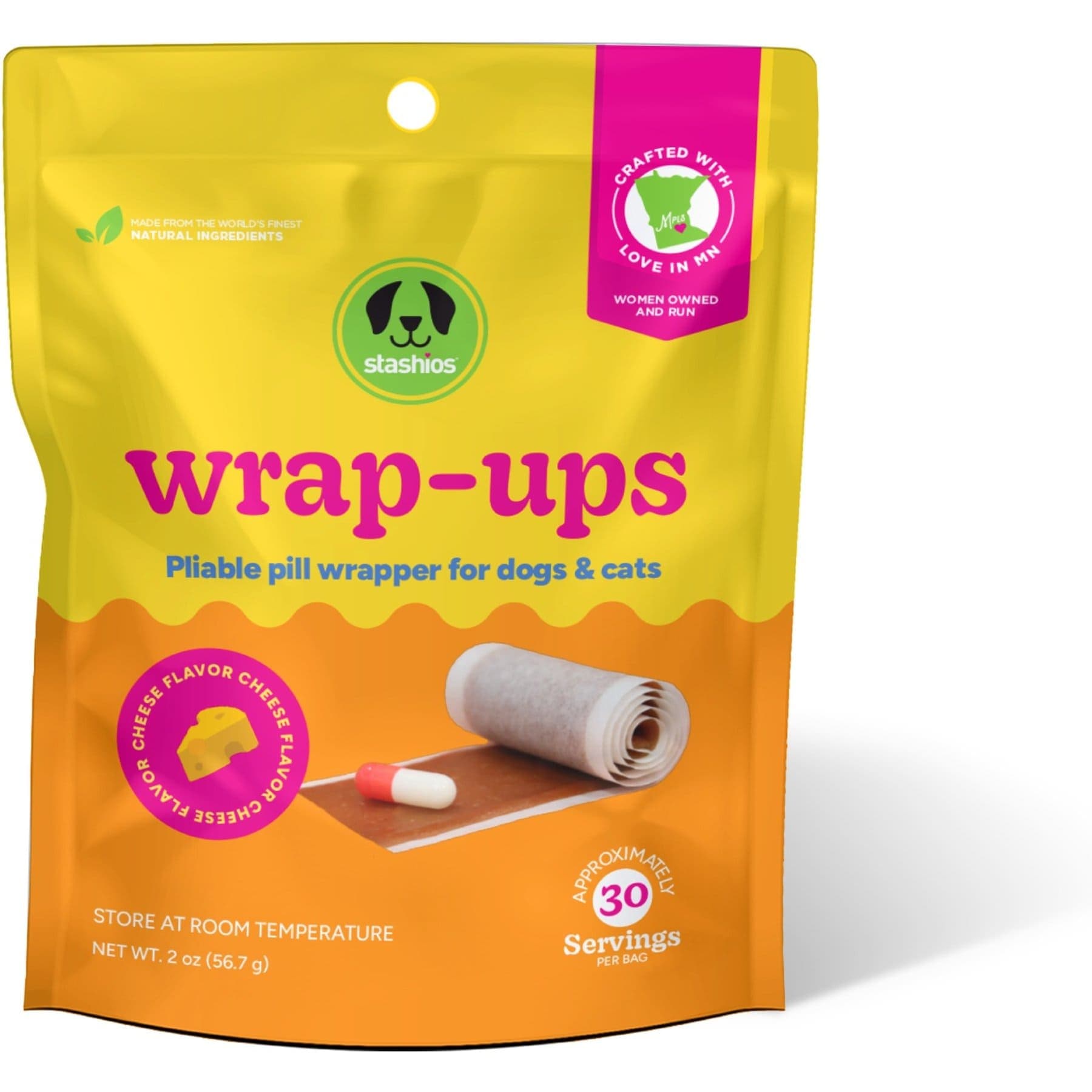
Cheese-flavored wrap treats that work for cats and dogs in a multi-pet home.
Webvet may earn a commission when you click through to Chewy, at no extra cost to you.
Stashios is a tear-off wrap made for both dogs and cats, which makes it practical when two species take pills in the same house. The directions are to tear off the amount needed, wrap it around the pill, seal it tight, and serve. Chewy listed the 30 count pack at $9.50 when we checked in October 2026.
Its ingredients differ from the Greenies pockets:
- Listed ingredients (one US retailer): carrots, sweet potatoes, honey, brown rice syrup, powdered cheese, dried citrus pulp, citric acid, and vinegar.
- Grain status: Chewy calls it grain-free, and the retailer lists no grain, gluten, or soy.
- Calories: 3,607 kcal per kg, or 5.74 kcal per serving.
The catch is consistency. A Hong Kong listing shows a different recipe with cheese, potato flour, sunflower oil, and gelatin, so formulas vary by market. Check the ingredient panel on the Chewy pack. For dog-only households, our guide to the best pill pockets for dogs covers dog options.
Capsuline PetCaps Size 3 Chicken Flavored Empty Gelatin Cat Pill Capsules: best for bitter pills
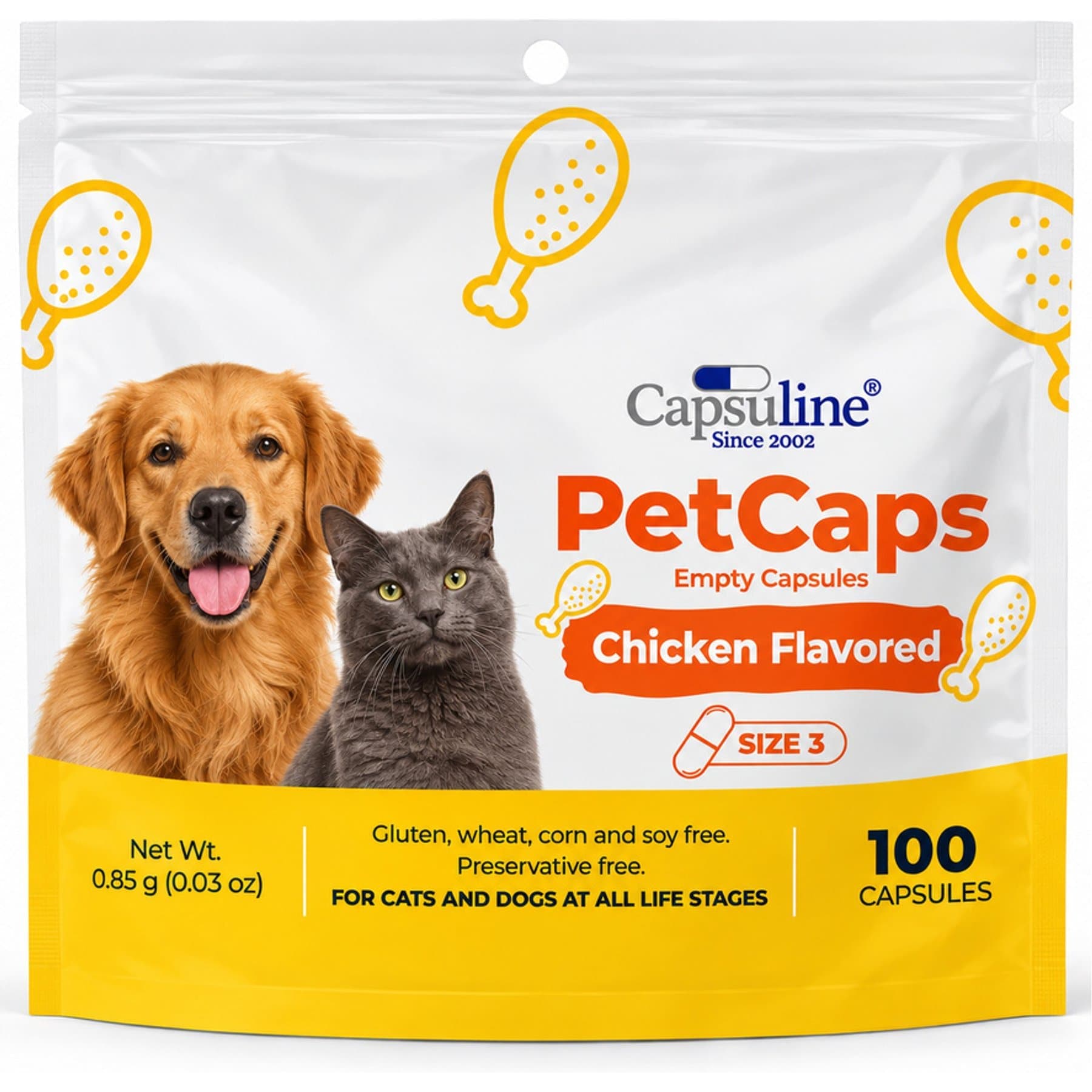
Chicken-flavored empty gelatin capsules that hide the taste of bitter or crushed pills before they go in a pocket or food.
Webvet may earn a commission when you click through to Chewy, at no extra cost to you.
An empty capsule is a shell that holds the pill, so the cat is less likely to taste it. Capsuline says its capsules are made from bovine hide and purified water, with a flavored coating meant to mask the smell of medicine. Chewy's listing says they mask the bitter taste and smell.
It earns a place for two jobs:
- Bitter or strong-smelling drugs: the capsule goes inside a pocket or paste, so a cat that bites through the treat still hits a sealed, flavored shell.
- Several pills at once: Auburn says that when more than one pill is needed, you can insert all of them into one gelatin capsule.
Chewy listed the 100 count at $8.59 when we checked in October 2026, and Capsuline listed it at $9.02. Capsuline does not say which pills fit a size 3 capsule, so check that the pill fits and ask your vet before opening or splitting any drug to make it fit.
Lixit Pill Popper: best pill popper when treats fail
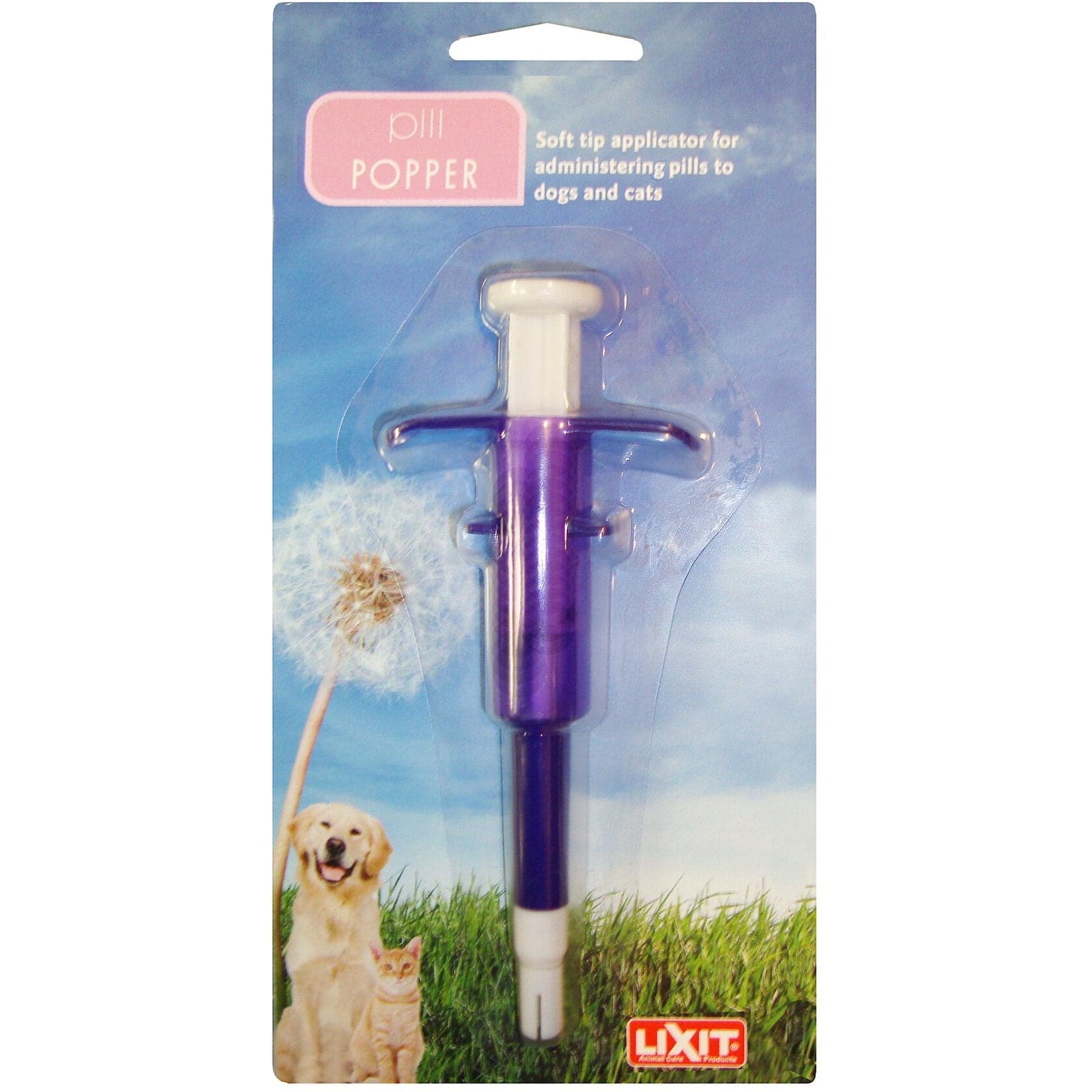
Soft-tipped pill popper that places a tablet at the back of the tongue when treats fail.
Webvet may earn a commission when you click through to Chewy, at no extra cost to you.
A pill popper places the tablet at the back of the tongue without your fingers in the mouth. Lixit lists a soft tip that protects the throat and works with varying pill sizes, and Chewy says it can be used dry or wet. Chewy listed it at $3.99 when we checked in October 2026.
Know that vets disagree here. Merck and Auburn describe using a piller, while the AAFP caregiver flyer says to skip piller gadgets because they can hurt the back of the mouth. If you use one, ask your vet to demonstrate it first, and follow every dose with water.
SponsoredVet care that's always there
Unlimited video calls and messaging with licensed vets for less than a typical vet visit. One membership covers up to five pets.
Use code Pets60
Plans start at $12/month · covers up to 5 pets
- Licensed vets in most states
- Rx for 150+ conditions
- 4.7 on Trustpilot
Choosing between pockets, pastes, and flavored capsules
The choice comes down to how your cat finds the pill. A pocket is the simplest to use. A paste closes every gap. A gelatin capsule hides taste and smell from the inside, and pairs with either one.
Here is how the three formats compare:
- Soft pockets: a pre-formed pouch you pinch shut. Best for cats that eat soft treats and small tablets. The weak point is the open end and the extra bulk around a tiny pill.
- Pastes and putty: you mold the paste fully around the pill. Merck's dosage form overview calls pastes a popular form for treating cats that owners can give easily and safely. Best for cats that bite and find the pill.
- Flavored gelatin capsules: Merck defines a capsule as an oral dosage form usually made from gelatin and filled with an active ingredient. An empty flavored capsule adds a sealed layer for bitter drugs.
For a hard case, put the pill inside a Capsuline PetCaps Size 3 Chicken Flavored Empty Gelatin Cat Pill Capsules, 100 count shell, then wrap it in a pea-sized ball of Tomlyn Pill-Masker Bacon Flavored Paste for Cats, 4-oz canister.
For a cat with a simple daily tablet, a Greenies Pill Pockets Feline Chicken Flavor Natural Soft Adult Cat Treats, 3-oz bag, 85 count pouch is the simplest place to start.
What can I use instead of PILL POCKETS for cats?
After checking with your veterinarian, the AAFP suggests you hide the pill in a liquid or lickable cat treat, hide it in a pile of treats, or roll a pill treat in crushed dry treats. Auburn's "meatball" approach wraps the pill in soft food, cheese, or a pill wrap, then coats it or dips it in tuna juice.
You can also change the medicine instead of the treat. Cornell's hospital pharmacy says flavoring may help pets accept liquid medication, but it must be requested when the prescription is ordered and is not possible with every product. VCA notes many drugs can be made into liquid or treat formulas flavored with tuna, chicken, or salmon.
Which pill pockets do cats like best?
We found no published study that ranks pill pocket flavors by cat preference. In the JFMS study, the authors noted that cats may take Greenies Pill Pockets spontaneously. Chicken is a sensible first try, and the Greenies Pill Pockets Feline Natural Salmon Flavor Soft Adult Cat Treats, 45 count suit cats that favor fish.
When your cat licks the pocket and leaves the pill
A cat that eats the treat and leaves a bare tablet has detected the pill, whether by smell, by an exposed edge, or because the wrap was too big to take in one bite. The fix depends on the exact behavior.

The AAFP's advice is simple: if your cat stops responding to one method, try another option, and ask your vet. Match what your cat does to the next thing to try:
| What your cat does | Likely giveaway | Next method to try | Watch for |
|---|---|---|---|
| Licks the treat off and leaves the pill | Exposed edge or taste of the pill | Seal the pill fully in paste, or put it in a flavored capsule first | Keep the ball pea-sized |
| Will bite and spit out the pill | Wrap too big, so the cat chews | Smaller pea-sized wrap; flavored gelatin capsule inside the paste | Bitter taste can make the cat refuse treats later |
| Sniffs the treat and walks away | Smell of the medicine | Flavored capsule to mask smell; coat in crushed treats or bonito flakes; dip in tuna juice | Offer a plain treat first so the pill treat is not the only one |
| Refuses every treat, even plain ones | Treat suspicion or low appetite | Towel wrap and hand pilling or a pill popper, then water | Ask the vet about a flavored liquid |
| Eats it, but you are not sure it went down | Pill may be held in the mouth | Watch the cat after dosing | A nose lick usually means the pill was swallowed |
A cat that bites and spits out the pill may have chewed into an oversized wrap and tasted the drug. Auburn warns that such a cat may reject the treat in the future.
Make the next attempt smaller and fully sealed, for example in a pea-sized ball of Tomlyn Pill-Masker Bacon Flavored Paste for Cats, 4-oz canister, ideally with the pill inside a capsule.
For the sniffer, change the outside smell. Auburn suggests a "panko" coating of crushed hard treats or bonito fish flakes, or a dip in tuna juice. A Capsuline PetCaps Size 3 Chicken Flavored Empty Gelatin Cat Pill Capsules, 100 count shell adds a second layer between the drug and your cat's nose.
How to put a pill in a cat's food without them knowing?
Do not mix it into the regular meal; the AAFP warns the cat can start to dislike that food. Use a separate small portion instead. Auburn says most cats will lick a pill or capsule straight from a towel or rough surface if it is covered with a little creamy treat, and a tuna juice dip hides the scent.
My cat won't eat pill pockets. What can I do to help them?
First, offer empty pockets as plain treats when no pill is due; the AAFP suggests getting cats used to moldable treats early. Then step through the options: a smaller sealed paste ball, a flavored capsule, a coating, and finally hand pilling. VCA says to watch your cat after dosing, since some cats spit pills out.
Pill pockets for cats on special diets or with kidney disease
For a cat on a kidney or diabetic diet, start with one rule from WSAVA's guide to feeding treats to your cat: if a cat has a medical condition, dietary sensitivities, or eats a veterinary-prescribed diet, conventional treats may not be appropriate. VCA likewise says to check with your veterinary team before feeding treats to such a cat.
For kidney disease, the concern is phosphorus and appetite. The Merck Veterinary Manual recommends a renal diet, lower in phosphorus with modest high-quality protein, for cats with chronic kidney disease at stage 2 or higher. A chronic kidney disease diet only works if the cat keeps eating it.
What matters for a kidney cat:
- Phosphorus: VCA says limiting dietary phosphorus appears to help delay CKD progression, and the vet chooses the formulation. VCA, Merck, and Cornell give no phosphorus or sodium limit for treats or pill pockets, so there is no published number to check a pocket against.
- Appetite: Merck says cats in later CKD stages are particularly prone to inappetence and weight loss, and the Cornell Feline Health Center notes these cats often resist therapeutic diets.
- Practical approach: ask your vet whether a pea-sized piece of a pocket fits the renal diet, or whether a flavored compounded liquid is the better route.
That is why the AAFP's rule against putting pills in regular food matters most here. Cornell notes that cats with CKD that go without food for even short periods can develop significant health problems, so never risk a food aversion to get a pill down.
Diabetic cats raise a different question, which is carbohydrate. Merck says diabetic cats should get a high-protein, low-carbohydrate diet alongside insulin, and its cat owner page says not to change the amount or timing of diet or insulin without your veterinarian. We found no carbohydrate figure published for any of these pockets.
Labels give some clues: Greenies pockets list wheat flour and dried corn syrup, and Stashios lists honey and brown rice syrup. If your cat is on a diabetic diet, ask your vet before adding a daily treat. For food allergies, read the ingredient list:
- Chicken, wheat, or milk allergy: neither Greenies pocket is a hypoallergenic option, since both list chicken, wheat, and milk ingredients.
- Grain-free: Stashios is listed as grain-free, but its recipe varies by market, so check the pack.
- Skipping the treat: an empty gelatin capsule given by hand or popper, or a vet-compounded flavored liquid, avoids the treat itself, though the Capsuline shell is chicken flavored. Ask your vet which fits an allergy diet.
Giving a cat a pill without a pocket: the towel wrap and pill popper method
When a cat refuses every treat, the fallback is to place the pill by hand or with a pill popper, with the cat wrapped in a towel if it struggles. Ask your vet to show you the technique before you try it at home.

The steps, drawing on VCA, Cornell, Merck, and Auburn:
- Wrap: if your cat resists, VCA says to wrap it securely in a towel or blanket with only the head exposed. Cornell notes a towel wrap restrains the legs.
- Position the head: hold the head with the nose pointing up. Merck says to gently pull the lower jaw down.
- Place the pill: put it far back on the tongue by hand, or insert a pill popper such as the Lixit Pill Popper, Purple from the side of the mouth, just behind the canine teeth, rather than from the front, as Auburn describes.
- Release and close: push the plunger, let the mouth close, and watch for a swallow or a nose lick.
- Follow with water: give a small syringe of water right away so the pill does not stick in the esophagus.
The AAFP adds an important detail: never pill your cat with just the pill. Wrap it in a thin layer of moldable treat, follow with a syringe of water, and feed your cat afterward.
How much water to give by mouth varies by source:
- VCA (minocycline page): a syringe of 3 to 5 ml of water after the dose to prevent esophageal ulcers.
- Auburn: at least 4 ml of water or tuna juice, or some food, or coat the pill with butter.
- Cornell: about a teaspoonful, 5 to 6 ml, by dropper or syringe, right after the tablet or capsule.
The JFMS paper backs this up, reporting that giving water after a tablet or capsule shortens transit time in cats.
How to get a stubborn cat to take a pill?
Wrap the cat in a towel with only the head out, tip the nose up, and place the pill far back on the tongue by hand or with a pill popper from the side of the mouth. Follow with 3 to 6 ml of water. If this fails, ask your vet about a flavored liquid instead.
Making medication time easier long term
For cats on long courses, routine matters. The AAFP nursing care handout says forcing medication is stressful for both you and your cat, and recommends a set routine in a small, secure place.

The AAFP's habits for long-term dosing:
- Same place: a bathroom sink lined with a soft towel or fleece gives an enclosed, secure spot for each dose.
- Same routine: build a consistent routine so the cat knows what to expect.
- Good timing: do not interrupt your cat while it is eating, grooming, or using the litter box to give medication.
- Reward: give positive reinforcement such as treats, brushing, or petting after the cat accepts the dose.
- Practice: offer moldable treats before medication is needed so they are not a warning sign.
- Learn the technique: ask your veterinarian to demonstrate how to give the medication.
Keep reward treats within your cat's treat allowance, which WSAVA puts at no more than 10 percent of daily calories. If dosing time is becoming stressful for your cat, raise it with your vet; our guide to cat anxiety covers the signs.
If a method stops working partway through a course, switch rather than force it. The AAFP's advice is to try another option and ask your vet, and Cornell notes that a flavored version of some drugs can be requested when the prescription is ordered.
Cat pill pocket questions
Frequently Asked Questions
How to make homemade pill pockets for cats?
Auburn's flyer suggests wrapping the pill in a small "meatball" of soft food or cheese. With a soft cheese such as cream cheese, keep the ball no larger than a big pea. For a sniffer, dip it in tuna juice or roll it in crushed treats. Ask your vet first if your cat is on a special diet.
Which cat medications should never be crushed or hidden in food?
Any drug your vet has not cleared for crushing. VCA's drug pages forbid crushing omeprazole and extended-release forms, and say metronidazole is too bitter to crush. Ask your vet whether a tablet is enteric-coated or extended-release before altering it, and do not hide medication in a therapeutic diet without your vet's approval.
Can kittens have pill pockets?
Both Greenies pockets are sold as adult cat treats, so ask your veterinarian before giving one to a kitten. If your vet agrees, use a small piece, no larger than a big pea, and count it toward the kitten's daily treat calories.
How many pill pockets can a cat have a day?
WSAVA says treats, including foods used to give medication, should be no more than 10 percent of daily calories, which works out to about 18 to 28 calories a day for a 2.5 to 7 kg cat. At about 3 kcal per Greenies pocket, six pockets would use a small cat's entire treat allowance.
Why does my cat foam at the mouth after a pill?
Usually it is the taste. VCA says some cats foam at the mouth from the taste of medicine, and Cornell calls salivation after medication normal and not harmful. A flavored capsule can hide a bitter pill. Persistent drooling, regurgitation, or trouble swallowing needs a vet visit, since a stuck pill can injure the esophagus.

Editor
The Webvet Editorial Team is the in-house group of pet-care editors and writers behind Webvet, operated by Smart Pet Collective. The team researches, writes, and maintains Webvet's pet health, behavior, and medication content. Every article follows a defined editorial process: research from reputable veterinary and scientific sources, careful drafting, mandatory review of medical content by a credentialed veterinarian, and dated publication. Health and medication articles are medically reviewed by a licensed veterinary professional before they go live and are kept current over time.
Veterinarian · BVMS MRCVS
Dr. Pippa Elliott, BVMS, MRCVS, is a veterinarian with nearly 30 years of experience in companion animal practice. Dr. Elliott earned her Bachelor of Veterinary Medicine and Surgery from the University of Glasgow. She was also designated a Member of the Royal College of Veterinary Surgeons. Married with 2 grown-up kids, Dr. Elliott has a naughty Puggle named Poggle, 3 cats and a bearded dragon.
Related reading

Best Pill Pockets for Dogs: Vet-Reviewed Picks That Hide Every Pill Size

Dog Anxiety Meds: What Vets Prescribe, Over-the-Counter Options, and How to Choose

Interceptor Plus for Dogs: What It Prevents, Dosing by Weight, Side Effects, and vs. Heartgard Plus
