Interceptor Plus for Dogs: What It Prevents, Dosing by Weight, Side Effects, and vs. Heartgard Plus
Interceptor Plus is a monthly prescription chew that prevents heartworm and treats four intestinal worms, including tapeworms. See the dose for each weight band, side effects, and how it compares with Heartgard Plus.

BVMS MRCVS
Medically reviewed by Dr. Pippa Elliott, BVMS MRCVS · Last reviewed

This article contains affiliate links. Webvet may earn a commission when you buy through them, at no extra cost to you.
Interceptor Plus for dogs is a monthly prescription chew that prevents heartworm disease and treats and controls four kinds of intestinal worms: roundworms, hookworms, whipworms and tapeworms. It pairs two drugs, milbemycin oxime and praziquantel, in four weight-band chews, so the right box depends on what your dog weighs today.
Below, we cover what Interceptor Plus for dogs protects against and what it leaves out, the milligram dose in each weight band, how the chew actually stops heartworm, the side effects on its FDA-approved label, which dogs need extra caution, and how it compares with Heartgard Plus and the combination chews that add flea control.

 Sponsored
Need a prescription or refill for your dog?
A licensed vet at Dutch can assess your dog over video and prescribe treatment when it's appropriate, delivered to your door.
Use code Pets60
Plans start at $12/month · covers up to 5 pets
- Licensed vets in most states
- Rx for 150+ conditions
- 4.7 on Trustpilot
What Interceptor Plus for dogs is and what it prevents
Interceptor Plus is an Elanco chewable labeled to prevent heartworm disease (Dirofilaria immitis) and to treat and control adult roundworm, hookworm, whipworm and tapeworm infections, per its FDA-approved label. It is not labeled to kill fleas or ticks, and federal law restricts it to use by or on the order of a licensed veterinarian, so it needs a prescription.
The Interceptor Plus ingredients for dogs come down to two actives. Milbemycin oxime is a macrocyclic anthelmintic and praziquantel is an isoquinolone anthelmintic, and the label lists no other active ingredient. The package panel calls the result a broad-spectrum parasiticide, and the FDA approved it under NADA 141-338.
- 1Interceptor Plus covers the five parasites on the label: heartworm, hookworm, roundworm, whipworm and tapeworm.
- 2It does not cover fleas, ticks or mites, so flea and tick control needs a separate product.
- 3It comes as four weight-band chews (2 to 8, 8.1 to 25, 25.1 to 50 and 50.1 to 100 lbs), one chew on a monthly schedule.
- 4Dogs over 7 months old that were not already on prevention need a heartworm test before the first dose.
What does Interceptor Plus protect dogs from?
Interceptor Plus protects dogs from heartworm disease and from four groups of intestinal worms. The label names each species, which helps when your vet matches a preventive to the parasites common where you live:
- Heartworm: Dirofilaria immitis, which the chew prevents rather than cures.
- Roundworms: adult Toxocara canis and Toxascaris leonina.
- Hookworm: adult Ancylostoma caninum.
- Whipworm: adult Trichuris vulpis.
- Tapeworms: adult Taenia pisiformis, Echinococcus multilocularis, Echinococcus granulosus and Dipylidium caninum.
So yes, Interceptor Plus treats hookworms, kills roundworms in dogs and will kill tapeworms, including Taenia and Echinococcus. That tapeworm coverage is the clearest difference from Heartgard Plus, whose intestinal-worm coverage stops at roundworms and hookworms. The label gives no figure for how fast the worms die, only that laboratory studies eliminated the adult stages.
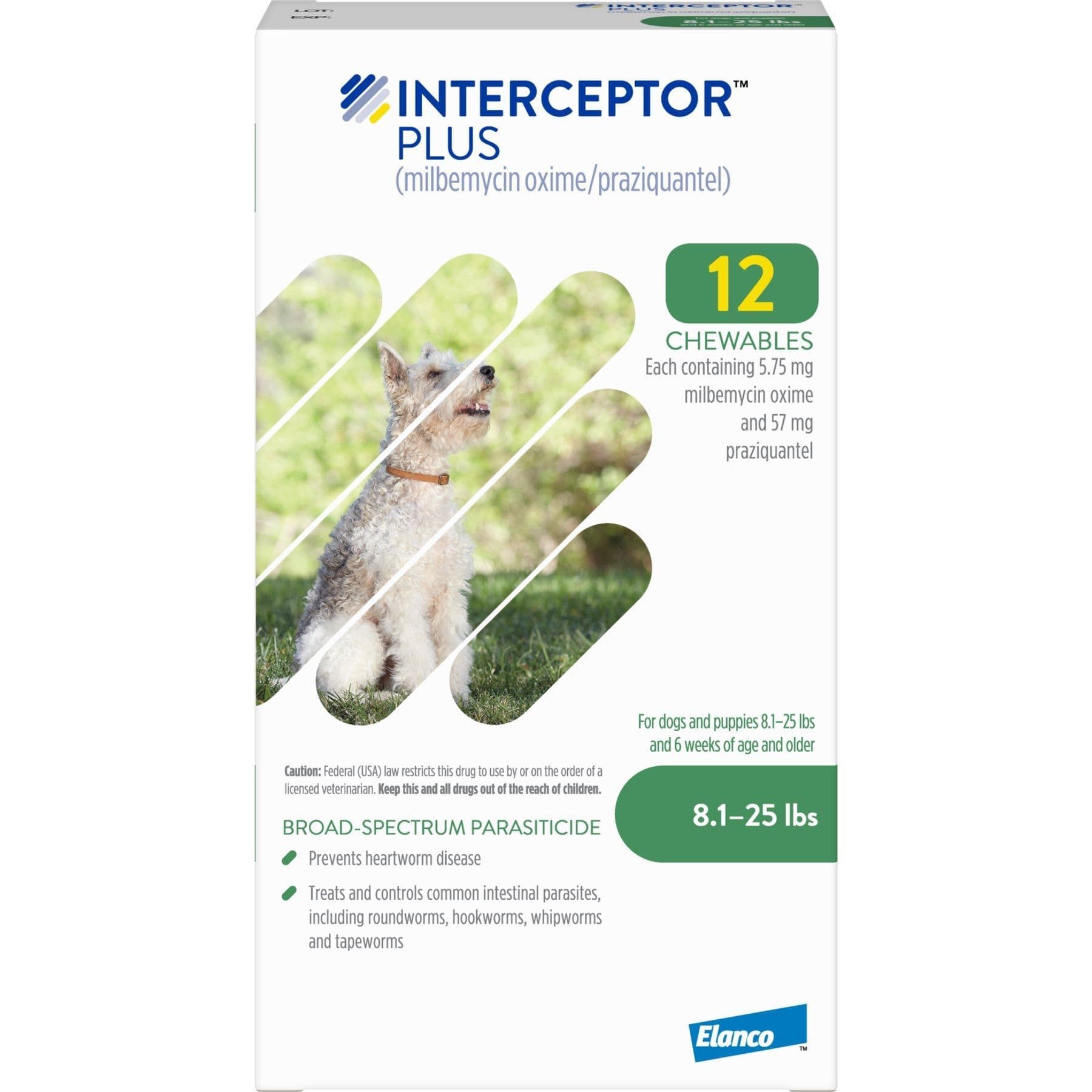
A 12-chew green box for dogs 8.1 to 25 pounds, each chew with 5.75 mg milbemycin oxime and 57 mg praziquantel.
Webvet may earn a commission when you click through to Chewy, at no extra cost to you.
What is Interceptor Plus for dogs used for beyond those five parasites? Nothing else on its label. Giardia and lungworm are not among its indications, and the roundworm claim covers adult worms, not roundworm eggs.
The American Heartworm Society notes that a number of heartworm preventives also work against certain intestinal parasites. If your dog has Giardia or another parasite outside this label, your vet will need a different treatment, and our dog dewormer guide covers standalone options for intestinal worms.
Giving Interceptor to a dog with heartworms is a different matter. The label states it is not effective against adult Dirofilaria immitis, so a heartworm-positive dog needs adult-worm treatment at your veterinarian's discretion. The Merck Veterinary Manual notes that melarsomine is the only drug currently available to treat adult heartworms.
- Life expectancy after treatment: we found no primary veterinary source that gives an average figure, so your vet is the right person to judge your own dog's outlook. Our guide to heartworm treatment for dogs walks through what treatment involves.
Interceptor Plus dosage by weight

The label sets a minimum dose of 0.23 mg/lb (0.5 mg/kg) of milbemycin oxime and 2.28 mg/lb (5 mg/kg) of praziquantel, given by mouth once every month. You never measure that out yourself. Instead, you give one chewable sized for your dog's weight band, and each band delivers at least that minimum to every dog within its range.
There are four Interceptor Plus chews: 2 to 8 lbs, 8.1 to 25 lbs, 25.1 to 50 lbs and 50.1 to 100 lbs. Each dog gets one chewable a month, whatever its breed. For dogs over 100 lbs, the label says to give the appropriate combination of chewables, which your vet will work out from your dog's weight.
The weight-band dose table below lists the milbemycin oxime and praziquantel amounts in each Interceptor Plus chew. Beside each band sits the Heartgard Plus chew a dog of that weight would take, with its box color, and the final rows give a direct Interceptor Plus versus Heartgard Plus coverage comparison, so the tapeworm difference shows at a glance.
| Dog's weight | Interceptor Plus chew: milbemycin oxime / praziquantel | Heartgard Plus chew for the same dog: ivermectin / pyrantel |
|---|---|---|
| 2 to 8 lbs | 2.3 mg / 22.8 mg | Blue box (0 to 25 lbs): 68 mcg / 57 mg |
| 8.1 to 25 lbs | 5.75 mg / 57 mg | Blue box (0 to 25 lbs): 68 mcg / 57 mg |
| 25.1 to 50 lbs | 11.5 mg / 114 mg | Green box (26 to 50 lbs): 136 mcg / 114 mg |
| 50.1 to 100 lbs | 23 mg / 228 mg | Brown box (51 to 100 lbs): 272 mcg / 227 mg |
| Chews per month | One | One |
| Parasites on the label | Heartworm, roundworm, hookworm, whipworm, tapeworm | Heartworm, roundworm, hookworm |
| Minimum age and weight | 6 weeks and 2 lbs | 6 weeks |
Two details in that table are easy to miss. In the three larger bands, the milligram amounts equal the label minimum for a dog at the top of the band, so a lighter dog in the same band gets more per pound. And the bands differ between brands, so a dog switching products may change box size.
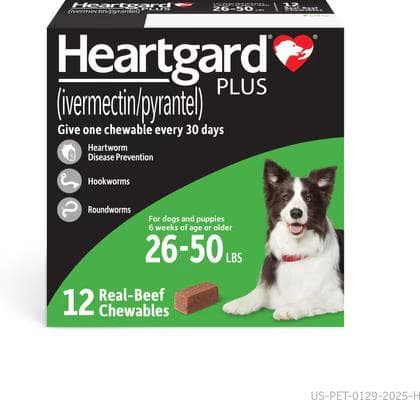
Twelve monthly Heartgard Plus chews for dogs 26 to 50 pounds, each with 136 mcg ivermectin and 114 mg pyrantel.
Webvet may earn a commission when you click through to Chewy, at no extra cost to you.
- Weigh first. The American Heartworm Society advises having your pet weighed at every visit to confirm the right preventive dosage, and a growing puppy can move up a band between visits.
- Check the puppy minimums. The label says not to use it in puppies under six weeks of age or under 2 pounds; our guide to heartworm prevention for puppies covers when to start.
- Read the weight range, not just the color. The Chewy listing calls the 8.1 to 25 lb Interceptor Plus box the green box, while the Heartgard Plus label assigns green to its 26 to 50 lb chew, so the same color means different dogs across brands.
- Match your dog's current weight. A 15-pound dog, for example, takes the Interceptor Plus Chew for Dogs, 8.1-25 lbs, (Green Box), 12 Chews (12-mos. supply).
Should dogs take an interceptor every month?
Yes. Interceptor Plus is labeled for once-a-month dosing and can be given year-round without interruption. If your vet uses a seasonal schedule instead, the label says to start within 1 month of your dog's first seasonal exposure to mosquitoes and to continue until at least 6 months after the last exposure.
AHS goes further with its "think 12" rule: test your dog every 12 months and give heartworm preventive 12 months a year, even in states like Arizona. VCA Animal Hospitals agrees that year-round prevention is generally recommended in the United States, and our guide to heartworm in dogs and how to prevent this silent killer explains why.
If you are switching from another heartworm preventive, the label says to give the first Interceptor Plus dose within a month of the last dose of the former product, so coverage continues without a gap.
 Sponsored
Vet care that's always there
Unlimited video calls and messaging with licensed vets for less than a typical vet visit. One membership covers up to five pets.
Use code Pets60
Plans start at $12/month · covers up to 5 pets
- Licensed vets in most states
- Rx for 150+ conditions
- 4.7 on Trustpilot
How Interceptor Plus works and how long it takes
Interceptor Plus works backward in time. According to the American Heartworm Society, heartworm preventives treat heartworms that already infected the pet within the past month or longer, and every approved heartworm medication works by eliminating the immature larval stages. In practice, milbemycin oxime kills the larvae your dog picked up over the previous 30 days or so.
Those larvae arrive with mosquito bites, which our guide on how dogs get heartworm explains. Timing matters because, as AHS warns, in as little as 51 days the larvae can molt into a juvenile stage that preventives cannot effectively eliminate. Giving a dose late can let immature larvae reach the adult stage, which is poorly prevented.
A dose only works if your dog actually swallows all of it, on time, and the label is specific about how to give it:
- Pick a fixed day each month. The Merck Veterinary Manual calls giving the prescribed dose at the correct time the most important thing an owner can do against heartworm.
- Give it by hand or with food. The label lets you offer Interceptor Plus by hand or add it to a small amount of dog food, which helps when a dog won't eat it plain.
- Encourage chewing. It is a chewable rather than a pill, but you can split it into pieces for a dog that gulps treats without chewing.
- Watch for a few minutes. The label asks you to observe your dog briefly after dosing so no part of the dose is lost or rejected, and it recommends redosing if you suspect some was lost.
- Call before redosing after vomiting. If your dog threw up soon after the chew, ask your vet whether to give another, since that is the lost-dose situation the label describes.
- Do not guess about extra chews. If you can't remember whether you gave this month's dose, or your dog ate two doses or got into the box and ate too many, call your vet before doing anything else.
Timing is the same for every size. Small dogs on the 2 to 8 lbs chew and large dogs on the 50.1 to 100 lbs chew, from a six-chew or 12-chew pack, all get one chew a month. Breed does not change the dose; owners of collies, shelties and other herding dogs should read the MDR1 notes below.
Interceptor Plus contains no ivermectin. Its heartworm-active ingredient is milbemycin oxime, while Heartgard Plus pairs ivermectin with pyrantel. For comparison, the Heartgard Plus label describes eliminating the tissue stage of heartworm larvae for a month (30 days) after infection, so the length of protection from either chew looks back one month rather than forward.
How long does it take Interceptor Plus to work?
Each chew acts on the larvae already in your dog when you give it, but complete heartworm protection builds over a run of doses. In the label's laboratory study, Interceptor Plus was 100% effective against induced heartworm infections when given once monthly for 6 consecutive months. Neither one dose nor two consecutive doses reached 100%.
The label also warns that fewer than 6 monthly doses after the last mosquito exposure may not give complete heartworm prevention. For the intestinal worms on its broad-spectrum label, laboratory studies eliminated the adult stages, but no hours-to-effect figure is published.
Can your dog get worms while on Interceptor Plus? Yes, through reinfection between monthly doses: fleas can carry tapeworms back, whipworm eggs persist in soil, and Echinococcus can reinfect within less than a month. AHS also notes that heartworm preventives are highly effective but not 100 percent effective, which is why annual testing continues even on year-round prevention.
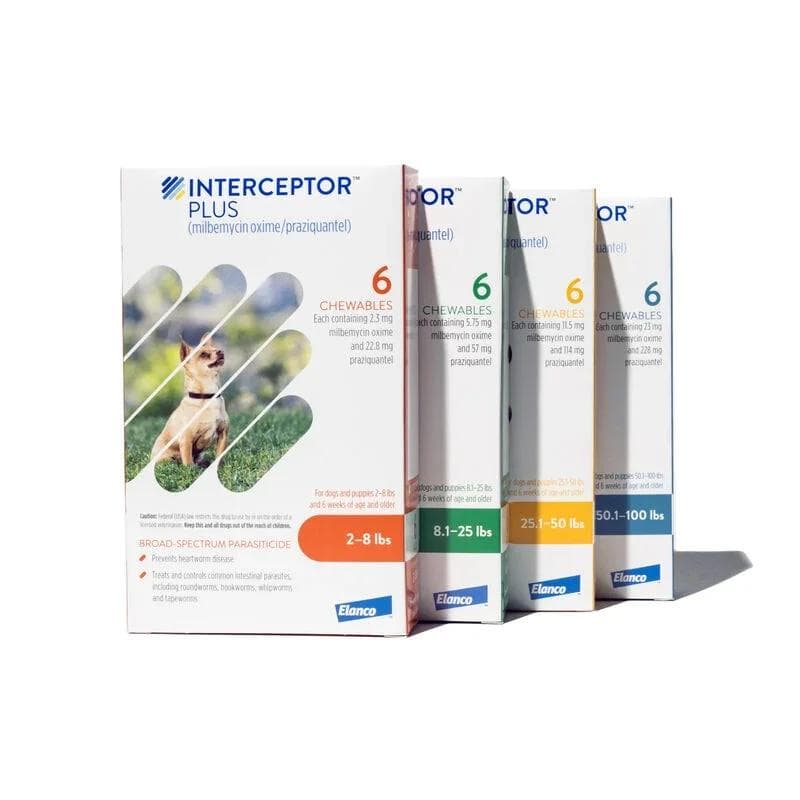
Six monthly chews for dogs 50.1 to 100 pounds, each with 23 mg milbemycin oxime and 228 mg praziquantel.
Webvet may earn a commission when you click through to Chewy, at no extra cost to you.
Interceptor Plus side effects and which dogs need caution
The Interceptor Plus label lists the side effects reported after milbemycin oxime or praziquantel, but it gives no percentage of dogs affected at the label dose. So the label cannot tell you how common each reaction is. What it does show is which signs to watch for and which dogs need extra caution.

What are the potential side effects of Interceptor Plus in dogs?
The label lists these adverse reactions reported in dogs after milbemycin oxime or praziquantel:
- Vomiting
- Diarrhea
- Depression or lethargy, such as a dog that seems lethargic or unusually sleepy after dosing
- Ataxia, meaning a wobbly, uncoordinated walk
- Anorexia, meaning a dog that stops eating
- Convulsions (seizures)
- Weakness
- Salivation (drooling)
Can Interceptor Plus cause diarrhea or seizures in dogs? Both are on that list, so yes, though the label gives no rate for either and lists no known contraindications. In a 64-puppy safety study, ataxia appeared in all three treated groups, including one puppy at the normal 1X dose.
The closest data to a double dose or larger overdose come from repeated-dose studies at three and five times the maximum label exposure. There, salivation and tremors began right after dosing and lasted up to six hours, and ataxia, lethargy and salivation followed each of the seven doses.
That test protects heartworm-positive dogs. The label notes mild, transient hypersensitivity reactions (labored breathing, vomiting, hypersalivation and lethargy) in some dogs with many circulating microfilariae treated with milbemycin oxime. AHS says dogs over 7 months not already on a preventive need testing first; see our guide to the heartworm test for dogs.
Is Interceptor Plus safe for collies? In the label's rising-dose study in rough-coated Collies, none reacted below 12.5 mg/kg of milbemycin oxime; at that dose, five times the maximum exposure, one of fourteen showed ataxia, fever and periodic recumbency. Collies and border collies with the MDR1 gene mutation follow the same rule: the label dose.
The label also says the safety of Interceptor Plus has not been evaluated in dogs used for breeding or in lactating females. If your dog is pregnant, nursing or part of a breeding program, choosing a preventive is a decision to make with your vet.
What Interceptor Plus does not cover: fleas, ticks, and mites
Interceptor Plus is not labeled to kill fleas or ticks. Its label lists only milbemycin oxime and praziquantel as actives and carries no flea or tick indication, and mites do not appear among its indications either. A dog on Interceptor Plus therefore needs a separate flea and tick product, or a combination chew that adds flea control.
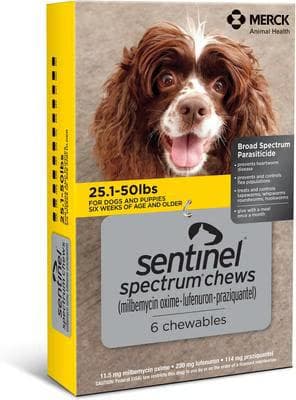
Milbemycin oxime, lufenuron and praziquantel in one chew for dogs 25.1 to 50 pounds, adding flea population control.
Webvet may earn a commission when you click through to Chewy, at no extra cost to you.
Fleas matter even for the worms Interceptor Plus does treat. VCA Animal Hospitals explains that the tapeworm Dipylidium caninum must pass through a flea before it can infect a dog, and that in a flea-infested environment reinfection can happen in as little as two weeks. Taenia tapeworms, by contrast, come from eating an infected host.
Echinococcus works on a similar clock. The Interceptor Plus label states that because the prepatent period for Echinococcus multilocularis can be as short as 26 days, dogs treated at the labeled monthly interval may become reinfected and shed eggs between treatments.

Whipworms are on the label, so the gap there is the environment rather than coverage. Cornell University's Riney Canine Health Center notes that monthly preventives containing milbemycin are approved for whipworm treatment and prevention, but whipworm eggs need 9 to 21 days in the environment to become infective and can survive in soil for years.
Cornell says persistent infection or reinfection is likely due to re-exposure to a contaminated environment. For an established whipworm infection, the Merck Veterinary Manual notes treatment is repeated three times at monthly intervals, a rhythm a monthly milbemycin schedule already follows.
Mites are outside the label too. Washington State University notes that mange treatment uses higher doses of this drug class than heartworm prevention does, and those doses can cause neurologic effects in dogs with the MDR1 mutation. A monthly Interceptor Plus chew is not a mange or ear mite treatment. For the gaps it leaves:
- Fleas and ticks: NexGard (afoxolaner) is labeled to treat and prevent flea infestations and to treat and control several tick species, which Interceptor Plus does not cover. Our guide to flea, tick and heartworm prevention for dogs compares the options.
- Tapeworm reinfection: treat every animal in the household for fleas; the Sentinel Spectrum label makes the same point to minimize flea reinfestation.
- Whipworm reinfection: stay on the monthly schedule and ask your vet how to reduce re-exposure in yards and soil.
Interceptor Plus vs Heartgard Plus and other preventives
The biggest difference between Interceptor Plus and Heartgard Plus is tapeworm coverage. Here is how the two FDA-approved labels compare, parasite by parasite:
- Heartworm: both prevent it. Interceptor Plus uses milbemycin oxime; the Heartgard Plus label pairs ivermectin with pyrantel.
- Roundworms: both treat and control Toxocara canis and Toxascaris leonina.
- Hookworms: both. Heartgard Plus lists three species (Ancylostoma caninum, Uncinaria stenocephala and Ancylostoma braziliense); Interceptor Plus lists Ancylostoma caninum.
- Whipworm: Interceptor Plus only. The Heartgard Plus label does not list whipworm.
- Tapeworms: Interceptor Plus only, with four species across Taenia, Echinococcus and Dipylidium. Heartgard Plus does not list tapeworm.
- Fleas and ticks: neither.
- Starting age: both are labeled from 6 weeks of age; Interceptor Plus adds a 2-pound minimum.
Heartgard Plus uses three weight bands to Interceptor Plus's four, color-coded blue for up to 25 lbs, green for 26 to 50 lbs and brown for 51 to 100 lbs. Our full guide to Heartgard Plus for dogs covers its dosing and safety on their own.
Combination products change the comparison. Sentinel Spectrum, from Merck Animal Health, combines milbemycin oxime, lufenuron and praziquantel, and the Sentinel Spectrum label adds flea population prevention and control to the same five parasite groups. Its label says to give each chew with or right after a normal meal for absorption.
So the main difference between Sentinel and Interceptor Plus for dogs is lufenuron, the flea ingredient. Sentinel Spectrum's 25.1 to 50 lb chew carries the same 11.5 mg of milbemycin oxime and 114 mg of praziquantel as the matching Interceptor Plus chew, plus 230 mg of lufenuron.
- Other milbemycin chews: Cornell lists Trifexis alongside Interceptor and Sentinel among the milbemycin- or moxidectin-containing monthly preventives approved for whipworms.
- A separate flea and tick chew: NexGard and Interceptor Plus can be given together under your vet's direction, which lets you guard against ticks as well as fleas; the label evidence for giving them at the same time is in the next section.
- An all-in-one chew: products that combine flea, tick and heartworm protection are compared in our Simparica Trio vs NexGard Plus guide.
If you settle on Heartgard Plus, a 40-pound dog takes the Heartgard Plus Chew for Dogs, 26-50 lbs, (Green Box), 12 Chews (12-mos. supply). For Interceptor Plus coverage plus flea control, the Sentinel Spectrum Chew for Dogs, 25.1-50 lbs, (Yellow Box), 6 Chews (6-mos. supply) is the closest match at that weight.
Is Interceptor Plus better than Heartgard?
Neither is better for every dog. Interceptor Plus has the broader label, adding whipworm and four tapeworm species, so it fits a dog at risk of those parasites better. Heartgard Plus covers heartworm, roundworms and hookworms, and its field trials report vomiting or diarrhea within 24 hours after 1.1% of administered doses.
Their safety data differ in form. The Heartgard Plus label says certain Collies are more sensitive to ivermectin above 16 times the target dose and reports choking or intestinal obstruction in some cases, advising owners to break the chew for dogs that gulp treats. The Interceptor Plus Collie study saw no reactions below 12.5 mg/kg.
What is the safest heartworm preventative for dogs?
No primary veterinary source ranks one product as the safest. AHS says veterinarians know which parasites are common where they practice, so owners should ask their vet which product or products are best for their pet.
Washington State University adds that every heartworm product labeled for dogs in the United States was tested in dogs with the MDR1 mutation, as the FDA requires, and found safe.
Preventives come in several forms, according to AHS: monthly chewables, topical spot-on medications, and an injectable given every 6 or 12 months. For a wider comparison of products, see our guide to the best heartworm medicine for dogs.
Missed doses, overdoses, and giving Interceptor Plus with NexGard
The Interceptor Plus label sets no missed-dose window; beyond redosing when part of a chew is lost, it says nothing about late doses. The American Heartworm Society fills the gap: oral and topical preventives must be given strictly monthly, and after a late dose, AHS advises consulting your veterinarian and restarting prevention immediately.
If you miss a dose:
- Call your vet and restart the monthly chew right away, as AHS advises.
- Keep to a strict monthly schedule from that new dose.
- Book a heartworm test about six months later, because AHS says a new infection cannot be detected until the worms are about seven months old.
Heartgard Plus's label gives the same direction for its own chew: whether a dose is a few days or many days late, treat immediately and resume the schedule to minimize adult worm development.
Infections that do slip through are long-lived. AHS says adult heartworms can live 5 to 7 years in dogs, while the Merck Veterinary Manual gives 3 to 5 years.
Between now and that test, watch for early heartworm signs. AHS lists a mild persistent cough, reluctance to exercise, fatigue after moderate activity, decreased appetite and weight loss; our guide to heartworm symptoms in dogs covers them in more detail.

If your dog ate two doses, or got into the box and ate several chews, the label gives no specific overdose protocol. Its repeated-dose puppy studies at three and five times the maximum label exposure produced ataxia, lethargy and salivation, and its Collie study saw reactions only at five times that exposure.
A single extra chew from the right band stays below those tested multiples. A chew from the wrong band is another matter: the 23 mg chew for 50.1 to 100 lb dogs holds four times the milbemycin oxime of the 5.75 mg chew for 8.1 to 25 lb dogs. When you call your vet, have this ready:
- The box, so you can name the weight band and the milligram strength.
- How many chews are missing and roughly when they were eaten.
- Your dog's current weight.
- Any signs since, such as drooling, stumbling, tremors or unusual tiredness.
Can NexGard and Interceptor Plus be given together? The NexGard label reports use alongside other medications, including anthelmintics (dewormers), vaccines and antibiotics, with no adverse reactions observed. It does not name Interceptor Plus, so confirm the pairing with your vet, but the two cover different parasites: NexGard handles fleas and ticks, Interceptor Plus handles worms.
One caution applies to that pairing. NexGard belongs to the isoxazoline class, which its label says has been associated with tremors, ataxia and seizures, so it should be used with caution in dogs with a history of seizures or neurologic disorders. Tell your vet about any seizure history before combining products.
Can I get heartworm medication without a vet?
No. Federal law restricts Interceptor Plus to use by or on the order of a licensed veterinarian, and AHS explains that heartworm preventives in general must be bought from your veterinarian or with a prescription through a pet pharmacy. AHS is also clear that there is no such thing as a natural heartworm preventive.
That rules out buying Interceptor Plus for dogs without a vet prescription, online or in a store. Chewy and other pet pharmacies fill it only against your vet's prescription. Price depends on weight band and pack size (six chews cover six months, 12 chews a year), so ask your clinic and pharmacy about current rebates or coupons.
Interceptor Plus questions
Frequently Asked Questions
Can Interceptor Plus be given to puppies?
Yes, from six weeks of age, as long as the puppy weighs at least 2 pounds. AHS recommends starting puppies on a heartworm preventive as early as the product label allows and no later than 8 weeks of age, and the Merck Veterinary Manual puts the start at 6 to 8 weeks.
Puppies under 7 months can start without a heartworm test, but AHS advises testing 6 months later, again 6 months after that, and then yearly. Reweigh often, since a growing puppy will move up through the weight bands.
Does Interceptor Plus kill fleas or ticks?
No. Interceptor Plus has no flea or tick claim on its label, because its two actives, milbemycin oxime and praziquantel, are both anthelmintics aimed at worms. To cover fleas and ticks, pair it with a separate product your vet recommends, or ask whether a combination chew suits your dog better. Flea control also protects the tapeworm results, since fleas carry Dipylidium tapeworms.
What happens if I miss a dose of Interceptor Plus?
A gap gives heartworm larvae time to mature past the point a preventive can clear them, which AHS says can happen in as little as 51 days. Give it as soon as you remember, call your vet, and plan a heartworm test about six months later, because a new infection cannot be detected until the worms are about seven months old.
Is Interceptor Plus safe for collies and other MDR1 dogs?
Yes, at the label dose. Washington State University says heartworm-prevention doses of these drugs have been shown safe even in dogs with the MDR1 mutation, while the higher doses used for mange can cause neurologic effects and should be avoided. Give exactly the label dose of milbemycin for your dog's weight band, and note that WSU urges caution with combination products containing spinosad in MDR1 dogs.
Veterinarian · BVMS MRCVS
Dr. Pippa Elliott, BVMS, MRCVS, is a veterinarian with nearly 30 years of experience in companion animal practice. Dr. Elliott earned her Bachelor of Veterinary Medicine and Surgery from the University of Glasgow. She was also designated a Member of the Royal College of Veterinary Surgeons. Married with 2 grown-up kids, Dr. Elliott has a naughty Puggle named Poggle, 3 cats and a bearded dragon.
Related reading

Dog Anxiety Meds: What Vets Prescribe, Over-the-Counter Options, and How to Choose

Heartgard Plus for Dogs: What It Prevents, Dosing by Weight, Side Effects, and Missed Doses

Can Dogs Have Tylenol? Acetaminophen Toxicity in Dogs
