Best Flea Tick Heartworm Prevention for Dogs: A Vet-Reviewed Comparison
No single product covers fleas, ticks, and heartworm equally. Compare Simparica Trio, Trifexis, Interceptor Plus, Advantage Multi, and Sentinel Spectrum, and see how a veterinarian matches prescription prevention to your dog.

BVMS MRCVS
Medically reviewed by Dr. Pippa Elliott, BVMS MRCVS · Last reviewed

This article contains affiliate links. Webvet may earn a commission when you buy through them, at no extra cost to you.
Ask five veterinarians to name the best flea tick heartworm prevention for dogs and you will hear the same honest answer: it depends on the dog. Every combination preventive on the US market is a prescription product, and each one protects against a different mix of parasites.
This guide compares the five products vets prescribe most often: Simparica Trio, Trifexis, Interceptor Plus, Advantage Multi, and Sentinel Spectrum. You will see what each covers, where the gaps are, and how a vet makes the match. Because one mosquito bite is all it takes for a dog to get heartworm, the stakes run high.
- 1No single product covers everything: only Simparica Trio combines flea, tick, and heartworm protection in one monthly chew.
- 2Interceptor Plus and Sentinel Spectrum cover heartworm plus intestinal worms, including tapeworms, but always need a separate flea and tick product.
- 3Advantage Multi is a topical route for dogs that refuse pills; it covers heartworm and fleas but not ticks.
- 4Every heartworm preventive in the US is prescription only, and adult dogs must test heartworm negative before starting.
- 5The American Heartworm Society recommends year-round prevention with an annual heartworm test for every dog.
- 6Dogs with a history of seizures may need a non-isoxazoline product; raise this with your vet before choosing.
- 7Monthly prevention costs a small fraction of what heartworm treatment costs.
What Is the Best Flea, Tick, and Heartworm Prevention for Dogs?
The best flea, tick, and heartworm prevention is the one your veterinarian matches to your dog's weight, age, health history, and parasite exposure; no single product is right for every dog. For the broadest protection in one monthly chew, Simparica Trio covers fleas, ticks, and heartworm together. Every option in this comparison is prescription only.
All five products here belong to the class of prescription heartworm preventives regulated by the FDA. None can be legally purchased without a veterinarian's authorization, and that rule exists to protect your dog, not to inconvenience you. The why-a-prescription section below explains it in full.
Is There a True All-in-One?
Yes, in the chewable class. Simparica Trio, along with newer combinations such as NexGard PLUS and Credelio Quattro, bundles flea, tick, and heartworm protection into a single monthly dose. Even so, no chew covers every parasite: most of the all-in-one products skip tapeworms entirely.
See the detailed guides to Simparica Trio for dogs and NexGard Plus for dogs for product-specific coverage, eligibility and dosing.
Before the full comparison, here is the short version of how vets think about the category:
- One chew that does the most: Simparica Trio.
- Broad worm coverage without the isoxazoline class: Interceptor Plus or Sentinel Spectrum, paired with a separate flea and tick product.
- Pills are a nightly wrestling match: a topical such as Advantage Multi.
- Heartworm-only coverage on purpose: Heartgard Plus plus standalone flea and tick control your vet picks for your region.
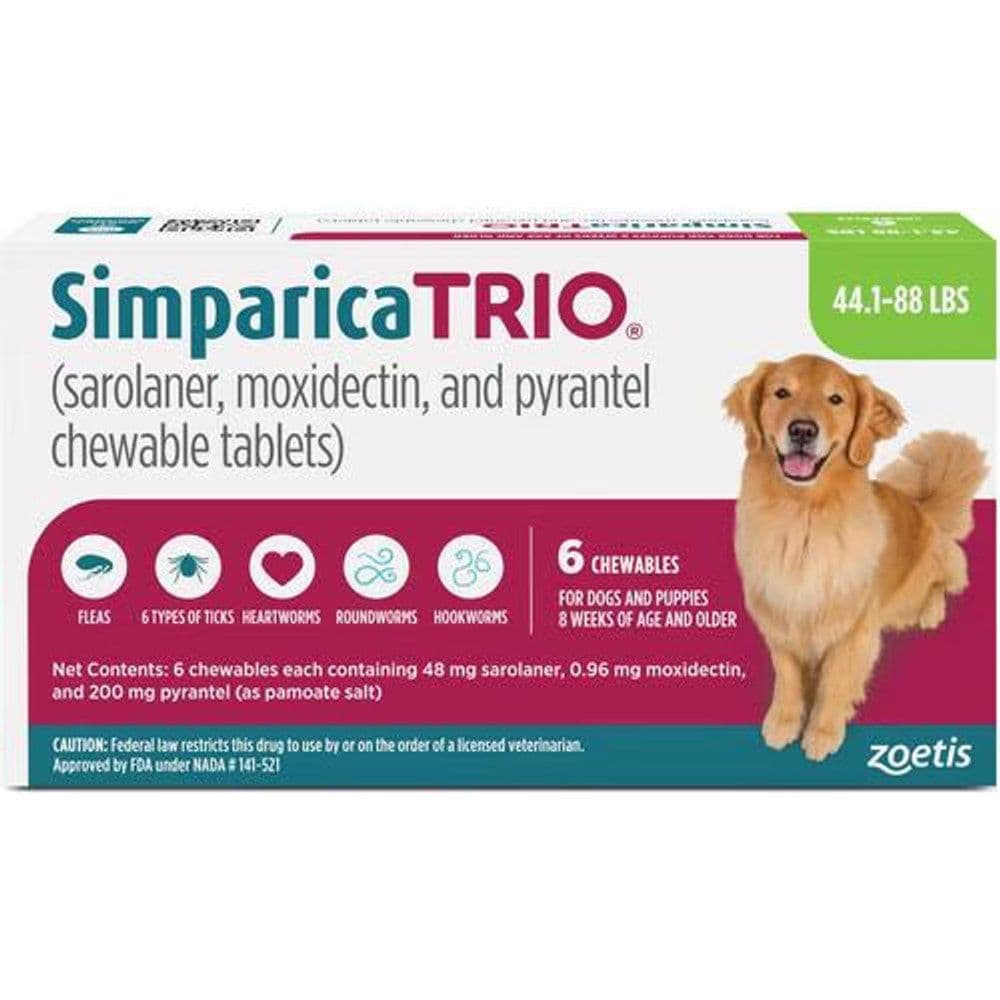
Monthly chew that protects dogs from fleas, six species of ticks, heartworm disease, roundworms, and hookworms.
Webvet may earn a commission when you click through to Chewy, at no extra cost to you.
What Each Product Covers: Comparison Table
The core split is simple. Only Simparica Trio covers fleas, ticks, and heartworm in one chew. Trifexis covers fleas and heartworm but not ticks. Interceptor Plus and Sentinel Spectrum cover heartworm and intestinal worms, including tapeworms, and need a separate flea and tick product. Advantage Multi is a topical covering heartworm and fleas, but not ticks.
Here is what each product covers, taken from each FDA-approved label:
| Product | Active Ingredients | Heartworm | Fleas | Ticks | Intestinal Worms | Tapeworms | Route | Frequency |
|---|---|---|---|---|---|---|---|---|
| --- | --- | --- | --- | --- | --- | --- | --- | --- |
| Simparica Trio | Sarolaner, moxidectin, pyrantel | Yes | Kills adults | Yes (five species) | Roundworms, hookworms | No | Chewable | Monthly |
| Trifexis | Spinosad, milbemycin oxime | Yes | Kills adults | No | Roundworms, hookworms, whipworms | No | Chewable | Monthly |
| Interceptor Plus | Milbemycin oxime, praziquantel | Yes | No | No | Roundworms, hookworms, whipworms | Yes | Chewable | Monthly |
| Advantage Multi | Imidacloprid, moxidectin | Yes | Kills adults | No | Roundworms, hookworms, whipworms | No | Topical | Monthly |
| Sentinel Spectrum | Milbemycin oxime, lufenuron, praziquantel | Yes | Sterilizes flea eggs only | No | Roundworms, hookworms, whipworms | Yes | Chewable | Monthly |
Two rows in that table decide more prescriptions than any marketing claim. First, tick protection: only one of these five products covers ticks at all, which matters enormously if your dog hikes, hunts, boards, or lives anywhere ticks thrive. Second, tapeworms: only Interceptor Plus and Sentinel Spectrum include praziquantel for tapeworms.
That tapeworm gap is easy to miss. Dogs pick up tapeworms by swallowing infected fleas while chewing at their coat, or by scavenging wildlife. If your dog does either, the praziquantel products earn their place even though both require a second product for fleas and ticks.

Dogs that work brush and tall grass like this face the heaviest tick exposure, and ticks are the biggest coverage gap in this category. If you ever find one attached, our guide to what tick bites look like on dogs shows what to check. Fleas are easier: only Interceptor Plus ignores them entirely.
How the Monthly Dose Actually Works
The heartworm side of every combination preventive works backward, not forward. Moxidectin and milbemycin oxime do not shield your dog from new mosquito bites; they clear the immature larvae your dog picked up during the previous 30 days, before those larvae can mature into adult worms.
The flea and tick ingredients work the opposite direction, killing parasites as they arrive over the weeks after dosing. This split explains why a single missed month matters far more for heartworm than for fleas: the flea protection just fades, but the heartworm window closes behind you. Miss it, and larvae already on board keep developing.
Product Breakdowns
Each profile below opens with what the product covers, what it misses, and which dog it suits. Every label fact comes from that product's FDA-approved label, and all five are monthly prescription products your vet must authorize.
Simparica Trio
Simparica Trio covers the widest span in a single chew: heartworm prevention, adult flea kill, five tick species, plus roundworms and hookworms. It misses whipworms and tapeworms. It suits healthy dogs whose owners want one monthly dose and no second product to remember.
Three active ingredients split the work. Sarolaner, an isoxazoline, kills fleas and ticks. Moxidectin prevents heartworm disease. Pyrantel clears roundworms and hookworms. The label approves puppies as young as 8 weeks and dogs as small as 2.8 pounds. Pharmacies including Chewy dispense it as Simparica TRIO Chewable Tablets for Dogs once your vet approves the prescription.
One caution belongs up here rather than in fine print: because sarolaner is an isoxazoline, the FDA advises careful use in dogs with seizure histories. The safety section below covers that decision in detail.
Trifexis
Trifexis covers heartworm, fleas, and three intestinal worms (roundworms, hookworms, and whipworms) in one beef-flavored chew. It does not touch ticks or tapeworms. It suits dogs in low-tick households that need the whipworm coverage Simparica Trio lacks.
Its pairing is spinosad, a fast-acting flea adulticide, with milbemycin oxime for heartworm and intestinal worms. Give it with food, which improves absorption and lowers the chance of vomiting. Veterinary pharmacies list it as Trifexis Chewable Tablet for Dogs, prescription required.
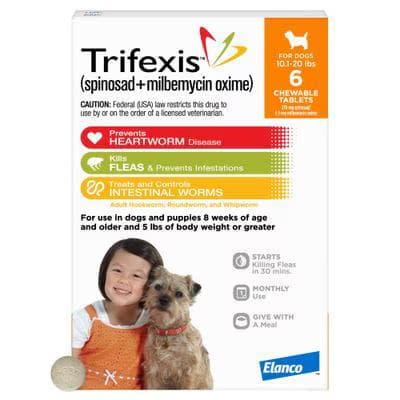
A monthly chew (spinosad and milbemycin oxime) that kills fleas, prevents heartworm, and treats intestinal worms. A non-isoxazoline oral option that starts killing fleas within 30 minutes.
Webvet may earn a commission when you click through to Chewy, at no extra cost to you.
Trifexis carries its own neurologic note: the label advises caution in dogs with pre-existing epilepsy. Spinosad is not an isoxazoline, but seizure-prone dogs still deserve the vet conversation before any flea product.
Interceptor Plus
Interceptor Plus covers heartworm plus the broadest worm panel in this comparison: roundworms, hookworms, whipworms, and tapeworms. It offers zero flea or tick protection, so it always pairs with a separate flea and tick product. It suits dogs that need to avoid the isoxazoline class and owners who prefer to choose flea control separately.
The chew combines milbemycin oxime for heartworm and intestinal worms with praziquantel for the tapeworm species dogs pick up from fleas and wildlife. Chewy stocks it as Interceptor Plus Chew for Dogs behind the usual prescription check. The label approves puppies from 6 weeks and 2 pounds, the earliest start in this group.
If intestinal parasites are your bigger worry, our guide to deworming a dog explains how vets confirm which worms are actually present before treating.
Advantage Multi
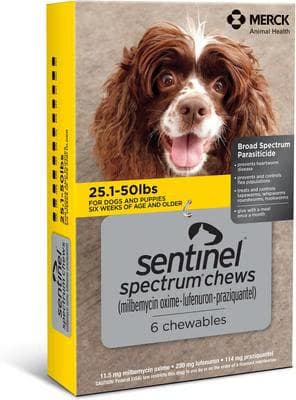
Advantage Multi is a topical, not a chew. It covers heartworm, adult fleas, roundworms, hookworms, whipworms, and sarcoptic mange. It does not cover ticks or tapeworms. It suits dogs that refuse pills, dogs sensitive to flavored chews, and dogs that need a non-isoxazoline option.
The monthly liquid combines imidacloprid for fleas with moxidectin for heartworm and worms, applied to the skin between the shoulder blades where the dog cannot lick. The label also approves it, under direct veterinary supervision, for clearing circulating microfilariae in heartworm-positive dogs, a job no chew in this lineup is labeled to do.
Application discipline matters with any topical. Part the fur to bare skin, apply the full tube, and keep the site dry until fully absorbed, following the label's bathing guidance. Keep children and other pets away from the wet spot.
Sentinel Spectrum
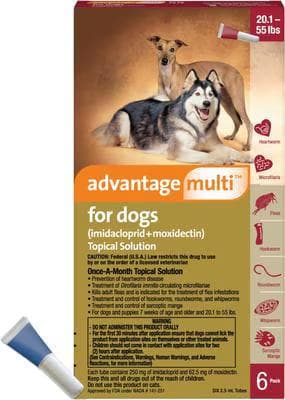
Sentinel Spectrum covers heartworm, roundworms, hookworms, whipworms, and tapeworms, and adds long-game flea control. Sentinel Spectrum adds tapeworm coverage through praziquantel, while its third ingredient, lufenuron, sterilizes flea eggs so an infestation collapses over several weeks. It does not kill adult fleas or any ticks.
Webvet may earn a commission when you click through to Chewy, at no extra cost to you.
The formula is milbemycin oxime, lufenuron, and praziquantel in a flavored chew given with food. Because lufenuron only breaks the flea life cycle, most dogs still need a separate flea and tick product for immediate, bite-stopping protection, especially in tick country.
Like Interceptor Plus, Sentinel Spectrum contains no isoxazoline, which is exactly why vets reach for these two when a dog's neurologic history narrows the field.
 $65 · no membership
Need flea, tick, or heartworm prevention for your dog?
A licensed vet can recommend and prescribe the right preventive for your dog online when it's appropriate.
 Talk to a vet
- Licensed vets
- All 50 states
- same-day Rx

Webvet may earn a commission if you book.
Oral vs. Topical: Which Route Fits Your Dog?
Most dogs do well on monthly chews, and most vets reach for chews first. A topical makes more sense when your dog refuses pills, vomits after flavored chews, or reacts to the meat-based flavorings. Weighing oral and topical options honestly, the deciding factor is usually your dog's cooperation, not the pharmacology.

Here is how the two routes trade off:
- Chews: nothing to rub off, so swimming and bathing never weaken the dose. Flavored bases can bother food-allergic dogs, and a dose vomited soon after giving may need replacing (call your vet before redosing).
- Topicals: no swallowing required, which ends the pill fight entirely. The fur must stay dry for the label's specified window, the application spot must be out of licking reach between the shoulder blades, and other pets should not groom the site.
If your vet suggests the topical route, Advantage Multi is the primary combination option, and Revolution Topical Solution for Dogs is the other prescription topical worth asking about: it covers heartworm, fleas, ear mites, sarcoptic mange, and American dog ticks, a slightly different mix.
There is also a third route many owners never hear about. ProHeart 6 and ProHeart 12 are injections your veterinarian administers that prevent heartworm for 6 or 12 months at a time, though fleas and ticks still need their own product. Our guide to the heartworm injection for dogs covers who qualifies.
Webvet may earn a commission when you click through to Chewy, at no extra cost to you.
How a Vet Matches a Preventive to Your Dog
A veterinarian matches the product to your dog using seven inputs: weight, age, breed sensitivities, seizure history, lifestyle, region, and the result of an annual heartworm test. That matching process, not any brand name, is what "best" actually means in this category. It is also the reason these are prescription drugs rather than shelf products.

Here is what each factor changes:
- Weight and age: every label sets a minimum age and weight, and doses are banded by weight. Puppies have their own timing rules, covered in our guide to heartworm prevention for puppies.
- Seizure history: shifts the choice away from the isoxazoline class, as the next section explains.
- Lifestyle: dog parks, boarding, hiking, and hunting each raise different exposures, from ticks to tapeworms.
- Region: tick species, mosquito season length, and heartworm pressure vary; southern and coastal states carry the heaviest burden.
- Test result: the annual heartworm test confirms your dog is still negative before another year of prevention continues.
Region is more knowable than most owners assume. The Companion Animal Parasite Council publishes county-level prevalence maps for heartworm, tick-borne disease, and intestinal parasites, and many vets check them when weighing how much local coverage a dog needs. If you split time between states, say so; snowbird travel routinely changes the pick.
The American Heartworm Society recommends year-round parasite prevention with testing every 12 months, noting that heartworm has been diagnosed in all 50 states. That position anchors everything in this article, and our hub on how to prevent heartworm in dogs explains the full case for it.
Some dogs genuinely do best on an unbundled plan: a heartworm-and-worm chew such as Heartgard Plus paired with a standalone flea and tick product chosen for the local tick species. That is a vet judgment call, and it is often the route for dogs with complicated medication histories.
Switching products mid-year is routine, and it does not require starting over. The usual approach is to give the new product on the date the next dose of the old one was due, so the monthly rhythm never breaks. Your vet confirms the heartworm test status first, then the swap is a same-day, no-washout change for most product pairs.
Safety: Seizures, Side Effects, and the Isoxazoline Class
The safest flea, tick, and heartworm prevention for dogs is the one chosen with your veterinarian after a full health history; safety here is about fit, not brand. Most healthy dogs tolerate all five products well, with vomiting and lethargy the most common label side effects. For dogs with a history of seizures, the isoxazoline class becomes the central question.
In practice, vets often steer dogs with a history of seizures toward non-isoxazoline coverage: Interceptor Plus or Sentinel Spectrum for heartworm and intestinal worms, plus a carefully selected flea and tick product that fits the dog's neurologic record. Trifexis is not an isoxazoline either, but its own label urges caution with pre-existing epilepsy, so it is not an automatic substitute.
Herding breeds and the MDR1 mutation
Owners of collies, Australian shepherds, and other herding breeds often ask about the MDR1 mutation, which makes some dogs sensitive to certain parasite drugs at high doses. At standard label doses, these preventives were tested in ivermectin-sensitive collies during approval. Still confirm your dog's MDR1 status with your vet; it changes other medication decisions too.
Whatever your vet prescribes, watch your dog for a day or two after the first dose of any new preventive. Report tremors, wobbliness, or seizure activity to your vet immediately; those reactions are exactly what the FDA asks veterinarians and owners to document.
Why These Products Require a Prescription
There is no legitimate heartworm preventive sold without a prescription in the United States. The FDA regulates every heartworm preventive as a prescription drug, and this is why a prescription is required: an adult dog must test negative for heartworms before starting or continuing prevention, and only a veterinarian can run that test and interpret it.

What prevention without a prescription actually means
If you searched for heartworm prevention without a prescription, know what that market actually is: overseas or gray-market pharmacies shipping prescription drugs outside FDA oversight, with no guarantee of authentic product, correct storage, or correct dosing. The FDA advises buying only from your vet or an accredited US pharmacy that verifies prescriptions.
The honest over-the-counter alternative exists only for fleas. OTC flea products are legal and useful for flea-only control, and our guide to the best OTC flea treatments for dogs covers them. Nothing over the counter prevents heartworm.
Skipping prevention to save the vet visit is a false economy for one more reason: heartworm disease is nearly silent at first. By the time signs appear, the infection is established, which is why our guide to heartworm symptoms in dogs reads more like a late-warning list than an early one.
What Combination Prevention Costs
Combination prevention generally runs in the low to mid double digits per month: based on typical retail pricing, roughly $15 to $45 depending on the product and your dog's weight band, with large-dog doses at the top. Heartworm treatment, by contrast, routinely runs into the four figures; our heartworm treatment cost guide breaks down those numbers.
A few things move your cost per month:
- Weight band: doses are priced by weight, so a 90-pound dog costs meaningfully more to protect than a terrier.
- Package size: 6-dose and 12-dose boxes usually lower the per-dose price versus buying month to month.
- Bundled versus unbundled: a single combination chew can beat, or lose to, the price of a heartworm-only product plus separate flea and tick control. Run both totals.
- Manufacturer rebates: several brands run rebates through veterinary clinics that meaningfully cut the annual total; ask before you fill the prescription elsewhere.
One budgeting note owners rarely hear: the exam and heartworm test are part of the real annual cost, not an add-on. Whichever product you land on, the yearly total is the doses plus one wellness visit, and that combined figure is still a rounding error next to treating an established infection.
The full protocol, from staged melarsomine injections to the recheck schedule, is laid out in our guide to heartworm treatment for dogs. Read it once and monthly prevention stops feeling like a subscription and starts feeling like a bargain.
What to Do After a Missed Dose
Give the missed dose as soon as you remember, then get back on the monthly schedule and call your veterinarian to report the gap. Per American Heartworm Society guidance, a lapse longer than a couple of weeks warrants a heartworm test about 6 months after the missed window, because antigen tests cannot detect a new infection any earlier than that.
Do not double up doses to compensate, and do not quietly skip the vet call. A short lapse handled correctly almost always ends fine; an unreported lapse that turns into an undetected infection is how the treatment scenario above begins.

Frequently Asked Questions
Straight answers to the questions owners actually ask about combination prevention.
Frequently Asked Questions
What is the best 3 in 1 heartworm flea and tick?
Simparica Trio is the most commonly prescribed 3 in 1 chew in the US, covering heartworm, fleas, and five tick species through sarolaner, moxidectin, and pyrantel. NexGard PLUS and Credelio Quattro are newer alternatives. The best pick for your individual dog depends on health history, so the final call runs through your veterinarian.
Is there an all-in-one flea, tick, and heartworm medicine for dogs?
Yes. Simparica Trio, NexGard PLUS, and Credelio Quattro each combine flea, tick, and heartworm protection in one monthly prescription chew. None is truly universal, though: Simparica Trio and NexGard PLUS both skip tapeworms, for example. Your veterinarian confirms your dog is heartworm negative before dispensing any of them.
Is there a flea, tick, and heartworm combo?
Yes, in two forms. Combination chews such as Simparica Trio handle all three parasites in one monthly dose. Alternatively, vets build a combo from two products: a heartworm and worm chew like Interceptor Plus or Sentinel Spectrum, paired with a separate flea and tick product matched to your region's tick species.
Do dogs really need flea, tick, and heartworm medicine?
Veterinarians say yes for nearly all dogs. The American Heartworm Society reports heartworm has been diagnosed in all 50 states and recommends year-round prevention with annual testing, because untreated heartworm disease is progressive and can be fatal. Fleas and ticks also transmit disease in every season, indoors and out.
What is the safest flea, tick, and heartworm prevention for dogs?
The safest option is the one your veterinarian selects after reviewing your dog's full health history. All five products compared here are FDA approved and well tolerated by most dogs. For dogs with a history of seizures, vets often avoid the isoxazoline class and choose Interceptor Plus or Sentinel Spectrum plus separate flea and tick control.
Is NexGard or Simparica better?
Neither is clearly better. Both are monthly isoxazoline chews with comparable flea and tick efficacy, NexGard using afoxolaner and Simparica using sarolaner. Note that the base versions of both cover only fleas and ticks. For heartworm protection you need NexGard PLUS or Simparica Trio, and your vet will steer that choice.
Can you get heartworm prevention for dogs without a vet prescription?
No. Every heartworm preventive legally sold in the US is a prescription drug under FDA rules, because an adult dog must test heartworm negative before starting. Websites that ship these products without a prescription operate outside FDA oversight, with genuine counterfeit and storage risks. The exam and test are part of the product working safely.
What is the difference between Heartgard Plus and the combination chews?
Heartgard Plus pairs ivermectin with pyrantel to prevent heartworm and treat roundworms and hookworms, nothing more, so it always runs alongside separate flea and tick control. Combination chews such as Simparica Trio or Trifexis fold flea protection, and in Simparica Trio's case tick protection, into the same monthly dose. Vets use both approaches successfully.
Sources
- American Heartworm Society, Pet Owner Resources: https://www.heartwormsociety.org/pet-owner-resources/
- US Food and Drug Administration, Animal and Veterinary: https://www.fda.gov/animal-veterinary/
- American Veterinary Medical Association, Pet Owner Resources: https://www.avma.org/resources-tools/pet-owners
- Merck Veterinary Manual, Dog Owners: https://www.merckvetmanual.com/dog-owners/
- VCA Animal Hospitals, Know Your Pet: https://vcahospitals.com/know-your-pet
- Companion Animal Parasite Council, Guidelines: https://capcvet.org/guidelines/
$65 · no membershipNeed flea, tick, or heartworm prevention for your dog?
A licensed vet can recommend and prescribe the right preventive for your dog online when it's appropriate.
Talk to a vet- Licensed vets
- All 50 states
- same-day Rx
Webvet may earn a commission if you book.

Editor
The Webvet Editorial Team is the in-house group of pet-care editors and writers behind Webvet, operated by Smart Pet Collective. The team researches, writes, and maintains Webvet's pet health, behavior, and medication content. Every article follows a defined editorial process: research from reputable veterinary and scientific sources, careful drafting, mandatory review of medical content by a credentialed veterinarian, and dated publication. Health and medication articles are medically reviewed by a licensed veterinary professional before they go live and are kept current over time.
Veterinarian · BVMS MRCVS
Dr. Pippa Elliott, BVMS, MRCVS, is a veterinarian with nearly 30 years of experience in companion animal practice. Dr. Elliott earned her Bachelor of Veterinary Medicine and Surgery from the University of Glasgow. She was also designated a Member of the Royal College of Veterinary Surgeons. Married with 2 grown-up kids, Dr. Elliott has a naughty Puggle named Poggle, 3 cats and a bearded dragon.


