Simparica Trio for Dogs: Uses, Dosage, Safety and Cost
Simparica Trio for dogs: a current US guide to ingredients, parasite coverage, weight-band dosing, prescription requirements, side effects and buying costs. Use it to discuss the right preventive with your veterinarian.

BVMS MRCVS
Medically reviewed by Dr. Pippa Elliott, BVMS MRCVS · Last reviewed

Drug facts
Simparica Trio· sarolaner, moxidectin, and pyrantel
Monthly prescription oral chew for dogs at least 8 weeks old and 2.8 pounds. Treats and prevents flea infestations, controls six labeled tick species, prevents heartworm disease, and treats specified roundworms and hookworms. Does not treat adult heartworms.
Treats
 $65 · no membership
Need a prescription for Simparica Trio?
A licensed vet can assess your dog over video and prescribe Simparica Trio online when it's appropriate.
 Talk to a vet
- Licensed vets
- All 50 states
- same-day Rx

Webvet may earn a commission if you book.
Simparica Trio for dogs is a once-monthly prescription chew containing sarolaner, moxidectin, and pyrantel. It treats and prevents flea infestations, controls specified ticks, prevents heartworm disease, and treats certain roundworms and hookworms. Dogs must be at least 8 weeks old and weigh at least 2.8 pounds. The right product and dose depend on your dog's current weight and veterinary history.
This guide follows the US label. Simparica Trio is different from ordinary Simparica, and a lower price is useful only if the product matches the prescription. Start with what the medicine covers, then check the weight band, safety precautions, and complete monthly cost.
What is Simparica Trio for dogs?
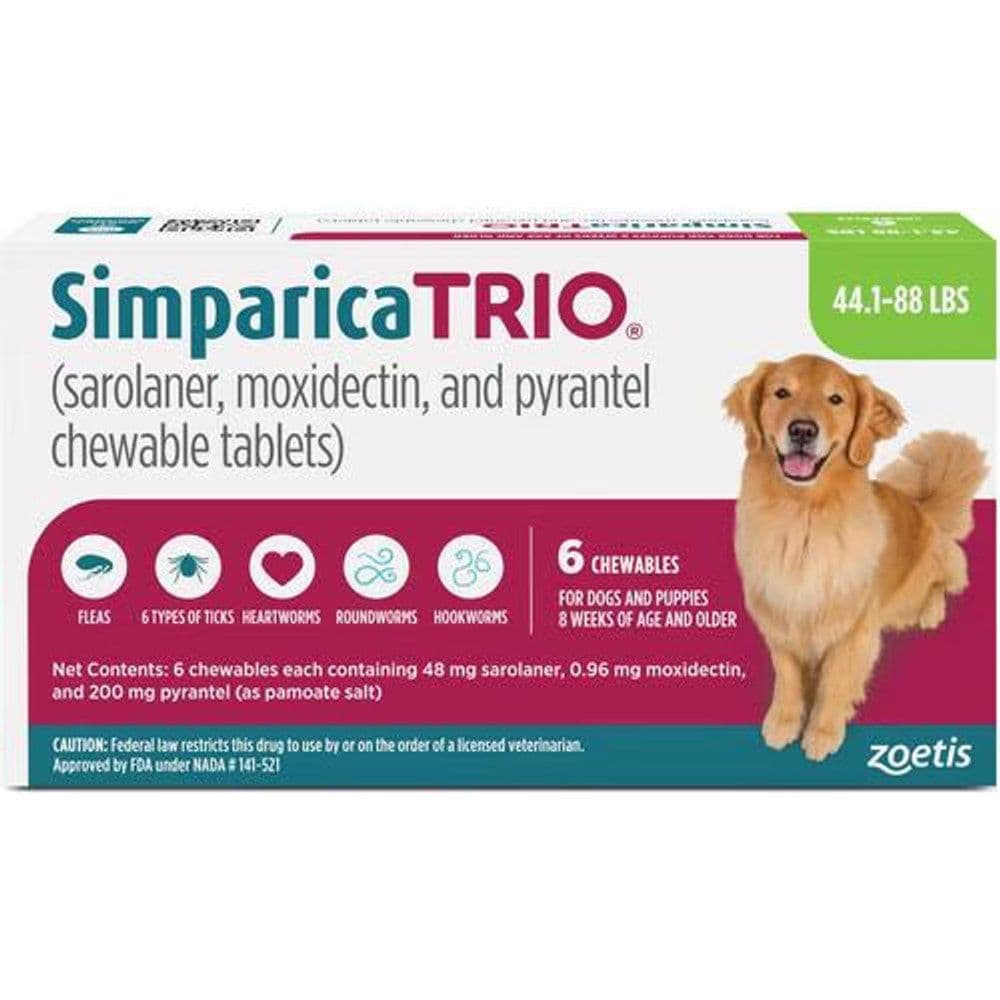
Zoetis makes Simparica Trio chewable tablets for dogs. The three active ingredients have different jobs: sarolaner targets fleas and ticks; moxidectin supplies heartworm prevention and activity against certain intestinal parasites; pyrantel acts against susceptible intestinal worms. These ingredients work on susceptible parasites. That combination makes Trio a convenient option when a veterinarian wants these protections in one monthly chew. It is still a medicine, with label limits and precautions, rather than a general supplement.
Simparica Trio is a monthly chew for dogs at least 8 weeks old and 2.8 pounds. Match the full prescription name and weight band. Heartworm prevention is not treatment for adult heartworms, and flea-mediated tapeworm prevention is not treatment of an existing tapeworm infection.
The flavored tablet can be given with or without food. The label describes flavored chewables; ask the manufacturer or veterinarian about flavoring ingredients if your dog has a food allergy. A six-chew box usually supplies six monthly doses for one dog receiving one chew per dose; the box is not a single six-month treatment. A dog above the largest weight band may need a veterinarian-selected combination. Follow the product instructions rather than treating the tablet as a generic pet supplement. A matching ingredient list alone does not establish that a different pill is an approved interchangeable generic. Product reviews, including Reddit posts, can describe an owner's experience, but they cannot establish which preventive is safest for your dog or prove that an unrelated symptom was caused by the medicine.
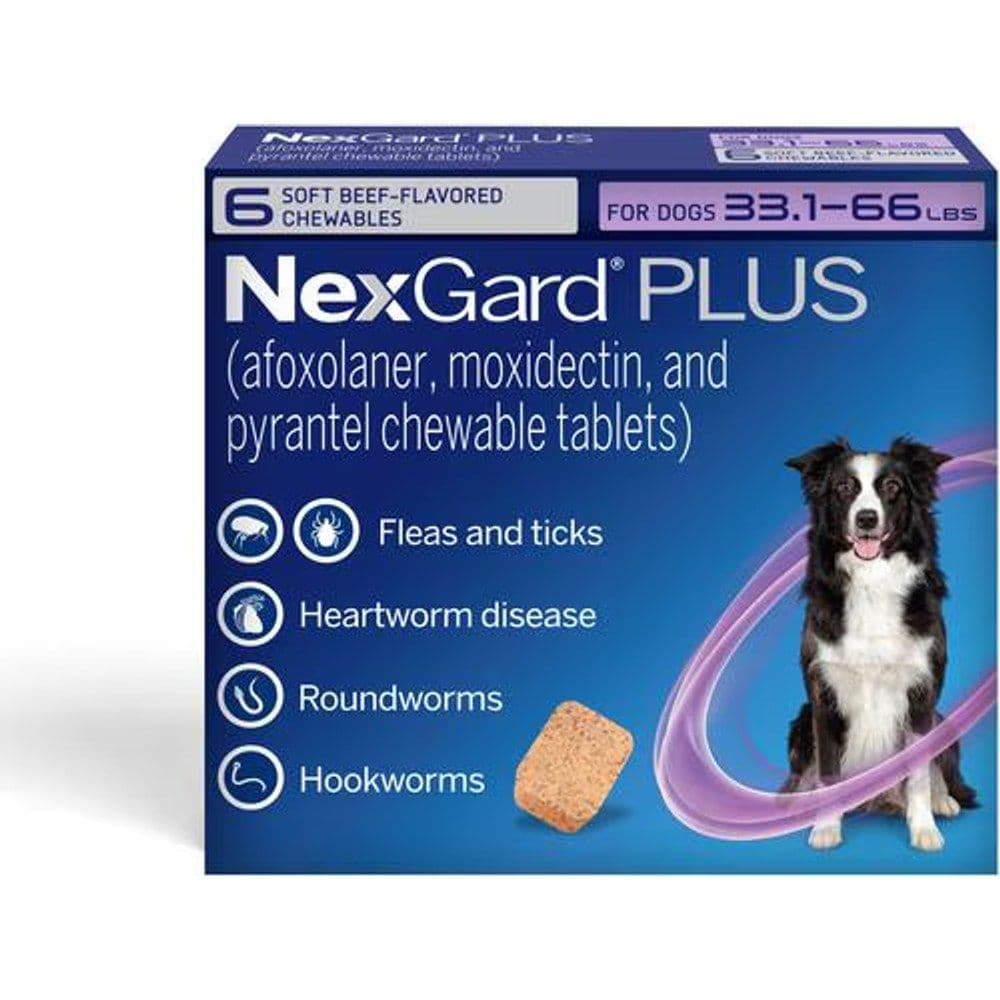
For product identification, these are two distinct US prescriptions. Have your veterinarian choose before ordering.
| Product | Active ingredients | Labeled minimum | Purchase check |
|---|---|---|---|
| Simparica Trio | Sarolaner, moxidectin, pyrantel | 8 weeks; 2.8 lb | Choose the prescribed weight band and quantity |
| NexGard Plus | Afoxolaner, moxidectin, pyrantel | 8 weeks; 4 lb | Different strengths and weight bands |
What does Simparica Trio cover?
The current US label supports heartworm disease prevention, flea treatment and prevention, control of six tick species, and treatment of specified roundworms and hookworms. It also includes prevention of Borrelia burgdorferi infection by killing the black-legged tick that transmits it. These are specific indications, not protection against every parasite or every tick-borne disease. The DailyMed label gives the organism and life-stage details.
| Parasite or condition | What the US label covers | Important limit |
|---|---|---|
| Fleas | Adult flea killing; treatment and prevention of infestations | The home and other pets can remain sources of new fleas |
| Ticks | Six named tick species for one month | Does not mean ticks cannot attach |
| Heartworm | Prevention of disease caused by Dirofilaria immitis | Does not kill adult heartworms |
| Roundworms | Specified immature adult/adult Toxocara canis and adult Toxascaris leonina | Does not replace a fecal-testing plan |
| Hookworms | Specified stages of Ancylostoma caninum and adult Uncinaria stenocephala | Persistent infection needs veterinary reassessment |
| Flea tapeworm | Prevention of Dipylidium caninum through killing vector fleas | Does not treat an existing tapeworm infection |
| Whipworms | No labeled treatment | A different medicine may be needed |
The six tick species are lone star, Gulf Coast, American dog, black-legged or deer, brown dog, and Asian longhorned ticks. A tick check after outdoor activity still makes sense. Tell your veterinarian where you live and travel, because parasite exposure and the need for additional measures vary.
Tapeworm prevention does not treat an existing tapeworm infection
Simparica Trio's tapeworm prevention claim concerns Dipylidium caninum, the flea tapeworm: killing infected fleas on the treated dog can interrupt transmission. It does not mean the chew kills existing tapeworms inside the intestine, prevents every tapeworm species, or protects against swallowing infected fleas from untreated animals. Rice-like segments around the anus or in bedding warrant a veterinary diagnosis and appropriate treatment.
Simparica Trio treats its labeled roundworms and hookworms, but it does not kill every type of intestinal worm. This dewormer is not a universal wormer. The US label does not list whipworm treatment or ear-mite treatment. If your dog has diarrhea, ongoing itching, suspected mites, or a positive stool test, ask what organism was found before assuming the monthly chew covers it. A complete flea, tick, and heartworm prevention plan may include testing and household flea control as well as medication.
How fast does Simparica Trio work?
How quickly Simparica Trio starts to work depends on the parasite being measured. In a laboratory study reported in the label, Simparica Trio began killing fleas four hours after the first dose and reached 100% effectiveness at eight hours. For owners wondering how long it will take to kill existing fleas, those are study results under defined conditions, not a promise that a household infestation or a dog's itching will disappear in eight hours. Newly emerging fleas can continue to jump onto a treated dog from the environment.
For ticks, the label reports different kill-time measurements by species. It is misleading to give one universal number for every tick. Simparica Trio works systemically after the dog swallows the medicine; it does not create a shield that prevents every tick from attaching. Finding a tick therefore does not, by itself, prove a failed dose.
If your dog still has fleas or ticks while taking Simparica Trio:
- Check that the entire prescribed dose was swallowed and the monthly schedule has not slipped.
- Confirm the current weight band, especially for a growing puppy.
- Make sure other household animals have species-appropriate flea protection.
- Ask your veterinarian about ongoing exposure, skin irritation, and environmental control.
Do not shorten the dosing interval or add another flea medicine on your own. The label's longer study observation periods do not change the monthly dosing directions.
Simparica Trio dosage and weight chart
This Simparica Trio dosage chart lists six US weight bands, from small dogs weighing 2.8–5.5 pounds through large dogs weighing 88.1–132 pounds. The table identifies the amounts in one labeled chew; it is not a formula for dividing a larger tablet or making a home dose. All three ingredient amounts change with the package size. Your veterinarian chooses the prescribed dose using a current weight.
| Dog's weight | Sarolaner per chew | Moxidectin per chew | Pyrantel per chew |
|---|---|---|---|
| 2.8–5.5 lb | 3 mg | 0.06 mg | 12.5 mg |
| 5.6–11.0 lb | 6 mg | 0.12 mg | 25 mg |
| 11.1–22.0 lb | 12 mg | 0.24 mg | 50 mg |
| 22.1–44.0 lb | 24 mg | 0.48 mg | 100 mg |
| 44.1–88.0 lb | 48 mg | 0.96 mg | 200 mg |
| 88.1–132.0 lb | 72 mg | 1.44 mg | 300 mg |

For a dog over 132 pounds, the label directs an appropriate combination of tablets; have the prescriber specify that combination. Puppies must meet both minimums: 8 weeks of age and 2.8 pounds. Reweigh a puppy before refilling instead of assuming the same size remains correct for a three-, six-, or twelve-month supply.
The dosing chart should be read with the full prescription. Retail titles sometimes shorten the ranges to “11–22,” “22–44,” “44–88,” or “88–132.” Package colors such as caramel, blue, green, and brown are convenient identifiers, but the complete pound range and product name control the selection. A dog at 44 pounds and a dog at 44.1 pounds fall into different label bands. Do not round your dog's weight down to use a cheaper box.
The number of chewables changes the supply, not the dose strength. Six monthly doses cover six months when one chew is prescribed per month; “lbs” in a listing means pounds, not the number of doses. A six-pack of 44.1–88 lb Simparica Trio is different from a six-pack of 11.1–22 lb tablets even when an online search lists both under the same product family. At Chewy, Costco, or any pharmacy, check the final selected weight band, tablet count, prescription, and price before paying. “12-month supply” should describe the actual prescribed number of monthly doses, not a longer interval between them.
Giving a dose, missed doses, and vomiting
Give Simparica Trio once a month, following the prescription. How often you give it does not change because the last box contained more tablets: a single dose is one scheduled monthly treatment. It can be offered with or without food. Watch your dog swallow the entire chew and check for pieces that have been dropped or spat out. A calendar reminder helps more than relying on the date you last bought a box. The manufacturer's owner guidance addresses a vomited or spat-out dose, but uncertain ingestion deserves a call to the prescriber.
If your dog threw up, will not eat Simparica Trio, refuses the chew, or leaves part of it, describe what happened and when. Your veterinarian can advise whether a replacement is needed. Do not borrow a redosing time rule from a different product, assume a partially eaten tablet gave full protection, or automatically give another full chew when you do not know how much was absorbed.
For a missed dose, the label directs giving the missed dose and resuming monthly administration. Contact your veterinarian about the lapse and a heartworm-testing plan; a negative test immediately after a gap cannot exclude every recent infection. Do not double the next scheduled dose to make up for missed protection. Follow the product's monthly schedule even if a laboratory study followed parasite counts for longer than a month.
Simparica Trio cost and where to buy
How much Simparica Trio costs depends on the selected prescription and seller. The best price for Simparica Trio is the lowest complete price for your dog's exact prescribed strength and supply from a legitimate pharmacy. Compare checkout cost per monthly dose, including shipping or other applicable charges. Keep one-time coupons and later rewards separate. A search result showing a low “from” price may represent one chew, a different weight band, or a price range covering several quantities.
There is no single reliable nationwide price for a six-month supply at Costco, Walmart, or CVS. Ask for a current quote using the full product name, weight range, and six-chew quantity. For Costco, its prescription-price instructions explain how to look up a medicine and view available pricing. A member-program quote should not be presented as a price available to every shopper. Confirm any membership conditions and the final amount with the pharmacy.
Compare pharmacy quotes
To order Simparica Trio online or find a nearby source, confirm who dispenses the pet medicine before ordering. A “near me” result in California or Texas still needs a local availability and price check; this guide is not a live store-stock directory.
For Walmart or CVS, first confirm that the dispensing pharmacy can fill this veterinary prescription and supply the selected strength. Do not assume every store stocks it because the chain name appears in a search. The same caution applies when comparing Petco, PetSmart, Tractor Supply, Sam's Club, Allivet, or PetMeds. Availability and promotions need to be checked with the actual dispensing service.
| Hypothetical quote, not a current retailer price | Monthly calculation | Result |
|---|---|---|
| $180 for 6 prescribed monthly doses | $180 ÷ 6 | $30 per month |
| $336 for 12 prescribed monthly doses | $336 ÷ 12 | $28 per month |
| $180 plus $12 shipping for 6 doses | $192 ÷ 6 | $32 per month |
To compare Simparica Trio at Chewy with a veterinary-clinic quote, select the correct box before comparing totals. An Amazon marketplace listing or an unusually cheap no-prescription offer is not proof that the seller can legally dispense your dog's medicine. Check who fills the prescription and how the seller verifies it. A coupon service such as GoodRx is a starting point for checking a discount, not a guarantee that a particular pharmacy accepts it for this product.
If a refill seems more expensive than the last one, compare like with like: strength, number of tablets, expired introductory discounts, shipping, and reward eligibility. A price increase on one receipt does not establish a nationwide price change or its cause. Ask for written quotes instead of relying on an old Reddit receipt. Choosing the cheapest place to buy should not mean stretching doses or accepting the wrong medicine.
Simparica Trio rebates and Zoetis rewards
As checked September 17, 2026, the Zoetis Petcare Rewards offer uses points and membership tiers. At the Bronze tier, an eligible six-dose purchase earns 250 points, equivalent to $25 in reward value; an eligible twelve-dose purchase earns 600 points, equivalent to $60. Higher-tier promotions are conditional. Do not apply the largest advertised number to every buyer or every pack.
Under the program terms, eligible US veterinary or retail purchases require a valid prescription and qualifying documentation. Submit the invoice within 30 days and make sure it identifies the purchase clearly. Use the official program to check current eligibility before assuming a retailer coupon, promo code, subscription discount, or another offer can be combined with it.
The reward is a later veterinary rewards credit, not an automatic reduction in today's checkout cost. That matters when comparing a cash price with a “price after rebate.” Keep both figures visible: what you pay now, and what you may receive later for eligible veterinary spending. If a retailer advertises a separate Simparica Trio rebate or discount, read its own conditions as well. Rewards and promotions can change after this article's check date.
Why Simparica Trio requires a prescription
You cannot legally buy US Simparica Trio without a veterinarian's prescription. The prescription requirement is part of the drug's approval, and appropriate use includes checking the dog's weight, health history, other medicines, and heartworm-prevention history. Ordering online does not remove those requirements. A pharmacy may request approval directly from the veterinarian or ask for the prescription through its normal process.
The label calls for heartworm testing before treatment. There is an age-specific nuance: the American Heartworm Society says puppies under 7 months can start prevention without a baseline test, then need follow-up testing on an age-appropriate schedule. An eight-week-old puppy should not be left unprotected simply because a test cannot yet detect a recent infection. Your veterinarian sets the testing plan.
For older dogs, uncertain prevention history or missed doses can change that plan. Simparica Trio does not kill adult heartworms, so a positive dog needs a treatment strategy rather than a preventive-only substitute. The American Heartworm Society recommends year-round prevention and annual testing; discuss travel, local exposure, and any proposed seasonal stopping date with the prescriber.
Is there a cheaper alternative to Simparica Trio?
For dogs taking Simparica Trio, a less expensive alternative can be reasonable if it supplies the protection your veterinarian wants and suits your dog's history. The cheaper option must still fit the prescribed prevention plan. Compare a complete monthly plan, not the price of one component. Ordinary Simparica, ordinary NexGard, and standard Bravecto chews provide flea and tick control but do not supply the heartworm and intestinal-worm coverage of this three-ingredient tablet. Adding a separate preventive changes the total cost and administration schedule.
NexGard Plus is another monthly combination prescription. Its labeled minimum weight is 4 pounds, compared with 2.8 pounds for Trio, and its parasite details are not identical. A switch should follow a veterinary recommendation, with the next dose timed around the current prescription. A lower quoted price alone does not establish that one product is a better choice.
Heartgard Plus supplies heartworm prevention and treatment of specified intestinal worms, but it does not replace flea and tick control. Bravecto products also come in different formulations, so ask which exact product is being compared. If neurologic history is the reason for changing medicines, ask about the drug class as well as the brand: several competing flea and tick chews are isoxazolines too. WebVet's guide to the safest flea treatment for dogs explains why individual medical history matters.
Simparica Trio vs NexGard Plus
Simparica Trio vs NexGard Plus is primarily a prescription-fit decision. Both are monthly dog chews with moxidectin and pyrantel; the flea and tick ingredient is sarolaner in Trio and afoxolaner in Plus. Both current US labels list six tick species and prevention of the Lyme-associated organism through killing vector ticks. An older chart claiming that Plus covers only four ticks is out of date.
There are meaningful differences in minimum weight, intestinal-worm life stages or species, flea-tapeworm prevention labeling, and seasonal heartworm instructions. Neither label establishes a universally safer winner. Use the direct Simparica Trio vs NexGard Plus comparison for the chart and evidence, or the NexGard Plus for dogs monograph for its own dosing and safety details. NexGard Spectra is a different overseas formulation, not another name for US Plus.
Simparica Trio side effects and the FDA warning
Reported Simparica Trio side effects in dogs include vomiting, diarrhea, reduced appetite, and lethargy. The label also lists neurologic reports, including tremors, loss of coordination, and seizures. A dog becoming sick after a dose needs assessment, but timing alone cannot prove the drug caused every symptom. Post-approval reports do not provide a reliable frequency or establish causation for every case. They should neither be dismissed nor treated as a population risk rate. Reports of serious problems or deaths require investigation; an online report alone cannot establish that Simparica Trio caused a death or show how often such an event occurs. A medicine can be dangerous for an individual dog without every treated dog sharing the same risk.
The FDA's isoxazoline warning applies to the drug class, including Simparica Trio. Neurologic reactions have occurred in animals with no previous seizure history. The FDA also states that these products are considered safe and effective and that most treated pets have not experienced neurologic adverse reactions. Both parts belong in a balanced safety discussion.
For vomiting, diarrhea, unusual tiredness, poor appetite, or behavior changes, contact your veterinarian for advice based on severity and your dog's other conditions. Severe or bloody diarrhea, repeated vomiting, collapse, or neurologic signs need prompt attention. Record the product, dose, time, symptoms, other medicines, and any possible toxin exposure. Keep the package so the veterinarian can identify the strength and lot.
There is no single reliable answer to how long side effects last: the cause and severity matter. Do not wait through severe symptoms because an online review says they resolved in a day. Long-term use also does not guarantee that a new problem is harmless. The Merck Veterinary Manual's isoxazoline toxicology discussion provides clinical background on the class; the product label and your veterinarian determine use for your dog.
Which dogs need extra caution?
Some veterinarians may recommend a different preventive for a particular dog because of seizure history, another neurologic disorder, a previous reaction, or the dog's broader treatment plan. That is different from saying veterinarians generally advise against Simparica Trio. The label lists no known contraindications, while still requiring caution in dogs with seizures or neurologic disorders. “No known contraindications” does not mean the medicine has zero risk.
Discuss these situations before starting or renewing:
- Your dog has had seizures, tremors, poor coordination, or a previous suspected drug reaction.
- Your dog is breeding, pregnant, or nursing; safe use in these groups has not been evaluated.
- Your dog is younger than 8 weeks, weighs less than 2.8 pounds, or has changed weight substantially.
- Your dog has a positive heartworm test, an uncertain prevention history, or other medicines that may overlap.
Breed labels alone do not answer whether Simparica Trio is safe for a Greyhound, French Bulldog, Collie, or another dog. Give the veterinarian the individual medical history, including any known drug sensitivity. Do not infer safety or danger from breed anecdotes. The right question is which complete prevention plan is appropriate for this dog, at this weight, with this history, and how to monitor it.
Simparica vs Simparica Trio: check the full name
Ordinary Simparica tablets for dogs contain sarolaner alone as their active ingredient. The combination your dog receives matters. Simparica Trio contains sarolaner, moxidectin, and pyrantel. Both are prescription products, but ordinary Simparica does not supply Trio's heartworm prevention or labeled roundworm and hookworm treatment. A search for “Simparica” may return either product; check the full name on the prescription, shopping page, carton, and invoice before comparing prices.
Compare the active ingredients as well as the brand. The age minimum also differs. The ordinary Simparica US label starts at 6 months, while Trio starts at 8 weeks; both require at least 2.8 pounds. Do not transfer one product's tablet strength or puppy instructions to the other. If a prescription says Simparica Trio and the package says only Simparica, ask the pharmacy and veterinarian to resolve the mismatch before giving it.
Can cats take Simparica Trio?
Simparica Trio is a dog formulation, not a cat medicine. Do not split a small-dog chew for a cat or assume a familiar ingredient makes the whole combination suitable. Cat-specific products may contain some related ingredients, but their formulation, dose, approved uses, and precautions are different. A veterinarian should choose the cat's own parasite-prevention plan.
The same distinction applies to ordinary Simparica: its dog tablets are not a substitute for a cat prescription. If a cat may have swallowed either product, contact your veterinarian or an animal poison-control service promptly with the product name, strength, amount, and time. Do not wait for symptoms or try a home treatment. In a mixed-pet household, store dog chewables where cats cannot reach them and give each animal only its own prescribed product.
Simparica Trio questions from dog owners
Frequently Asked Questions
How should I store Simparica Trio?
The US label says to store Simparica Trio at or below 86°F (30°C). Keep the original package so the product name, weight band, expiry and lot remain available. Choose a secure place away from children and pets, especially dogs that may mistake flavored medication for treats. Ask the dispensing pharmacy about tablets exposed to excessive heat or damaged packaging before using them.
What if my dog accidentally eats extra chews?
If your dog accidentally eats extra Simparica Trio chews, contact your veterinarian or an animal poison-control service promptly. Have the dog's current weight, package strength, estimated number of chews, time of exposure, and other medicines ready. Do not assume a safety study means an accidental extra dose is harmless for your individual dog. Do not induce vomiting or give a home treatment unless a veterinary professional specifically directs you.
Can I bathe my dog after giving Simparica Trio?
You can bathe a dog after giving an oral Simparica Trio dose without washing it off. Simparica Trio is swallowed, so bathing does not wash the dose off the skin as it might affect some topical products. Do not give another chew because your dog had a bath or went swimming. If you are also using a medicated shampoo or another parasite treatment, follow that product's directions and ask the veterinarian how it fits the dog's overall plan.
Can I give Simparica Trio with Heartgard or another preventive?
Have your veterinarian coordinate the products and timing. Simparica Trio already supplies heartworm prevention and several other parasite indications, so adding Heartgard or another medicine can create unnecessary overlap. Tell the prescriber the full names and dates of the last dose of every preventive. A switch or a diagnosed infection may need a specific plan; do not create one by combining boxes at home.
Sources
$65 · no membershipNeed a prescription for Simparica Trio?
A licensed vet can assess your dog over video and prescribe Simparica Trio online when it's appropriate.
Talk to a vet- Licensed vets
- All 50 states
- same-day Rx
Webvet may earn a commission if you book.
Veterinarian · BVMS MRCVS
Dr. Pippa Elliott, BVMS, MRCVS, is a veterinarian with nearly 30 years of experience in companion animal practice. Dr. Elliott earned her Bachelor of Veterinary Medicine and Surgery from the University of Glasgow. She was also designated a Member of the Royal College of Veterinary Surgeons. Married with 2 grown-up kids, Dr. Elliott has a naughty Puggle named Poggle, 3 cats and a bearded dragon.


