Best Pill Pockets for Dogs: Vet-Reviewed Picks That Hide Every Pill Size
A pill pocket turns a daily fight into a two-second treat, as long as it fits the pill and the dog does not learn to eat around it. Here is how a vet picks pockets and pastes by pill size, diet, and dog, plus six Chewy picks.

BVMS MRCVS
Medically reviewed by Dr. Pippa Elliott, BVMS MRCVS · Last reviewed

This article contains affiliate links. Webvet may earn a commission when you buy through them, at no extra cost to you.
Pill pockets for dogs can turn pill time into treat time, but only when the pocket fits the pill and the dog never finds the medicine. A pocket that is too big lets a clever dog chew around the tablet, and the wrong ingredients can clash with an allergy diet or a low-fat plan.
The right choice comes down to three things: the size and type of pill, your dog's diet, and how suspicious your dog is. Nearly every pocket here contains chicken and a grain, at about 9 to 21 calories a piece where listed, and a few drugs must never be crushed or chewed.
| Product | Best fit | Format | Calories per piece (label) | Main tradeoff |
|---|---|---|---|---|
| Greenies Pill Pockets Canine Chicken Flavor Dog Treats | Everyday small and medium tablets | Soft pocket with a built-in pouch | About 9 to 10 | Wheat flour and wheat gluten on the label |
| Greenies Pill Pockets Canine Hickory Smoke Capsule Dog Treats, 60 ct | Capsules and larger tablets | Capsule-size soft pocket | No figure listed | Extra treat around small tablets |
| Milk-Bone Pill Pouches Real Chicken Flavor Soft & Chewy Dog Treats, 30 count bag | Budget daily dosing | Soft pouch molded around the pill | 21 | Highest calories per piece here |
| Pet MD Wrap-A-Pill with Probiotics Bacon Flavored Pill Paste Nutritional Supplement for Dogs & Cats, 4.2-oz tub | Half tablets and odd shapes | Moldable paste in a tub | 9 per serving (cheese and bacon version) | Check the tub's own ingredient panel |
| Earthly Pill Buddy Naturals Roasted Chicken Soft & Chewy Dog Treats, 30 count | Dogs avoiding wheat-based pockets | Barley-based soft chew | 18 | Contains chicken fat and whey |
| VetriScience Pinchers Pill Hiders Chicken Flavored Chews with Probiotics Non-Greasy Pill Wrap for Dogs, 45 count | Owners who want non-greasy fingers | Triangular pinch-closed chew | 10 | Large pills need two chews |
 Sponsored
Need a prescription or refill for your dog?
A licensed vet at Dutch can assess your dog over video and prescribe treatment when it's appropriate, delivered to your door.
Use code Pets60
Plans start at $12/month · covers up to 5 pets
- Licensed vets in most states
- Rx for 150+ conditions
- 4.7 on Trustpilot
How pill pockets work and when a vet says not to hide a pill
A pill pocket is a soft dog treat that can be molded around the pill, as VCA Animal Hospitals describes it. It works when the tablet or capsule fits inside and the dog swallows it whole. The one safety rule: ask your vet before you crush, split, or hide certain drugs.

Hiding is the simplest method. Kirk & Bistner's Handbook of Veterinary Procedures calls hiding a tablet or capsule in food the simplest way to medicate a dog. Cornell University College of Veterinary Medicine adds that a dog who thinks it is getting a special treat takes medicine much more easily.
- 1Hide the pill whole in a pocket that just covers it, and hand-feed it so you see it swallowed.
- 2Use a tablet size pocket for small tablets, a capsule size pocket or two chews for capsules and large tablets, and a paste for half pills.
- 3Never crush, split, or let your dog chew extended-release or enteric-coated tablets, and ask your vet before hiding them.
- 4Count every pocket toward the 10 percent treat rule, and clear pockets with your vet during an allergy diet trial or pancreatitis care.
Some medicines lose their effect if their shell is broken. The Merck Veterinary Manual says extended-release levetiracetam should not be crushed, broken, or chewed. Merck also says crushed or divided enteric-coated macrolide tablets are degraded by stomach acid, and that itraconazole capsules must be given intact because crushing lowers how much drug is absorbed.
Chewing counts too. Because Merck lists chewing alongside crushing for that extended-release tablet, a dog that chomps its pocket instead of swallowing it can undo the formulation, so drugs like it need a pocket small enough to go down in one gulp.
Crushing a pill into a meal rarely works anyway. A veterinarian writing for PetMD says most pets notice a bitter medicine after a few bites and refuse the rest of the food, and that enteric-coated tablets and capsules are usually meant to be absorbed further down the gut.
What are pill pockets made of?
Most of the pockets here are a soft dough of meat or meat flavoring, flour, and glycerin. The Greenies Original label lists chicken, glycerin, wheat flour, vegetable oil, wheat gluten, and dried corn syrup, at about 9 calories per treat. Milk-Bone Pill Pouches list chicken, glycerin, soy flour, cane molasses, wheat flour, and pea protein.
Not every recipe leans on wheat. Earthly Pill Buddy Naturals Roasted Chicken Soft & Chewy Dog Treats, 30 count lead with barley flour and include whey powder and chicken fat.
VetriScience Pinchers Pill Hiders Chicken Flavored Chews with Probiotics Non-Greasy Pill Wrap for Dogs, 45 count use oat flour, chickpea, apple powder, and a hydrolyzed chicken liver flavor. Read the panel if your dog has a food allergy, because nearly every option contains chicken and a grain.
Our picks: the best pill pockets for dogs
Pill pockets for dogs now come as preformed pockets, pouches, pinch-closed chews, and paste, and the best one depends on pill size and diet. Prices are what Chewy listed in October 2026, and they change often. Shopping for a cat instead? See our guide to the best pill pockets for cats.
Greenies Pill Pockets Canine Chicken Flavor Dog Treats: best overall for tablets
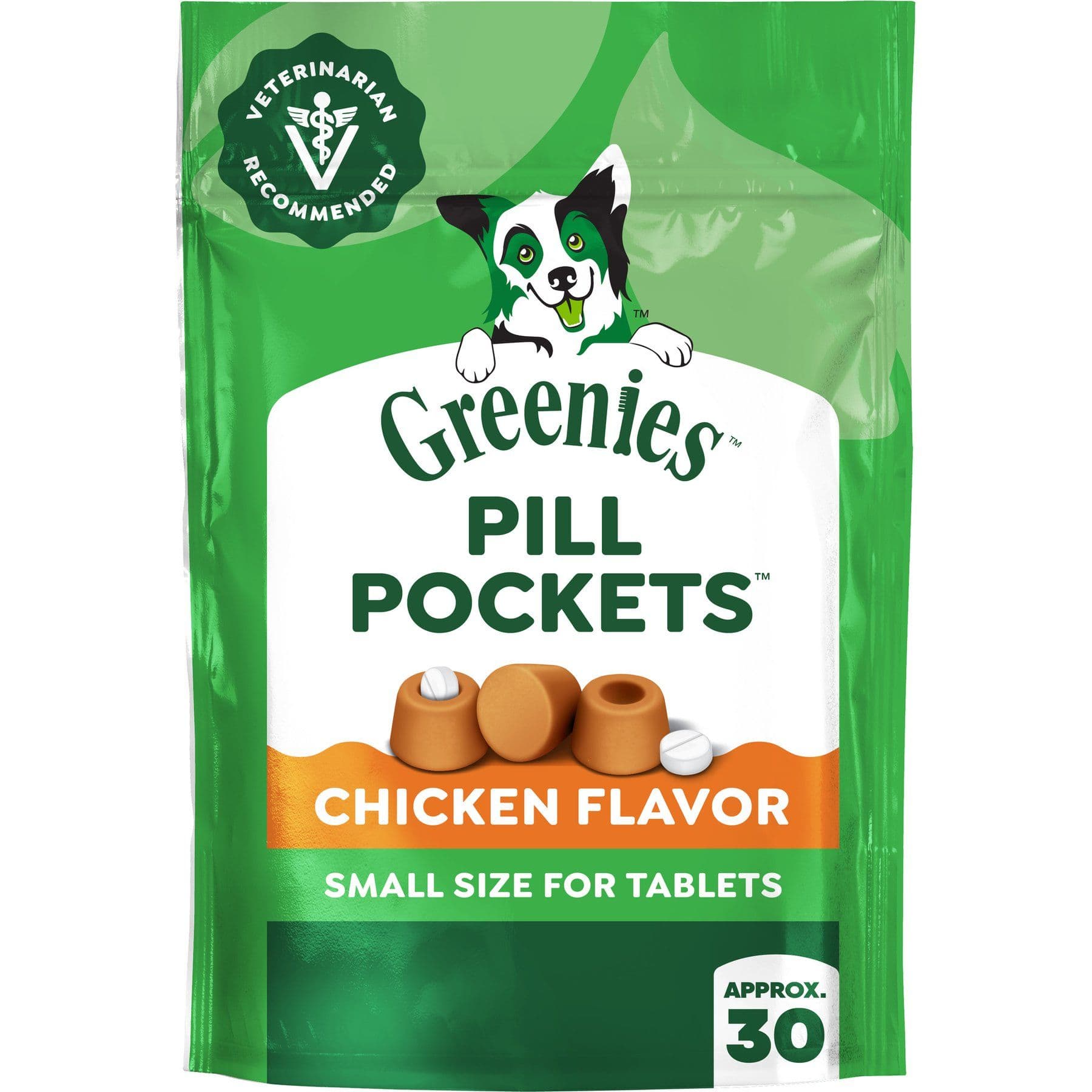
The classic soft pocket with a built-in pouch and real chicken first, sized for everyday tablets.
Webvet may earn a commission when you click through to Chewy, at no extra cost to you.
Greenies Pill Pockets are a soft treat with a built-in pouch and a shapeable texture, with real chicken first, per the Chewy listing. The Greenies label lists about 9 calories per treat; PetSmart's tablet-size listing says 10, sold 30 to a bag. Chewy listed this bag at $8.98 when we checked in October 2026.
- Best for: small to medium tablets given every day.
- Label facts: chicken first, crude fat 10 percent minimum, about 9 to 10 calories.
- Tradeoff: wheat flour and wheat gluten sit high on the label, so it is a poor fit for a dog on a grain-restricted or elimination diet. For capsules, Greenies sells a separate capsule size.
Greenies Pill Pockets Canine Hickory Smoke Capsule Dog Treats: best for capsules
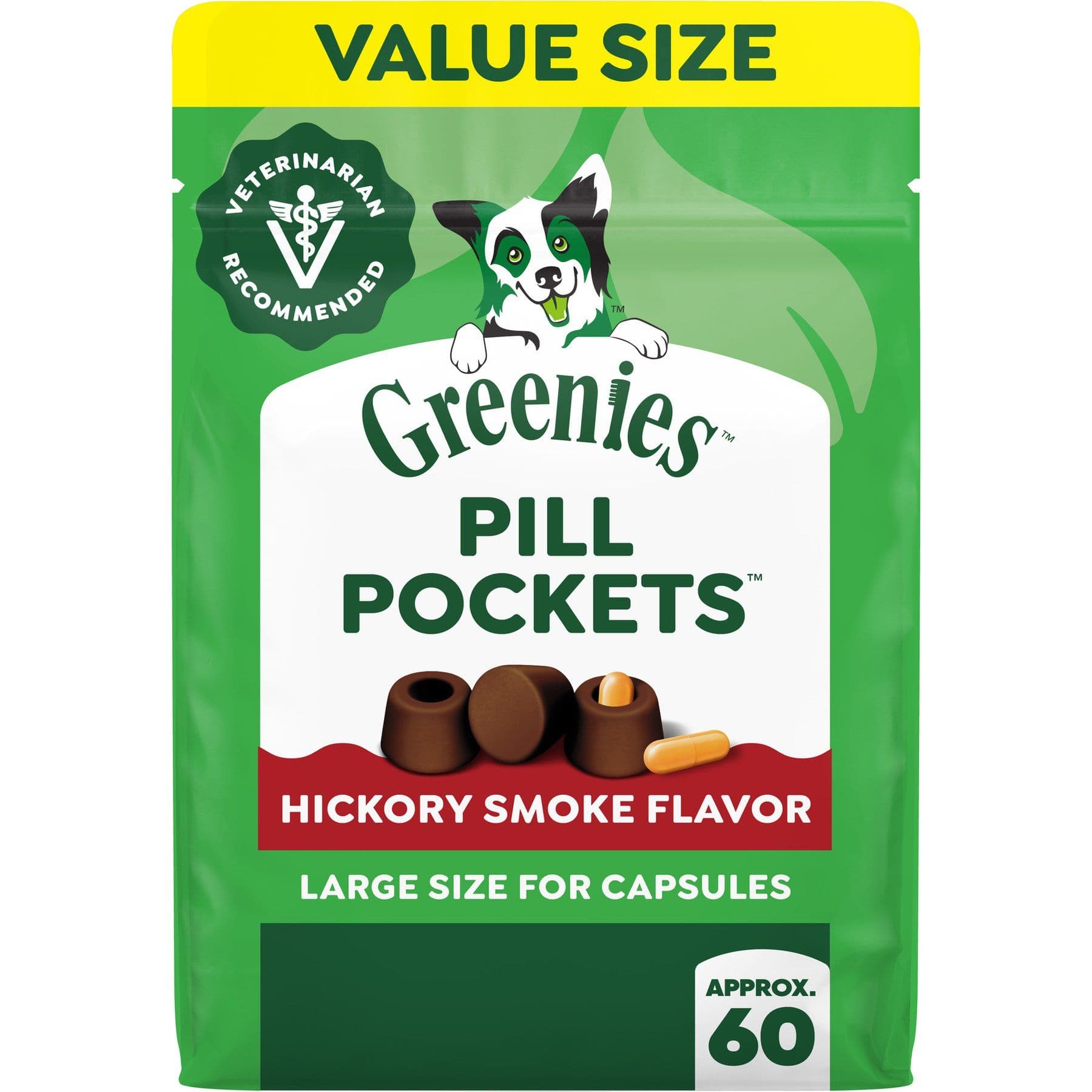
Larger capsule-size pockets in hickory smoke flavor for antibiotics and supplements that come as capsules.
Webvet may earn a commission when you click through to Chewy, at no extra cost to you.
The capsule size is the larger Greenies pocket, here in hickory smoke flavor with real chicken first, per the Chewy listing. Chewy listed the 60-count bag at $19.96 in October 2026, roughly 33 cents a pocket. Greenies' capsule-size chicken listing says to feed 1 treat per 15 pounds of body weight per day.
- Best for: capsules and large tablets that will not close inside a tablet-size pocket.
- Label facts: the capsule-size listings we checked give no calorie figure, so ask the brand before counting it into a tight calorie budget.
- Tradeoff: the extra treat around a small tablet gives a dog more to chew around, so pinch off the excess.
Milk-Bone Pill Pouches Real Chicken Flavor: best budget pocket
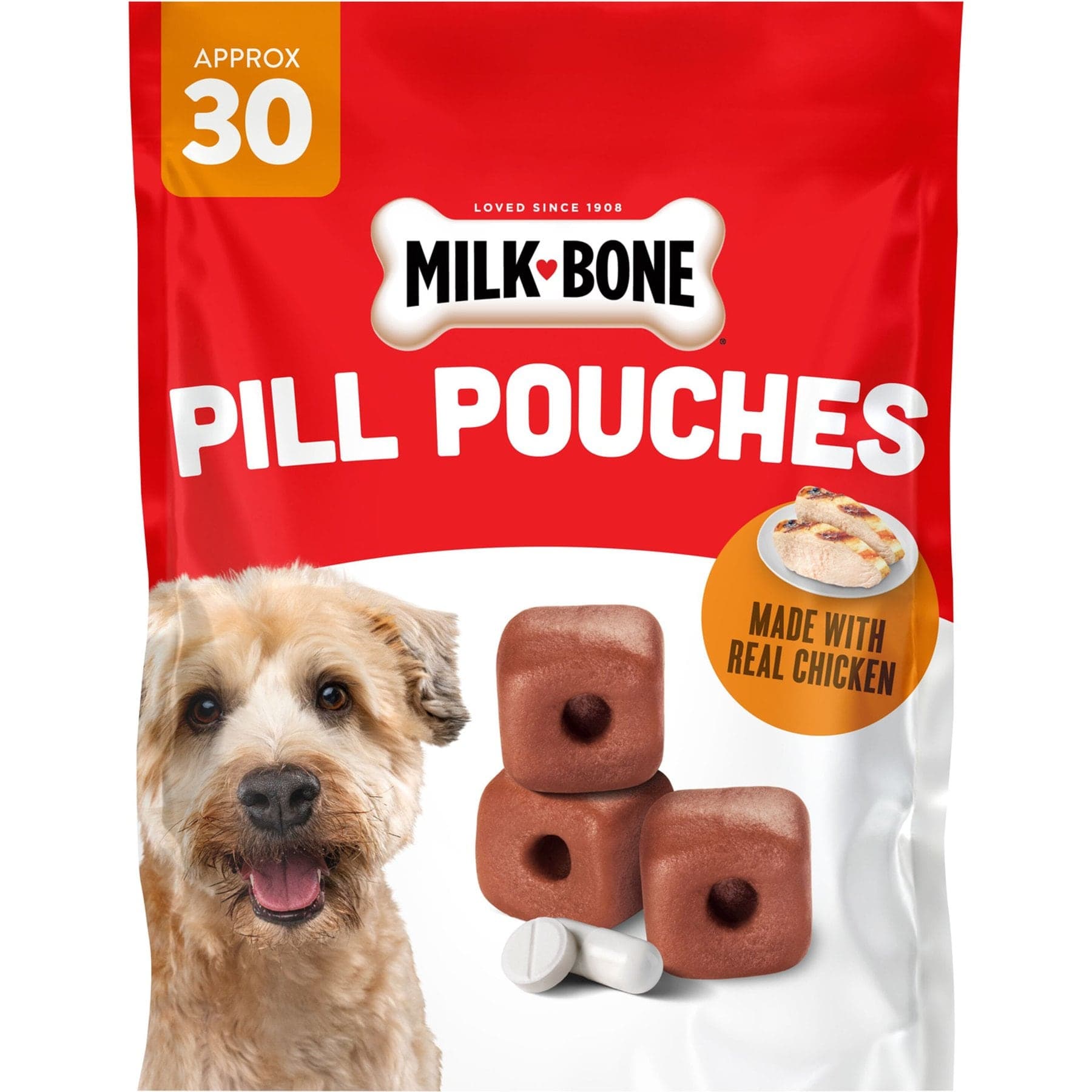
Soft chicken-flavored pouches at a lower price per treat, a good budget option for daily tablets.
Webvet may earn a commission when you click through to Chewy, at no extra cost to you.
The listing says these chicken-flavored pouches hold most capsules and tablets when molded around the pill. Chewy listed the 30-count bag at $6.48 in October 2026, about 22 cents a pouch. Milk-Bone says 1 to 2 pouches per 10 pounds of body weight daily is about 10 percent of daily calories.
- Best for: long courses of daily tablets where cost adds up.
- Label facts: 21 calories per piece, chicken first, crude fat 7 percent minimum, crude protein 15 percent minimum.
- Tradeoff: the highest calories per piece in this lineup, and soy and wheat flour are on the label.
Pet MD Wrap-A-Pill with Probiotics Bacon Flavored Pill Paste: best moldable paste
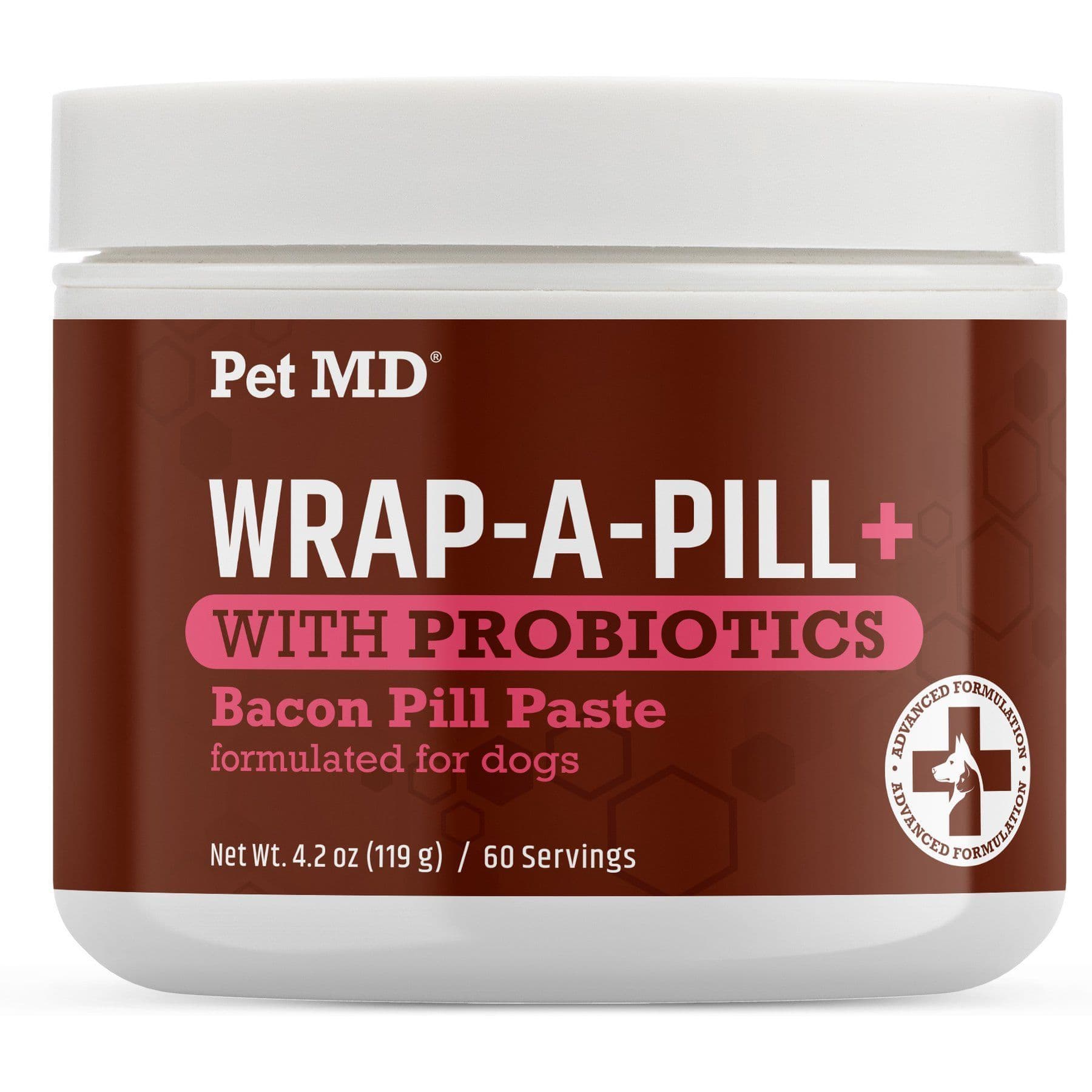
Moldable bacon-flavored paste that wraps half tablets and odd-shaped pills a pocket cannot hold.
Webvet may earn a commission when you click through to Chewy, at no extra cost to you.
Pet MD Wrap-A-Pill is a paste, not a preformed pocket, in a 4.2-ounce tub Chewy listed at $16.99 in October 2026. The label says to pinch off a portion and wrap the pill or capsule until completely covered, which suits a split tablet or an oddly shaped pill.
- Best for: half tablets and odd-shaped pills that a preformed pocket cannot close around.
- Label facts: the related cheese and bacon version lists 9 calories per serving, crude fat 4 percent minimum, and dogs 6 weeks and older with no weight requirement.
- Tradeoff: the listings we checked do not show this probiotic bacon tub's own ingredient panel, so read it before use. The cheese and bacon label says not to use it for cats.
Earthly Pill Buddy Naturals Roasted Chicken Soft & Chewy Dog Treats: best limited-ingredient pocket
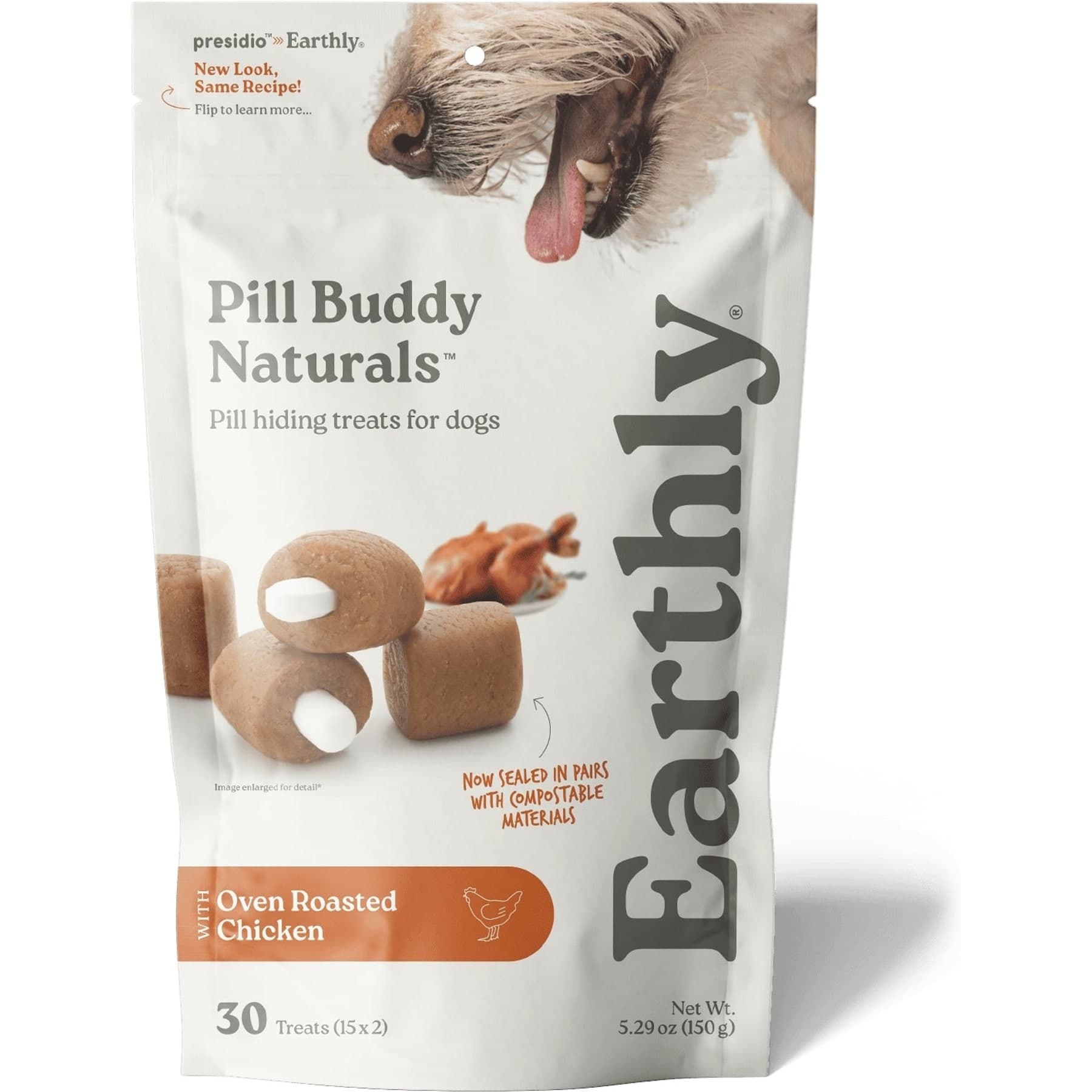
Barley-based soft chews that work with any size tablet or capsule, and two stick together for extra-large pills.
Webvet may earn a commission when you click through to Chewy, at no extra cost to you.
Earthly Pill Buddy Naturals are soft, malleable chews made in small batches, according to the listing. Earthly says they work with any size tablet or capsule, and that extra-large pills can take two treats stuck together. Chewy listed the 30-count bag at $12.98 when we checked in October 2026, about 43 cents each.
- Best for: owners who want a pocket that does not lead with wheat flour.
- Label facts: barley flour, vegetable glycerin, canola oil, brewers yeast, blackstrap molasses, whey powder, and chicken fat; 18 calories per treat; crude fat 8.9 percent minimum.
- Tradeoff: chicken fat and whey powder mean it is neither poultry-free nor dairy-free, despite its allergy-friendly marketing.
VetriScience Pinchers Pill Hiders Chicken Flavored Chews: best non-greasy pocket with probiotics
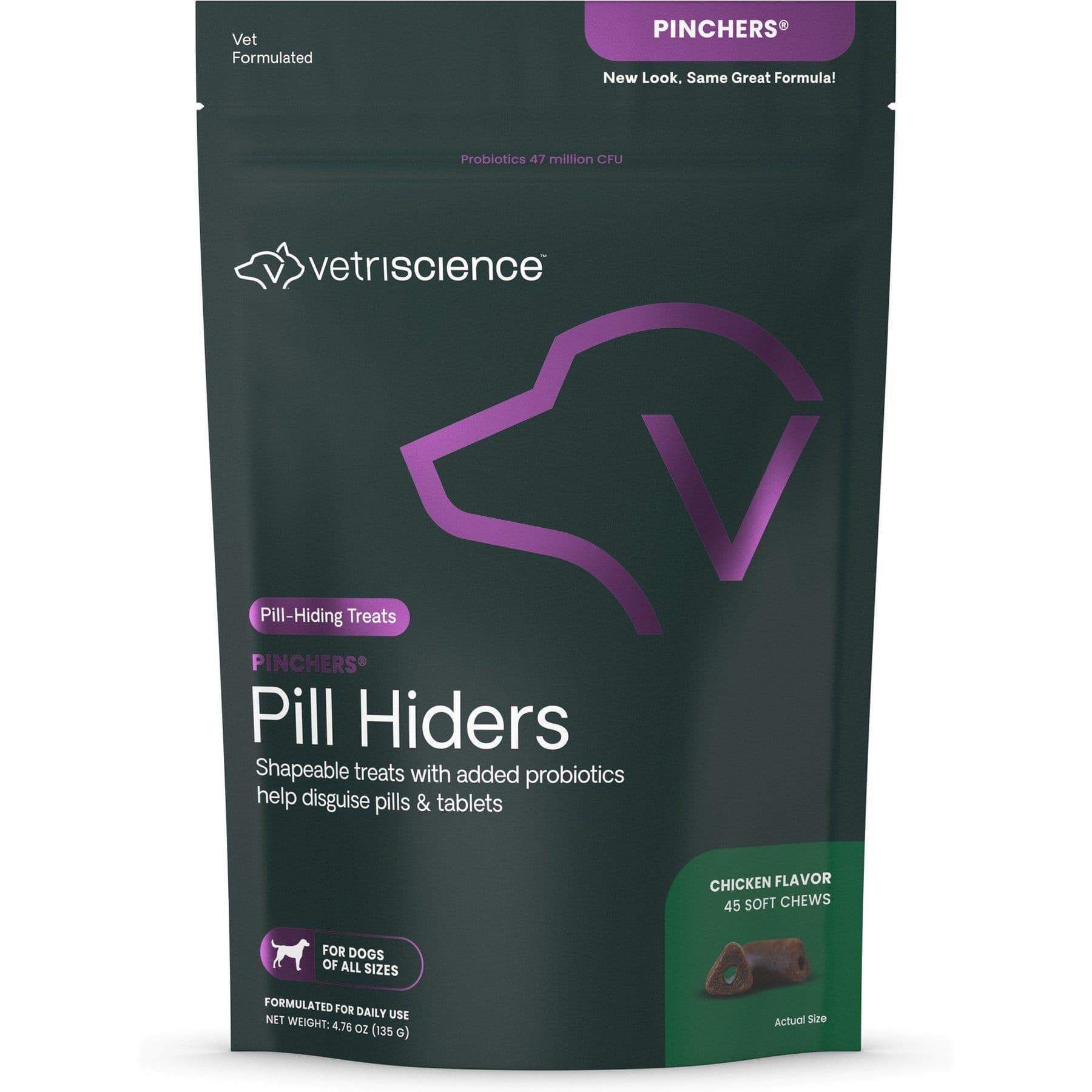
Non-greasy triangular chews with added probiotics that pinch closed around tablets and capsules.
Webvet may earn a commission when you click through to Chewy, at no extra cost to you.
VetriScience Pinchers are triangular chews you insert the pill into, pinch, and give. The brand sells them as non-greasy and moldable, with Bacillus coagulans at 47 million CFU per chew. Chewy listed the 45-count bag at $9.99 in October 2026, about 22 cents each.
- Best for: owners who dislike greasy fingers, and dogs that take both tablets and capsules.
- Label facts: hydrolyzed chicken liver flavor, oat flour, chickpea, apple powder; 10 calories per treat; crude fat 9 percent minimum.
- Tradeoff: larger tablets or capsules need two Pinchers, or the separate Extra Large size.
 Sponsored
Vet care that's always there
Unlimited video calls and messaging with licensed vets for less than a typical vet visit. One membership covers up to five pets.
Use code Pets60
Plans start at $12/month · covers up to 5 pets
- Licensed vets in most states
- Rx for 150+ conditions
- 4.7 on Trustpilot
Matching the pocket to the pill: tablets, capsules, half pills, and liquids
Pocket size follows the pill, not the dog. Greenies sells separate tablet size and capsule size bags. Use the tablet size for small tablets, and a capsule-size pocket such as Greenies Pill Pockets Canine Hickory Smoke Capsule Dog Treats, 60 ct or a moldable chew for capsules.
A pocket that is too big causes its own trouble. Cornell warns that too much treat lets a dog chew around the pill, so use just enough to cover it. For larger pills, VetriScience suggests two Pinchers or its Extra Large size, and Earthly says two Pill Buddy treats can be stuck together.
Half pills need a different tool. A moldable paste such as Pet MD Wrap-A-Pill with Probiotics Bacon Flavored Pill Paste Nutritional Supplement for Dogs & Cats, 4.2-oz tub can be wrapped around a split tablet until no edge shows. Split a tablet only when your vet prescribed the half dose.
| Pill type | Hiding method that works | What to use | Do not |
|---|---|---|---|
| Small whole tablet | Pinch the pocket closed and hand-feed it | Tablet-size pocket or one pinch-closed chew | Wrap it in extra treat the dog can chew around |
| Large tablet or chewable | Close it fully, using two chews if needed | Capsule-size pocket, two chews, or an extra-large size | Break it to fit unless your vet approves |
| Capsule | Keep the capsule whole inside the pocket | Capsule-size pocket or paste | Open or crush it unless your vet approves |
| Split tablet or half pill | Wrap until no edge shows | Moldable paste | Split coated or extended release tablets |
| Bitter pill | Hide it whole and give it fast | Pocket or paste, or ask about a flavored compounded version | Crush it into a full meal |
| Extended release tablet | Swallowed whole in a small pocket | Smallest pocket that covers it | Crush, break, or let the dog chew it |
| Enteric-coated tablet | Swallowed whole | Pocket or paste | Crush or divide it |
| Liquid medicine | Mix into a small amount of a treat the dog accepts | A spoon of accepted soft food, with vet approval | Use a sugar-free base or food that contains xylitol |
Liquids and crushed tablets follow different rules. The Kirk and Bistner handbook says liquid medications or pulverized tablets can be mixed with the diet or an accepted treat whenever feasible. Merck warns that sugar-free syrups used as medicine bases, such as some liquid gabapentin for dogs and cats formulations, frequently contain xylitol.
If no pocket solves the problem, Cornell suggests asking your vet about alternatives, including having the medication compounded with flavorings. Drug-by-drug form and dosing questions are covered on our pages for amoxicillin for dogs and cats, meloxicam for dogs and cats, and Benadryl for dogs.
Check dewormer labels the same way. Whether the tablet is a prescription dog dewormer or an over the counter dewormer for dogs, look for an instruction to give it whole before choosing a pocket.
Pill pockets for dogs with allergies, pancreatitis, or on a diet
Every pill pocket is food. The Merck Veterinary Manual says any food-based item, including pill pockets, must be avoided during a food elimination trial. Merck also notes that medication capsules may be beef or pork gelatin, and flavored heartworm and flea chewables generally contain beef, pork, or soy protein.
So a pocket marketed as hypoallergenic or grain free still needs your vet's approval during a diet trial. VCA Animal Hospitals asks owners in a trial to list every food the dog eats, including treats and flavored medications.
Outside a trial, compare labels against the proteins your vet has ruled out. Every pocket here lists chicken, a grain, or both:
- Greenies chicken, tablet and capsule size: chicken first, with wheat flour and wheat gluten. The hickory smoke capsule pocket also lists real chicken first.
- Milk-Bone: chicken first, with soy flour and wheat flour.
- VetriScience: hydrolyzed chicken liver flavor with oat flour and chickpea.
- Earthly: barley flour base, but with chicken fat and whey powder.
- Pet MD paste (cheese and bacon label): wheat flour, cheese powder, and pork liver powder, with no chicken listed.
A homemade pocket is no different: it is still food your vet needs to know about, and any peanut butter in it needs a xylitol check.
Can pill pockets cause diarrhea in dogs?
No veterinary guidance we found ties pill pockets themselves to diarrhea. Two factors are worth watching. A pocket is extra food, so for a dog with a sensitive stomach, the added fat and calories count. For a food-allergic dog, its proteins count too.
If loose stool starts alongside a new antibiotic, ask your vet whether the drug or the food is the cause, and read our guide to dog probiotics after antibiotics.
Are there any low-fat pill pockets for dogs?
We found no pill pocket marketed as low fat. The labels print only crude fat minimums, which are not exact fat content:
- Pet MD paste (cheese and bacon): 4 percent minimum
- Milk-Bone: 7 percent minimum
- Earthly: 8.9 percent minimum
- VetriScience: 9 percent minimum
- Greenies Original: 10 percent minimum
For pancreatitis, Merck's owner guide says dogs with mild cases are usually switched to a low-fat diet and low-fat treats, and the Merck Veterinary Manual sets the ration at less than 20 g fat per 1,000 kcal.
Because labels list minimums, ask your vet which pocket fits that limit. VCA caps treats and toppers at no more than 10 percent of daily calories.
If your dog is watching calories, the labels list about 9 to 10 calories per piece for Greenies, 10 for VetriScience, 18 for Earthly, and 21 for Milk-Bone.
When your dog eats the pocket and spits out the pill
Some dogs eat the pocket and spit out the pill. VCA says this is why you should watch your dog after dosing, and to hand-feed the medicated piece so you know it was swallowed rather than dropping it in the bowl.
If your dog is picky, try these steps:
- Offer decoys first. Cornell advises giving several small plain pieces of the treat before the medicated one.
- Use less treat. Too much treat lets the dog chew around the pill, so cover it and no more.
- Seal it completely. A paste such as Pet MD Wrap-A-Pill with Probiotics Bacon Flavored Pill Paste Nutritional Supplement for Dogs & Cats, 4.2-oz tub, wrapped until the pill is fully covered, leaves no edge to find.
- Keep hands separate. Earthly advises not handling the medication and the treat with the same hand.
- Time it. Offer the pill when your dog is hungry, as VCA suggests.

Can dogs smell pills in their food?
There is no published measure of how well dogs detect pills in food. PetMD's veterinarian author says most pets notice a bitter medicine after a few bites and refuse the rest. Earthly's advice to keep the hand that touches the pill away from the treat targets the same problem.
What to do when a dog won't take a pill?
Go back to plain pieces first, then hand-feed a pocket that just covers the pill. If your dog spits it out, do not guess at a second dose; call your vet or pharmacist first.
If your dog is anxious or fearful about pilling, VCA advises contacting your vet, since some drugs can be compounded into a flavored liquid or treat.
Pill pockets versus pastes, wraps, and food: pros and cons
Owners usually find it far easier to hide a whole pill in food or a pill pocket than to crush it, according to PetMD's veterinarian author. The real choice is which wrapper:
- Store-bought pill pockets: a consistent size and usually a printed calorie count; most contain chicken and a grain.
- Pill pastes: wrap any shape until it is completely covered; the tub must be portioned by hand.
- Household foods: already in the fridge, but fat, calories, and xylitol vary by brand.
- Homemade pockets: you control the ingredients, but no veterinary source publishes a tested recipe or a calorie count.

What to wrap a pill in for a dog?
VCA Animal Hospitals lists peanut butter, lunch meat, cheese, marshmallows, and cooked sweet potato as foods owners use to hide pills. The U.S. Food and Drug Administration says to check a nut butter's label for xylitol first. Whatever you choose, use only enough to cover the pill.
What can I use instead of Pill Pockets for dogs?
A pinch-closed chew such as VetriScience Pinchers Pill Hiders Chicken Flavored Chews with Probiotics Non-Greasy Pill Wrap for Dogs, 45 count or a pill paste does the same job as a Greenies Pill Pocket.
A soft household food, a flavored compounded version of the drug from your vet, or a pill gun can also replace the pocket. Each solves a different problem: taste, fit, or a dog that refuses all food.
You can also make your own pockets. No veterinary source publishes a tested homemade recipe, so the same rules apply to any version you make:
- Keep each piece just large enough to cover the pill.
- Check any peanut butter for xylitol; NC State College of Veterinary Medicine notes peanut butter is commonly used to disguise pills and that some brands now contain xylitol.
- Count the pieces toward your dog's daily treat allowance.
- Clear the ingredients with your vet if your dog is on an elimination diet or has had pancreatitis.
Giving a pill without a pocket: pill guns and the hand method
When a dog refuses every pocket, the pill can go straight to the back of the mouth. Cornell describes a pilling gun as a device with a rubber tip that holds the pill and a plunger that delivers it near the back of the throat. VCA mentions the same tool as a pet piller.

How to give an unwilling dog a pill?
Cornell's hand method takes a few seconds once your dog is used to it:
- Coat the pill in a little soft treat first; VCA says a lubricated pill is easier to swallow.
- Place your non-dominant hand over the muzzle, behind the canine teeth.
- Drop the pill into the mouth.
- Close the mouth and gently hold it closed until you see your dog swallow.
- Watch for a nose lick, which VCA says usually means the pill went down.
If your dog fights the hand method or a pill gun, stop and ask your vet about a compounded flavored version rather than forcing it.
Pill pocket questions
Frequently Asked Questions
What can I mix my dog's pills with?
Only mix a crushed tablet or liquid medicine into food if your vet says the drug allows it; the Kirk and Bistner handbook says that, when feasible, it can go into the diet or an accepted treat. Use a small portion so the full dose is eaten.
Peanut butter is a common choice, but check it for xylitol, which ASPCA Animal Poison Control lists in sugar-free peanut butter. If your dog eats xylitol, call your vet or the ASPCA hotline at 888-426-4435 right away.
Which medications should never go in a pill pocket?
Any medication during a food elimination trial, because Merck says pill pockets must be avoided then. Also take care with drugs chewing can damage: an extended release tablet should not be crushed, broken, or chewed, and enteric-coated tablets and some capsules must be given intact. Ask your vet before hiding one.
Can puppies have pill pockets?
The Pet MD cheese and bacon paste label lists dogs 6 weeks and older, with no weight requirement; the other labels we checked state no minimum age. One 21-calorie pouch uses more of a small puppy's daily treat calories than a large dog's. Use the smallest piece that covers the pill.
How many pill pockets can a dog have a day?
Treats, pockets included, should stay within about 10 percent of daily calories, the limit WSAVA and AAHA recommend for non-complete foods. Brand guidance fits that treat allowance: Milk-Bone says 1 to 2 pouches per 10 pounds daily, and Greenies' capsule label says 1 treat per 15 pounds per day.
Do capsule-size pill pockets fit tablets too?
Yes, a capsule size pocket will hold a tablet, but the extra treat around a small tablet gives your dog more to chew around, which Cornell warns against. Pinch off the excess, or buy the tablet size for small pills. Keep capsule size for capsules and large tablets.

Editor
The Webvet Editorial Team is the in-house group of pet-care editors and writers behind Webvet, operated by Smart Pet Collective. The team researches, writes, and maintains Webvet's pet health, behavior, and medication content. Every article follows a defined editorial process: research from reputable veterinary and scientific sources, careful drafting, mandatory review of medical content by a credentialed veterinarian, and dated publication. Health and medication articles are medically reviewed by a licensed veterinary professional before they go live and are kept current over time.
Veterinarian · BVMS MRCVS
Dr. Pippa Elliott, BVMS, MRCVS, is a veterinarian with nearly 30 years of experience in companion animal practice. Dr. Elliott earned her Bachelor of Veterinary Medicine and Surgery from the University of Glasgow. She was also designated a Member of the Royal College of Veterinary Surgeons. Married with 2 grown-up kids, Dr. Elliott has a naughty Puggle named Poggle, 3 cats and a bearded dragon.
Related reading

Best Pill Pockets for Cats: Vet-Reviewed Picks for Cats That Spit Out Pills

Dog Anxiety Meds: What Vets Prescribe, Over-the-Counter Options, and How to Choose

Interceptor Plus for Dogs: What It Prevents, Dosing by Weight, Side Effects, and vs. Heartgard Plus
