Over the Counter Dewormer for Dogs: Vet Guide
A vet-reviewed guide to the best over the counter dewormer for dogs: which active ingredients kill which worms, how to dose safely by weight and breed, and when an OTC product is not enough.

BVMS MRCVS
Medically reviewed by Dr. Pippa Elliott, BVMS MRCVS · Last reviewed

This article contains affiliate links. Webvet may earn a commission when you buy through them, at no extra cost to you.
WebVet may earn a commission from qualifying purchases made through links on this page, at no additional cost to you.
If your dog has worms, the first thing most owners want to know is whether an over the counter dewormer for dogs can solve the problem at home, or whether this is really a job for the vet. The honest answer is that it depends. Over-the-counter deworming products can clear the most common intestinal worms that puppies and adult dogs pick up, but they miss certain parasites completely, and a handful of situations make treating on your own genuinely risky.
An over the counter dewormer for dogs is any deworming product you can buy without a prescription, whether from a pet-store shelf or online. These products rely on a small number of proven active ingredients, and knowing which ingredient kills which worm is the difference between actually fixing the problem and wasting money on something that was never going to work in the first place.
The sections below break the choice down the way a vet actually thinks about it: first the ingredient that matches your dog's worm, then the honest limits of what you can buy without a prescription, and finally the dogs and situations where reaching for a shelf product is the wrong move. Used correctly, an over-the-counter dewormer is safe, affordable, and effective. Used blindly, it can leave a real infection untreated while you assume the job is done.
- 1Over-the-counter dewormers work well against the most common intestinal worms in dogs: roundworms, hookworms, and some tapeworms, depending on the active ingredient.
- 2The three ingredients to look for are pyrantel pamoate, fenbendazole, and praziquantel, and each targets a different set of worms.
- 3No over-the-counter dewormer prevents heartworm, and most miss whipworm and the tapeworm dogs get from fleas, so a fecal test at the vet is still the safest first step.
- 4Herding breeds with the MDR1 gene, very young puppies, pregnant dogs, and visibly sick dogs should be dewormed under a vet's guidance, not on guesswork.

 Sponsored
Need flea, tick, or parasite care for your dog?
A licensed vet at Dutch can recommend the right preventive and prescribe it when it's appropriate. Annual members get 20% off their first flea and tick order.
Use code Pets60
Plans start at $12/month · covers up to 5 pets
- Licensed vets in most states
- Rx for 150+ conditions
- 4.7 on Trustpilot
The most effective over-the-counter dewormers for dogs
The most effective over-the-counter dewormer for dogs is a broad-spectrum product built around pyrantel pamoate, which treats the two worms dogs get most often: roundworms and hookworms. If your dog might also have a tapeworm, the most effective choice is a combination product that adds praziquantel, since a single ingredient rarely covers every worm at once.
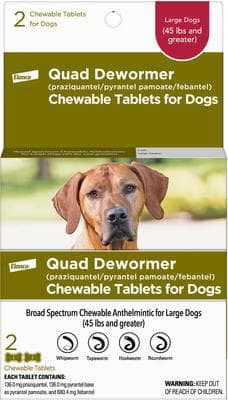
Broad-spectrum chewable dewormer (praziquantel, pyrantel, febantel) that treats tapeworms, roundworms, hookworms, and whipworms in one course. For large dogs 45 lbs and over.
Webvet may earn a commission when you click through to Chewy, at no extra cost to you.

A few widely sold options show how the categories differ. Bayer Quad Dewormer and generic pyrantel pamoate liquids and chewables cover roundworms and hookworms, while Panacur C (fenbendazole) is a broad-spectrum granule that also reaches whipworm and one common tapeworm. Products such as Drontal Plus add praziquantel for tapeworm, but in the United States that combination is prescription-only, so treat it as the vet-visit benchmark rather than a shelf pick.
When you compare products, read the active-ingredient line on the dewormer packaging rather than the front-of-box marketing. Two boxes can look almost identical yet contain completely different drugs, and the front label often highlights the worms a product treats while staying quiet about the ones it does not. The active-ingredient panel is where the real answer lives.
| Active ingredient | Worms it treats | Sold over the counter? |
|---|---|---|
| Pyrantel pamoate | Roundworms, hookworms | Yes |
| Fenbendazole | Roundworms, hookworms, whipworms, Taenia tapeworm | Yes |
| Praziquantel | Tapeworms (including the flea tapeworm) | Often, in combination products |
So which product is genuinely the most effective for your dog? It is the one matched to the specific worm your dog has, dosed to your dog's current weight, and repeated on the right schedule. A cheap pyrantel liquid can outperform an expensive combination product if roundworms are the only problem. Getting all three of those factors right matters more than the brand on the box.
- Match the ingredient to the worm: pyrantel pamoate for roundworms and hookworms, fenbendazole for a broader range that includes whipworm, and praziquantel for tapeworm.
- Match the dose to your dog's current weight, not last year's number, because every canine dewormer is dosed by body weight.
- Match the schedule to the worm: roundworms and hookworms almost always need a repeat dose two to three weeks later to catch larvae that had not hatched during the first treatment.
One practical point that owners overlook: buy from a source you trust. Deworming products bought from unfamiliar overseas sellers can be underdosed, expired, or mislabeled, and a product that contains less active ingredient than the box claims will look exactly like a treatment failure when the real problem is the supply. A reputable pet retailer or your own vet's clinic is worth the small premium for a product you can rely on.
Active ingredients: pyrantel, fenbendazole, and praziquantel
Almost every over-the-counter dewormer for dogs is built on one of three active ingredients, or a blend of them. Learning what each one does turns a confusing wall of brand names into a simple decision. The three you will see again and again are pyrantel pamoate, fenbendazole, and praziquantel.

Pyrantel pamoate for dogs
Pyrantel pamoate for dogs is the workhorse of over-the-counter deworming. It paralyzes roundworms and hookworms so the dog passes them, and it is gentle enough that many formulations are labeled for puppies from as young as two weeks of age. It does not treat whipworm or tapeworm, so it is a targeted tool rather than a cure-all.
It is also one of the most affordable dewormers on the market, which is why so many puppy deworming schedules start with it. Because pyrantel acts mostly inside the gut and is poorly absorbed into the bloodstream, its safety margin is wide, but you still measure the dose against your dog's current weight rather than eyeballing it.
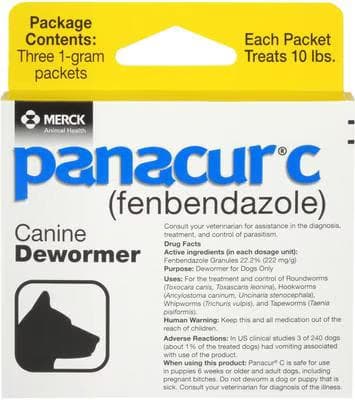
Broad-spectrum dog dewormer (fenbendazole) that treats roundworms, hookworms, whipworms, and Taenia tapeworms. Three daily 1-gram packets dosed by weight.
Webvet may earn a commission when you click through to Chewy, at no extra cost to you.
- Treats: roundworms and hookworms, the two most common worms in puppies.
- Does not treat: whipworm, tapeworm, or heartworm.
- Typical use: a first dose followed by a repeat dose two to three weeks later.
Fenbendazole for dogs
Fenbendazole for dogs, sold most often as Panacur C, is the broadest over-the-counter option. Given as a three-day course, fenbendazole treats roundworms, hookworms, whipworms, and the Taenia tapeworm that dogs pick up from eating wildlife or raw meat. The three-day schedule matters: a single day of fenbendazole is not enough, and stopping early is a common reason the worms come back.
Fenbendazole is also the ingredient many vets reach for when a fecal test is unclear, because its broad coverage catches several worms at once instead of gambling on a single target. The trade-off is that three-day commitment, so set a phone reminder rather than trusting yourself to remember day two and day three in the middle of a busy week.
- Treats: roundworms, hookworms, whipworms, and Taenia tapeworm.
- Does not treat: the flea tapeworm (Dipylidium) or heartworm.
- Typical use: the same dose once daily for three consecutive days.
Praziquantel for dogs
Praziquantel for dogs is the tapeworm specialist. It is the ingredient that dissolves tapeworm segments, including Dipylidium, the flea tapeworm you may notice as rice-like grains near your dog's tail. Praziquantel is usually sold inside combination products rather than on its own, and treating tapeworm without also controlling fleas is a losing battle, because a single infected flea can start the cycle over again.
You will rarely find praziquantel sold by itself on a shelf. It is far more common inside a combination dewormer that also carries pyrantel or fenbendazole, and that is usually a good thing, because a dog carrying tapeworm has often picked up other worms along the way. A combination product cleans up the whole picture in one course instead of leaving a second parasite behind.
 Sponsored
Vet care that's always there
Unlimited video calls and messaging with licensed vets for less than a typical vet visit. One membership covers up to five pets.
Use code Pets60
Plans start at $12/month · covers up to 5 pets
- Licensed vets in most states
- Rx for 150+ conditions
- 4.7 on Trustpilot
Over-the-counter vs. prescription dewormers
The line between over-the-counter and prescription dewormers is not about strength. It is about which parasites the product covers and how much judgment the treatment requires. Over-the-counter dewormers handle the routine, predictable worms. Prescription dewormers exist for the parasites that need a diagnosis, a broader drug, or a monthly preventive schedule.

Over-the-counter options such as pyrantel pamoate, fenbendazole, and praziquantel handle roundworms, hookworms, and common tapeworm reliably. Where they fall short is coverage: pyrantel misses whipworm and tapeworm, fenbendazole misses the flea tapeworm, and no over-the-counter dewormer prevents heartworm. A prescription dewormer or a monthly heartworm preventive that also covers intestinal worms fills those gaps, which is why the vet route still matters even when a shelf product would have worked for the immediate problem.
| Dewormer type | Example active ingredients | Worms it kills | Worms it misses |
|---|---|---|---|
| Over the counter | Pyrantel pamoate, fenbendazole, praziquantel | Roundworms, hookworms, most tapeworms, whipworm (fenbendazole) | Heartworm, some resistant whipworm cases |
| Prescription | Milbemycin oxime, moxidectin, febantel combinations | The above plus heartworm prevention and broader whipworm control | Fewer gaps, but requires a vet's dosing |
This is exactly where most ranking pages let readers down. They either sell prescription-only bundles or discourage OTC dewormers entirely, without ever telling readers which active ingredient treats which worm. Almost none provide a simple OTC-vs-prescription table that maps each ingredient to the parasite it kills, so owners are left to guess. The comparison above exists to close that gap by pairing every active ingredient with the worms it treats and the ones it misses.
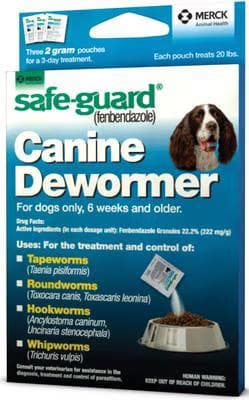
Fenbendazole 3-day dewormer that treats tapeworms (Taenia), roundworms, hookworms, and whipworms. Over the counter, for dogs 6 weeks and older.
Webvet may earn a commission when you click through to Chewy, at no extra cost to you.
Can I deworm my dog myself without a vet? Yes, when the situation is routine: a healthy adult dog, a known or strongly suspected roundworm or hookworm infection, and a product matched to that worm. You can buy the right over the counter product, dose it by weight, and repeat it on schedule without ever seeing a vet. The catch is that self-treating only works when your read of the situation is correct, and worms are easy to guess wrong about.
- Choose over the counter when: your dog is a healthy adult, the likely worm is roundworm or hookworm, and there are no other symptoms.
- Choose a prescription dewormer when: your dog has whipworm, an unusual tapeworm, diarrhea with blood, weight loss, or needs heartworm coverage.
- Choose the vet either way when: you are treating a young puppy, a pregnant dog, or a dog with another health condition.
None of this means the vet route is always necessary. It means the two options solve different problems. For a healthy adult dog with a common worm, the over the counter path is genuinely enough, and there is no need to feel guilty about handling it at home. For anything outside that lane, the prescription route exists for a reason, and paying for it is almost always cheaper than treating a parasite that a shelf product was never designed to touch.
Can you deworm a dog without going to the vet?
Yes, you can deworm a dog without going to the vet in many routine cases, and millions of owners do it every year. If your adult dog is otherwise healthy and you are treating a common roundworm or hookworm infection, a correctly chosen and correctly dosed over the counter dewormer will do the job at home. Deworming a dog at home is a normal part of responsible ownership, not a shortcut.

Does over-the-counter dewormer actually work? For the worms it is designed to treat, yes. When owners feel like a dewormer failed, the usual reasons are that the product did not cover the worm the dog actually had, the dose was too low for the dog's real weight, or the follow-up dose was skipped. Fix those three things and over the counter dewormers work as well as anything a vet would hand you for the same parasite.
The mechanics of dosing at home, from weighing your dog to giving the tablet, are covered step by step in our guide to how to deworm a dog at home. Follow the weight-based dose on the label exactly, and never split a single large-dog dose across two small dogs by eye.
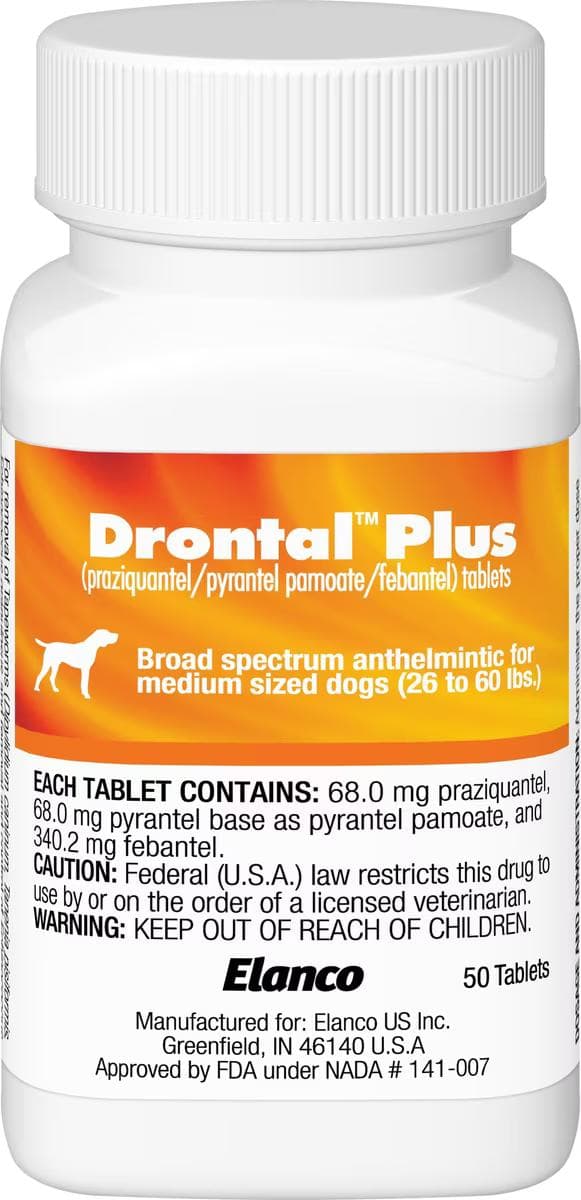
Broad-spectrum prescription dewormer (praziquantel, pyrantel, febantel) that clears tapeworms, roundworms, hookworms, and whipworms in one dose. Prescription required.
Webvet may earn a commission when you click through to Chewy, at no extra cost to you.
- Blood in the stool, black tarry stool, or diarrhea that lasts more than a day or two.
- Visible weight loss, a bloated belly, vomiting, or a dog that seems weak or lethargic.
- A puppy under six weeks old, a pregnant or nursing dog, or a dog with a known medical condition.
- Worms you cannot identify, or an infection that keeps returning after correct treatment.
How to tell if your dog actually has worms
Before you buy anything, it is worth confirming that worms are the problem. The first signs of worms in dogs are easy to miss: the clearest ones are visible worms or small rice-like segments in the stool or around the tail, scooting across the floor, a pot-bellied look in puppies, and unexplained weight loss despite a normal appetite. A fecal test at the vet is the only way to be certain which worm is present.
This page focuses on choosing and using a product, so for the complete symptom checklist, what each worm looks like, and how the different infections are diagnosed, see our full guide to signs your dog has worms, which owns that side of the topic in depth.

Are over-the-counter dewormers safe for every dog?
Over-the-counter dewormers are safe for most dogs when dosed correctly, but not for every dog in every situation. Safety comes down to three variables: the dog's breed and genetics, its age, and its weight. Herding breeds deserve extra attention, because some carry the MDR1 gene, so breed sits right alongside age and weight when you judge whether a product is safe. Get those three right and the common ingredients are very well tolerated; ignore them and an otherwise routine treatment can turn into a problem.

What wormers are safe for border collies? This is the question that trips up the most owners, because herding breeds can carry the MDR1 gene mutation that causes dangerous ivermectin sensitivity. The reassuring news is that the standard over-the-counter deworming ingredients, pyrantel pamoate, fenbendazole, and praziquantel, are not in the drug class that MDR1 dogs react to, so they are generally considered safe for border collies and other herding breeds at label doses. The drugs to be careful with are high-dose ivermectin and related macrocyclic lactones, which is a conversation to have with your veterinarian, ideally after an MDR1 test.
- Generally safe for MDR1 herding breeds at label dose: pyrantel pamoate, fenbendazole, and praziquantel.
- Dose by weight every time, because dewormers are calculated per pound or kilogram and a small dog given a large-dog dose can be overdosed.
- Use vet guidance for puppies under six weeks, pregnant or nursing dogs, seniors on other medications, and any dog that is unwell.
One more thing sets a careful choice apart: no competitor page pairs OTC dewormer selection with MDR1 herding-breed safety or weight-based dosing guidance, yet that combination is exactly what keeps self-treatment safe. Picking the right product is only half the job. Matching it to your dog's breed, weight, and MDR1 status is what turns a shelf purchase into responsible care rather than a gamble.
Do natural dewormers for dogs actually work?
What naturally kills worms in dogs? Here is an honest assessment, because this is the section where being truthful matters most: the evidence for natural dewormers is thin. Popular natural options include pumpkin seeds, carrots, and diatomaceous earth, and while a few have a plausible mechanism, none has been shown in reliable studies to clear an established worm infection the way a proven dewormer does.

Pumpkin seeds contain a compound called cucurbitacin that may help paralyze worms, but the amount needed and the real-world results are unproven. Coarsely chopped carrots can scrape the gut wall and may help move some worms along, which is harmless enough to try but not a treatment. Diatomaceous earth is often promoted online, yet it can irritate the lungs if inhaled and has little evidence of working inside a moist digestive tract.
Natural dewormers at a glance
Pros
- Low cost and easy to find at home
- Gentle foods like pumpkin and carrot are safe to add to meals
Cons
- No reliable evidence they clear an established worm infection
- Some options (garlic, undiluted essential oils) are toxic to dogs
- Delaying a proven dewormer lets the worm burden grow
It also helps to be clear about what the word natural is being asked to do here. Preventing worms in a dog that already has a strong immune system and good flea control is a very different job from clearing a stool sample full of roundworm eggs. Food-based approaches sit on the prevention side of that line, not the treatment side, and treating them as a cure is where owners get into trouble.
The bottom line is that natural options can complement good nutrition, but they are not a substitute for a real dewormer when your dog actually has worms. If you want to try a food-based approach alongside prevention, that is reasonable. If your dog has a confirmed infection, reach for a proven ingredient and save the home remedies for the healthy-maintenance stage.
Frequently Asked Questions
How often should I deworm my dog?
Most healthy adult dogs benefit from deworming or a fecal-guided treatment several times a year, and puppies need it more often on a set schedule. The companion animal parasite control guidelines recommend year-round parasite protection and testing a dog's stool at least a few times a year, with deworming based on what those tests find. Your vet can tailor the frequency to your dog's age, lifestyle, and local parasite risk.
Can I give my dog a human dewormer?
No. Human deworming medications are formulated and dosed for people, and the safe canine dose is different. Some human antiparasite drugs are not appropriate for dogs at all. The active ingredients sometimes overlap, but the concentrations and the inactive fillers differ, and it is easy to get the dose badly wrong when you try to convert from a human tablet. Always use a product labeled for dogs and dosed to your dog's weight, and check with your vet before improvising.
How long does an over-the-counter dewormer take to work?
Most over-the-counter dewormers begin killing worms within hours, and you may see whole or partial worms in the stool for a day or two afterward, which is normal. The infection is not fully cleared until the follow-up dose two to three weeks later has caught the larvae that were too young to be affected the first time.
Do I need to repeat the dose?
Usually, yes. Roundworms and hookworms have life stages that a single dose cannot reach, so a second dose two to three weeks later is standard. Fenbendazole is given as a three-day course rather than a single tablet. The Merck Veterinary Manual is a reliable reference for the specific parasite life cycles behind these repeat-dose schedules.

Editor
The Webvet Editorial Team is the in-house group of pet-care editors and writers behind Webvet, operated by Smart Pet Collective. The team researches, writes, and maintains Webvet's pet health, behavior, and medication content. Every article follows a defined editorial process: research from reputable veterinary and scientific sources, careful drafting, mandatory review of medical content by a credentialed veterinarian, and dated publication. Health and medication articles are medically reviewed by a licensed veterinary professional before they go live and are kept current over time.
Veterinarian · BVMS MRCVS
Dr. Pippa Elliott, BVMS, MRCVS, is a veterinarian with nearly 30 years of experience in companion animal practice. Dr. Elliott earned her Bachelor of Veterinary Medicine and Surgery from the University of Glasgow. She was also designated a Member of the Royal College of Veterinary Surgeons. Married with 2 grown-up kids, Dr. Elliott has a naughty Puggle named Poggle, 3 cats and a bearded dragon.


