Heartgard Plus for Dogs: What It Prevents, Dosing by Weight, Side Effects, and Missed Doses
Heartgard Plus is a monthly beef chew that prevents heartworm and treats roundworms and hookworms. See what it covers, the chew for each weight band, missed-dose steps, side effects, and how it compares with Interceptor Plus.

BVMS MRCVS
Medically reviewed by Dr. Pippa Elliott, BVMS MRCVS · Last reviewed

This article contains affiliate links. Webvet may earn a commission when you buy through them, at no extra cost to you.
Heartgard Plus for dogs is a monthly prescription chew that prevents heartworm disease and treats and controls roundworms and hookworms. It combines ivermectin with pyrantel pamoate, comes in three color-coded weight bands, and protects best when every chew lands on schedule, one per month.
The practical questions about Heartgard Plus for dogs are which chew fits your dog, what to do when a month slips or a second chew goes down by mistake, which breeds need extra care, and whether another preventive would cover more parasites. The FDA-approved label and veterinary references answer each one.

 Sponsored
Need a prescription or refill for your dog?
A licensed vet at Dutch can assess your dog over video and prescribe treatment when it's appropriate, delivered to your door.
Use code Pets60
Plans start at $12/month · covers up to 5 pets
- Licensed vets in most states
- Rx for 150+ conditions
- 4.7 on Trustpilot
What Heartgard Plus for dogs is and what it prevents
Heartgard Plus is an FDA-approved chewable tablet from Boehringer Ingelheim. It contains ivermectin, a macrocyclic lactone that prevents heartworm, and pyrantel pamoate, which clears certain intestinal worms. The DailyMed Heartgard Plus label names three parasites:
- Heartworm (Dirofilaria immitis): prevented by eliminating the tissue stage of the larvae a dog picks up from an infected mosquito.
- Roundworms (Toxocara canis and Toxascaris leonina): treated and controlled.
- Hookworms (Ancylostoma caninum, A. braziliense, and Uncinaria stenocephala): treated and controlled.
That makes Heartgard Plus a dewormer as well as a heartworm preventive, but only for roundworms and hookworms. It does not treat tapeworms or whipworms, and it does not kill fleas or ticks, so a dog on it still needs a separate flea and tick product.
- 1Heartgard Plus prevents heartworm and treats roundworms and hookworms. Those are the three parasites on the label, and the whipworm and tapeworm gaps remain.
- 2What Heartgard Plus adds over plain Heartgard is pyrantel pamoate, the ingredient that treats roundworms and hookworms.
- 3It does not kill fleas or ticks, so your dog still needs a flea and tick product your vet approves.
- 4It requires a vet prescription, and dogs 7 months or older need a negative heartworm test before the first chew.
- 5Give one chew every month. A gap longer than 30 days can reduce protection, so call your vet if a dose runs late.
Each chew is matched to one of three weight bands, sold in blue, green, and brown boxes. The brown box covers the largest dogs, from 51 to 100 lbs.
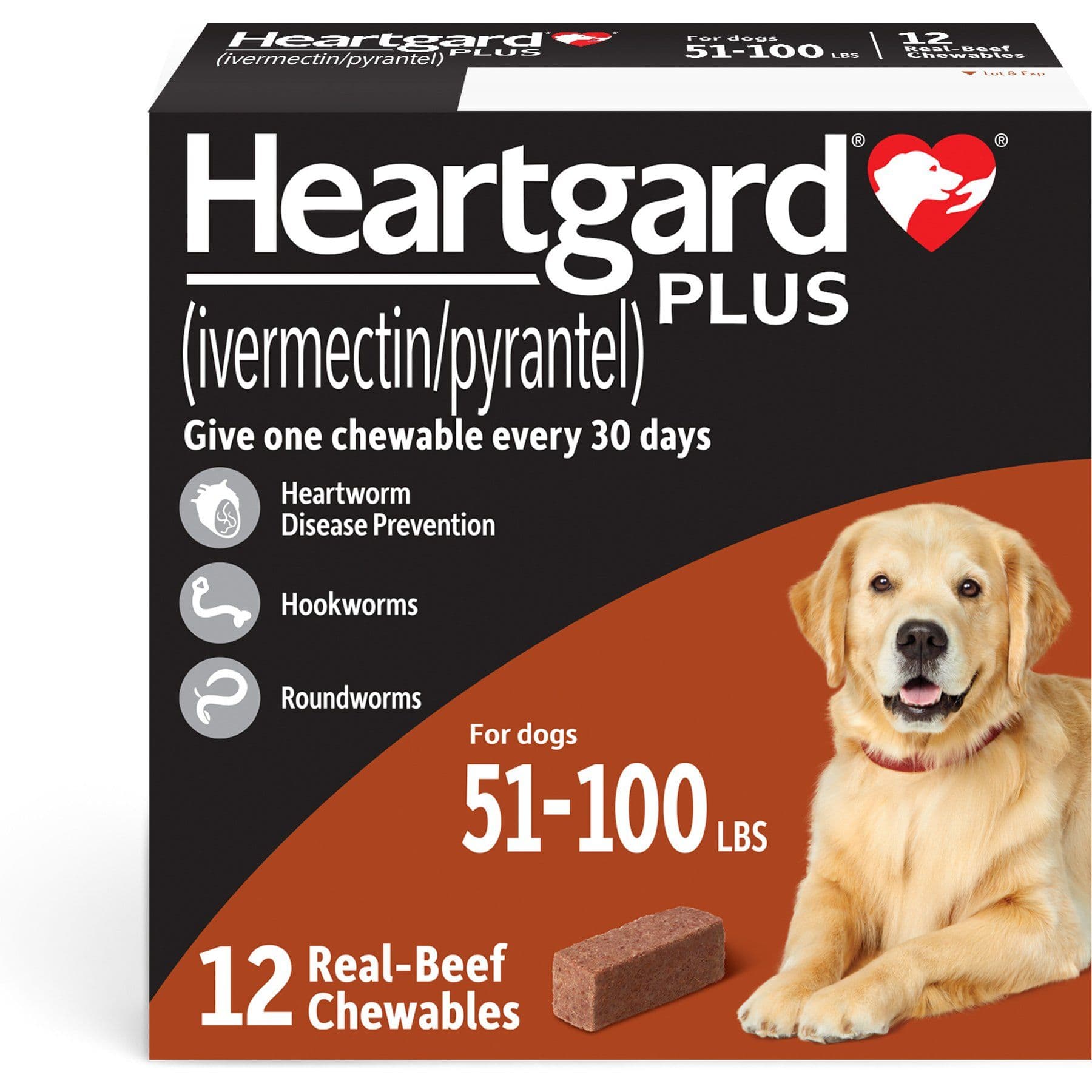
Brown-box Heartgard Plus for dogs 51 to 100 lbs: 12 monthly chews, each with 272 mcg ivermectin and 227 mg pyrantel.
Webvet may earn a commission when you click through to Chewy, at no extra cost to you.
Heartgard Plus is a preventive, not a cure for an existing infection. The Merck Veterinary Manual explains that preventive drugs kill young larval stages, and it notes that the only drug available for adult heartworm infection is melarsomine.
That is why the label says every dog should be tested for existing heartworm infection before starting. A dog that tests positive needs a plan for heartworm treatment for dogs from your vet before prevention takes over.
A few other questions come up often:
- How effective is it? The American Heartworm Society calls preventives highly effective but not 100 percent effective. That is how a dog can still get heartworms while taking Heartgard, especially when doses run late, and why yearly testing continues.
- Is it FDA-approved? Yes. Its labeling is FDA-approved, and federal law limits it to use by or on the order of a licensed veterinarian. It is a prescription drug given by mouth, not a pesticide.
- Can it cause liver damage or pancreatitis? Neither appears among the adverse events on the label, which are mainly digestive and neurologic signs plus itching.
- Does it interact with other medications? Give your vet a list of everything your dog takes, prednisone included, before the first chew.
- My dog threw up hours after taking it. Now what? Call your vet before giving another chew. The label recorded vomiting or diarrhea within 24 hours of dosing after 1.1% of doses in field trials.
Heartgard vs Heartgard Plus: what the Plus adds
Plain Heartgard contains ivermectin alone, for heartworm prevention. Heartgard Plus adds pyrantel pamoate, which VCA Animal Hospitals describes as a treatment for intestinal roundworm, hookworm, and stomach worm parasites. Both rely on ivermectin for heartworm; the Plus adds the intestinal worm coverage.
Pyrantel brings its own possible side effects, though VCA calls them rare at proper dosing: nausea, vomiting, decreased appetite, and diarrhea.
Heartgard Plus lists no whipworms or tapeworms on its label. For those, Interceptor Plus is labeled to treat adult whipworm and adult tapeworm.
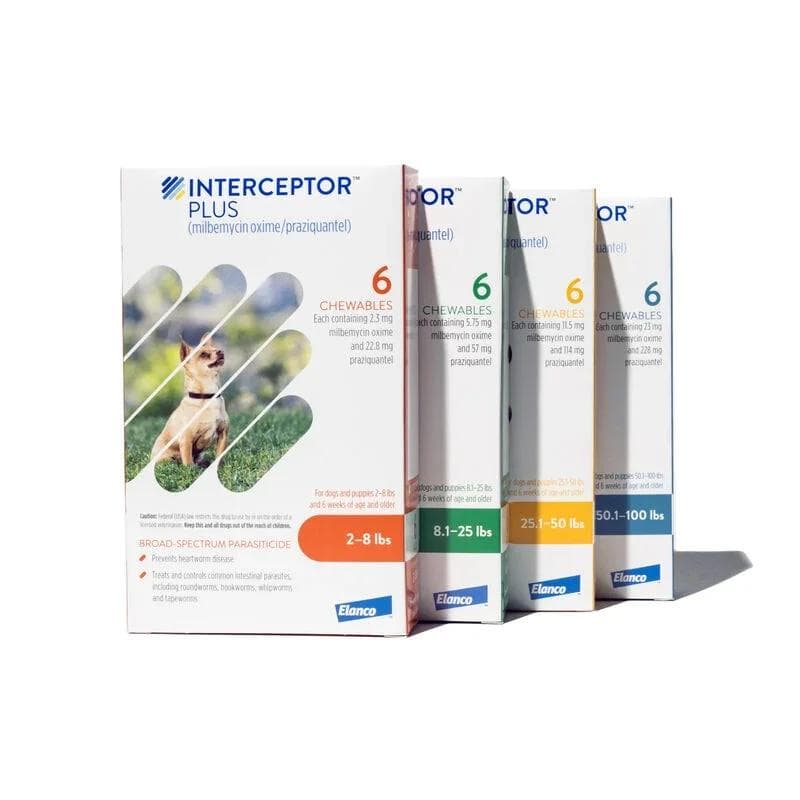
Interceptor Plus for dogs 50.1 to 100 lbs adds whipworm and tapeworm coverage in a 6-chew, six-month supply.
Webvet may earn a commission when you click through to Chewy, at no extra cost to you.
What is the difference between Heartgard and Heartgard Plus?
Heartgard contains only ivermectin and is used to prevent heartworm disease. Heartgard Plus adds pyrantel pamoate, so the same monthly chew also treats and controls roundworms and hookworms. If your dog needs that intestinal worm coverage, choose the Plus version, and remember that it still does not cover fleas, ticks, whipworms, or tapeworms.
Heartgard Plus dosage by weight

Heartgard Plus is dosed by body weight, one chew a month. The label's weight chart has three bands, and each box color matches one band:
- Blue box, up to 25 lbs (about 11 kg): 68 mcg ivermectin and 57 mg pyrantel per chew.
- Green box, 26 to 50 lbs (about 12 to 23 kg): 136 mcg ivermectin and 114 mg pyrantel per chew.
- Brown box, 51 to 100 lbs (about 23 to 45 kg): 272 mcg ivermectin and 227 mg pyrantel per chew.
- Over 100 lbs: the label calls for an appropriate combination of these chewables, which your vet works out for your dog's weight.
Use your dog's current weight from the scale, not a guess. A 24-lb dog takes the blue box, but the same dog at 27 lbs moves up to the green box, and a 52-lb dog needs the brown box. Your vet sets the band when writing the prescription for the chewables.
How often do dogs take Heartgard Plus? Once a month, every month. The three weight-band chews are built around a 30-day window, because the label warns that a gap of more than a month between doses can reduce ivermectin's efficacy.
Two dosing mistakes deserve a call to your vet:
- The wrong weight band: each band up roughly doubles the drug in the chew, from 68 to 136 to 272 mcg of ivermectin, so a chew from a lighter band gives less than the label dose for your dog's weight and a heavier band gives more.
- Two chews at once, or an accidental overdose: the label reports a wide margin of safety at the recommended dose, and original Heartgard showed no signs of toxicity at 10 times the recommended dose in sensitive Collies. Your vet can still tell you which side effects to watch for.
Small dogs and growing puppies need a fresh look at the scale at each refill. Our guide to heartworm prevention for puppies covers the first year. Box colors belong to the brand, so if your pharmacy dispenses a generic, go by the weight range printed on that box.
Pack size only changes how long a box lasts. Each chew covers one month, so a 12-chew box in any band is a 12-month supply, and six chews cover six months. For a large dog, the Heartgard Plus 51-100 lbs box holds 12 chews.
At the time of writing, Chewy listed that brown 12-chew box at $163.09, which works out to about $13.59 per monthly chew. Check current prices for the blue and green boxes before you buy.
 Sponsored
Vet care that's always there
Unlimited video calls and messaging with licensed vets for less than a typical vet visit. One membership covers up to five pets.
Use code Pets60
Plans start at $12/month · covers up to 5 pets
- Licensed vets in most states
- Rx for 150+ conditions
- 4.7 on Trustpilot
How Heartgard Plus works and why timing matters
Heartworm starts with a mosquito. Merck explains that a single bite from a mosquito carrying infective heartworm larvae can infect a dog, and Heartgard Plus works by eliminating the tissue stage of those larvae before they develop further. Ivermectin, the heartworm ingredient in Heartgard Plus, is a macrocyclic lactone. Merck lists ivermectin, milbemycin oxime, moxidectin, and selamectin as the macrocyclic lactone drugs that target the larval stages of the parasite, so yes, Heartgard is a macrocyclic lactone preventive.
Timing matters because that development does not wait. Merck notes that heartworms need about 6 months to develop, a period that also sets the rhythm for retesting.
The label builds its schedule around a 30-day window. The first dose must be given within a month (30 days) after the dog's first exposure to mosquitoes, and the final dose within a month (30 days) after the last exposure. Each chew in between should follow the previous one by no more than 30 days.

Each chew does two jobs on that schedule. The ivermectin handles heartworm larvae, and the pyrantel treats and controls roundworms and hookworms, so monthly dosing doubles as routine deworming for those two parasites.
Here is how the seasonal rule plays out where mosquitoes appear in April and disappear by the end of October. The first chew is due within a month of that first April exposure, chews follow every month, and the last one is due by the end of November.
A puppy's first mosquito season follows the same rule from the start: the first chew falls within 30 days of its first exposure. A small puppy begins in the blue box for dogs up to 25 lbs and moves up a band as it grows.
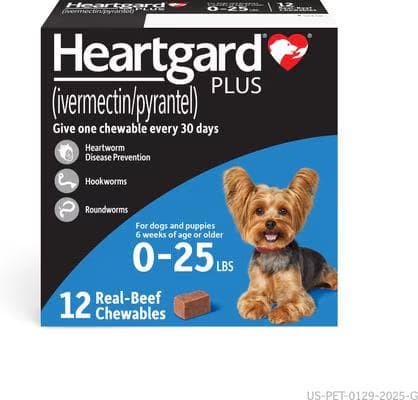
Blue-box Heartgard Plus for small dogs up to 25 lbs: 12 chews, one per month for a full year.
Webvet may earn a commission when you click through to Chewy, at no extra cost to you.
Veterinary references go further than the label. The American Heartworm Society recommends year-round prevention, even in dry states like Arizona, and Merck says year-round preventive treatment is recommended for most dogs. Because the label's seasonal wording and that advice differ, ask your vet which schedule fits where you live.
A few habits keep every chew inside the 30-day window:
- Pick one date each month and set a recurring reminder.
- Note the date and the box color each time you give a chew.
- Watch your dog finish the chew, and call your vet if it is spat out or vomited.
- Reorder before the box runs out, so a refill delay never pushes a dose past 30 days.
- If you are switching from another heartworm preventive, ask your vet to set the first date so no month goes uncovered.
For owners wondering what to give instead of heartworm medicine, VCA Animal Hospitals describes heartworm disease as preventable through regular use of FDA- or Health Canada-approved preventives, the ground covered in our guide to heartworm in dogs and how to prevent this silent killer.
Do dogs really need Heartgard every month?
Yes. Preventives work on young larval stages, and the label warns that stretching the interval between doses past 30 days can reduce ivermectin's efficacy. Merck adds that missing an administration date may have serious consequences. One chew every month, on time, is what the protection is built on.
Going without prevention leaves a dog exposed every time an infected mosquito bites, which is how dogs get heartworm in the first place. Our explainer on how dogs get heartworm walks through that cycle.
Because Merck and the American Heartworm Society both favor year-round dosing, a 12-chew box matches a full year of monthly doses. For a dog of 26 to 50 lbs, that is the green box.
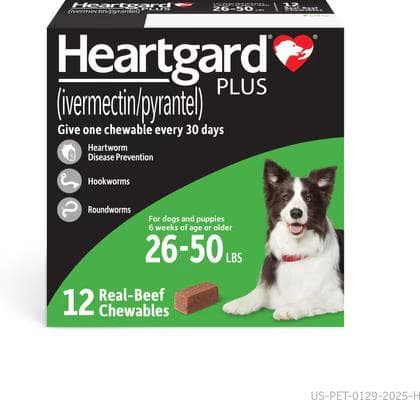
Green-box Heartgard Plus for dogs 26 to 50 lbs: 12 chews, a full year of monthly heartworm prevention.
Webvet may earn a commission when you click through to Chewy, at no extra cost to you.
Heartgard Plus side effects and dogs that need caution
Heartgard Plus side effects were uncommon in the label's field trials, where vomiting or diarrhea within 24 hours of dosing followed 1.1% of administered doses. The label also lists reactions reported after approval:
- Vomiting and diarrhea
- Lethargy and anorexia (not eating)
- Seizures, ataxia (loss of coordination), and muscle tremors
- Hypersalivation (drooling) and pruritus (itching)
- Choking or intestinal obstruction, which matters for dogs that gulp chews whole
Any of these signs after a dose deserves a call to your vet, and a seizure is an emergency. Heartgard Plus does not kill Giardia, which is not on its label, so lingering diarrhea needs a vet check.
Tell your vet before starting if your dog has a seizure history or is pregnant or nursing, so the plan fits your dog.
Ivermectin sensitivity in herding breeds traces to a mutation in the MDR1 gene. Washington State University College of Veterinary Medicine explains that dogs with this gene mutation can have severe, life-threatening reactions to some common drugs, and estimates how often several breeds carry it:
- Collie: about 70%
- Australian Shepherd: about 50%
- Shetland Sheepdog: about 15%
- German Shepherd: about 10%
- Border Collie: under 5%
WSU also states that the FDA determined Heartgard is safe for dogs with the MDR1 mutation when used at label doses. For these breeds, the risk lies in extra or oversized doses.
What dogs should not take Heartgard?
A dog 7 months or older that has not had a heartworm test should not start Heartgard Plus, because the label calls for testing for existing infection first; your vet will set the testing plan for a young puppy. Puppies younger than six weeks fall outside the Heartgard manufacturer's age guidance. Herding breeds can take it at the label dose but should never get extra chews.
Is Heartgard Plus bad for dogs?
Not for a dog that has tested negative and gets the right weight band. The label reports a wide margin of safety at the recommended dose, and digestive upset was uncommon in field trials. The real risk sits on the other side: one bite from an infected mosquito can infect an unprotected dog.
Missed doses, double doses, and heartworm testing
A missed month matters because ivermectin depends on steady timing. The label states that when the interval between doses exceeds a month (30 days), the efficacy of ivermectin can be reduced, and it advises giving a chew right away and resuming the regular schedule.
The American Heartworm Society gives the same first step for a missed dose: consult your veterinarian and restart the monthly preventive immediately, then retest 6 months later after a 2-month lapse.
Use this decision table to match the situation with the next step and whether to retest:
| Situation | What to do now | Retest? |
|---|---|---|
| Chew given within 30 days of the last one | Keep the same monthly date | Yearly test only |
| Missed dose, more than 30 days since the last chew | Give a chew now, restart monthly dosing, call your vet | Ask your vet; after 2 missed months, AHS advises a retest 6 months later |
| Dog 7 months or older starting prevention | Antigen test before the first chew | Second negative test 6 to 7 months later, per Merck |
| Accidental double dose | Call your vet, fastest for herding breeds | Yearly test only |
| Wrong weight band given | Call your vet; use the correct band next month | Ask your vet |
If your dog has missed 2 months of prevention, the American Heartworm Society advises restarting the monthly preventive right away and retesting 6 months later, because heartworms must be about 7 months old before a test can find them. For a shorter lapse, ask your vet whether a retest makes sense. The American Heartworm Society also advises testing all dogs every year. Our guide to the heartworm test for dogs explains the tests.

While you wait on any retest, learn the heartworm symptoms in dogs so you can report changes early.
Can I get Heartgard Plus without a vet prescription?
No. Federal law restricts Heartgard Plus to use by or on the order of a licensed veterinarian, which is why it requires a prescription. The American Heartworm Society says heartworm preventives must be bought from your veterinarian or with a prescription through a pet pharmacy. Chewy is one such pharmacy, so expect a prescription check wherever you buy.
Heartgard Plus vs Interceptor Plus, NexGard Plus, and Simparica Trio
All four chews are labeled to prevent heartworm disease, so the choice comes down to what else each one covers and which label cautions apply. Here is the side-by-side coverage against Interceptor Plus and the two flea-tick combination chews, parasite by parasite:
- Heartworm (Dirofilaria immitis): all four are labeled to prevent it.
- Roundworms and hookworms: all four carry these claims, per the Interceptor Plus label, the DailyMed NexGard Plus label and the DailyMed Simparica Trio label. Our Interceptor Plus for dogs guide covers that label's full worm list.
- Whipworms: only the DailyMed Interceptor Plus label carries a claim, for adult Trichuris vulpis.
- Tapeworms: Interceptor Plus treats Taenia pisiformis, Echinococcus multilocularis, Echinococcus granulosus, and Dipylidium caninum. Simparica Trio covers only Dipylidium, by killing the fleas that carry it. Heartgard Plus and NexGard Plus have no tapeworm claim.
- Fleas and ticks: only NexGard Plus and Simparica Trio.
If your dog needs whipworm or tapeworm coverage, Interceptor Plus fills the gap Heartgard Plus leaves. It is also prescription-only, and its label calls for a heartworm test first. For a dog over 50 lbs, the Interceptor Plus Chew for Dogs, 50.1-100 lbs comes as a six-month supply.
The Merck Veterinary Manual notes that even confined dogs can pick up Dipylidium caninum because it cycles through fleas, so flea control is the key step. Our guide to flea, tick, and heartworm prevention for dogs compares layered plans.
NexGard Plus (afoxolaner, moxidectin, pyrantel) and Simparica Trio (sarolaner, moxidectin, pyrantel) add flea and tick control. Both labels carry the isoxazoline warning that seizures have been reported, even in dogs with no seizure history, and both advise caution in dogs with a history of seizures. Our Simparica Trio vs NexGard Plus comparison goes deeper.

Heartgard Plus needs a flea and tick partner, and owners ask about giving it together with NexGard, Simparica, Bravecto, Advantix, or Frontline at the same time, or switching from Trifexis. The labels reviewed here do not address those pairings, so your vet should confirm the combination.
NexGard Plus already includes a heartworm preventive, so ask whether it should replace Heartgard Plus rather than join it as a combo. Generic questions get similar advice: Iverhart Plus, Iverhart Max, Tri-Heart Plus, and other alternatives have their own labels, so check the ingredients and weight range with your vet.
What is the safest heartworm preventative for dogs?
No primary source ranks one heartworm preventive as the safest, so compare labels against your dog's history. The combination chews call for caution in dogs with a seizure history, while WSU reports that MDR1 dogs can take Heartgard at label doses. Our roundup of the best heartworm medicine for dogs lays out the options.
Which is safer, Heartgard or Simparica?
Neither is ranked safer by a primary source; they carry different risks. Simparica Trio carries the isoxazoline seizure warning and adds flea and tick control. Heartgard Plus has no such class warning, though seizures appear among its post-approval reports, and it leaves fleas and ticks to a separate product.
Heartgard Plus questions
Frequently Asked Questions
What happens if I accidentally gave my dog two doses of Heartgard Plus?
Call your vet, even though the label reports a wide safety margin at the recommended dose. No primary source gives an outcome figure for a doubled dose, so your vet will want your dog's weight, the box color, and when each chew was given. Ask before moving the next dose date.
Can Heartgard Plus cause seizures in dogs?
Seizures appear in the label's list of post-approval reports, alongside ataxia and tremors. The ivermectin sensitivity concern involves elevated doses: WSU reports the FDA found Heartgard safe for dogs with the MDR1 mutation at the label dose. Treat a seizure after any chew as an emergency.
Can I give Heartgard Plus and NexGard together?
No primary source reviewed here addresses giving them on the same day, so your vet should confirm the pairing. NexGard Plus is a different case: it already contains a heartworm preventive, so adding Heartgard Plus would mean two heartworm preventives at once.
Does Heartgard Plus need to be given year-round?
For most dogs, yes. The American Heartworm Society's Think 12 advice is to test every 12 months and give a heartworm preventive 12 months a year. Year-round dosing also removes the risk of missing the label's 30-day start and stop deadlines around mosquito season.
Is Heartgard Plus safe for puppies and how early can they start?
Yes. The manufacturer says puppies can start at six weeks of age with no weight restriction, and the smallest weight band runs from 0 to 25 lbs. Weigh your puppy at each refill and move up a weight band once it passes 25 lbs.
Veterinarian · BVMS MRCVS
Dr. Pippa Elliott, BVMS, MRCVS, is a veterinarian with nearly 30 years of experience in companion animal practice. Dr. Elliott earned her Bachelor of Veterinary Medicine and Surgery from the University of Glasgow. She was also designated a Member of the Royal College of Veterinary Surgeons. Married with 2 grown-up kids, Dr. Elliott has a naughty Puggle named Poggle, 3 cats and a bearded dragon.
Related reading

Dog Anxiety Meds: What Vets Prescribe, Over-the-Counter Options, and How to Choose

Interceptor Plus for Dogs: What It Prevents, Dosing by Weight, Side Effects, and vs. Heartgard Plus

Can Dogs Have Tylenol? Acetaminophen Toxicity in Dogs
