Hydroxyzine for Dogs: Uses, Dosage, Side Effects, and Safer Alternatives
A veterinarian explains hydroxyzine for dogs: what it is prescribed for, the dose range vets use by weight, onset, side effects such as sedation, drugs it should not be mixed with, and when Benadryl or Apoquel is the better choice.

BVMS MRCVS
Medically reviewed by Dr. Pippa Elliott, BVMS MRCVS · Last reviewed

This article contains affiliate links. Webvet may earn a commission when you buy through them, at no extra cost to you.
What hydroxyzine does for dogs and when vets prescribe it
Veterinarians prescribe hydroxyzine for dogs as a first-generation H1 antihistamine; it is an extra-label use for allergic itch, hives, and sometimes anxiety. VCA Animal Hospitals describes it as an antihistamine for allergic and itchy conditions or as a sedative or tranquilizer.
Sedation is its main side effect, and the dose is set by your veterinarian from your dog's weight.

Can you give your dog hydroxyzine for itching on your own? No. Hydroxyzine for dogs is prescription-only: the FDA-labeled product is a prescription drug, and Chewy sells it through its pharmacy with a veterinary prescription. There is no over-the-counter (OTC) version, unlike the options in our guide to over the counter allergy medicine for dogs.
- 1What hydroxyzine treats in dogs: allergic itch and hives, and sometimes mild sedation for anxiety, always on a veterinarian's prescription.
- 2The dose vets prescribe centers on 2 mg per kg every 12 hours, worked out from your dog's weight; there is no published chart for home dosing.
- 3HCl versus pamoate forms deliver the same drug: the pamoate capsule is labeled as the hydrochloride equivalent, so the choice is about strength, not salt.
- 4Sedation is the main side effect; stop the drug and call your vet for trouble urinating or seizures.
- 5For itch, the evidence favors hydroxyzine over Benadryl, and a prescription itch drug such as Apoquel when an antihistamine is not enough.
It treats the histamine-driven problems: allergic itch and hives. The Merck Veterinary Manual says hives and angioedema generally respond quickly to glucocorticoids and antihistamines, and names hydroxyzine pamoate as one choice for dogs. Off label, in VCA's definition, means the FDA has not reviewed or approved that use, so only your veterinarian's directions apply.
Itch itself has many causes, and hydroxyzine addresses only the histamine part of the picture:
- dog skin allergies
- parasites
- an infected hot spot
That is why the first question is always why your dog is so itchy, and only then which drug.
Cost is low: Hydroxyzine HCl (Generic) Tablets, 25-mg, 90 tablets were listed at $15.30 on Chewy when we checked in October 2026, or 17 cents a tablet.
For a 12.5 kg (28 lb) dog at AAHA's 2 mg per kg twice daily, that is one tablet twice a day, 60 a month, about $10.20, with the dose itself set by your veterinarian.
What does hydroxyzine do to a dog?
It blocks histamine at H1 receptors, which is why it eases hives and histamine-driven itch. Merck explains that histamine is only one component of a complex inflammatory cascade, so antihistamines have very weak anti-inflammatory activity and may be less effective for atopy, where other mediators matter.
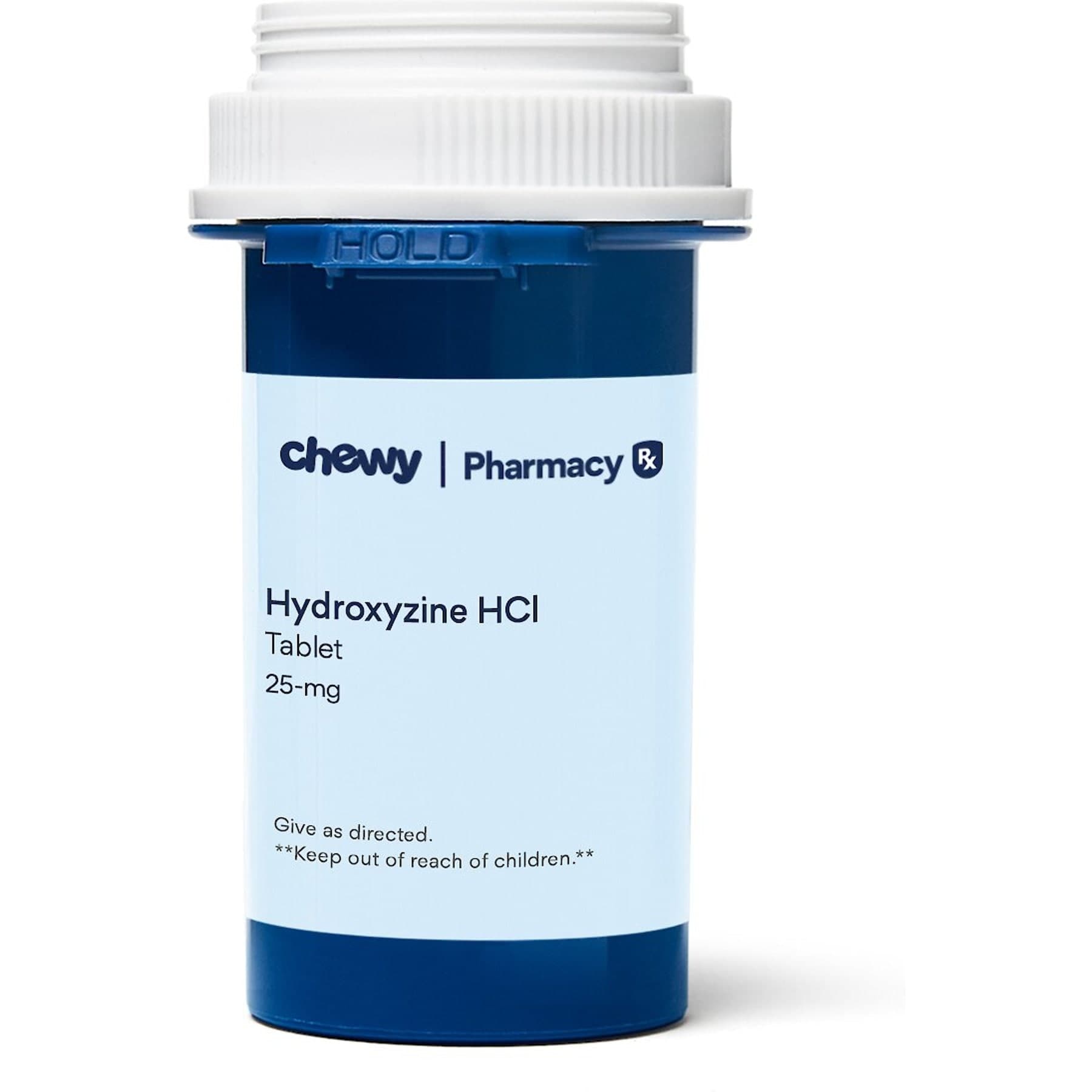
Hydroxyzine HCl Tablets, 25 mg: the generic prescription antihistamine, filled through Chewy's pharmacy with your vet's script.
Webvet may earn a commission when you click through to Chewy, at no extra cost to you.
The evidence for itch relief is modest:
- The 2023 AAHA allergic skin disease guidelines rate antihistamines as questionable efficacy, possibly useful only in mildly itchy dogs.
- In a placebo-controlled crossover trial on PubMed, 10 of 17 atopic dogs improved by more than 25 percent in itch on hydroxyzine plus chlorpheniramine, against 2 of 19 on placebo, an improvement the authors called limited in most cases.
Vets prescribe it for regular, long-term use rather than rescue:
- VCA: it works best given regularly, before allergen exposure
- Merck: antihistamines have very little efficacy for acute flares but can help control chronic disease alongside other treatments
- AAHA: listed for long-term management only, not for acute flares
That is why hydroxyzine and prednisone are often prescribed together: Merck notes antihistamines may act synergistically with glucocorticoids and allow lower steroid doses, inside a broader plan of dog allergy medicine. Adding Benadryl on top needs your vet's say-so. VCA warns drug sensitivities can develop with repeated exposure, so keep watching for reactions.
Anxiety and sleep come up often: VCA lists sedative or tranquilizer use, and Merck notes antihistamines are also used as sedatives and antiemetics, but no published veterinary dose exists for anxiety or sleep in dogs. The ranges vets quote are for itch and hives.
It is an antihistamine, not an antibiotic, so an ear infection needs its own diagnosis. Merck lists its toxic dose in dogs as unknown and warns that first-generation antihistamine overdoses can be fatal, so the bottle stays out of reach.

 Sponsored
Need a prescription or refill for your dog?
A licensed vet at Dutch can assess your dog over video and prescribe treatment when it's appropriate, delivered to your door.
Use code Pets60
Plans start at $12/month · covers up to 5 pets
- Licensed vets in most states
- Rx for 150+ conditions
- 4.7 on Trustpilot
Hydroxyzine HCl vs pamoate, tablet strengths, and how it is given to dogs
The HCl versus pamoate question comes up constantly, and the two forms deliver the same drug:
- Hydroxyzine hydrochloride (HCl) is the tablet: the FDA label on DailyMed lists 10 mg, 25 mg, and 50 mg strengths.
- Hydroxyzine pamoate is the capsule: its label states each capsule is equivalent to 25 mg or 50 mg of hydroxyzine hydrochloride, and the pamoate salt is practically insoluble in water.
No primary veterinary source ranks one salt above the other for dogs, and the salt does not change the drug's uses. Merck's canine hives protocol names the pamoate salt, at 2 mg per kg every 12 hours for 3 to 5 days, while Merck's atopic dermatitis table lists hydroxyzine without naming a salt.
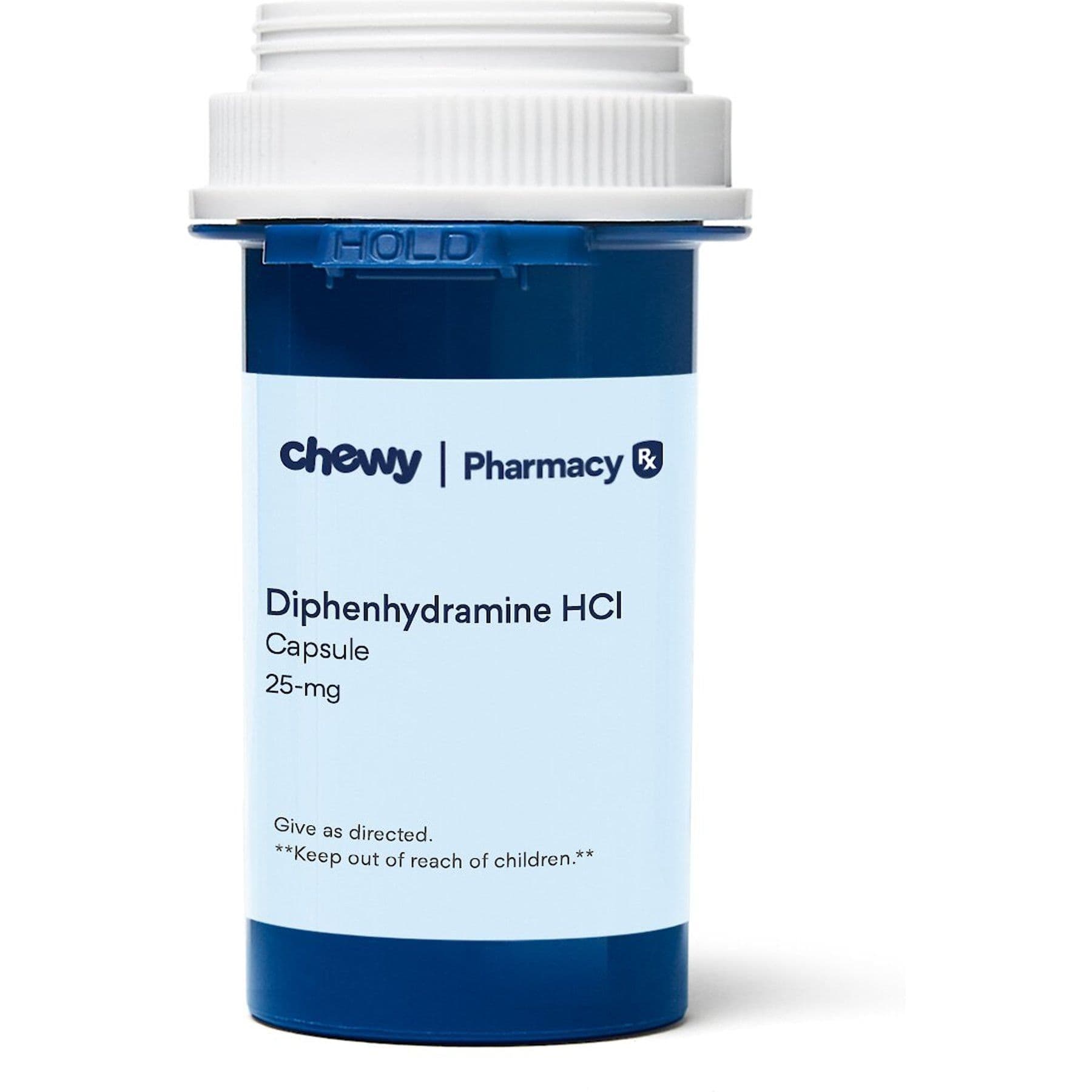
Diphenhydramine HCl Capsules, 25 mg: generic Benadryl, dosed by weight and filled through Chewy's pharmacy with a prescription.
Webvet may earn a commission when you click through to Chewy, at no extra cost to you.
That same table lists a hydroxyzine plus chlorpheniramine combination, (20.9 mg + 0.7 mg) per 10 kg divided every 12 hours, the regimen from the placebo-controlled trial. Chlorpheniramine is also a prescription antihistamine, filled through Chewy's pharmacy with a veterinary prescription.
Strength follows weight, so the question of 10 mg, 25 mg, or 50 mg, for itching or anxiety alike, is really a question about the dog. At the AAHA figure of 2 mg per kg, each tablet strength lines up with roughly one size of dog:
- 10 mg: a 5 kg (11 lb) dog
- 25 mg: a 12.5 kg (28 lb) dog
- 50 mg: roughly a 25 kg (55 lb) dog
That is arithmetic from the cited dose, not a published chart, which is why no single dosage chart by weight fits every dog. A 50 mg tablet is not stronger medicine, only more of it, and side effects track the milligrams per kilogram your dog receives rather than the tablet size.
How it is given, in VCA's instructions:
- by mouth as a tablet, liquid solution, or capsule, or by injection in the hospital
- with or without food; if your dog vomits when dosed on an empty stomach, give later doses with food
- only as a product with hydroxyzine as the single active ingredient, because VCA warns against combination products
Chewy's pharmacy fills Hydroxyzine HCl (Generic) Tablets, 25-mg, 90 tablets with a veterinary prescription, alongside:
- the 10 mg and 50 mg tablets
- the 25 mg and 50 mg pamoate capsules
- a compounded beef-flavored hydroxyzine HCl liquid at 25 mg per mL
Chewy's own listing calls the pamoate capsule a prescription medication for itchy skin due to allergies.
 Sponsored
Vet care that's always there
Unlimited video calls and messaging with licensed vets for less than a typical vet visit. One membership covers up to five pets.
Use code Pets60
Plans start at $12/month · covers up to 5 pets
- Licensed vets in most states
- Rx for 150+ conditions
- 4.7 on Trustpilot
Hydroxyzine dosage for dogs: the range vets prescribe and how fast it works
Hydroxyzine dosage for dogs centers on one figure in the two main references. The AAHA oral antihistamine dose table lists hydroxyzine at 2 mg per kg every 12 hours, citing Bizikova 2008, and Merck's atopic dermatitis table gives the same 2 mg per kg every 12 hours.
Merck's other tables widen the range and change the interval, so the sources disagree and each is worth knowing:
- Merck's integumentary antihistamine table: 0.5 to 2 mg per kg every 6 to 8 hours as needed
- Merck's toxicology table: a therapeutic dose of 2 to 3 mg per kg every 8 to 12 hours
- Merck's hives protocol: hydroxyzine pamoate at 2 mg per kg every 12 hours for 3 to 5 days
Your veterinarian picks the dose and the interval for your dog's condition, and that choice is not one to adjust at home. Here is what 2 mg per kg works out to by weight, as arithmetic on the AAHA figure (about 0.9 mg per pound), not a dose to give on your own:
- 5 kg (11 lb): 10 mg per dose
- 10 kg (22 lb): 20 mg per dose
- 20 kg (44 lb): 40 mg per dose
- 30 kg (66 lb): 60 mg per dose
No veterinary source publishes a hydroxyzine dosage chart by weight, in kilograms or pounds. AAHA and Merck give mg per kg ranges, and VCA's owner page gives no number at all, telling you to follow your veterinarian's directions. There is no published dose for anxiety either.
More is not better, and no veterinary table states a maximum. Pharmacodynamic modeling in the Bizikova study found that raising the dose or the frequency would not improve histamine inhibition beyond 2 mg per kg twice daily, so a bigger dose only raises the overdose risk without adding relief.
Course length follows the condition: Merck's hives protocol runs 3 to 5 days, while atopy management is long term, with the drug given regularly before exposure rather than after a flare has started.

How much hydroxyzine can a dog take?
As much as the veterinarian prescribes, and no more. Across the veterinary tables the range runs from Merck's 0.5 mg per kg up to 3 mg per kg, with AAHA and Merck's atopic dermatitis table both at 2 mg per kg every 12 hours.
The figure for your dog depends on its weight, the condition being treated, and the other drugs it takes: a 20 kg dog gets 40 mg per dose at 2 mg per kg and 60 mg at 3 mg per kg, so the number on the label is the vet's, not a chart's.
How long does it take for hydroxyzine to kick in for dogs?
VCA says hydroxyzine takes effect in about 1 to 2 hours; the human label's 15 to 30 minutes is human data. In the Bizikova pharmacokinetic study, hydroxyzine was rapidly converted to cetirizine, the active ingredient in Zyrtec for dogs, and the skin-wheal suppression was almost entirely due to cetirizine, peaking in the first 8 hours.
The cetirizine half-life was 10 to 11 hours, which fits twice-daily dosing, and oral availability in six healthy dogs was 72 percent. VCA calls hydroxyzine short acting: it should stop working within 24 hours, longer in dogs with liver or kidney disease.
For a Benadryl comparison on dose alone, the two references land close together:
- AAHA: diphenhydramine at 2 to 3 mg per kg every 12 hours
- Merck: 2 to 4 mg per kg every 8 to 12 hours
Similar per-dose milligrams do not make the drugs interchangeable, and Diphenhydramine HCl (Generic) Capsules, 25-mg, 120 capsules also need a prescription through Chewy's pharmacy.
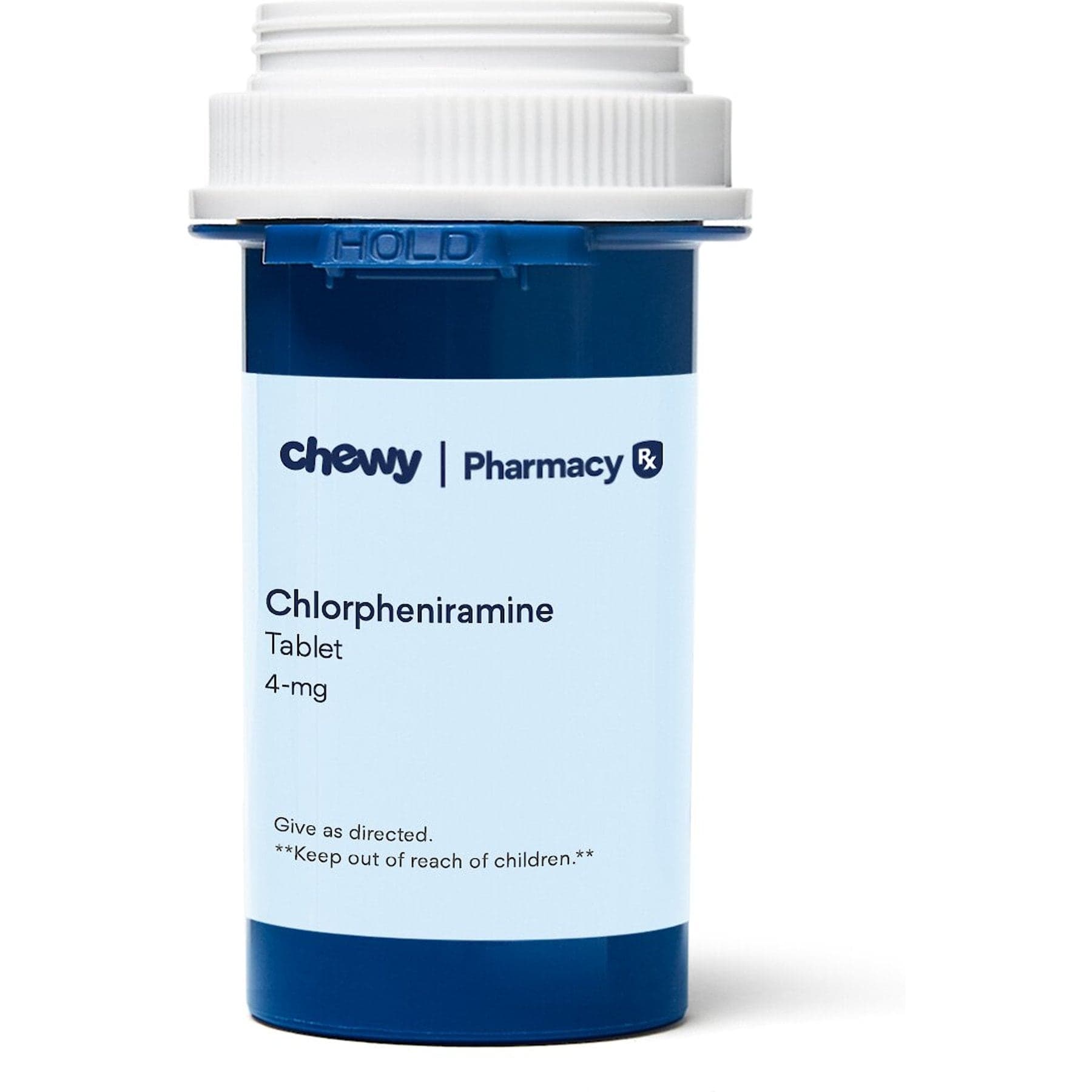
Chlorpheniramine Maleate Tablets, 4 mg: the antihistamine Merck lists with hydroxyzine for atopic dogs, a Chewy pharmacy prescription.
Webvet may earn a commission when you click through to Chewy, at no extra cost to you.
Hydroxyzine side effects in dogs: sedation, dry mouth, and when to call the vet
VCA lists the side effects of hydroxyzine for dogs as:
- sedation
- excitability
- tremors
- dry mouth
- increased drinking
- constipation
- lack of appetite
Merck adds that first-generation antihistamines may cause drowsiness or gastrointestinal signs such as vomiting and diarrhea, and that their anticholinergic properties lead to dry mouth, blurred vision, urinary retention, and raised blood pressure, which is why Merck lists the class as contraindicated in glaucoma and in cardiac disease.

What are the worst side effects of hydroxyzine?
Two signs mean stop the drug and call your veterinarian immediately, in VCA's words: difficulty urinating and seizures. VCA also warns that drug sensitivities can develop over time with repeated exposure, so an allergic reaction can surface weeks into a course that started without trouble.
At overdose, Merck warns that first-generation antihistamines may cause CNS hyperexcitability and may be fatal, and lists these signs:
- lethargy
- sedation
- agitation
- rapid heart rate
- vomiting
- low blood pressure
- dilated pupils
- tremors
- potentially seizures
The human label adds a serious pustular skin reaction (AGEP) and fixed drug eruptions, plus a contraindication with a prolonged QT interval, all human data.
Excitability sits on VCA's list right beside sedation, so some dogs react the opposite way to the one expected. Merck's overdose profile includes agitation and CNS hyperexcitability, so a wired, pacing dog after a dose is a reason to call the clinic, not to repeat the dose.
Will hydroxyzine make dogs sleepy?
Usually a little, rarely a lot. Sedation heads VCA's list, and in the placebo-controlled trial on PubMed Central, four dogs on the hydroxyzine plus chlorpheniramine combination showed drowsiness, mild enough that none needed a dose change. VCA notes effects last longer in dogs with liver or kidney disease, so those dogs may stay sleepier.
On the human label, drowsiness is usually transitory, often fading within a few days of continued therapy or with a lower dose. That is human data, and Merck notes mild signs can occur even at therapeutic doses, with peak plasma concentration at about 3 hours, so any dose change is your veterinarian's decision.
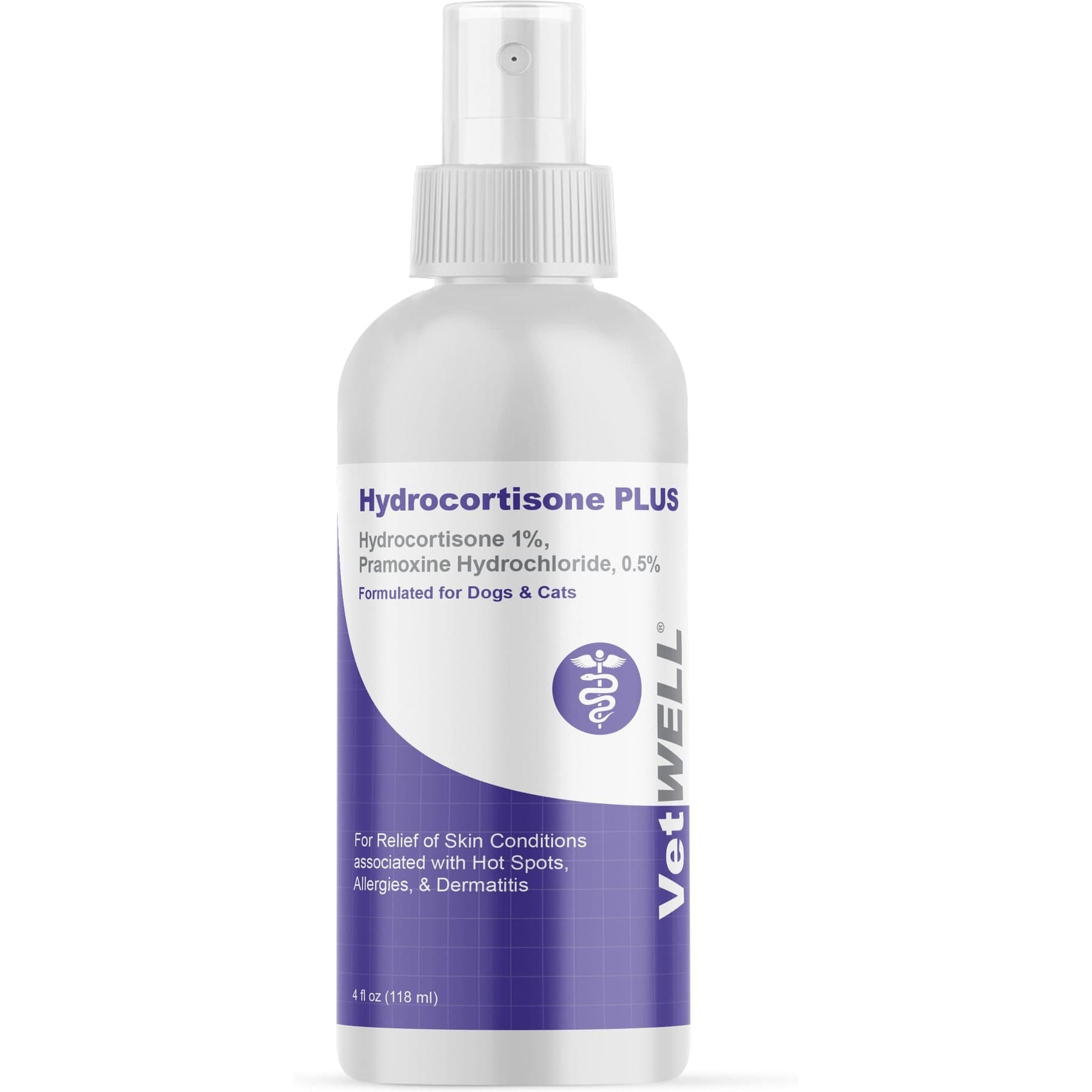
VetWELL Hydrocortisone with Pramoxine Spray: a topical for one itchy patch, used up to three times a day or as your vet directs.
Webvet may earn a commission when you click through to Chewy, at no extra cost to you.
Drugs and conditions that do not mix with hydroxyzine
Start with the pairing that is fine: when a veterinarian prescribes prednisone and hydroxyzine together for dogs, no primary source lists an interaction. VCA's hydroxyzine page does not name corticosteroids among its cautions, and Merck says antihistamines may act synergistically with glucocorticoids, NSAIDs, or fatty acid supplements, sometimes allowing lower doses.
The conditions are a different matter. VCA's do-not-use list is short and absolute: dogs allergic to hydroxyzine or to cetirizine, and dogs with heart failure, urinary obstruction, or stomach obstruction. VCA then grades the cautions:
- extreme caution: dogs with seizures, very young or old dogs, and the first trimester of pregnancy
- caution: glaucoma, trouble urinating, an enlarged prostate, heart, liver, or kidney disease, later pregnancy, lactation, and working animals
Merck states plainly that hydroxyzine is teratogenic, which is why pregnancy appears twice on that list.

What cannot be mixed with hydroxyzine?
VCA names two drug classes to use with caution alongside hydroxyzine: anticholinergic agents and central nervous system depressants, and the human label says CNS depressants given with hydroxyzine should have their dose reduced because hydroxyzine potentiates them. The pairings owners ask about most fall under that heading:
- Gabapentin: VCA's gabapentin page names antacids, hydrocodone, and morphine as its cautions, not hydroxyzine, so there is no published interaction; added sleepiness is the practical concern, and the pair is a veterinarian's call.
- Trazodone: VCA lists CNS depressants among trazodone's cautions and sedation among its side effects, so the same stacking concern applies.
- Benadryl: no veterinary source addresses giving hydroxyzine and Benadryl together, but both are first-generation antihistamines with sedative and anticholinergic effects, so they are not combined without your vet's instruction, since the pair stacks sedation and dry mouth in dogs.
- Intradermal allergy testing: VCA says to stop hydroxyzine at least two weeks before testing.
Hydroxyzine vs Benadryl for dogs and when a prescription itch drug is better
How hydroxyzine compares to Benadryl for dogs (diphenhydramine) starts with what they share: both are first-generation antihistamines, a class Merck says shares anticholinergic, sedative, and local anesthetic effects while varying greatly in potency, dose, side effects, and cost.
| Drug | Dose range vets prescribe | Onset | Duration | Sedation and main cautions | Prescription status |
|---|---|---|---|---|---|
| Hydroxyzine | 2 mg/kg every 12 h (AAHA, Merck); Merck also lists 0.5–2 mg/kg every 6–8 h and 2–3 mg/kg every 8–12 h | About 1–2 h (VCA) | Within 24 h (VCA); metabolite half-life 10–11 h | Main side effect is sedation, usually mild; dry mouth, urinary retention | Prescription (Chewy pharmacy) |
| Benadryl (diphenhydramine) | 2–3 mg/kg every 12 h (AAHA); 2–4 mg/kg every 8–12 h (Merck) | About 1–2 h (VCA) | Within 24 h (VCA); not stated by AAHA | Lethargy, dry mouth, urinary retention (VCA); questionable oral efficacy (AAHA) | Prescription for the generic capsules (Chewy pharmacy) |
| Apoquel (oclacitinib) | 0.4–0.6 mg/kg twice daily for up to 14 days, then once daily (label, Merck) | Hours (AAHA); within 1–2 days (VCA) | Once-daily maintenance | Infection, demodicosis, and neoplasia cautions; not under 12 months | Prescription (veterinarian's order) |
| Cytopoint (lokivetmab) | 2 mg/kg injection under the skin every 4–8 weeks (Merck) | Hours to 3 days (AAHA) | At least 4–8 weeks (VCA) | No age limits or drug interactions (Merck); safe with infection or neoplasia (AAHA) | Clinic-administered; clinic-priced |
Is hydroxyzine basically just Benadryl?
No. They act on the same H1 receptor and VCA gives both the same onset of about 1 to 2 hours, but hydroxyzine is converted in the dog to cetirizine, and that metabolite does most of the work. Diphenhydramine has no such step.
In a beagle study on PubMed, oral diphenhydramine at 2.2 mg per kg twice daily for six days failed to inhibit histamine skin reactions despite reaching blood levels considered effective in people, while cetirizine at 2 mg per kg did; AAHA flags oral diphenhydramine as questionable efficacy on that basis.
Which is better for dogs, hydroxyzine or Benadryl?
For itch, the evidence favors hydroxyzine: its cetirizine metabolite suppressed wheals in the Bizikova work while diphenhydramine did not in the beagle study. No head-to-head trial exists, so this is an inference, not a direct comparison. Both sedate: VCA lists lethargy and dry mouth for diphenhydramine too.
Price runs the other way: Diphenhydramine HCl (Generic) Capsules, 25-mg, 120 capsules were listed at $8.40 on Chewy when we checked in October 2026, filled through its pharmacy with a prescription, against $15.30 for 90 hydroxyzine tablets.
Cetirizine (Zyrtec) itself is contested: AAHA lists it for dogs at 1 to 2 mg per kg every 24 hours, but Merck's integumentary chapter says second-generation antihistamines have not proved useful to date for itch in small animals. Your veterinarian weighs both positions.
When a prescription itch drug is better
AAHA lists antihistamines for long-term management only, with questionable efficacy, possibly only in mildly itchy dogs, so beyond mild itch the next step is the prescription tablet Apoquel for dogs (oclacitinib).
The Apoquel label doses it at 0.4 to 0.6 mg per kg twice daily for up to 14 days, then once daily, for dogs at least 12 months old; in its 30-day field study of 436 dogs, 86.4 percent on Apoquel versus 42.5 percent on placebo had a 2 cm itch reduction at one week.
The label warns it may increase susceptibility to infection, including demodicosis, and worsen neoplastic conditions, and Merck lists it as contraindicated with serious infection or neoplasia. Onset differs by source:
- AAHA: very rapid, within hours
- Merck: within 24 hours
- VCA: one to two days
Apoquel (oclacitinib) TABLETS for Dogs, 5.4-mg, 60 tablets was listed at $189.72 on Chewy when we checked in October 2026, filled through its pharmacy with a prescription; the Apoquel alternatives for dogs guide covers the options when it is ruled out, and pairing hydroxyzine with Apoquel is your vet's call.
Cytopoint for dogs (lokivetmab) is the injectable option:
- Merck: 2 mg per kg under the skin every 4 to 8 weeks; no age restrictions or reported drug interactions
- AAHA: onset of hours to 3 days; safe for puppies and dogs with neoplasia, infection, or systemic disease
- VCA: lasts at least 4 to 8 weeks
It is given at the clinic, so it is clinic-priced with no retail figure; the Apoquel vs Cytopoint comparison covers that choice.
If hydroxyzine is simply not the right fit, the usual substitute is another antihistamine: AAHA's table lists chlorpheniramine at 0.4 mg per kg every 12 hours alongside cetirizine, loratadine, and fexofenadine, and our guide to antihistamines for dogs explains how vets choose.
How to give hydroxyzine safely: missed doses, overdose signs, and storage
Two routine rules for the bottle at home:
- Missed dose: VCA says give it as soon as you remember, unless the next dose is almost due, in which case skip it and resume the regular schedule; never give two doses at once.
- Storage: keep tablets and capsules at room temperature and protected from light, and do not freeze the liquid formulations.

The human label names hypersedation as the most common overdose sign; Merck's list runs from lethargy, agitation, and vomiting to tremors and potentially seizures.
Because signs start quickly, Merck says inducing vomiting is not appropriate for most dogs. Activated charcoal can be useful within 1 to 2 hours in a dog that is still clinically normal, and treatment is primarily supportive, all of it the clinic's decision.
At home, VCA's instruction is to watch for side effects such as sedation, tremors, dry mouth, or vomiting and, if any appear, stop the medication and contact your veterinarian.
Hydroxyzine for dogs questions
Frequently Asked Questions
Can dogs take hydroxyzine for anxiety?
Sometimes, on a veterinarian's prescription. VCA lists sedative or tranquilizer use, but no primary veterinary source gives an anxiety dose for dogs; the calming effect is really its sedation side effect, so your vet decides whether a drowsier dog is the goal.
How long does hydroxyzine last in a dog?
VCA says this short-acting drug should stop working within 24 hours, and the cetirizine metabolite's half-life of 10 to 11 hours is why it is prescribed twice a day. Effects last longer in dogs with liver or kidney disease.
Can I give my dog hydroxyzine and Benadryl together?
Not without your veterinarian's instruction. Both are first-generation antihistamines with sedative and anticholinergic effects, so giving them together stacks sedation rather than adding relief. If one antihistamine is not enough, AAHA's evidence points to a prescription itch drug instead.
Is hydroxyzine safe for pregnant or senior dogs?
Treat both as high-caution. VCA says to use hydroxyzine with extreme caution in old dogs and in the first trimester of pregnancy, and Merck states it is teratogenic. A pregnant or senior dog receives it only when the veterinarian judges the benefit worth that risk.
Does hydroxyzine need a prescription for dogs?
Yes. The FDA-labeled hydroxyzine product is a prescription drug, and Chewy sells both the HCl tablets and the pamoate capsules through its pharmacy as prescription medications. There is no over-the-counter hydroxyzine.
Can a dog take hydroxyzine 50 mg?
Only if its weight calls for it. No primary source gives a per-dog milligram dose; at AAHA's 2 mg per kg, a 50 mg tablet corresponds roughly to a 25 kg (55 lb) dog, arithmetic rather than a stated figure, and the veterinarian matches strength to weight.
Is hydroxyzine pamoate or HCl better for dogs?
Neither is ranked above the other in any primary veterinary source. The pamoate capsule is labeled as the equivalent of 25 mg or 50 mg of hydroxyzine hydrochloride, so your veterinarian's choice is about strength and form, not a difference in the drug.
Can hydroxyzine be given with gabapentin or trazodone?
Only with your veterinarian's approval. No primary source names either pairing, but VCA lists CNS depressants as a caution for hydroxyzine and for trazodone, and sedation is a side effect of both, so added sleepiness is the expected result.
Can hydroxyzine be given with prednisone?
Yes, when a veterinarian prescribes them together. No primary source lists an interaction, and Merck says antihistamines may act synergistically with glucocorticoids such as prednisone, sometimes allowing a lower steroid dose, which is the vet's adjustment to make.
Is hydroxyzine or Apoquel better for an itchy dog?
For allergic itch beyond mild, Apoquel: AAHA rates antihistamines as questionable efficacy, possibly only in mildly itchy dogs, while oclacitinib's field study showed 86.4 percent of dogs with a 2 cm itch reduction at one week versus 42.5 percent on placebo. Hydroxyzine stays an option for mild itch.
What is the maximum dose of hydroxyzine for a dog?
No primary veterinary source states a maximum: Merck lists the toxic dose as unknown, the highest table figure is 3 mg per kg, and modeling found no benefit above 2 mg per kg twice daily. The ceiling is whatever your veterinarian wrote on the label.
Veterinarian · BVMS MRCVS
Dr. Pippa Elliott, BVMS, MRCVS, is a veterinarian with nearly 30 years of experience in companion animal practice. Dr. Elliott earned her Bachelor of Veterinary Medicine and Surgery from the University of Glasgow. She was also designated a Member of the Royal College of Veterinary Surgeons. Married with 2 grown-up kids, Dr. Elliott has a naughty Puggle named Poggle, 3 cats and a bearded dragon.
Related reading

Best Pill Pockets for Cats: Vet-Reviewed Picks for Cats That Spit Out Pills

Best Pill Pockets for Dogs: Vet-Reviewed Picks That Hide Every Pill Size

Dog Anxiety Meds: What Vets Prescribe, Over-the-Counter Options, and How to Choose
