Dog Allergy Medicine: A Vet's Guide to Over-the-Counter and Prescription Options for Itchy Dogs
A veterinarian walks through every class of dog allergy medicine, from over-the-counter antihistamines and supplements to Apoquel, Cytopoint, Atopica, and steroids, with safety limits, costs, and a guide to matching the drug to the dog.

BVMS MRCVS
Medically reviewed by Dr. Pippa Elliott, BVMS MRCVS · Last reviewed

This article contains affiliate links. Webvet may earn a commission when you buy through them, at no extra cost to you.
Dog allergy medicine is not one drug. For mild, seasonal itch with intact skin, it is usually a single-ingredient antihistamine your veterinarian approves. For moderate, severe, or year-round itch, it is a prescription drug such as Apoquel, Zenrelia, Cytopoint, or Atopica, with any skin or ear infection treated at the same time.
We wrote this the way we talk it through in the exam room: what the itch actually is, which medicine fits which dog, what each one was listed at on Chewy when we checked, and the human products that must never go into a dog.
The one rule that never changes is that a veterinarian chooses the drug and the dose for your dog. Nothing here replaces that call.

 Sponsored
Want a vet's take on your dog's skin or coat?
Talk to a licensed vet at Dutch over video, often the same day. They can recommend treatment and prescribe it when it's appropriate.
Use code Pets60
Plans start at $12/month · covers up to 5 pets
- Licensed vets in most states
- Rx for 150+ conditions
- 4.7 on Trustpilot
What dog allergy medicine does: the itch cycle and what each drug targets
Mild, seasonal itch can often be managed with an antihistamine your veterinarian approves. Moderate to severe allergic itch, and any itch that runs most of the year, needs a prescription drug such as Apoquel or Cytopoint. Human allergy products that pair an antihistamine with a decongestant are never safe for dogs.

- 1Knowing how allergic itch starts in the skin explains why antihistamines help some dogs and fail others: histamine is only one of several itch signals.
- 2The over-the-counter antihistamines vets consider safe are single-ingredient products such as diphenhydramine and cetirizine, given only at the dose your veterinarian sets.
- 3Apoquel, Zenrelia, Cytopoint, and Atopica are prescription-only and block the itch signal itself; they are the answer for moderate, severe, or year-round itch.
- 4Any human product with a decongestant (a "-D" on the box) or xylitol in a liquid is dangerous for dogs.
- 5Secondary skin and ear infections must be treated at the same time, or no itch medicine will look like it is working.
Allergic itch starts in the skin, not the nose. The Merck Veterinary Manual describes canine atopic dermatitis as four things working together:
- a genetic predisposition
- a skin barrier that does not seal properly
- an imbalance in the skin's microbes
- an overactive immune response
Pollen, mold spores, and dust mites cross that leaky barrier, and the immune system treats them as a threat. On first exposure the dog makes allergen-specific IgE antibodies that attach to mast cells in the skin.
Merck explains that when the allergen turns up again, those primed cells release histamine, bradykinin, and other inflammatory chemicals. A separate signal, the cytokine IL-31, drives itching through the JAK family of enzymes, which is why the newest drugs aim at JAK and IL-31 rather than at histamine.
Dogs show all this as skin disease rather than the watery eyes and sneezing people get, as VCA Animal Hospitals notes. Merck lists the usual trouble spots as:
- the paws
- the face and ears
- the folds of the front legs
- the armpits
- the belly
That is why licking paws, a belly rash after lying on grass, and recurring ear infections are often the first signs of a pollen or grass allergy. Most of the visible sores, Merck adds, come from the dog's own scratching and the infections that follow. Our guide to dog skin allergies covers the signs.
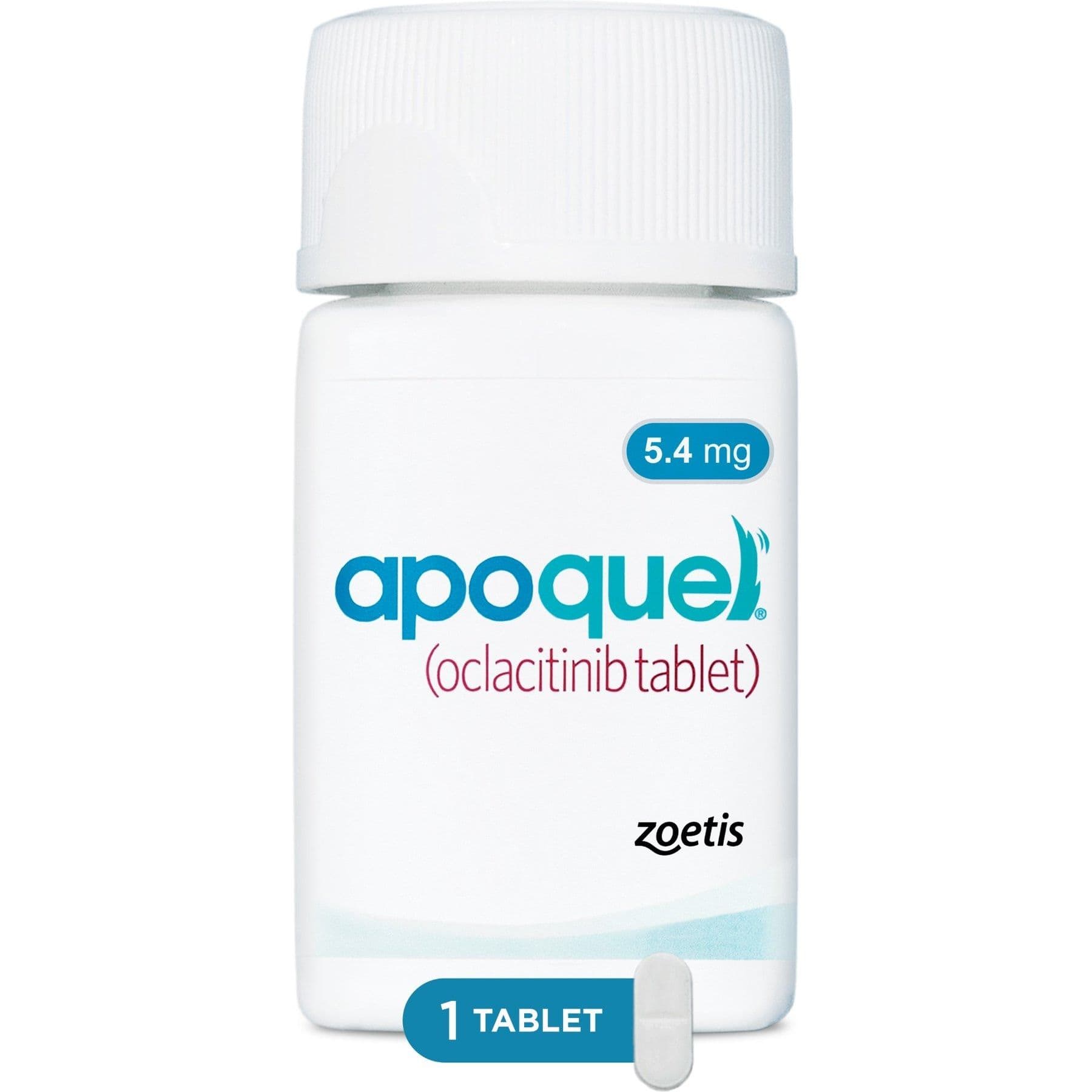
Apoquel (oclacitinib) Tablets, 5.4 mg: prescription itch control that works within about a day; Chewy's pharmacy fills it with a script.
Webvet may earn a commission when you click through to Chewy, at no extra cost to you.
The age it starts is one point where the sources differ: Merck puts onset between 6 months and 3 years, while VCA says symptoms typically begin between 2 and 6 years. Either way, the itch usually arrives in young adulthood.
It is worth reading why your dog is so itchy before assuming allergy, because Merck names fleas, food, and secondary yeast, bacterial, and ear infections as the things that set off a flare in an otherwise controlled dog.
Where each drug class breaks the cycle
Each class of dog allergy medicine interrupts that cycle at a different point:
- Antihistamines (diphenhydramine, cetirizine, hydroxyzine, chlorpheniramine) block the H1 receptor that histamine acts on. Merck notes they relieve histamine-driven itching but have very little effect on an acute flare.
- Oclacitinib (Apoquel) blocks the JAK1 and JAK3 enzymes that carry the IL-31 itch signal. VCA reports it is as effective as corticosteroids in many patients with fewer side effects, and its label states it is neither a steroid nor an antihistamine.
- Lokivetmab (Cytopoint) is an injected antibody that, in VCA's words, inactivates the inflammatory protein that causes itchiness. It is used only in dogs.
- Cyclosporine (Atopica) suppresses the T cells and interleukin-2 behind the immune overreaction, per its FDA label.
- Corticosteroids (prednisone, prednisolone) shut down inflammation broadly and fast, with the longest side-effect list.
What can I give my dog for their allergies?
For a dog that is already scratching, VCA lists corticosteroids such as prednisone and cyclosporine (Atopica) as the drugs that often bring relief, and says antihistamines are tried but appear relatively ineffective once the itching is established.
In practice that means a vet-approved antihistamine for mild seasonal itch, Apoquel, Zenrelia, or Cytopoint for anything moderate or year-round, and treatment of any skin or ear infection alongside. VCA's bottom line is that there is no single best treatment: treatment manages the disease, it does not cure it.
Which allergy medicine is best for your dog: a vet's decision guide
Can dogs take allergy medicine? Yes, and the better question is which one. Merck separates atopic dogs into three patterns: signs that are seasonal, signs that are nonseasonal, and year-round disease with seasonal flares.
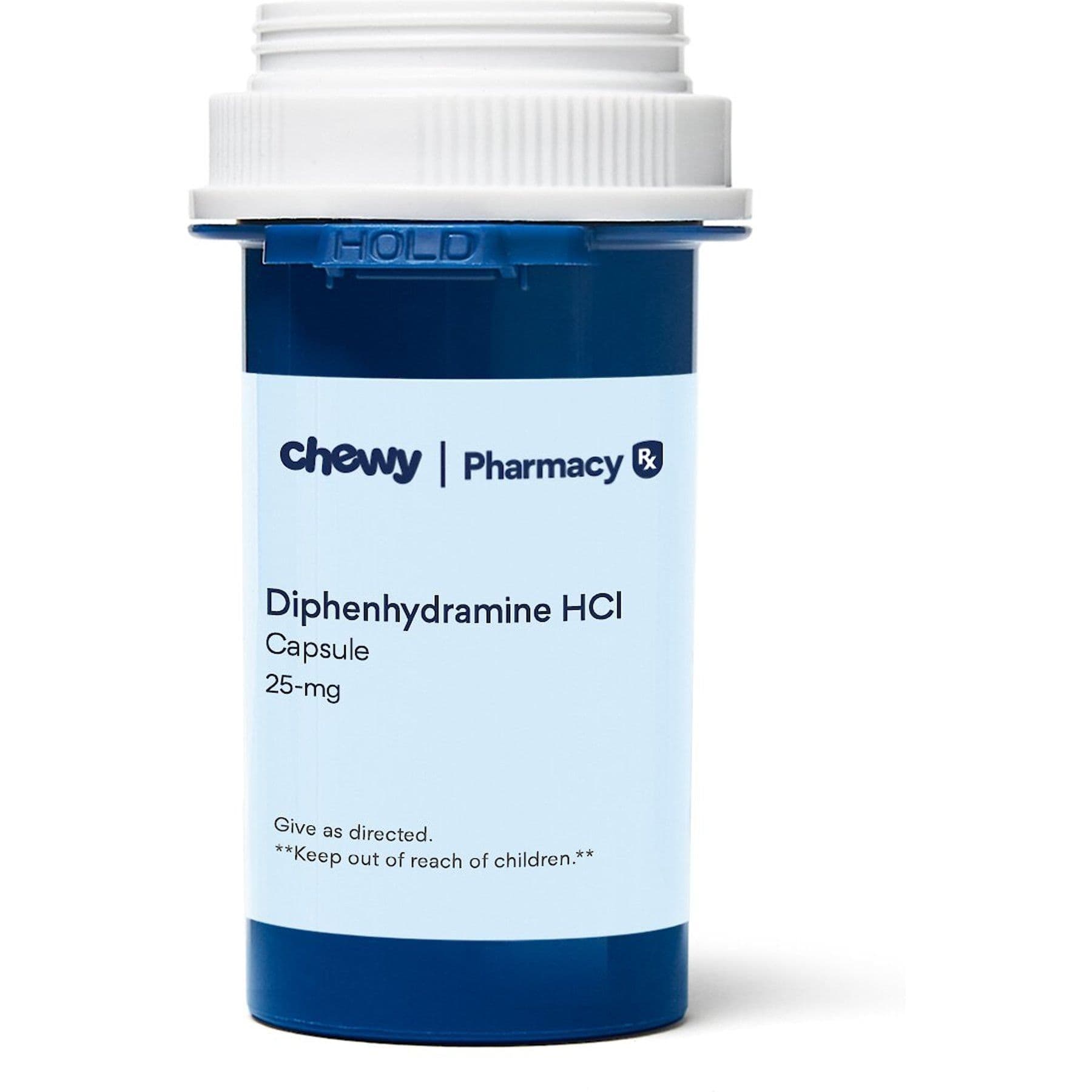
Diphenhydramine HCl Capsules, 25 mg: the generic form of Benadryl, an antihistamine vets use off label for mild allergic itch.
Webvet may earn a commission when you click through to Chewy, at no extra cost to you.
That pattern, plus how raw the skin is and whether it is infected, decides the drug class before any brand name comes up, and it is what the monthly cost follows from.
| The dog in front of you | Usual medicine class | Onset | Prescription needed? | Monthly cost (what it works out to) |
|---|---|---|---|---|
| Mild seasonal itch, skin intact | Single-ingredient antihistamine your vet selects, plus bathing and a fish oil add-on | 1 to 2 hours per dose (VCA); works best given regularly before exposure (VCA) | No for diphenhydramine, cetirizine, loratadine, fexofenadine, chlorpheniramine; yes for hydroxyzine | About $4.20 if your vet sets a 22 lb dog on one 25 mg diphenhydramine capsule twice daily: 60 capsules at about 7 cents each (Chewy listed 120 at $8.40 in October 2026) |
| Moderate flare, a few weeks a year | Oclacitinib (Apoquel) or ilunocitinib (Zenrelia) tablets, or a Cytopoint injection | Hours to about a day for Apoquel (AAHA, Merck); 1 to 3 days for Cytopoint (Merck) | Yes | About $95 at once-daily maintenance for a 20 to 29.9 lb dog on one 5.4 mg Apoquel tablet: 30 tablets at about $3.16 each (Chewy listed 60 at $189.72 in October 2026); Cytopoint is a clinic fee per injection every 4 to 8 weeks, no published figure |
| Year-round atopic disease | Apoquel or Zenrelia daily, Cytopoint every 4 to 8 weeks, or cyclosporine (Atopica) for long-term control, with immunotherapy considered | Weeks for Atopica (AAHA); months to a year for immunotherapy | Yes | $91.30 for the first 30 days for an 11 lb dog on one 25 mg Atopica capsule daily at the label's 5 mg/kg start (Chewy listed 30 at $91.30 in October 2026), then the label taper lowers it; immunotherapy is clinic and lab priced, no published figure |
| Severe acute flare, raw skin | Short prednisone or prednisolone course with a taper | Rapid (AAHA) | Yes | Clinic priced; no published figure |
| Secondary skin or ear infection on top of allergy | Antibiotic, antifungal, or ear treatment at the same time as itch control | Treated alongside the itch, not after it (AAHA) | Yes | Depends on the infection; no published figure |
For the mild seasonal itch dog with intact skin, the usual plan has three parts:
- a single-ingredient antihistamine your veterinarian picks from the AAHA list (diphenhydramine, cetirizine, hydroxyzine, chlorpheniramine, loratadine, or fexofenadine)
- weekly bathing to wash allergen off the coat
- a fish oil as an add-on
Its monthly cost is the lowest of any class, and the trade is modest, gradual relief rather than a switch being flipped.
Where the sources disagree on how well that class works, the honest answer is both. The AAHA 2023 allergic skin disease guidelines rate antihistamines as having uncommon side effects but questionable efficacy.
Merck says they have very little effect on acute flares yet can help control chronic disease alongside other treatment, and its table calls fexofenadine helpful for mild pruritus, best as part of combination therapy, and useful for sparing steroids.

When the itch is moderate or year-round
For a moderate flare or year-round atopic dermatitis, the prescription drugs are the answer, and speed is what separates them. AAHA's onset figures:
- oclacitinib (Apoquel): hours
- lokivetmab (Cytopoint): hours to 3 days
- corticosteroids: rapid, with common side effects
- cyclosporine (Atopica): slow, in weeks, with common side effects and the need for periodic liver enzyme and blood count monitoring
Merck notes oclacitinib and ilunocitinib are licensed only for dogs over 12 months. Some dogs are not candidates for the first-line tablet at all. VCA says oclacitinib should not be used in dogs with:
- current or recent demodectic mange
- a serious infection such as pneumonia
- cancer, or a history of cancer
- a pregnancy, a litter to nurse, or breeding plans
- fewer than 12 months of age
For those dogs the conversation moves to Cytopoint, which AAHA calls safe in puppies and dogs with other illness, or to a short steroid course. Choosing between the two fastest options is its own decision, covered in our Apoquel vs Cytopoint comparison.
A few products sold as allergy medicine are not itch control at all. Shampoos and wipes are about washing allergen off the coat, which Merck says bathing does well; allergy chews are supplements, not medicine. None of them turns off the itch signal.
What is the best anti-itch medicine for dogs?
The fastest is oclacitinib (Apoquel), with an onset AAHA measures in hours, and VCA calls it as effective as corticosteroids in many patients with fewer side effects.
But AAHA's diagnostic pathway makes a point owners miss: secondary bacterial and yeast infections and ear infections must be treated at the same time as the itch, and the dog should be on flea and tick prevention, or the itch medicine will look like it failed.
 Sponsored
Vet care that's always there
Unlimited video calls and messaging with licensed vets for less than a typical vet visit. One membership covers up to five pets.
Use code Pets60
Plans start at $12/month · covers up to 5 pets
- Licensed vets in most states
- Rx for 150+ conditions
- 4.7 on Trustpilot
Over-the-counter allergy medicine for dogs: antihistamines, supplements, and topicals
Over-the-counter allergy medicine for dogs means, in practice, a handful of human antihistamines that veterinarians use off label, plus supplements and shampoos. The ones vets consider safe are the single-ingredient drugs on the AAHA list:
- diphenhydramine (Benadryl), sold without a vet prescription in its human-label form
- cetirizine (Zyrtec), the same
- loratadine (Claritin), the same, and never the "-D" version
- fexofenadine, the same
- chlorpheniramine, the same, as a product containing only chlorpheniramine (VCA)
- hydroxyzine, the prescription-only member of the list
The veterinary-channel generics, including the diphenhydramine capsules Chewy sells, go through its pharmacy with a veterinary prescription. Either way the dose you give comes from your veterinarian, because VCA notes off-label directions can differ sharply from the human label.
Whether they work is where the sources hedge. AAHA flags oral diphenhydramine as questionable efficacy, and Merck says antihistamines have very little effect on an acute flare. The strongest controlled evidence is a randomized crossover study of 12 healthy beagles in Veterinary Dermatology.
In that study oral cetirizine significantly reduced histamine-induced skin wheals and late-phase reactions, while diphenhydramine showed no significant difference, even though both reached blood levels considered therapeutic in people. Diphenhydramine is still the antihistamine most people know as Benadryl; VCA says it takes effect in about 1 to 2 hours, with side effects of:
- lethargy
- dry mouth
- urinary retention
- vomiting or diarrhea
- lack of appetite
VCA also lists conditions where it must be used with caution:
- glaucoma
- prostate enlargement
- intestinal or bladder obstruction
- COPD
How much Benadryl a given dog can have is a question for the Benadryl for dogs monograph and your vet, because Merck's reference range and AAHA's do not match.
VCA says cetirizine (Zyrtec) is used off label for itching from atopic dermatitis, hives, and insect bite reactions, takes effect in one to two hours, and needs no specific monitoring. How much Zyrtec a dog can have varies between Merck's tables and AAHA's, so use the Zyrtec for dogs page and your vet.
Two comparisons come up constantly:
- Benadryl or Zyrtec, and which antihistamine is safest overall. Our antihistamines for dogs guide answers both; the short version is that the beagle study favored cetirizine.
- Zyrtec or Claritin. The risk is the "-D" version, since Merck warns loratadine is often combined with pseudoephedrine; we compare them in over the counter allergy medicine for dogs.

Hydroxyzine rounds out the oral list. VCA says it works best given regularly before allergen exposure, as a single-ingredient product only, and must stop two weeks before intradermal allergy testing; our hydroxyzine for dogs page covers it in full.
Topicals do a different job. Merck recommends weekly to biweekly baths because bathing lowers the allergen load and is often the most effective form of allergen avoidance. For a single hot spot, Merck lists topical steroids (triamcinolone 0.015 percent) as a veterinary choice for acute, localized lesions, best kept to 7 to 14 days.
A medicated wash such as Vet's Best Allergy Itch Relief Shampoo for Dogs, 16-fl oz bottle, with oatmeal, d-limonene, and tea tree oil, is sold for exactly that job, washing allergens away, and Pet Poison Helpline considers shampoos under 1 to 2 percent tea tree oil non-toxic when used as labeled. Supplements are the rest:
- Fish oil (EPA and DHA). Merck says essential fatty acids can take up to 2 months to work, so they do nothing for a flare, but several studies show they both improve the effect and reduce the needed dose of steroids, cyclosporine, or oclacitinib. A product such as Nutramax Welactin Omega-3 Fish Oil Liquid Softgels Skin & Coat Supplement for Dogs, 360 count is that class; its label gives one softgel per 20 lb daily or as directed by a veterinarian, and Merck adds that no particular formulation has proven superior.
- Allergy chews. Zesty Paws Allergy & Immune Bites, for example, are built on bovine colostrum and a yeast fermentate and sold for seasonal allergy and immune support, but neither Merck nor AAHA lists colostrum or yeast fermentate among itch treatments.
The practical order is a fish oil as the add-on with evidence behind it, and chews only on top of that, never instead of the plan your vet set.

Zesty Paws Allergy & Immune Bites: peanut butter soft chews marketed for seasonal allergy and immune support in dogs.
Webvet may earn a commission when you click through to Chewy, at no extra cost to you.
Prescription allergy medicine for dogs: Apoquel, Cytopoint, Zenrelia, Atopica, and steroids
Every drug in this group is prescription-only in the strict sense: the Apoquel label states federal law restricts it to use by or on the order of a licensed veterinarian. Chewy fills Apoquel, Atopica, and the other prescription items through its pharmacy with that prescription in hand.
Apoquel (oclacitinib) is licensed, per its FDA label, to control itching from allergic and atopic dermatitis in dogs from 12 months old, in 3.6, 5.4, and 16 mg tablets; Chewy sells the middle strength as Apoquel (oclacitinib) TABLETS for Dogs, 5.4-mg, 60 tablets. The label dose is 0.4 to 0.6 mg/kg twice daily for up to 14 days, then once daily.
Merck gives onset within 24 hours; VCA says one to two days, and our Apoquel for dogs monograph has the full picture. In the label's field study of 283 dogs, the most common adverse events were:
- pyoderma (12 percent)
- unspecified skin lumps (12 percent)
- ear infection (9.9 percent)
- vomiting (9.2 percent)
- diarrhea (6 percent)
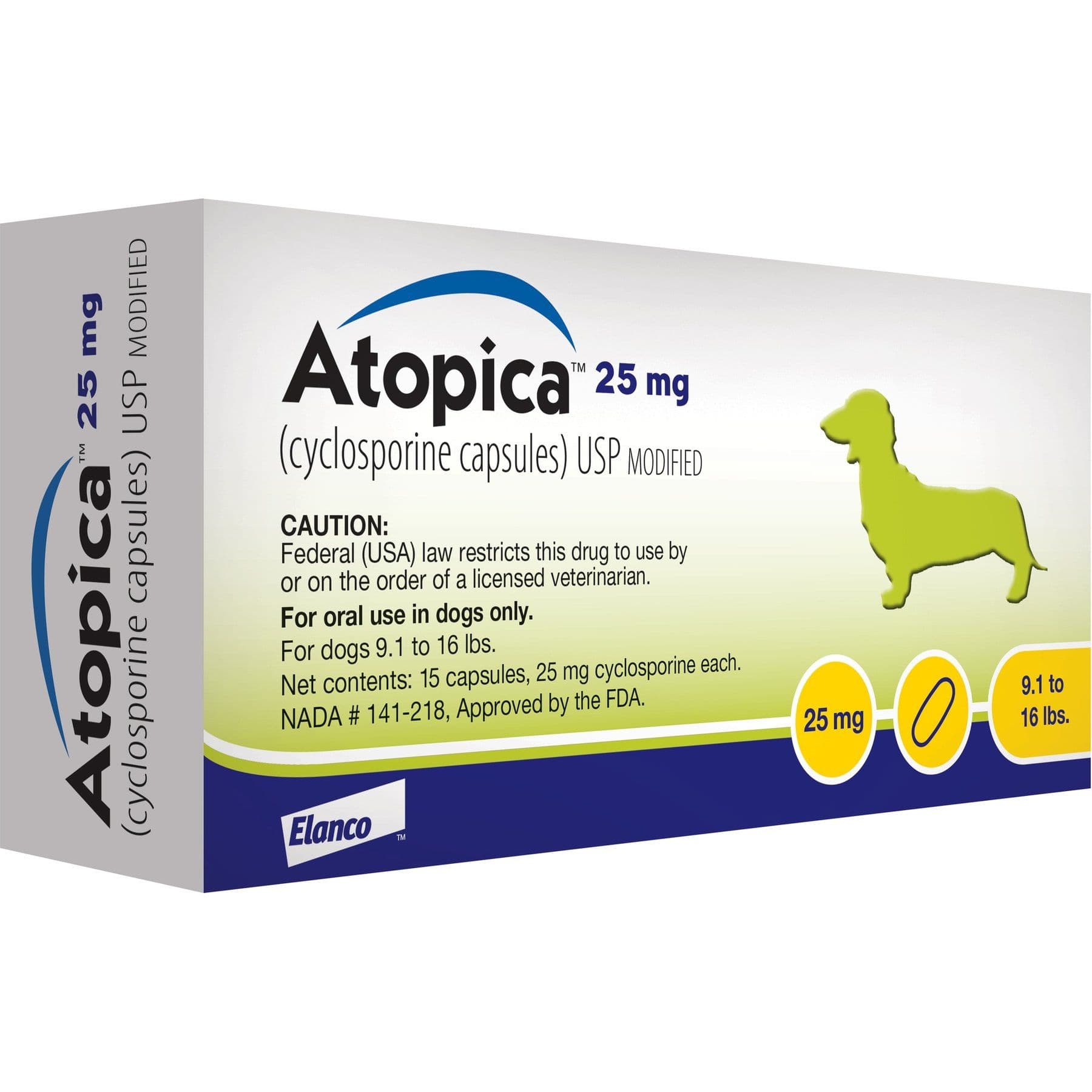
Atopica (cyclosporine modified) Capsules, 25 mg: the prescription option for long-term atopic dermatitis control, via Chewy's pharmacy.
Webvet may earn a commission when you click through to Chewy, at no extra cost to you.
Cytopoint (lokivetmab) is the injectable option, and the one drug here with no take-home bottle: VCA says it is given under the skin, usually at the veterinary clinic. The figures the sources give:
- dose: 2 mg/kg every 4 to 8 weeks (Merck)
- onset: 1 to 3 days (Merck); Zoetis says it starts controlling itch within a day
- duration: 4 to 8 weeks (Zoetis), so a dog is back at the clinic every month or two for the next shot
- most common adverse effects: lethargy and vomiting (Merck)
AAHA calls it safe in puppies and in dogs with cancer, infection, or systemic disease, and notes it does not interfere with allergy testing.

Immunotherapy injections are a different thing, built from allergy test results and measured in months. Details on the Cytopoint injection are on our Cytopoint for dogs page.
Zenrelia (ilunocitinib) is the newer JAK tablet, similar to Apoquel in how it works; Merck groups the two together as JAK inhibitors. Its FDA label sets out:
- the same indications, in dogs at least 12 months old
- 0.6 to 0.8 mg/kg once daily, with or without food
- scored tablets of 4.8, 6.4, 8.5, and 15 mg
- a boxed warning: dogs on Zenrelia are at risk of an inadequate immune response to vaccines, so the drug is stopped at least 28 days to 3 months before vaccination and withheld for at least 28 days after
That boxed warning is what sets its side effects apart. AAHA reported in 2025 that FDA removed the earlier warning about potentially fatal vaccine-induced disease; the vaccination warnings remain. VCA says not to combine it with cyclosporine or prednisone, and the FDA notes a veterinarian must monitor for infections and other side effects.
Steroids are the fastest option for a severe flare. Merck gives prednisone or prednisolone at an initial 0.5 to 1.1 mg/kg once daily with a taper, targeting 0.25 to 0.5 mg/kg every 48 hours, and is blunt that long-term use carries high risk; our prednisone for dogs and cats page covers the taper.
Atopica (cyclosporine modified) is the long-game capsule; the 25 mg strength is sold on Chewy as Atopica (Cyclosporine Modified) Capsules for Dogs, 25-mg, 30 capsules. Its FDA label sets out:
- a start of 5 mg/kg once daily (a range of 3.3 to 6.7 mg/kg) for 30 days
- a taper after that, at the veterinarian's call, to every other day or twice weekly, down to the least frequent dose that holds the result
- soft gelatin capsules of 10, 25, 50, and 100 mg
Merck's table says it can take 4 to 6 weeks to show clinical improvement and is not suited to acute flares, which makes it a year-round-disease drug rather than a flare drug.
What is the difference between Temaril-P and Apoquel?
Temaril-P is a combination tablet: per its label, each tablet contains 5 mg of trimeprazine, an antihistamine-type phenothiazine, and 2 mg of prednisolone, a corticosteroid, dosed by weight band twice daily, then halved after 4 days.
Apoquel contains oclacitinib alone, which its label states is neither a corticosteroid nor an antihistamine. So Temaril-P brings a low-dose steroid with every tablet, and Apoquel does not.
Dosing, side effects, and drugs that are never safe for dogs
Can you give a dog allergy medicine you already own? Only a single-ingredient antihistamine, and only at a dose your veterinarian sets for that dog's weight. There is no published over-the-counter dose an owner can use without a veterinarian: the numbers that exist are reference ranges for prescribers, and they differ between references.
Those dosing boundaries set by a veterinarian start from these ranges:
- Diphenhydramine: AAHA lists 2 to 3 mg/kg every 12 hours; Merck's integumentary table lists 2 to 4 mg/kg every 8 to 12 hours as needed.
- Cetirizine: AAHA lists 1 to 2 mg/kg every 24 hours; Merck lists 1 mg/kg or 10 to 20 mg per dog every 12 to 24 hours in one table and 0.5 to 1 mg/kg every 12 hours in another.
- Hydroxyzine: AAHA and Merck's atopic dermatitis table list 2 mg/kg every 12 hours; Merck's integumentary table lists 0.5 to 2 mg/kg every 6 to 8 hours.
- Chlorpheniramine: AAHA lists 0.4 mg/kg every 12 hours.
- Loratadine: AAHA lists 1 mg/kg every 12 hours; Merck's toxicology table lists 0.25 to 1.1 mg/kg every 24 hours.
- Fexofenadine: AAHA lists 5 to 15 mg/kg every 24 hours; Merck lists 18 mg/kg every 24 hours in one table and 2 to 5 mg/kg every 12 to 24 hours in another.
The spread in those numbers is the lesson: how much a dog gets, and how often, is a prescribing decision.
Can I give my dog a generic or store-brand version? If it is the same single molecule at the dose your vet set, yes: Chewy's listing notes generic diphenhydramine is the drug commonly known as Benadryl, so generic versus brand changes only the price.
Merck's toxicology page explains why the human aisle is the problem: antihistamines are routinely combined with decongestants and with painkillers such as acetaminophen or NSAIDs in cold, sinus, and allergy products, and the dangerous combination products sit on the shelf beside the safe single-ingredient ones.
VCA is explicit that the cetirizine-plus-pseudoephedrine product must not be used in dogs or cats, and that liquid chlorpheniramine must be checked for xylitol.
Side effects track the drug class:
- Antihistamines. AAHA calls their side effects uncommon; VCA's diphenhydramine list runs to lethargy and stomach upset.
- Apoquel. The label lists pyoderma, skin lumps, ear infection, vomiting, and diarrhea, and Merck adds that acute kidney injury is possible at toxic doses of oclacitinib (27.3 mg/kg, far above the label).
- Atopica. AAHA notes cyclosporine commonly causes gastrointestinal signs, excess hair growth, gum overgrowth, and warty skin growths, and needs periodic liver enzyme and blood cell monitoring; the label rules it out for dogs with a history of cancer.
- Steroids. VCA lists increased thirst, urination, and appetite, and, with higher doses or long use, vomiting, diarrhea, behavior change, and panting.
How long and how often also have a boundary. Merck says therapy usually runs until signs resolve, that many dogs need long-term treatment, and that medication should then be tapered to the lowest dose and frequency that holds remission. That taper is a vet's job, and so is the cost conversation.
Allergy testing, immunotherapy, and when medicine alone is not enough
Dog allergy testing does not tell you whether your dog has allergies. AAHA is direct: atopy is a diagnosis of exclusion, and allergy testing, intradermal or serum, does not diagnose it and should only be performed if immunotherapy is planned.
Merck says the same from the other side: the main reason to test is to identify allergens and formulate allergen-specific immunotherapy, because a positive result reflects exposure, not disease.

AAHA and Merck describe two tests, both ordered and read by a veterinarian; our dog allergy testing guide walks through each:
- intradermal skin testing
- serum IgE testing
Testing with immunotherapy is the one path that changes the disease itself: AAHA calls it the only management strategy that induces change in the immune response, with onset of months to a year. For the oral, under-the-tongue version, Merck says not to expect much for 6 months and to commit to a full year.
Merck cites a 2022 study of 664 dogs on injection immunotherapy: about 60 percent treated for at least 9 months had over a 50 percent drop in itching, and about half of those still needed other medication. VCA says about half of treated dogs itch significantly less, often after 3 to 12 months. Timing matters:
- VCA says diphenhydramine and cetirizine can alter intradermal results and should be stopped at least two weeks before testing; hydroxyzine, the same.
- VCA says prednisone should not be used in a dog due for allergy testing within the next month unless the vet advises otherwise.
- AAHA notes oclacitinib, lokivetmab, and cyclosporine do not interfere with intradermal testing or immunotherapy, so a dog can stay comfortable while the workup runs.
Food belongs in the workup too, through an elimination diet rather than a test. AAHA runs diet trials for 4 to 12 weeks with a food challenge to confirm, while VCA's food allergy page says 8 to 12 weeks with no other foods, treats, or supplements; your vet will set the length.
When does medicine alone stop being enough? AAHA tells veterinarians that working out the best long-term plan can take 2 to 4 months, that management is for the pet's life, and that flares are not uncommon even in a well-managed dog; it also says to offer referral and let the owner decide.
VCA adds that signs of atopy tend to worsen with age, though quality of life is usually good with care. If your dog is still raw after a fair trial of a prescription, or needs steroids every season, ask for a referral to a veterinary dermatologist, who runs the testing and immunotherapy.
What dog allergy medicine costs and how to lower the bill
No published figure exists for what dog allergy medicine costs per month: not from AAHA, Merck, VCA, the FDA, or the manufacturers. AAHA simply tells veterinarians to be clear about costs. What we can show is the arithmetic from Chewy's listed prices in October 2026, which you can rerun for your own dog's weight:
- Diphenhydramine HCl (Generic) Capsules, 25-mg, 120 capsules, listed at $8.40 on Chewy when we checked in October 2026, about 7 cents a capsule. If the vet sets a 22 lb dog on one capsule twice daily, 60 capsules a month works out to about $4.20.
- Apoquel 5.4 mg, 60 tablets, listed at $189.72 on Chewy when we checked in October 2026, about $3.16 a tablet. A 20 to 29.9 lb dog takes one tablet per dose under the label, so once-daily maintenance works out to about $95 a month, with the first 14 twice-daily days costing more.
- Atopica 25 mg, 30 capsules, listed at $91.30 on Chewy when we checked in October 2026, about $3.04 a capsule. One capsule a day covers an 11 lb dog at the label's 5 mg/kg start, so the first 30 days work out to $91.30 before the taper.
- Cytopoint is clinic-administered, so its cost is a clinic fee per injection every 4 to 8 weeks, and the same goes for immunotherapy and steroid courses. No published figure exists for any of them.
The cheapest plan, then, depends on which dog you have: the mild seasonal dog on an antihistamine spends a few dollars a month, and the year-round atopic dog on a prescription spends on the order of a hundred.
Four things the sources say genuinely lower the bill over time:
- Taper. Merck says long-term medication should be tapered to the lowest dose and frequency that holds remission; the Atopica label builds that in, dropping to every other day or twice weekly after the first 30 days.
- Add a fatty acid. Merck cites studies showing fish oil reduces the required dose of steroids, cyclosporine, or oclacitinib.
- Bathe. Merck calls weekly to biweekly bathing often the most effective way to cut allergen exposure, which costs a bottle of shampoo.
- Say so. AAHA tells veterinarians that altering the plan to fit an owner's budget does not mean substandard care, so a cheaper plan is a legitimate thing to ask your vet for.
Dog allergy medicine questions
Frequently Asked Questions
Can you give a dog human allergy medicine?
Only a single-ingredient antihistamine, and only at the dose your veterinarian sets, because VCA notes off-label doses can differ sharply from the human label. Skip anything with a decongestant (pseudoephedrine or phenylephrine, the "-D" products), which Pet Poison Helpline says can cause dangerous high blood pressure and stroke, and check liquids for xylitol.
How long does dog allergy medicine take to work?
Antihistamines such as diphenhydramine and cetirizine take effect within one to two hours, per VCA, though AAHA rates their benefit as questionable. Apoquel works within hours to about a day (AAHA, Merck), Cytopoint within 1 to 3 days (Merck), Atopica over several weeks (AAHA), and immunotherapy over months, often 3 to 12 per VCA.
Can a dog take allergy medicine every day?
Many atopic dogs need long-term treatment, per Merck and VCA, and daily dosing is how Apoquel, Zenrelia, and Atopica are labeled. The condition is that a veterinarian tapers to the lowest effective dose and keeps up monitoring: VCA recommends periodic bloodwork on oclacitinib long-term, and AAHA says cyclosporine needs liver and blood count checks.
What is the strongest allergy medicine for dogs?
Prescription steroids such as prednisone are the fastest and broadest, but AAHA and Merck note common side effects and a high long-term risk. VCA says oclacitinib (Apoquel) is as effective as corticosteroids in many patients with fewer side effects, the usual argument for choosing it over steroids for anything beyond a short, severe flare.
Does my dog need allergy testing before medicine?
No. AAHA says allergy testing does not diagnose atopy and should only be performed if immunotherapy is planned, so a dog can start itch medicine first. Testing comes in when you and your veterinarian, or a veterinary dermatologist, decide to pursue immunotherapy, and some antihistamines and steroids have to be stopped for weeks beforehand.
Veterinarian · BVMS MRCVS
Dr. Pippa Elliott, BVMS, MRCVS, is a veterinarian with nearly 30 years of experience in companion animal practice. Dr. Elliott earned her Bachelor of Veterinary Medicine and Surgery from the University of Glasgow. She was also designated a Member of the Royal College of Veterinary Surgeons. Married with 2 grown-up kids, Dr. Elliott has a naughty Puggle named Poggle, 3 cats and a bearded dragon.
Related reading

Apoquel vs Cytopoint: How a Vet Chooses Between Them for an Itchy Dog

Over the Counter Allergy Medicine for Dogs: What Is Safe, What Helps, and What to Skip

Antihistamines for Dogs: Which Ones Vets Use, Typical Doses, and When They Are Not Enough
