Apoquel vs Cytopoint: How a Vet Chooses Between Them for an Itchy Dog
A veterinarian compares Apoquel and Cytopoint head to head: how each one switches off allergic itch, how fast they work and how long they last, the side effects and safety limits, what a month of each costs, and when a dog gets both.

BVMS MRCVS
Medically reviewed by Dr. Pippa Elliott, BVMS MRCVS · Last reviewed

This article contains affiliate links. Webvet may earn a commission when you buy through them, at no extra cost to you.
Apoquel vs Cytopoint at a glance: which is safer and which fits your dog
When a clinic offers both, the Apoquel vs Cytopoint choice rests on a few label facts. Apoquel is a daily tablet that blocks itch signalling inside the cell. Cytopoint is an injection that neutralises the itch protein interleukin-31 for four to eight weeks and carries fewer drug restrictions. Both are priced by the dog's weight.

Neither drug wins in every dog. The Apoquel vs Cytopoint question is which one fits this dog, and your veterinarian makes that call with the full history in hand:
- its age;
- its infection and cancer history;
- whether it will take a pill;
- how often it can reach the clinic;
- what a month works out to.
- 1How each drug switches off itch: Apoquel (oclacitinib) blocks Janus kinase signalling inside cells, while Cytopoint (lokivetmab) is a monoclonal antibody that neutralises interleukin-31 in the bloodstream.
- 2Onset with duration compared: Apoquel starts within hours and wears off within a day, so it is given daily; one Cytopoint injection takes hours to three days to work and lasts four to eight weeks.
- 3Cytopoint is the safer fit for puppies and for dogs with an infection or cancer history; Apoquel is labelled only for dogs 12 months and older and is not for dogs with serious infection or neoplasia.
- 4A 45 to 60 lb dog on once-daily Apoquel works out to $189.72 a month at Chewy's October 2026 price; Cytopoint is priced by the clinic, per injection, by weight.
- 5The two can be used together under veterinary direction, and the final choice belongs to the vet who knows the dog.
The main difference between Cytopoint and Apoquel is where each is given. Apoquel is a prescription pet allergy medicine given at home, twice daily for up to 14 days and then once daily, per the Apoquel label. Cytopoint must be given at a veterinary clinic every four to eight weeks, per the AAHA 2023 guidelines.
Cetirizine is a different kind of drug from Apoquel, and the two are not interchangeable. Cetirizine is an antihistamine, and the Merck Veterinary Manual says antihistamines have very little efficacy for acute flares, although they can help alongside other treatments in chronic disease.
Apoquel and cetirizine can be given together: VCA Animal Hospitals says oclacitinib combines safely with antihistamines. Doses and limits are in our guide to antihistamines for dogs, and the full range of options sits in our dog allergy medicine overview.
| Label fact | Apoquel (oclacitinib) | Cytopoint (lokivetmab) |
|---|---|---|
| Form and how it works | Daily tablet or chewable given at home; blocks JAK1 and JAK3 itch and inflammation signalling inside cells | Injection under the skin at the clinic; monoclonal antibody that binds and neutralises interleukin-31 |
| Onset | Hours: Zoetis says as little as 4 hours, Merck says within 24 hours, AAHA says very rapid (hours) | Zoetis says within one day, Merck says 1 to 3 days, AAHA says variable (hours to 3 days) |
| Duration | Stops working within 24 hours (VCA), so it is given every day | 4 to 8 weeks per injection (Zoetis, Merck); half-life about 16 days |
| Minimum age | 12 months (FDA label) | No age restriction (Merck); the EU label excludes dogs under 3 kg |
| Cancer and infection caution | Not for deep skin or systemic infection, neoplasia, or a history of neoplasia (AAHA); may worsen infections and neoplastic conditions (label) | Listed as safe in dogs with neoplasia, infection, or systemic disease (AAHA); no reported drug interactions (Merck) |
| Handling at home | Wash hands after handling (label); VCA calls it a hazardous drug, advises gloves, and says pregnant or nursing people should not handle it | None; the vet gives it |
| Monthly cost | $189.72 for a 45 to 60 lb dog on once-daily maintenance, which is 60 tablets of 5.4 mg at Chewy's October 2026 price; heavier dogs use 16 mg tablets, priced separately | Set by the clinic per injection; vial count rises with weight and the interval runs 4 to 8 weeks; no published figure |
Both drugs do the same two jobs: Merck lists oclacitinib for acute flares and for control of chronic atopic dermatitis, and lokivetmab for acute flares and long-term management. Merck also calls canine atopic dermatitis a chronic disease needing lifelong management and regular progress checks, so whichever you start is likely a long relationship.
Apoquel is a prescription drug: its label restricts it to use by or on the order of a licensed veterinarian, and Chewy fills it through its pharmacy against your vet's prescription. It comes as a plain tablet and as a chewable. Weight-band dosing and the monitoring plan are in our guide to Apoquel for dogs.
Cytopoint has no take-home version. It is a Zoetis biologic given under the skin at the clinic, dosed by weight from 10, 20, 30 and 40 mg vials, and repeated every four to eight weeks as needed, per the Cytopoint package insert. Our Cytopoint for dogs guide walks through the injection visit itself.
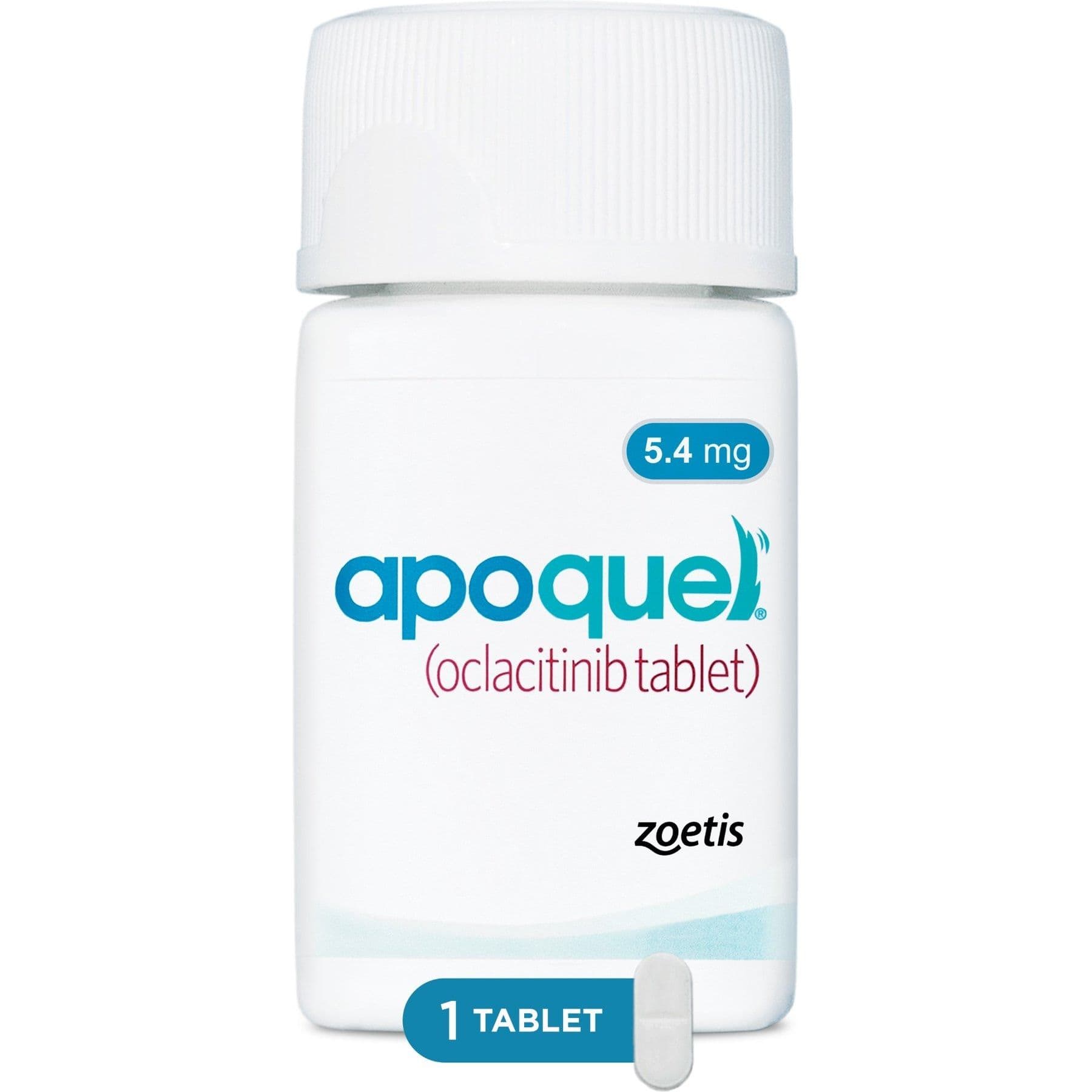
Apoquel (oclacitinib) Tablets for Dogs, 5.4 mg, 60 count: the prescription itch tablet, filled by Chewy's pharmacy with your vet's script.
Webvet may earn a commission when you click through to Chewy, at no extra cost to you.
Which is safer for dogs, Apoquel or Cytopoint?
On the published safety profiles, Cytopoint has the wider margin. The AAHA 2023 guidelines table lists lokivetmab as safe for puppies and for dogs with neoplasia, infection, or systemic disease, and lists oclacitinib as not for dogs under a year old or dogs with deep skin or systemic infection, neoplasia, or a history of neoplasia.
Merck adds that lokivetmab has no age restriction and no reported drug interactions. That is a safety-profile verdict, not a trial result: a Veterinary Evidence knowledge summary rated the evidence comparing the two drugs as insufficient and said further comparative study is required.
The one small trial that ran them side by side, Lee et al., found both reduced atopic itch by a similar degree over eight weeks, but only five of its 25 dogs were on lokivetmab. For a healthy adult dog with no infection or cancer history, both are reasonable. Call your vet before you:
- change or combine either drug;
- start Apoquel in a dog under 12 months;
- start Apoquel in a dog with a past tumour or a recent infection.

 Sponsored
Want a vet's take on your dog's skin or coat?
Talk to a licensed vet at Dutch over video, often the same day. They can recommend treatment and prescribe it when it's appropriate.
Use code Pets60
Plans start at $12/month · covers up to 5 pets
- Licensed vets in most states
- Rx for 150+ conditions
- 4.7 on Trustpilot
How Apoquel and Cytopoint stop itch, how fast they work, and how long they last
Both drugs quiet the itch of allergic skin disease; neither removes its cause. If the diagnosis is still open, start with the common causes of canine pruritus, because fleas, food, and secondary infections each need their own treatment. Once allergy is the working diagnosis, the mechanism of action is where the two drugs part ways.
Apoquel works inside the cell. The FDA-approved label says oclacitinib inhibits the itch-causing, pro-inflammatory, and allergy cytokines that depend on the Janus kinase enzymes JAK1 or JAK3, with little effect on the JAK2-dependent cytokines that make blood cells, and that it is neither a corticosteroid nor an antihistamine.
Cytopoint works outside the cell, on one protein. The package insert describes lokivetmab as a caninized monoclonal antibody against interleukin-31 that binds and neutralises soluble IL-31, inhibiting itch and reducing skin lesions, and it stays in circulation for several weeks. Zoetis calls it a protein rather than a chemical.
- Onset, Apoquel, per Zoetis: starts relieving itch in as little as 4 hours, a manufacturer claim from a flea-allergy model study.
- Onset, Apoquel, per Merck and AAHA: within 24 hours for itch control (Merck); very rapid, within hours (AAHA).
- Onset, Apoquel, label trial: after one week, 86.4 percent of treated dogs versus 42.5 percent of placebo dogs had a 2 cm reduction on the 10 cm owner-assessed itch scale.
- Onset, Cytopoint, per Zoetis: starts controlling allergic itch within one day.
- Onset, Cytopoint, per Merck and VCA: 1 to 3 days (Merck) or 1 to 2 days (VCA).
- Onset, Cytopoint, per AAHA: variable, hours to 3 days; a 2025 PMC review notes reduced itch as early as 8 hours in experimental models.
Duration is the mirror image, and it explains why one drug is daily and the other is every month or two:
- Apoquel half-life: the PMC review gives oclacitinib a plasma half-life of about 4 to 6 hours and roughly 89 percent oral bioavailability, which is why the label starts twice daily and then drops to once daily.
- Apoquel wear-off: VCA says the tablet should stop working within 24 hours, possibly longer in dogs with liver or kidney disease.
- Cytopoint half-life: lokivetmab has a half-life of 16 days, per a long-term use paper in Veterinary Research Communications, and field studies show 4 to 8 weeks of itch and lesion control after one injection.
- Cytopoint duration on the label: the 211-dog study showed a treatment effect for at least one month at 2.0 mg/kg, and VCA says the effect lasts at least 4 to 8 weeks, possibly longer with kidney or liver disease.

The dose is your vet's calculation, not yours. The label figures:
- Apoquel: 0.18 to 0.27 mg of oclacitinib per lb (0.4 to 0.6 mg/kg) by mouth, twice daily for up to 14 days and then once daily for maintenance, with or without food; Merck lists the same regimen.
- Cytopoint: a minimum of 0.9 mg/lb (2 mg/kg) under the skin, repeated every 4 to 8 weeks as needed; Merck's table matches it.
Merck lists oclacitinib as a tablet or a chewable tablet, and the chewable carries the same prescription requirement and the same safety information. Chewy's listing for the chewable says it was demonstrated to control allergic itch within 24 hours, which matches the within-24-hours onset in Merck's table.
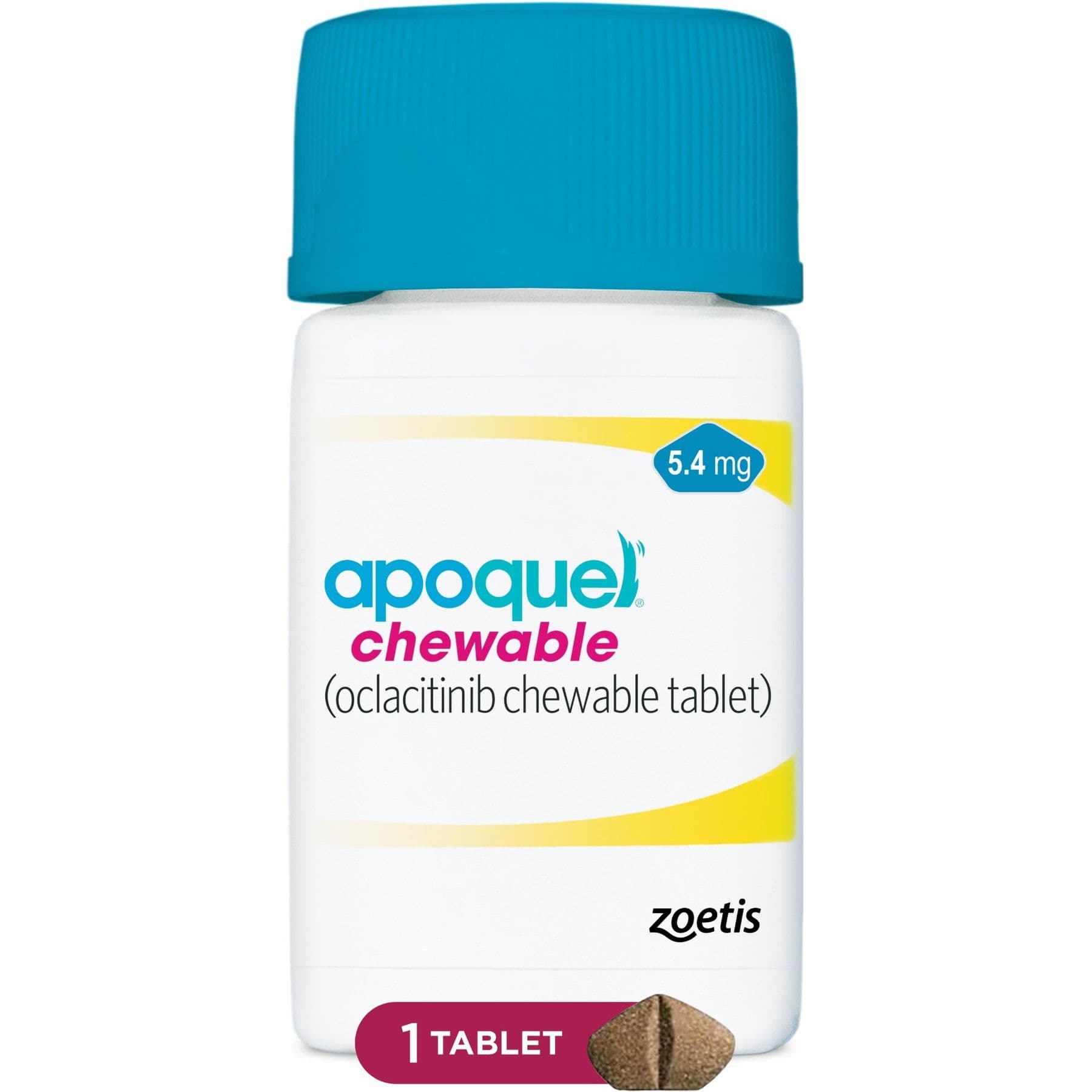
Apoquel Chewable for Dogs, 5.4 mg, 30 tablets: the chewable form of oclacitinib for dogs that refuse a plain tablet, prescription required.
Webvet may earn a commission when you click through to Chewy, at no extra cost to you.
The PMC review puts the logistics plainly: JAK inhibitors are daily oral tablets, while lokivetmab is a subcutaneous injection every 4 to 8 weeks. A Cytopoint injection suits a dog that cannot be pilled reliably or a household that travels; the tablet suits a dog whose dose needs adjusting week by week.
How long should a dog stay on Apoquel?
As long as the itch needs it and the monitoring stays clean. The Apoquel label's continuation study kept 239 dogs on the drug for a mean of 372 days (range 1 to 610 days).
A Zoetis-funded open-label study by Cosgrove et al. continued once-daily dosing in 247 dogs for up to 630 days, with 63.9 percent showing at least a 50 percent itch reduction on day 90.
Merck frames the goal: when long-term therapy is required, taper to the lowest dose and frequency that maintains remission. Since the disease is lifelong, the question is rarely whether to stop but how low the dose can go. Stopping, pausing for the off season, or switching to the injection are decisions for your vet.
The downside of Cytopoint and when the injection is the wrong choice
The Cytopoint drawbacks are mostly practical. The AAHA 2023 table lists two: it must be administered at a veterinary clinic, and its onset is variable, from hours to 3 days. For a dog in a raw, sleepless flare, a possible three-day wait is a real cost when the tablet works within hours.
The second drawback is that it can stop working. The package insert says Cytopoint may induce transient or persistent anti-drug antibodies; this is uncommon, and transient antibodies may have no effect, but persistent ones can reduce efficacy. The PMC review puts treatment-induced antibodies at 2.1 to 2.6 percent of dogs.

The same review offers a second reason for sudden loss of effect: itch driven by cytokines other than IL-31. Cytopoint neutralises one protein, so a dog whose itch runs on other pathways may never respond well, while Apoquel blocks several cytokine signals at once. The side effects on record:
- VCA Animal Hospitals lists sleepiness, vomiting, diarrhea, lack of appetite, pain at the injection site, and skin redness and ear infection occasionally seen in safety studies.
- Merck names lethargy and GI disturbances as the most common adverse effects of lokivetmab.
- The package insert reports rare post-approval events, in more than 1 but fewer than 10 of every 10,000 dogs treated: hypersensitivity reactions, vomiting or diarrhea, and neurological signs such as seizure or ataxia.
- The insert's 245-dog field safety study found no clinically relevant difference in adverse event rates between Cytopoint and placebo, and Zoetis cites that result as its safety claim.
Hypersensitivity is the one to know by sight. The package insert lists anaphylaxis, facial swelling, and hives among the rare reactions and says appropriate treatment should be given immediately. Facial swelling, hives, or collapse after an injection is an emergency: call the clinic or an emergency vet at once.
Long-term data are thinner than for Apoquel. A 12-month cohort of 75 atopic dogs injected every 4 to 8 weeks needed no rescue treatment, but 23 of them developed a skin infection that required treatment. The paper had no comparison arm, so it cannot say whether Apoquel would have done better or worse.
What is the downside of Cytopoint?
Its downside is practical rather than toxic. It must be given at the clinic every four to eight weeks, it can take up to three days to start working, and because it targets only interleukin-31 a small share of dogs never respond or stop responding once antibodies form. Rare hypersensitivity reactions round out the list.
Set against Apoquel's side effects, Cytopoint's list is shorter: Merck pairs lokivetmab with lethargy and GI upset, while it pairs the JAK inhibitors with GI upset plus infections, blood count changes, and liver enzyme elevations. The trade is convenience and speed, not safety.
One useful detail from the Veterinary Evidence summary: a dog's response to oclacitinib can predict how well it responds to lokivetmab, which gives your vet a way to test the water before committing to injections. The injection is usually the wrong first choice when:
- the dog is in a severe acute flare where hours matter, because AAHA puts the onset at anything from hours to 3 days;
- the dog responded to Cytopoint before and then lost the response, since the insert links that pattern to persistent anti-drug antibodies;
- the dog is allergic to it, the only hard exclusion on VCA's lokivetmab page, which also advises caution in pregnant or nursing dogs;
- the dog is pregnant, lactating, or used for breeding, because the insert says Cytopoint has not been tested in those animals;
- the dog weighs under 3 kg and you are in the EU, where the PMC review notes the product information excludes it (the US insert lists no weight limit);
- the household cannot keep a clinic appointment every four to eight weeks.
One more timing detail from VCA: if Cytopoint is given at a vaccination visit, it should be injected at a different site on the body from the vaccines.
 Sponsored
Vet care that's always there
Unlimited video calls and messaging with licensed vets for less than a typical vet visit. One membership covers up to five pets.
Use code Pets60
Plans start at $12/month · covers up to 5 pets
- Licensed vets in most states
- Rx for 150+ conditions
- 4.7 on Trustpilot
Apoquel safety: liver, infections, cancer history, age limits, and handling
The Apoquel safety limits by age and cancer history sit on the label. The FDA-approved label says Apoquel is not for dogs under 12 months, because a margin-of-safety study in 6-month-old dogs stopped at four months when the high-dose groups (three and five times the label dose) developed bacterial pneumonia and generalised demodex mange.
Infection is the second limit. The label says Apoquel may increase susceptibility to infection, including demodicosis, and may worsen neoplastic conditions, and it asks that treated dogs be monitored for both. VCA lists urinary tract, respiratory, and skin infections among those seen, and Merck calls the drug contraindicated in dogs with serious infections or neoplasia.
Ear infections deserve their own answer, because the question is usually whether Apoquel will fix them. It will not. Apoquel treats itch, not infection, and Merck lists secondary skin and ear infections with Staphylococcus and Malassezia yeast as common in atopic dogs. Its flare factors that must be treated in their own right:
- Malassezia dermatitis;
- superficial pyoderma;
- otitis externa.
So a dog with chronic ear infections needs the ear treated and the yeast or bacteria cleared, with Apoquel or Cytopoint controlling the itch.
A dog that keeps getting yeast infections on Apoquel needs its vet to ask whether the drug's effect on immunity is part of the pattern; the label lists dermatitis, pyoderma, and pododermatitis in dogs among post-approval reports.

Is Apoquel hard on a dog's liver?
Apoquel is not labelled as a liver toxin, but liver enzymes do appear in its adverse event lists:
- The label's post-approval reports include elevated liver enzymes alongside vomiting, lethargy, diarrhea, seizures, and demodicosis, with the caveat that frequency cannot be estimated from voluntary reports.
- Merck lists liver enzyme elevations, leukopenia, and lymphopenia among events associated with oclacitinib and ilunocitinib.
The reassuring data come from the long-term study by Cosgrove et al., where haematology and serum chemistry means stayed within normal reference ranges across up to 630 days of dosing. Merck adds that acute kidney injury is possible with toxic doses, citing 27.3 mg/kg, more than 45 times the top of the label range.
The practical rule is VCA's: periodic bloodwork for any dog on long-term oclacitinib, because a minority develop lowered white cell counts that make infection more likely. Cancer history is the limit that changes the choice outright, and the sources differ in how hard they draw the line:
- The label: new benign and malignant neoplastic conditions were observed in treated dogs during clinical studies and reported after approval; vets should consider risks and benefits before starting Apoquel in a dog with a history of neoplasia.
- VCA: stricter; do not use oclacitinib in pets with cancer or a history of cancer, because it may worsen some cancers.
- Merck: contraindicated in dogs with neoplasia.
Why can't I touch Apoquel?
You can handle it, but with care. The label says to wash hands immediately after handling the tablets and, if any gets in an eye, to flush with water or saline for at least 15 minutes and seek medical attention.
VCA classes oclacitinib as a hazardous drug: wear gloves, and do not handle it if you are pregnant or nursing. The Apoquel Chewable label adds a storage rule: keep it secured out of reach of dogs, cats, and other animals to prevent accidental ingestion or overdose.
Whether Cytopoint is safer than Apoquel is, on the evidence, a yes for the dogs the Apoquel label excludes:
- the AAHA table lists lokivetmab as safe in puppies and in dogs with neoplasia, infection, or systemic disease;
- the 2025 PMC review says lokivetmab appears preferable in dogs with impaired immunity, cancer, or active vaccination;
- the insert's 245-dog field study found no clinically relevant difference in adverse events from placebo.
For a healthy adult, the gap narrows to monitoring: Apoquel needs periodic bloodwork, while no source sets a bloodwork schedule for Cytopoint.
Two last label limits are easy to miss: Apoquel is not for breeding dogs or for pregnant or lactating bitches, and Cytopoint has not been tested in them, so a breeding animal needs a plan from your vet rather than an assumption.
What Apoquel and Cytopoint cost per month and over a year
The Apoquel price that matters is the price per tablet times the tablets per day for your dog's weight band. Apoquel (oclacitinib) TABLETS for Dogs, 5.4-mg, 60 tablets was listed at $189.72 on Chewy when we checked in October 2026, which divides to about $3.16 per tablet.
Apoquel (oclacitinib CHEWABLE tablet) CHEWABLE for Dogs, 5.4mg, 30 tablets was listed at $89.70 in the same check, about $2.99 per chewable, so the chewable was the cheapest Apoquel per dose we recorded. Both are filled through Chewy's pharmacy against a veterinary prescription, and neither label publishes a price.
Cost comparison against the alternatives uses the same arithmetic:
- Atopica (Cyclosporine Modified) Capsules for Dogs, 25 mg, 30 capsules, was listed at $91.30 on Chewy in October 2026, about $3.04 a capsule.
- The Atopica label starts at 5 mg/kg daily, so one capsule covers a 5 kg (11 lb) dog: $91.30 for 30 days, rising with weight.
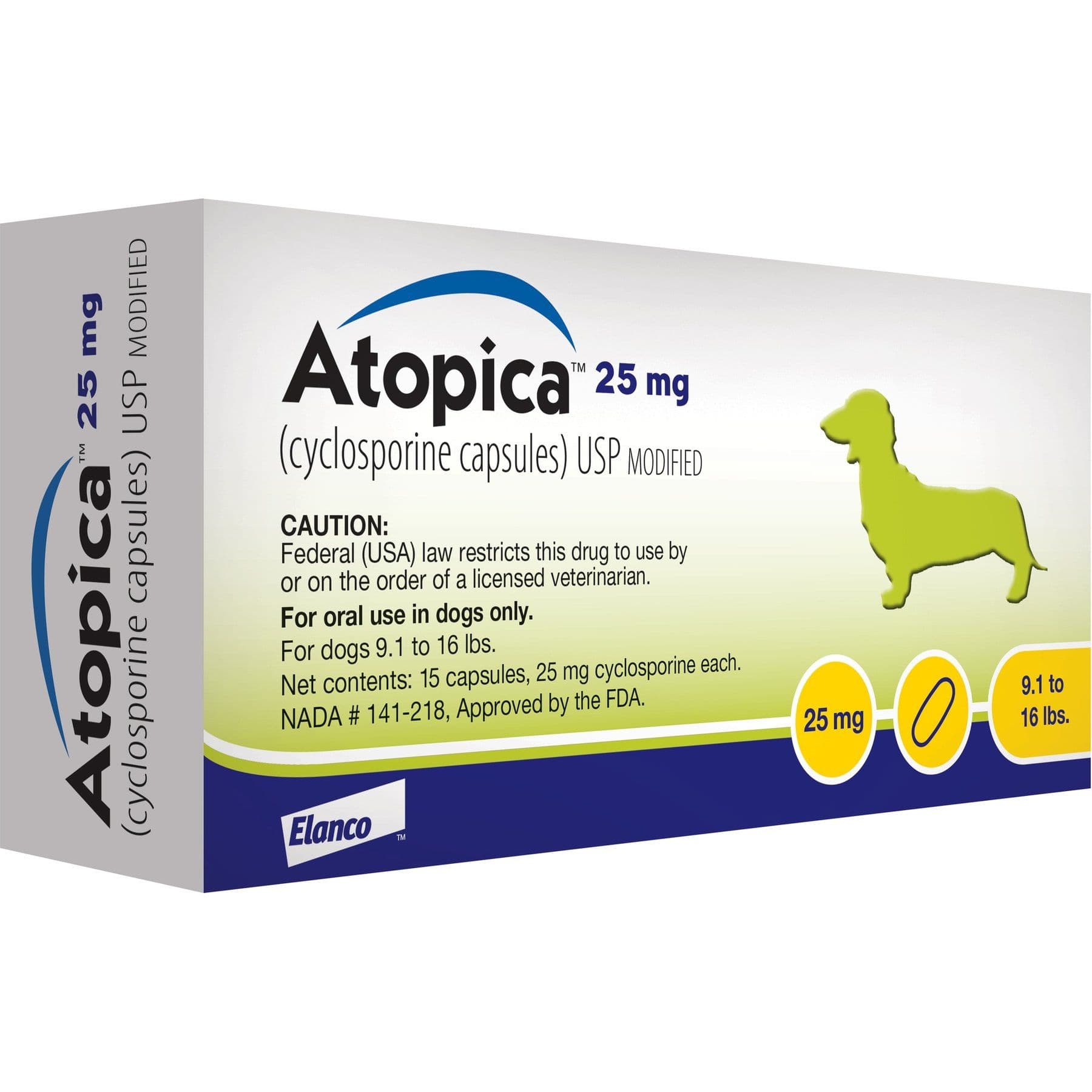
Atopica (cyclosporine modified) Capsules for Dogs, 25 mg: a prescription option for long-term atopic dermatitis control.
Webvet may earn a commission when you click through to Chewy, at no extra cost to you.
The monthly cost of each Apoquel strength comes from the label chart. For a 45 to 59.9 lb dog (20 to 26.9 kg) the chart assigns two 5.4 mg tablets per dose, so once-daily maintenance is two tablets a day, 60 tablets a month, and the month works out to $189.72 at that listed price.
The twice-daily first two weeks use four tablets a day, so month one costs more than a maintenance month.
| Dog weight band | Apoquel tablets per dose (label chart) | Cytopoint minimum dose per injection (label, 0.9 mg/lb) |
|---|---|---|
| 45 to 59.9 lb (20 to 26.9 kg) | 2 tablets of 5.4 mg | At least 41 to 54 mg; over 40 lb needs a combination of 10, 20, 30, or 40 mg vials |
| 60 to 89.9 lb (27 to 39.9 kg) | 1 tablet of 16 mg | At least 54 to 81 mg; combination of vials |
| 90 to 129.9 lb (40 to 54.9 kg) | 1.5 tablets of 16 mg | At least 81 to 117 mg; combination of vials |
| 130 to 175.9 lb (55 to 80 kg) | 2 tablets of 16 mg | At least 117 to 158 mg; combination of vials, rising to 5 vials at 190 to 200 lb |
Heavier dogs move to the 16 mg tablet, a separate Chewy listing with its own price. The lowest price for Apoquel comes from matching the strength to the weight band: the chart, not the per-tablet price, decides how many tablets a month the dog uses.
Over the counter allergy medicine for dogs costs far less per month, but Merck rates antihistamines as having very little efficacy for acute flares; our guide to over the counter allergy medicine for dogs sets out what they can and cannot do.

There is no Apoquel shot: Apoquel exists only as a tablet or chewable. The injection owners usually mean is Cytopoint, whose cost is set by the clinic because the AAHA table says it must be administered there, and the package insert shows why that price rises with weight:
- Cytopoint comes in 10, 20, 30, and 40 mg vials;
- a dog over 40 lb (18.1 kg) needs a combination of vials per dose;
- the chart runs to five vials for a 190 to 200 lb dog;
- no per-injection price is published by Zoetis or any primary source.
Which is cheaper, Apoquel or Cytopoint?
The monthly cost of each turns on the dog's weight and on how long each injection lasts for that dog, and no primary source publishes a Cytopoint price to settle it.
Apoquel's monthly cost is checkable arithmetic: for a 45 to 60 lb dog it is $189.72 at Chewy's October 2026 price, and it climbs with the tablet chart.
Cytopoint's cost is the clinic's per-injection fee, which rises with vial count by weight, divided by an interval of four to eight weeks that varies by dog. To compare them:
- ask your clinic for its price at your dog's weight;
- multiply by the injections it expects in a year;
- set that beside twelve months of the tablet arithmetic for the same weight band.
The interval matters as much as the fee. In the 75-dog cohort, 45 percent of dogs averaged four to five weeks between injections, 40 percent six to seven, and 15 percent seven to eight, so the same clinic price can mean anywhere from six to thirteen injections a year.
Using Apoquel and Cytopoint together, with steroids, or with Zenrelia and Atopica
Apoquel's generic name is oclacitinib, sold as oclacitinib maleate, and Cytopoint's is lokivetmab; both are Zoetis products. There is no generic Apoquel tablet for dogs in the United States: the DailyMed listing for oclacitinib shows only Apoquel and Apoquel Chewable under Zoetis, plus one bulk-powder entry that is not a finished dog medicine.
Apoquel layers with the everyday adjuncts. VCA says oclacitinib can be safely combined with:
- antihistamines, which covers a drug such as hydroxyzine for dogs when your vet wants one alongside it;
- NSAIDs;
- anti-seizure medications;
- allergy immunotherapy;
- vaccines;
- fish oil, which Merck lists at 65 to 90 mg/kg of EPA and DHA daily as adjunctive therapy, with two caveats: no particular formulation, ratio, or dose has proven superior for skin or itch, and essential fatty acids can take up to two months to work, so they are no use for an acute flare.
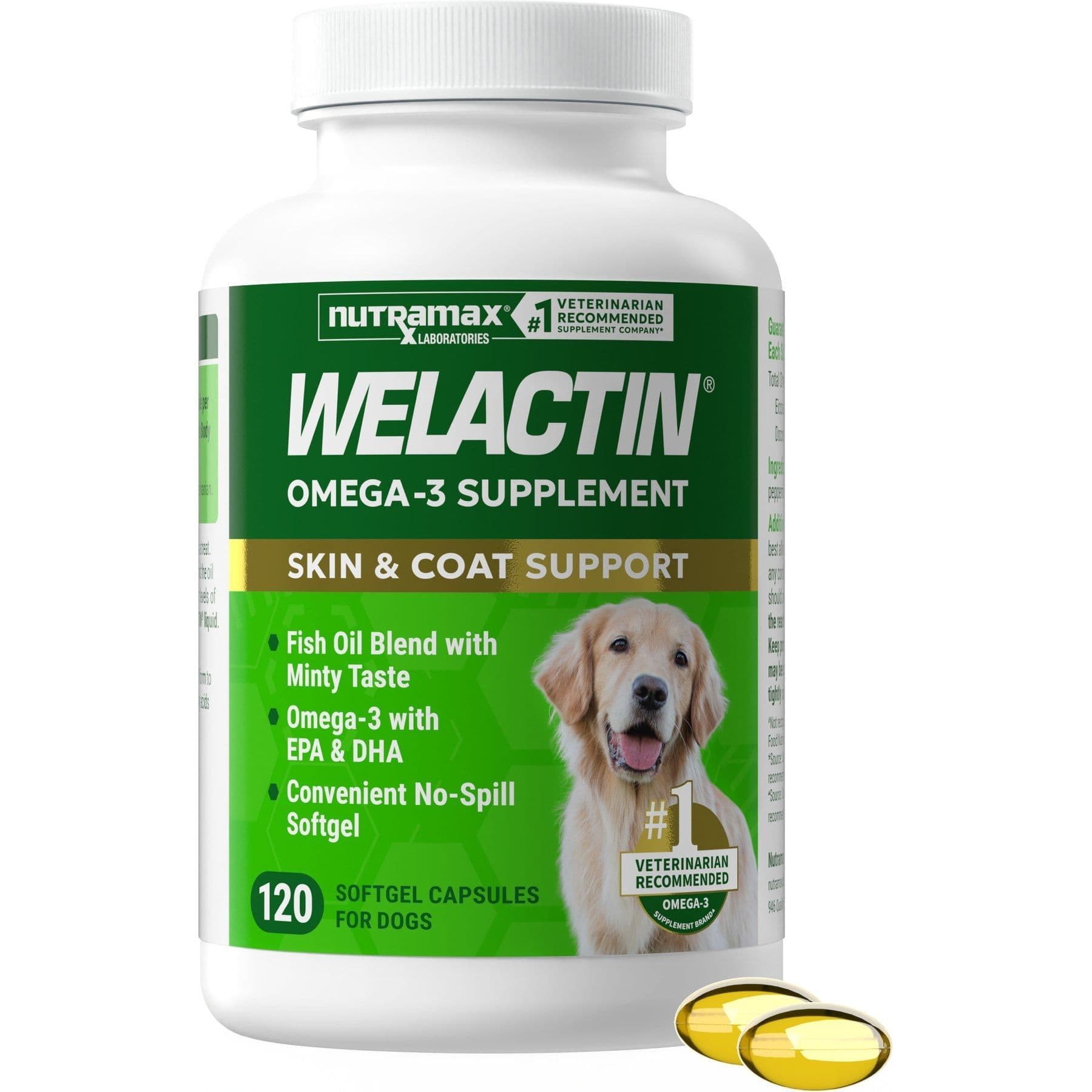
Nutramax Welactin Omega-3 Fish Oil Softgels for Dogs, 360 count: an EPA and DHA adjunct from wild-caught, cold-water fish.
Webvet may earn a commission when you click through to Chewy, at no extra cost to you.
Using Cytopoint and Apoquel together
Combining the two drugs has label-level support on the Cytopoint side. The package insert's field safety study used a wide range of concomitant medications safely, naming oclacitinib and cyclosporine among the other antipruritics. The AAHA table lists lokivetmab as safe in combination with other medications, and Merck reports no drug interactions.
The evidence for using Cytopoint and Apoquel together as a regimen is newer and thinner. A 2026 retrospective study by Bachtel and Snidow looked at 44 dogs that had failed each drug alone: 27 of them (61.4 percent) responded adequately to the pair, judged by at least a 2 cm drop on the itch scale.
No adverse effects were noted, but it was small, retrospective, and uncontrolled, so the combination is a vet-directed step for dogs that have failed monotherapy, not a label-endorsed routine. Steroids are the other combination to understand, and here the labels have not tested it:
- the Apoquel label says its use has not been evaluated with glucocorticoids, cyclosporine, or other systemic immunosuppressive agents;
- AAHA repeats that it has not been tested in dogs on long-term corticosteroids or cyclosporine;
- VCA draws the practical line: short-term corticosteroids or cyclosporine while on oclacitinib has been shown to be safe, while prolonged use together has not been evaluated and is not recommended.
Against prednisolone, the question is duration. Merck puts oral prednisone or prednisolone at an initial 0.5 to 1.1 mg/kg once daily with a taper, calls it best for severe acute flares because it is fast acting, and warns that long-term use carries a high risk of adverse effects.
Merck's tapered target is 0.25 to 0.5 mg/kg every 48 hours. In a Zoetis-funded 123-dog trial by Gadeyne et al., both drugs started working within 4 hours, were not significantly different except on day 14, when oclacitinib reduced itch more, and had adverse events at similar frequency.
The steroid's longer-term side effects are the subject of our guide to prednisone for dogs and cats. Atopica is cyclosporine, and against Apoquel it comes down to speed and monitoring. The label facts, from the Atopica label, Merck, VCA, and AAHA:
- Dose as the vet prescribes it: 5 mg/kg once daily (label range 3.3 to 6.7 mg/kg) for 30 days, then the frequency is tapered as the response allows; Merck says taper to the lowest dose that controls the disease.
- Onset: Merck says 4 to 6 weeks to clinical improvement, so it is not suitable for acute flares; VCA says full effect can take up to six weeks.
- Side effects: AAHA calls them common, listing gastrointestinal signs, excess hair growth, gum overgrowth, and papillomas, and says periodic monitoring of liver enzymes and blood cell counts is required.
- Exclusions: the label contraindicates it in dogs with a history of neoplasia and indicates it only for dogs of at least 4 lb (1.8 kg); VCA says not under 4 pounds or under 6 months.
- Vaccines: the label recommends killed vaccines, because the effect of cyclosporine on modified live vaccines is unknown.
- Speed against Apoquel: in a 226-dog randomised trial by Little et al., oclacitinib reduced itch significantly faster than ciclosporin at every time point through day 28, and ciclosporin caught up by day 56.
- Apoquel and cyclosporine together: VCA's rule applies, so short-term overlap has been shown safe and prolonged overlap is not recommended.
Atopica (Cyclosporine Modified) Capsules for Dogs, 25-mg, 30 capsules is the strength we priced, and like Apoquel it is a prescription product filled through Chewy's pharmacy.
Where Zenrelia fits against Apoquel and Cytopoint
Zenrelia is the newest entry: a second JAK inhibitor, from Elanco, set against Apoquel and the antibody. The FDA-approved Zenrelia label sets ilunocitinib at 0.27 to 0.36 mg/lb (0.6 to 0.8 mg/kg) by mouth once daily for dogs at least 12 months of age, so unlike Apoquel it has no twice-daily starting phase.
Like Apoquel, its safe use has not been evaluated with glucocorticoids, cyclosporine, or other systemic immunosuppressives. The difference that decides most cases is the boxed warning for an inadequate immune response to vaccines.
The label says to stop the drug at least 28 days to 3 months before vaccination and withhold it for at least 28 days after, and VCA's ilunocitinib page turns that into a do-not-use list:
- dogs that are not up to date on vaccinations;
- dogs vaccinated in the previous 28 days;
- dogs with severe infections or neoplasia;
- dogs currently taking other immunosuppressive medications such as cyclosporine or prednisone.
On efficacy, an Elanco-funded 338-dog trial by Forster et al. found ilunocitinib gave significantly lower itch and lesion scores than oclacitinib from day 28 to day 112 with similar safety. It was sponsor-funded, and a comment published in 2026 disputes its statistics, so we treat it as promising rather than settled.
Cytopoint sits apart from both tablets here: Merck reports no drug interactions with lokivetmab, and the insert's field study included vaccines among the medications used alongside it.
The newest alternative to Apoquel, and the wider list of what a dog can take for itching instead of it, from antihistamines to topicals and immunotherapy, is covered in our guide to Apoquel alternatives for dogs.
Which dogs do best on each: a vet's decision guide

Both drugs are itch control, not a cure. Merck says allergen-specific immunotherapy is the only treatment that can change a dog's immune response to allergens and induce remission, so for a dog with confirmed dog skin allergies the long game is immunotherapy with Apoquel or Cytopoint covering the itch while it takes hold.
The choice between Cytopoint and Apoquel for dogs sorts cleanly once you line the labels up by dog rather than by drug. The AAHA table, the two labels, and the VCA monographs agree on who is excluded from Apoquel, and that exclusion list is most of the decision. Dogs that do best on Cytopoint:
- Puppies under 12 months. The AAHA table lists lokivetmab as safe for puppies; the Apoquel label excludes dogs under a year.
- Dogs with cancer or a cancer history. AAHA lists lokivetmab as safe with neoplasia, and the 2025 PMC review calls it preferable to broader immunosuppressive drugs in dogs with neoplastic disease.
- Dogs with active or recurrent infections or demodex. VCA's do-not-use list for oclacitinib names current or recent demodectic mange and serious infections such as pneumonia.
- Dogs with impaired immunity or in a vaccination window. The same review prefers lokivetmab during active immunisation, and Merck reports no drug interactions with it.
- Dogs that cannot be pilled, and households that travel. The review contrasts daily oral tablets with an injection every 4 to 8 weeks.
- Homes where no one should handle a hazardous drug. VCA says pregnant or nursing people should not handle oclacitinib.
Dogs that do best on Apoquel:
- Healthy adults over 12 months in a severe acute flare. Merck lists oclacitinib for acute flares with onset within 24 hours, against a Cytopoint onset that AAHA puts at hours to 3 days.
- Dogs whose dose needs adjusting. Merck's rule is to taper to the lowest dose and frequency that holds remission, which a daily tablet allows and a two-month injection does not.
- Dogs going through allergy work-up. AAHA says oclacitinib does not interfere with intradermal allergy testing or immunotherapy, so it can control itch during dog allergy testing.
- Dogs that did not respond to Cytopoint. The PMC review explains sudden loss of effect by itch cytokines other than IL-31, which oclacitinib's wider cytokine blockade still covers.
Two questions about Apoquel come up often enough to answer plainly:
- Is Apoquel an antibiotic? No. The label says oclacitinib is neither a corticosteroid nor an antihistamine, and it acts on itch and inflammation signalling, not on bacteria or yeast. Merck is clear that secondary Staphylococcus and Malassezia infections are common in atopic dogs and need their own treatment.
- Is Apoquel for IBD in dogs? No. Merck gives its indication as acute flares and long-term itch control in dogs 12 months or older, so inflammatory bowel disease is a separate conversation with your vet.
Whichever drug wins, Merck recommends weekly to biweekly baths, because bathing can reduce the allergen load on the skin. A gentle, fragrance-free product such as Veterinary Formula Clinical Care Hypoallergenic Shampoo, 16-fl oz bottle, which Chewy listed at $14.99 in October 2026, fits that routine.
Chewy's listing describes it as coconut-based, pH balanced, and free of dyes, fragrances, sulfates, parabens, and soap; it does not kill fleas or ticks, so parasite control stays separate.
Switching has a little data behind it. In the Lee et al. trial, dogs moved from oclacitinib or prednisolone to lokivetmab held their itch and dermatitis at the same level, though that arm was five dogs. Veterinary Evidence adds that response to oclacitinib predicts response to lokivetmab, a reason to trial the tablet first.
What dog should not take Apoquel?
The exclusions come straight from the label and from VCA:
- dogs younger than 12 months;
- dogs that are pregnant, nursing, or used for breeding, because safe use has not been evaluated;
- dogs with current or recent demodectic mange;
- dogs with serious infections such as pneumonia, or with deep skin or systemic infection;
- dogs with cancer or a history of cancer (VCA says do not use; the label says weigh risks and benefits);
- dogs on long-term corticosteroids or cyclosporine, since the combination has not been evaluated.
The PMC review sums up the reason: by suppressing several cytokine pathways at once, oclacitinib needs cautious use wherever there is infectious risk or another immune-modifying drug on board.
If your dog is on this list, Cytopoint is the drug the AAHA table clears for those same histories, and that is the conversation to have with your vet before any prescription is written.
Apoquel vs Cytopoint questions
Frequently Asked Questions
Can Apoquel and Cytopoint be given together?
Yes, together and under veterinary direction. The Cytopoint package insert lists oclacitinib among the drugs used safely alongside it in its field study, and AAHA rates lokivetmab as safe in combination with other medications.
A 2026 retrospective study found 61.4 percent of 44 dogs that had failed each drug alone responded to the pair, with no adverse effects noted. Ask your vet before adding the tablet to cover a flare between injections; the pairing is a prescribed step, not a home decision.
How long does a Cytopoint injection last?
Zoetis says one injection provides relief for 4 to 8 weeks, the package insert's 211-dog study showed a treatment effect for at least one month at 2 mg/kg, and VCA says it lasts at least 4 to 8 weeks and may last longer in dogs with kidney or liver disease.
The insert's instruction is to repeat every 4 to 8 weeks as needed, so the repeat date is set by when the itch returns in your dog rather than by a fixed calendar.
Does Apoquel need blood work?
VCA recommends periodic bloodwork monitoring for any dog on long-term oclacitinib, because a small number develop lowered white blood cell counts that make infection more likely. The FDA label asks that treated dogs be monitored for infections, demodicosis, and neoplasia but sets no blood test schedule.
In the long-term Cosgrove study, haematology and chemistry means stayed within normal ranges, so monitoring is a safety net rather than an expectation of trouble; your vet sets the interval.
Is there a generic for Apoquel?
Not for dogs in the United States. Oclacitinib is the generic name, and the DailyMed animal drug listing for oclacitinib shows only Apoquel and Apoquel Chewable from Zoetis, plus a bulk-powder entry from a chemical packager that is not a finished tablet.
If cost is the concern, the per-dose figures we recorded in October 2026 put the chewable at about $2.99 and the plain tablet at about $3.16, both prescription-only through Chewy's pharmacy.
Can a puppy have Apoquel or Cytopoint?
Cytopoint, yes; Apoquel, no. The Apoquel label is explicit that it is not for dogs under 12 months of age, after a safety study in 6-month-old dogs had to be stopped for pneumonia and demodex in the high-dose groups.
Cytopoint has no age limit: Merck lists no age restriction, AAHA lists it as safe for puppies, and Zoetis says it is safe in dogs of any age. The one caveat is the EU label, which excludes dogs under 3 kg.
Is Cytopoint a steroid?
No. Cytopoint is a monoclonal antibody, a protein rather than a chemical, that binds and neutralises interleukin-31, the itch-signalling protein, and Zoetis describes it as working like the dog's own immune system.
It is not a steroid; VCA groups it with the newer drugs that control itch without the potential side effects of corticosteroids. Apoquel is not a steroid either, though it is a different kind of drug.
Does Apoquel work for ear infections?
It controls the itch that drives ear scratching, not the infection itself. Merck lists secondary ear infections with Staphylococcus and Malassezia as common in atopic dogs and as flare factors that need their own treatment, so an infected ear needs ear medication whether or not the dog is on Apoquel.
Because the label says Apoquel may increase susceptibility to infection, a dog whose ear infections keep returning on the drug should have that pattern reviewed by the vet.
How does Atopica compare to Apoquel and Cytopoint?
Atopica is cyclosporine, and it is the slow one. Merck says it can take 4 to 6 weeks to produce improvement and is not suitable for acute flares, while Apoquel works within hours and Cytopoint within hours to days.
In a 226-dog trial oclacitinib beat ciclosporin on itch through day 28 and the two were level by day 56. Cyclosporine also needs periodic liver enzyme and blood count monitoring, is contraindicated with a history of neoplasia, and was listed at $91.30 for thirty 25 mg capsules on Chewy in October 2026.
How does Zenrelia compare to Apoquel and Cytopoint?
Zenrelia is ilunocitinib, an Elanco JAK inhibitor in the same family as Apoquel, given once daily to dogs at least 12 months old. Its label carries a boxed warning for inadequate immune response to vaccines: stop it 28 days to 3 months before a vaccine and withhold it for 28 days after.
A sponsor-funded trial found it beat oclacitinib on itch from day 28 to day 112, but a 2026 comment disputes the statistics. Cytopoint has no vaccine restriction and no reported interactions.
Is Apoquel better than prednisone for itching?
Not by much on itch, but by a lot on side effects. In a Zoetis-funded 123-dog trial, oclacitinib and prednisolone both started working within 4 hours and were not significantly different except on day 14, when oclacitinib reduced itch more; adverse events were similar in frequency over that short trial.
The difference is the long run: Merck says long-term steroid use carries a high risk of adverse effects, while VCA says oclacitinib matches a steroid's effect in many patients with fewer side effects.
Can Apoquel cause yeast or skin infections?
It can make them more likely. The label says Apoquel may increase susceptibility to infection, including demodicosis, and lists pyoderma and pododermatitis among post-approval reports; VCA names urinary tract, respiratory, and skin infections.
The reason is immune: oclacitinib suppresses several cytokine pathways, and VCA notes some dogs develop lowered white cell counts. Malassezia yeast is already common in atopic skin, per Merck, so a yeast flare on Apoquel needs the yeast treated and the drug reviewed.
Which costs more over a year, Apoquel or Cytopoint?
It turns on the dog's weight and the clinic's injection fee. For a 45 to 60 lb dog, maintenance Apoquel at Chewy's October 2026 price is $189.72 a month, which multiplies to $2,276.64 a year before the costlier twice-daily first two weeks.
Cytopoint's yearly cost is the clinic's per-injection price for that weight, with vial count rising with weight, times anywhere from six to thirteen injections depending on whether the dog needs it every eight weeks or every four. No published figure settles the comparison.
Can Apoquel be given with cetirizine?
Yes. VCA says oclacitinib can be safely combined with antihistamines, and cetirizine is one; Merck lists it at 0.5 to 1 mg/kg twice daily when a vet prescribes it.
The two are not substitutes, though: Merck rates antihistamines as having very little efficacy in acute flares and useful only together with other treatments for chronic disease, so cetirizine is an add-on your vet may layer onto Apoquel, not a cheaper replacement for it.
Veterinarian · BVMS MRCVS
Dr. Pippa Elliott, BVMS, MRCVS, is a veterinarian with nearly 30 years of experience in companion animal practice. Dr. Elliott earned her Bachelor of Veterinary Medicine and Surgery from the University of Glasgow. She was also designated a Member of the Royal College of Veterinary Surgeons. Married with 2 grown-up kids, Dr. Elliott has a naughty Puggle named Poggle, 3 cats and a bearded dragon.
Related reading

Over the Counter Allergy Medicine for Dogs: What Is Safe, What Helps, and What to Skip

Antihistamines for Dogs: Which Ones Vets Use, Typical Doses, and When They Are Not Enough

Dog Allergy Medicine: A Vet's Guide to Over-the-Counter and Prescription Options for Itchy Dogs
