Over the Counter Allergy Medicine for Dogs: What Is Safe, What Helps, and What to Skip
A veterinarian sorts over the counter allergy options for dogs into safe to try, ask your vet first, and never: antihistamines, omega-3 and quercetin supplements, medicated shampoos, sprays, and the signs that a prescription is needed.

BVMS MRCVS
Medically reviewed by Dr. Pippa Elliott, BVMS MRCVS · Last reviewed

This article contains affiliate links. Webvet may earn a commission when you buy through them, at no extra cost to you.
An itchy dog at nine at night sends plenty of owners straight to the pharmacy aisle. The over the counter allergy medicine for dogs that veterinarians are comfortable with is a plain antihistamine: diphenhydramine (Benadryl), cetirizine (Zyrtec), or loratadine (Claritin), with cetirizine holding the better evidence.
The same shelf holds products that can poison a dog, starting with anything marked D, and even the safe ones do less than most owners hope. We sort every over-the-counter category into three tiers, safe to try, ask your vet first, and never, with the reason and the realistic result for each.
The dose that suits your dog remains your veterinarian's call; our job is to tell you what to ask for and what to leave on the shelf.

 Sponsored
Want a vet's take on your dog's skin or coat?
Talk to a licensed vet at Dutch over video, often the same day. They can recommend treatment and prescribe it when it's appropriate.
Use code Pets60
Plans start at $12/month · covers up to 5 pets
- Licensed vets in most states
- Rx for 150+ conditions
- 4.7 on Trustpilot
What you can safely buy over the counter for a dog with allergies
The over-the-counter antihistamines veterinarians consider for dogs are plain diphenhydramine (Benadryl), cetirizine (Zyrtec), and loratadine (Claritin). VCA lists all three as usually safe, with two caveats: some dogs get drowsy and others hyperactive, and any combination version with a decongestant is not safe, which rules out every brand with a D after its name.

Expect modest results. The Merck Veterinary Manual says antihistamines have very little effect on an acute flare and are mainly useful in chronic disease alongside other treatments. So the over-the-counter options that are safe to try help mild, early itch; they rarely rescue a dog that is already raw and sleepless.
- 1The over-the-counter options that are safe to try for mild itch are plain diphenhydramine, cetirizine, or loratadine, at a dose your veterinarian sets for your dog's weight.
- 2OTC antihistamine brands compared: Benadryl is diphenhydramine, Zyrtec is cetirizine, Claritin is loratadine. The D version of each adds a decongestant and is never safe for dogs.
- 3A weekly bath with a mild shampoo and a reputable omega-3 fish oil are the other safe-to-try items, and both work slowly.
- 4Allergy chews, chlorhexidine shampoos, and hydrocortisone sprays or wipes are ask-your-vet items: usually safe, but easy to use on the wrong dog or the wrong skin.
- 5If the itch is spreading, the skin smells, or your dog cannot sleep, stop experimenting and book the appointment.
Before buying anything, be honest about the diagnosis. VCA warns that itchy, red skin can come from flea infestations, skin mites, ringworm, autoimmune skin disease, and certain cancers, not just allergy. The signs that point to allergy, and the look-alikes, are covered in our guide to dog skin allergies.
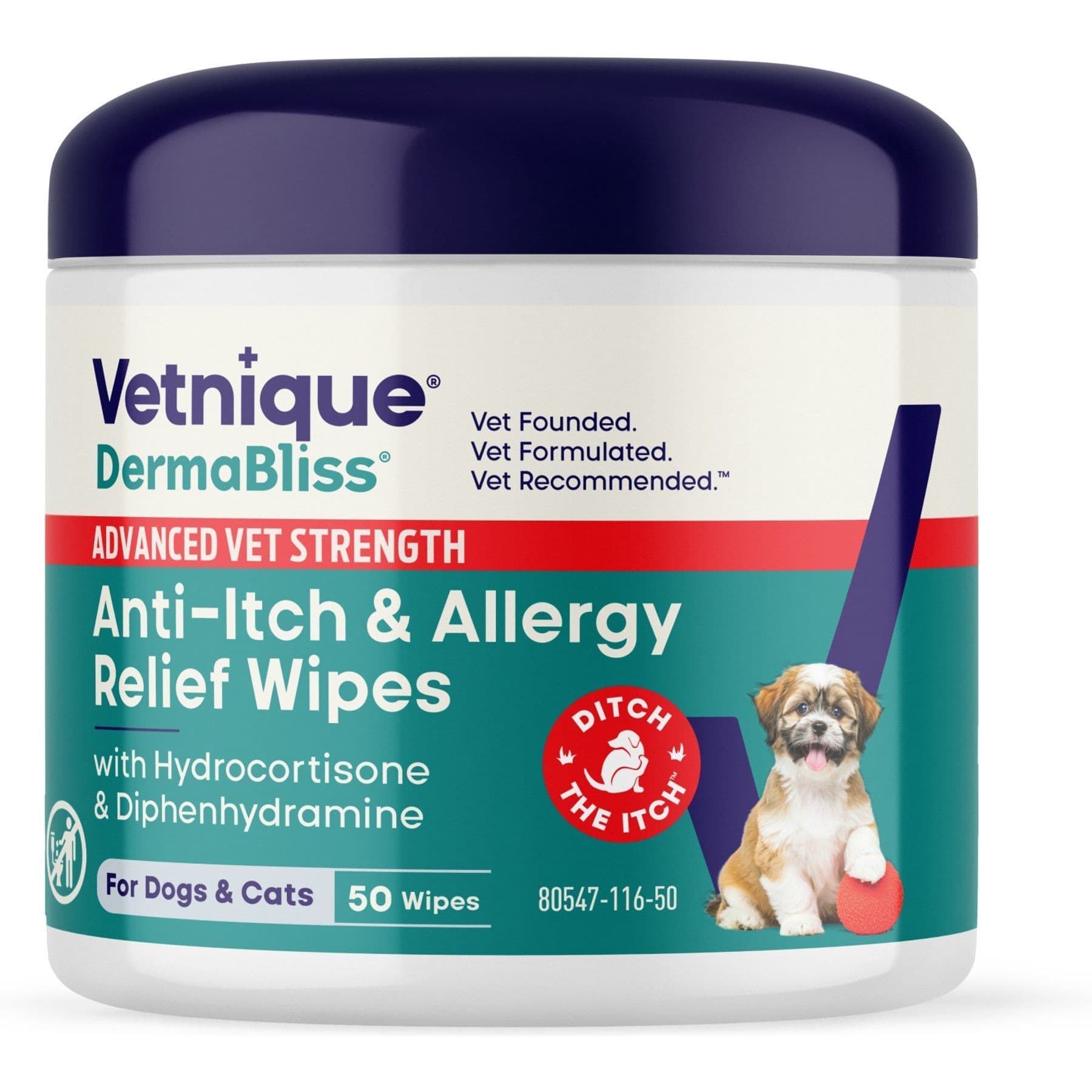
DermaBliss wipes: pramoxine, diphenhydramine, and hydrocortisone in a 50-count wipe for the itchy paw or skin fold between baths.
Webvet may earn a commission when you click through to Chewy, at no extra cost to you.
| Product category | Tier | Why | What to expect |
|---|---|---|---|
| Plain diphenhydramine, cetirizine, or loratadine tablets | Safe to try, dose confirmed by your vet | VCA lists all three as usually safe for dogs; some dogs get drowsy, others hyperactive | Small relief for mild itch; little effect on a full flare (Merck) |
| Dog-labeled diphenhydramine tablets (PetArmor) | Safe to try | Single active ingredient, 25 mg per tablet, weight chart on the label; ask a vet under 14 lb | The same modest antihistamine effect, easier to dose |
| Omega-3 fish oil with EPA and DHA | Safe to try from a reputable brand | Merck and ICADA rate it a useful add-on that may lower the dose of other drugs | Nothing for today's itch; benefit may take up to two months |
| Weekly bath with a mild, non-irritating shampoo | Safe to try | Merck says bathing is often the most effective way to cut allergen load | Fewer flares over weeks; calmer skin after each bath |
| Allergy chews (quercetin, colostrum, probiotics) | Ask your vet first | ICADA finds no clinical evidence of benefit in atopic dogs | Possibly nothing; fish oil and bathing have better support |
| Chlorhexidine or other antiseptic shampoo | Ask your vet first | Helps infected skin (Merck) but can dry skin and trigger a flare (ICADA); VCA says use under vet direction | Clears surface infection; wrong for dry, uninfected skin |
| Hydrocortisone sprays, creams, and wipes | Ask your vet first | VCA says OTC strengths are usually safe but delay healing of infected skin | Short-term calm on a small patch; not for large areas or long use |
| Zyrtec-D, Claritin-D, Allegra-D, and any cold, sinus, or multi-symptom allergy product | Never | Pseudoephedrine can be fatal to dogs (Pet Poison Helpline, Merck); combinations may add acetaminophen or an NSAID | Vomiting, agitation, seizures; call a poison line if swallowed |
The one over-the-counter step with the strongest backing is a bath. Merck says bathing lowers the allergen load on the skin and is often the most effective form of allergen avoidance, and it recommends weekly to biweekly baths.
The ICADA treatment guidelines add that a mild, non-irritating shampoo in lukewarm water at least weekly is likely beneficial, and that how often you bathe may matter more than which bottle you buy.
For the oral tier, buy the plain single-ingredient tablet and nothing else, and get the dosage from your veterinarian: VCA notes that human and dog doses differ, and Merck's own tables give more than one range for the same drug. The rest of the shelf sorts like this:
- Omega-3 fish oil from a reputable brand is the other safe-to-try item, with the caveat that it works slowly.
- Allergy chews are ask-your-vet items because they have no clinical evidence behind them.
- Chlorhexidine shampoos are ask-your-vet items too: VCA says they are sold over the counter but should only be used under a veterinarian's direction.
- Hydrocortisone sprays draw the same caution, since VCA says to ask your veterinarian whether a topical steroid suits your dog.
What can I give my dog for allergies without going to the vet?
Without a visit, the safest things you can do are a weekly bath with a mild shampoo and a reputable omega-3 fish oil; neither needs a prescription or a dose calculation.
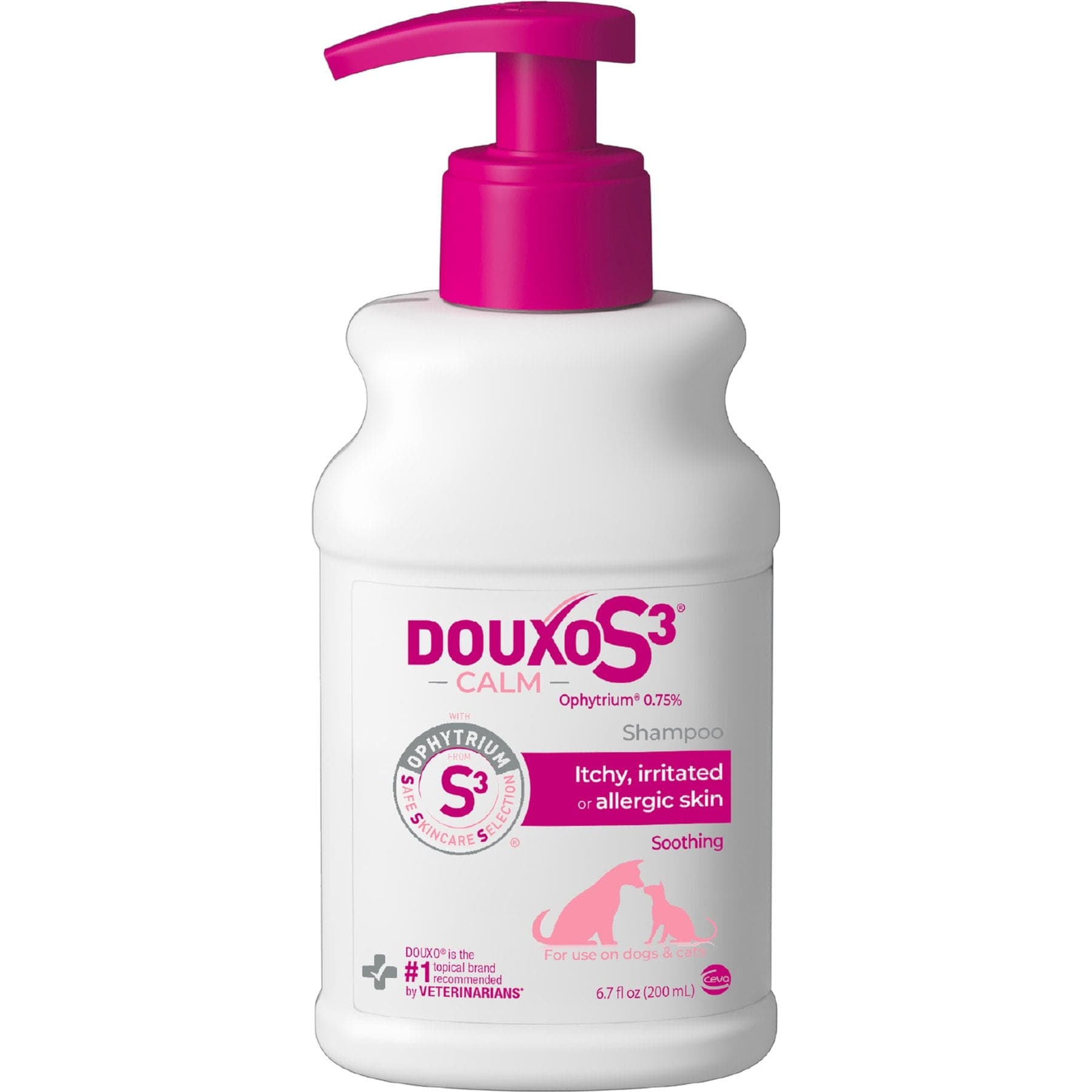
Douxo S3 CALM: a soothing shampoo with 0.75% Ophytrium for the weekly bath that helps allergic, itchy dogs.
Webvet may earn a commission when you click through to Chewy, at no extra cost to you.
If you want to try an antihistamine, VCA's advice is to check with your veterinary team that the product suits your dog and that you know the right dose, which may take only a phone call. Anything with a D after the name, or a cold-and-sinus label, stays on the shelf.
Over-the-counter antihistamines for dogs: Benadryl, Zyrtec, and Claritin
On the published evidence, the best over-the-counter allergy medicine for dogs is cetirizine, and even that is a modest drug. The ICADA guidelines name hydroxyzine and its metabolite cetirizine as the preferable antihistamines in dogs, with demonstrable antihistamine action in the species. Hydroxyzine is prescription only, so cetirizine is the one you can buy.
The easiest safe purchase, though, is diphenhydramine labeled for dogs. PetArmor Antihistamine Medication for Allergies for Dogs, 100 count lists diphenhydramine 25 mg as the only active ingredient, per the 1-800-PetMeds label text. The label chart reads:
- Under 14 pounds: ask a veterinarian.
- 14 to 30 pounds: one tablet twice daily.
- Over 30 pounds: two tablets twice daily.
Chewy listed the 100-count bottle at $6.99 when we checked in October 2026. At the label's two tablets a day for a 14 to 30 pound dog, that works out to about 14 cents a day and a 50-day supply.
Merck's view sets expectations for all of them: very little efficacy for acute flares, some help controlling chronic disease alongside other treatments, and best results when given before a flare. ICADA goes further: no conclusive evidence that these drugs treat active atopic dermatitis in dogs, and at most a small and limited benefit in some.
Here are the OTC antihistamine brands compared by active ingredient, with the ranges Merck publishes; those ranges are what a veterinarian prescribes from, not self-dosing instructions:
- Benadryl (diphenhydramine): Merck's antihistamine table gives 2–4 mg/kg every 8–12 hours as needed. VCA says it takes effect in about 1 to 2 hours and wears off within 24, and lists lethargy, dry mouth, urinary retention, vomiting, diarrhea, and lack of appetite as side effects.
- Zyrtec (cetirizine): Merck prints three different ranges across its tables: 1 mg/kg or 10–20 mg per dog every 12–24 hours; 1–4 mg/kg every 24 hours in its second-generation table; and 0.5–1 mg/kg every 12 hours in its atopic dermatitis table. VCA lists rare vomiting and drooling, and sleepiness in small dogs at high doses.
- Claritin (loratadine): Merck's second-generation table gives 0.25–1.1 mg/kg every 24 hours. VCA publishes no loratadine monograph, and no trial compares it head to head with cetirizine in dogs.
- Allegra (fexofenadine): Merck's tables disagree widely, 18 mg/kg every 24 hours in one and 2–5 mg/kg every 12–24 hours in another, so there is no single figure to rely on; this one is strictly ask your vet.
For Benadryl and Zyrtec, our antihistamines for dogs comparison weighs the two in detail; the short version is that cetirizine has the better evidence, while diphenhydramine lists lethargy among its side effects. Zyrtec dosing by weight lives in our Zyrtec for dogs monograph, and Benadryl's in Benadryl for dogs.

If your veterinarian prefers the generic, Chewy files Diphenhydramine HCl (Generic) Capsules, 25-mg, 120 capsules with its prescription medications, listed at $8.40 when we checked in October 2026, so expect to supply your veterinarian's prescription. The active ingredient is the same as Benadryl and PetArmor; the capsule is simply the pharmacy route.
Who should not get these drugs, according to VCA's monographs:
- Diphenhydramine should not be used in pets allergic to it or to similar antihistamines, or in pediatric or neonatal pets.
- Diphenhydramine needs caution with glaucoma, prostate enlargement, intestinal or bladder obstruction, COPD, elevated thyroid hormone, heart disease, high blood pressure, pregnancy or lactation, geriatric dogs, and working dogs.
- Diphenhydramine interacts with anticholinergic drugs, tricyclic antidepressants, and CNS depressants such as sedatives, anesthetics, and pain medications.
- Cetirizine is ruled out in pets hypersensitive to cetirizine or hydroxyzine.
- Cetirizine needs caution in seizure disorders, trouble urinating, thyroid problems, prostatic enlargement, heart, kidney, or liver disease, glaucoma, senior dogs, working dogs, and pregnant or nursing dogs.
Those lists are why an itchy senior dog on heart medication is an appointment, not a pharmacy run.
Is Zyrtec available over-the-counter?
Yes. The DailyMed label for Zyrtec Allergy shows cetirizine 10 mg tablets sold as an over-the-counter human antihistamine for hay fever and upper respiratory allergies. Use in dogs is off label, so VCA frames it as a drug to confirm with your veterinary team, not one to dose from the human box.
Buy the plain tablet only; Zyrtec-D is a different product and is never safe for dogs.
Will Zyrtec stop itching in dogs?
Sometimes, modestly, and mostly in mild or chronic cases. VCA lists cetirizine for itch from atopic dermatitis, hives, and insect bite reactions in dogs. Set against that, ICADA finds oral antihistamines give at most a small and limited benefit in some dogs, and Merck says they do little for an acute flare.
If your dog is already chewing itself raw, cetirizine on its own is unlikely to stop it.
Which is better for my dog, Claritin or Zyrtec?
Zyrtec, on the evidence. ICADA singles out cetirizine as the preferable antihistamine in dogs because it has demonstrated antihistamine action in the species. No primary source compares loratadine head to head with cetirizine in dogs; Merck simply lists a loratadine range of 0.25–1.1 mg/kg once daily.
Claritin is a reasonable second choice if your veterinarian prefers it, and both brands come in D versions that are off limits.
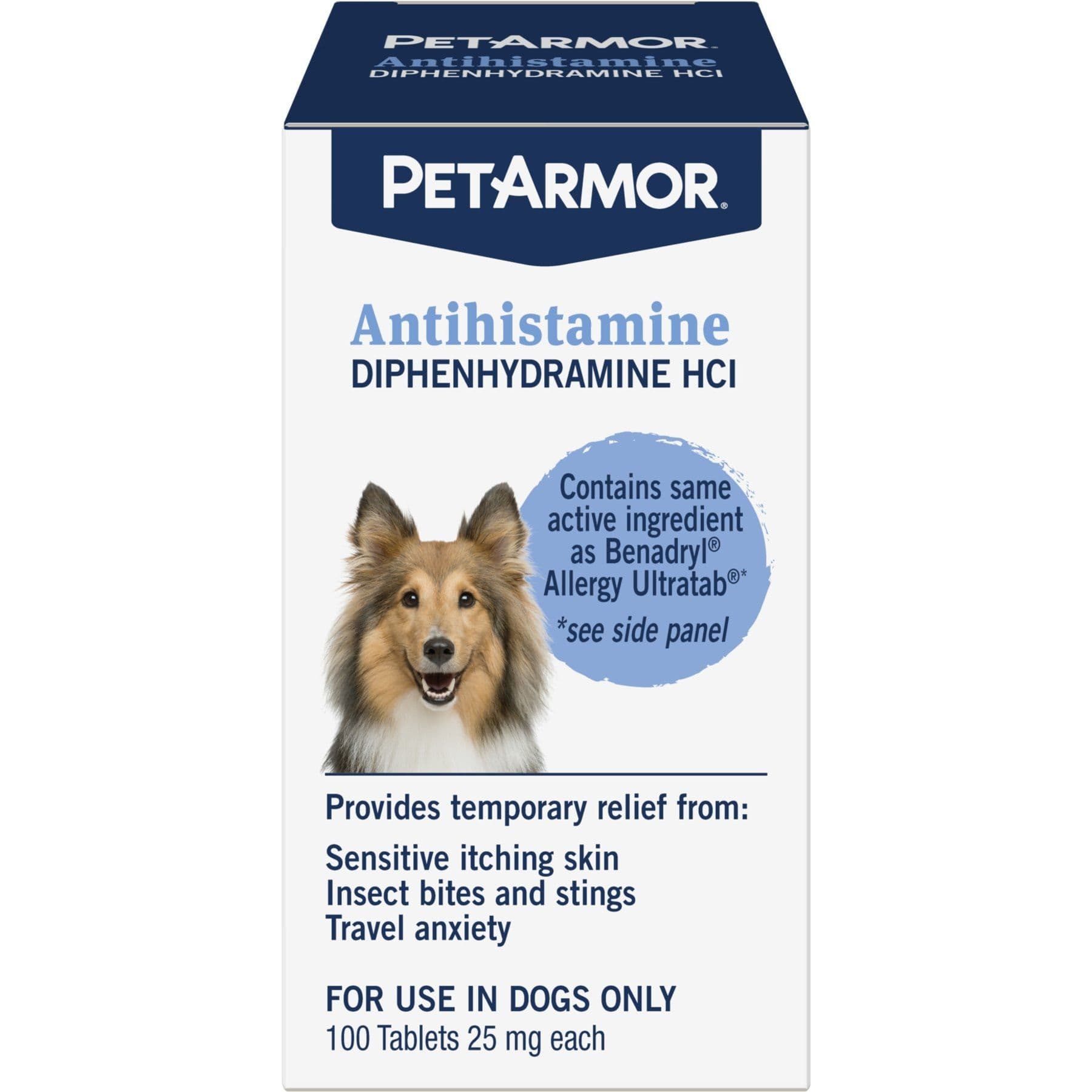
PetArmor Antihistamine tablets: 25 mg diphenhydramine labeled for dogs, with a weight chart on the box and no decongestant.
Webvet may earn a commission when you click through to Chewy, at no extra cost to you.
What to skip: human allergy products that are dangerous for dogs
The human products that are dangerous for dogs share one feature: a second active ingredient. Merck's toxicology section notes that antihistamines are often combined with decongestants, and with painkillers such as acetaminophen or NSAIDs, in over-the-counter cold, sinus, and allergy medicines. The antihistamine part is the same; the add-ons are what poison dogs.
The Pet Poison Helpline explains that the letter D after an allergy brand signals a decongestant, and that decongestant poisoning in pets causes vomiting and neurologic abnormalities. Pseudoephedrine, the decongestant in Sudafed, can be extremely toxic and even fatal to pets, which are more sensitive to it than people are.
How little it takes: Merck says clinical signs of pseudoephedrine poisoning appear at 5–6 mg/kg and death can occur at 10–12 mg/kg. The ASPCA Animal Poison Control Center describes severe hyperactivity, hallucinations, and seizures from antihistamines that carry pseudoephedrine, and calls such exposures potentially life-threatening.
Which Zyrtec is not safe for dogs?
Zyrtec-D. VCA's cetirizine monograph says plainly not to use the cetirizine and pseudoephedrine combination product in dogs or cats. The DailyMed label shows each Zyrtec-D tablet contains cetirizine 5 mg plus pseudoephedrine 120 mg.
Set against Merck's symptomatic dose of 5–6 mg/kg, that single tablet reaches the poisoning threshold for a dog of roughly 20 to 24 kg (44 to 53 pounds), and smaller dogs get proportionally more. Merck adds that loratadine and fexofenadine are often sold combined with pseudoephedrine too, so Claritin-D and Allegra-D are equally off limits.
 Sponsored
Vet care that's always there
Unlimited video calls and messaging with licensed vets for less than a typical vet visit. One membership covers up to five pets.
Use code Pets60
Plans start at $12/month · covers up to 5 pets
- Licensed vets in most states
- Rx for 150+ conditions
- 4.7 on Trustpilot
Supplements for allergic dogs: omega-3, quercetin, probiotics, and what the evidence shows
Supplements with evidence behind them come down to one group: omega-3 fatty acids from fish oil. Merck's atopic dermatitis table lists high-quality fish oil with EPA and DHA at 65–90 mg/kg once daily.
Merck rates essential fatty acids as most helpful as an add-on, citing studies in which they increased the efficacy and lowered the required dose of other medications. The catch is speed: they can take up to 2 months to work, so they do nothing for a flare already under way.

Allergy chews are a different proposition, and the two we looked at are built differently. Zesty Paws Allergy & Immune Bites Allergies, Immune, & Gut Support Peanut Butter Flavored Soft Chews Supplement for Dogs, 180 count bundle lists, per serving of the peanut butter flavor:
- Colostrum 200 mg.
- EpiCor fermentate 170 mg.
- Astragalus root 100 mg.
- A six-strain gut blend, with no fish oil and no quercetin in that flavor.
The maker says the chews may help maintain normal histamine levels, which is a support claim rather than a treatment claim. The ask-your-vet tier is the right expectation for an owner who wants a daily chew in the routine while fish oil builds up.
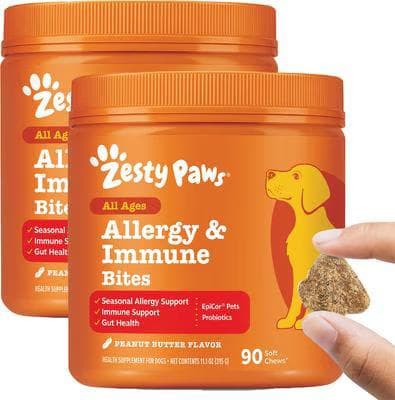
Zesty Paws Allergy & Immune Bites: colostrum, EpiCor, astragalus, and a six-strain gut blend in a peanut butter chew for dogs.
Webvet may earn a commission when you click through to Chewy, at no extra cost to you.
Pet Parents Allergy SoftSupps Immune & Allergy Relief Dog Supplement, 90 count is the chew to look at if you want quercetin. Each chew lists quercetin 50 mg, colostrum 250 mg, salmon oil 80 mg, apple cider vinegar, licorice root, and vitamin C; Chewy listed the 90-count jar at $29.99 in October 2026.
The Pet Parents label doses one chew up to 25 pounds, two for 26–75 pounds, and three above that, and the maker's own wording sets the right expectation: a daily support tool, not a medical cure. What the evidence says about quercetin and probiotics is thin:
- ICADA finds that some supplements improve skin barrier function in the laboratory but shows no clinical benefit in dogs with atopic dermatitis.
- No primary veterinary source gives a clinical efficacy figure for quercetin in dogs.
- ICADA rates the evidence for oral probiotics as insufficient for preventing or treating canine atopic dermatitis.
- A 2025 meta-analysis of five dog trials in the Journal of Veterinary Medical Science found probiotics had no significant effect on lesion scores (P=0.08) or itch scores (P=0.85), even though every trial recorded some reduction.
For fish oil, pick a product that states its EPA and DHA. Nutramax Welactin Omega-3 Fish Oil Liquid Softgels Skin & Coat Supplement for Dogs, 360 count lists 300 mg total omega-3 per softgel, with EPA 155 mg and DHA 100 mg, and directs one softgel daily per 20 pounds, per the Jeffers Pet label.
Merck notes no evidence that any particular fatty acid combination, dose, ratio, or formulation beats another, so a clearly labeled, reputable product is the goal. Our guide to omega-3 fatty acids for dogs covers dosing and sourcing in detail.
VCA's fish oil monograph sets the rest of the expectations:
- Several weeks before full effect, with gradual improvement along the way.
- Possible mild stomach upset, fishy odor, oily coat, delayed wound healing, or itchiness and flaking.
- No fish oil from a source that cannot be vouched for, because some carry a high risk of heavy metal contamination.
ICADA's verdict fits the tier: a small benefit, unlikely to be enough on its own, and possibly not visible before two months.
Medicated shampoos, wipes, and sprays that calm itchy skin
For itchy skin, the over-the-counter allergy medicine that helps dogs most is applied, not swallowed, and the schedule matters more than the brand. ICADA says bathing at least weekly with a mild, non-irritating shampoo in lukewarm water is likely beneficial, and that bathing intensity and frequency may be the most important factor in relieving itch.
Emollient shampoos are likely the most soothing; antiseptic or anti-seborrhoeic products suit greasy, scaly, or infected skin, in ICADA's reading.
Pairing medicated shampoos with topicals, meaning wipes and sprays, covers the days between baths. Vetnique Labs DermaBliss Advanced Vet Strength Antihistamine & Hydrocortisone Itch Relief, Allergies & Odor Control Cat & Dog Wipes, 50 count carry three active ingredients, per the Vetnique label:
- Pramoxine, to numb the irritated patch.
- Diphenhydramine, the antihistamine.
- Hydrocortisone, for redness and itch.
Chewy listed the 50-count pack at $29.99 when we checked in October 2026. The wipes suit a paw, belly, or skin fold your dog keeps worrying at, used on that patch, not the whole dog.
The soothing shampoo with a published trial behind it is Douxo, though the evidence is for an earlier formula. ICADA reports that the older Douxo Calm (phytosphingosine, raspberry oil, and lipids) gave a modest improvement in lesions and itch, most likely in mild disease.
The current Douxo S3 CALM Soothing Itchy, Hydrated Skin Dog & Cat Shampoo, 6.7-fl oz bottle contains 0.75% Ophytrium instead, used at one pump per 4 pounds and left on for 5 to 10 minutes, per Ceva. Ceva's "clinically proven" wording rests on congress abstracts and field trials rather than peer-reviewed trials.

Chlorhexidine shampoos and hydrocortisone topicals: ask your vet first
Chlorhexidine is the antiseptic to know, and it is an ask-your-vet item. Merck says that in superficial pyoderma an antimicrobial product such as chlorhexidine will likely give the best results, and VCA notes chlorhexidine products are sold over the counter but should only be used under a veterinarian's direction.
The reason is the flip side: ICADA warns that antimicrobial shampoos can dry or irritate skin enough to set off an atopic flare, so they belong on infected skin, not merely itchy skin. For other options, see our picks for medicated dog shampoo and dog shampoo for itchy skin.
Label rules that travel with any hydrocortisone wipe, spray, or cream:
- VCA says over-the-counter steroid sprays, gels, and creams carry a lower percentage of active ingredient than prescription steroids and are usually safe, but they can delay healing, especially on infected skin, and chronic use has adverse effects, so ask your vet whether a topical steroid suits your dog.
- Vetnique's label says do not let the dog lick treated areas.
- Vetnique's label also says do not use the wipes alongside any other diphenhydramine product, including tablets taken by mouth.
- Merck's table lists triamcinolone 0.015% for acute flares and localized lesions, applied to the affected area and best suited to 7–14 days, with skin thinning and calcinosis cutis as the risks of overuse.
Topical steroids, in short, are for a small area and a short run. A moist, spreading sore is a different problem; our guide to hot spots on dogs explains when a wipe is enough and when it is not.
How to tell whether over-the-counter treatment is working
Judge each tier on its own clock. VCA says diphenhydramine takes effect in about 1 to 2 hours and wears off within 24, so an antihistamine that is going to help shows it within a day or two of daily dosing given before the flare, not during it.
Fish oil runs on weeks: VCA expects several weeks before full effect, and Merck and ICADA say the benefit may not appear before two months.
Signs to stop and call your veterinarian:
- Itch that has not eased on the antihistamine's own timeline, since diphenhydramine acts within hours and clears within a day, so several days of daily dosing is enough to know whether it is helping at all.
- Skin that smells, weeps, or crusts: Merck says secondary Staphylococcus and Malassezia infections of the skin and ears are common and often worsen the signs.
- A wound or hot spot that does not look better after a couple of applications of a steroid product, which VCA says needs veterinary evaluation.
- A dog that was well controlled and relapses: Merck says that relapse should prompt a search for the cause before any long-term therapy is chosen.
- Drowsiness, hyperactivity, vomiting, or trouble urinating after a dose, which are among the side effects VCA lists for these antihistamines.
There is no published figure for how long to keep trying. Neither Merck nor VCA sets a number of days for an over-the-counter antihistamine trial; the only timing rule either gives is VCA's "a couple of applications" for topical steroids. An itch that is worsening needs a diagnosis rather than a second box.
Merck also lists fleas, food and environmental allergens, and secondary infections as recognized flare factors, so a plan that skips flea control or ignores an ear infection will look like a failed antihistamine when it is really an untreated trigger.
When over-the-counter is not enough: signs your dog needs a prescription
The signs a prescription is needed are the ones over-the-counter products are not built to fix:
- An acute flare: Merck says antihistamines have very little efficacy here, while oral prednisone or prednisolone is fast acting and best suited to severe, acute flares.
- Itch that keeps your dog awake or has broken the skin, which is where the prescription itch drugs earn their place.
- Infected skin or ears: Merck says secondary Staphylococcus and Malassezia infections are common and worsen the signs, and they need diagnosis and treatment rather than more shampoo.
- Relapse in a dog that was previously controlled, which Merck says should prompt a search for the cause.
- A dog with any condition on VCA's caution lists, for whom even a usually safe antihistamine is a prescribing decision.
The prescription options are faster and better studied. VCA describes newer drugs that block the itch signal: daily oral oclacitinib (Apoquel) and ilunocitinib (Zenrelia), and the long-acting injection lokivetmab (Cytopoint).
Merck calls the oral JAK inhibitors fast-acting, useful for both acute flares and chronic disease, and licensed for dogs over 12 months. Its table gives oclacitinib at 0.4–0.6 mg/kg every 12 hours for 2 weeks, then once daily, and Zoetis says Apoquel starts relieving itch in as little as 4 hours in a flea-allergy model study.
Apoquel's label is also why it is a prescription decision. Zoetis says:
- Do not use it in dogs under 12 months or with serious infections.
- It may raise the chance of serious infections and worsen existing parasitic skin infestations or pre-existing cancers.
- It is not for breeding, pregnant, or lactating dogs.
- Vomiting and diarrhea are the most common side effects.

Our Apoquel for dogs guide covers it in full, and Apoquel vs Cytopoint weighs it against the injection. Cytopoint is clinic-administered: Zoetis says one injection starts controlling allergic itch within one day, lasts 4 to 8 weeks, and can be used in dogs of any age.
Prescription hydroxyzine, which ICADA names alongside cetirizine as the preferable antihistamine in dogs, is covered in our hydroxyzine for dogs monograph. The full menu of dog allergy medicine, prescription and over the counter, sits in our hub.
VCA's bottom line stands either way: an itchy dog needs a full diagnostic evaluation to rule out other causes of itching before anyone settles on a long-term plan.
Over-the-counter dog allergy medicine questions
Frequently Asked Questions
Can I give my dog over-the-counter allergy medicine every day?
Antihistamines are meant to be given daily if they are given at all. Merck says they work best before a flare, to block histamine, and ICADA says they should be used as preventatives on a continuous daily basis.
The product and the dose for daily use still come from your veterinarian, because VCA notes that human and dog doses differ and the caution lists for diphenhydramine and cetirizine are long.
Does fish oil help dogs with allergies?
Modestly, and slowly. Merck lists omega-3 fish oil with EPA and DHA as an add-on that increases the efficacy and lowers the dose of other allergy medications, and VCA says to expect several weeks before full effect.
ICADA puts the benefit at small, unlikely to suffice alone, and possibly not visible for two months. It is the supplement worth buying; it is not a treatment for this week's flare.
Is hydrocortisone spray safe for dogs?
Usually, on a small area, for a short time, and after asking your veterinarian. VCA says over-the-counter steroid sprays, gels, and creams carry less active ingredient than prescription steroids and are usually safe, but they delay healing of infected skin and chronic use causes harm.
Prevent licking of the treated patch, as the Vetnique wipe label requires, and have any spot that is not better after a couple of applications checked.
What over-the-counter allergy medicine is safe for puppies?
Very little without a vet. VCA says diphenhydramine should not be used in pediatric or neonatal pets, and the PetArmor label says ask a veterinarian under 14 pounds, which covers many puppies. Weight-based dosing is the other problem: a growing puppy gains weight month to month, so the dose changes with it.
For a young dog with real allergic itch, Zoetis notes Cytopoint can be used at any age, while Apoquel is for dogs 12 months and older; both are your veterinarian's call.
How long should I try over-the-counter treatment before seeing the vet?
No published veterinary figure sets a trial length, so do not treat any number of days as a safe default. Diphenhydramine acts within 1 to 2 hours and clears within 24, per VCA, so a few days of daily dosing tells you whether it helps at all, while fish oil needs weeks.
See your veterinarian sooner if the skin smells, weeps, or crusts, since Merck says secondary infection is common and makes the itch worse, or if any wound is not better after a couple of steroid applications.
Veterinarian · BVMS MRCVS
Dr. Pippa Elliott, BVMS, MRCVS, is a veterinarian with nearly 30 years of experience in companion animal practice. Dr. Elliott earned her Bachelor of Veterinary Medicine and Surgery from the University of Glasgow. She was also designated a Member of the Royal College of Veterinary Surgeons. Married with 2 grown-up kids, Dr. Elliott has a naughty Puggle named Poggle, 3 cats and a bearded dragon.
Related reading

Apoquel vs Cytopoint: How a Vet Chooses Between Them for an Itchy Dog

Antihistamines for Dogs: Which Ones Vets Use, Typical Doses, and When They Are Not Enough

Dog Allergy Medicine: A Vet's Guide to Over-the-Counter and Prescription Options for Itchy Dogs
