Best Flea Treatment for Dogs Over the Counter: What Works
A vet-reviewed guide to the best flea treatment for dogs over the counter: honest efficacy rankings for Frontline Plus, K9 Advantix II, Seresto, and Capstar, plus why the strongest products stay prescription-only.

BVMS MRCVS
Medically reviewed by Dr. Pippa Elliott, BVMS MRCVS · Last reviewed

This article contains affiliate links. Webvet may earn a commission when you buy through them, at no extra cost to you.
The best flea treatment for dogs over the counter depends on the job. For fast knockdown of live fleas, Capstar (nitenpyram) kills adult fleas within 30 minutes. For monthly protection, Frontline Plus and K9 Advantix II are the strongest OTC topicals. For long-haul convenience, the Seresto collar protects for up to 8 months.
That short list is the honest answer. Everything else you can buy without a prescription, shampoos, sprays, powders, and "natural" repellents, plays a supporting role at best. And the most effective flea products on the market, the isoxazoline chews your vet prescribes, are not available over the counter at all.
This guide ranks the real OTC field, explains the regulatory line that decides what needs a prescription, and flags the safety checks that matter most, especially if you also have a cat at home.
- 1Capstar kills adult fleas within 30 minutes but lasts only about a day; it is a rescue tool, not a monthly program.
- 2Frontline Plus (fipronil) and K9 Advantix II (imidacloprid plus permethrin) are the top OTC monthly topicals.
- 3The Seresto collar releases imidacloprid and flumethrin for up to 8 months of continuous protection.
- 4Prescription isoxazoline chews (NexGard, Simparica TRIO, Bravecto, Credelio) outperform every OTC option; they are FDA-regulated drugs, which is why they stay Rx-only.
- 5K9 Advantix II contains permethrin, which is dangerous to cats. Households with cats need a cat-safe plan.

 Sponsored
Need flea, tick, or parasite care for your dog?
A licensed vet at Dutch can recommend the right preventive and prescribe it when it's appropriate. Annual members get 20% off their first flea and tick order.
Use code Pets60
Plans start at $12/month · covers up to 5 pets
- Licensed vets in most states
- Rx for 150+ conditions
- 4.7 on Trustpilot
Honest efficacy ranking: which OTC flea treatments actually work
The most effective flea treatment you can buy without a prescription is a monthly topical, either Frontline Plus or K9 Advantix II, paired with Capstar when you need same-day kill. The Seresto collar matches the topicals on sustained protection and beats them on convenience. Nothing else sold over the counter comes close.

Here is the OTC field ranked by real-world performance, with each product's known weaknesses stated plainly:
| Rank | Product | Active ingredients | Kill speed | Duration | Known weaknesses |
|---|---|---|---|---|---|
| 1 | Seresto collar | Imidacloprid + flumethrin | New fleas within 2 hours once active | Up to 8 months | Counterfeits are common; must fit snugly to work; higher upfront cost |
| 2 | K9 Advantix II | Imidacloprid + permethrin + pyriproxyfen | Within 12 hours | 1 month | Permethrin is toxic to cats; repellency fades in week 4 |
| 3 | Frontline Plus | Fipronil + (S)-methoprene | Within 12 to 24 hours | 1 month | Reduced fipronil susceptibility reported in some flea populations; frequent swimming or bathing shortens protection |
| 4 | Capstar | Nitenpyram | Within 30 minutes | About 24 hours | No residual protection at all; new fleas reinfest the next day |
| 5 | Flea shampoos (e.g., Adams Plus) | Pyrethrins + insect growth regulator | On contact during the bath | Hours to a few days | No meaningful lasting protection; a cleanup step, not prevention |
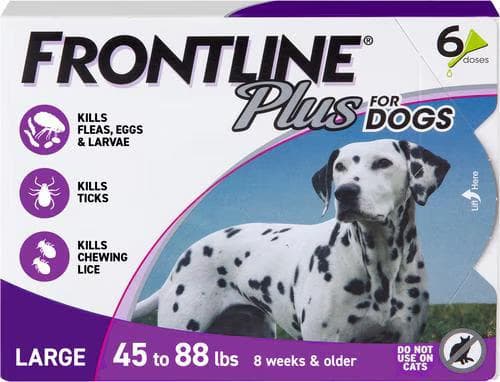
A monthly topical spot-on for large dogs 45 to 88 lbs that kills fleas, ticks, and chewing lice. A waterproof pick for dogs who do better with a topical than an oral chew.
Webvet may earn a commission when you click through to Chewy, at no extra cost to you.
The fipronil resistance question, answered honestly
Fipronil has been on the market for roughly three decades, and researchers have documented reduced susceptibility in some flea populations after years of heavy use. Frontline Plus still works well for many dogs. But when owners report that it "stopped working," resistance and application errors are the two usual explanations.
Perceived product failure is more often a program failure. If your home is seeded with flea eggs and pupae, adult fleas will keep appearing on a correctly treated dog for weeks, because the environment, not the product, is the source.
Signs the product itself may be underperforming:
- Live, active fleas on the dog more than 48 hours after a correctly applied dose
- Flea numbers that hold steady or climb through the second month of consistent treatment
- Good results from the same product in past years that clearly no longer hold
If you see that pattern, switching ingredient classes, for example from fipronil to an imidacloprid-based product, or moving up to a prescription chew, beats buying another box of the same thing.
How to verify the product is working
Judge any OTC product with a flea comb, not a glance. Comb the rump, tail base, and belly onto a white paper towel, then dampen any black specks. Flea dirt turns rust-red because it is digested blood.
Comb weekly and track the trend. A working product shows falling counts of live fleas and fresh flea dirt within two to three weeks, even while stragglers from the home environment keep hopping on. Flat or rising counts after a month mean the product, the application, or the home plan needs to change.
OTC vs prescription: what stays Rx-only and why
Most vets recommend a prescription isoxazoline chew, such as NexGard, Simparica TRIO, Bravecto, or Credelio, as first-line flea and tick control, because these drugs deliver the most consistent kill rates in the current parasitology literature. The best OTC products are a legitimate second tier, not an equal alternative.
Why can you buy Frontline Plus at any store while NexGard requires a vet? The answer is regulatory, and almost no product roundup explains it.
Two agencies, two legal pathways
Products that work on the outside of your dog, spot-on topicals, collars, shampoos, and sprays, are regulated as pesticides. They are EPA-registered under federal pesticide law, and pesticide registration does not require a prescription for sale. That is why every major topical and collar is over the counter.
Products that work systemically, absorbed into your dog's bloodstream so fleas die when they bite, are regulated as animal drugs by the FDA Center for Veterinary Medicine. The FDA approved the isoxazoline class with prescription-only status, which puts a veterinarian's judgment between the drug and your dog.
Capstar is the notable exception: it is an FDA-regulated systemic drug that was approved for over-the-counter sale, which is why a fast-kill flea pill sits on store shelves while every monthly flea pill does not.
| EPA-registered pesticides | FDA-approved animal drugs | |
|---|---|---|
| How they work | On or in the coat and skin (contact kill or repellency) | Systemic: absorbed into the bloodstream |
| Examples | Frontline Plus, K9 Advantix II, Seresto, flea shampoos and sprays | NexGard, Simparica TRIO, Bravecto, Credelio (Rx); Capstar (OTC) |
| Prescription needed? | No | Yes for isoxazolines; no for Capstar |
| Where to buy | Pet stores, big-box retailers, pharmacies, online | Veterinary clinics and pharmacies with a valid prescription (Capstar sold anywhere) |
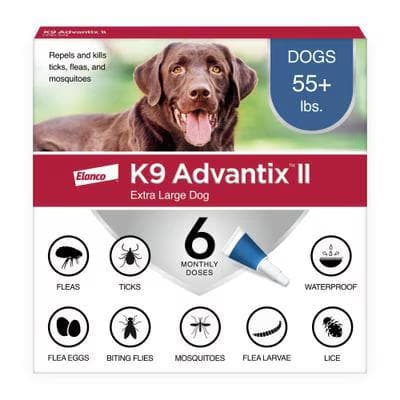
A monthly topical for dogs over 55 lbs that repels and kills ticks, fleas, and mosquitoes. Repelling ticks before they bite is a useful layer during heavy tick season.
Webvet may earn a commission when you click through to Chewy, at no extra cost to you.
The practical takeaway: "flea pills for dogs without a vet prescription" has exactly one good answer, Capstar, and Capstar only works for a day. There is no legal OTC equivalent of a monthly flea pill. Any website selling isoxazoline chews without requiring a prescription is operating illegally, and counterfeit risk is high.
Best OTC monthly topicals: Frontline Plus and K9 Advantix II
For month-to-month protection without a prescription, these two spot-on topicals are the field. Both are applied to the skin between the shoulder blades, both are sold in weight-banded doses, and both are widely available at grocery stores, pet retailers, and big-box chains, including the flea aisle at Walmart.
Frontline Plus: the fipronil standard
Frontline Plus combines fipronil, which kills adult fleas and ticks, with (S)-methoprene, an insect growth regulator that stops flea eggs and larvae from developing. That two-stage attack on the flea life cycle is its real strength: it does not just kill the fleas you see, it interrupts the next generation.
- Kills adult fleas within about 12 to 24 hours of contact
- Labeled for puppies 8 weeks and older
- Waterproof once fully dry, though frequent swimming or bathing erodes month-long protection
- Safe to use in households with cats (a separate feline Frontline product exists for the cat)
K9 Advantix II: kill plus repellency, with one hard rule
K9 Advantix II pairs imidacloprid (flea kill) with permethrin (tick and mosquito repellency) and pyriproxyfen (growth regulator). Its edge over Frontline Plus is repellency: permethrin deters ticks and mosquitoes before they bite, which matters for dogs in heavy tick country.
If your dog does not need tick or mosquito coverage, Advantage II is the flea-only version of the same imidacloprid formula without the permethrin. That also makes it the safer topical for homes with cats, where permethrin is dangerous. It kills fleas, larvae, and eggs but does not repel ticks.
- Kills fleas within about 12 hours; repels and kills ticks and mosquitoes
- Labeled for puppies 7 weeks and older and dogs over 4 pounds
- Never use on cats, and use caution in homes where cats groom or sleep against the dog
How to apply a spot-on so it actually works
Application technique decides whether either topical performs. Most "it did not work" stories start with one of these steps skipped:
- Part the fur until you see skin. The dose must land on skin, not sit on top of the coat.
- Apply between the shoulder blades or at the base of the skull, where the dog cannot reach to lick.
- Empty the entire applicator. A partial dose is the most common cause of early product failure.
- Skip baths for 48 hours before and after, so the skin's natural oils can carry the ingredient across the body.
- Mark the calendar and redose every 30 days. Stretching a monthly product to 5 or 6 weeks opens a protection gap fleas exploit.
Generics and store brands: what is worth buying at Walmart
The flea aisle at Walmart, Target, and grocery chains mixes legitimate generics with weak look-alikes; the label tells them apart. Fipronil is off patent, so generic fipronil plus (S)-methoprene spot-ons (PetArmor Plus is the best-known) contain the same actives at the same concentrations as Frontline Plus for noticeably less money.
Read the actives panel, not the front of the box, and apply two filters:
- Worth buying: spot-ons listing fipronil plus (S)-methoprene, or imidacloprid-based generics, at the same percentages as the name brand. Same chemistry, lower price.
- Approach skeptically: bargain spot-ons and collars whose only actives are older pyrethroids, and anything that lists only "essential oils." These are the products behind most "flea treatment did nothing" reviews.
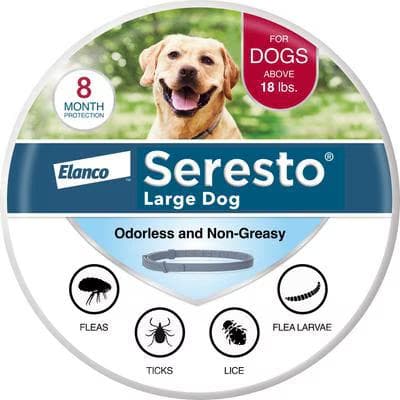
An eight-month flea and tick collar for dogs over 18 lbs that releases protection steadily. A low-effort layer to help keep ticks off between vet-recommended preventives.
Webvet may earn a commission when you click through to Chewy, at no extra cost to you.
One more label habit: confirm the EPA registration number on the back panel. Its presence means the product went through federal pesticide review; its absence means nobody verified the efficacy claims at all.
 Sponsored
Vet care that's always there
Unlimited video calls and messaging with licensed vets for less than a typical vet visit. One membership covers up to five pets.
Use code Pets60
Plans start at $12/month · covers up to 5 pets
- Licensed vets in most states
- Rx for 150+ conditions
- 4.7 on Trustpilot
Seresto collar: 8 months of OTC protection
The Seresto collar is the longest-lasting flea protection you can buy without a prescription: a single collar releases low doses of imidacloprid and flumethrin continuously for up to 8 months. For owners who forget monthly doses, that set-and-forget duration is the strongest argument in the entire OTC field.

The active ingredients spread through the skin's oil layer, so fleas and ticks are killed on contact, before they bite. The collar is labeled for puppies 7 weeks and older, keeps working through occasional swimming, and includes a release mechanism designed to open if the collar snags.
The safety controversy, in context
Seresto drew scrutiny after media reports compiled adverse-event complaints. The EPA reviewed the incident data and allowed the collar to remain on the market with updated reporting and labeling requirements, concluding the benefits outweighed the documented risks when the product is used as directed.
Two practical lessons survive that review: buy only from authorized retailers, because counterfeit collars are a real and documented problem, and remove the collar if your dog develops skin irritation at the site.
Fitting the collar so the 8 months actually happen
The collar only works while it touches skin, because the actives travel through skin oils. Fit it snugly enough to slide two fingers underneath, no looser, and trim the excess length. A collar dangling off the neck like jewelry protects nothing.
Expect protection to ramp up over the first 24 to 48 hours as the ingredients distribute. Recheck the fit monthly on growing puppies, and count the 8 months from the day you open the sealed tin, not the day you bought it.
Is the Seresto tick and flea collar for dogs worth it?
If you want a flea collar that lasts 8 months on a single fitting, the Seresto tick and flea collar for dogs is the one product on the OTC shelf that actually delivers it. Most drugstore flea collars fade within a few weeks; the slow, steady release of imidacloprid and flumethrin is what stretches one Seresto collar across two-thirds of a year.
That long-lasting design changes the math for a lot of households. Instead of remembering twelve separate monthly doses, you fit one collar, note the date, and swap it once. For a dog that squirms away from spot-on applications, or an owner who honestly forgets the monthly reminder, an 8-month flea and tick collar removes the exact step people are most likely to skip.
- One collar covers both fleas and ticks, so a separate tick preventive is usually unnecessary
- Spread across all 8 months, the per-month cost often lands below a monthly topical
- It layers safely with a Capstar tablet on the day you first fit it, clearing any fleas already aboard while the collar ramps up
The long duration is only real if the collar fits and stays on. A collar worn too loosely, stored past its date, or bought from an unauthorized seller will not give you the full 8 months, whatever the box promises, so fit it snugly and buy it from a retailer you trust.
Capstar (nitenpyram): the fastest OTC flea killer
What kills fleas immediately on dogs? Capstar. Its active ingredient, nitenpyram, is absorbed into the bloodstream and starts killing adult fleas within 30 minutes of the dose, with the vast majority dead within a few hours. No other product you can buy, prescription or otherwise, works faster on the fleas currently biting your dog.
The catch is duration. Nitenpyram clears the body within roughly 24 to 48 hours, and it has zero effect on eggs, larvae, or pupae. New fleas from the environment reinfest the dog the next day. Capstar is a rescue tool, never a program.
Where Capstar genuinely earns its place:
- Day one of an active infestation, to crash the adult flea population while a monthly product takes over
- After a boarding stay, dog park visit, or shelter pickup where the dog clearly picked up fleas
- Very young or small pets: it is labeled for puppies as young as 4 weeks and 2 pounds, earlier than any topical
- Flea-allergic dogs mid-flare, when every additional bite matters
The label allows a dose as often as once daily during an active infestation. But if you are dosing Capstar daily, the real problem is the flea reservoir in your home. Our guide to how to get rid of fleas on dogs covers the home and yard side, which is where infestations are actually won.
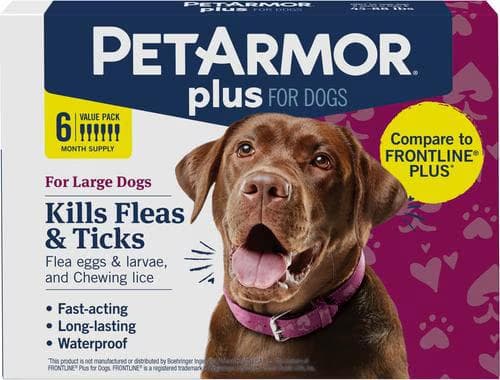
Webvet may earn a commission when you click through to Chewy, at no extra cost to you.
Capstar as a fast-acting flea pill for dogs
A fast-acting flea pill for dogs is exactly what Capstar is, and it is the only oral flea medication you can buy over the counter. Because nitenpyram is swallowed rather than smeared on the coat, it reaches biting fleas through the bloodstream, which is how a single tablet kills fleas faster than any topical or collar can.
Owners searching for a fast-acting flea pill usually have an urgent, visible problem: a dog scratching right now, or fleas spotted the night before a car trip or a grooming appointment. For that job a single Capstar tablet is the right tool, and you can give it the same day you see fleas without waiting for a vet visit or a prescription.
- It is a tablet, so there is no greasy spot-on residue and nothing to rub off onto furniture, bedding, or children
- It can be given with or without food and is small enough to hide in a treat for a fussy dog
- It layers cleanly with a monthly topical or the Seresto collar, which cover the weeks a single pill cannot
Keep the ceiling in mind, though. A fast-acting flea pill kills fleas fast but only briefly, so Capstar buys you a day of relief, not a month of protection. Treat it as the opening move of a program, then hand the job to a longer-lasting OTC product the same day.
Flea shampoos and sprays: a supporting role only
Flea shampoos, including well-formulated options like Adams Plus, kill the fleas on your dog during the bath and provide little protection afterward. They are a cleanup step for a flea-covered dog, not prevention. Bathing too close to a topical application actually strips the topical's protection.
For how the good shampoos work, which ingredients matter, and when a bath is genuinely the right first move, see our full guide to flea shampoo for dogs.
Why growth regulators matter: breaking the flea life cycle
Adult fleas are only about 5 percent of a flea infestation. The other 95 percent lives off the dog as eggs, larvae, and pupae in carpet, bedding, and floor cracks. An OTC product that only kills adults treats the visible tip of the problem while the reservoir keeps producing replacements.
That is why the insect growth regulator (IGR) in a product's ingredient list matters as much as the adulticide. IGRs mimic insect hormones, so eggs laid by any surviving flea fail to hatch and larvae never mature:
- (S)-methoprene: the IGR in Frontline Plus and many generic equivalents
- Pyriproxyfen: the IGR in K9 Advantix II and many premise sprays
- No IGR: Capstar, plain fipronil-only generics, and most flea shampoos, which is why none of them can run a program alone
The Companion Animal Parasite Council recommends year-round flea control for dogs rather than seasonal treatment, precisely because the life cycle continues indoors through winter. Whichever OTC product you choose, consistency beats intensity: an average product used every month outperforms a premium product used sporadically.
What does not work: garlic, ultrasonic devices, and other myths
There is no natural flea treatment for dogs with efficacy anywhere near the EPA-registered products above. That is the honest answer to "what is the most effective natural flea treatment," and it is worth saying plainly because the natural-remedy aisle is where owners lose weeks while an infestation compounds.
The common claims, examined:
- Garlic: does not kill or repel fleas at any meaningful level, and it damages canine red blood cells. Feeding garlic for fleas adds toxicity risk with no benefit.
- Ultrasonic repellers: repeatedly tested, repeatedly shown to have no effect on flea behavior. Fleas do not navigate by sound.
- Essential-oil sprays and collars: weak, short-lived repellency at best, and concentrated oils like tea tree and pennyroyal are themselves toxic to dogs and especially cats.
- Brewer's yeast, apple cider vinegar, and diatomaceous earth on the coat: no reliable evidence of on-dog efficacy; inhaled diatomaceous earth dust irritates airways.
If your dog has already been given garlic or doused in essential oils and seems unwell, contact your veterinarian or ASPCA Animal Poison Control. "Natural" and "safe" are not synonyms, and the least toxic flea medicine is the correctly dosed, correctly chosen registered product, not the home remedy.
Which OTC option is safest for your dog?
Every product in this guide is safe for most healthy adult dogs when used exactly as labeled. The safety failures that fill poison-control case files are almost always matching failures: wrong species, wrong weight band, wrong age, or a cat in the wrong place at the wrong time.

If safety is your primary decision driver, for example a dog with a seizure history, a very small senior, or a multi-pet household with young children, our dedicated guide to the safest flea treatment for dogs walks through product selection from the safety side first, across both OTC and prescription options.
How to choose: budget, cats, water, and infestation status
Four questions sort nearly every dog into the right OTC product. Answer them in order and the choice usually makes itself.
| Your situation | Best OTC fit | Why |
|---|---|---|
| Cat in the household | Frontline Plus or Seresto | Both are permethrin-free; K9 Advantix II is off the table unless pets are strictly separated |
| Dog swims or gets bathed weekly | Seresto collar | Sustained release outlasts water exposure that strips monthly topicals |
| Heavy tick or mosquito pressure | K9 Advantix II (no cats at home) | Permethrin repellency deters ticks and mosquitoes before they bite |
| Active infestation right now | Capstar today, plus a monthly product and home treatment | Fast knockdown, then residual control while you clear the environment |
| Tightest budget per month | Frontline Plus (generic fipronil options exist) | Lowest cost of entry among effective monthly options |
| Forgetful with monthly doses | Seresto collar | One decision covers up to 8 months |
One distinction matters more than any product choice: prevention and eradication are different jobs. No on-dog product alone will clear an established infestation from your home. Treat the dog and the environment together, following the full plan in our guide to getting rid of an established flea infestation.
When a prescription chew is worth the vet visit
OTC products can absolutely run a successful flea program. But three situations justify the exam fee for a prescription isoxazoline chew:
- OTC products have genuinely failed after correct use, suggesting local resistance
- Your dog has flea allergy dermatitis, where the faster, more complete kill of an isoxazoline measurably reduces flares
- You want one product covering fleas, ticks, and (in combination products like Simparica TRIO or NexGard PLUS) heartworm prevention in a single monthly dose
The FDA advises caution with the isoxazoline class in dogs with seizure histories, one more reason this class runs through a veterinarian. For a full comparison of NexGard, Simparica TRIO, Bravecto, and Credelio, including how they differ on speed, duration, and parasite coverage, see our complete guide to oral flea treatments for dogs.
Frequently asked questions
Are OTC flea treatments as effective as prescription ones?
Not quite. The best OTC options (Frontline Plus, K9 Advantix II, Seresto) provide solid protection for most dogs, but prescription isoxazoline chews consistently deliver faster, more complete flea kill in comparative studies. For a healthy dog with light flea pressure, OTC is usually enough. For flea-allergic dogs or heavy infestations, prescription products earn their cost.
Can I buy monthly flea pills for my dog without a vet prescription?
No. The only oral flea product legally sold over the counter in the US is Capstar, and it lasts about 24 hours. Every monthly or 12-week oral flea product (NexGard, Simparica TRIO, Bravecto, Credelio) is an FDA-regulated prescription drug. Sites offering them without a prescription are selling illegally, and counterfeits are common.
How long does an OTC topical take to start working?
K9 Advantix II begins killing fleas within about 12 hours; Frontline Plus within about 12 to 24 hours. Neither is instant, because the ingredient must spread across the skin's oil layer first. If you need fleas dead this afternoon, give Capstar alongside the topical; the two work through different mechanisms and are commonly combined this way.
Can I use a dog flea treatment on my cat if I lower the dose?
Never. Dose math does not fix species toxicity. Permethrin products like K9 Advantix II can cause fatal tremors and seizures in cats at any dose, and dog-strength concentrations of other ingredients are also unsafe. Cats need cat-labeled products only. If a cat is accidentally exposed to a dog product, contact a veterinarian immediately.
Do fleas have to bite my dog for OTC products to work?
It depends on the product. Contact-kill products (Frontline Plus, K9 Advantix II, Seresto) kill fleas through surface exposure, no bite required, and K9 Advantix II and Seresto add repellency. Systemic products like Capstar and the prescription chews require the flea to bite before it ingests the drug. For flea-allergic dogs, contact-kill and repellent products reduce bites the most.
The bottom line
The OTC field is smaller than the pet-store shelf suggests: two strong monthly topicals, one 8-month collar, one fast-kill tablet, and a supporting cast of shampoos. Match the product to your household (especially the cats), your dog's weight and age, and your actual problem, prevention versus an active infestation, and over-the-counter protection works.

Editor
The Webvet Editorial Team is the in-house group of pet-care editors and writers behind Webvet, operated by Smart Pet Collective. The team researches, writes, and maintains Webvet's pet health, behavior, and medication content. Every article follows a defined editorial process: research from reputable veterinary and scientific sources, careful drafting, mandatory review of medical content by a credentialed veterinarian, and dated publication. Health and medication articles are medically reviewed by a licensed veterinary professional before they go live and are kept current over time.
Veterinarian · BVMS MRCVS
Dr. Pippa Elliott, BVMS, MRCVS, is a veterinarian with nearly 30 years of experience in companion animal practice. Dr. Elliott earned her Bachelor of Veterinary Medicine and Surgery from the University of Glasgow. She was also designated a Member of the Royal College of Veterinary Surgeons. Married with 2 grown-up kids, Dr. Elliott has a naughty Puggle named Poggle, 3 cats and a bearded dragon.


