Cat Anxiety: Signs, Causes, and How Vets Treat It
Hiding, over-grooming, litter box misses, and 3am yowling can all be anxiety, and they can all be disease. Here is how to tell, what a vet checks first, and the environmental, behavioral, and medication options that actually help.

BVMS MRCVS

This article contains affiliate links. Webvet may earn a commission when you buy through them, at no extra cost to you.
Cat anxiety is a sustained state of anticipating something bad, and it changes how a cat behaves even when nothing threatening is actually in the room. Fear is the reaction to a threat that is present right now. Stress is the physical load those states put on the body. A cat startled by the vacuum and settled again ten minutes later was afraid. A cat that stays braced, flattened, and watchful for days is describing something closer to anxiety.
The complication is that cat anxiety has no signature sign of its own. Hiding, over-grooming a bald patch, urinating outside the box, sudden growling, and 3am yowling are all produced just as reliably by pain, urinary disease, thyroid disease, and high blood pressure as they are by emotional distress. That is why the honest first step is a veterinary exam, not a calming product, and why this guide puts the medical rule-out before a single management tip.
- 1Anxiety in cats is anticipation of a threat, fear is the response to a threat that is present, and stress is the physical toll of both, which is why the three are managed differently.
- 2The most common presentations are hiding, over-grooming, litter box changes, new aggression, and increased vocalizing, and most owners notice a cluster of two or three rather than one dramatic sign.
- 3Every one of those signs is also a disease sign, so a physical exam with bloodwork, urinalysis, blood pressure, and thyroid testing in older cats comes before any behavior plan.
- 4Two situations inside the anxiety frame are emergencies: open-mouth breathing or panting in a cat, and a cat straining in the litter box without producing urine.
- 5Environmental management works when it is specific, meaning enough litter boxes and feeding stations placed apart, vertical escape routes, a predictable routine, and daily hunting-style play.
- 6Medication is a legitimate tool for moderate to severe cases and is always prescription-led, with daily drugs taking roughly four to six weeks to reach full effect.
- 7Situational anxiety with a removable trigger often resolves, generalized anxiety is usually managed rather than cured, and meaningful progress is measured in weeks to months.
What cat anxiety is, and how it differs from fear and stress
Veterinary behavior medicine draws a clean line between three states that owners tend to use interchangeably. Getting the distinction right matters, because it decides whether you are removing a trigger, teaching a new association, or treating a cat whose nervous system stays switched on regardless of what is happening around it.
- Fear is a normal, protective response to something present and identifiable: a stranger at the door, a dog barking, a carrier on the floor.
- Anxiety is the anticipation of a threat that may not arrive at all, so the cat behaves defensively in an empty room.
- Stress is the physiological load, the cortisol and adrenaline side, which is what eventually shows up as bladder inflammation, over-grooming, or a suppressed appetite.
- Phobia is an extreme, disproportionate, and persistent fear response that does not fade with repeated harmless exposure, which is the pattern behind many noise reactions.
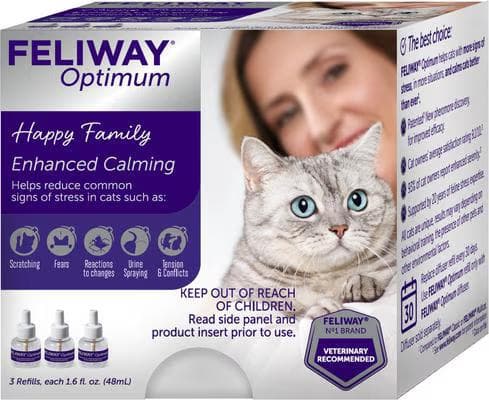
Owners very often reach for a background calming aid at exactly this point, before that distinction has been made. A plug-in pheromone product such as the Feliway Classic 30 Day Starter Kit releases a synthetic analog of the facial pheromone cats deposit when they rub against furniture, it runs quietly in the background, and it carries little risk, which is why it is such a common first move. What it cannot do is tell you which of the three states above you are actually looking at, and it cannot rule out a medical cause.
Webvet may earn a commission when you click through to Chewy, at no extra cost to you.
Situational anxiety versus generalized anxiety
Situational anxiety is tied to an identifiable event: the carrier, the car, the vet room, fireworks, the vacuum, a visitor. It has a beginning and an end, and it responds well to preparation. Generalized anxiety has no clean on and off switch. The cat is watchful, quick to startle, slow to settle, and often hides for most of the day regardless of what is happening in the house. Separation anxiety sits between the two: it is triggered by an owner's absence but produces a persistent baseline of distress in cats who are strongly attached to one person.
That distinction shapes everything downstream. Situational cases are usually solved with environmental changes plus a short-acting medication given before the event, while generalized cases usually need daily medication layered on top of long-term environmental work. Both need the medical rule-out below before either label is applied.
Signs of cat anxiety, from easy to miss to impossible to ignore
Cat anxiety symptoms are often quiet and easy to misread. Cats do not signal distress the way dogs do. There is no whining at the door and no obvious clinging. What you get instead is subtraction: a cat that is around less, eats less, plays less, and occupies a smaller share of the house than it did six months ago. Most owners notice a cluster of two or three signs rather than one dramatic change.
Behavior you can see from across the room
- Hiding and withdrawal. Spending most of the day under a bed, behind a sofa, or in a closet, and only emerging at night when the house is quiet.
- New or escalating aggression. Hissing, swatting, or growling at housemates, guests, or a person who could previously pick the cat up.
- Increased vocalizing. Yowling at night, or a persistent, urgent call that is different in pitch from a normal greeting or a food demand.
- Restlessness and pacing. Unable to settle, repeatedly changing spots, or sudden bursts of running that look like panic rather than play.
- Escape attempts. Door-dashing, clawing at windows, or fixating on getting out, which we cover in more depth in our guide to a cat that keeps trying to escape.
Signs on the body
- Over-grooming. Licking one flank, the belly, or the inside of the back legs until the coat thins or a bald stripe appears, sometimes with no broken skin at all.
- Litter box changes. Urinating on soft surfaces or by doors and windows, spraying vertical surfaces, or standing at the box without using it.
- Appetite change. Eating noticeably less, refusing food when the house is busy, or eating only at night.
- Posture. Crouched low with weight on the paws, tail wrapped tight, ears rotated back or flattened, and pupils dilated in normal light, which our guide to cat body language breaks down in detail.

A quick self-check before you call the clinic
There is no validated at-home quiz for feline anxiety, but the questions a veterinary behavior consult opens with are worth answering before your appointment. Write the answers down and take them with you.
- How many hours a day is your cat visible, and how does that compare to six months ago?
- Has anything changed in the household in the last three months, including people, pets, furniture, work schedules, or building work nearby?
- Where exactly is the cat urinating, and is it on soft horizontal surfaces or sprayed on vertical ones?
- Is there a bald or thinned patch, and can you reach it with a hand without the cat reacting to being touched there?
- Does the cat still come out for something it never refuses, and does it still play for even a minute or two?
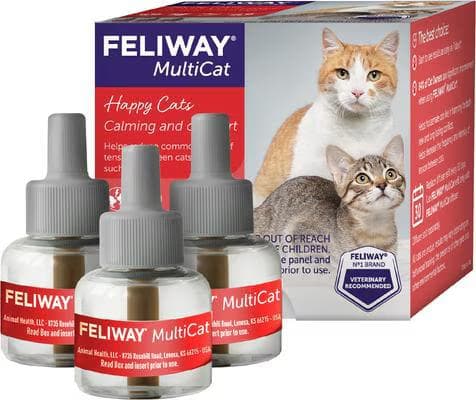
That last question is more useful than it looks. Offer something with a very high value, like a lickable puree treat such as Feliway Happy Snack Chicken Puree Lickable Cat Treats, and watch what happens. A cat that breaks cover for it and eats is stressed but still engaging with the world. A cat that will not come out for the one thing it never turns down is more shut down, and that is worth reporting to your vet as its own finding.
Webvet may earn a commission when you click through to Chewy, at no extra cost to you.
The rule that matters most: anxiety signs and disease signs look identical
This is the part almost every article on this topic skips, and it is the reason the article exists. There is not one sign on the list above that belongs exclusively to anxiety. A cat hiding all day may be in pain. A cat licking a bald patch may have flea allergy dermatitis. A cat urinating on the bath mat may have cystitis or stones. A senior cat yowling at 3am is more likely to have a thyroid or blood pressure problem than a psychological one.
VCA states plainly that anxiety signs in cats are non-specific and that physical health problems should be ruled out first. What almost nobody tells owners is which conditions and which tests. Here is the map.
| Sign you are seeing | Medical conditions a vet rules out | Workup that does it |
|---|---|---|
| Hiding, less movement, no jumping | Osteoarthritis, dental pain, injury, fever, anemia | Full physical exam including joints and mouth, bloodwork, imaging if a painful area is found |
| Over-grooming or a bald patch | Flea allergy dermatitis, food or environmental allergy, skin infection, pain under the licked area | Skin and flea exam, skin cytology, strict parasite control trial, diet trial |
| Urinating outside the box | Feline idiopathic cystitis, bladder stones, urethral obstruction, urinary infection, diabetes, kidney disease | Urinalysis, urine culture, bloodwork, bladder imaging |
| New aggression or touch sensitivity | Pain (arthritis, dental, ear disease), hyperthyroidism, systemic hypertension, neurological disease | Exam, thyroid panel, blood pressure, full bloodwork |
| Night vocalizing in an older cat | Hyperthyroidism, hypertension, cognitive dysfunction syndrome, hearing or vision loss, kidney disease | Thyroid panel, blood pressure, bloodwork and urinalysis, eye exam |
| Appetite or weight change | Dental disease, gastrointestinal disease, kidney disease, hyperthyroidism, nausea | Exam, bloodwork, urinalysis, imaging |

Ask for the specific workup rather than a general check. In a cat under seven with elimination signs, that means a physical exam, urinalysis, and usually bloodwork. In a cat over ten with any behavior change, it means adding a thyroid panel and a blood pressure reading, because both hyperthyroidism and hypertension present as behavior change long before they present as anything else. Pain is the single most under-diagnosed driver, and it is worth reading our guide to what is normal and what is not in senior cat mobility if your cat is middle-aged or older.
Common triggers, and what a sudden change in behavior means
Once disease is off the table, triggers usually turn out to be unremarkable to a human and enormous to a cat. Cats are territorial animals with a strong preference for predictability, and most of what destabilizes them is a change to the layout, the schedule, or the social makeup of their space.
- Household and routine change. A move, a renovation, new furniture, a change in your work hours, or a family member leaving home.
- New pets or people. A new cat or dog, a baby, a housemate, or frequent guests. Introductions done fast are one of the most reliable ways to create a long-running problem.
- Resource competition. Multi-cat homes where boxes, food, water, and resting spots are clustered in one area, forcing cats to pass each other to reach anything they need.
- Noise and unpredictability. Building work, fireworks, thunderstorms, a new appliance, or an alarm that goes off at odd hours.
- Vet visits and travel. The carrier, the car, and the clinic form one of the most concentrated stress chains a house cat encounters.
- Under-stimulation. An indoor cat with nothing to hunt, climb, or investigate is not calm, it is understimulated, and that surfaces as night activity, over-grooming, or play aggression.
- Separation. Cats strongly bonded to one person can become distressed in that person's absence, showing destructive behavior, vocalizing, or eliminating on the owner's belongings.
When a trigger is one you can see coming, such as a move, a new baby, or scheduled building work, start early rather than reacting on the day. Some veterinarians add a daily supplement in the run-up, and Purina Pro Plan Veterinary Diets Calming Care is a commonly used example: it is a probiotic fed once daily, and the manufacturer's own guidance is to allow around six weeks of daily feeding before judging it, which tells you it is a preparation tool and not a rescue one. It does not replace the environmental work below, and it is not a treatment for a diagnosed condition.
Webvet may earn a commission when you click through to Chewy, at no extra cost to you.
Why is my cat scared of me all of a sudden?
Lead with pain. An abrupt change from affectionate to avoidant in a cat that previously liked being handled is a pain presentation until proven otherwise, because a cat that hurts when it is picked up learns quickly to avoid the person who picks it up. The second explanation is redirected aggression: a cat aroused by something it cannot reach, usually another cat outside a window, redirects onto whoever is closest, and can stay reactive to that person for hours or days afterward. The third is a negative association, where one bad experience (a pill, a nail trim, a startle) attaches itself to you. See the vet first, then give the cat control over the approach rather than pursuing it, and if the reaction is aimed at visitors rather than you, our guide to fear aggression toward guests covers the handling in detail.

Environmental and behavioral management that actually moves the needle
Cat anxiety relief starts with specific environmental changes. Most advice at this stage is too vague to act on. The version that works is specific, and it starts with resources, because resource competition is the most common fixable driver in a multi-cat home. The guideline used in feline practice is one of each key resource per cat plus one spare, distributed rather than grouped.
- Litter boxes. Two cats means three boxes, in three separate locations, not three boxes side by side in the same utility room. Each box should be roughly one and a half times the length of the cat, uncovered if the cat is anxious, and placed where nothing can corner the cat while it is inside.
- Food and water. Separate bowls in separate rooms, and water away from food. A cat that has to eat shoulder to shoulder with a housemate it is avoiding will simply eat less.
- Resting spots. Multiple options at different heights, including at least one that is fully enclosed and one that is elevated with a view of the room's entrance.
- Escape routes. Every room a cat uses regularly should have a way out that does not involve passing another animal.
Build a safe room before you need it
A safe room is the piece of this that is worth having in place before anything goes wrong. Pick a quiet room the cat already likes, and put in it: a litter box, food and water at opposite ends, a covered bed or a cardboard box on its side, an elevated perch, a scratching post, and something of yours that smells of you. Leave the door open so it functions as a retreat rather than a confinement, and use it as the base whenever the house becomes unpredictable, such as during building work, a party, or the first fortnight after a new pet arrives.
Vertical space and escape routes
Cats manage social pressure by climbing. Height gives distance without confrontation, and a room with good vertical structure genuinely reduces conflict in multi-cat homes. That means shelves, a windowsill perch, the top of a wardrobe, or a tall multi-level tree such as the Yaheetech Multi-Level 63-in Plush Cat Tree, which is tall enough to put a cat above standing human eye level. Put it where the cat already chooses to sit, near a window and not in a traffic corridor, and expect it to be ignored for a week before it becomes the most-used object in the room.
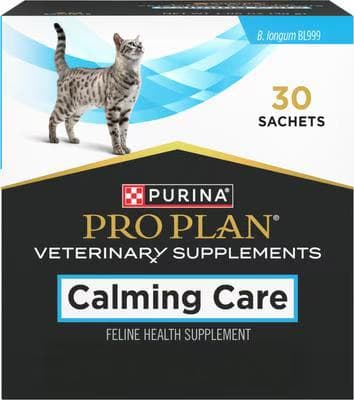
Probiotic supplement with Bifidobacterium longum BL999 that supports cats in maintaining calm behavior plus digestive and immune health. One daily sachet.
Webvet may earn a commission when you click through to Chewy, at no extra cost to you.

How to help a cat with bad anxiety
For a cat that is severely affected, work in this order and give it time. First, complete the veterinary workup so you are not managing a behavior problem that is actually a bladder or a joint problem. Second, fix resources and add vertical escape routes, because no amount of training compensates for a cat that cannot get away from a housemate. Third, make the day predictable: feed, play, and clean at the same times, since predictability is what lowers baseline arousal. Fourth, add two short play sessions a day that follow a hunting arc of stalk, chase, catch, and eat, finishing with food. Fifth, start desensitization and counterconditioning on the specific trigger. Sixth, if there is no meaningful change after four to six weeks of consistent work, go back to your vet and discuss medication or a referral. Our guide to short-term cat stress relief covers what to do in the moment while the longer plan takes hold.
Desensitization and counterconditioning, in plain language
Desensitization means exposing the cat to a weak version of the trigger, so weak that it notices but does not react, then increasing it in very small steps. Counterconditioning means pairing that weak exposure with something excellent so the trigger starts to predict good things. In practice, for a carrier, that is leaving the carrier out permanently with the door off, feeding meals beside it, then inside it, then closing the door for two seconds, then three. The rule is simple: if the cat stops eating, freezes, or leaves, you moved too fast and the last step was too big. Enrichment does the same job preventatively, which is why enrichment for bored indoor cats, puzzle feeders that make cats work for food, and cat puzzle toys belong in an anxiety plan rather than in a separate box marked fun.
What makes cat anxiety worse
- Punishment. Shouting, spray bottles, and physical correction increase arousal and teach the cat that you are unpredictable. They do not reduce spraying, hiding, or aggression.
- Forcing the cat out of hiding. Pulling a frightened cat out from under a bed reliably produces bites and scratches and removes the one coping strategy it has.
- Flooding. Exposing the cat to the full-strength trigger until it stops reacting is not habituation, it is shutdown, and it usually makes the response worse over time.
- Restricting access. Shutting an anxious cat into a small space it did not choose adds a trigger rather than removing one.
- Changing everything at once. Multiple simultaneous changes make it impossible to identify what is helping, and change itself is a stressor for cats.
When medication is appropriate, and what vets actually prescribe
Medication is not a last resort or an admission of failure. It is appropriate when anxiety is severe enough to affect welfare, when it has not responded to consistent environmental work, when the cat is self-injuring through over-grooming, or when the trigger is unavoidable and predictable, such as a flight or a course of veterinary treatment. It works best alongside behavior work, not instead of it, because medication lowers arousal enough for the cat to be able to learn.

Is there cat anxiety medication over the counter? No safe product fits that description, and there is no single best anti-anxiety medication for cats; the choice depends on diagnosis, health, and trigger. All of the options below are prescription-only and are chosen, dosed, and monitored by a veterinarian who has examined the cat. One oral pregabalin solution is licensed specifically for cats to reduce acute anxiety and fear around transport and veterinary visits. Most of the rest are used extra-label in cats, which is legal, routine, and evidence-informed in veterinary practice, but it is a decision that belongs to your vet. No doses appear here on purpose.
| Class and examples | Typically used for | How long before it works | Commonly reported side effects |
|---|---|---|---|
| Daily SSRI (fluoxetine) | Generalized anxiety, urine marking, compulsive over-grooming | 4 to 6 weeks for full effect | Sedation in the first weeks, reduced appetite, gastrointestinal upset |
| Tricyclic (clomipramine, amitriptyline) | Generalized anxiety, marking, compulsive behavior | 4 to 6 weeks for full effect | Sedation, constipation, dry mouth, urine retention |
| Gabapentin | Predictable single events: carrier, car, clinic, grooming | Given a few hours before the event | Sedation, wobbliness, occasional vomiting |
| Trazodone | Short-course situational anxiety, post-operative confinement | Given 1 to 2 hours before the event | Sedation, gastrointestinal upset, agitation in a minority of cats |
| Pregabalin oral solution | Transport and veterinary-visit anxiety, licensed for cats | Given ahead of the event as directed | Sedation, wobbliness, vomiting, hypersalivation |
| Buspirone | Milder ongoing anxiety and some multi-cat conflict cases | 1 to 2 weeks | Increased boldness or affection, occasional gastrointestinal upset |
Two practical points owners rarely hear. First, a sedated cat is not a calm cat: older sedatives that flatten movement without reducing fear can leave an animal fully frightened and unable to react, which is why they have fallen out of favour for anxiety. Second, giving the medication is often the hard part, and crushing tablets into a whole meal usually fails because the cat eats around it. Ask for a flavoured liquid or a compounded formulation, hide the dose in a small high-value portion given before the meal rather than mixed into it, and ask the clinic to demonstrate the technique before you leave.
When to involve a veterinary behaviorist
If the cat is self-injuring, if aggression has caused an injury to a person or another pet, if there has been no measurable improvement after a properly run environmental plan plus medication, or if you are close to rehoming, ask for a referral to a board-certified veterinary behaviorist. It is worth saying plainly that living with a severely anxious cat is exhausting, that plateaus and relapses around routine changes are normal rather than a sign you did it wrong, and that most owners underestimate how slow the timeline is. Meaningful change is measured in weeks to months, not days.
Calming products: what each category can and cannot do
To calm a cat down from stress or when it seems angry, start with the trigger and the environment. If you are asking what helps anxiety in cats naturally, environmental changes come first and calming products are supportive tools. None of them diagnose anything, none of them replace a veterinary workup, and none of them treat a medical condition.
- Pheromone analogs. Synthetic versions of the facial or maternal pheromones cats use to mark territory as safe, sold as plug-in diffusers, sprays, and wipes. Study results are mixed but the safety profile is good, which is why they are a reasonable first layer. Our guides to cat pheromone diffusers and whether pheromone diffusers are safe cover the detail.
- Nutraceutical supplements. Alpha-casozepine (the ingredient in Zylkene), L-theanine, and probiotic strains marketed for calm behavior. Evidence quality is lower than for prescription drugs, effects are modest where present, and most need weeks of daily dosing.
- Calming treats and chews. Convenient, usually containing the same ingredients as the supplements above at varying strengths. Read the label for the actual ingredient rather than the claim on the front.
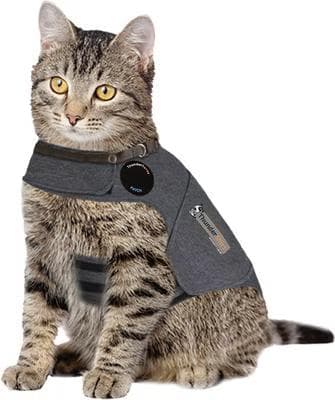
- Compression wraps and vests. Applied pressure suits some cats and is disliked by others. Harmless to try, worth abandoning quickly if the cat freezes or tries to remove it. The ThunderShirt Anxiety Vest for Cats, Medium is one fitted option, but remove it promptly if your cat freezes, struggles, or avoids moving normally.
- Diet and enrichment products. Puzzle feeders, foraging toys, and scratching furniture change behavior by changing what the cat does all day, which is often more durable than anything that comes in a bottle.
For product-level comparisons and which options veterinarians actually suggest, see our guide to cat calming products. Tell your vet about anything you are already giving, including supplements and treats, before a prescription is written.
Frequently Asked Questions
What is the 3-3-3 rule for cats?
The 3-3-3 rule is a shelter and rescue rule of thumb for a newly adopted or rehomed cat: roughly three days to decompress and mostly hide, three weeks to start learning the routine and showing real personality, and three months to feel genuinely at home. It is a useful expectation-setter rather than a clinical standard, and it is a reason not to diagnose anxiety in the first fortnight after a move. If a cat is still hiding constantly at the three-month mark, that is worth a veterinary conversation.
Does cat anxiety go away?
It depends on the type. Situational anxiety attached to a trigger you can remove or prepare for often resolves, and a cat that was anxious because of resource competition can settle within weeks of the resources being fixed. Generalized anxiety is more often managed than cured, with some cats weaned off medication after six to twelve months and others staying on it long term. Expect improvement in weeks to months, and expect relapses around house moves and routine changes.
Can catnip help with cat anxiety?
Not in the way most owners assume. Catnip produces a short stimulant and euphoric response lasting around ten minutes in cats that respond to it, followed by a refractory period, and responsiveness is inherited, so a substantial share of cats show no reaction at all. It is not an anxiolytic and it will not lower a cat's baseline anxiety. The genuine value is enrichment and play motivation, which does matter, and catnip toys are a reasonable part of a broader plan. Silver vine is an alternative for non-responders.
What to get for anxious cats?
Start with what changes the environment rather than what comes in a package: enough litter boxes in separate locations, food and water away from each other, vertical perches, an enclosed retreat, and a scratching post tall enough to stretch on. After that, pheromone diffusers and calming supplements are the usual first product layer, and interactive toys that create a daily hunting sequence do more than most owners expect. Our roundup of cat calming products covers the specific options and where each one fits.
Is there a cat anxiety medication you can buy over the counter?
No true anxiolytic is available over the counter for cats. What you can buy without a prescription are supplements and pheromone products: alpha-casozepine, L-theanine, calming probiotic strains, and synthetic pheromone analogs. These are not equivalent to prescription medication, their evidence base is weaker, and they are not appropriate on their own for a cat with severe anxiety or one that is self-injuring. Human over-the-counter medications should never be used in cats without veterinary direction.
How do you treat separation anxiety in cats?
Confirm it first, ideally with a phone video of what the cat does after you leave, since night-time noise and elimination often have other explanations. Then reduce the contrast between present and absent: make departures and returns low-key, feed a puzzle-fed meal or a food toy right before you go, leave something that smells of you, and add climbing and window access so there is something to do. Build tolerance by leaving for very short periods and extending gradually. Severe cases warrant a veterinary consult about medication.
Can you give a cat anxiety medication for travel?
Yes, with a prescription, and this is one of the clearest indications for short-acting medication. Vets commonly use gabapentin or a licensed pregabalin oral solution for transport and clinic visits, given ahead of the journey rather than during it. Always do a trial dose at home on a normal day before travel day so you know how your cat responds, and pair the medication with carrier training rather than relying on it alone. Check airline and destination requirements well in advance.
Sources

Editor
The Webvet Editorial Team is the in-house group of pet-care editors and writers behind Webvet, operated by Smart Pet Collective. The team researches, writes, and maintains Webvet's pet health, behavior, and medication content. Every article follows a defined editorial process: research from reputable veterinary and scientific sources, careful drafting, mandatory review of medical content by a credentialed veterinarian, and dated publication. Health and medication articles are medically reviewed by a licensed veterinary professional before they go live and are kept current over time.
Veterinarian · BVMS MRCVS
Dr. Pippa Elliott, BVMS, MRCVS, is a veterinarian with nearly 30 years of experience in companion animal practice. Dr. Elliott earned her Bachelor of Veterinary Medicine and Surgery from the University of Glasgow. She was also designated a Member of the Royal College of Veterinary Surgeons. Married with 2 grown-up kids, Dr. Elliott has a naughty Puggle named Poggle, 3 cats and a bearded dragon.


