Cat Body Language: What Your Cat Is Telling You
Cats say a lot without making a sound. This vet-reviewed guide decodes cat body language head to tail, so you can read your cat's tail, ears, eyes, whiskers, and posture and know exactly how they feel.

BVMS MRCVS

This article contains affiliate links. Webvet may earn a commission when you buy through them, at no extra cost to you.
Cat body language is how cats tell you almost everything they feel, mostly without a sound. Read the whole cat at once (tail, ears, eyes, whiskers, and posture, plus what is happening around them) and you can tell in seconds whether your cat is happy, scared, overstimulated, or unwell.
Cats are quiet communicators. While dogs broadcast their feelings loudly, cats speak in a layered, subtle language of posture and motion that is easy to miss until you know what to look for.
The good news: it is very learnable. Once you can read cat body language fluently, you will prevent bites and scratches, catch stress and illness earlier, and build a deeper, calmer relationship with your cat.
This vet-reviewed guide decodes that language head to tail. It then pulls it together into clear emotional profiles, a vocalization section, a dedicated look at the body language of a sick or painful cat, and a quick-reference chart you can come back to anytime.
- 1Read the whole cat plus the context, never one signal in isolation. A flicking tail means very different things on a hunting cat versus a cat you are petting.
- 2The clearest happy signals: a tail held straight up, forward ears, slow blinks, kneading, and a relaxed, loose body.
- 3The clearest 'give me space' signals: flattened sideways or pinned-back ears, dilated pupils, a crouched or puffed-up body, and a lashing tail.
- 4Cats hide illness by instinct, so subtle changes (hunching, hiding, squinting, less grooming) can be the first sign your cat is in pain and needs a vet.
- 5A cat that cannot urinate is a life-threatening emergency that needs care within hours, not after a day. This affects female cats too, though it is most common in males.
- 6Most meowing is aimed at humans, not other cats. Your cat learned that talking gets your attention.
What Is Cat Body Language (and Why Reading It Matters)
Cat body language is the system of nonverbal signals (tail position, ear angle, eye shape, whisker set, body posture, and fur) that cats use to express emotion and intent.
Cats are highly visual, scent-driven communicators, so they layer these signals together into something like a single sentence. The skill is not memorizing one cue at a time. It is learning to read several cues at once and weigh them against the situation.
Why reading the signals matters
Why does this matter so much? There are three big reasons.
- Safety: most cat bites and scratches happen because a person missed (or ignored) the warning signs that came first.
- Health: because cats instinctively mask pain and illness, a shift in body language is often the earliest clue that something is wrong, sometimes days before more obvious symptoms appear.
- The bond: a cat who feels understood and not pushed past their limits learns to trust you, and trust is the whole foundation of life with a cat.
If your real question is whether your cat actually likes you, the affection signals that show your cat likes you run throughout this guide, and your cat is almost certainly telling you more than you realized.
Reading Your Cat's Tail

The tail is the most expressive part of a cat and the best place to start. It moves constantly and broadcasts mood at a distance, which is exactly why it is so useful to read.
- Tail straight up, often with a little hook at the tip: this is the single clearest friendly greeting a cat gives. It means confidence and a happy 'hello.' A cat who trots toward you with the tail up like a flagpole is genuinely glad you are here.
- Tail held straight up and visibly quivering or vibrating: this is high excitement and also a scent-marking gesture. A cat may do this as an intense, happy greeting, but the same upright quiver against a vertical surface (often with a treading motion of the back feet) is urine marking. Read the context: a quivering tail as your cat rushes to greet you is affectionate, while a quivering tail aimed at a wall or doorframe is your cat leaving a scent message.
- Puffed-up, bottlebrush tail: the tail (and sometimes the whole body) fluffs to make the cat look bigger. This is fear or a threat response, not aggression for its own sake. The cat feels cornered or startled and is bluffing to scare off whatever frightened them.
- Tucked tail, wrapped tight against or under the body: anxiety, insecurity, or appeasement. The cat is trying to take up less space and avoid notice.
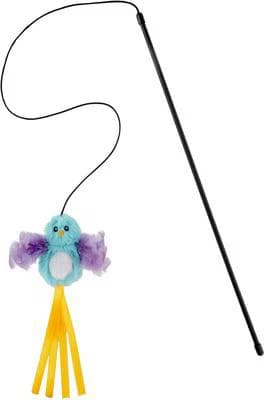
Teaser wand with a feathered bird charm and catnip to trigger your cat's chase-and-pounce instinct.
Webvet may earn a commission when you click through to Chewy, at no extra cost to you.
- Low tail with a fast swish, lash, or thump: irritation or overstimulation. This is a warning, not an invitation. A thumping tail on a cat in your lap is one of the most commonly missed 'I am done being petted' signals.
- Question-mark or gently curved tail: a playful, curious, approachable mood. A small twitch at just the tip usually means mild interest or concentration.
- Tail wrapped around you, another pet, or curled over their own paws: affection, contentment, and trust. A tail draped across your arm is a quiet compliment.
What Your Cat's Ears Are Saying

A cat's ears are like little radar dishes, controlled by more than two dozen muscles. Their position is one of the fastest-changing mood indicators on the whole cat.
- Forward and upright: alert, curious, and generally content. This is the default position of a relaxed, interested cat.
- Swiveling independently: the cat is tracking sounds and assessing the environment. One ear may point at you while the other rotates toward a noise behind them. This is information-gathering, not necessarily worry.
- Flattened out to the sides ('airplane ears'): fear, anxiety, or building irritation. This is a clear early back-off cue. A cat with airplane ears is uncomfortable and asking for distance.
- Pinned flat back against the head: a defensive, highly aroused cat that may be about to swat, scratch, or bite. The cat is protecting the ears in anticipation of a scuffle. Treat this as a firm stop.
The Eyes: Pupils, Blinks, and the Slow Blink

Cats use their eyes deliberately, and learning to read them unlocks some of the most affectionate signals your cat sends.
The slow blink (a 'cat kiss')
The slow blink is the famous one, often called a 'cat kiss.' When a relaxed cat looks at you and slowly closes and opens their eyes, they are signaling trust and affection. A direct stare is confrontational in cat culture, so a cat that softens and blinks at you is saying they feel safe.
You can return it: meet your cat's gaze softly, then slowly close your eyes for a beat and reopen them. Many cats will blink back. That exchange is about as close to 'I love you' as the feline language gets.
What pupil size tells you
Pupil size matters too, with one important caveat: pupils also respond to light, so always factor in the room before reading emotion.
- Wide, dilated pupils (in steady lighting) signal high arousal, which can mean fear, excitement, or intense play.
- Narrow, constricted, slit-like pupils can accompany tension, focus, or offensive aggression.
- Soft, half-closed, sleepy eyes mean a relaxed and content cat.
- A hard, wide, unblinking stare is a challenge or a threat.
If you find yourself studying your cat's eyes for proof of love, you are not alone. The slow blink, relaxed eyes around you, and a willingness to fall asleep in your presence are all real affection signals that show your cat likes you.
Whiskers, Face, and Head Signals
Whiskers are not just sensory tools; their position tells you about mood. Because they are subtle, they are easy to overlook, but they add useful detail.
- Relaxed whiskers held loosely out to the sides: a calm, neutral cat.
- Whiskers fanned and pushed forward: curiosity, hunting focus, or arousal. A cat stalking a toy will point the whiskers toward it.
- Whiskers pulled back and flattened against the cheeks: fear or defensiveness. The cat is bracing.
Head-butting and cheek-rubbing
Then there is head-butting (called bunting) and cheek-rubbing against your hand, legs, or furniture. It is one of the warmest things a cat can do.
Cats have scent glands on the face, so when your cat rubs you, they are depositing their scent and marking you as familiar and safe, part of their group. This ties directly to how cats use scent to mark you as safe, a sense that drives much of feline social life.
On the flip side, a tight, flattened brow, tense facial muscles, and dilated pupils together suggest a stressed or even painful cat, which we return to in the sick-cat section below.
Body Posture, Kneading, and Sleeping Positions
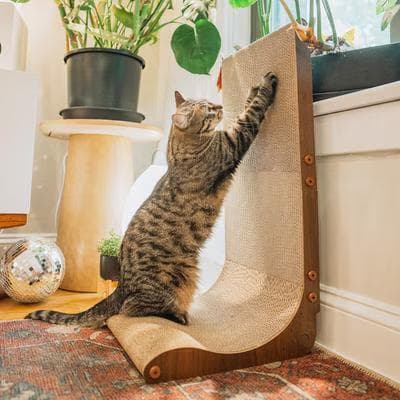
Curved cardboard wall scratcher with a wood frame that protects walls and gives cats a satisfying vertical scratch surface.
Webvet may earn a commission when you click through to Chewy, at no extra cost to you.

Overall posture ties the individual signals together. How a cat holds its whole body, where its weight sits, and how exposed it is willing to be all reveal how secure it feels.
Relaxed postures (and the belly trap)
A cat in a relaxed loaf (paws tucked, body settled), curled up asleep, sprawled out, or rolling to show the belly is a cat that feels safe in its space.
Kneading ('making biscuits')
One of the clearest contentment signals is kneading, the rhythmic push-pull of the front paws against a soft surface, your lap, or a blanket, often called 'making biscuits.'
Kittens knead while nursing, and adult cats carry the gesture into a deep sense of comfort and security, frequently while purring. A cat that climbs into your lap and starts kneading is telling you it feels safe and content with you.
If you want the full story, here is why cats knead the people they love.
Fearful and defensive postures
By contrast, a cat crouched low with its weight forward on its paws, ready to spring away, is frightened or preparing to flee. The classic arched back with raised fur (the 'Halloween cat') is a fear and defense display meant to look as large and intimidating as possible.
Read it in context, though: an arched back where the cat leans into your hand and slides along it, fur flat, is the opposite. That is a cat soliciting petting, not warning you off.
Sleeping positions
Sleeping positions follow the same logic. A cat that sleeps belly-up or stretched out in the open feels secure, while a cat curled tight in a hidden spot may simply be conserving warmth or may feel the need to stay guarded.
And when your cat chooses to sleep on you specifically, that is a meaningful vote of confidence. As we explain in our look at why a cat sleeping on you is signaling trust, they are seeking your warmth, your scent, and a safe place where they feel they can fully let their guard down.
Vocalizations: How Sound Works With Body Language
Sound is the layer most people notice first, but it is meant to be read together with the visual signals, never alone. A purr next to relaxed posture means something very different from a purr next to a hunched, squinting body.
Meowing
Meowing is, fascinatingly, aimed almost entirely at humans rather than other adult cats. Kittens meow to their mothers, but grown cats mostly reserve meows for us because they have learned it works. Pitch, length, and frequency carry meaning, from a short, bright 'hi' to an insistent, drawn-out demand.
If your cat seems unusually talkative, our guide to what your cat's meows are trying to tell you breaks down the most common reasons (and when a sudden change in vocalizing is worth a vet visit).
Purring (it is not always happiness)
Purring usually signals contentment, but it is not a guaranteed 'I am happy' button. Cats also purr to self-soothe when they are stressed, frightened, or in pain, which is exactly why you must read the purr alongside posture and face.
Chirps and trills
Chirps and trills are friendly, upbeat sounds, often a greeting or a 'follow me' invitation borrowed from how mother cats call their kittens.
If you want to know how to greet a cat back in roughly their own language, pair a soft slow blink with a gentle, high chirp. Our piece on chirps and trills as friendly greetings digs into these chattery little sounds and what they mean.
Distance-increasing sounds
At the other end are the distance-increasing sounds: hisses, growls, spits, and yowls. These are unambiguous warnings that say 'stop' and 'stay back,' and they nearly always come packaged with flattened ears, a puffed coat, and a tense body.
When you hear them, give the cat room and remove whatever is upsetting them rather than trying to soothe by reaching in.
Putting It Together: Happy, Scared, Angry, and Playful Cats

Now we read the whole cat. Individual signals are letters; emotional states are the words they spell. Here are the four profiles you will see most often.
The happy, relaxed cat
Tail upright or softly curved, ears forward, pupils normal, eyes soft or slow-blinking, whiskers loose, body relaxed in a loaf or rolling contentedly, and often kneading or purring softly. Movements are loose and unhurried. This cat is comfortable and open to interaction.

Probiotic supplement formulated to help cats maintain calm behavior, with the BL999 strain. 30 daily sachets.
Webvet may earn a commission when you click through to Chewy, at no extra cost to you.
The scared, anxious cat
Body crouched low or shrinking back, ears flattened to the sides, pupils dilated, tail tucked or puffed, whiskers pulled back. The cat may freeze, hide, or try to slip away. The right response is space and quiet, never cornering or 'reassurance' by force. Let the cat choose to come out.
The overstimulated or aggressive cat
Tail lashing or thumping, ears pinned, pupils dilated, body stiff, and sometimes a rippling twitch of the skin along the back. Some cats give a warning nip that does not break the skin before a real bite, but do not count on it.
Many cats escalate fast or give a warning so brief it is easy to miss, and individual cats vary widely, so the safe move is to stop touching and back off the moment you see the early signs rather than waiting for a 'polite' nip.
These early cues are the exact warning signs your cat is overstimulated and about to bite. High arousal can also spill onto a nearby person or pet who did nothing wrong, which is how arousal can spill into redirected aggression.
The playful, predatory cat
Question-mark tail, forward whiskers, dilated pupils, and the unmistakable bum-wiggle right before a pounce. This looks intense but is hunting play, not anger, though play that targets your hands and feet can sting.
If your cat ambushes your ankles after dark, see nighttime ambushes and play aggression, and if a cat turns tense and hostile when visitors arrive, our guide to reading aggression toward visitors walks through what is happening and how to defuse it.
Sick or In-Pain Body Language: When to Call the Vet
This is the section the typical body-language guide skips, and as a vet publication it is where we can help you most.
Cats descend from solitary hunters, and in the wild a visibly weak animal is a target. So cats instinctively hide pain and illness, which means a subtle change in body language is frequently the very first thing you notice, often before appetite or litter-box changes. Learning to spot it can genuinely save your cat's life.
- 1Cats hide pain by instinct, so body-language shifts are often the earliest warning.
- 2Watch for a hunched 'meatloaf' posture, squinting, hiding, and reluctance to move or jump.
- 3Grooming, vocal, gait, and eating changes all count, especially when several appear together.
- 4Anything vague that lasts beyond a day deserves a prompt vet call.
Postures that suggest pain
Postures that suggest pain or illness include several telltale signs:
- A hunched 'meatloaf' position with the paws tucked tightly and the body held rigid (different from a relaxed loaf because the cat looks tense and reluctant to move).
- Squinted or half-closed eyes paired with a flat, tense face.
- A head held low, sitting hunched and still for long stretches.
- Reluctance to jump, climb, or be touched in a particular spot.
Behavior changes to watch for
- A normally social cat suddenly withdrawing, hiding more than usual, or seeking out unusual quiet spots.
- A quiet cat that becomes unusually vocal, or a chatty cat that goes silent.
- Grooming changes in either direction: a scruffy, ungroomed coat, or over-grooming and licking at one area until it thins or goes bald. Over-grooming can point to pain underneath, but it is just as often driven by skin allergies, fleas or other parasites, or stress and anxiety, so it warrants a vet workup rather than guesswork.
- A stiff, careful, or altered gait, hesitating before jumping, or no longer using high perches.
- Dropping food while eating (sometimes called quidding) or chewing on one side, which can point to dental or mouth pain.
For a deeper checklist, see our guide to the subtle body-language signs a cat is in pain. Movement matters too: small changes in gait that hint at joint pain often show up long before a cat limps.
And do not overlook the litter box, since posture and habit shifts there, like straining, frequent trips, going outside the box, or pink or red urine (blood), can be litter-box changes that can signal a medical problem.
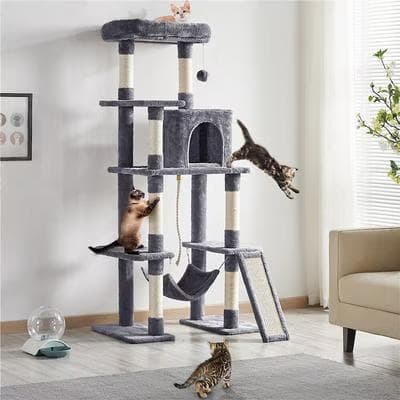
63-inch multi-level cat tree with plush perches, a condo, a hammock, sisal scratching posts, and a dangling toy. Dark gray.
Webvet may earn a commission when you click through to Chewy, at no extra cost to you.
Visible blood in the urine is a common sign of feline urinary tract disease and is always a reason to call your vet.
Cat-to-Cat vs Cat-to-Human Signals (Multi-Cat Households)
Cats do not speak to each other the same way they speak to us, and understanding that difference is the key to a peaceful multi-cat home. Between cats, much of the communication is about managing space and avoiding outright conflict.
Tension vs play between cats
Tension between cats often shows up quietly: a hard stare, blocking a doorway or the path to the litter box, slow stalking, or one cat going stiff while another approaches.
Real fights involve flattened ears, puffed fur, yowling, and tightly defensive postures, whereas play-wrestling tends to be loose, near-silent, and turn-taking, with the cats swapping who is 'on top.' If you are not sure which you are watching, look for stillness and staring (warning signs) versus bouncy, springy movement (play).
Friendly signals between bonded cats
The friendly signals between bonded cats are just as readable: a tail-up greeting as they approach, mutual grooming (allogrooming), and rubbing along each other's bodies (allorubbing) all signal an affiliative, trusting relationship.
Reading the room in a multi-cat home, and giving each cat enough resources and escape routes, prevents the simmering stress that boils over into fights.
For the full playbook, see reading body language to keep peace in a multi-cat home, and remember that one tense cat can trigger how arousal can spill into redirected aggression onto an innocent housemate.
How your cat signals to you
With you, the signals lean affiliative and attached.
A cat that why a kitten that follows you is bonded to you trails you from room to room, and a cat that practices why a cat brings you gifts by depositing a toy (or a less welcome 'present') at your feet, is communicating closeness and a sense that you belong to the same group.
Cat Body Language Chart: Quick-Reference Guide

Use this scannable cat body language chart to match a single body part to its most likely meaning. Treat it as a starting point, then read the rest of the cat and the situation before you decide what your cat is really saying.
| Body part | Signal | Most likely meaning |
|---|---|---|
| Tail | Straight up, tip hooked | Confident, friendly greeting (happy) |
| Tail | Straight up and quivering | High excitement or scent-marking |
| Tail | Puffed / bottlebrush | Fear or threat response |
| Tail | Tucked under or against body | Anxiety or insecurity |
| Tail | Low and lashing / thumping | Irritation, overstimulation (a warning) |
| Tail | Question-mark curve | Playful, curious |
| Ears | Forward and upright | Alert, curious, content |
| Ears | Flattened sideways (airplane) | Fear or irritation (back off) |
| Ears | Pinned flat back | Defensive, may react aggressively |
| Eyes | Slow blink | Trust and affection (a cat kiss) |
| Eyes | Wide, dilated pupils | High arousal: fear, excitement, or play |
| Eyes | Hard, unblinking stare | A challenge or threat |
| Whiskers | Loose, out to the sides | Calm and relaxed |
| Whiskers | Forward and fanned | Curious, hunting, or aroused |
| Whiskers | Flattened back on cheeks | Fear or defensiveness |
| Posture | Kneading ('making biscuits') | Comfort, contentment, security |
| Posture | Relaxed loaf or exposed belly | Feels safe (belly is trust, not a rub request) |
| Posture | Crouched low, weight forward | Fearful or ready to flee |
| Posture | Arched back, raised fur | Fear / defensive display |
| Posture | Hunched 'meatloaf', squinting, still | Possible pain or illness (consider a vet) |
Reading cat body language is a skill that compounds. The more you watch with these signals in mind, the more your cat's quiet running commentary comes into focus, and the more you will catch both the affection and the early warning signs that matter.
If you want to keep going, explore the single-behavior deep dives linked throughout this guide, starting with the affection signals that show your cat likes you.
Frequently Asked Questions
What is the 3-3-3 rule for cats?
The 3-3-3 rule is a rough timeline for helping a newly adopted cat settle in. Expect roughly 3 days for your cat to decompress (often hiding and very cautious), about 3 weeks to start learning the household routine and showing more of their personality, and around 3 months to feel fully at home and bonded. The numbers are a guide, not a deadline. During the first days especially, lean on body language: give a hiding, crouched, wide-eyed cat quiet and space rather than forcing interaction.
How do you say "I love you" in cat talk?
The closest thing to 'I love you' in cat language is the slow blink, sometimes called a cat kiss. Look at your relaxed cat, soften your gaze, then slowly close your eyes for a moment and open them again. Many cats will slow-blink back. Because a hard stare is a threat to cats, this soft, slow blink communicates that you are calm, safe, and not a danger, which is exactly how cats signal trust and affection to one another.
How do I say "hi" to a cat?
Greet a cat the way another friendly cat would: get down to their level, avoid staring directly, and offer a soft slow blink, optionally with a gentle, high-pitched chirp or 'hi.' Then extend a relaxed finger or hand at their nose height and let them approach and sniff rather than reaching over their head. If the cat rubs their cheek on your hand or their tail goes up, the greeting was welcome. If they lean away, flatten their ears, or stay crouched, give them more time.
How can you tell if a cat loves you?
Cats show affection through body language and behavior rather than words. Reliable signs include slow blinking at you, greeting you with the tail straight up, head-butting and cheek-rubbing against you, kneading on your lap, following you around, sleeping on or near you, and a relaxed, soft-eyed posture in your presence. A cat that feels safe enough to nap on you or expose its belly near you is paying you one of the highest compliments in the feline world.
What smell do cats absolutely hate?
Cats have a powerful sense of smell and tend to dislike strong citrus (lemon, orange, lime) and pungent herbs, along with the obvious one: a dirty or heavily scented litter they find unpleasant. Important safety note: do not reach for essential oils as a cat repellent. Many essential oils, including tea tree (melaleuca), citrus oils, peppermint, eucalyptus, wintergreen, pine, cinnamon, and lavender oil, are genuinely toxic to cats, whether licked off the fur, absorbed through the skin, or even inhaled from a diffuser. Cats lack a liver enzyme needed to process these compounds, and exposure can cause drooling, vomiting, tremors, liver damage, and death. Avoid using essential oils on or near your cat and skip diffusing them in rooms your cat uses. If your cat suddenly seems bothered by a normal smell, or avoids the litter box, that can also signal a medical issue worth a vet check rather than a simple dislike.
How do you read a cat's tail language?
Read the tail by its height, shape, and speed. A tail held straight up is a confident, friendly greeting, and an upright tail that quivers signals high excitement or scent-marking. A question-mark curve is playful. A puffed tail signals fear, and a tucked tail signals anxiety. A low tail that lashes or thumps quickly is irritation or overstimulation, which is a warning to give the cat space. In general, slow and lifted is friendly, while fast, stiff, and low means the cat wants the interaction to stop.
What does it mean when a cat flattens its ears?
Flattened ears mean the cat is uncomfortable, and the exact position tells you how serious it is. Ears turned out flat to the sides ('airplane ears') signal fear or irritation and are an early back-off cue. Ears pinned tightly flat against the head signal a defensive, highly aroused cat that may swat, scratch, or bite. In both cases, stop whatever is happening and give the cat space. Pair the ears with the eyes, tail, and body to tell fear from offensive aggression.
How can you tell if a cat is in pain from its body language?
Because cats hide pain, the signs are often subtle: a hunched, tense 'meatloaf' posture, squinted or half-closed eyes with a flat face, reluctance to move, jump, or be touched, hiding more than usual, and a stiff or altered gait. Watch for grooming changes (a scruffy coat or over-licking one spot), a shift in vocalizing, dropping food while eating, and changes in litter-box habits or posture. If you notice these signs, especially several together, contact your veterinarian promptly, as cats tend to show pain only once it is significant. A cat that is straining with little or no urine, collapsing, or repeatedly vomiting needs emergency care within hours.

Editor
The Webvet Editorial Team is the in-house group of pet-care editors and writers behind Webvet, operated by Smart Pet Collective. The team researches, writes, and maintains Webvet's pet health, behavior, and medication content. Every article follows a defined editorial process: research from reputable veterinary and scientific sources, careful drafting, mandatory review of medical content by a credentialed veterinarian, and dated publication. Health and medication articles are medically reviewed by a licensed veterinary professional before they go live and are kept current over time.
Veterinarian · BVMS MRCVS
Dr. Pippa Elliott, BVMS, MRCVS, is a veterinarian with nearly 30 years of experience in companion animal practice. Dr. Elliott earned her Bachelor of Veterinary Medicine and Surgery from the University of Glasgow. She was also designated a Member of the Royal College of Veterinary Surgeons. Married with 2 grown-up kids, Dr. Elliott has a naughty Puggle named Poggle, 3 cats and a bearded dragon.


