Cat Calming Products: What Works and What Is Unsafe
Six categories of cat calming products compared: what each one actually does, how strong the feline evidence is, how long it takes to work, and which widely sold natural options are unsafe for cats.

BVMS MRCVS

This article contains affiliate links. Webvet may earn a commission when you buy through them, at no extra cost to you.
Cat calming products come in six categories: pheromone diffusers and sprays, nutritional supplements, calming treats, compression wraps, calming beds and hiding places, and prescription medication from your veterinarian. A calming collar is the seventh thing you will see on the shelf, and it is really the first category worn around the neck. None of them sedate a cat, none of them work in seconds, and the right one depends far more on your situation than on the brand on the box.
This guide compares those categories the way a shop shelf never does: what each one is meant to do, how much feline-specific evidence sits behind it, how long it takes to work, and where it fails. It also carries the warning most product guides leave out, which is that several widely sold cat calming products marketed as natural are genuinely unsafe for cats. And it says the thing no product listing will say, which is that a behavior that started suddenly is a veterinary question before it is a shopping question.
- 1Start from your situation rather than the product shelf, because a car trip on Friday, a standoff between two cats that has run for months, and a behavior that appeared last week all need different answers.
- 2Pheromone products are the most studied over-the-counter option and the evidence behind them is genuinely mixed, so expect a modest shift rather than a transformed cat.
- 3Nothing sold over the counter works in seconds, and most supplements need one to six weeks of daily use before you can fairly judge them.
- 4Supplements and calming treats are not reviewed for effectiveness the way a prescription medicine is, so the same named ingredient can appear at very different amounts across two products on the same shelf.
- 5Calming beds have no product research behind them but rest on one of the best supported ideas in feline behavior, which is that a cat needs somewhere safe to hide and somewhere high to sit.
- 6Essential oils, alcohol-preserved remedies, unregulated hemp products, and anything labeled for dogs can harm a cat, and no human anti-anxiety medication should ever be given to a cat.
- 7A cat that has started hiding, over-grooming, or urinating outside the litter box needs a veterinary examination first, and a male cat straining to urinate is an emergency.
How to choose between cat calming products
The useful question is not which product is best. It is what is actually happening in your house. Every calming product is trying to do one of four things: change how a place smells to your cat, change the cat's internal state, change what the cat's body feels, or give the cat somewhere better to be. Those are four different jobs, and a clinic appointment on Friday does not need the same one as two cats who have been sniping at each other since March.
Match the situation to the category before you compare brands:
- A one-off event you cannot reschedule, such as an emergency clinic trip: a spray in the carrier, familiar bedding, and, if your vet agrees in advance, a prescription given before you leave home.
- A predictable event with lead time, such as a house move, a holiday, or a booked grooming appointment: start a diffuser or a supplement early enough that it has done its work by the day itself.
- Ongoing household tension, such as two cats avoiding each other or a cat who never quite settles: a diffuser plus changes to the space, judged over weeks rather than days.
- A behavior that appeared suddenly: no product at all. Book a veterinary examination first, because pain and illness look a great deal like anxiety.
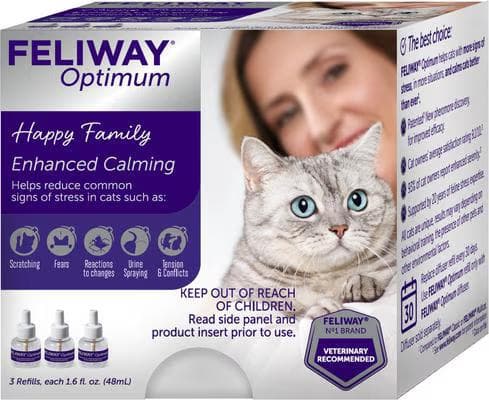
The first three routes all have a pheromone product somewhere in them, which is why the plug-in diffuser ends up being the default first purchase in most households. A starter kit such as the Feliway Classic 30 Day Starter Kit Calming Pheromone Diffuser for Cats is where most owners begin, because it treats the room rather than the cat and asks nothing of an animal who is already on edge.
Webvet may earn a commission when you click through to Chewy, at no extra cost to you.
What is the best calming product for cats?
There is no single best product, and any page that names one has skipped the only question that matters. For a scheduled event with days of notice, a pheromone diffuser started early is the most sensible first purchase. For a same-day car journey, a spray in the carrier plus a conversation with your vet beats anything you can grab off a shelf. For a cat whose behavior changed suddenly, the best calming product is a veterinary examination, because a product bought instead of that visit costs your cat time.
What is the best thing to calm cats down?
In the moment, the most reliable thing is not a purchase at all. Reduce what the cat can see, hear, and smell of whatever frightened them, then leave them alone somewhere enclosed and let them come out on their own terms. A covered bed, a cardboard box turned on its side, or the top of a wardrobe all work. Chasing a frightened cat around the house to apply a product makes the fear worse every single time.
When the problem is not anxiety at all
Behavior is a symptom. A cat who has started hiding, snapping, over-grooming a patch bare, yowling at night, or going outside the litter box may well be stressed, but pain and illness produce exactly the same picture, and a calming product bought instead of an examination simply buys the illness time. Older cats in particular hide arthritis behind what reads as a personality change, and our guide to mobility changes in senior cats covers what that actually looks like.
Will a calming collar stop my cat peeing outside the litter box?
Not on its own, and reaching for one first carries real risk. Urinating outside the box is one of the most common signs of a urinary tract problem in cats, and it is also caused by litter box setup, arthritis that makes a high-sided box hard to climb into, and tension between cats in the home. The order matters: veterinary examination and a urine test first, then the box setup, then stress reduction. Where stress genuinely is part of the picture, pheromone products are used alongside veterinary care and box changes, never in place of them.
Book an examination before you buy anything if your cat has:
- Changed behavior suddenly, over days rather than months.
- Started hiding, or stopped using their usual resting places.
- Begun over-grooming, especially in one patch.
- Lost or gained weight, or changed how much they eat or drink.
- Become aggressive when touched in a particular spot.
- Started vocalizing at night, which is common in older cats and often has a medical cause.
If none of that applies and you are still not certain what you are looking at, our guide to cat anxiety signs and causes walks through what feline anxiety actually looks like and what tends to drive it.
Pheromone diffusers and sprays
Pheromone products are synthetic copies of scent signals cats produce themselves. The classic version copies part of the facial pheromone a cat leaves behind when it rubs its cheek on a doorframe, which is the signal marking a place as familiar and already claimed. A second version copies the appeasing pheromone a mother cat produces while nursing, and it is sold for tension between cats sharing a home. Neither is a drug. Neither enters the bloodstream to sedate anything. They change what a room smells like to a cat, and the cat decides what to do with that information.

Format decides the use. A plug-in diffuser treats one room continuously and suits an ongoing situation, and it needs a day or two of running before you judge anything at all. A spray treats one object, which is why it belongs on a carrier, a blanket, or a car seat, and it should be applied about fifteen minutes before the cat goes near it so the carrier liquid can evaporate. Spraying a cat directly does nothing useful and quietly undoes the association you were trying to build.
What is better than Feliway?
Usually a different category, not a different brand. Pheromone analogs from any manufacturer are variations on the same two signals, so swapping labels rarely changes much. If a diffuser has not helped after a fair trial of several weeks, the more productive moves are a supplement course, a change to the layout of the house, or a conversation with your vet about prescription options for a cat whose fear is severe. For tension between cats specifically, the appeasing pheromone formula is a genuinely different signal from the classic facial one, and that swap is worth making before you write off the category.
Webvet may earn a commission when you click through to Chewy, at no extra cost to you.
Choosing between diffuser models, working out how many rooms one unit covers, and knowing when to change a refill are their own subject, and our guide to choosing a cat pheromone diffuser covers them properly. If your worry is whether the thing is safe to run around a dog, a child, or a cat with airway disease, that question is answered in full in our guide to whether cat pheromone diffusers are safe.
Nutritional supplements and calming treats
Calming supplements are foods, not medicines. They supply ingredients that have been studied for their effect on stress-related behavior, they are given daily as a course, and they are judged over weeks. The best known example on veterinary shelves is Purina Pro Plan Veterinary Diets Calming Care Cat Supplement, 30 Count, a probiotic sachet built around a strain of Bifidobacterium longum, and its own instructions ask for daily use for around six weeks before you decide whether it helped. That timeline is typical of the whole category, and it is the single biggest reason owners write these products off too early.
Webvet may earn a commission when you click through to Chewy, at no extra cost to you.

The ingredients you will meet most often are:
- Alpha-casozepine, a fragment of milk protein given as a daily capsule or powder, and the most studied single ingredient in the category.
- L-theanine, an amino acid found in green tea, usually given daily and sometimes marketed for short-term situations.
- L-tryptophan, a building block the body uses to make serotonin, common in calming diets and chews.
- Probiotic strains, most often a Bifidobacterium, working through the gut rather than directly on the brain.
- Hydrolyzed milk protein blends, which overlap with alpha-casozepine products under different trade names.
- Herbal additions such as chamomile, valerian, or passionflower, which carry the least feline-specific evidence of anything on this list.
Here is the part the packaging will not tell you. In the United States a supplement for cats is regulated as a food ingredient rather than as a drug, which means nobody reviewed it for effectiveness before it reached the shelf. Two products naming the same active can contain very different amounts of it, and neither is obliged to prove it does anything. A National Animal Supplement Council seal on the label at least tells you the maker follows an audited manufacturing and adverse-event reporting program, which is a lower bar than proven effectiveness but a real one.
How long does a calming supplement take to work?
Longer than most owners expect. Products built on alpha-casozepine or L-theanine are generally judged over one to two weeks of consistent daily dosing, and probiotic supplements are usually given for around six weeks before any verdict. Nothing in this category is a same-day answer, which is why a supplement is the wrong purchase for an appointment on Friday and a reasonable one for a house move next month. Give it the full course the label describes, keep the dose consistent, and note your cat's behavior at the start so you have something honest to compare against.
Getting a supplement into a cat who has noticed
The best supplement in the world does nothing while it sits in the bowl. Cats detect novelty in food faster than anything else in the house, and a powder stirred through a full portion of wet food frequently means the whole portion gets refused and the dose goes in the bin with it.
- Start with a fraction of the dose mixed into a small amount of strongly flavored wet food, then build up over several days.
- Serve the medicated portion first, while your cat is hungriest, and follow it with the rest of the meal.
- Never mix a supplement through the entire daily ration, because one refusal then costs you the food as well as the dose.
- If your cat eats around a capsule, ask your vet whether that product can be opened and whether a different format exists.
- Keep the routine identical every day. Cats accept a predictable oddity far more readily than a changing one.
What about calming diets?
Some veterinary diets are formulated with the same ingredients found in calming supplements, usually hydrolyzed milk protein or added tryptophan, built into a complete food rather than sold as an add-on. The advantage is that there is nothing extra to give, so nothing gets refused or forgotten. The disadvantages are that the cat has to actually eat the food, that the food has to suit the rest of their health picture, and that in a multi-cat home you either feed everyone the same diet or feed separately. Ask your veterinary practice whether a calming diet is appropriate before switching, particularly for a cat with kidney, urinary, or weight considerations already in play.
Calming treats do a different job
A calming treat usually contains the same actives in snack form. That makes it convenient and it makes it inconsistent. The amount of active ingredient per treat varies enormously between products, some are dosed by body weight and some are not meaningfully dosed at all, and a handful of chews adds calories to a cat who probably does not need them. Treats are best understood as a handling aid rather than a course of treatment. Their real strength is that a cat has to stop and eat one, which buys you a few seconds of cooperation during a nail trim, a brush, or a carrier loading.
Before you buy a calming treat, check the label for:
- The amount of each active per treat, not just the ingredient name on the front.
- A feeding amount matched to your cat's weight, and what that actually works out to per day.
- Whether the product is labeled for cats. Dog chews are dosed for a much larger animal.
- Calories per treat, especially for an indoor cat on a measured diet.
- A batch or lot number and a manufacturer contact, which is the minimum sign of a company that can trace a problem.
- Any added fragrance or plant oil, which belongs nowhere near a cat.
Lickable purees are the easiest format to use during handling, because the cat has to keep licking to finish the tube and that keeps them still and facing away from your hands. Squeeze Feliway Happy Snack Chicken Puree Lickable Cat Treats, 0.5-oz Tubes, 12 Count onto a saucer or offer it straight from the tube while somebody else does the brushing, and a wrestling match becomes a snack. Read the ingredient panel the way you would read any other treat, and treat the tube as a handling tool rather than a course of anything.
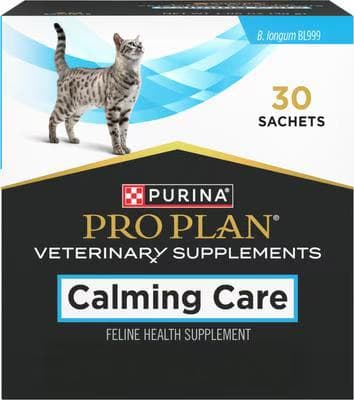
Probiotic supplement with Bifidobacterium longum BL999 that supports cats in maintaining calm behavior plus digestive and immune health. One daily sachet.
Webvet may earn a commission when you click through to Chewy, at no extra cost to you.
Calming collars: what the side-effect reports mean
Cat calming collar reviews are most useful when they name the formula, fit, and side effects instead of relying on a star rating. A Sentry cat calming collar is one recognizable example of a format that carries a pheromone analog, or sometimes a plant fragrance blend, in a plastic collar that sits against the neck and releases as the cat's body warms it. The appeal is obvious, because it travels with the cat instead of staying in one room. The complications are real too, and they are why this format generates more owner complaints than any other calming product. Read the ingredient panel before you buy, because collars sitting side by side on the same shelf are not all doing the same thing. Some carry a pheromone analog. Others carry lavender, chamomile, or another plant oil, which is a very different proposition for a cat.
Do calming collars make cats sleepy?
They should not. A pheromone analog is a scent signal rather than a drug, and it has no sedative action. Owners do sometimes report a quieter cat, which is usually the difference between a settled cat and a stressed one rather than actual sedation. Telling those two apart is what matters. A calm cat still eats, grooms, jumps, and responds to you. A cat who is unusually sleepy, wobbly, off their food, or hiding needs a veterinary appointment, whatever is around their neck.
If you do try one, use it properly:
- Fit two fingers flat between the collar and the neck. Tighter causes rubbing, and looser lets a paw or a jaw get caught.
- Use a collar with a breakaway safety clasp so the cat can free themselves if it snags on furniture.
- Trim the excess tail of the collar after fitting so it cannot be chewed by your cat or a housemate.
- Check the skin underneath every couple of days for redness, scabbing, or fur loss, and remove the collar at the first sign of any of them.
- Skip fragrance-based collars entirely for a cat with asthma or any airway disease, and ask your vet before trying one on any cat with sensitive skin.
Common cat calming collar side effects include skin reactions at the contact point, and they usually settle once the collar comes off. A collar is also the wrong tool for a cat who already resents being handled, because the fitting itself is a fight you do not need to pick.
Products marketed as natural that are unsafe for cats
Natural is a marketing word, not a safety category. Cats are unusually poor at processing several plant compounds that other species clear without trouble, because they lack much of the liver enzyme activity that handles phenols and some terpenes. That single piece of biology is why a product sold in a health food shop can be dangerous to a cat and unremarkable to the dog asleep next to them.

The products to keep away from your cat:
- Essential oils, in any form. Tea tree, pennyroyal, wintergreen, pine, citrus, peppermint, eucalyptus, cinnamon, clove, and ylang ylang are all documented hazards for cats. Swallowing them is not the only route. Oils are absorbed through skin and inhaled, and an active nebulizing diffuser puts fine droplets into the air that settle on the coat and get groomed off later.
- Any calming spray or collar that names a plant oil as its calming ingredient. A pheromone analog and an aromatherapy blend are not interchangeable, whatever the front of the box suggests.
- Alcohol-preserved flower remedies. The human versions of these drops are preserved in alcohol, which has no place in a cat, and the category has no controlled feline evidence behind it either way.
- Unregulated hemp and CBD products. Content varies widely from bottle to bottle, contamination has been documented, and interactions with prescribed medication are a genuine concern. If you want to try one, make it a conversation with your vet rather than a purchase.
- Anything labeled for dogs. Dose, ingredients, and species tolerance all differ, and cats have been seriously harmed by dog products applied in good faith.
Are essential oils or natural calming sprays safe for cats?
No, not as a group, and the oils sold for calming are among the riskier ones. Signs of essential oil exposure in a cat include drooling, vomiting, wobbliness or tremors, labored breathing, and redness or burns around the mouth and paws. If you use oils yourself, keep the bottles closed and out of reach, avoid active diffusers in any room your cat can enter, and never apply anything to a cat's skin or coat. A cat with asthma is at particular risk from anything airborne, including scented sprays sold for pets.
Compression wraps and calming beds
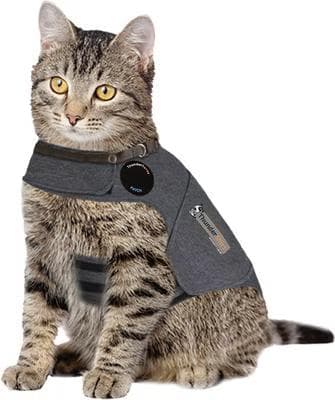
A compression wrap is a snug elastic garment that applies steady, gentle pressure across the chest and back. The idea borrows from swaddling, and most of the published research sits in dogs rather than cats, where the results are modest and inconsistent. Feline-specific evidence is thin. That does not make a wrap useless, but it does mean it is worth a try rather than worth a promise, and it means you judge it on your own cat instead of on the packaging. The ThunderShirt Anxiety Vest for Cats, Medium is one fitted example, but only for a cat who continues to walk, rest, and groom normally while wearing it.

Fit decides almost everything. The garment should be snug enough to stay put with no loose folds, and loose enough that you can slide two fingers under it at the chest. Introduce it across several short sessions with food long before you use it for a stressful event, because a cat meeting a wrap for the first time on the way to the clinic has been handed a second problem rather than a solution. Never leave a wrap on a cat who is not being supervised.
Do calming beds and compression wraps actually help cats?
They help different cats in different ways, and they are not equally supported. Compression wraps have limited feline evidence and a real failure mode, which is that some cats stop moving altogether, and stillness is easy to misread as calm when it is actually shutdown. Learn to read what your cat's body language is telling you before you decide a wrap is working. Calming beds have no meaningful product research at all, yet the principle underneath them is one of the best supported in feline behavior, which is that a cat with a safe enclosed place to retreat to copes better with everything else.
That principle does not require a branded bed. A cardboard box on its side, a carrier left open in a quiet corner, or a high shelf cleared of ornaments satisfies it as well as anything sold as a calming bed. What matters is that the place is enclosed on at least three sides, that it sits somewhere the cat already chooses to be, and that nobody ever uses it to grab the cat. Height counts as much as enclosure does. Cats resolve a surprising amount of household tension by simply sitting above it.
That is the case for vertical furniture as a calming purchase rather than a play purchase. A tall multi-level tower such as the Yaheetech Multi-Level 63-in Plush Cat Tree, Dark Gray gives a nervous cat several elevated positions to choose between and a covered condo to disappear into, which covers two of the three things a stressed cat wants and lasts far longer than most product courses.
Prescription medication and what a vet can offer
Vet-recommended cat calming products can include prescription medication when fear is severe or persistent. This is the category retail pages leave out, and for a badly frightened cat it is often the one that matters most. A veterinarian can prescribe medication for a cat whose fear is severe enough to affect their welfare, and that decision follows an examination rather than a product description. There are two broad approaches, and they solve different problems:
- Situational medication is given before a known event such as a car journey, a clinic appointment, or a grooming visit, and it works within hours. Gabapentin and trazodone are the two most commonly used in cats, and a dose given at home before a visit is now a routine part of feline-friendly veterinary practice.
- Daily medication is used for ongoing anxiety and works over weeks rather than hours. Fluoxetine is the example most owners have heard of. It is prescribed alongside behavior work rather than instead of it.
Can a vet prescribe something to calm my cat?
Yes, and it is a reasonable thing to ask for. Bring specifics to the appointment: what the cat does, when it started, how often it happens, and what you have already tried. Your vet will examine the cat and often run bloodwork first, because several medical problems produce behavior that looks exactly like anxiety. If medication is appropriate they will choose the drug, the dose, and the timing for your individual cat. Never adjust a prescription yourself, never share medication between pets, and never give a cat anything prescribed for a person.
If the picture is complicated, ask about a referral to a veterinary behaviorist. That is a specialist qualification, and for aggression, compulsive over-grooming, or house soiling that has not responded to anything so far, it is usually the most efficient money you can spend.
What the evidence actually shows, category by category
Nobody grades these products against each other, so a flower essence and a pheromone analog sit on the same shelf looking equally credible. They are not. Here is an honest read, stated in words rather than invented numbers, because the research in this field is small, uneven, and often funded by the people selling the product.
Do cat calming products work?
Some do something for some cats, and none work the way the packaging implies. Pheromone products carry the most feline research and the results are genuinely mixed, with several controlled trials reporting a benefit and reviewers pointing out that the studies are small and variable. Supplements have a handful of small trials for a few named ingredients and nothing at all for others. Wraps, beds, and flower essences have little or no feline-specific evidence behind them. Prescription medication is the best supported option and it is also the only one that requires a veterinary examination first. Expect a modest shift rather than a different cat.
| Category | What it is meant to do | Feline-specific evidence | Typical onset | Main caution |
|---|---|---|---|---|
| Pheromone diffuser or spray | Make a space smell familiar and claimed | Mixed, the most studied option on the shelf | Diffuser 1 to 2 days, judge over 2 to 4 weeks | Not a sedative, and no fix for a medical problem |
| Calming collar | The same signal, worn at the neck | Limited for the collar format specifically | Days to weeks | Skin reactions at the contact point; check for plant oils |
| Nutritional supplement | Supply studied ingredients daily | Mixed, small trials for a few named actives | 1 to 6 weeks depending on the product | Not reviewed for effectiveness like a medicine |
| Calming treat | The same actives in snack form | Limited, and amounts vary widely between products | Same day at best, and unreliable | Dose per treat is often unstated; adds calories |
| Compression wrap | Apply steady gentle pressure to the body | Limited in cats, mostly canine research | Minutes, if the cat tolerates it | Stillness can be shutdown; never leave it on unsupervised |
| Calming bed or hiding place | Give a safe enclosed retreat and height | None for products, good for the principle | Immediate, once the cat chooses it | The cat picks the spot, not you |
| Prescription medication | Reduce fear directly under veterinary care | The strongest of any option here | Situational within hours, daily over weeks | Prescription only, after an examination |
Read that table as a starting point rather than a verdict on your own cat. The only evidence that decides your purchase is what happens in your house over the trial period, which is why writing down what you see before you start is worth more than any review score.
Matching the product to the situation: travel, vet visits, and grooming
The best cat calming products for travel depend first on lead time. The categories only become useful once you attach them to a date. Lead time is the variable nobody prints on a label, and it is the whole difference between a product that helps and a product that arrives too late to do anything.

| Situation | Where to start | Lead time | The step that is not a purchase |
|---|---|---|---|
| Emergency clinic trip | Pheromone spray in the carrier | 15 minutes before loading | Leave the carrier out as furniture all year |
| Booked vet or grooming visit | Ask your vet about medication before the visit | Days, at the time you book | Practice short handling sessions at home |
| Car journey or holiday | Spray plus a covered carrier | Same day, plus a week of carrier practice | Line the carrier with unwashed bedding |
| House move | Diffuser in one prepared room | Set up 1 to 2 days ahead | Confine to that room, then expand slowly |
| Fireworks or storms | Diffuser plus hiding places | Start 3 to 7 days ahead | Close windows and add background sound |
| Ongoing tension between cats | Appeasing pheromone formula | Judge it over 4 weeks | Duplicate and separate every resource |
| New baby, guests, or builders | Diffuser plus a gated safe room | 1 to 2 weeks ahead | Set the safe room up before the disruption |
| A behavior that started suddenly | No product | Book now, same day if straining to urinate | Veterinary examination and urine test |
What calms a cat down immediately?
Honestly, nothing you can buy. Every over-the-counter category needs at least minutes and usually days, and the only genuinely fast option is a prescription your vet gave you in advance for that specific event. In the moment what works is removing the trigger, dimming the room, cutting the noise, and giving the cat a covered place to retreat into that nobody reaches a hand inside. Then wait. A frightened cat comes down on their own timetable, and being followed, picked up, or talked at only extends it.
Which cat calming products help during grooming?
Grooming is a handling problem more than a fear problem, so the useful products are the ones that occupy the cat and the ones that shorten the session. A lickable treat buys a genuine thirty to sixty seconds of stillness. A pheromone spray on the towel or table fifteen minutes beforehand costs nothing to try. A compression wrap suits a cat already used to wearing one and nobody else. Beyond that, split the groom into several short sessions across a week and handle a different area each time.
If your cat becomes genuinely aggressive during grooming or handling, stop. Ask your veterinary practice about sedation for the appointment rather than trying to win the argument at home, because a cat who is frightened or hurt once will remember it for a very long time.
Multi-cat homes, fireworks, and moving
Three situations account for most calming purchases, and in each of them the product is the smaller half of the answer.
What are the best cat calming products for multiple cats?
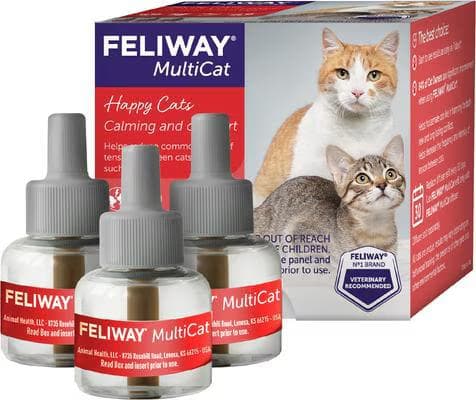
The appeasing pheromone formula, which is a different signal from the classic facial one and is sold specifically for tension between cats, is the sensible product to start with. But cats fall out over resources, so count them first: one litter box per cat plus one spare, in separate places, and the same logic for food bowls, water, beds, and high perches. Feed the cats where they can see each other without having to compete. If one cat is being cornered, make sure every room has a second exit. Where the aggression is aimed at visitors rather than at each other, our guide to aggression toward guests has the management plan. If the first month helps, Feliway MultiCat 3-count refills continue that same appeasing-pheromone formula in a bulk pack.
For fireworks and thunder, prepare rather than react:
- Start a diffuser a few days before the date, not on the night itself.
- Close windows and curtains, and leave a familiar background sound running.
- Set out two or three covered hiding places at floor level and one high one, then leave the cat in whichever they choose.
- Keep the cat indoors from late afternoon and check that microchip details are current.
For a house move, confine the cat to one prepared room in the new house with their own litter box, bedding, and food, run a diffuser in that room, and let them expand into the rest of the house at their own pace over several days. Moving a cat straight into a whole unfamiliar house is the most common avoidable mistake in this entire list.
Change the environment before you buy anything
Every category in this guide works better on top of an environment that already suits the cat, and a fair number of households find that once the environment is right, the product becomes optional. The things a cat needs from a home are a safe place to hide, separated resources, an outlet for hunting behavior, handling that happens on the cat's terms, and a scent landscape nobody keeps scrubbing away.

- Give every cat a covered retreat at floor level and a high perch, in different rooms.
- Separate food, water, litter, and resting places so one cat cannot control access to all of them at once.
- Run two short play sessions a day that finish with a meal, because the hunt-and-eat sequence settles cats better than either half on its own. Our roundup of interactive cat toys covers the ones that actually hold a cat's attention.
- Leave scent alone. Do not wash every blanket in the house at once, and do not scrub a scratched doorframe back to bare wood.
Our full guide to cat stress relief routines goes through those daily changes in detail. They cost nothing, they work for every cat in the house at once, and they are the foundation every product on this page is supposed to sit on top of.
Cat calming product questions
Frequently Asked Questions
Do cat calming products work?
Some help some cats, modestly. Pheromone products have the most feline research behind them and the findings are mixed, with several controlled trials showing a benefit and reviewers noting that the studies are small. A few supplement ingredients have small trials, others have none. Wraps, beds, and flower essences have little feline-specific evidence. Prescription medication is the best supported option of all, and it is the only one that starts with a veterinary examination. Judge any of them on your own cat over a fair trial period rather than on the packaging.
What calms a cat down immediately?
Nothing you can buy off a shelf. Every over-the-counter option needs minutes at best and usually days, and the only fast option is a medication your vet supplied in advance for that specific event. In the moment, cut the noise, dim the room, remove whatever frightened the cat, and give them an enclosed place to retreat into that nobody reaches into. Then leave them alone. Cats come down on their own schedule, and following a frightened cat around the house makes the episode last longer.
What is better than Feliway?
Usually a different category rather than a different brand. Pheromone products from any maker are versions of the same two signals, so switching labels rarely changes the outcome. If a diffuser has had a fair trial of several weeks without helping, the more useful next steps are a supplement course, changes to the layout and resources in your home, or a conversation with your vet about prescription options. For friction between cats specifically, switching from the classic facial formula to the appeasing formula is a genuine change of signal and worth trying first.
What is the best calming product for cats?
It depends entirely on the situation, and any answer that names one product has skipped the question. For a scheduled event with days of notice, a pheromone diffuser started early is the sensible first buy. For a car trip today, a spray in the carrier and a call to your vet beat anything on a shelf. For ongoing tension between cats, start with the appeasing pheromone formula plus resource changes. For a behavior that appeared suddenly, the right first step is a veterinary examination, not a purchase.
Do calming collars make cats sleepy?
They should not, because a pheromone analog is a scent signal rather than a drug and has no sedative action. A settled cat still eats, grooms, jumps, and comes when you move around. If your cat becomes genuinely drowsy, unsteady, withdrawn, or off their food after a collar goes on, that is not the product working. Remove the collar, wash the skin underneath, and call your veterinary practice the same day, because unexplained lethargy in a cat always deserves an examination.
Are essential oils safe to use around cats?
No. Cats lack much of the liver enzyme activity needed to clear phenols and some terpenes, so oils that are unremarkable for people or dogs can poison a cat. Tea tree, pennyroyal, wintergreen, pine, citrus, peppermint, eucalyptus, cinnamon, and clove are all documented hazards. Exposure happens through swallowing, through skin, and through the air, and an active diffuser leaves droplets on the coat that get groomed off. Keep bottles sealed, skip diffusers in rooms your cat uses, and never apply oil to a cat.
What are the best cat calming products for multiple cats?
Start with the appeasing pheromone formula, which is the version sold for tension between cats rather than the classic facial one, and run it in the room where the trouble happens. Then do the part that matters more: one litter box per cat plus a spare in separate locations, duplicated food and water stations, and enough beds and high perches that no cat can control access to everything. Feed them within sight of each other but not nose to nose.
Sources

Editor
The Webvet Editorial Team is the in-house group of pet-care editors and writers behind Webvet, operated by Smart Pet Collective. The team researches, writes, and maintains Webvet's pet health, behavior, and medication content. Every article follows a defined editorial process: research from reputable veterinary and scientific sources, careful drafting, mandatory review of medical content by a credentialed veterinarian, and dated publication. Health and medication articles are medically reviewed by a licensed veterinary professional before they go live and are kept current over time.
Veterinarian · BVMS MRCVS
Dr. Pippa Elliott, BVMS, MRCVS, is a veterinarian with nearly 30 years of experience in companion animal practice. Dr. Elliott earned her Bachelor of Veterinary Medicine and Surgery from the University of Glasgow. She was also designated a Member of the Royal College of Veterinary Surgeons. Married with 2 grown-up kids, Dr. Elliott has a naughty Puggle named Poggle, 3 cats and a bearded dragon.


