Cat Aggressive Towards Visitors? A Safe Guest Plan
Visitor aggression often begins with fear, territory, pain, or redirected arousal. Learn a safety-first guest protocol, warning signs, and gradual counterconditioning plan.


BVMS MRCVS

This article contains affiliate links. Webvet may earn a commission when you buy through them, at no extra cost to you.
A cat aggressive towards visitors is usually trying to create distance because of fear, territorial concern, pain, overstimulation, or redirected aggression. The immediate answer is safe separation: move the guest away, give the cat a prepared retreat, and do not touch, corner, punish, or force an introduction.
Long-term improvement comes from identifying the aggression pattern and building controlled positive associations below the cat's threshold. Guests need simple rules, the cat needs an escape route and respectful distance, and sudden or severe aggression needs veterinary assessment before behavior training intensifies.
Why Is My Cat Aggressive Toward Guests?
Cat aggression toward visitors is defensive communication, not a character flaw. An unfamiliar person changes the sights, sounds, movement, and scent inside the cat's territory. A cat who cannot predict the person's behavior or reach a safe retreat may hiss, stalk, swat, lunge, or bite to make that person leave.
When a cat aggressive towards visitors pattern appears, the goal is to identify the trigger and protect distance, not prove that the cat can tolerate contact. Cat aggression towards people may reflect fear aggression, while cat aggression towards humans at an entryway may be territorial or redirected aggression from another animal outside. Pain and overstimulation can produce similar attacks. Record the event before the warning, the cat's posture, and how quickly the cat recovers.
The most common patterns are:
- Fear aggression: The cat crouches, leans away, flattens the ears, hisses, and strikes when approach continues.
- Territorial aggression: The cat patrols, blocks routes, follows a guest, or advances toward someone entering the home.
- Redirected aggression: An outdoor cat, loud noise, conflict, or other inaccessible trigger raises arousal that is redirected to a nearby person.
- Pain-related aggression: Touch, movement, or approach becomes threatening because the cat hurts.
- Play or predatory arousal: Fast feet, dangling clothing, or running children can trigger stalking and pouncing in some cats.
- Overstimulation: A cat approaches socially but becomes tense, tail-flicking, or reactive when interaction lasts too long.
Read the whole sequence rather than labeling one hiss. WebVet's guide to cat body language explains ear, eye, tail, posture, and movement signals that appear before an attack. Earlier recognition gives everyone more time to increase distance safely. See WebVet’s guide to cat tail language, position by position.
- 1Fear aggression and territorial aggression can look similar, but both require distance before training.
- 2Use safe separation during arrivals and never make a guest confront, hold, or corner the cat.
- 3Punishment can increase fear and suppress warnings without making the cat safer.
- 4Counterconditioning happens below threshold, where the cat can observe, eat, and disengage.
- 5Sudden aggression, pain, unpredictable attacks, and bite injuries require professional help.
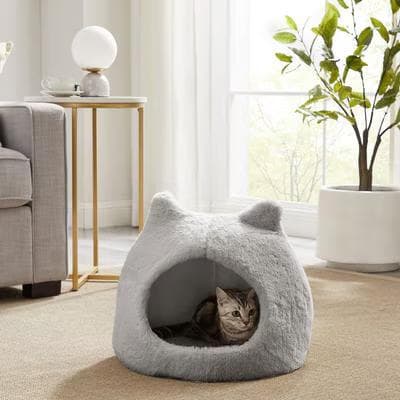
Covered, igloo-style cat bed in soft plush with a water-resistant bottom, giving cats a cozy enclosed spot to curl up. Grey.
Webvet may earn a commission when you click through to Chewy, at no extra cost to you.
A covered cat bed can be one retreat option for a cat who already likes enclosed spaces. Put it away from guest traffic and never let a visitor reach inside. The retreat must remain voluntary when safety permits and should not be used as a substitute for a stocked room, barrier, or behavior plan.
Why Is My Cat Hostile to Visitors?
A cat may seem hostile to visitors because the person is unfamiliar, moves directly toward the cat, smells like another animal, blocks an exit, or arrives while the cat is already aroused. The practical next step is not to test friendliness. Create distance, restore choice, and note the trigger and warning sequence.
Limited positive experience with different people can increase uncertainty, but social history does not make an outcome inevitable. A fearful cat can learn that quiet visitors predict safety when exposure is gradual, controlled, and never forced. A previously friendly cat who changes suddenly needs a medical rule-out.
Cat Aggression Warning Signs
Cat aggression warning signs often begin before hissing or swatting. Watch for a fixed stare, abrupt stillness, ears rotating sideways or back, pupils changing with arousal, skin rippling, a twitching or lashing tail, crouching, leaning away, route blocking, stalking, growling, and refusal of food.
Cat signs of aggression are easier to interpret when you connect them to the trigger. Cat fear aggression often includes leaning away, hiding, or striking only when approach continues. Cat territorial aggression may include entryway patrol, following, and route blocking. A redirected aggression cat pattern begins after another animal, noise, or conflict raises arousal, even if the guest was not the original trigger. These cat aggression causes need different management, so record what happened before the warning rather than reacting only to the final swat.
Use a simple defensive body-language ladder:
- Watching: The cat tracks the visitor but can look away, move normally, and eat.
- Tension: The body lowers or stiffens, the tail starts moving sharply, and food acceptance may slow.
- Distance signals: Ears flatten, pupils widen, the cat hisses, growls, or retreats.
- Active defense: The cat swats, rushes forward, stalks, or blocks a route.
- Attack: Lunging, biting, or sustained pursuit means the session is over and barriers are needed.
Do not wait for the last step before responding. At the first rise in tension, increase distance, reduce movement and eye contact, and let the cat leave. A warning is valuable information. Punishing it can make future behavior less predictable.
Red Flag Aggression Behavior
Red flag aggression behavior includes sudden attacks in a previously social cat, unpredictable lunging, sustained pursuit, bites, aggression paired with pain or neurologic change, and any pattern that puts a child or vulnerable adult at risk. The practical next step is safe separation followed by veterinary guidance, not a more difficult exposure session.
Emergency separation is also warranted when the cat cannot disengage, an uninvolved person or pet becomes a target, or the household cannot reliably maintain distance. Never place hands between an aroused cat and a guest. Use doors, solid barriers, and an exit route.
Match the Aggression Pattern to the First Step
The first safety step depends on the aggression pattern. This fear-versus-territorial trigger table also separates redirected arousal, play, and pain so the household does not apply one generic response to every attack.
| Aggression pattern | Common clues | First safety step |
|---|---|---|
| Fear aggression | Crouching, leaning away, flattened ears, hiding, defensive swat | Stop approach and give a clear retreat route |
| Territorial aggression | Door patrol, following, route blocking, advancing at entry | Secure the cat before the door opens and keep guests out of the cat's core area |
| Redirected aggression | Recent outdoor-cat sighting, noise, pet conflict, or inaccessible trigger | Block the trigger and separate everyone until arousal fully settles |
| Play or predatory arousal | Stalking moving feet, pouncing, few warning vocalizations | End movement, separate safely, and schedule appropriate play away from visits |
| Pain-related aggression | New touch sensitivity, hiding, stiffness, appetite or movement change | Avoid handling and arrange a veterinary examination |
| Overstimulation | Social approach followed by tail flicking, skin twitching, tension, or bite | End contact at the earliest signal and shorten future interactions |
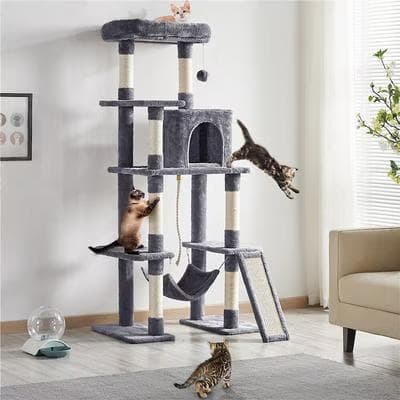
63-inch multi-level cat tree with plush perches, a condo, a hammock, sisal scratching posts, and a dangling toy. Dark gray.
Webvet may earn a commission when you click through to Chewy, at no extra cost to you.
For outdoor-animal triggers, see WebVet's guide to redirected aggression in cats. A redirected episode can outlast the original sight or sound. Do not assume the cat is ready for contact just because the trigger is gone.
Visitor Safety Protocol: Before, During, and After
To stop a cat from attacking guests, management comes first. A visitor protocol and defensive distance plan remove surprise, control the threshold, and give the cat a safe retreat before any behavior session begins.
Searches for cat aggressive towards visitors, cat aggression towards people, and cat aggression towards humans point to the same immediate reader need: prevent contact and make the visit predictable. The visitor protocol should plan before, during, and after visitor behavior around the household's highest-risk traffic moments, including the doorbell, entry, people standing or walking, and departure. A safe retreat should stay outside guest traffic, preserve respectful distance, and remain available throughout gradual counterconditioning. Every person should know the same stop signals.
Before the Visitor Arrives
Prepare a quiet room or separated zone with water, an accessible litter box, bedding, hiding choices, and stable vertical space. Finish household activity before the doorbell. If your cat enjoys play and does not become more aroused, use supervised pre-visit wand play and put the toy away before the guest enters.
Secure the cat before the exterior door opens. If entryway activity is the trigger, use WebVet's cat door and entryway management guidance to build a second barrier and station routine. Do not rely on a guest to block a fast or frightened cat.
A securely anchored cat tree placed outside the guest traffic path can provide vertical distance and choice. It should not trap the cat in a corner or require passing close to the visitor. Match the height and access to mobility, especially for a senior or painful cat.
During the Visit
Give every guest the same rules:
- Ignore the cat unless the owner directs otherwise.
- Sit or stand side-on instead of facing the cat directly.
- Avoid staring, reaching, calling, following, or blocking an exit.
- Keep voices and movement steady.
- Never enter the retreat or pull the cat from hiding.
- End the interaction if the cat stiffens, stops eating, stalks, growls, or advances.
The guest's job is to be predictable, not persuasive. Curiosity is not consent to touch. A cat may approach to gather scent information and still be uncomfortable with a hand moving overhead.
After the Visit
Let the cat settle before restoring full access to the home. Check whether outdoor animals, lingering scents, or conflict with another pet keeps arousal high. Record the distance, duration, body language, food acceptance, and exact point the session became harder.

Lickable cat treats with real chicken, made to support comfort and tranquility. 12 single-serve 0.5-oz tubes.
Webvet may earn a commission when you click through to Chewy, at no extra cost to you.
How to Stop a Cat From Attacking Guests
Cat aggression treatment begins with safety management, a medical rule-out when indicated, and below-threshold counterconditioning. Desensitization presents a very mild version of the visitor trigger, while counterconditioning pairs that safe exposure with something the cat values. The rule is below-threshold counterconditioning not forced exposure: the cat must remain able to eat, look away, move normally, and retreat while the visitor stays predictable. Food acceptance helps identify below threshold work, but posture, movement, breathing, and recovery must remain relaxed too.
Find the Cat's Working Distance
The working distance is where the cat notices the guest but can still eat, look away, groom, explore, or leave. Food acceptance is useful evidence, but eating alone does not prove comfort. Watch posture, tail, ears, breathing, movement, and recovery.
If the cat freezes, crouches, refuses food, stares, growls, stalks, or advances, the setup is too difficult. Increase distance, reduce movement, use a barrier, or end the session. Below threshold work should look almost boring.
Build Positive Associations in Small Steps
Start with one calm adult visitor who follows instructions. The cat may remain behind a barrier or at the far end of a large room. The owner, not the guest, delivers food away from the visitor so the cat is never lured closer.
- Reward option: A high-value freeze-dried cat treat can be one reward option if it fits the cat's diet. Stop if the cat will not eat or shows rising tension. A guest should never hand-feed an aroused cat.
A lickable treat may help the owner deliver a small reward during controlled counterconditioning at a safe distance. Do not let the guest hold it, use it to lure the cat forward, or describe it as a treatment for aggression. Count all rewards within the cat's daily food plan.
Progress one variable at a time:
- Calm visitor seated far away with no eye contact.
- Visitor makes one small movement while the owner rewards the cat.
- Visitor speaks quietly.
- Visitor stands, then sits again.
- Visitor moves within the room while preserving the established distance.
- A future session starts slightly closer only if the cat stayed relaxed and recovered quickly.
Keep sessions short and finish after a success. Several calm minutes are more valuable than one prolonged visit that ends in a lunge. If progress stalls, the setup may still be too difficult or the aggression pattern may need professional reassessment.
What About Pheromones, Medication, or Neutering?
Owners often search for Feliway for cat aggression, cat pheromones for aggression, or cat aggression medication. A pheromone product or veterinarian-selected medication may be an adjunct for some cats, but neither replaces safe separation, diagnosis, environmental change, and a behavior plan.

Probiotic supplement with Bifidobacterium longum BL999 that supports cats in maintaining calm behavior plus digestive and immune health. One daily sachet.
Webvet may earn a commission when you click through to Chewy, at no extra cost to you.
Medication decisions belong to a veterinarian because the likely diagnosis, other illnesses, current drugs, and monitoring needs matter. Spaying or neutering may reduce hormonally influenced roaming or conflict, but it does not reliably stop fear aggression, pain-related aggression, or a learned visitor pattern.
At What Age Are Cats Most Aggressive?
There is no single age when cats are most aggressive toward visitors. Young cats may show intense play or predatory behavior, adolescents may have high arousal, intact cats may show hormonally influenced behavior, and older cats may become defensive because of pain or sensory change. The practical next step is to assess pattern and health, not age alone.
Breed and sex also do not provide a safe shortcut. Avoid assuming that a Siamese, Bengal, male, female, neutered, or unneutered cat will behave a certain way. Individual history, current trigger, body language, health, and opportunity are more useful for planning.
What Tarzan Syndrome Means in Cats
Tarzan syndrome is an informal, non-diagnostic term sometimes used for cats with limited feline social skills, often after being raised without typical kitten-to-kitten learning. It is mainly discussed in relation to interactions with other cats, not as the default explanation for hostility to visitors.
Tarzan syndrome guidance should not replace a visitor-specific assessment. The practical next step is to identify fear, territory, pain, redirected arousal, and learning history. A cat who attacks people needs a safety and veterinary plan regardless of the informal label.
The label also does not mean a cat should be placed near more people or animals to "catch up." Social learning must stay controlled and safe. For guest aggression, use the cat's actual body language and recovery, not the informal term, to set distance and decide whether a veterinarian or qualified behavior professional should guide the plan.
Bites, Scratches, and When to Get Help
Cat bites and deep scratches can become infected, especially punctures to a hand, wrist, joint, or face. Bite and scratch first aid begins with safe separation and thorough washing with soap and running water. Seek human medical guidance promptly for a deep puncture, uncontrolled bleeding, severe pain, impaired movement, or a high-risk location.
Also obtain medical advice for increasing redness, warmth, swelling, drainage, fever, red streaks, or swollen lymph nodes. People with diabetes, reduced immunity, or other infection risk should use a lower threshold for professional care. Do not place an affiliate product in wound guidance or substitute pet advice for human medical assessment.
Veterinary behavior escalation is appropriate when aggression is sudden, severe, unpredictable, directed at children or vulnerable adults, or not controlled by barriers. A board-certified veterinary behaviorist can assess medical and behavioral factors together. WebVet's guide to trainer versus behaviorist credentials explains important differences, even though the examples include dogs.
A cat-specific calming supplement may be discussed with the veterinarian as an adjunct only after safety and assessment are established. It is not treatment for aggression and must not delay evaluation of pain, illness, or escalating attacks.
Frequently Asked Questions
Why is my cat so hostile to visitors?
A cat may look hostile to visitors because fear, territory, redirected arousal, pain, scent, movement, or limited positive experience makes the person feel unsafe. Useful hostile visitors guidance starts with a practical next step: create distance and restore a retreat. Then record the guest aggression trigger and body language before beginning gradual training.
What is a red flag behavior in cats?
Red flags include sudden aggression, unpredictable lunging, sustained stalking, bites, attacks without a clear escape route, pain signs, neurologic change, or behavior that cannot be safely managed around children. Sound flag behavior guidance gives one practical next step first: separate the cat and guest, then contact a veterinarian or qualified behavior professional.
How do I stop my cat from attacking guests?
Start with barriers, a prepared retreat, and consistent guest rules. Effective stop attacking guidance makes the practical next step management, not forced exposure. Once medical concerns are addressed, work below threshold with one calm visitor, owner-delivered rewards, short sessions, and gradual counterconditioning. Stop if the cat freezes, refuses food, growls, stalks, or advances.
At what age are cats most aggressive?
There is no universal age when cats are most aggressive. Cats most guidance should focus on the pattern rather than a birthday. The practical next step is to distinguish play, fear, territory, pain, and redirected arousal. A sudden change in an older cat needs veterinary assessment, while a young cat may need safer play outlets and boundaries.
What is tarzan syndrome in cats?
Tarzan syndrome in cats is an informal term for limited feline social skills, often discussed when a cat lacked normal kitten-to-kitten learning. It is not a formal diagnosis and does not explain most visitor aggression. Responsible tarzan syndrome guidance uses a practical next step: assess the actual trigger, medical status, defensive distance, and learning history. Do not use the label to justify forced social contact or skip a veterinary rule-out.
Should guests give treats to an aggressive cat?
Should guests give treats to an aggressive cat? No, guests should not hand-feed an aggressive or highly aroused cat. During controlled counterconditioning, the owner delivers food at a safe distance so the cat is not lured toward the visitor. If the cat will not eat, stiffens, stares, growls, or advances, increase distance or end the session rather than offering more valuable food. The goal is a safe association at working distance, not taking food from a stranger's hand.
Should I lock my cat away when visitors come?
Should I lock my cat away when visitors come? Secure separation in a prepared retreat can be the safest choice and is not punishment when it includes water, litter, comfort, hiding places, quiet, and enough space. When risk is high, use secure separation. When the cat can choose safely, keep the voluntary retreat available and tell every guest never to enter, reach inside, or block its exit. Set up the room before the doorbell and release the cat only after guest traffic has ended and arousal has settled.
Can calming products stop a cat from attacking guests?
Calming products are an adjunct only and cannot stop every cat from attacking guests. A bed, treat, pheromone product, toy, or supplement does not replace separation, veterinary assessment, environmental change, or a behavior plan. Discuss medication or supplements with a veterinarian and continue below-threshold training only when safety can be maintained.
The Bottom Line
Cat aggression toward guests improves through safety, accurate pattern recognition, and gradual learning. Separate first, preserve defensive distance, teach visitors predictable rules, and work below threshold. Sudden aggression, injuries, pain, or uncontrolled attacks belong with a veterinarian and qualified behavior professional, not a tougher home test.

Wendy Toth is an entrepreneurial writer, editor, and mom of two humans, two dogs and one cat. She’s currently Content Director here at PetFul. For the last 15 years she has held positions at Parents Magazine, NBC, PetSmart, and GreatPetCare, where she was co-founder. Her writing has appeared in many national outlets including Pet Lab Co., Retail Me Not, Ask Men, Wild Society Nutrition, and The New York Times. Because she loves her work so much, she’s obsessed with helping others find career fulfillment, and covers it regularly at PowerSuiting.
Veterinarian · BVMS MRCVS
Dr. Pippa Elliott, BVMS, MRCVS, is a veterinarian with nearly 30 years of experience in companion animal practice. Dr. Elliott earned her Bachelor of Veterinary Medicine and Surgery from the University of Glasgow. She was also designated a Member of the Royal College of Veterinary Surgeons. Married with 2 grown-up kids, Dr. Elliott has a naughty Puggle named Poggle, 3 cats and a bearded dragon.


