What Do Cats Dream About? Cat Dreams, Twitching and Nightmares Explained
Cats very likely dream during REM sleep, most likely about hunting, play, food and the people they live with. Here is what the research shows, how to spot a dreaming cat, and how to tell dream twitching from a seizure.


BVMS MRCVS

This article contains affiliate links. Webvet may earn a commission when you buy through them, at no extra cost to you.
What do cats dream about? Sleep science gives a strong clue. Cats have REM sleep, the stage when people have their most vivid dreams, and research suggests this stage replays waking experience. Your cat most likely dreams about its own day: stalking, play, food and the people and animals it lives with.
Below, you'll find what the research actually shows, how to tell when your cat is dreaming, why dream twitching is different from a seizure, whether cats have nightmares, and whether you should wake a cat in the middle of a dream.
How Cats Sleep: Dozing, Deep Sleep and REM
Most adult cats sleep roughly 12 to 16 hours a day, according to VCA, and kittens and seniors often sleep more. Our guide to how much cats sleep breaks that down by age. Not all of those hours are the same kind of sleep, and only one stage is closely tied to dreaming. If your cat keeps moving its favorite nap spot, Petful looks at why cats change where they sleep.
Researchers who recorded cats' brain waves split feline sleep into light slow-wave sleep, deep slow-wave sleep and REM sleep, and cats move through these stages in repeating cycles rather than one long block.
| Sleep stage | What you may notice | Link to dreaming |
|---|---|---|
| Light slow-wave sleep (dozing) | Curled or tucked, wakes quickly to sounds | Not the main dreaming stage |
| Deep slow-wave sleep | Muscles relaxed, slow and even breathing, harder to wake | Less closely tied to vivid dreams |
| REM (paradoxical) sleep | Body goes limp, eyes may flick under closed lids, brief twitches of whiskers, paws, ears or tail | The stage most closely linked to dreaming |
How often do cats dream? No study has counted cat dreams directly. But because REM sleep returns again and again across a cat's many daily sleep cycles, a healthy adult cat probably dreams several times a day.
Where a cat sleeps matters too. The AAFP and ISFM feline environmental needs guidelines describe a cat's safe place as private and secure, often raised, and note that a cat feels safer when it cannot see a potential threat. A covered bed such as the Best Friends by Sheri Meow Hut gives a cat that enclosed option.
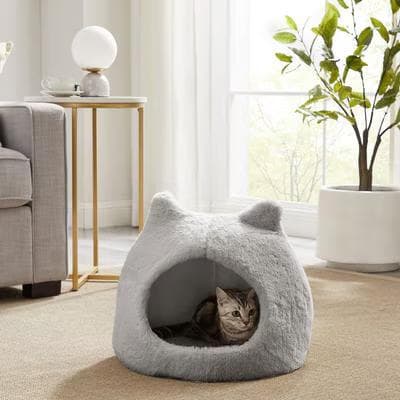
Covered, igloo-style cat bed in soft plush with a water-resistant bottom, giving cats a cozy enclosed spot to curl up. Grey.
Webvet may earn a commission when you click through to Chewy, at no extra cost to you.
Do Cats Dream? What Sleep Research Shows
Cats very likely dream, and much of what science knows about dreaming sleep was first learned from cats. In the late 1950s, French neuroscientist Michel Jouvet found that during REM sleep, which he called paradoxical sleep, a sleeping cat's muscles go slack while its brain stays busy (Arnulf and colleagues, 2018).
That built-in REM sleep paralysis, called atonia, is what normally keeps a dreaming cat still. REM is a state normally characterized by paralysis: circuits in the brainstem switch off most muscle tone, so only small twitches slip through.

When researchers damaged the small brainstem areas that produce this paralysis, cats began to act out their REM sleep instead of lying quietly.
In one study of 25 cats with these brainstem lesions, different cats raised their heads, stared, searched, made attack-like movements and even walked while still in REM sleep. Those behaviors were largely isolated from what was happening around them, much like human dreams. That is as close as science gets to watching a cat dream.
Why do cats dream? No one knows for certain. A leading idea comes from rats: at MIT, Matthew Wilson's lab found that brain activity from waking experience was replayed during REM sleep at a similar pace, which may help the brain process memories. Cats share the same basic REM machinery.
What Do Cats Dream About?
Most likely, cats dream about their own lives, so what your cat is dreaming about depends on how it spends its day. Harvard dream researcher Deirdre Barrett told Scientific American that cats very likely dream about stalking and pouncing on prey.
The brainstem studies point the same way, since the behaviors cats released during REM sleep looked like orienting, searching and attacking.
- 1Hunting: stalking, chasing and pouncing, close to the searching and attack-like behaviors lesioned cats acted out in REM sleep
- 2Play: wand toys, balls and games with other pets in the home
- 3Food: meals, treats and the routines that come before them
- 4Territory: windows, perches and the routes a cat patrols around the house
- 5Companions: the owners and other animals a cat spends its days with
If hunting fills a cat's dreams, it deserves a daily outlet while the cat is awake. The AAFP and ISFM guidelines suggest letting a cat catch the toy on the end of a rod or wand to simulate a capture, then rewarding it with a treat. A feather wand like the Frisco Bird with Feathers Teaser Wand makes that easy. Put it away after each session, since the same guidelines advise storing toys with string or other parts a cat could swallow.

Teaser wand with a feathered bird charm and catnip to trigger your cat's chase-and-pounce instinct.
Webvet may earn a commission when you click through to Chewy, at no extra cost to you.
What Does an Indoor Cat Dream About?
An indoor cat's dreams probably draw on an indoor day: birds seen through the window, play sessions, meals, and the rooms and routes it patrols. There's no evidence that indoor cats dream less than outdoor cats. What changes is the material they have to work with, so an enriched day gives them more to process.
The AAFP and ISFM guidelines say cats should be able to engage in pseudo-predatory play and feeding behaviors, and our guide to interactive cat toys shows how to play so a cat actually engages. Easy ways to give an indoor cat more to hunt:
- Two short wand-toy sessions a day, each ending with a capture and a small treat
- A food puzzle like the Catit Senses 2.0 Food Tree for part of each meal
- A few pieces of kibble tossed across the floor for a quick chase
- A window seat with a view of birds, squirrels or passing traffic
Do Cats Dream About Their Owners?
Probably, at least sometimes. Barrett told Scientific American that cats with a fairly strong attachment to their owners would likely dream about them some, though perhaps less than dogs do. That is expert opinion, not a measured result: no study has recorded what a sleeping cat's brain replays about a specific person.
It does fit what researchers know about cats' bonds with people. A 2019 study found that cats form distinct attachment styles toward their human caregivers, measured with tests first designed for human infants.
If REM sleep replays the important parts of a cat's day, the person who feeds it, plays with it and naps beside it is likely part of that material. If your cat likes to nap on you, see why cats sleep on their owners.
Signs Your Cat Is Dreaming
Is my cat dreaming? Look for a cat that has been asleep for a while, lies loosely with its body relaxed, and then makes small, brief movements. Common signs include:
- Twitching whiskers, lips or face
- Paws that flex, twitch or paddle for a moment
- Ears or the tip of the tail that flick
- Eyes that move under closed lids
- Soft chirps, muffled meows or purring sounds

Purring during sleep can fit a relaxed dream, but the sound needs context; see why cats purr for what it can mean. A tail that flicks while your cat is awake is body language rather than dreaming, which our guide to cat tail language explains.
Many dream periods happen when nobody is watching. Recording a few ordinary naps on your phone or with a pet camera such as the INSTACHEW Purrsight 360 gives you a baseline of what your cat's normal dream twitching looks like, so anything unusual stands out later.

A 360-degree Wi-Fi pet camera you can check from your phone, handy for recording a twitching episode while your cat sleeps so your vet can see it.
Webvet may earn a commission when you click through to Chewy, at no extra cost to you.
What Do Cats Dream About When They Twitch?
Twitches are small bursts of movement that slip through REM paralysis. When the brainstem experiments removed that paralysis completely, cats did not just twitch: they searched, stared and struck out as if attacking. That suggests a twitching paw may be a tiny echo of the same actions, such as chasing, batting or pouncing.
Nobody can confirm the content of any single dream. Brief, patchy twitches in a relaxed, sleeping cat are normal. Rhythmic, whole-body or prolonged movements are not, and the seizure section below explains the difference.
Should You Wake a Dreaming Cat?
Usually, no. REM periods end on their own, and there's no known benefit to interrupting a dream. A cat that is touched or picked up suddenly can lash out before it is fully awake, and a startled cat may scratch or bite by reflex. Children in particular should learn to let a sleeping cat lie.
Can Cats Have Nightmares?
Possibly. If cats replay their experiences in REM sleep, frightening ones such as a fight, a car ride or a trip to the clinic could be replayed too. In the brainstem studies, damage to a pathway from the amygdala, a brain area involved in fear and threat responses, released attack-like behavior during REM sleep in some cats.
That shows cats' REM sleep can involve emotionally charged behavior, but it doesn't prove cats have bad dreams the way people do. Kittens and adult cats alike can look distressed while sleeping. Signs people often read as a cat having a nightmare include:
- Growling, hissing, crying out or loud meowing in sleep
- Ears pulled back or flattened while asleep
- Waking suddenly with wide eyes, then looking around or bolting
If your cat often seems to wake frightened, look at what might be stressing it during the day, such as a new pet, a move, loud work nearby or tension between cats. Our cat stress relief guide covers the basics. Some owners also add a plug-in pheromone diffuser such as Feliway Classic while they fix the cause.
Research on pheromone products is mixed: a 2010 systematic review in the Journal of the American Veterinary Medical Association found insufficient evidence that they reliably reduce stress-related problems, and a 2023 evidence review found only moderate evidence that they ease short-term stress at the veterinary clinic, so treat a diffuser as an optional extra rather than a fix. Our guide to cat calming pheromones explains how to use one.

A plug-in diffuser with a synthetic copy of the feline facial pheromone, an optional extra for a cat that seems unsettled at rest. 30-day starter kit.
Webvet may earn a commission when you click through to Chewy, at no extra cost to you.
What to Do If Your Cat Seems to Have a Bad Dream
- Stay back and keep your hands away from its face and paws.
- If you want to wake it, say its name softly or make a gentle sound from a few feet away.
- Let it settle on its own terms, and pet it only if it comes to you.
- If it keeps happening, note the time, what the movements looked like and how quickly your cat returned to normal.
Most bad-dream moments pass in seconds. A cat that can't be roused, stiffens or paddles rhythmically needs the seizure checks below, not comfort.
Dream Twitching or Seizure? How to Tell the Difference
Normal dream twitches are small, brief and patchy, and they stop and start. Seizures look different. VCA's veterinarians note that seizures often begin at moments of changing brain activity, such as play, feeding, falling asleep or waking up, which is why one can be mistaken for a dream.
| What you notice | Dream twitching | Possible seizure |
|---|---|---|
| Movements | Brief flickers of whiskers, ears, paws or tail that come and go | Jerking, paddling or running movements, rigid legs or spasms through the whole body |
| Response to your voice | Stirs or wakes when you call its name | No response during a generalized seizure |
| Other signs | No loss of bladder or bowel control | May lose bladder or bowel control |
| How long | Seconds at a time | A generalized seizure usually lasts one to two minutes |
| Afterward | Wakes normally or drifts back to sleep | Confused, sleepy, pacing or restless, sometimes for 24 to 48 hours |
Focal seizures are harder to spot because they affect only certain muscle groups and can cause twitching on one side of the body without a collapse. Twitching in cats that recurs in the same spot, leg or body twitching while awake, or twitching in a cat that seems sick all need a veterinary exam.
VCA also describes a REM sleep behavior disorder in pets in which dream movements become violent and can closely resemble a seizure.
What to Do During a Suspected Seizure
- Keep your hands away from its mouth. Cats don't swallow their tongues, and VCA warns that reaching in risks a serious bite.
- Stop your cat from falling, and move objects it could knock onto itself.
- Time the episode from start to finish.
- If you can do it safely, record a video, which VCA notes helps your veterinarian reach a diagnosis.
- Call your vet the same day after any first seizure, even if your cat seems to recover.
Once it's over, keep your cat somewhere quiet, away from stairs, and talk to it calmly while it recovers.
Do Kittens Dream More Than Adult Cats?
Do kittens dream? They certainly spend far more time in REM sleep. A 2026 review of REM sleep development reports that a newborn kitten spends about half its time awake and half in REM sleep, and that REM sleep then falls from about 50% to 20% of the day between roughly day 11 and day 50.
The same review notes that very young kittens are frequently jerked by twitches during this sleep, and that twitches become less frequent with age while staying more pronounced than in adult cats. A kitten dreaming, or at least twitching through REM sleep, is a normal part of growing up.
What do kittens dream about? If their REM sleep carries dream content at all, which researchers can't confirm, their world is small: their mom, littermates, nursing and their first clumsy chases. A leading hypothesis is that early REM sleep helps the developing brain wire itself.
Do Cats Dream Like Humans and Dogs?
Cats, dogs and people all cycle through REM sleep, and all three show brief twitches during it. Dogs twitch, paddle and make small sounds in their sleep in much the same way cats do; our guide to what dogs dream about covers the canine side. In both species, brief sleep twitches are normal, while rhythmic or prolonged movement calls for the same dream-or-seizure check described above.
The big difference is reporting. People can describe their dreams; cats and dogs can't, so no one knows whether a cat's dream has a storyline, images or feelings like ours. The evidence strongly suggests both species dream, and a cat's dreams are most likely built from feline experience: sounds, smells and the urge to hunt.
How to Help Your Cat Sleep Well
You can't choose what your cat dreams about, but you can make its sleep safer and more restful. A few changes cover most cats:
- Offer more than one quiet resting spot, including one raised and one enclosed, away from busy doorways.
- Give a window view. The AAFP and ISFM guidelines suggest resting areas that let a cat see outdoors and describe the ideal perch as elevated and padded, like the K&H Pet Products Window Lounger Cat Perch Kitty Window Sill. Our cat window perch guide covers the safest types.
- Keep a routine of play, then a meal, then quiet time.
- Keep lights low and noise down near sleeping spots at night.

Older cats with stiff joints may skip high perches they used to love. A low, cushioned bed they can step into, such as the FurHaven NAP Ultra Plush Orthopedic Deluxe Cat & Dog Bed, can help. Our guide to mobility in senior cats explains what's normal and what's not.
Sleep Changes Worth a Vet Visit
A sudden, lasting change in how your cat sleeps matters more than any single odd dream. Cornell notes that altered cycles of sleep and wakefulness are among the signs of cognitive dysfunction in cats 10 and older, and that night-time vocalizing is relatively common in cats with hyperthyroidism or high blood pressure. Book a vet visit if your cat:
- Starts sleeping much more or much less, or is hard to rouse
- Paces, yowls or seems confused at night, especially if it is older (our guide to cat meowing at night covers the common causes)
- Rests in unusual hunched positions or hides to sleep, as our guide to cat sleeping positions when sick describes
- Has sleep episodes that are rhythmic, violent, prolonged or followed by confusion
VCA stresses that these changes often relate to a physical illness, so don't assume they're just old age.
Frequently Asked Questions About Cat Dreams
Frequently Asked Questions
Can cats sleepwalk or act out their dreams?
Not normally. REM sleep keeps a healthy cat's muscles largely switched off, which is why a dreaming cat twitches instead of running. Cats with brainstem lesions in research studies did walk and act out behaviors during REM sleep, and VCA describes a REM sleep behavior disorder in pets that can look like a seizure. A cat that walks, runs or thrashes while clearly asleep should be filmed and checked by a vet.
Why does my cat meow, chirp or growl in its sleep?
Soft chirps, muffled meows or a brief growl during sleep often come with the same REM activity that makes whiskers and paws twitch, and they are normal in an otherwise healthy cat. Loud, repeated crying at night in an older cat is different. It can go with cognitive dysfunction, hyperthyroidism or high blood pressure, so it's worth a vet check.
Can cats sense when you're having a nightmare?
No research shows that cats can sense a person's dreams or nightmares. Cats do notice movement, sound and changes around them, so a cat may react to someone who thrashes, talks or cries out in their sleep by leaving the bed, watching closely or moving nearer. That reaction is to what it hears and feels, not to the nightmare itself.

Wendy Toth is an entrepreneurial writer, editor, and mom of two humans, two dogs and one cat. She’s currently Content Director here at PetFul. For the last 15 years she has held positions at Parents Magazine, NBC, PetSmart, and GreatPetCare, where she was co-founder. Her writing has appeared in many national outlets including Pet Lab Co., Retail Me Not, Ask Men, Wild Society Nutrition, and The New York Times. Because she loves her work so much, she’s obsessed with helping others find career fulfillment, and covers it regularly at PowerSuiting.
Veterinarian · BVMS MRCVS
Dr. Pippa Elliott, BVMS, MRCVS, is a veterinarian with nearly 30 years of experience in companion animal practice. Dr. Elliott earned her Bachelor of Veterinary Medicine and Surgery from the University of Glasgow. She was also designated a Member of the Royal College of Veterinary Surgeons. Married with 2 grown-up kids, Dr. Elliott has a naughty Puggle named Poggle, 3 cats and a bearded dragon.


