Are Cat Pheromone Diffusers Safe? A Vet-Reviewed Guide
A vet-reviewed safety answer on cat pheromone diffusers: why the analogue is not a drug, what it means for people, dogs, birds, fish, kittens, and pregnancy, plus plug-in heat rules and what to do if a vial breaks.

BVMS MRCVS

This article contains affiliate links. Webvet may earn a commission when you buy through them, at no extra cost to you.
Are cat pheromone diffusers safe? In the great majority of homes, yes. A plug-in diffuser releases a synthetic copy of the scent signal cats already leave behind when they rub their cheeks on a doorframe. It is not a drug and not a sedative, nothing meaningful is absorbed into your cat's bloodstream, and there is no known interaction with medication.
That verdict comes with named exceptions, because "broadly safe" is not the same as "safe in every room." Whether cat pheromone diffusers are safe in your house depends on who else lives there: a caged bird, an open fish tank, someone with asthma, a kitten who chews anything at outlet height. This guide gives the answer first, then the exceptions, in the order you are likely to need them.
- 1A synthetic feline facial pheromone is a scent message read through the cat's vomeronasal organ, not a drug, so there is no sedation, no systemic effect, and no known interaction with medication.
- 2Almost every real risk in this product belongs to the oil-based carrier liquid and the heated plug unit rather than to the pheromone itself, which is why handling and placement matter far more than the active ingredient.
- 3Pheromone signals are species specific, so a cat diffuser is harmless to a dog and will also do absolutely nothing to calm one.
- 4Caged birds and open aquariums are the two genuine household exceptions, and both are about airborne oil rather than about the pheromone.
- 5If a vial cracks or your cat licks the liquid, do not make the cat vomit, because oils of this kind are most dangerous when they reach the lungs.
- 6No published human safety studies exist for these products, so a pregnant or asthmatic reader should raise it with their own doctor rather than assume proven safety.
- 7A diffuser supports a cat through stress but never explains it, so a sudden change in behavior still needs a veterinary exam first.
Are Cat Pheromone Diffusers Safe? The Short Answer
Cat pheromone diffusers are safe for cats and for the people who live with them when used according to the label. The analogue is a communication signal rather than a medicine, so there is no sedation and no systemic effect. The exceptions worth knowing are caged birds, open aquariums, and the liquid itself.
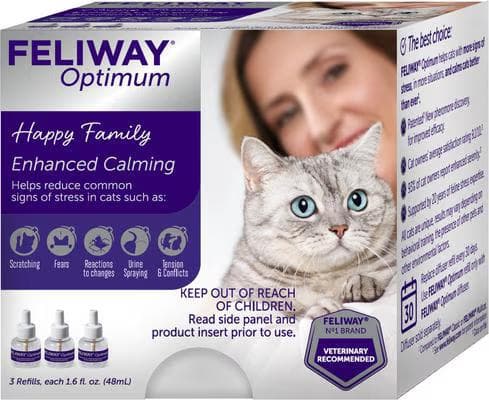
Are pheromone diffusers okay for cats? Yes, and that includes kittens, senior cats, pregnant or nursing queens, and cats already taking prescription medication. Because a facial pheromone analogue is not absorbed into the bloodstream in any meaningful amount, there is no dose to get wrong and nothing for a liver or a kidney to process. Continuous-use kits such as the Feliway Classic 30 Day Starter Kit Calming Pheromone Diffuser for Cats are designed to run for roughly a month per refill, and the label's schedule is the one to follow rather than one you improvise.
Webvet may earn a commission when you click through to Chewy, at no extra cost to you.
What changes the answer is not the cat. It is everyone else sharing the air in that room.
| Who else is in the room | Verdict | The caution that actually matters |
|---|---|---|
| People, including children | Safe at label use | No published human safety studies, so ventilate and keep it out of bedrooms |
| Cats and kittens | Safe, no known contraindication | Nothing is absorbed, so the risk is a chewed unit, not the pheromone |
| Dogs | Safe and completely inactive | A cat analogue carries no message to a dog, so it will never calm one |
| Caged birds | Do not run one in the same room | Bird airways are unusually sensitive to airborne particles and fumes |
| Fish in an open tank | Do not run one above or beside the tank | Airborne oil can settle on the water surface |
| Rabbits and small mammals | No established hazard | Keep hutches and cages out of the unit's immediate airspace |
What a Pheromone Analogue Actually Does
The reason the safety answer is reassuring is worth understanding, because it is what separates this product from a sedative or a supplement. When a cat rubs its cheek on a table leg it deposits a facial pheromone that means, in effect, this place is familiar and nothing bad happened here. A diffuser releases a laboratory copy of that same signal.
Cats read it through the vomeronasal organ, a small scent-detecting structure in the roof of the mouth, not through the bloodstream. That single fact drives the whole safety profile:
- Nothing is swallowed, injected, or absorbed in a meaningful amount, so there is no dose, no overdose, and no known drug interaction.
- There is no sedative action at all. A cat under a diffuser is not drowsy, slowed, or chemically altered, and a cat that suddenly seems sedated needs a vet, not a second diffuser.
- The signal is species specific by design, which is why the same technology had to be re-engineered from scratch for dogs and why it means nothing to a person. There is no single Feliway for dogs and cats; the dog version uses a different, species-specific signal.
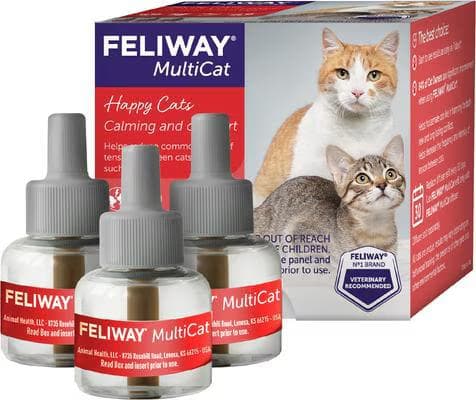
One distinction is worth knowing before you buy, because it changes what a product is for without changing its safety profile. Classic formulations copy the facial pheromone a cat deposits when it rubs its cheeks on furniture. Multi-cat formulations copy the appeasing pheromone a nursing queen produces for her kittens. Both are scent messages rather than drugs, so everything in this guide applies to either.
Webvet may earn a commission when you click through to Chewy, at no extra cost to you.
Because the pheromone itself does so little in the body, the honest risk conversation moves to the two things that surround it: the oil the analogue is dissolved in and the warm electrical unit that disperses it. That is where the rest of this guide spends its time. It is also why some households prefer comfort tools that involve no plug and no liquid at all: a hand-given lickable puree such as Feliway Happy Snack Chicken Puree Lickable Cat Treats, 0.5-oz Tubes, 12 Count is used in the moment and finished in a minute, with nothing left running unattended in the wall.
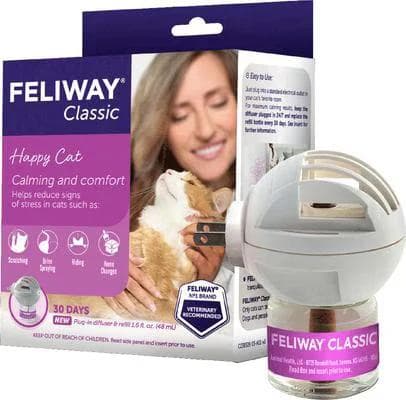
A vet-recommended plug-in diffuser that releases the drug-free Feliway Classic pheromone to reduce stress signs in cats like scratching, hiding, and urine marking. 30-day starter kit.
Webvet may earn a commission when you click through to Chewy, at no extra cost to you.
Dogs, Birds, Rabbits, and Fish in the Same Home
Are pheromone diffusers safe for dogs? Yes. A feline facial pheromone analogue carries no message a dog can read, so it neither harms nor helps them. Dogs and cats can share a room with a running diffuser without any special precautions. The flip side is that owners hoping one device will settle the whole household will be disappointed, because a cat product will not calm a dog. A separate dog pheromone product exists for that, built on an entirely different signal, and the two are not interchangeable.

Birds are the one species where the guidance changes to a clear no. Birds have an exceptionally efficient respiratory system built around air sacs and one-way airflow, which is what makes them so sensitive to anything airborne: cooking fumes, aerosols, smoke, and heated oils. Manufacturers of pheromone diffusers commonly caution against use around caged birds for exactly this reason. Do not run a plug-in diffuser in a room a bird lives in, and read the packaging on any unit you already own.

Fish and small mammals sit in the sensible-precaution category rather than the established-hazard one:
- Fish: never run a diffuser directly above or immediately beside an open aquarium. Fine airborne oil residue can settle on the water surface, and the surface is where gas exchange happens.
- Rabbits, guinea pigs, ferrets, and other small mammals: no cat-pheromone hazard has been established, but their cages sit low, are often enclosed, and are hard to ventilate. Keep them out of the unit's immediate airspace.
- Reptiles and amphibians: the same placement logic applies to a closed vivarium, particularly one with a fine mesh top near an outlet.
Plug-In Heat and Electrical Safety
Set the pheromone aside for a moment and look at the object itself. A diffuser is a small electrical appliance that gently warms an oil to release it, and it runs unattended in your wall for weeks at a time. That is the part of it most owners are actually staring at when they start worrying, and it deserves the same treatment you would give any plug-in air freshener or night light.

The placement checklist is short and worth following exactly:
- Use a free-standing outlet with clear space above the unit, since the warm air rises.
- Never plug it in behind or underneath furniture, a curtain, a bed, a shelf, or a pile of laundry.
- Never cover the unit or drape anything over it, and never plug it in behind a door that swings against the wall.
- Keep it out of reach of a cat that jumps to low shelves and away from a kitten's chewing range.
- Follow the manufacturer's guidance on power strips and extension cords rather than assuming either is fine.
- Replace the plug unit on the schedule printed on the packaging instead of running the same one indefinitely.
If the appliance itself is the sticking point, whether because of limited outlets, an older building, or a household that unplugs everything at night, the calming category is not limited to plug-ins. A daily supplement such as Purina Pro Plan Veterinary Diets Calming Care Cat Supplement, 30 Count is given by mouth with food, so nothing hangs in the wall and nothing is dispersed into shared air. Anything you add by mouth is worth clearing with your veterinarian first, especially for a cat with existing health conditions.
Webvet may earn a commission when you click through to Chewy, at no extra cost to you.
Are Cat Pheromone Diffusers Safe for Humans?
Do cat pheromone diffusers affect humans? Whether cat pheromones affect humans in practice starts with one fact: people cannot detect feline pheromones, and questions about cat pheromone diffuser effects on humans or Feliway side effects in humans or whether Feliway is safe for humans to breathe concern the warmed carrier liquid rather than the analogue. Humans have no functional equivalent of the cat's vomeronasal signalling system for these compounds, so the analogue is not doing anything to you, your partner, or your children. Any faint smell you notice near a running unit is the warmed carrier liquid, not the pheromone.
The honest caveat is this: no published human safety or toxicity studies exist for feline pheromone diffusers. That is an absence of data rather than a finding of harm, and it is the reason the advice below points to your own doctor rather than to a veterinarian on anything concerning human health.
Asthma and reactive airways
Is Feliway safe for humans with asthma? No evidence suggests the analogue triggers airway symptoms. However, any device that warms and disperses an oil can bother reactive airways, exactly as scented plug-ins and candles can. Keep the unit away from bedrooms and from the chair someone occupies for hours, ventilate the room, and if breathing symptoms appear after you start using one, unplug it and air the room out. Then talk to the doctor who manages the asthma.
Headaches and a faint smell
Can Feliway cause headaches in humans? Headaches are the most common human complaint about these products, and they track the warm carrier release rather than the pheromone. The fix is ordinary: move the diffuser out of the room you spend most of your time in, pick a spot with airflow, and stop using it for a week to see whether the headaches stop with it. If they do not, the diffuser was not the cause.
Pregnancy
Is Feliway safe for pregnant humans? It has not been established: no evidence shows a risk, and no human studies confirm safety. Use the same sensible measures as anyone else, meaning good ventilation and placement away from where you sleep, then ask your own physician or midwife whether they have a concern. That is a human health question, and a veterinarian is not the right person to answer it.
Side Effects: What Is Normal and What Is Not
Are there any side effects of cat pheromones? The analogue itself has no systemic effect, so it produces no drowsiness, no appetite change, and no organ stress. What owners do occasionally report traces back to the carrier liquid or the warm unit rather than to the pheromone: a faint oily smell, a headache in a sensitive person, an oily film on the wall above the outlet, or a cat that pays close attention to the device for a day or two before ignoring it.

What is genuinely normal in the first week:
- Sniffing, rubbing, or briefly staring at the unit, then losing interest in it.
- No visible change at all, since environmental effects build slowly rather than switching on.
- A faint warm smell in a small closed room that fades once the room is aired.
What is not normal and is worth a call to your veterinarian:
- Drooling, retching, gagging, or repeated lip-licking, which suggest contact with the liquid.
- Coughing, wheezing, or any change in breathing effort or rate.
- Vomiting, unsteadiness, or a cat that suddenly seems sedated, since the analogue does not sedate.
- Redness, squinting, or pawing at an eye after the cat has been near a leak.
- Any new behavior problem that starts or worsens after you begin using one.
Judging whether a diffuser is doing anything at all takes an accurate read of your own cat, and reading cat body language in context is more reliable over two to four weeks than a gut sense that things feel calmer.
Do Veterinarians Recommend Pheromone Diffusers?
Yes, veterinarians and veterinary behaviorists commonly suggest pheromone diffusers, and the honest reason matters. They are recommended primarily because the risk is very low, not because the evidence for them is strong. Published results are genuinely mixed, several of the supporting studies were funded or conducted by manufacturers, and independent replication is thinner than the marketing implies. Feline behavior guidance still treats pheromone support as a reasonable first-line option for mild stress precisely because there is so little that can go wrong with trying it.
The consistent professional framing is that a diffuser belongs alongside environmental changes rather than instead of them. Litter box math, separated resources, vertical space, hiding places, and daily predatory play do the heavy lifting, and there is a full plan for reducing stress at home that a diffuser is meant to support. Vertical and scratching options are part of that same picture, and a wall-mounted board such as the Necoichi Premium Comfort Cat Scratcher Wall, Dark Cherry/Brown, Regular covers a corner a floor post cannot reach in a small apartment.
If the Bottle Breaks or Your Cat Licks the Liquid
Even a low-risk product has one scenario worth planning for, and this is it. The pheromone is not the problem here. The carrier is an oil-based solvent, and the danger with oils like this is not systemic poisoning but aspiration, meaning the liquid getting into the lungs and causing a serious pneumonia. That risk is why the standard first-aid instinct is the wrong one.
Work through these steps in order:
- Unplug the unit at the wall and move the cat into a separate closed room, away from the spill and away from any glass.
- Wipe the cat's mouth, chin, and paws with a damp cloth so it cannot groom more of the liquid off its fur.
- Open windows and ventilate the room the spill happened in.
- Clean the spill with paper towels and dispose of them and any broken glass outside the home.
- Keep the packaging, since the label carries the ingredient information a vet or poison control will ask for.
- Call your veterinarian or an animal poison control service now, and tell them how much was spilled and whether the cat licked it, walked through it, or only sniffed it.
Go in the same day, without waiting to see how things develop, if the cat is coughing, gagging, retching, drooling heavily, breathing faster or with visible effort, unsteady, or unusually quiet. Rinse any liquid in an eye with clean water and have a vet look at it. For people, treat it like any household oil: avoid handling the liquid, wash skin with soap and water after contact, rinse eyes with water, and call your own doctor if irritation persists.
Kittens, Pregnant Cats, and Cats on Medication
There is no known contraindication for kittens, pregnant queens, nursing queens, senior cats, or cats on prescription medication, and the reason runs through this whole guide: without meaningful systemic absorption there is nothing to interact with a drug, cross a placenta, or accumulate in a small body.
The genuine caution with a kitten is not the pheromone. It is the object. A kitten will investigate the warm plastic unit, chew a nearby cord, or knock a loosely seated vial out of the base:
- Choose an outlet a kitten cannot reach from the floor or from a nearby chair or shelf.
- Check that the vial is screwed in firmly, and check it again after each refill.
- Supervise the first few days and move the unit if the kitten keeps returning to it.
- Never run a diffuser in a room where a kitten is confined alone for long stretches, such as an overnight crate or a small bathroom setup.
When to Skip the Diffuser and Call Your Vet Instead
When should you not use a pheromone diffuser? There are four clear situations. Skip it in any room shared with a caged bird. Skip it directly above or beside an open aquarium. Stop using any unit that is cracked, leaking, discolored, or damaged rather than trying to get one more week out of it. And do not reach for one at all when a cat's behavior has changed suddenly and nobody has examined that cat yet.

Once a physical cause has been ruled out or treated, a diffuser is a reasonable part of the plan. The signs worth learning are covered in our guide to anxiety in cats, and situational patterns such as aggression toward visitors usually respond better to a change in how the household handles the situation than to any device.
Safe Is Not the Same as Effective
Everything above is a safety answer, and safety is the easy half of the question. Whether a diffuser will actually help your cat is a separate matter, with a mixed evidence base, results that vary by cat and by problem, and real differences between the formulations sold for solo cats, multi-cat tension, and urine marking. That discussion, including how long to give one before you judge it, lives on our guide to how cat pheromone diffusers work.
Choosing and Running a Diffuser Safely
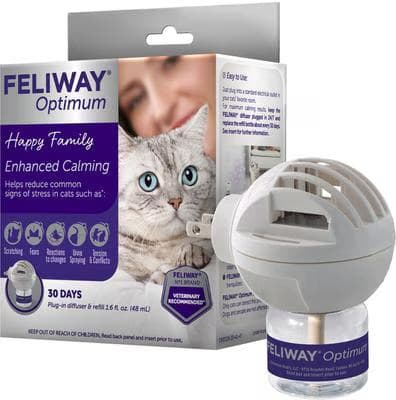
If you have decided to try one, the safe-use rules are already above: one unit per main living area, a free-standing outlet with clear space, a refill schedule you follow rather than stretch, and a unit you retire when the packaging says to. Comparing a diffuser against collars, sprays, treats, and supplements is a selection question rather than a safety one, and our roundup of cat calming products covers the trade-offs. For the Optimum formula, the Feliway Optimum Starter Kit includes the unit and first vial; Feliway Optimum 3-count refills are for continued use after a successful first cycle. Multi-cat households using the appeasing formula can use Feliway MultiCat 3-count refills on the same label-directed replacement schedule.
Frequently Asked Questions
Are there any side effects of cat pheromones?
The analogue itself causes none, because it is a scent signal rather than a substance absorbed into the bloodstream. There is no sedation, no appetite change, and no organ effect. What owners report traces to the oil carrier or the warm plug instead: a faint smell, an oily film on the wall, or a headache in a sensitive person. Drooling, gagging, coughing, vomiting, or apparent sedation in a cat are not expected and warrant a call to your veterinarian.
Do vets recommend Feliway diffusers?
Yes, veterinarians commonly suggest pheromone diffusers, but the reason is worth knowing. They are recommended largely because the risk is very low, not because the evidence is strong. Published results are mixed and much of the supporting research was manufacturer funded. Feline behavior guidance still treats pheromone support as a sensible first-line option for mild stress, always alongside environmental changes and never as a replacement for a veterinary exam.
When should you not use a pheromone diffuser?
Skip it in four situations. Do not run one in a room shared with a caged bird, since avian airways are exceptionally sensitive to airborne particles and fumes. Do not run one above or beside an open aquarium, where airborne oil can settle on the water surface. Stop using any unit that is cracked, leaking, or damaged. And do not reach for one when a cat's behavior has changed suddenly, because that cat needs a veterinary exam first.
Are pheromone diffusers okay for cats?
Yes. Facial pheromone analogues are considered safe for healthy cats, kittens, senior cats, pregnant and nursing queens, and cats already on prescription medication. The reason is mechanical rather than marketing: the analogue is detected as a scent signal and is not absorbed into the bloodstream in any meaningful amount, so there is no dose to get wrong and no known drug interaction. The practical cautions concern the carrier liquid and the heated unit.
Are cat pheromone diffusers safe for humans?
There is no evidence of harm at label use, and people cannot detect feline pheromones at all, so the analogue is doing nothing to anyone in the room. The honest qualifier is that no human safety studies have been published, which is an absence of data rather than proof of safety. Ventilate the room, keep the unit out of bedrooms, avoid handling the liquid, and raise any human health concern with your own doctor.
Are cat pheromone diffusers safe for dogs?
Yes, and they are completely inactive in dogs. Pheromone signals are species specific, so a feline analogue carries no message a dog can read, and the two can share a room with a running diffuser without special precautions. The corollary is that a cat diffuser will never calm an anxious dog. A separate dog pheromone product exists for that, built on a different signal, and the two are not interchangeable.
Are cat pheromone diffusers safe during pregnancy?
No evidence suggests a risk, and no human studies exist to confirm safety either, so a blanket reassurance would not be honest. Take the sensible steps anyone would: run the unit in a ventilated room, keep it out of the bedroom, and let someone else handle refills. Then ask your own physician or midwife whether they have any concern, because this is a human health question rather than a veterinary one.
Can a pheromone diffuser cause headaches?
Some people report headaches near a running unit, though the analogue is undetectable to humans and is not a plausible cause. What people notice is the warmed carrier oil being released into the air, the same way scented plug-ins and candles bother some households. Move the unit to a room you spend less time in, improve ventilation, and stop using it for a week to see whether the headaches stop with it.
Sources

Editor
The Webvet Editorial Team is the in-house group of pet-care editors and writers behind Webvet, operated by Smart Pet Collective. The team researches, writes, and maintains Webvet's pet health, behavior, and medication content. Every article follows a defined editorial process: research from reputable veterinary and scientific sources, careful drafting, mandatory review of medical content by a credentialed veterinarian, and dated publication. Health and medication articles are medically reviewed by a licensed veterinary professional before they go live and are kept current over time.
Veterinarian · BVMS MRCVS
Dr. Pippa Elliott, BVMS, MRCVS, is a veterinarian with nearly 30 years of experience in companion animal practice. Dr. Elliott earned her Bachelor of Veterinary Medicine and Surgery from the University of Glasgow. She was also designated a Member of the Royal College of Veterinary Surgeons. Married with 2 grown-up kids, Dr. Elliott has a naughty Puggle named Poggle, 3 cats and a bearded dragon.


