Cat Pheromone Diffuser: What the Evidence Shows and How to Use One
Pheromone diffusers help some cats with some signs, and only when the environment is fixed too. Here is what the evidence supports, how Classic, MultiCat and Optimum differ, exactly where to plug the unit, and when to call your vet instead.

BVMS MRCVS

This article contains affiliate links. Webvet may earn a commission when you buy through them, at no extra cost to you.
A cat pheromone diffuser is a plug-in device that gently warms a vial of liquid and releases a synthetic copy of a scent signal cats make themselves, so a room reads to your cat as familiar territory rather than unclaimed space. It is a behavioral support that changes how a place feels to the cat. It is not a drug, not a sedative, and not a treatment for any disease.
That distinction matters, because most people buy a cat pheromone diffuser at a moment of real frustration: a cat spraying the hallway wall, two cats who used to nap together now hissing at doorways, a new arrival due next weekend. The honest answer is that these products help some cats with some signs, some of the time, and only when the underlying problem in the house is also fixed. This guide covers what the evidence supports, how the formulas differ, exactly where to plug the unit, when to refill it, and the signs that mean you should call your vet before you buy anything at all.
- 1A pheromone diffuser releases a synthetic analogue of a scent cats deposit naturally, and it works by changing the chemical impression of a room rather than by acting on the cat like a medication.
- 2Published research reports modest benefit for specific signs in some cats, but the studies are small, the outcomes are measured differently from trial to trial, and several were funded by the companies that sell the products.
- 3Feliway Classic copies the F3 facial pheromone and targets marking, scratching and settling into a space, while Feliway MultiCat copies the cat appeasing pheromone and targets tension between cats who share a home.
- 4Placement decides whether the product does anything at all: use a free wall socket in the room your cat actually lives in, out in the open and near cat level, never behind furniture or beside a vent, fan or air purifier.
- 5The manufacturer rates one Feliway unit for up to 700 square feet, so a large or multi-level home needs more than one, and a spent refill gives a human no smell or sound to notice.
- 6Give a diffuser one full refill cycle before you judge it, pair it with the environmental fix that does the real work, and stop paying for refills if nothing has shifted after two cycles.
- 7Any change in urination, straining, blood in the urine, escalating aggression or new over-grooming is a veterinary matter first, and a cat who cannot pass urine needs emergency care immediately.
What a cat pheromone diffuser actually does
A cat pheromone diffuser is a small plug-in unit that holds a vial of oil containing a synthetic analogue of a feline pheromone. The unit warms the liquid so it evaporates slowly into the room over several weeks. Cats detect these molecules through the vomeronasal organ in the roof of the mouth, a separate chemical sense from ordinary smell, and the message they read is roughly "another cat has already marked this place as safe."
Cats create the original signal themselves. When your cat presses her cheek against a door frame, the corner of the sofa or your ankle, she is depositing scent from glands on her face. That behavior, sometimes called bunting, is how a cat labels the parts of her territory she has no reason to be worried about. A diffuser does not teach the cat anything and does not sedate her. It simply loads the air of a room with a familiar chemical impression she would otherwise have to build herself, which is why it is most useful in spaces that feel new, contested or disrupted.
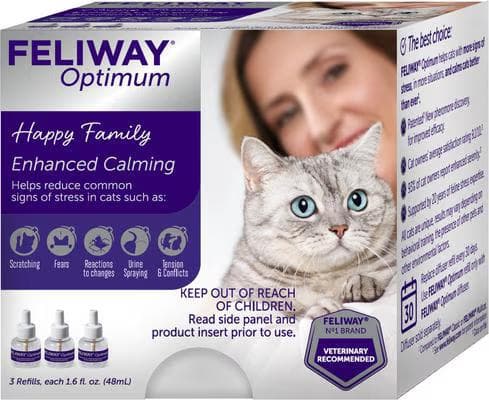
Most brands sell the unit and the refill together for a first purchase, which is the least wasteful way to run a trial: you get the plug-in housing plus one 30-day vial, and you only commit to further refills if you see something change. The Feliway Classic 30 Day Starter Kit Calming Pheromone Diffuser for Cats is the common starting point for a single-cat marking or settling-in problem, and the same brand sells refill twin packs once you know the product is worth continuing.
Webvet may earn a commission when you click through to Chewy, at no extra cost to you.
Whatever you buy, the ceiling on what any of these products can do is the same:
- It can make an unfamiliar or tense room feel more settled to a cat who is otherwise healthy.
- It cannot fix a litter box that is dirty, in the wrong place, or shared by too many cats.
- It cannot resolve pain, illness, or a genuine fight over food, resting spots or access to a window.
- It cannot substitute for a slow, structured introduction between cats.
- It is not a medication and should never be used to postpone a veterinary exam.
Do cat pheromone diffusers actually work? What the evidence supports
Do cat pheromone diffusers work? Sometimes, for some signs, to a modest degree. The published literature on synthetic feline pheromones reports reductions in specific behaviors such as urine marking and scratching in a proportion of cats studied, along with calmer behavior in some clinic and travel settings. It is not a product that works reliably in every cat, and the effect size in the studies that do show a benefit is generally described as modest rather than dramatic.
The reason honest sources hedge is that the study base is genuinely thin. Trials in this area tend to enroll small numbers of cats, they measure very different outcomes (owner-scored behavior diaries, counts of marking events, clinic stress scales), the follow-up periods are short, and a meaningful share of the work has been funded or run by the companies that manufacture the products. Independent reviews of the literature have repeatedly called for larger, better-controlled trials. None of that means pheromones do nothing. It means the evidence is not strong enough to promise you a result, and any source that does is overselling.
Where the case is comparatively stronger and where it is weakest is worth separating:
- Reasonably supported: reduction in urine marking and vertical scratching in some cats, and lower stress-related behavior during short veterinary or transport events.
- Mixed: tension between cats already living together, where results vary widely between households.
- Weak or unstudied: any claim about treating a medical condition, curing anxiety, or producing a permanent behavior change on its own.
In practice, "it worked" usually means the frequency of an unwanted behavior fell rather than stopping outright, and that the change appeared alongside other adjustments the owner made at the same time. That is not a failure of the product. It is how a mild environmental intervention behaves. If you want a way to measure the change rather than guess at it, count something specific before you plug the unit in, which is covered further down this page.
A diffuser is also not the only option with research behind it, and it is not the only thing worth raising with your vet. Nutritional and probiotic calming products are a separate category with their own evidence and their own limits, and your veterinarian may suggest trying one alongside environmental changes for a cat with ongoing stress-related behavior. Purina Pro Plan Veterinary Diets Calming Care Cat Supplement, 30 Count is one of the veterinary-diet options a vet may bring up in that conversation, and like a diffuser it belongs after a physical exam, not instead of one. Whichever route you take, read the broader picture in our guide to cat anxiety before you spend anything.
Webvet may earn a commission when you click through to Chewy, at no extra cost to you.
F3 facial analogue vs cat appeasing pheromone: what each one is for
What is the most effective pheromone for cats? There is no single winner, because the two pheromone families on the market copy different messages and are aimed at different problems. The F3 facial analogue speaks to a cat about territory and familiarity. The cat appeasing pheromone speaks to a cat about social reassurance between cats. Choosing the more "effective" one is really a question of which signal is missing in your house.

The F3 facial analogue is the synthetic version of one fraction of the scent a cat leaves when she cheek-rubs furniture, doorways and people. In a cat's own chemical language, a surface carrying that mark is a surface she has already checked and accepted. That is why products built on F3, including Feliway Classic, are aimed at signs that come from a cat feeling unsettled about her own space: spraying on walls and furniture, scratching the sides of the sofa, hiding after a house move, or refusing to settle in a newly rearranged room.
The cat appeasing pheromone, usually shortened to CAP, copies a different signal entirely. It is the analogue of a scent a nursing queen produces that keeps a litter of kittens calm and tolerant of each other. A CAP pheromone diffuser is therefore aimed at the social relationship between cats rather than at the walls, which is why Feliway MultiCat is marketed for households where cats stare, block doorways, swat, chase or hiss at one another.
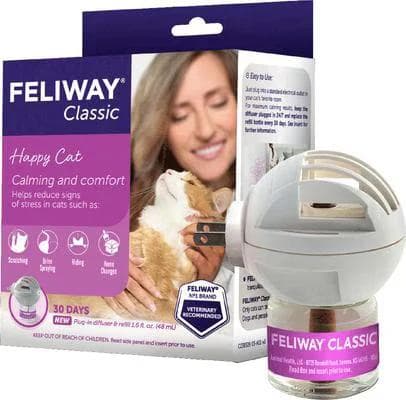
A vet-recommended plug-in diffuser that releases the drug-free Feliway Classic pheromone to reduce stress signs in cats like scratching, hiding, and urine marking. 30-day starter kit.
Webvet may earn a commission when you click through to Chewy, at no extra cost to you.
Pick by the signal you are missing, not by the box that looks strongest:
- One cat, spraying, scratching, hiding or unsettled by a change to the home: the F3 facial analogue.
- Two or more cats who live together and are tense with each other: the cat appeasing pheromone.
- A cat who is fine at home but panics in the carrier or at the clinic: the F3 analogue in spray form, applied to bedding and the carrier ahead of time.
The two are not interchangeable, and swapping one for the other is one of the most common reasons an owner concludes that pheromones "did not work." A CAP product will not do much about a single cat spraying the hallway wall, and an F3 product is not designed to smooth over a resource conflict between two cats who both want the same sunny shelf.
Classic vs MultiCat vs Optimum: matching the formula to the problem
What is the best pheromone diffuser for cats? The best cat pheromone diffuser for fighting is a cat-appeasing-pheromone formula, while marking usually calls for an F3 facial analogue. The best cat pheromone diffuser is the one that matches the sign you are trying to change, and for most households that is a straight choice between the F3 formula and the CAP formula rather than a hunt for the strongest product. A single cat marking the wall and two cats fighting over a hallway are different problems, and buying the wrong formula wastes a month before you find out.
| Formula | Pheromone it copies | Signs it is aimed at | What it will not do |
|---|---|---|---|
| Feliway Classic | F3 feline facial analogue | Urine marking, furniture scratching, hiding, settling into a new or rearranged home | Resolve conflict between cats, or change a cat's response to another cat |
| Feliway MultiCat | Cat appeasing pheromone (CAP) | Staring, blocking, chasing, swatting and hissing between cats sharing a home | Reduce spraying or scratching driven by a single cat's territorial stress |
| Feliway Optimum | Manufacturer's proprietary pheromone complex | Marketed by Ceva for a broader range of stress-related signs in one product | Replace a veterinary exam, or deliver the independent evidence base that F3 has |
Read those rows as decision rules:
- Choose Classic when one cat is the problem and the problem is about the space itself. It is the formula with the longest track record and the most independent study attention.
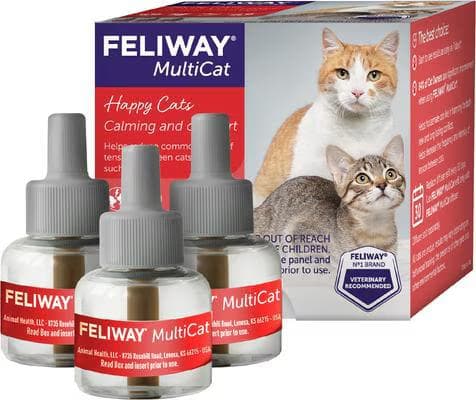
- Choose MultiCat when the problem is the relationship between cats already living together. Running it alongside a resource fix beats running it alone. If a first cycle helps, Feliway MultiCat 3-count refills are the bulk continuation format for that same formula.
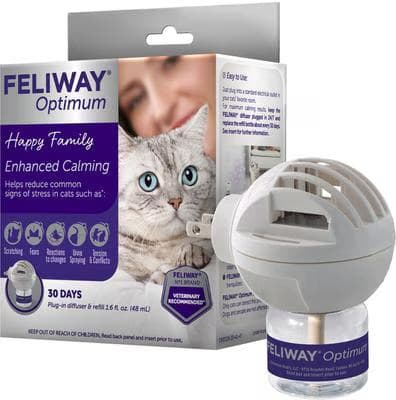
- Consider Optimum when you want the manufacturer's broader-spectrum product and are willing to accept a thinner independent evidence base. Ceva markets Feliway Optimum as its enhanced formula covering more signs than Classic, and that positioning comes from the company. Independent, published work on the newer complex is considerably thinner than the body of work on F3, so treat the broader claims as marketing until more outside research exists. The Feliway Optimum Starter Kit supplies the plug-in and first vial; households that see a useful response can continue with Feliway Optimum 3-count refills without replacing the unit early.
Other brands sell pheromone diffusers too, including Comfort Zone in the United States and Virbac Zenifel, and some readers will find one easier to buy locally or cheaper to refill. Judge any of them on the same three questions: which pheromone does it copy, what area does the label say one unit covers, and how long does one refill last. If you want a cat pheromone diffuser for anxiety specifically, note that "anxiety" is not a single thing in cats, and the product you need depends on what is triggering it, which is worth reading about in our overview of cat calming products.
Where to plug a cat pheromone diffuser (and where not to)
Where not to put a Feliway diffuser, or any other brand, is the question that decides whether you get anything for your money. Do not plug it behind a sofa, under a bed, behind a curtain, inside a cabinet or cupboard, under a low shelf, directly beneath an air conditioning vent, next to a fan or air purifier, beside an open window, or into a switched socket that gets turned off at night. Anything that blocks, dilutes or vents the airflow removes the product from the room.
| Situation | Where to plug it | Why |
|---|---|---|
| One cat, marking or scratching indoors | Free wall socket in the room where the marking happens, out in the open | The signal needs to reach the surfaces the cat is targeting |
| Multi-cat tension | The room where the cats overlap most, usually the main living space or a hallway junction | Conflict happens at shared thoroughfares and resource points |
| New cat settling in | The confinement room first, then a second unit in the shared space before the door opens | Builds a familiar chemical impression before the cats meet |
| Open-plan or multi-level home | One unit per floor or per open zone, not one unit for the whole house | Coverage is rated per unit and does not travel between floors |
| Carrier or car travel | Not the diffuser. Use the spray on bedding 15 minutes ahead | A plug-in cannot serve an enclosed, moving space |
The practical rule is simple: put it in the room your cat genuinely spends time in, at an open wall socket, close to cat level rather than up above a worktop, and near the spots where she actually rests. If your cat spends her afternoons on a sunny sill, a socket in that room does more good than one in a hallway she only passes through. The same logic applies to the resting spot itself, and a proper perch in the calm room helps as much as the diffuser does: something like the Frisco Plush Cat Window Perch with Removeable Bolster, Cream gives a cat a defensible, elevated place to settle in the same space the pheromone is filling.

Run through this list before you walk away from the socket:
- Is the unit out in the open, with nothing in front of it and nothing directly above it?
- Is it upright, the way the label shows, rather than in a horizontal or floor-level socket that lets the liquid pool?
- Is anything blowing air across it, including a vent, a fan, an air purifier or an open window?
- Is the socket always on, or is it controlled by a wall switch or a smart plug that turns off overnight?
- Is the door to that room usually open, so the cat can actually get in?
Coverage is the other half of the placement question. Ceva's label for the Feliway diffuser states that one unit covers up to roughly 700 square feet, and the figure on your own box is the one that counts, since coverage claims vary between brands and between markets. That number assumes an open space, so a two-storey house, a home with closed internal doors, or a household where the cats keep to separate floors realistically needs a unit on each level. Two units in the two rooms that matter will always beat one unit in a hallway.
Refill timing, unit replacement, and how to tell it is empty
Most pheromone refills are labelled to last about 30 days in normal use, and the plug-in unit itself has a separate lifespan: Ceva advises replacing the Feliway diffuser device roughly every six months, because the heating element and wick degrade long before the plastic housing looks worn. Running a fresh vial in a two-year-old unit is one of the quietest ways to get a disappointing result.

The awkward part is that a spent refill gives you no signal at all. There is no smell for a human to miss, no light that changes colour on most units, and no sound. The liquid level in the vial is the only visual cue, and it drops slowly enough that people stop noticing. A calendar reminder set for the day you plug it in is the only reliable check, and writing the date on a piece of tape stuck to the unit is a decent backup.
- Set a repeating 30-day reminder the moment you plug in a new vial.
- Check the vial level at the same time you scoop the litter box, so it rides along with a habit you already have.
- Replace the plug-in unit itself on the schedule the label gives, not when it looks dirty.
- If a diffuser seemed to help and then quietly stopped, check the refill date before you conclude the product failed.
- Do not leave an empty vial in the unit. It heats nothing useful and hides the fact that the product ran out.
Using a diffuser for spraying, cat-to-cat tension, introductions and travel
A diffuser earns its place as the background layer of a plan, never as the plan. In every scenario below, the environmental change does most of the work and the pheromone supports it. Plug the unit in a few days before the event you are preparing for wherever you can, because a room that already carries the signal is worth more than one you set up on the morning of.
Webvet may earn a commission when you click through to Chewy, at no extra cost to you.
Spraying and peeing in the house
A cat diffuser for peeing is only reasonable once a veterinarian has ruled out a medical cause, because urinating outside the box is a medical sign before it is a behavioral one. Once your cat has been examined and cleared, the F3 formula is the sensible choice, since spraying is territorial marking rather than a litter box failure. Pair it with the real fix: one litter box per cat plus one spare, boxes in quiet and separate locations rather than lined up in a row, unscented litter, daily scooping, and thorough enzymatic cleaning of every marked spot so the old scent does not invite a repeat. Searching for the best cat pheromone diffuser for peeing without addressing box count and cleaning almost always ends in a refund request.
Tension and fighting between cats
If you want a cat pheromone diffuser for fighting, use the cat appeasing pheromone formula, and be clear-eyed that it moderates tension rather than settling a dispute. Most inter-cat conflict in homes is competition over resources, so the fix is duplication and distance: separate food and water stations out of sight of each other, extra litter boxes in different rooms, and plenty of vertical space so cats can pass each other without a confrontation. That is what people are really shopping for when they search for the best cat calming diffuser for multiple cats or the best cat pheromone diffuser for multiple cats, and the diffuser only pays off when it sits on top of those changes.

Genuine, escalating aggression between cats is a different problem from ordinary friction, and it needs professional help rather than a bigger box of refills. If the trigger is a visitor rather than a housemate, our guide to aggressive cat behavior toward guests covers the management side. If the trigger is the household itself, ask your vet for a referral before the relationship between the cats hardens. The same is true for a cat who is shredding the wrong surfaces, where the environmental half of the fix is covered in our guide to what to do when your cat won't use the scratching post.
Introducing a new cat
A cat pheromone diffuser for introducing cats is best plugged in before the new cat arrives, not on the day. Run one in the room the newcomer will be confined to and one in the shared space, give the resident cat several days of scent swapping through blankets and closed doors, then feed both cats on either side of that door so the smell of the other cat predicts something good. Open the door only when both cats are eating calmly and neither is fixating on the gap. Rushing that sequence is the single most common reason a household ends up with two cats who cannot share a hallway.
The food you use at that door matters as much as the timing, because you are paying the cat for tolerating a smell she did not ask for. Something high value and easy to deliver through a gap works best, which is why lickable purees have become the standard tool for introductions and carrier work: a tube such as Feliway Happy Snack Chicken Puree Lickable Cat Treats, 0.5-oz Tubes, 12 Count lets you keep a cat licking in one spot for thirty seconds while the other cat moves past.
Carrier trips, vet visits and travel
For an enclosed, moving space, the plug-in is the wrong format. Spray the F3 product on a towel or the carrier bedding around 15 minutes before your cat goes in, so the alcohol carrier has evaporated, and leave the carrier out as furniture year-round rather than producing it only on clinic days. A diffuser running at home in the days before and after a stressful trip is still useful, because the room your cat returns to is the one that has to feel normal again.
What to expect in the first month, and when to stop
Nothing about a diffuser is instant. Some owners notice a change within the first week, plenty notice nothing until the second or third, and a real proportion of cats never visibly respond at all. The manufacturer's own guidance is to give it a full refill cycle, which means about 30 days, before deciding. Judging it after four days is how most people end up believing the whole category is useless.
- Week one: expect little or nothing. The room is still building up. Keep the environmental changes going and do not add a second variable.
- Weeks two and three: this is where a partial response usually shows, and it usually looks like fewer incidents rather than none. Two spray marks a week instead of six is a response.
- Day 30, the end of the first refill: decide. Clear improvement means keep going. A partial response means run a second cycle while you tighten the environmental side. No change at all in any measurable sign means stop and reassess with your vet.

Reading the cat rather than the calendar helps too. A cat who is genuinely more settled sits with a loose body and a relaxed tail, sleeps stretched out in open parts of the room instead of tucked under furniture, and grooms and eats on a normal schedule. Our guide to reading cat body language is a more reliable gauge than a vague sense that the house feels calmer. If you are running a cat pheromone diffuser for anxiety and two full cycles have produced no change on the sign you chose to count, stop buying refills and put that money toward a behavior consultation and the environmental work covered in our guide to cat stress relief at home.
When a diffuser is the wrong tool, and when to call your vet
When should you not use Feliway or any other pheromone product? Do not use one as your first response to a new or worsening physical sign, and do not use one to delay an appointment. Pheromones are not treatments and they do not cure, treat or prevent any medical condition. A cat who suddenly starts urinating outside the box, straining, over-grooming a patch of fur bare, hiding constantly, or turning aggressive without an obvious trigger needs a physical examination before any product goes near the situation, because behavior change is often the first visible sign of pain or illness in cats.
See a veterinarian before buying anything if your cat shows:
- Any new change in urination, including going outside the box, going more often, or passing only small amounts.
- Straining in the litter box, crying while trying to urinate, or blood in the urine.
- Repeated trips to the box with nothing produced.
- New or escalating aggression toward people or other cats in the household.
- Over-grooming, bald patches, or skin that looks sore or inflamed.
- Appetite change, weight loss, vomiting, or a drop in activity.
- Any sudden, unexplained change in a cat's normal routine or personality.

Once medical causes are ruled out, a diffuser can be a reasonable part of a plan, and a cat pheromone diffuser for peeing in house situations sits alongside litter box management, cleaning and stress reduction rather than replacing them. If the behavior is severe, long-standing, or getting worse despite those changes, ask your veterinarian for a referral to a veterinary behaviorist. That is a different level of help from anything you can buy in a box, and it is the right next step when the household is genuinely not working.
Safety notes for cats and the people in the house
Synthetic feline pheromone analogues are generally well tolerated by cats, and the species-specific chemistry means people and dogs do not perceive the signal the way a cat does. Questions about Feliway side effects in humans, including whether Feliway is safe for humans to breathe, deserve a proper answer rather than a one-line reassurance. Our dedicated guide to whether cat pheromone diffusers are safe covers human exposure, the electrical and heat considerations, what to do if a vial leaks or breaks, and the handful of situations that warrant caution. As with any plug-in appliance, follow the label, keep it away from bedding and curtains, and stop using it if anyone in the household reacts to it.
Diffuser, spray, collar or wipe: picking the format
The same pheromone families are sold in several delivery formats, and the format should follow the space you need to influence rather than the price on the shelf.
- Diffuser: the right choice for a whole room, continuously, over weeks. The best fit for marking, multi-cat tension and settling a cat into a home.
- Spray: the right choice for a specific surface or an enclosed space, such as a carrier, bedding, or a single doorway the cat keeps targeting. Apply and wait about 15 minutes before the cat goes near it.
- Collar: body-worn, so the signal travels with the cat rather than staying in one room. Useful for cats who move between spaces, with the usual safety-collar caveats.
- Wipe: convenient for the inside of a carrier or a crate before a short trip.
If you are weighing a pheromone product against calming treats, supplements or a snug wrap, the full format comparison lives in our roundup of cat calming products, which covers what each one is realistically good for.
Frequently asked questions about cat pheromone diffusers
Frequently Asked Questions
Do pheromone diffusers actually work for cats?
For some cats, with some signs, to a modest degree. Published work reports reductions in urine marking and scratching in a proportion of cats studied, along with calmer behavior around veterinary visits and travel. The trials are small, they measure outcomes differently, and several were manufacturer funded, so no honest source can promise a result. Expect fewer incidents rather than none, give it a full 30-day refill cycle, and treat it as support for an environmental fix rather than a treatment on its own.
Where should you not put a Feliway diffuser?
Not behind a sofa, under a bed, behind a curtain, inside a cabinet, under a low shelf, beneath an air conditioning vent, beside a fan or air purifier, next to an open window, or in a socket controlled by a wall switch or smart plug that gets turned off. Plug it directly into a wall socket in the room the cat actually uses, out in the open and near cat level, and never into an extension lead or a crowded power strip.
What is the best pheromone diffuser for cats?
The one that matches your problem. Choose the F3 facial analogue formula, sold as Feliway Classic, when a single cat is spraying, scratching or struggling to settle into a space. Choose the cat appeasing pheromone formula, sold as Feliway MultiCat, when the friction is between cats who already live together. Feliway Optimum is the manufacturer's broader-spectrum product, but its independent evidence base is thinner than the work behind F3, so weigh the marketing accordingly.
When should you not use Feliway?
Never as a first response to a new physical sign, and never as a reason to delay a veterinary appointment. Urinating outside the box, straining, blood in the urine, over-grooming, sudden hiding, appetite change or unexplained aggression all need an examination first, because behavior change is often the earliest visible sign of pain or illness in cats. A cat who cannot pass urine is an emergency. A diffuser is also the wrong format for a carrier or a car, where a spray applied to bedding beforehand makes more sense.
What is the most effective pheromone for cats?
There is no single most effective pheromone, because the two families do different jobs. The F3 facial analogue copies the scent a cat leaves when she cheek-rubs furniture and targets territorial signs like spraying, scratching and failing to settle. The cat appeasing pheromone copies a nursing queen's signal to her kittens and targets social tension between cats in the same home. Using the wrong one for your problem is the most common reason owners conclude that pheromones do nothing.
What are the potential side effects of pheromones on cats?
Synthetic feline pheromone analogues are generally well tolerated, and reported problems in cats are uncommon and mild. Because this question overlaps heavily with human exposure, electrical safety and what to do about a leaking vial, we cover it properly in our dedicated guide to whether cat pheromone diffusers are safe. Stop using any plug-in product and speak to your veterinarian if your cat's behavior changes for the worse after you start it.
How long does a cat pheromone diffuser take to work?
Give it a full refill cycle, which is about 30 days on most labels. A minority of cats show a change within the first week, many show nothing until the second or third week, and some never respond visibly at all. Count one specific sign before you plug it in so you have something to compare against, then decide at the 30-day mark whether to run a second cycle, keep going, or stop and reassess with your veterinarian.
Can a pheromone diffuser help when introducing cats?
It can support the introduction, but it will not do the introduction for you. Plug a cat appeasing pheromone unit into the newcomer's confinement room and another into the shared space several days before the new cat arrives, then run a slow, structured introduction: scent swapping through bedding, feeding both cats on either side of a closed door, and opening that door only when both eat calmly and neither fixates on the gap.
Sources

Editor
The Webvet Editorial Team is the in-house group of pet-care editors and writers behind Webvet, operated by Smart Pet Collective. The team researches, writes, and maintains Webvet's pet health, behavior, and medication content. Every article follows a defined editorial process: research from reputable veterinary and scientific sources, careful drafting, mandatory review of medical content by a credentialed veterinarian, and dated publication. Health and medication articles are medically reviewed by a licensed veterinary professional before they go live and are kept current over time.
Veterinarian · BVMS MRCVS
Dr. Pippa Elliott, BVMS, MRCVS, is a veterinarian with nearly 30 years of experience in companion animal practice. Dr. Elliott earned her Bachelor of Veterinary Medicine and Surgery from the University of Glasgow. She was also designated a Member of the Royal College of Veterinary Surgeons. Married with 2 grown-up kids, Dr. Elliott has a naughty Puggle named Poggle, 3 cats and a bearded dragon.


