Cat Chirping: What It Means at Birds, Bugs and You
Cat chirping is a short, bird-like call cats use when they're excited or friendly. Learn what it means at birds, bugs and people, how it compares with trilling and chattering, and which vocal changes need a vet.


BVMS MRCVS

This article contains affiliate links. Webvet may earn a commission when you buy through them, at no extra cost to you.
Cat chirping is a short, high-pitched, bird-like call, usually a single "mrrp" or a quick string of them, that a cat makes when something has its full attention. Most often that's a bird or bug it can see but can't reach, or a person it's glad to see.
In most cases chirping is normal and healthy. Researchers who catalog cat sounds describe the chirp as a contact call, used to reach another cat or to signal that something is wanted, and mother cats use it to call their kittens (Tavernier et al., Journal of Veterinary Science).
Below you'll find what each kind of chirp means, how it differs from a trill or chatter, and when a change in your cat's voice is worth a call to the vet.
What Does Cat Chirping Mean?
A chirp means your cat is focused and aroused, usually in an eager or friendly way. What it's "saying" depends on where it's aimed, so the target of your cat's stare tells you more than the sound itself.
- 1Chirping is normal: a short, bird-like contact call cats use when they want something or are locked onto it.
- 2At birds and bugs, it usually signals hunting excitement mixed with frustration at prey out of reach.
- 3At people and other cats, it's typically a friendly greeting or a "come here" call.
- 4A sudden change in how often or how your cat vocalizes, especially in a cat over 10, is a reason to call your veterinarian.
| Where the chirp is aimed | What it usually means | What you can do |
|---|---|---|
| A bird, squirrel or bug outside the window | Hunting excitement mixed with frustration at prey out of reach | Let your cat watch, then offer play so the hunt has an ending |
| A fly, moth or light reflection indoors | The same prey drive, aimed at anything small that moves like prey | Make sure it isn't a bee or wasp, then redirect to a toy |
| You, when you walk in or wake up | A friendly greeting or a request for attention | Answer calmly, but don't reward demands with food |
| Another cat, a kitten or the dog | A contact call, usually friendly; mother cats use it to call kittens | Let them interact unless hissing, swatting or chasing follows |
| A toy during play | Arousal and anticipation just before a pounce | Let your cat catch the toy before play ends |
| Nothing obvious, suddenly and often | A sound you can't hear, or a change worth tracking | Note when it happens and call your vet if it's new and frequent |
The sound stays roughly the same across these situations. Context, plus the rest of your cat's body language, turns the chirp into a message: ears, tail and eyes tell you whether it's excitement, friendliness or frustration.
If most of the chirping happens at a window, a stable perch gives your cat a comfortable lookout and a front-row seat for the birds it talks to. Our guide to cat window perches explains which mounting types are safest.
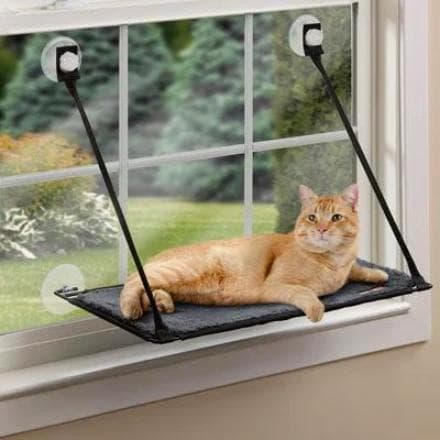
Webvet may earn a commission when you click through to Chewy, at no extra cost to you.
Is a Chirping Cat Happy?
Usually, yes, or at least engaged. In most cases chirping and trilling are good signs. A cat that trills while trotting toward you, tail up and ears forward, is relaxed and happy to see you.
A cat chirping at a bird it can't reach is excited, but it may also be a little frustrated. That's normal in small doses; it only becomes a problem if your cat stays agitated long after the bird is gone.
To judge the mood, read the whole cat. Soft eyes, a relaxed body and a raised tail go with happy chirps; a lashing tail and a tense crouch go with hunting ones. Our list of signs your cat likes you covers the friendly signals in more detail.
What Does a Cat Chirp Sound Like?
A cat chirp sounds a lot like a bird: one short, high, clipped note, often written as "mrrp," "brrp" or "chirrup." That brief, tonal quality is why so many owners wonder why their cat is chirping like a bird.
In the published feline vocal ethogram, the chirp lasts about 0.15 seconds, with a pitch between roughly 220 and 1,190 Hz (Tavernier et al.). A meow is typically longer and more drawn out.
Some cats make a single chirp; others string several together into a chattering, chirping run while they watch something. Either way, you'll recognize the chirping noise once you've heard it.

How do cats chirp? The sound comes out in one short burst of voice, without the long vowel of a meow. A weird chirping noise that sounds hoarse, strained or new is a different matter, covered in the problem section further down.
Why Do Cats Chirp at Birds and Bugs?
Prey is the most common trigger, and the reason traces back to hunting instinct. Even well-fed indoor cats keep the full predatory drive, which is also why some cats bring home dead animals. When your cat spots a bird or bug it can't reach, you'll usually see hunting mode:
- A fixed stare with dilated pupils
- Ears pricked forward
- A low, tense crouch
- A twitching or lashing tail
- Chirping, chattering or tweeting sounds
Chirping at Birds Through the Window
Birds are the classic trigger, and the window is where most cats do their chirping. A small Lund University pilot study recorded 257 sounds from three cats as they watched birds through a window, then sorted them into chirps, chatters, tweets and tweedles (Schötz, 2013).
The glass matters. Your cat can see and hear the bird but can't stalk it, so the excitement has nowhere to go. That's why cats chatter when they see birds and often chirp faster the closer the bird lands to the window.
A window view is still good enrichment. Feline environmental guidelines recommend giving indoor cats a resting spot with a view of the outdoors (AAFP and ISFM). A tall perch such as the Yaheetech Multi-Level 63-in Plush Cat Tree, set beside the glass, lets your cat watch from higher up, where many cats feel safest.
A feather wand makes that after-window hunt easy to stage. Flick it like a bird taking off, let your cat stalk and pounce, and let it win at the end.
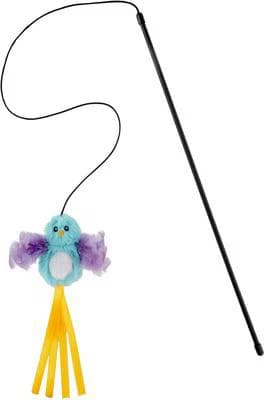
Teaser wand with a feathered bird charm and catnip to trigger your cat's chase-and-pounce instinct.
Webvet may earn a commission when you click through to Chewy, at no extra cost to you.
Chirping at Bugs, Flies and Laser Dots
Indoor cats chirp at flies, moths and spiders for the same reason: anything small, fast and erratic reads as prey. The same goes for light reflections dancing on a wall. Some cats meow or chatter at bugs instead of chirping, which is the same excitement in a different sound. If the bug is a bee or wasp, though, move your cat to another room so the hunt doesn't end in a sting.
Can cats hear bugs? Cats hear a far wider range than people. In laboratory testing, the domestic cat's hearing spanned about 48 Hz to 85 kHz, one of the broadest ranges measured in mammals (Heffner and Heffner). That helps explain why your cat can lock onto a fly or crawling bug before you notice it.

Laser dots trigger chirping too, but a dot can never be caught. The feline environmental guidelines recommend letting a cat catch the toy at the end of play to simulate a capture.
So if you use a laser toy like the PetSafe Dancing Dot Laser Cat Toy, finish every session on something your cat can actually grab.
The Hunting Theories Behind the Chirp
No one knows for certain why cats chirp at prey. These are the main explanations, from best supported to most speculative:
- Frustration. A review of feline vocal communication lists chatter as a displacement behavior that appears "when desiring prey which is out of reach" (Tavernier et al.).
- Excitement. Chirping rises and falls with arousal, which may be why many cats chirp faster as a bird gets closer.
- Mimicry. In the Brazilian Amazon, researchers watched a wild margay imitate the calls of pied tamarin babies, drawing a curious adult tamarin closer (Wildlife Conservation Society). It was one observation of a wild species, so it doesn't show that house cats imitate birds.
- Kill-bite rehearsal. A popular older idea holds that rapid jaw movement mimics the neck bite cats use on prey. It fits what the jaw does, but no one has tested it.
Why Does My Cat Chirp at Me?
A chirp aimed at you is usually a happy one. Yes, cats chirp when they're happy to see someone: a cat will often chirp or trill when you walk by, when you come home, or when she sees you first thing in the morning. A cat trilling at you is saying hello.
The Greeting Chirp
Some cats also chirp or trill when touched or petted, often pressing into your hand at the same time. That's a pleased response. If your cat chirps when you touch him and then leans in, keep going; if he chirps, flinches and pulls away, stop and check whether the spot is sore.

Occasionally a cat chatters when you pet her. That's less common, and if it happens along with flinching or drooling, it's worth a closer look at her mouth.
Chirping for Food or Attention
Many cats chirp, walk a few steps and look back, leading you to the food bowl, a door or a toy. It's the same "follow me" use of the chirp that mother cats make with kittens, and it's why kittens follow you everywhere once they've bonded.
If your cat keeps chirping at you for breakfast at 5 a.m., don't feed in response. Veterinary behaviorists advise that rewards of all types, including play, affection and treats, should only be given when a cat is quiet (VCA Animal Hospitals). The same guidance suggests timed feeders to keep a cat occupied overnight.
A programmable feeder serves meals on a schedule, so your cat learns breakfast comes from the feeder instead of from making chirping noises at you. Our vet-reviewed look at whether automatic feeders are good for cats covers the pros and cons.
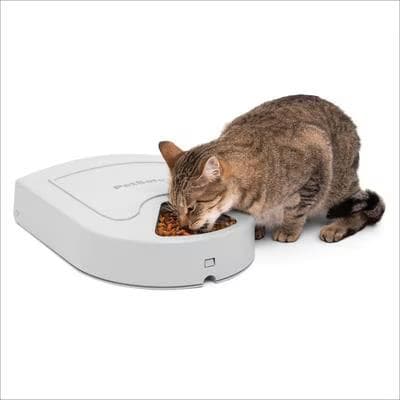
Webvet may earn a commission when you click through to Chewy, at no extra cost to you.
Why Does My Cat Chirp When I Sneeze?
No study has looked at this directly, but it comes up often. The simplest explanation is that a sneeze or cough is a sudden, sharp sound from someone your cat knows well. Many cats answer a surprising noise with a quick chirp, trill or chatter, the same way some trill when they're startled awake.
Some owners notice the cat walks over to check on them afterward. Either way, it's harmless, and there's nothing to correct.
Chirp vs. Trill vs. Chatter: How to Tell the Sounds Apart
Chirp, trill and chatter get used interchangeably, but they're different sounds with different jobs.
So why do cats chirp and not meow at birds or kittens? Because the meow is mostly a sound for people. Adult cats rarely meow at each other, yet it's one of their most common sounds with humans, while the chirp works as a cat-to-cat contact call (Tavernier et al.).
| Sound | What it sounds like | When cats use it | What it usually means |
|---|---|---|---|
| Chirp | One short, high, bird-like note | Watching prey, calling people or kittens | "I want that" or "come here" |
| Trill | A soft, rolling "brrrp," often rising at the end | Greeting people and friendly cats | "Hello," relaxed and friendly |
| Chatter | Rapid jaw clicks, mostly without voice | Prey in sight but out of reach | Excitement and frustration |
| Meow | A longer, drawn-out "mew" or "meow" | Mostly aimed at people | A request for food, a door or attention |
| Purr | A continuous low rumble | Resting, being petted, sometimes pain or stress | Usually contentment, but not always |
The chirp and the trill overlap so much that many owners use the words for the same sound, and older writing adds "chirrup" for chirps and trills alike. The review lists the trill as a greeting call and the chirp as a contact call.
A cat may blend the two, or follow a trill with a meow. If your cat keeps trilling and meowing at you, it usually wants something specific, like food or an open door. For the rumble in the last row, see why cats purr. For a cat that meows nonstop, Petful covers the common reasons cats meow constantly.
What Is Cat Trilling?
Cat trilling is a soft, rolling sound, a bit like a purr and a chirp combined, that cats make mostly as a greeting. Trills tend to come as a cat trots toward you, when you come home, when food is on the way, or when it wants you to follow.
Mother cats use chirps and trills with their kittens, and cats that get along trill to each other. So what does it mean when a cat trills? Almost always something friendly: "hello," "there you are" or "come with me."
Both male and female cats trill, and some trill far more than others. When do cats trill most? Around the people and routines they like best, and every cat makes its own version of the trill sound.
What Is Cat Chattering?
Cat chattering is the rapid clicking of the jaw you see when a cat stares at a bird. The review describes a cat that "rhythmically clashes the jaws, creating a low-amplitude, smacking sound," mostly voiceless.
It often mixes with chirps, which is why cat chirping and chattering tend to show up together at a window. The chatter usually comes with the stare, crouch and twitching tail from the hunting checklist above, and it fades once the bird flies off.
Why do cats chatter their teeth? At prey, it's frustration and excitement. When a cat chatters its teeth or jaws while eating, resting or having its mouth touched, oral pain is a common cause worth ruling out, as explained in the jaw chattering section further down.
Why Do Cats Chirp at Other Cats and Kittens?
Chirps and trills started as cat-to-cat sounds. A mother cat chirps as she approaches the nest, and kittens learn to recognize their own mother's chirp and follow it when she calls them out (Tavernier et al.). A mom cat trilling at her litter is doing exactly that.
Adult cats that get along often chirp or trill at each other as a greeting. An older cat trilling at a new kitten, or a kitten trilling at an older cat, is usually a curious, friendly sign. A new cat still needs a gradual introduction; our tips for a harmonious multi-cat household walk through it.
Some cats chirp at the dog, too, using the same contact call. Chattering at another cat is different: aimed at a cat outside the window, it's usually the frustrated hunting sound, and it can precede tension indoors.
Chirping and Trilling in Heat
A female cat in heat becomes very vocal, rolls on the floor, raises her rear and rubs persistently against people (VCA Animal Hospitals). VCA doesn't break those sounds down further, so if an unspayed female is suddenly chirping, trilling and rolling around, heat is a likely explanation.
Male cats chirp and trill too, mostly for the same greeting reasons. VCA lists sexual behavior, in females in heat and in intact males, among the most common reasons cats vocalize, and notes that neutering should help reduce it. Most veterinarians recommend spaying before the first heat, around six months of age.
Chirping at Night, While Playing and Other Times
Why Is My Cat Chirping So Much at Night?
Cats are naturally most active around dawn and dusk, so evening and early-morning chirping at moths, shadows or you is common. A young, healthy cat chirping or trilling at night is usually bored or ready to hunt.
VCA's behaviorists suggest giving food, play and attention in the morning and evening, and offering quiet night-time activities such as timed feeders and food puzzles. A puzzle feeder loaded with part of the evening meal gives a night-active cat something to hunt; our guide to cat puzzle feeders compares the main types.
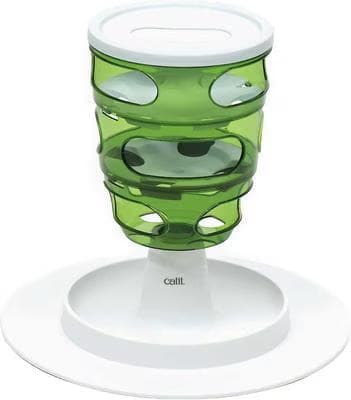
Webvet may earn a commission when you click through to Chewy, at no extra cost to you.
If an older cat has only recently started vocalizing at night, don't assume boredom. Vocalizing, especially overnight, tops VCA's list of the most common signs of cognitive dysfunction in senior cats, and hyperthyroidism can cause vocalizing and nervousness too (Cornell University). Our guide to cats meowing at night covers yowling and meowing in more depth.
Chirping While Playing, Jumping or Waking Up
Chirping while playing is common. Many cats chirp or trill just before a pounce, while carrying a toy, or when a play session starts, all signs of arousal and anticipation. Kittens and young cats do it most.
Other everyday chirps and trills have no published research behind them, but the likely reasons are simple:
- Jumping: some cats trill when they jump up onto a bed or counter, possibly effort plus a heads-up to you.
- Waking up: a cat trilling when woken up, or when you wake her up by touching her while she's sleeping, is usually giving a mild startle mixed with a greeting. Some cats chirp when they wake up on their own, too.
- Running: a cat that trills while running, or trills and runs away, is often inviting a chase.
- Surprised: some cats trill when surprised by a noise or movement.
- Chirping at nothing: a cat that walks around chirping, or chirps at nothing you can see, may hear a sound you can't, or may be calling for you or another pet.
If chirping at nothing is new, frequent, or comes from a senior cat, read the problem signs below.
Which Cats Chirp the Most?
Any cat can chirp or trill, male or female, purebred or mixed, and there's no evidence coat color plays a role: a black cat can chirp just as readily as a tabby.
Breed can shape the sounds you hear. The Cat Fanciers' Association says a Maine Coon's daily conversation may include "chirps, trills, and purrs," even though it doesn't consider the breed especially talkative (CFA). VCA notes that breeds such as the Siamese are much more likely to be vocal than others.
You'll hear chirps from Bengals, Savannahs, Siberians and Norwegian Forest Cats as well as ordinary shelter cats, but no study has compared chirping across breeds. Personality and habit matter more than pedigree.
- Why do some cats trill and others don't? Some cats simply rarely vocalize, and that's normal.
- Do all cats chirp at birds? No. Plenty just stare in silence or chatter without a sound.
At What Age Do Cats Start Chirping?
Usually within the first two to three months, as hunting-style play develops, though no study pins chirping to an exact week. Kittens can vocalize almost from birth, learn to recognize their own mother's chirp, and hear like adult cats by about four weeks (Tavernier et al.).
Play that mimics hunting follows: social play starts at about 4 weeks, and object play, with stalking and pouncing, begins at about 6 to 8 weeks (Merck Veterinary Manual). That's when most owners start hearing a kitten chirping while playing, when greeting them, or at older cats in the home.
- Usually normal: a kitten that keeps chirping, makes trilling noises all the time or chirps instead of meowing is typically just an alert, social kitten. Safe, age-appropriate kitten toys give that energy somewhere to go.
- A different sound: loud, repeated cries from a very young kitten are calls meant to bring its mother back to the nest, so a kitten crying like that needs checking for hunger, cold or discomfort.
Why Does My Cat Chirp Instead of Meowing?
Some cats rarely meow and speak mostly in chirps and trills, and that's normal. Because adult cats barely meow at each other, a cat that only chirps or only trills may simply be using its cat-to-cat vocabulary with you. No breed is known to chirp instead of meowing.
Cats also adapt the sounds they already have to whatever works with their own people (Tavernier et al.), so a chirp that reliably gets your attention can become the habit.
What matters is change. If a cat that used to meow suddenly can only chirp, sounds hoarse, or seems to have lost its voice, that's worth a vet check. For the full range of meows, see why cats meow so much.
How to Respond When Your Cat Chirps or Trills
The right way to respond depends on what your cat is chirping or trilling at.

- Check the target. Follow your cat's stare. A bird or bug needs nothing from you; a chirp at you usually wants a reply.
- Answer a greeting. Talk back softly or offer a hand to sniff. Some owners trill back with a rolled "brrrp"; there's no evidence cats read it as a reply, but it does no harm.
- Give the hunt an ending. After window time, use interactive play with a wand and let your cat catch the toy, as the feline environmental guidelines recommend. Toss something grabbable at the end, such as the Yeowww! Catnip Yellow Banana Cat Toy.
- Reward after play. The same guidelines suggest a treat after play; a small lick of a treat such as Inaba Churu Chicken Variety Pack Lickable Cat Treats is plenty.
- Don't punish chirping. It's natural communication. Just avoid paying for demand chirps with food or attention.
- Watch for change. A new, constant or strained sound is the one to follow up on.
Can you get your cat to trill on command? Not reliably. You'll hear the most trills if you keep a predictable routine of greetings, meals and play, since cats trill most in anticipation of things they like.
When Cat Chirping Can Signal a Problem
Chirping itself isn't a symptom. What deserves attention is change: a cat that suddenly vocalizes much more, at odd hours, in a different voice, or alongside other signs. For middle-aged and older cats, veterinary behaviorists recommend an exam to rule out medical causes such as pain, hormone disorders and high blood pressure (VCA).
Why Does My Cat Keep Chirping?
If your cat keeps making a chirping noise, look for the pattern before you worry:
- Near a window or feeder: prey watching, and usually fine.
- Whenever you're around: a greeting habit, or a demand you've been rewarding.
- At dawn and dusk: normal activity peaks.
- All the time, and new: a cat that has suddenly started chirping or trilling constantly has changed its behavior, and that's worth a vet visit, especially in a cat over 10.
A cat chirping a lot, or one that won't stop trilling after a new cat arrives or the furniture moves, may be more aroused or stressed than usual. If it lasts more than a few days or comes with other changes, call your vet.
What Sounds Do Sick Cats Make?
Sick or painful cats often go quiet rather than chirp, so pay attention to sounds that are new for your cat:
- Yowling or crying at night in an older cat, which can point to cognitive dysfunction or hyperthyroidism.
- Vocalizing plus weight loss, a big appetite or more thirst, classic signs of feline hyperthyroidism in middle-aged and older cats.
- Growling or hissing when touched in a normally friendly cat, which can signal pain; see how to tell if a cat is in pain.
- A hoarse, weak or lost voice that doesn't recover within a few days.
Jaw Chattering That Isn't About Prey
Chattering at a bird is normal. A cat's mouth chattering while eating, while resting, or when the face is touched can mean oral pain.
VCA lists jaw chattering, pawing at the mouth and head shaking among signs of dental disease in cats, and cats with painful tooth resorption can show jaw spasms or trembling when the affected tooth is touched (VCA).
Book a dental exam if your cat's jaw keeps chattering after eating, or if its teeth chatter along with drooling, oral bleeding, swallowing food without chewing, or a new preference for soft food. Tooth resorption in cats is common and painful, and it often needs dental X-rays to find.
Cat Chirping FAQ
Frequently Asked Questions
What do cats say when they chirp?
There's no literal translation, because cat sounds signal intent and arousal rather than words. Researchers call the chirp a contact call: it means "pay attention to this," and the listener is either you, another cat, or no one at all when your cat is staring at a bird. The closest everyday readings are "look at that," "hello" and "follow me."
How do I say "I love you" in cat?
Try a slow blink. In a University of Sussex study, cats slow-blinked back more often after their owners slow-blinked at them, and cats were more likely to approach an unfamiliar person after a slow-blink exchange (Humphrey et al., Scientific Reports). Narrow your eyes slowly, close them for a moment, and let your cat choose whether to come over.
How do you say no in cat language?
Cats don't understand "no" as a word, and scolding or punishment tends to make a cat wary of you rather than teaching it anything. Interrupt calmly, redirect your cat to an allowed choice, such as a scratching post instead of the sofa, and reward the choice you want. For chirping itself, there's nothing to say no to.
Is it cruel to let my cat watch birds it can't catch?
No. For most indoor cats, a window view is enrichment, and feline environmental guidelines recommend a resting spot with visibility of the outdoors. Keep it balanced: pair window time with daily play that ends in a real catch, and cut back the view if your cat becomes agitated or starts swatting at other pets afterward.

Wendy Toth is an entrepreneurial writer, editor, and mom of two humans, two dogs and one cat. She’s currently Content Director here at PetFul. For the last 15 years she has held positions at Parents Magazine, NBC, PetSmart, and GreatPetCare, where she was co-founder. Her writing has appeared in many national outlets including Pet Lab Co., Retail Me Not, Ask Men, Wild Society Nutrition, and The New York Times. Because she loves her work so much, she’s obsessed with helping others find career fulfillment, and covers it regularly at PowerSuiting.
Veterinarian · BVMS MRCVS
Dr. Pippa Elliott, BVMS, MRCVS, is a veterinarian with nearly 30 years of experience in companion animal practice. Dr. Elliott earned her Bachelor of Veterinary Medicine and Surgery from the University of Glasgow. She was also designated a Member of the Royal College of Veterinary Surgeons. Married with 2 grown-up kids, Dr. Elliott has a naughty Puggle named Poggle, 3 cats and a bearded dragon.


