Best Cat Carriers for Vet Visits, Travel, and Difficult Loaders
Compare four cat carriers for top loading, soft-sided travel, car attachment, and compact storage. Learn how to check usable space, closures, cleaning, and journey requirements before choosing.

BVMS MRCVS
Medically reviewed by Dr. Pippa Elliott, BVMS MRCVS · Last reviewed

This article contains affiliate links. Webvet may earn a commission when you buy through them, at no extra cost to you.
The best cat carriers give your cat enough usable space, let you close every opening securely, and suit the trip you actually need to make. For a cat who resists a front door, the Petmate Two Door Top Load is a useful starting point. For flexible top-and-side entry, consider the Sherpa Element. The Frisco Travel Safety emphasizes car attachment and fold-flat storage, while the Sleepypod Atom offers a compact soft carrier with washable bedding.
How to choose the best cat carrier
Choose the loading method before comparing color or carrying straps. If every appointment starts with a struggle at a narrow entrance, a more expensive carrier with the same entrance may leave the problem unchanged. Top loading gives you another way to place a cooperative cat inside; a side door lets a cat walk in voluntarily. Neither opening makes it appropriate to force a frightened cat through it.
- 1Compare interior dimensions with your cat’s standing, turning, and resting space.
- 2Match top loading or side entry to the way your cat can enter calmly.
- 3Check car installation instructions and the actual airline’s requirements separately.
This is a specifications-based comparison, not a hands-on test. We compared the selected models’ published construction, entry, care, and travel information. That approach can tell you whether a carrier has two entrances or washable bedding. It cannot establish that one cat will be calmer, that a zipper will withstand every escape attempt, or that a model without verified testing will protect a pet in a crash.
Our 2026 shortlist favors the Petmate for rigid top access, the Sherpa for flexible top-and-side entry, the Frisco for car attachment and compact storage, and the Atom for a small soft enclosure with washable bedding. For routine vet visits, start by comparing the Petmate’s usable dimensions with your cat. Choose a different model when its specific advantage solves your travel problem. These are specifications-based recommendations; we have not established a winner from an independent analysis of customer review scores. When reading reviews, prioritize repeated, specific comments about closures, seams, handles, and cleaning for the exact size you are buying.
For the best cat carriers according to reviews, start with the same four candidates but compare the evidence behind each review. A report about a failed latch or a cat fitting comfortably is useful only when it identifies the model, size, and circumstances. Reviews can reveal recurring practical concerns; they cannot establish crash protection or airline acceptance. We have not collected a comparable owner-review dataset that supports ranking these four by star score.
- Before comparing prices, check included bedding and replacement parts; a missing liner or damaged latch may matter more than a small price difference.
- Confirm the return conditions before allowing the cat to use a carrier you have not yet checked for fit.
- Keep the instructions and model label so replacement parts and travel information match the exact carrier.
| Carrier | Best fit | Useful feature | Main tradeoff |
|---|---|---|---|
| Petmate Two Door Top Load, 24-inch | Rigid carrier with top access | Listed interior: 21 × 14.5 × 13.5 inches | Rigid shell needs storage space; check body fit as well as weight |
| Sherpa Element, Medium | Soft carrier with two loading options | Top and side entry; removable washable liner | Confirm this size against the airline and your cat |
| Frisco Travel Safety, Medium | Car trips and fold-flat storage | Headrest straps, seat-gap anchors, and seat-belt path | Attachment hardware alone does not establish crash protection |
| Sleepypod Atom, Strawberry Red | Compact soft carrier with washable bedding | Ultra Plush bedding and water-repellent liner | Compact interior makes an individual fit check essential |

A leak-proof claim needs evidence for the exact enclosure and seams, not merely a water-repellent liner. None of this comparison’s recommendations rests on an independently verified leak-proof claim. If accidents are likely, compare removable bedding, cleanable surfaces, and a secure cleanup plan rather than assuming liquid cannot escape.
For a small cat who fits comfortably inside it, the Atom is our bedding-focused choice; for more flexible entry, consider the Sherpa. Neither is automatically more comfortable than a correctly sized rigid carrier with appropriate bedding. Your cat should be able to stand, turn, and lie down without being compressed, overheated, or destabilized. For a large or long-bodied cat, including a Norwegian Forest Cat, prioritize usable floor space over plushness. Compare the cat’s actual resting length and turning space with each candidate’s interior instead of assuming a breed label selects the right carrier. For a difficult loader, access may matter most; for a flight, first establish the permitted under-seat space.
Of these four carriers, the Atom has explicit model-specific crash-test information on its manufacturer’s product page. Sleepypod identifies the Atom as Center for Pet Safety certified for pets up to 12 pounds. Check the current rating, sizing guidance, and installation instructions together; a weight limit does not establish that your cat fits. We did not verify equivalent crash certification for the other three selected models. A rigid shell, a seat-belt loop, or the words “travel safety” do not independently prove crash protection.
Four cat carriers for different journeys
Petmate Two Door Top Load Dog & Cat Kennel, Tan, 24 inches, up to 15-lbs
The Petmate Two Door Top Load is the most straightforward choice here for someone who wants a rigid carrier with a second way in. Its plastic shell and steel-wire doors suit owners who prefer a defined, stable enclosure over a soft bag. The top door is particularly relevant when a cat does not readily walk through a front entrance, although calm handling and preparation still matter.
Petmate lists the 24-inch model’s interior as 21 inches long, 14.5 inches wide, and 13.5 inches high. Those measurements are more useful for a cat’s body fit than the “24-inch” product name, which describes the outer carrier. The selected listing is for pets up to 15 pounds, but a long, tall cat can run out of room before reaching that weight.
- Choose it for: a rigid shell, top access, and an interior measurement you can compare directly with your cat.
- Check first: the door openings, the cat’s standing height, and whether you can carry the assembled carrier comfortably.
- Main compromise: the rigid shape takes up space between appointments and will not flex to accommodate a tight storage or travel opening.
Inspect the door latches and the connections between the shell halves before every trip. If your veterinary team prefers an examination approach that involves opening or removing part of a carrier, ask whether this model’s assembly suits that approach before the appointment. Do not assume that a top door alone makes any carrier easy to dismantle around a patient. Petmate’s model page distinguishes the 19-inch and 24-inch versions, so keep the dimensions for your selected size together.
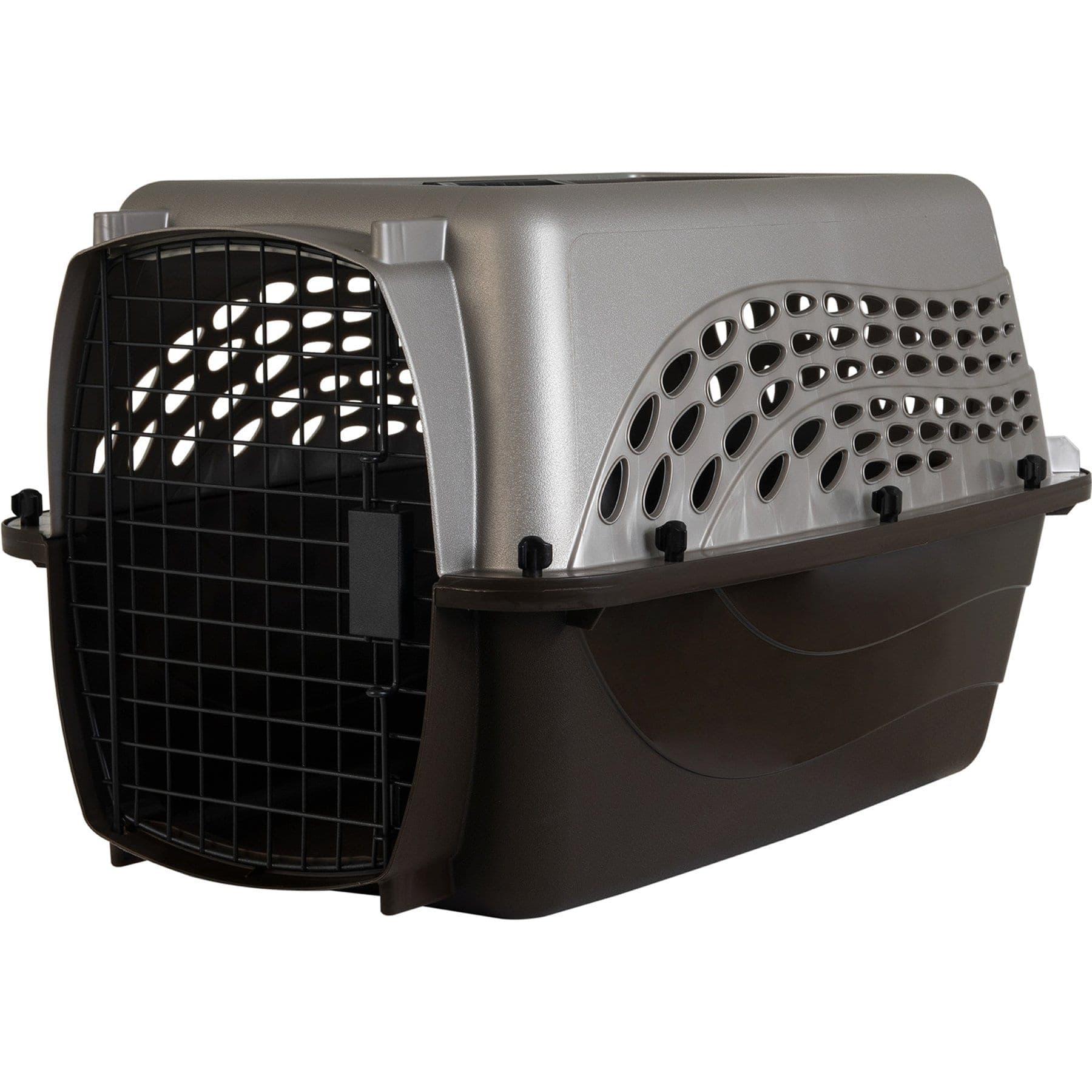
A rigid carrier with front and top access. Compare the 21 × 14.5 × 13.5-inch interior with your cat’s body measurements.
Webvet may earn a commission when you click through to Chewy, at no extra cost to you.
Sherpa Element Dog & Cat Carrier, Medium, Black
The Sherpa Element Medium gives you top and side entry in a soft-sided format. That combination is useful when you want a cat to explore through a side opening at home but also want another access option during travel preparations. Its locking zippers, spring-wire rear frame, and removable liner are concrete features to compare with a simple zippered tote.
The manufacturer describes the liner as machine washable. A removable liner is convenient after a spill or an accident, but it does not mean the entire carrier belongs in the washing machine. Check the separate instructions for the liner, base, fabric, and frame, and allow everything to dry before putting the carrier away.
- Choose it for: two entry options, soft sides, and bedding that can be removed for cleaning.
- Check first: Medium-size measurements, your cat’s posture inside, and the airline’s requirements for the particular flight.
- Main compromise: a flexible carrier still needs to retain enough usable space when positioned beneath a seat.
Sherpa markets the Element for airline travel, but an “airline approved” label is not a promise that every airline, aircraft, cabin, or itinerary will accept it. The rear frame’s flexibility is not permission to compress the carrier around your cat. Ask the airline how it measures permitted carriers, then compare those rules with the current Sherpa Element specifications. Also check that the closures remain fully accessible when the bag is positioned for travel; convenient access at home may be different under a seat.
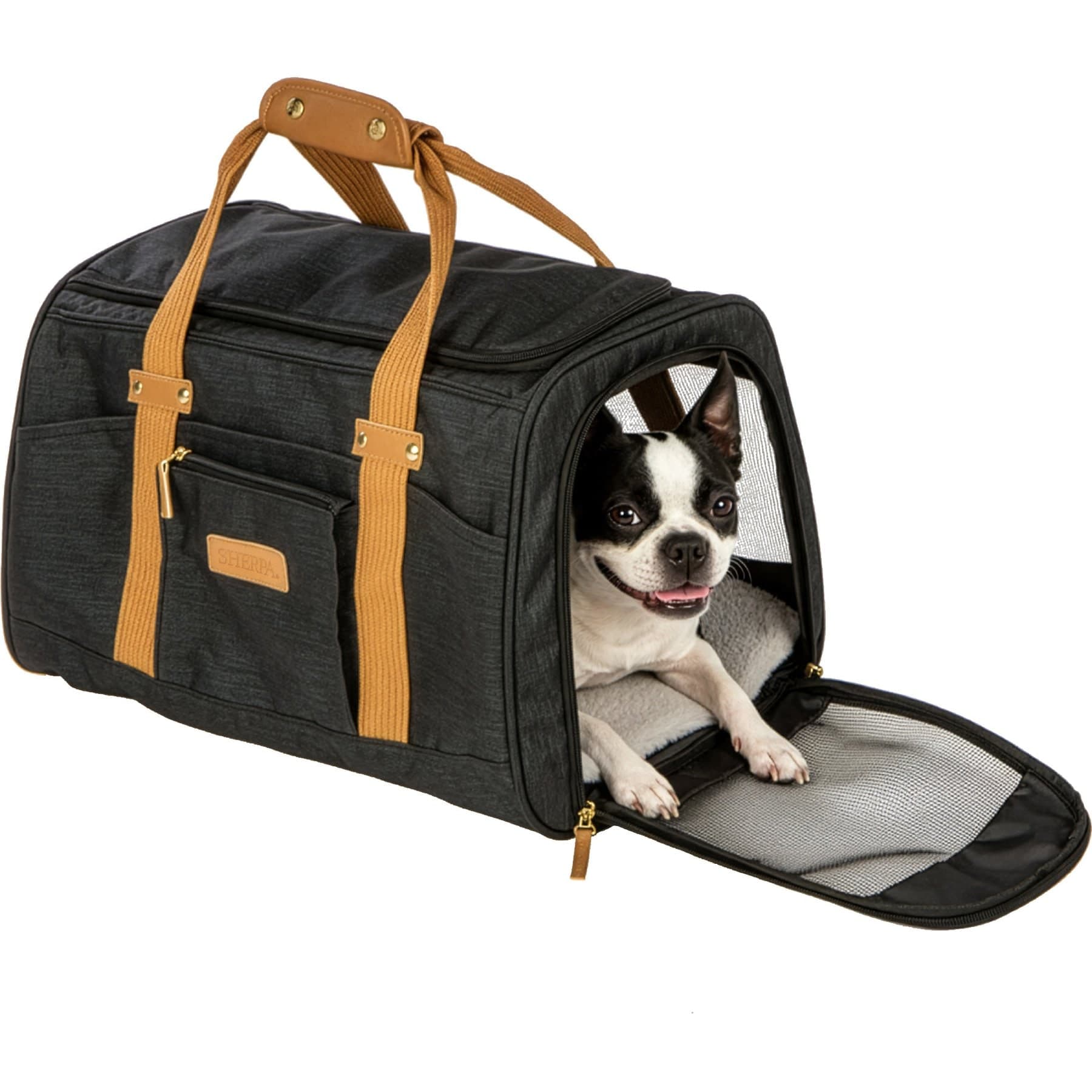
Top and side entry with a removable washable liner. Check the Medium size against your cat and the airline’s actual requirements.
Webvet may earn a commission when you click through to Chewy, at no extra cost to you.
Frisco Travel Safety Dog & Cat Carrier, Medium
The Frisco Travel Safety Medium is a distinct option for owners prioritizing car journeys and storage between trips. Frisco’s own-brand description identifies headrest straps, anchors that pass through seat gaps, and a seat-belt path. It also describes mesh sides and a fold-flat design. Those are useful practical differences from a rigid kennel that keeps its full shape in a cupboard.
The important question is whether the attachment arrangement works with your actual vehicle seat. Before bringing your cat to the car, read the supplied instructions, identify each attachment, and make sure you can install the carrier without improvising. A strap that happens to reach an anchor point is not necessarily being used as intended.
- Choose it for: a carrier designed around car-seat attachment and fold-flat storage.
- Check first: current Medium interior dimensions, the complete installation instructions, and access to the vehicle’s seat-belt path and seat gaps.
- Main compromise: the attachment features do not, by themselves, establish crash certification or a tested protection level.
Mesh panels let you observe the cat, but you still need to check airflow around the installed carrier and protect it from direct heat. Keep loose objects away from the panels and openings. This model is also different from Frisco’s Travel Bag carrier, so use the instructions for the exact Travel Safety model when checking entry, cleaning, and transport requirements. Similar brand names are not a reliable shortcut for those details.
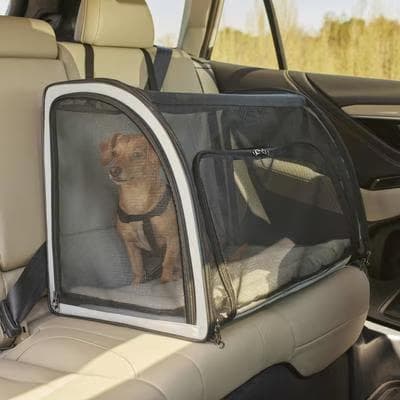
A fold-flat carrier with mesh sides and car-seat attachment features. Confirm fit and follow the exact installation instructions.
Webvet may earn a commission when you click through to Chewy, at no extra cost to you.
Before the trip, check where the assembled carrier will sit in the vehicle and follow the exact installation instructions. A placement photograph can help you think about clearance, but only the manufacturer’s directions establish the correct attachment for this model.

Sleepypod Atom Bag Dog Carrier, Strawberry Red
The Sleepypod Atom is the compact soft-carrier option in this group. Sleepypod describes the current Atom with Ultra Plush bedding, a water-repellent interior liner, and machine-washable bedding. It is worth considering when your cat fits a compact enclosure comfortably and you value being able to remove the bedding for care.
The small format makes careful measurement especially important. Start with the cat’s normal standing and resting posture, then compare it with the current Atom sizing guidance. A manufacturer weight limit is a boundary, not a promise that every cat below it will fit. Long bodies, tall ears, and a preference for stretching out can change the decision.
- Choose it for: a compact carrier with removable washable bedding and model-specific travel information.
- Check first: the Atom sizing guide, exact installation instructions, and airline acceptance for the planned trip.
- Main compromise: a compact bag offers less room to work around a cat who does not fit or cannot settle in that shape.
Sleepypod sells several different carriers. Keep the Atom’s dimensions, tested limits, and instructions together rather than substituting details from another model. Its published crash-test information is useful to examine, but it does not remove the need to install the carrier exactly as directed. For everyday familiarity, you can leave the open carrier in a comfortable location at home and let your cat investigate the bedding without turning each approach into a trip.
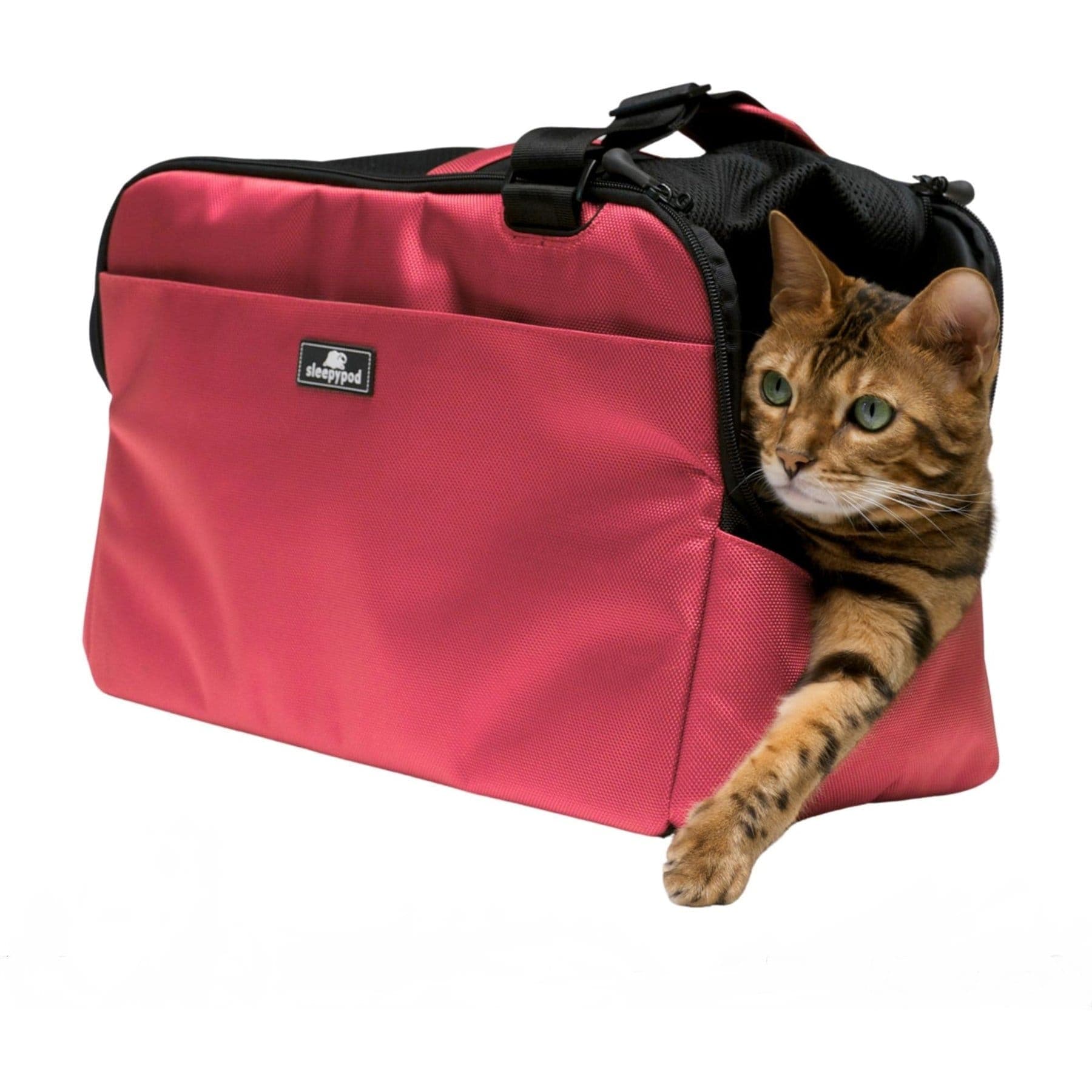
A compact soft carrier with washable Ultra Plush bedding. Check the Atom sizing guide before choosing it for your cat.
Webvet may earn a commission when you click through to Chewy, at no extra cost to you.
Carrier size, access, cleaning, and journey fit
Use this journey-to-carrier decision table to compare usable interior space, top versus side loading, and everyday containment. Seatbelt straps alone do not establish verified crash protection. A top opening may solve access but not cramped floor space. A fold-flat bag may solve storage but still need a larger footprint once assembled. Compare the loaded carrier, the cat, and the destination as one setup.
| Your decision | What to check | Why it changes the choice |
|---|---|---|
| A cat who resists a front entrance | Top loading, side entry, and how the door opens | Another access route may help, but force can increase distress |
| A long or tall cat | Usable interior dimensions with bedding installed | The outer shell and weight limit can overstate practical room |
| A car journey | Exact attachment instructions and model-specific crash certification or test information | Ordinary containment and crash protection are different questions |
| An airline journey | Actual airline and aircraft under-seat limits | A general airline label cannot guarantee acceptance |
| Repeated accidents or spills | Removable bedding, access to seams, and separate washing instructions | Easy cleaning must include the parts that actually get wet |
| Limited home storage | Rigid footprint versus a genuinely fold-flat design | A convenient stored size should not compromise the assembled enclosure |
Measure the cat and usable carrier space
Measure your cat when they are calm, without pulling them into an unnatural position. Note their body length and standing height, then check the manufacturer’s own measuring instructions. Look at usable internal length, width, and height, not just shipping dimensions or the longest outside measurement. Bedding and sloping walls can reduce the space where the cat can actually stand or lie down.
Use a tape measure to understand the proposed footprint before ordering. A rectangle marked on the floor can help you picture the resting area, although it cannot recreate the roof, walls, or door opening. Once you have the carrier, check the assembled space with the bedding in place. The cat needs to be able to stand, turn around, and lie comfortably rather than remaining wedged in one posture.
- Compare a large cat’s body dimensions with the interior, even if the weight is within the listed limit.
- For a kitten, check closures and openings carefully as well as the available space.
- Do not select a carrier for two cats simply by adding their weights; individual containment is generally easier to manage if one becomes distressed.
- Check your own carrying ability with the carrier’s weight added to the cat’s weight.
A carrier size chart is model-specific. A pet carrier for a 20lb cat must meet the weight limit and also provide enough usable length, width, and height for that individual cat. For a 10-, 12-, 15-, 20-, or 25-pound cat, measure the body and compare both the usable interior and load limit; weight alone cannot identify the correct size. For a double carrier or a wheeled enclosure, check each compartment separately and how the loaded frame can be handled.
For two cats, a soft carrier or double wheeled model still needs an individual compartment and handling assessment. Do not use combined weight as the sole purchase rule. A 25-pound load rating on a rolling carrier does not tell you whether a large cat can turn inside or whether you can lift the whole setup safely when wheels cannot be used.
A larger label is not always a larger usable enclosure. “Medium,” “large,” and “extra large” are manufacturer categories rather than a shared sizing standard. A broad Maine Coon or Norwegian Forest Cat and a lean cat of the same weight may need different proportions. Similarly, buying a small carrier for a small cat makes sense only if its interior still permits comfortable movement. Avoid treating a restrictive fit as a way to keep the cat still.
Hard-sided, soft-sided, and alternative carrier formats
Rigid plastic carriers keep a defined shape and can make it easier to inspect the enclosure and doors. Soft-sided bags offer different carrying and storage options, but their fabric, mesh, seams, and zippers deserve a close check. A collapsible or expandable carrier must be properly assembled and secured; extra panels should not be opened during movement unless the manufacturer specifically permits that use.
A top-loading cat carrier such as the selected Petmate gives access from above, while a side opening supports voluntary entry. Inspect the exact lid and fasteners, since top access is useful only when the upper opening can be operated securely. A stroller with a detachable carrier has two configurations to check: the enclosure off the frame and its attachment on the stroller.
Alternative designs solve different problems. A rolling carrier reduces carrying effort on suitable surfaces but adds wheels and movement to the experience. A backpack frees the owner’s hands while placing the cat behind them, where posture and breathing are harder to monitor directly. A sling or open pouch is not equivalent to a fully enclosed carrier. A cardboard carrier may serve a specific temporary transport purpose, but it is not interchangeable with a reusable kennel for repeated journeys.
- Check every opening, including small ventilation gaps and partly closed zippers.
- Inspect the floor support and how the carrier changes shape when lifted.
- Confirm that a handle or shoulder strap is intended to carry the loaded enclosure.
- Evaluate novelty shapes and bubble-front designs by usable space, ventilation, access, and cleaning rather than appearance.
Carriers with a built-in litter box or tray need enough separate resting space and a practical cleaning arrangement. None of the four selected models includes that feature. For long trips, plan appropriate secure stops and ask the veterinary team about your cat’s needs rather than squeezing extra equipment into an already cramped carrier. Wicker baskets, front-body pouches, and open picnic-style containers should be assessed for secure enclosure, ventilation, and cleanability before being treated as transport equipment.
A metal cage, slide-out base, or three-in-one stroller/carrier/car-seat design adds different inspection points. Check sharp edges, base locks, and instructions for each configuration. A head-out or fanny-pack design does not offer the same enclosure as a closed carrier. Do not infer crash protection from a car-seat label or call a carrier the most durable without relevant testing.
Put only compatible bedding and accessories inside the carrier. A water bottle needs a manufacturer-approved attachment and must not crowd the cat or create a leak or entanglement problem. When taking a cat outside in a carrier, keep ventilation open and the enclosure secured; an unfamiliar setting is not the place to test an unsecured opening. Material descriptions alone cannot establish a broad “non-toxic” guarantee. If you plan to use a pee pad for your cat carrier, confirm compatibility with the carrier maker and choose an absorbent pad that lies flat without crowding the cat or covering ventilation. Replace wet padding when the cat can be kept securely contained during the change.
- Check locks and support again after converting or extending a carrier.
- Confirm that added bedding leaves enough interior room for the cat.
- Inspect edges, seams, and fasteners after cleaning and before another trip.
You cannot put every cat carrier in a washing machine. Wash a component only when the exact care instructions permit it. For cleaning, remove loose bedding and debris first, then follow the product instructions for each component. A washable liner does not establish that foam, a frame, a coated base, or an entire bag is washable. Check seams and folds where moisture can remain. Reassemble and inspect the carrier after cleaning so that a missing fastener or poorly seated base is discovered at home, not at the clinic entrance.
 $65 · no membership
Have a health question about your cat?
A licensed vet can assess your cat over video and prescribe online when it's appropriate.
 Talk to a vet
- Licensed vets
- All 50 states
- same-day Rx
Webvet may earn a commission if you book.
Car travel, airline rules, and carrier acclimation
Gradual carrier acclimation uses positive, voluntary practice before travel. Do not force a distressed cat into the carrier. Set it out open in a quiet, accessible area and add familiar bedding if the carrier instructions allow it. Let the cat investigate at their own pace. Progress from voluntary entry to brief closure, then gentle lifting and short practice sessions; move back a step if the cat becomes distressed.

If you need to put a cat in the carrier by yourself, prepare the open carrier in a quiet secure room first. Invite voluntary entry using familiar bedding or a reward the cat can have, then close the opening calmly. For a scared, aggressive, or difficult cat, the easiest method is not a trick or a forced drop through the top. Stop when handling becomes unsafe and contact the clinic for a specific plan before the necessary journey.
For a cat who hides, struggles, cries, or refuses to enter, consider both the carrier and the experience surrounding it. Repeatedly chasing the cat and producing the carrier only before an unpleasant event can make preparations harder. Our guides to cat anxiety and cat stress relief explain the broader signs and management options. Ask your veterinary team for an individual plan when distress is substantial or a necessary visit is approaching.
For routine visits, feline veterinarians recommend a cat carrier with a hard-sided body with top and front access and an easily removable upper half. The American Association of Feline Practitioners’ carrier guidance explains that removing the top can let a fearful or painful cat remain in the lower half during an examination. This is guidance about useful construction, not an endorsement of every two-door product. Ask your clinic whether the exact carrier’s opening and assembly suit its handling approach, especially if your cat has mobility problems or substantial travel distress.
Plan a calm car journey
A cat who hates the carrier needs gradual practice, not repeated forced loading. Reward calm investigation and train the cat to like short, easy steps before extending the session. Leaving an appropriate open carrier available as a resting bed can build familiarity. The least stressful approach depends on the individual cat; no enclosure guarantees calm behavior.
For a crash-tested cat carrier in this shortlist, examine the Atom’s model-specific certification and installation information linked above. Seatbelt straps on another carrier are not equivalent test evidence. A vet-recommended carrier design also does not imply a crash rating.
For car travel, follow the exact carrier installation instructions. Set up the empty carrier first so you can identify the required belt path, straps, and anchors without managing the cat at the same time. Keep the carrier closed while the vehicle is moving. If you need to open it, stop in a secure place and plan how to prevent an escape before opening a door or zipper.
- Recheck latches, zippers, handles, and attachment points before departure.
- Keep ventilation panels clear of bags, blankets, and other luggage.
- Avoid direct sun and monitor the cat and vehicle temperature.
- Never leave a cat unattended in a parked vehicle.
- Clean up an accident safely when stopped; do not open the carrier while driving.
If you cover part of the carrier to reduce visual stimulation, leave the ventilation unobstructed and continue checking the cat. A cover is not a solution for overheating or obvious breathing difficulty. Panting in the carrier should prompt attention to the cat and conditions, not an assumption that the carrier needs a different cushion. A cat who is open-mouth breathing, collapsing, or struggling to breathe needs urgent veterinary attention, rather than another attempt to settle them for an ordinary trip.
Check the actual flight requirements
For a cross-country road trip or other long-distance car journey, plan secure rest and cleanup stops, comfortable temperature, and supplies before departure. A carrier suited to a short clinic visit may still be awkward to clean or monitor over a long day. Ask your veterinarian about an individual travel plan and do not interpret a roomy carrier as permission for uninterrupted confinement.
Airline travel adds a separate set of questions. Contact the airline before booking or buying a carrier, explain the pet and itinerary, and verify the current cabin rules. Confirm the permitted carrier dimensions, whether measurements apply to soft or rigid sides, the under-seat space for the relevant aircraft, and any booking or document requirements. Check connecting flights too; acceptance by one carrier does not settle the entire journey.
Do not use “TSA approved,” “FAA approved,” “IATA approved,” or “airline approved” as a substitute for that conversation. If you must compress a soft carrier to fit, make sure the manufacturer permits the adjustment and that the cat retains adequate space and ventilation. A carrier that fits beneath a seat only when empty is not a workable fit for your cat.
Clean and dry the carrier after travel
Remove the bedding and inspect the base, seams, and liner after the cat is safely out. Follow the separate care labels for washable bedding and the enclosure. Let all parts dry before reassembly, and check that the base support and closures return to their intended positions.

Cat carrier questions
Frequently Asked Questions
Do cats prefer hard or soft carriers?
Preference varies with the cat and their experience. Some settle readily in a soft bag; others do well in a rigid enclosure that keeps its shape. Interior dimensions, bedding, visibility, and familiarity matter alongside material. Top loading can change how you get the cat inside, but it does not predict which enclosure they will prefer once closed. Offer calm practice before deciding that the material itself is the problem.
Do cats prefer big or small carriers?
Choose comfortable usable space rather than the smallest or largest label. The cat should be able to stand, turn, and lie down without being compressed. Check interior dimensions with the bedding installed and consider the cat’s length as well as weight. Top loading or a side door affects access; it does not compensate for insufficient room. An oversized carrier can also be awkward for the owner to carry and secure.
Do vets recommend cat slings?
A sling is not a substitute for a securely enclosed carrier when traveling to a veterinary clinic. An unfamiliar dog, a noise, or an attempt to get away can make an open design difficult to manage. Discuss unusual transport needs with your clinic. For most routine visits, compare a closed carrier’s interior dimensions and access options, including top loading, rather than relying on a sling to contain a frightened cat.
$65 · no membershipHave a health question about your cat?
A licensed vet can assess your cat over video and prescribe online when it's appropriate.
Talk to a vet- Licensed vets
- All 50 states
- same-day Rx
Webvet may earn a commission if you book.

Editor
The Webvet Editorial Team is the in-house group of pet-care editors and writers behind Webvet, operated by Smart Pet Collective. The team researches, writes, and maintains Webvet's pet health, behavior, and medication content. Every article follows a defined editorial process: research from reputable veterinary and scientific sources, careful drafting, mandatory review of medical content by a credentialed veterinarian, and dated publication. Health and medication articles are medically reviewed by a licensed veterinary professional before they go live and are kept current over time.
Veterinarian · BVMS MRCVS
Dr. Pippa Elliott, BVMS, MRCVS, is a veterinarian with nearly 30 years of experience in companion animal practice. Dr. Elliott earned her Bachelor of Veterinary Medicine and Surgery from the University of Glasgow. She was also designated a Member of the Royal College of Veterinary Surgeons. Married with 2 grown-up kids, Dr. Elliott has a naughty Puggle named Poggle, 3 cats and a bearded dragon.
Related reading

Best Cat Litter Mats for Tracking, Cleaning, and Sensitive Paws

Best Cat Harnesses: Fit, Adjustability, and Escape Resistance

Periodontal Disease in Dogs: Signs, Causes & Proactive Support
