Calming Chews for Dogs: What Works and How to Choose
Learn which calming chew ingredients have evidence, how to compare labels and serving directions, what side effects to watch for, and when dog anxiety needs veterinary care.

BVMS MRCVS

This article contains affiliate links. Webvet may earn a commission when you buy through them, at no extra cost to you.
Calming chews for dogs may support some dogs during mild, predictable stress, but products vary in ingredients, quality, evidence, and dose. They do not diagnose anxiety, stop panic on demand, or replace treatment for pain, separation anxiety, noise phobia, cognitive change, or aggression. Choose a product only after matching its label and intended use to your dog's health, medicines, trigger, and veterinarian's plan.

 Sponsored
Want a vet's help with your dog's anxiety or behavior?
Talk to a licensed vet at Dutch over video, often the same day. They can recommend treatment and prescribe it when it's appropriate.
Use code Pets60
Plans start at $12/month · covers up to 5 pets
- Licensed vets in most states
- Rx for 150+ conditions
- 4.7 on Trustpilot
Do Calming Chews for Dogs Really Work?
Some calming chews can help selected dogs, especially when used for a mild, predictable event and combined with management. The effect is not consistent across all dogs or all formulas. Clinical evidence for one standardized ingredient or combination cannot be transferred to every product that lists a similar ingredient. They are not dependable treatment for severe anxiety or a substitute for a veterinary diagnosis.
- 1Calming chews are a supportive adjunct, not a substitute for veterinary evaluation when anxiety is sudden, severe, worsening, or unexplained.
- 2Evidence is ingredient-specific, not a guarantee that every chew with a “calming” label works.
- 3A quality label identifies active ingredients, amount per chew, lot information, and manufacturer contact details.
- 4Melatonin, hemp, herbs, probiotics, and amino acids have different cautions and should not be stacked casually.
- 5Sleepiness does not prove that fear or anxiety improved.
- 6Sudden anxiety, self-injury, collapse, breathing trouble, or possible overdose needs veterinary care, not another chew.
Decide what “work” means before the first chew. Useful targets are observable and specific:
- accepts food during a low-intensity trigger
- settles within a defined period
- pants or paces less
- recovers more quickly after a sound or visitor
- remains coordinated and responsive
- can participate in reward-based training
A dog that becomes sleepy but still trembles, scans, hides, or startles has not necessarily become less afraid. Sedation can reduce movement while emotional distress remains.
When a chew may be reasonable
A veterinarian may consider a supplement as one part of a plan for predictable travel, veterinary visits, grooming, household change, mild noise sensitivity, or difficulty settling. A chew is most useful when the trigger is known, the dog is medically stable, and the family can also change the environment or train below threshold.
A product is less likely to be enough when a dog:
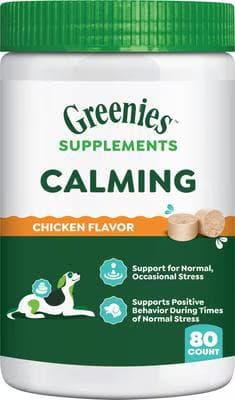
Chicken-flavored soft chew that supports normal, occasional stress and positive behavior during times of normal stress.
Webvet may earn a commission when you click through to Chewy, at no extra cost to you.
- panics when left alone
- attempts to escape or injures teeth, paws, or skin
- has sudden behavior change
- shows aggression or cannot recover
- cannot eat or respond during the trigger
- paces or vocalizes through the night
- has pain, confusion, urinary urgency, or breathing signs
Those patterns need diagnosis. Start with anxiety relief for dogs for the broader evaluation path. Absence-linked panic belongs in the dedicated separation anxiety in dogs guide.
For a clearly labeled soft-chew example, Greenies Calming Chicken Flavored Soft Chews let readers compare the exact ingredient panel and serving directions with the criteria below. A product listing is not evidence that the formula fits a particular dog's diagnosis, medications, or health history.
How the featured options differ
| Option | What distinguishes it | What it cannot establish |
|---|---|---|
| Greenies Calming, chicken soft chew | Manufacturer identifies L-tryptophan and L-theanine; intended for normal occasional stress | The dental-treat brand’s reputation is not a clinical trial of anxiety treatment |
| Zesty Paws Calming Bites, peanut butter | L-theanine plus a multi-ingredient herbal blend; check the received formulation | More ingredients do not show stronger benefit; interactions are harder to untangle |
| Purina Calming Care | Daily BL999 probiotic powder mixed with food | Not a fast-acting chew or rescue medicine |
| FurHaven calming bed | A comfortable optional resting place | No active calming ingredient or evidence that the bed treats an anxiety disorder |
The Greenies product information identifies an amino-acid approach. The Zesty Paws label lists a broader blend including chamomile and valerian. Check the actual package because versions change, and show the entire panel to the veterinarian when your dog takes medication. Choosing the simpler or more complex panel is a fit decision, not a potency ranking.
How long do calming chews take to work?
Timing depends on the product. A daily probiotic is evaluated over weeks, while a supplement intended for occasional stress may have pre-event directions. Neither is a dependable rescue treatment for a dog already panicking. Use the exact label and your veterinarian’s agreed trial period; there is no reliable universal “works in 30 minutes” rule for calming chews.
Do not give an extra chew because the dog has not settled at the expected time. Record the exact product, time, meal, trigger, behavior, and adverse effects. Ask the veterinarian how long to evaluate the product before deciding it failed.
Calming Chew Ingredients: What the Evidence Means
Ingredient lists can be difficult to compare because two products may use different forms, concentrations, combinations, or proprietary blends. Evidence should be tied to the exact substance and amount studied. A recognizable ingredient name alone does not establish an effective dose or safe combination.
| Label-to-use decision matrix: ingredient or category | What owners may see claimed | Observable behavior and safety decision before use |
|---|---|---|
| L-theanine | Supports calm behavior without intended heavy sedation | Confirm amount per chew, other sedatives, and whether the product has evidence for dogs |
| Alpha-casozepine or hydrolyzed milk protein | Supports adaptation to stressful situations | Review milk-derived ingredients, product standardization, and realistic trial length |
| Melatonin | Supports sleep timing or selected situational plans | Avoid xylitol-containing human products and ask about reproductive, liver, endocrine, and interaction risks |
| Tryptophan | Supports serotonin synthesis as part of a complete plan | More is not automatically better, and diet plus supplement totals matter |
| Probiotic strains | Some specific strains have been studied for stress-related behavior | Strain identity matters; “probiotic blend” is not enough to transfer evidence |
| Herbs such as valerian, chamomile, or passionflower | Promoted for relaxation | Evidence and standardization vary, and combined sedating effects are possible |
| Hemp or CBD ingredients | Promoted for calm or stress support | Product composition, legal status, liver effects, drug interactions, and evidence vary |

L-theanine and milk-protein ingredients
L-theanine is an amino acid found in tea. Some veterinary calming products use it to support relaxed behavior. Alpha-casozepine is a milk-protein-derived peptide used in some veterinary products. Evidence is product and condition specific, and neither ingredient turns a panic disorder into a simple supplement problem.
What a named study actually found
A 2015 open-label study of L-theanine in storm-sensitive dogs reported improvements in owners’ anxiety scores and recovery after storms. It studied Anxitane, not either soft chew below. Because owners knew dogs were receiving treatment and there was no placebo group, expectation and changing storm intensity could influence the result. It supports further study, not a promise that every L-theanine chew works.
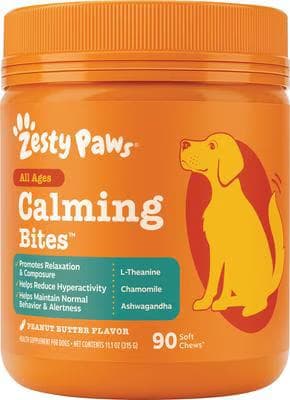
Peanut-butter-flavored soft chew that supports relaxation and helps reduce hyperactivity, with L-theanine, chamomile, and ashwagandha.
Webvet may earn a commission when you click through to Chewy, at no extra cost to you.
The useful purchase question is whether the evidence matches the exact ingredient, amount, formula and problem. A study of storm sensitivity does not establish treatment for separation panic, and a study of one ingredient does not validate a blend containing several herbs.
Ask:
- is the active amount listed per chew?
- is the exact form identified?
- was the ingredient studied alone or in a combination?
- does the dog take another sedating or serotonergic product?
- what observable change should occur, and by when?
Melatonin
Melatonin is a hormone involved in sleep-wake timing. Veterinarians may use it for selected dogs, but a calming chew can combine melatonin with several other ingredients. Never substitute a human gummy without checking every active and inactive ingredient because xylitol can be life-threatening to dogs.
Melatonin can cause drowsiness and may interact with other medicines. Reproductive status, liver disease, endocrine disease, and the reason for use matter. Do not calculate a dose from another dog's weight or a social-media chart.
Probiotics and the gut-behavior connection
Research on the gut and behavior is developing. A study on one identified bacterial strain does not validate every probiotic chew. Look for a full strain designation rather than only a species or a generic “proprietary probiotic blend.” Storage and viability also matter.
A probiotic is not an emergency calming product. If a veterinarian recommends a trial, define the target behavior and evaluate it over the intended time while keeping other variables stable.
Purina’s published account of its BL999 research describes improved stress-related behaviors in anxious dogs after six weeks of supplementation. The small Labrador study was manufacturer research in a controlled setting. It does not prove benefit for all breeds, every anxiety diagnosis or other probiotic strains. Calming Care is a daily powder containing that strain, so it belongs in a weeks-long veterinary trial, not an emergency chew comparison.
Hemp, CBD, and herbal blends
Hemp seed, hemp extract, and cannabidiol are not interchangeable terms. Product composition can vary, and labeling may not reliably show what is present. CBD can affect liver enzymes and interact with other drugs. Herbal ingredients can also produce gastrointestinal effects, agitation, or additive sedation.
Do not assume “natural” means gentle or interaction-free. Dogs with liver disease, seizure disorders, pregnancy, nursing, or multiple medications need an especially careful veterinary review.
Zesty Paws Calming Bites are another soft-chew format for comparing active ingredients, calories, and weight-based directions. Review the full label with the veterinarian instead of choosing from the front-of-package claim alone.
 Sponsored
Vet care that's always there
Unlimited video calls and messaging with licensed vets for less than a typical vet visit. One membership covers up to five pets.
Use code Pets60
Plans start at $12/month · covers up to 5 pets
- Licensed vets in most states
- Rx for 150+ conditions
- 4.7 on Trustpilot
How to Choose a Calming Chew
Start with the problem, not the package. A chew for a predictable car ride requires a different plan from treatment for daily separation panic, nighttime confusion, or aggression. Write down the trigger, first signs, intensity, recovery time, and what the dog must be able to do safely.
When choosing what to give a dog to calm down, match the ingredient evidence, product quality and timing to the dog’s medical history. Top-rated calming aids are not automatically the right fit. A clear label and a defined behavior goal are more useful than a star rating when deciding whether to try a supplement.

Step 1: confirm that a supplement fits the problem
Schedule a veterinary exam for sudden, severe, worsening, or unexplained anxiety. Pain, urinary disease, gastrointestinal disease, endocrine disorders, sensory loss, medication effects, and cognitive dysfunction can look behavioral. Treating only the visible agitation can delay care.
A supplement discussion is more reasonable when:
- the dog has been medically assessed as needed
- the trigger is mild and predictable
- there is no self-injury or severe aggression
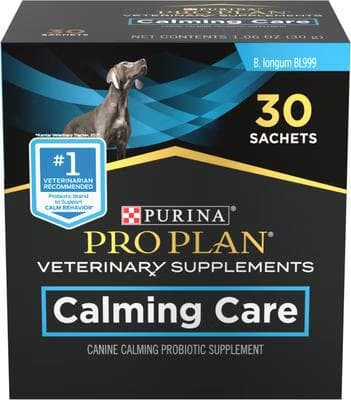
Probiotic supplement formulated to help dogs maintain calm behavior, with the BL999 strain. Liver-flavored powder in 30 daily sachets.
Webvet may earn a commission when you click through to Chewy, at no extra cost to you.
- the owner can use management and reward-based training
- the veterinarian has reviewed other medicines and supplements
Step 2: read the complete label
The front of the package is marketing. The decision lives in the supplement facts, inactive ingredients, warnings, and manufacturer information.
Check for:
- active ingredient amount per chew, not only per serving
- serving definition and dog weight range
- complete inactive ingredient list
- xylitol-free status
- lot number and expiration date
- manufacturer name and contact details
- storage instructions
- quality-testing information that can be verified
Be cautious with proprietary blends that list several active ingredients but hide their individual amounts. Avoid products that promise to cure anxiety, replace a veterinarian, or work instantly for every dog.
Step 3: compare quality signals
The National Animal Supplement Council quality seal can indicate that a company participates in specified quality programs, but it is not proof that a product works for a particular condition. Independent analysis, transparent manufacturing information, and an accessible adverse-event contact process are useful signals.
Ask the company for:
- a current certificate of analysis for the lot
- identity and contaminant testing
- how active ingredient amounts are verified
- where the product is manufactured
- how adverse events are reported

A plush, long-fur donut bolster bed with a raised rim that gives a recovering pet a secure, cushioned place to curl up during the crucial 10 to 14 days after surgery.
Webvet may earn a commission when you click through to Chewy, at no extra cost to you.
Step 4: avoid ingredient stacking
Two calming chews can share melatonin, tryptophan, valerian, CBD, or other sedating ingredients even when their brand names differ. A prescription medication, antihistamine, pain medicine, or seizure medicine may add another interaction.
Make one complete list for the veterinarian:
- prescriptions
- flea, tick, and heartworm preventives
- supplements and chews
- human medicines the dog could access
- food toppers and functional treats
- recent discontinued products
Step 5: run a one-variable trial
Test an approved product on a low-stakes day rather than for the first time during fireworks, air travel, or a long absence. Follow the label and veterinary instructions exactly. Keep the routine, meal timing, and trigger as consistent as practical.
Record:
- product, lot, amount, and time
- trigger and intensity
- latency to the first stress sign
- panting, pacing, trembling, hiding, barking, or food refusal
- ability to walk, respond, eat, and settle
- recovery time
- vomiting, diarrhea, agitation, sedation, or poor coordination
Do not increase the amount because a first trial seems ineffective. Share the record before changing products or combining approaches.
If a chew format is a poor fit, Purina Calming Care is a daily powder alternative to discuss with the veterinary team. It is not a fast-acting rescue product, and its delayed-use profile should be evaluated separately from situational chews.
Risks and Side Effects of Calming Chews
Possible effects depend on the product and can include sleepiness, gastrointestinal upset, agitation, appetite change, poor coordination, or altered behavior. Allergic reactions and interactions are also possible. A large ingestion can create risk from both active ingredients and calories, fat, sweeteners, or flavorings.
Do not give human cannabis products to a dog. THC can cause poisoning, and a hemp label does not establish safety. CBD products vary in concentration and quality, and evidence is limited and product-specific. Ask your veterinarian about interactions and other risks before considering any cannabinoid product.

When to call a veterinarian
Call promptly if the dog develops:
- marked or prolonged sedation
- agitation, disorientation, or new aggression
- repeated vomiting or diarrhea
- wobbling or inability to stand normally
- tremors or seizures
- unusual heart rate or breathing
- facial swelling, hives, or collapse
- worsening anxiety or inability to recover
Bring or photograph the label, lot number, ingredient panel, and estimated amount eaten. For a possible overdose, do not induce vomiting unless a veterinarian or animal poison specialist directs it.
Puppies, pregnant dogs, and dogs with medical conditions
Age and life stage matter. A product labeled for adult dogs may not be suitable for a puppy. Pregnancy and nursing can change risk. Liver, kidney, endocrine, seizure, cardiac, gastrointestinal, and bleeding conditions may affect product choice.
The veterinarian should also review calming chews before anesthesia, dental procedures, surgery, boarding, or a medication change. “Supplement” does not mean medically irrelevant.
Can calming chews make anxiety worse?
Some dogs become agitated, disinhibited, or unusually restless instead of calm. Sedation can also make a dog feel physically altered while a trigger continues, which may increase vulnerability. Stop the product and contact the veterinarian if behavior worsens.
Do not punish a dog for a reaction. Move away from the trigger when safe, reduce demands, and document the timing relative to the chew.
What Vets Recommend for Calming Dogs
Veterinarians recommend treating the cause and using humane behavior change. That may include pain treatment, environmental management, predictable routines, gradual exposure below threshold, reward-based training, prescription medication, and selected adjuncts. Vets may recommend calming treats when the specific ingredient and safety profile fit the dog, but there is no universally best brand.
Products should be used as adjuncts rather than cures because a chew cannot diagnose pain, resolve panic, or teach a coping skill by itself. Reward-based methods should proceed without flooding or punishment: keep the dog below its fear threshold, reinforce voluntary calm behavior, and stop an exercise before distress escalates. The chew is useful only if it safely helps the dog participate in that broader veterinary treatment plan.
The AVSAB humane training guidance supports reward-based methods and rejects aversive training. A chew should not be used to force a dog through exposure that is too intense.
- lower trigger intensity
- access to a familiar retreat
- food or play if the dog can engage
- an approved calming adjunct
- a short, measurable training session
- recovery time after the event
For panic, self-injury, aggression, or chronic distress, the right next purchase is not necessarily a stronger supplement. Veterinary behavior treatment may be the most efficient and humane path.
Some dogs benefit more from environmental support than another supplement. A FurHaven calming-style dog bed can provide a familiar resting surface, but it should remain optional and must not be used to confine a panicking dog.
Calming Chews for Dogs Questions
Frequently Asked Questions
Do calming chews really work for dogs?
Calming chews really work for some dogs when the exact ingredient, formula, trigger, and timing are a good fit, but no chew works reliably for every dog. Define one observable behavior before the trial, such as time to settle or recovery after a mild sound, and keep other major variables stable. A realistic expectation is a modest observable behavior change that helps the dog use management or training, not instant elimination of fear. Sudden, severe, or unexplained anxiety still needs veterinary evaluation and an appropriate veterinary treatment plan.
What is the most effective calming aid for dogs?
There is no single most effective calming aid for every dog because the cause and intensity of distress determine the plan. A realistic expectation is that environmental management and reward-based behavior modification may be enough for a mild trigger, while panic, pain, or a diagnosed anxiety disorder may require veterinary care and prescription treatment. A veterinarian-approved chew can be a supportive adjunct when its ingredients and timing fit the dog. Judge the veterinary treatment plan by observable behavior change, normal coordination, and recovery, not sleepiness alone.
Do vets recommend calming chews?
Veterinarians may recommend selected calming chews after reviewing the dog's health, medicines, diagnosis, trigger, and the exact product label. They may advise against a formula that hides active amounts, stacks sedating ingredients, or makes claims its evidence cannot support. During a trial, record an observable behavior such as time to settle, food acceptance, or recovery after the trigger. Contact the veterinary care team if the dog becomes agitated, excessively sleepy, uncoordinated, or otherwise worse so the veterinary treatment plan can be revised.
What are the risks of calming chews for dogs?
The risks of calming chews for dogs include excessive sedation, gastrointestinal upset, agitation, poor coordination, allergic reactions, ingredient interactions, and overdose. Human gummies can contain xylitol, and two pet products may unknowingly duplicate melatonin, hemp, herbs, or other sedating ingredients. Track observable behavior and physical effects after every dose so the veterinary treatment plan reflects both benefit and harm. Seek urgent veterinary care for collapse, breathing trouble, seizures, severe weakness, or possible xylitol exposure, and make a same-day veterinary call for marked or persistent adverse changes.
Is it okay to give dogs calming treats daily?
Some calming treats are intended for daily use, but others have directions for occasional stress. Give a dog a daily calming treat only when the exact label and your veterinarian’s plan support that schedule. Count overlapping ingredients in other supplements and track appetite, alertness and behavior. Daily use is not a reason to increase the dose or accept persistent sleepiness. Recheck an ineffective plan instead of adding more products.

Storing and handling chews safely
Calming chews can smell and taste like treats, so dogs may eat an entire package. Store them in the original child-resistant container, inside a closed cabinet the dog cannot reach. Do not transfer them to a treat pouch or unlabeled jar. Keep products separate in a multi-dog home because serving sizes and medical risks can differ.
If a dog eats an unknown amount, preserve the package, estimate the earliest and latest possible time, and call a veterinarian or animal poison service. The absence of immediate sleepiness does not prove the exposure is safe.

Editor
The Webvet Editorial Team is the in-house group of pet-care editors and writers behind Webvet, operated by Smart Pet Collective. The team researches, writes, and maintains Webvet's pet health, behavior, and medication content. Every article follows a defined editorial process: research from reputable veterinary and scientific sources, careful drafting, mandatory review of medical content by a credentialed veterinarian, and dated publication. Health and medication articles are medically reviewed by a licensed veterinary professional before they go live and are kept current over time.
Veterinarian · BVMS MRCVS
Dr. Pippa Elliott, BVMS, MRCVS, is a veterinarian with nearly 30 years of experience in companion animal practice. Dr. Elliott earned her Bachelor of Veterinary Medicine and Surgery from the University of Glasgow. She was also designated a Member of the Royal College of Veterinary Surgeons. Married with 2 grown-up kids, Dr. Elliott has a naughty Puggle named Poggle, 3 cats and a bearded dragon.
Related reading

Best Muzzle for Dogs: Basket, Soft, and Training Picks Sized for Comfort

Best Dog Anxiety Vests: ThunderShirt and Calming Wraps Compared

Best Dog Door for Sliding Glass Door Setups: Panel Inserts That Fit Without Cutting
