Best Chew Proof Dog Bed Picks: Vet-Reviewed Beds That Survive Heavy Chewers
Vet-reviewed guide to chew proof dog beds: why dogs shred bedding, how elevated frames compare with ripstop covers, what is safe to leave in a crate, and the beds that survive heavy chewers.

BVMS MRCVS
Medically reviewed by Dr. Pippa Elliott, BVMS MRCVS · Last reviewed

This article contains affiliate links. Webvet may earn a commission when you buy through them, at no extra cost to you.
A chew proof dog bed is supposed to outlast the dog that turns ordinary cushions into confetti. No bed is guaranteed indestructible, though, and the bigger worry is not the ruined bed. It is the fabric and stuffing that can end up in your dog's stomach.
The beds that hold up best share one idea: give the teeth nothing to grab. That means an elevated cot whose aluminum frame wraps every edge, a taut ripstop sling with no padding inside, or, for milder chewers, a ripstop crate mat. Match the build to why your dog chews, then choose the bed.
| Bed | Best fit | Build | Maker rating or capacity | Main tradeoff |
|---|---|---|---|---|
| K9 Ballistics Chew Proof Armored Ripstop Elevated Dog Bed, Sandstone, Small | Heavy, persistent chewers | Aluminum frame over every edge and corner, 1200D ripstop sling | Rated 10/10 for chewing by the maker, 250 lb stationary weight | The sling is not padded |
| Snorehound Chew-Proof Aluminum Frame Elevated Dog Bed, Barking Brown, Large | Large dogs that chew | Aluminum framing, PVC fabric secured inside the frame | 150 lb stationary weight | Lower weight rating, no warranty terms on the bed page |
| FXW TitanNest Cooling Chew-Proof Elevated Dog Bed, Black, Medium: 41-in | Lower-priced elevated cot, outdoor use | Fully enclosed aluminum frame, 900D waterproof fabric | Tested to support up to 100 lb, per FXW | Rated below K9 Ballistics (250 lb) and Snorehound (150 lb); no chew warranty stated |
| K9 Ballistics Chew Proof Armored Mesh Elevated Dog Bed, Black Mesh, Small | Outdoor and warm-weather chewers | All-aluminum frame and corners, polyester mesh sling | Small is 29 x 18 x 4.5 inches | Mesh is a different fabric from the ripstop sling |
| K9 Ballistics Tough Ripstop Orthopedic Dog Crate Mat, Blue Quartz, Small | Mild chewers in a crate | Orthopedic mat, removable ripstop cover, nonskid bottom | Rated 8/10 by the maker for a moderate chewer | Maker says it is not the best fit for a determined chewer |

 Sponsored
Have a health question about your dog?
Talk to a licensed vet at Dutch over video or message, including nights and weekends.
Use code Pets60
Plans start at $12/month · covers up to 5 pets
- Licensed vets in most states
- Rx for 150+ conditions
- 4.7 on Trustpilot
Why dogs chew their beds, and why swallowed stuffing is a vet problem
No chew proof dog bed is truly chew proof, so it is safer to think of these beds as chew resistant. Elevated frames that keep the fabric's edges out of reach, and tight ripstop covers, resist teeth best. Any swallowed stuffing is a reason to call your vet.

The fit rule is simple: pick the build by why and how your dog chews, and by whether that build leaves stuffing where the teeth can reach it.
- 1Dogs chew their beds out of boredom, teething pain, or stress when left alone, so treat the cause as well as the bed.
- 2Swallowed fabric and fill are the real danger: they can cause a blockage that needs prompt veterinary care.
- 3An unpadded elevated cot with a frame over every edge leaves no stuffing for a chewer to pull out.
- 4A ripstop crate mat suits mild chewers; its maker says it is not the best fit for a determined chewer.
Bed chewing has a handful of well-described causes, and each one points to a different fix:
- Boredom. The ASPCA says bored dogs look for ways to entertain themselves, and chewing is one option.
- Too little exercise or enrichment. The American Kennel Club says adult dogs often chew destructively because of boredom, insufficient exercise, or lack of enrichment.
- Teething. For young dogs, the ASPCA says chewing is a way to relieve pain from incoming teeth.
- Separation anxiety. Dogs who chew to relieve the stress of separation anxiety usually chew only when left alone, according to the ASPCA.
Timing is your best clue. A bed that only gets shredded while you are out fits the anxiety pattern. A puppy with new teeth coming in fits the teething pattern. An adult dog short on exercise and play fits the boredom pattern.
Each chewer type calls for a different build, and the deciding question for each is whether stuffing ends up within reach of the teeth.
| Chewer type | Why they chew | Build to choose | Stuffing within reach | Warranty terms to check |
|---|---|---|---|---|
| Teething puppy | Relieving pain from incoming teeth | Unpadded elevated cot with an armored aluminum frame | None in an unpadded sling | K9 Ballistics: 1-year chew warranty, one replacement |
| Bored adult chewer | Too little exercise, play, or enrichment | Elevated cot, plus more exercise and approved chew toys | None in an unpadded sling | Ask whether the whole bed or only the cover is replaced |
| Anxious crate chewer | Stress when left alone | Elevated crate bed sized to a wire crate | None in an unpadded sling; padded versions hold fill | K9 Ballistics says its warranty covers beds and crate pads |
| Mild chewer | Occasional chewing, digging, scratching | Ripstop crate mat with a removable cover | Yes, the foam mattress sits under the cover | The crate mat page does not state coverage |
| Power chewer or large dog | Strong jaws and more weight on the bed | Aluminum-frame elevated cot with a high weight rating | None in an unpadded sling | K9 Ballistics: 250 lb rating; Snorehound: 150 lb, no terms on its bed page; FXW: 100 lb, no chew warranty stated |
The swallowed stuffing risk
Bed fabric and fill fall into the soft-item category dogs are known to swallow. VCA Animal Hospitals lists articles of clothing alongside paper, tissues, and sticks among the things dogs are notorious for swallowing. VCA calls foreign body obstruction one of the more common and potentially life-threatening conditions seen in veterinary practice.
Dogs are also more likely than cats to swallow a foreign body and develop an obstruction, according to the Merck Veterinary Manual. Merck lists these possible signs of a gastrointestinal blockage:
- Loss of appetite
- Vomiting or regurgitation
- Diarrhea
- Lethargy
- Shock
In its owner guidance, the Merck Veterinary Manual says signs usually include lethargy, loss of appetite, and vomiting, and that vomiting a dog cannot stop can be life-threatening.
Time matters because, as VCA explains, a stomach or intestinal obstruction often compromises the blood supply to those tissues. When a foreign body is suspected, VCA says abdominal X-rays are performed, and exploratory surgery is generally recommended if an obstruction is diagnosed or suspected.
Treatment depends on what was swallowed and where it sits:
- Endoscopy. Merck says an endoscope can sometimes retrieve the object, though surgery is usually necessary to relieve a gastrointestinal obstruction.
- Watchful monitoring. Small objects may be followed with serial X-rays, but Merck says failure to pass within 36 to 48 hours, or worsening signs, calls for surgery.
- Surgery. The American College of Veterinary Surgeons says most gastrointestinal foreign bodies lodge in the stomach or intestines and need surgery to remove.
- Linear items. Merck links linear foreign body obstructions to a higher risk of intestinal perforation, one more reason not to wait if your dog has swallowed string, yarn, or fabric.
The good news is that Merck says dogs with an obstruction from a swallowed object tend to do well when it is diagnosed and treated quickly. The veterinary guidance does not include making your dog vomit at home. The advice is a prompt veterinary assessment.
That is why the build of the bed matters more than the label on the box. A bed that leaves no stuffing within reach removes the most dangerous part of the problem, even if the dog still gnaws at the frame.
What is the best anti-chew dog bed?
For a heavy or persistent chewer, the K9 Ballistics Chew Proof Armored Ripstop Elevated Dog Bed, Sandstone, Small is the strongest choice here. Its aluminum frame covers every edge and corner, its 1200D ripstop sling holds no padding, and the maker rates it 10/10 for chewing with a one-year chew warranty. Mild chewers in a crate can manage with a ripstop crate mat.
Our picks: the best chew proof dog beds
These five beds cover the builds that resist chewing: four aluminum-framed elevated cots, one of them a lower-priced option, and a ripstop crate mat. Each pick rests on the maker's published specifications, the Chewy listing, and veterinary guidance on chewing and swallowed objects. We did not test these beds hands-on.
All five are sold on Chewy, in the sizes named in each pick. The claims that a bed cannot be chewed up are the makers' own, so read each tradeoff before you buy for a dog that has already chewed through other beds.
K9 Ballistics Chew Proof Armored Ripstop Elevated Dog Bed: best overall chew proof bed
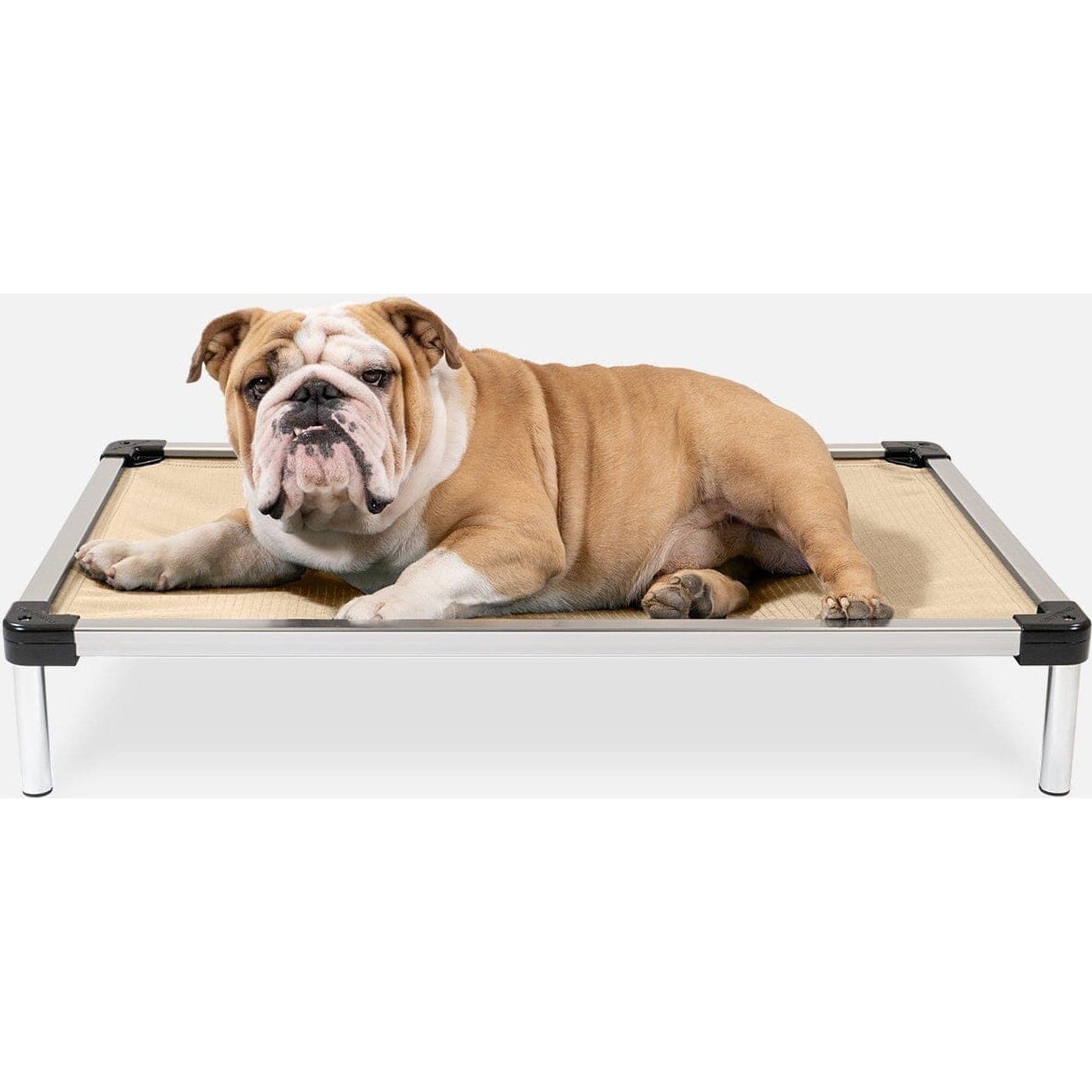
Aluminum frame over every edge and corner, with a 1200D ripstop sling the maker rates 10/10 for chewing.
Webvet may earn a commission when you click through to Chewy, at no extra cost to you.
This is an elevated cot built around one idea: the dog cannot get its teeth on an edge. K9 Ballistics says the aluminum frame covers every edge and corner, the spots chewers target first, and pulls the sling taut so no wrinkles or folds can be pinched between the teeth.
The Small size was listed at $120 on Chewy when we checked in October 2026. The Chewy listing describes it as made to withstand even the most persistent chewers, suitable for indoor and outdoor use, able to fit inside standard wire crates (sold separately), and pre-assembled.
Key specifications from the maker:
- All-aluminum frame, including the corners
- Densely woven 1200D ripstop ballistic fabric sling, which the maker says resists punctures and tears from digging and scratching
- Up to 250 lb of stationary weight
- Small measures 29 x 18 x 4.5 inches
- Rated 10/10 for chewing by the maker
- Covered by the 1 Year Chew Proof Warranty
Who it suits: K9 Ballistics positions its Armored series for heavy, persistent chewers, teething puppies, and dogs with separation anxiety.
The tradeoff: The maker states plainly that the bed is not padded and should not be bleached. A dog that wants a soft nest gets a firm sling instead, and anything soft you add on top is back within reach of the teeth.
Snorehound Chew-Proof Aluminum Frame Elevated Dog Bed: best aluminum frame for large chewers
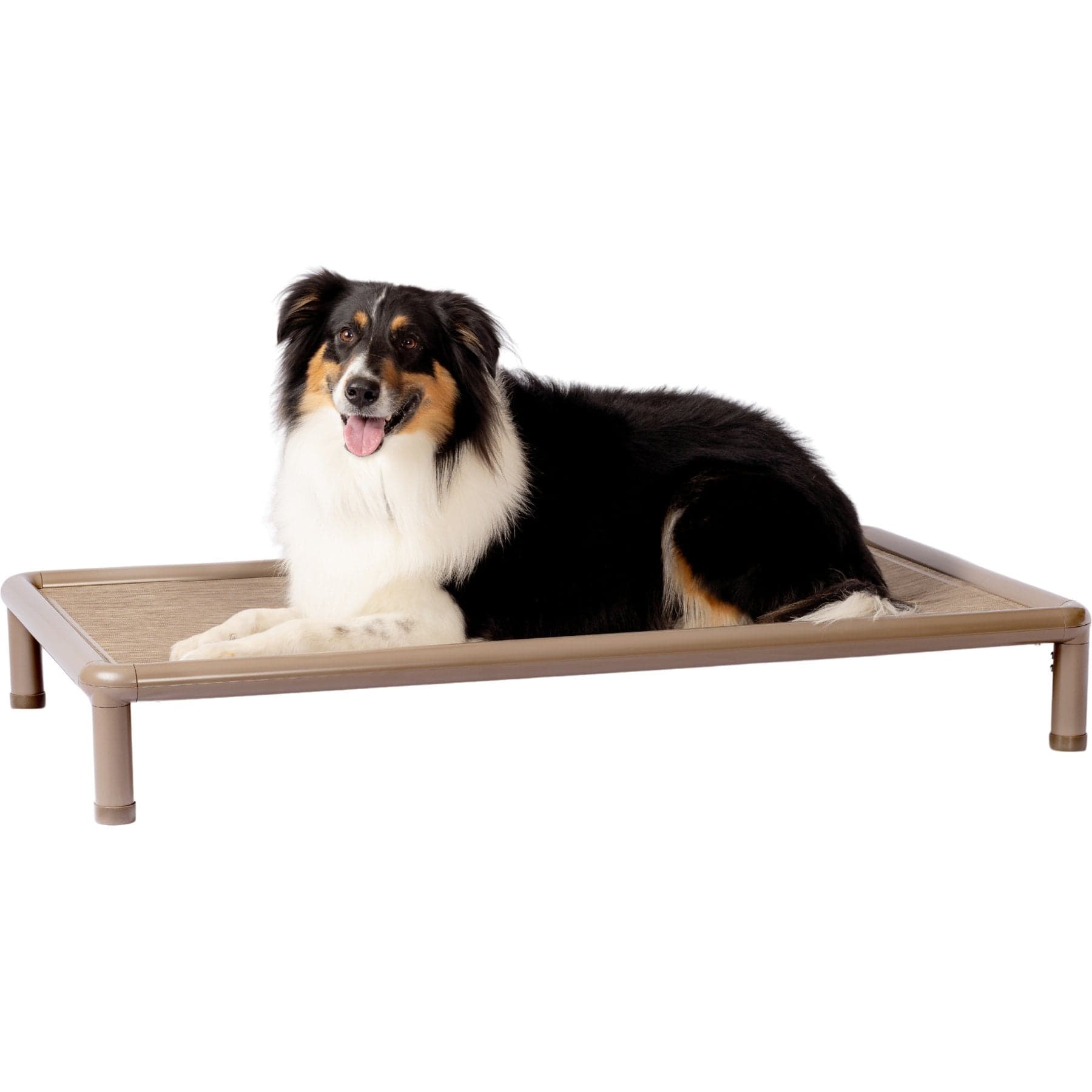
Aluminum-framed elevated bed with fabric secured inside the frame, in a Large size of 46.5 x 28.5 inches.
Webvet may earn a commission when you click through to Chewy, at no extra cost to you.
Snorehound takes a slightly different route to the same goal. Its fabric secures inside the frame rather than wrapping around it, with reinforced seams and a chew-resistant fabric, so there is no fabric edge wrapped around the outside of the frame for a dog to start on.
The Large size was listed at $191.76 on Chewy when we checked in October 2026. The Chewy listing pitches it for inside or outside the home, from a sunny patio to a spot indoors.
Key specifications from the maker:
- Aluminum framing
- PVC fabric rated for up to 150 lb of stationary weight
- Small 34.5 x 21.5 inches, Medium 40.5 x 26.5 inches, Large 46.5 x 28.5 inches
- Snorehound says its beds are designed to resist chewing
- Non-slip rubber feet for stability, per the Chewy listing
Who it suits: Large dogs that chew, and owners who want a bigger sleeping surface.
The tradeoff: The fabric's 150 lb stationary rating sits below the 250 lb rating K9 Ballistics gives its Armored Ripstop bed, which matters for giant breeds. Snorehound's bed page also states no warranty terms and only links to a product warranty section on its privacy policy page, so ask about chew damage coverage before you buy.
FXW TitanNest Chew-Proof Elevated Dog Bed: best value chew proof elevated bed
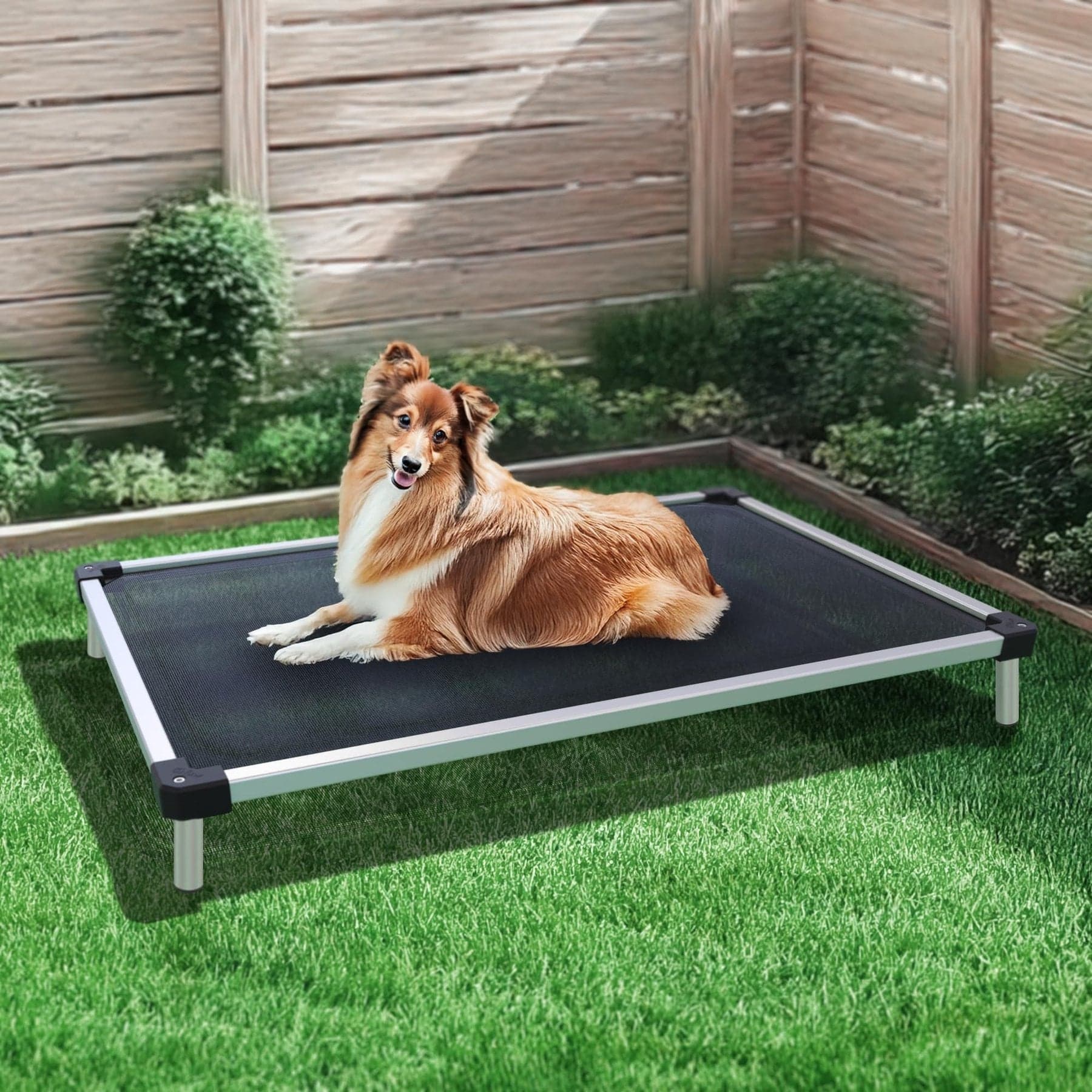
Cooling elevated bed that FXW designed around a 15-year target lifespan, at the lowest listed price of these picks.
Webvet may earn a commission when you click through to Chewy, at no extra cost to you.
The FXW TitanNest is the least expensive bed here. The 41-inch Medium was listed at $99.99 on Chewy when we checked in October 2026.
What FXW says in the Chewy listing:
- A fully enclosed metal frame that eliminates chew spots, built from a custom aluminum profile with reinforced ribs
- 900D fabric that resists scratches
- Waterproof fabric you can hose down and wipe dry
- Tested to support up to 100 lb
- Arrives pre-assembled
- A target lifespan of 15 years
Who it suits: Owners who want an aluminum-framed elevated cot at a lower price, especially for outdoor use where a hose-down fabric helps, and dogs well within its 100 lb rating.
The tradeoff: The listing gives no chew warranty terms, and its 100 lb tested rating sits below K9 Ballistics' 250 lb and Snorehound's 150 lb. FXW's unchewable design and 15-year lifespan target are the maker's goals, not a guarantee. For a proven power chewer, ask the seller about chew damage coverage first.
K9 Ballistics Chew Proof Armored Mesh Elevated Dog Bed: best breathable mesh for outdoor chewers
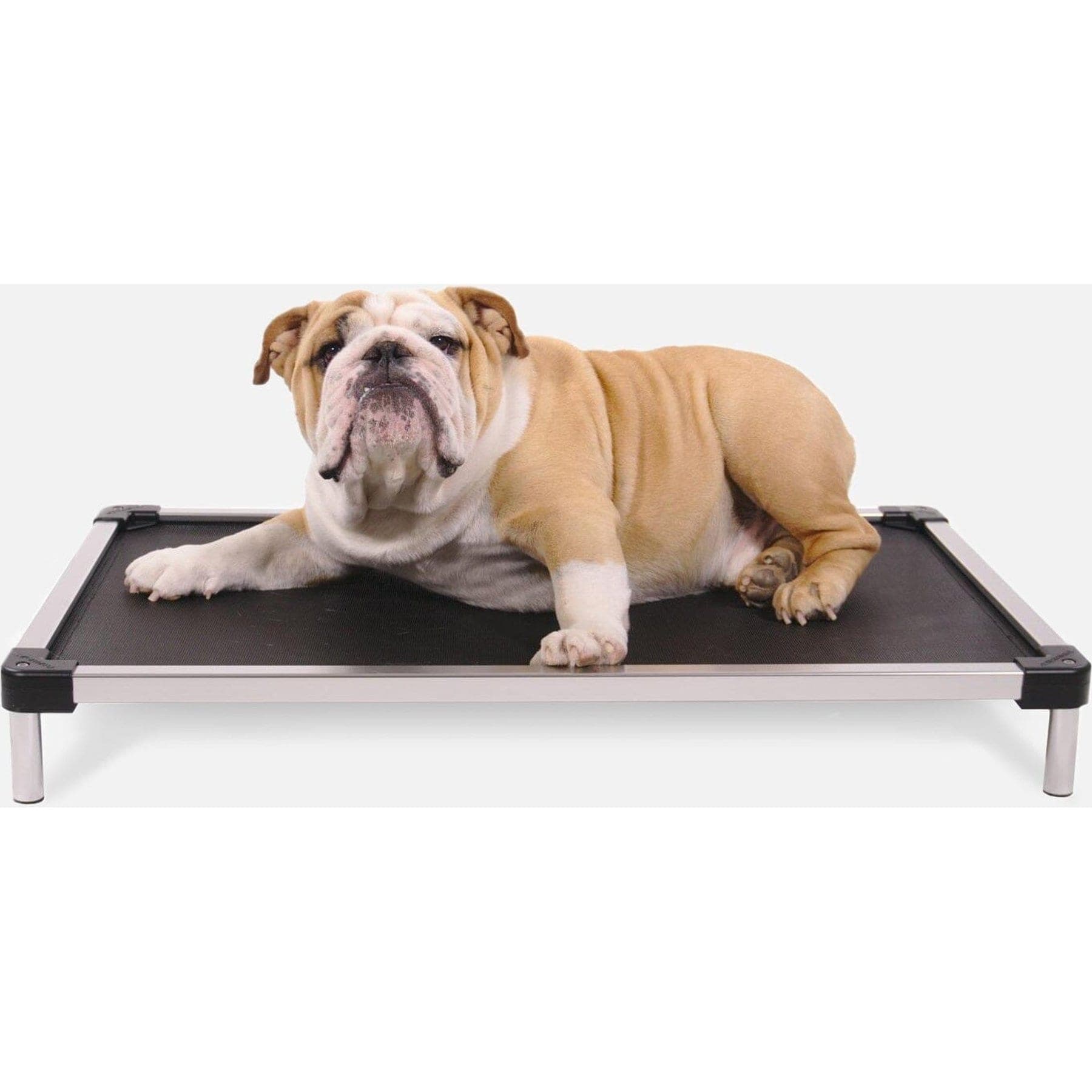
All-aluminum frame and corners with a ventilated polyester mesh sling for indoor, outdoor, or wire-crate use.
Webvet may earn a commission when you click through to Chewy, at no extra cost to you.
This is the mesh sibling of the Armored Ripstop bed. It uses the same armored idea, a 100% aluminum frame and corners, but swaps the ripstop sling for a polyester mesh one.
The Small size was listed at $120 on Chewy when we checked in October 2026. The Chewy listing says the heavy-duty mesh sling offers both durability and ventilation, and that the bed can be used indoors, outdoors, and in standard wire crates, which are sold separately.
Key specifications from the maker:
- 100% aluminum frame and corners
- Sling made from 100% polyester mesh
- Small measures 29 x 18 x 4.5 inches
Who it suits: Chewers who spend time outdoors or run warm, and dogs whose bed needs to move into a wire crate.
The tradeoff: The mesh is a different fabric from the 1200D ripstop sling, so judge the sling and the frame separately. The maker's 10/10 chew rating is published for the ripstop model, not this one. The warranty wording on the product page also differs from the FAQ on the same page, so confirm the remedy at purchase.
K9 Ballistics Tough Ripstop Orthopedic Dog Crate Mat: best tough ripstop crate mat
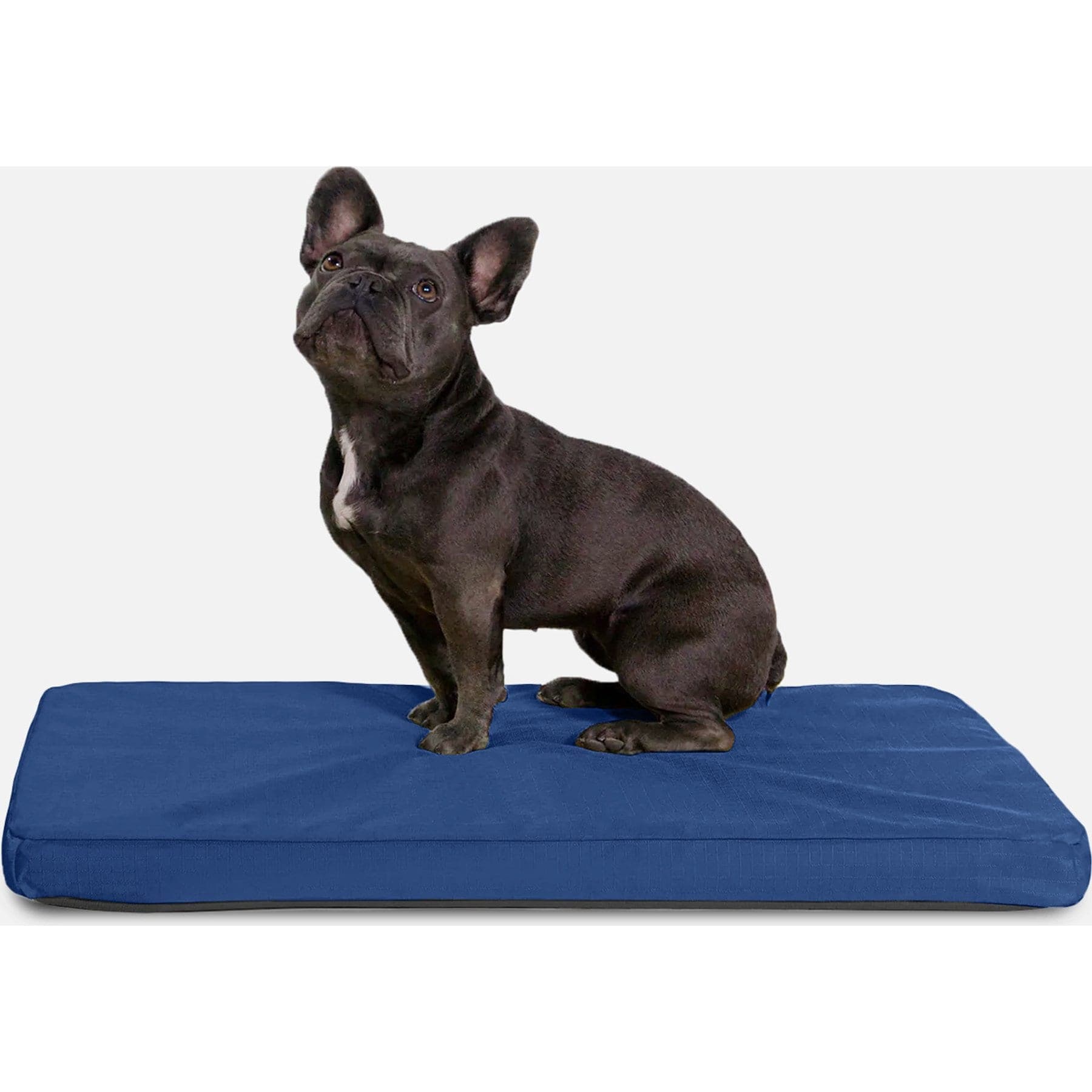
Ripstop crate mat with a removable cover, nonskid bottom, and anchor tie-downs, made for moderate chewers.
Webvet may earn a commission when you click through to Chewy, at no extra cost to you.
This is a flat crate mat rather than a cot, and K9 Ballistics is unusually candid about it. The maker rates it 8/10 for a moderate chewer, says it can hold up against mild chewing, and says it is still not the best fit for a determined chewer.
The Small size was listed at $100 on Chewy when we checked in October 2026. The Chewy listing says it is made from heavy-duty ballistic fabric for dogs that dig, scratch, or play rough.
Key specifications from the maker:
- Removable ripstop cover over a solid-foam mattress
- Nonskid bottom
- Anchor points at each corner to secure it to the crate floor
- Thickness from 2 inches in the small size to 4 inches in the largest
Who it suits: Dogs that dig and scratch at their crate bedding more than they chew it, and mild chewers you can supervise. The Chewy listing also names heavy dogs and older dogs with arthritis or hip or elbow dysplasia.
The tradeoff: Because it is a solid-foam mattress under a removable cover, a dog that breaches the cover can reach the foam. The listing itself points anxious or aggressive chewers to the Armored beds, and the crate bed page does not state whether the chew warranty covers it.
 Sponsored
Vet care that's always there
Unlimited video calls and messaging with licensed vets for less than a typical vet visit. One membership covers up to five pets.
Use code Pets60
Plans start at $12/month · covers up to 5 pets
- Licensed vets in most states
- Rx for 150+ conditions
- 4.7 on Trustpilot
Elevated frames vs ripstop covers vs crate mats: which build stops which chewer
The difference between these builds is where a dog's teeth can grip. The choice comes down to two things: how hard your dog chews, and whether the bed has stuffing inside.
Four of the five picks are elevated cots. An elevated cot suspends a fabric sling on a frame, which is why the frame design matters so much for a chewer.
Here is how the main builds compare:
- Armored elevated cot. An aluminum frame covers every edge and corner and pulls the sling taut, so there are no wrinkles or folds to pinch between the teeth, according to K9 Ballistics. The Armored Ripstop sling is not padded, so there is no stuffing to pull out.
- Elevated cot with the fabric secured inside the frame. Snorehound secures its PVC fabric inside the aluminum frame rather than around it, with reinforced seams.
- Fully enclosed metal frame. FXW says the TitanNest's enclosed aluminum frame eliminates chew spots, with 900D fabric that resists scratches.
- Ripstop cover on a traditional bed. K9 Ballistics says its Tough Ripstop traditional beds handle scratching and digging but are not as resistant to chewing as its Armored elevated beds.
- Ripstop crate mat. Rated 8/10 by its maker for a moderate chewer, with fill under a removable cover.

For a heavy-duty chewer, the elevated frame wins on two counts. It hides the edges dogs usually attack first, and an unpadded sling has no fill to swallow. The K9 Ballistics Chew Proof Armored Ripstop Elevated Dog Bed, Sandstone, Small is the clearest example of that design.
A ripstop cover wins for a different dog: one that digs and scratches, or chews only mildly, and wants a cushion to lie on. The cover protects the fill, but it does not remove it.
The materials makers lean on are worth knowing by name:
- Aluminum frame. A rigid frame that encloses the sling's edges and corners.
- Ripstop fabric. K9 Ballistics uses a densely woven 1200D ripstop ballistic fabric that it says resists punctures and tears from digging and scratching.
- Polyester mesh. Used on the K9 Ballistics Armored Mesh sling, which the Chewy listing says adds ventilation.
- PVC fabric. Used by Snorehound, rated to 150 lb of stationary weight.
- 900D waterproof fabric. Used on the FXW TitanNest, which FXW says hoses down and wipes dry.
Keep one caveat in mind. These durability claims come from the makers, not from independent testing, and no primary veterinary source compares elevated beds with other bed types for chewers. Words like indestructible, heavy duty, and tough on a product page describe the maker's intent, not a promise about your dog.
If your dog needs a bed that sheds water outdoors, the FXW TitanNest Cooling Chew-Proof Elevated Dog Bed, Black, Medium: 41-in is the only pick here whose listing names waterproof fabric. For a dog that has never chewed its bedding, the build matters far less; our Casper dog bed review covers a conventional option.
Crate beds for chewers: what is safe to leave in a crate
A crate is often where bed chewing happens, because it is where many dogs spend time alone. It is also where a chewer is most likely to swallow something nobody sees.
The behavior guidance treats the crate as a management tool for chewers:
- The American Kennel Club says that if a dog destroys upholstered furniture, keep it in a crate or a gated, dog-proof room when unsupervised.
- The ASPCA says to use a crate or a small room with the door or a baby gate closed, to keep crating to no more than six hours, and to give plenty of exercise outside the crate.
- The American College of Veterinary Surgeons says it is important to prevent a pet that has swallowed objects from ingesting any more foreign material.
Safe crate beds for chewers share a few traits:
- No reachable edges or seams. A frame that covers the sling's edges, or a fabric secured inside the frame, gives the teeth less to start on.
- No loose fill. An unpadded sling removes the stuffing risk; a padded bed or mat keeps fill under the cover.
- A snug fit. A bed that matches the crate floor leaves fewer gaps and corners to work at.
- Anchoring. The K9 Ballistics crate mat uses anchor tie-downs and a nonskid bottom to stay put.
K9 Ballistics also makes a Chew Proof Padded Elevated Crate Bed with an all-aluminum frame, including the corners. The maker says it is designed for wire crates and is unlikely to fit well inside plastic carriers or heavy-duty crates.
Its sizes pair to standard wire crates, from a Small bed of 29 x 18 inches for a 30 x 19 inch crate up to an XXL bed of 50 x 33 inches for a 54 x 35 inch crate. If you are still choosing the crate, our guide to the best dog crates covers wire models, and our roundup of heavy-duty dog crates covers stronger enclosures.
For a mild chewer, the K9 Ballistics Tough Ripstop Orthopedic Dog Crate Mat, Blue Quartz, Small gives a thick floor with a removable ripstop cover. For a determined chewer, the maker itself steers buyers away from that mat, so an unpadded elevated crate bed is the safer choice for a crate.
What to use instead of a dog bed?
For a dog that destroys every bed, use one with nothing inside to pull out: an elevated cot with an aluminum frame and an unpadded sling. The Chewy listing for the K9 Ballistics Chew Proof Armored Mesh Elevated Dog Bed, Black Mesh, Small says it fits standard wire crates. For unsupervised chewers, the AKC advises a crate or a gated, dog-proof room.

Crate time also works better when the dog sees the crate as its own space. If you are starting with a young dog, our guide on how to crate train a puppy walks through the process.
Large dogs, puppies, and power chewers: matching the bed to the jaw
Size and age change which chew proof dog bed makes sense. A big, strong dog needs a frame and fabric rated for its weight, and a puppy needs a bed that survives months of teething.
Weight ratings for large and extra large dogs
Stationary weight ratings are the clearest number these makers publish:
- K9 Ballistics Armored Ripstop: up to 250 lb of stationary weight.
- Snorehound: fabric rated for up to 150 lb of stationary weight.
- FXW TitanNest: tested to support up to 100 lb, per the Chewy listing.
K9 Ballistics sizes its Armored Ripstop bed by weight, though it says weight is only a guide:
- Small: under 30 lb
- Medium: about 30 to 50 lb
- Large: 50 to 80 lb
- XL: 80 to 100 lb
- XXL: over 100 lb
For a large or extra large dog, that 250 lb rating leaves the most headroom of the published ratings here.
The Snorehound Chew-Proof Aluminum Frame Elevated Dog Bed, Barking Brown, Large gives a 46.5 x 28.5 inch surface, with fabric rated to 150 lb. Our roundup of the best dog beds for large dogs covers big-dog beds for dogs that do not chew.
Take extra care with young, large dogs. The Merck Veterinary Manual notes that young, large-breed dogs are more likely to have an obstruction caused by eating a foreign object, so a big adolescent chewer is exactly the dog that should not have reachable stuffing.
Puppies and small dogs
Puppies have about 28 baby teeth and adult dogs about 42, and the American Kennel Club says all puppy teeth should have fallen out by about six months of age. That is the stretch when teething chewing is part of daily life, so plan the bed around it.
K9 Ballistics positions its Armored elevated beds for teething puppies. Pair the bed with things a puppy is allowed to chew; our guide to puppy teething toys covers options for sore gums.
For a small dog, the K9 Ballistics Small, at 29 x 18 x 4.5 inches, is sized for dogs under 30 lb. The Snorehound Small measures 34.5 x 21.5 inches.
Power chewers
Power chewers work at a bed until it gives. For these dogs, the maker ratings point one way. K9 Ballistics rates its Armored Ripstop elevated bed 10/10 and its ripstop crate bed 8/10, and says the crate bed is not the best fit for a determined chewer. Choose the armored elevated cot.
Warranties, replacement covers, and what chew proof really promises
No maker of these beds says a bed is guaranteed chew proof. K9 Ballistics, the brand behind three of the picks, rates its own crate bed 8/10. Chew proof warranties exist because beds sometimes lose.
The K9 Ballistics warranty is the most detailed of the brands here. Its 1 Year Chew Proof Warranty works like this:
- It covers damage your dog does within 1 year (365 days) of receiving the bed.
- You get one replacement.
- Full replacement applies to five listed products; ten other products get a cover replacement only.
- It is not a money-back guarantee, and damaged items are not eligible for refunds.
- Instead of a replacement, K9 Ballistics can issue one-time store credit, valid for 60 days.
- Claims go through a warranty portal, or by email with your order number and a photo of the damage for store credit.
Read the fine print on the product page too. K9 Ballistics product pages say the warranty is a one-time replacement of the cover, while the FAQ on the same pages says the entire bed is replaced once. Confirm which remedy applies to your bed before you buy.
K9 Ballistics says the warranty covers beds and crate pads, but its Tough Ripstop Orthopedic Crate Bed page does not say whether that product is covered. Ask before you buy if the chew warranty is part of your decision.
The other two brands publish far less:
- Snorehound: the bed page states no warranty terms and only links to a product warranty section on the company's privacy policy page.
- FXW TitanNest: the Chewy listing gives a 15-year target lifespan but no chew warranty terms.
Lifetime guarantees and replacement covers
None of these beds carries a lifetime guarantee against chewing. The K9 Ballistics chew guarantee runs one year, and a long target lifespan is not a warranty.
A replacement cover, whether from a warranty or bought separately, puts a fresh layer between the teeth and the fill. It does not take the fill away. The same goes for a homemade cover sewn over a stuffed bed: the stuffing is still inside, and loose edges and folds are exactly the grip points K9 Ballistics designs its frame to remove.
Keep your order number and photograph any damage as soon as you find it. Those are the two things a K9 Ballistics claim asks for.
Stopping bed chewing: boredom, anxiety, teething, and deterrents

A tougher bed limits the damage, but stopping bed chewing means dealing with the reason behind it. The fixes the ASPCA and AKC recommend line up with the causes.
How do I get my dog to stop chewing on his bed?
Start with the cause. Give plenty of exercise and mental stimulation, provide the dog's own toys and inedible chew bones and rotate them every couple of days, and spray the bed with a chewing deterrent daily for two to four weeks. When you cannot supervise, the ASPCA suggests a crate or small room, for no more than six hours.
Match the fix to the type of chewing:
- Boredom. The ASPCA recommends plenty of physical exercise, including playtime with you and with other dogs, plus mental stimulation. The AKC says insufficient exercise and mental stimulation can drive dogs to find destructive forms of entertainment.
- Teething. The ASPCA suggests frozen items, such as ice cubes or wet washcloths, to numb teething pain.
- Separation anxiety. Dogs that chew only when left alone are chewing to relieve stress, according to the ASPCA. A sturdier bed limits the damage but does not address the stress behind it.
Give the chewing somewhere to go. Our roundup of the best dog chew toys covers durable options, and our guide to safe dog chew toys explains how to choose toys that are safer to leave with a chewer.
What smell do dogs hate to stop chewing?
There is no single proven smell in the ASPCA or AKC guidance. The ASPCA recommends spraying off-limits items with a commercial chewing deterrent, reapplied daily for two to four weeks. The AKC notes that items carrying your smell can be irresistible to chew, which may be part of why a dog targets a bed that smells like the household.
What is the best chew deterrent for dogs?
The ASPCA's approach pairs a deterrent with teaching. Spray off-limits items, including the bed, with a chewing deterrent and reapply it daily for two to four weeks, while giving the dog its own toys to chew instead. No brand ranking is published, so the routine matters more than the bottle.
Keep management in place while the training takes hold. A crate or gated room when you are out, and a bed with no reachable stuffing, protect the dog from swallowing fabric while its habits change.
Chew proof dog bed questions
Frequently Asked Questions
What material can dogs not chew through?
No material is guaranteed against every dog. Makers point to two: an aluminum frame that encloses the edges and corners, and densely woven 1200D ripstop fabric pulled taut so there are no folds to grip. These are maker claims, not independent test results.
What can I put in my dog's crate that he won't chew?
For a heavy chewer, an elevated crate bed with an aluminum frame, sized to the wire crate, keeps edges out of reach and has no stuffing in an unpadded sling. A ripstop crate mat suits mild chewers only. If your dog has swallowed objects before, ACVS advises keeping it away from more foreign material.
Is a chew proof dog bed really chew proof?
No. Treat it as chew resistant. K9 Ballistics rates its own crate bed 8/10 and says it is not the best fit for a determined chewer, and its chew warranty is a one-year replacement, not a refund. Snorehound's bed page lists no warranty terms at all.
Are elevated dog beds better for chewers?
For many chewers, yes, based on design. An elevated bed with an aluminum frame that covers the edges removes the spots dogs grab first, and an unpadded sling has no fill. No veterinary source compares elevated beds with other beds for chewers, so this rests on the makers' design logic.
How do I stop my dog from chewing his bed?
Notice when it happens. Chewing only when the dog is alone points to separation anxiety, according to the ASPCA. Chewing from boredom usually eases with more exercise and enrichment, as the AKC describes. Teething puppies need safe things to chew until their adult teeth are in, around six months.

Editor
The Webvet Editorial Team is the in-house group of pet-care editors and writers behind Webvet, operated by Smart Pet Collective. The team researches, writes, and maintains Webvet's pet health, behavior, and medication content. Every article follows a defined editorial process: research from reputable veterinary and scientific sources, careful drafting, mandatory review of medical content by a credentialed veterinarian, and dated publication. Health and medication articles are medically reviewed by a licensed veterinary professional before they go live and are kept current over time.
Veterinarian · BVMS MRCVS
Dr. Pippa Elliott, BVMS, MRCVS, is a veterinarian with nearly 30 years of experience in companion animal practice. Dr. Elliott earned her Bachelor of Veterinary Medicine and Surgery from the University of Glasgow. She was also designated a Member of the Royal College of Veterinary Surgeons. Married with 2 grown-up kids, Dr. Elliott has a naughty Puggle named Poggle, 3 cats and a bearded dragon.
Related reading

Best Cat Cave Bed and Window Perch Picks: Covered and Perch-Style Beds Cats Actually Use

Best Cat Beds: Vet-Reviewed Picks for Every Sleeping Style

Best Couch Cover for Dogs: Waterproof, Washable Picks That Stay Put
