Cat Trees for Large Cats: Heavy-Duty Buyer's Guide
Big cats tip trees, they rarely break them. This heavy-duty buyer's guide publishes the perch diameter, base footprint, post thickness, and step rise thresholds by cat weight, plus how to anchor a tall tree safely.

This article contains affiliate links. Webvet may earn a commission when you buy through them, at no extra cost to you.
Cat trees for large cats have to solve a physics problem, not a decorating problem. A 20-pound Maine Coon lands on a top perch with real momentum, pulls sideways on a post at full stretch, and tries to rotate the whole structure around the front edge of its base. A tree engineered around a 9-pound cat survives none of that, which is why owners of big cats so often end up with a wobbling tower nobody will sit on.
This guide publishes the numbers the rest of the category leaves out: usable perch diameter, base footprint, post thickness, scratching height, and the step rise a heavy cat can actually manage. If you are still weighing a full tree against a simple post, start with our guide to cat trees and scratching posts and come back once you know you want the tree.
- 1Big cats almost never break a platform. They tip the whole tree, so base footprint and anchoring matter more than any advertised weight rating.
- 2Use the one-third rule: the shorter side of the base should measure at least a third of the tree's total height, and anything taller than about 50 inches should be wall-anchored anyway.
- 3Measure your cat curled up rather than shopping by breed name. Perch diameter has to exceed that curled loaf measurement or your cat will overhang the edge and stop using the perch.
- 4A stated weight capacity is usually a per-perch marketing figure with no published test method, so plan for at least double your cat's body weight on any perch it will jump onto.
- 5Post diameter of roughly four inches or more keeps a heavy cat's full-body pull from flexing the frame, and the tallest post must clear your cat's full standing stretch to be worth scratching.
- 6Particleboard trees rarely snap. The screw threads chew out of the board at the joints, the tree loosens, and that slow loosening is the wobble owners complain about.
- 7A cat that suddenly hesitates before a jump it used to make should be seen by a veterinarian, because that pattern is a common early sign of arthritis and no amount of furniture fixes it.
Why Standard Cat Trees Fail Large Cats
The failure almost nobody predicts correctly is the one that actually happens. Owners brace for a platform snapping under a heavy cat, but plywood and even thin particleboard shelves rarely break outright. What fails is the relationship between the cat's weight, the height at which that weight moves, and how far the base reaches out to resist it.
Think about the moment a large cat leaps off a top perch. It pushes horizontally, high above the floor, and that push tries to rotate the tree around the front edge of its base. Engineers call that a tipping moment, and it grows with both the force applied and the height at which it is applied. A wide, heavy base resists it. A narrow one does not, no matter how solid the individual shelves feel in your hands.

The mainstream multi-level plush format, of which the Yaheetech Multi-Level 63-in Plush Cat Tree is a familiar example, gives a big cat what it wants in terms of height and platform count. Whether that format works for your cat comes down to two things the listing photo will not tell you: how far the base extends past the tallest perch, and whether you are willing to strap the top of it to the wall. Both are checkable before you buy.
Here are the four ways a standard tree lets a big cat down, in the order owners tend to notice them:
- It rocks. The cat jumps up, the whole structure sways, and the cat decides the top perch is not trustworthy. Cats read instability fast and they do not give a second chance easily.
- The cat overhangs. A perch sized for an average cat leaves a long-bodied cat's legs and tail dangling off the edge, which is uncomfortable enough that the cat picks the sofa arm instead.
- The post flexes. A thin post bends visibly when a heavy cat pulls against it at full stretch, so the cat stops scratching there and goes back to your furniture.
- The joints loosen. Fasteners work their way out of soft board over months, and the tree that felt firm on assembly day develops a permanent wobble.
How to Size a Cat Tree for a Large Cat
Breed names are a poor sizing tool. A Ragdoll and a Maine Coon can weigh the same and still need different perch geometry, because one is compact and dense and the other is long and rangy. Three measurements taken off your own cat settle the question in about five minutes.
The three measurements that decide everything
- Curled loaf diameter. Wait until your cat is asleep in its usual curled position and measure the widest point across the body. This number sets your minimum usable perch diameter. Add two to three inches so the cat is not balanced on the edge.
- Full standing stretch. Coax your cat to reach up a doorframe or an existing post and measure from the floor to the tip of the highest claw. This sets the minimum height of the tallest scratching post.
- Shoulder height standing. Measure from the floor to the top of the shoulder blade with all four feet down. This is your reference for step rise, because a step much taller than shoulder height forces a heavy cat to jump rather than climb.
What size cat tree does a large cat need? For a cat in the 15 to 19 pound range, look for usable perches of at least 18 inches across, a base whose shorter side measures at least 24 inches, posts around four inches in diameter, and a tallest scratching post of 32 inches or more. Above 20 pounds, push perches toward 20 to 22 inches and the base toward 28 inches. Total height matters far less than those four numbers, and a shorter tree that meets them beats a taller one that does not.
Do Maine Coons need a special cat tree? They need a tree built to the measurements above, which most standard trees do not meet, so in practice the answer is yes. A Maine Coon is long rather than merely heavy, so the binding constraint is usually perch diameter and post height rather than raw load. An adult male can stretch well past three feet, meaning a typical 24-inch to 28-inch post gives him nowhere to scratch at full extension. Check post height against your own measurement before you look at anything else on the listing.
The Heavy-Duty Spec Checklist by Cat Weight
Nobody in this category publishes thresholds, so here are ours. These are working editorial minimums drawn from the geometry above and from how big cats actually load furniture, and they are meant to be used as a filter while you read listings.
| Cat weight | Usable perch diameter | Base shorter side | Post diameter | Tallest scratching post | Maximum step rise |
|---|---|---|---|---|---|
| 10 to 14 lb | 15 in or more | 20 in or more | 3.5 in or more | 28 in or more | 14 in |
| 15 to 19 lb | 18 in or more | 24 in or more | 4 in or more | 32 in or more | 12 in |
| 20 lb and up | 20 to 22 in or more | 28 in or more | 4.5 in or more | 36 in or more | 10 in |
Three notes on using that row while you shop:
- Treat the perch column as usable flat surface, not the outside dimension of the platform, since a raised bolster can eat two inches off every side.
- The scratching-post column is the one most trees miss, and it is also the easiest to fix after the fact. If your finalist is strong everywhere else but its tallest post is short, a wall-mounted panel such as the Necoichi Premium Comfort Cat Scratcher Wall adds vertical reach without adding a single inch of floor footprint.
- The base column assumes a freestanding tree. Anchor the top to the wall and you can accept a narrower base, though you should still avoid the extreme cases.
What is the best heavy duty cat tree for large cats? The honest answer is that no single model wins for every cat, because the binding specification changes with your cat's shape and your room. A heavy duty cat tree for large cats is one that clears the whole row above for your cat's weight band, not one that carries the words heavy duty in its title. Filter by the numbers first, then choose between the finalists on material, style, and how much floor you can give up. The Frisco 72-in Large Base Faux Fur Cat Tree & Condo is one current wide-base example to compare against those measurements.
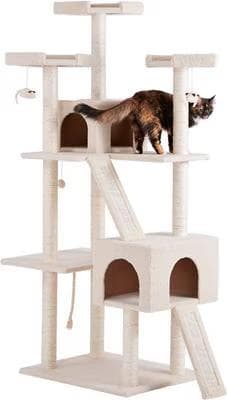
Webvet may earn a commission when you click through to Chewy, at no extra cost to you.
What is an XXL cat tree and does my cat need one? XXL is a marketing label rather than a defined size class, and manufacturers apply it to anything from a genuinely oversized build to a normal tree with one wide platform. Read it as a hint to go check the dimensions, nothing more. Your cat needs an XXL cat tree only if the measured specifications behind that label meet the thresholds above. Plenty of trees labeled XXL still ship a 16-inch top perch.
What are the best cat trees for large cats overall? The best cat trees for large cats share five traits regardless of brand: a base that is wide and heavy relative to the tree's height, perches that exceed the cat's curled diameter with room left over, posts thick enough not to flex under a full-body pull, joinery that uses bolts or dowels into solid material rather than screws into bare particleboard, and an included or retrofitted wall anchor. Anything meeting all five will outlast three cheap replacements.
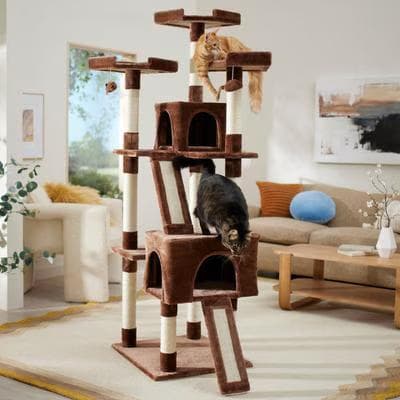
Webvet may earn a commission when you click through to Chewy, at no extra cost to you.
Weight Capacity: What the Number Really Tells You
A weight capacity printed on a listing is one of the least standardized numbers in pet furniture. There is no industry test protocol behind it, no requirement to disclose whether it was measured statically or dynamically, and usually no statement of whether it refers to one perch or the whole tree. Treat it as a rough signal of the manufacturer's intent, not as an engineering guarantee.
The number also describes the wrong kind of load. Your cat does not lower itself gently onto a perch. It lands, and a landing briefly drives force well above the cat's static body weight through whatever it lands on. A perch rated at exactly your cat's weight has no headroom for that instant. It is the same reason mounted products like window perches publish capacities far above the weight of any cat that will ever use them, because when the consequence of a failure is a fall, the safety factor has to be generous and visible.
How much weight can a cat tree hold? Manufacturers commonly rate individual perches somewhere between 20 and 50 pounds, and solid wood builds sometimes state higher figures for the whole structure, but the figure is rarely tested to any published standard. Use a simple rule instead: plan for at least double your cat's weight on any perch it will jump onto, and in a multi-cat home add the combined weight of every cat that might pile onto the same level. If the listing does not state a capacity at all, judge the tree on joinery and base instead.
What actually predicts load performance
Three things predict real-world load performance better than the printed number:
- Joint type. Bolts passing all the way through a platform, or dowels seated in solid wood, hold far better than wood screws biting into the face of a particleboard shelf.
- Base mass. Heft at the bottom lowers the center of gravity and buys you resistance to tipping that no perch rating captures.
- Post-to-platform contact area. A wide post supporting a platform across a broad footprint spreads load. A narrow post bolted through a single point concentrates it and starts working the fastener loose.
Base Width and Tip Resistance: The Stability Math
Stability is geometry, and it is the one part of this decision you can settle with a tape measure and arithmetic before anything is delivered. The working rule we use is simple: the shorter side of the base should measure at least one third of the tree's total height. Below that, the tree needs a wall anchor regardless of how the listing describes it.

| Tree height | Base needed at one third | Typical base shipped | Verdict |
|---|---|---|---|
| 72 in | 24 in | 16 to 20 in | Anchor to the wall |
| 63 in | 21 in | 18 to 20 in | Borderline, anchor if the cat is over 15 lb |
| 50 in | 17 in | 18 to 24 in | Usually stable freestanding |
| 36 in | 12 in | 16 to 20 in | Stable freestanding |
Run the arithmetic on the most common failure case and the problem becomes obvious. A 72-inch tree on a 16-inch base has a footprint equal to 22 percent of its height, well short of the 33 percent target. That tree can be perfectly well built and still go over when a 20-pound cat launches sideways off the top, because the geometry gives the cat more leverage than the base can resist.
What makes a cat tree stable for large cats? Four things, in descending order of importance: a base whose shorter side reaches at least a third of the tree's height, real mass low in the structure, perches positioned over the base rather than cantilevered out past its edge, and a wall anchor at the top. Carpet under the base helps a little by adding friction, and a hard floor or a thick shag rug both hurt, so check that the tree sits flat and does not rock before you let the cat on it.
Are tall cat trees safe for large cats? Tall trees are safe for large cats when they are anchored and unsafe when they are not, and that is more or less the whole answer. Height itself is not the risk factor, because cats are excellent climbers and a good tall tree gives a big cat the elevated territory it wants. The risk comes from height combined with a small footprint and no anchor. If your room cannot accommodate a base that satisfies the one-third rule, a shorter build or one of the compact options in our small cat tree guide is the better call than a tall tree balanced on a narrow base.
Perch Diameter and Hammocks for Heavy Cats
Perch size is where big-cat owners waste the most money, because a tree can be genuinely well engineered and still ship platforms sized for a 10-pound cat. A cat that overhangs a perch will use it a few times and then quietly stop, and no amount of catnip changes that. The fix is either a tree with genuinely oversized platforms or supplementary resting spots such as a wide window perch. A mounted option like the K&H EZ Mount Cat Window Perch gives a heavy cat a broad sunlit surface that takes up no floor space at all, and mounted perches state a capacity you can check against your cat before you commit.

How wide should a cat tree perch be for a big cat? Start from your cat's curled loaf measurement and add two to three inches so it is not resting on the rim. In practice that lands most 15 to 19 pound cats at 18 inches of usable surface and most cats over 20 pounds at 20 to 22 inches. Watch the word usable, because listings often quote the outside dimension of a platform that has a raised bolster eating two inches off every side. Measure the flat interior if the photos allow it.
Is a cat tree with a hammock good for a heavy cat? A cat tree for large cats with a hammock can be excellent, because the fabric cradles a heavy body and spreads pressure in a way a flat board cannot, and many big cats prefer that contained feeling. The catch is the mounting. On a heavy cat, a hammock slung from thin poles pulls those poles inward over time and loosens every joint it touches. Look for a hammock hung on a thick frame with reinforced corner fittings, and skip any design where the fabric attaches with small plastic clips. Some cat trees use multiple hammocks; in a multi-cat home, each hammock needs the same thick frame and reinforced corner fittings rather than small plastic clips.
Two more perch details worth checking before you buy:
- Bolster height. A raised lip helps a cat feel secure but steals usable diameter. A one-inch bolster on a 20-inch platform is a good trade. A three-inch bolster on the same platform is not.
- Cover material. Faux fur and plush read as comfortable but flatten under a heavy cat within months. A denser short-pile carpet holds its loft longer under real weight.
Post Thickness, Height, and Scratching Reach
Post diameter does two jobs at once, and both of them matter more for a big cat. Structurally, a thicker post resists flex, so the tree does not visibly deflect when a heavy cat throws its weight into a scratch. Behaviorally, a thicker post feels like a tree trunk rather than a broom handle, and cats commit to it.

How thick should a cat tree post be for a heavy cat? Aim for at least four inches in diameter for a cat in the 15 to 19 pound band and around four and a half inches for a cat over 20 pounds. Anything under three and a half inches will flex noticeably when a big cat pulls hard against it, and that flex is enough to make some cats abandon the post entirely. Diameter also determines how much sisal is wrapped around the core, which is the part that actually wears out.
The height question is separate and it is the one standard trees fail most often. A scratching post is only useful if it exceeds your cat's full standing stretch, because the whole point of the behavior is a full-body pull that stretches the back and shoulders. Long-bodied cats routinely stretch past 36 inches, and a great many trees top out around 26 inches on the tallest post. For a separate full-height option, the SmartCat Ultimate Scratching Post provides a tall sisal surface without another tower.
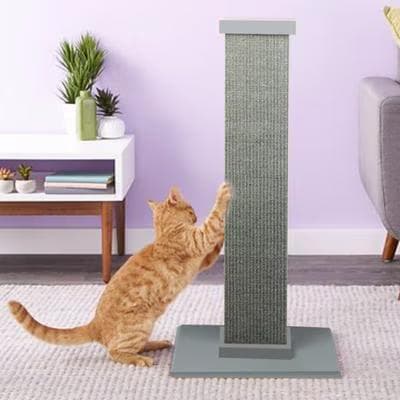
Webvet may earn a commission when you click through to Chewy, at no extra cost to you.
Keeping claws in reasonable shape also protects the sisal, since long claws snag and tear the wrap faster than blunt ones do. If your cat's claws are catching on the rope or on your rugs, our guide to cat nail clippers covers the tools and the technique.
Materials: Solid Wood, Particleboard, Sisal, and Carpet
Material choice on a big cat's tree splits into two separate questions: what carries the load, and what the cat actually lies on. Getting the comfort layer wrong costs you a nap spot. Getting the structural layer wrong costs you the tree. Plush and faux fur belong firmly in the comfort category, which is why they work well on a non-structural surface like the Frisco Plush Cat Window Perch and badly as the only thing standing between a heavy cat and a thin shelf.
Is a solid wood cat tree always better than particleboard? Not automatically, but the difference is real and it is a fastener question rather than a strength question. Solid wood holds a screw thread. Particleboard does not hold one well, and under repeated load the threads gradually chew out the surrounding board until the joint has play in it. That is the actual mechanism behind the wobble owners report months after assembly, and it explains why a tree can loosen badly without anything visibly breaking.
| Material | Real strength | Typical failure mode | Best use |
|---|---|---|---|
| Kiln-dried solid wood | Highest, holds fasteners indefinitely | Rare, usually surface wear only | Posts, base, load-bearing platforms |
| Plywood | High for its weight, good screw retention | Edge splitting if over-tightened | Platforms and bases |
| Particleboard or MDF | Adequate when new, degrades at the joints | Fastener pull-out and progressive wobble | Non-structural shelves only |
| Sisal rope | Excellent abrasion resistance | Fraying and loosening at the ends | Post wrap |
| Plush or faux fur | None structurally | Matting and flattening | Comfort surfaces, not load paths |
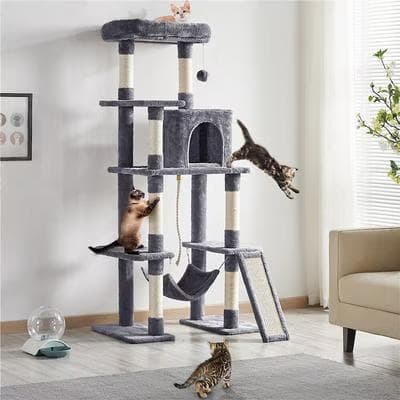
63-inch multi-level cat tree with plush perches, a condo, a hammock, sisal scratching posts, and a dangling toy. Dark gray.
Webvet may earn a commission when you click through to Chewy, at no extra cost to you.
Are wood cat trees better for large cats? Generally yes, for the reason above, and a wood cat tree for large cats is usually the right choice if you want one purchase to last a decade. A solid wood cat tree for large cats also tends to carry more base mass, which helps the tipping math on its own. Real-wood builds such as the Armarkat Classic Real Wood Cat Tree sit in this category. The tradeoffs are honest ones: wood trees cost more, weigh a great deal, and are difficult to move once assembled.
Two material notes that catch people out:
- Sisal rope versus sisal fabric. Rope is what most big cats prefer and it wears far longer under heavy scratching. Woven sisal fabric looks tidier and shreds faster.
- Carpet as a scratching surface. Carpeted posts teach a cat that carpet is a legitimate scratching target, which is a problem if your floors are carpeted. Sisal on the posts and carpet only on the platforms avoids that lesson.
Tall and Floor-to-Ceiling Trees for Big Cats
How tall should a large cat tree be? Anywhere from about 50 to 72 inches suits most large cats, and the deciding factor should be your ceiling height and your base width rather than a desire for maximum height. A big cat gains real benefit from height, because elevated resting places are a documented feline environmental need rather than a luxury, but that benefit disappears if the cat does not trust the structure. Choose the tallest tree whose base still satisfies the one-third rule in the space you have. If you want a straight comparison of tower-format builds at different heights, our best cat towers roundup covers that format specifically.

Should a floor to ceiling cat tree be used for a large cat? A floor to ceiling cat tree for large cats is a strong option in a room with a solid, level floor, because tension between floor and ceiling removes the tipping problem entirely. It trades that risk for a different one. Tension can relax over weeks, particularly on carpet, on a floating floor, or anywhere the ceiling flexes, and a relaxed pole is far more dangerous than a freestanding tree that was never load-bearing to begin with. Check the tension by hand once a month and retighten as needed.
- Best case for a tension pole: hardwood or tile over a solid subfloor, a drywall ceiling with joists you can locate, a big cat that likes serious height, and a small room where a 28-inch base is not realistic.
- Worst case for a tension pole: thick carpet or a plush pad underneath, a suspended or drop ceiling, sloped ceilings, or a household where nobody will remember to re-check the tension.
- The 10-foot question: poles marketed for 10-foot ceilings usually rely on extension segments, and every additional joint is one more place for the assembly to develop play. Verify the extension hardware is metal-to-metal, not friction-fit plastic.
Style Without Sacrificing Strength
Heavy-duty and attractive are not opposites, but the sculptural and design-led end of the category has its own buying logic and it deserves its own treatment. Wood-veneer builds such as the Catit Vesper line show that a tree can look like furniture rather than pet gear, though design-led pieces are usually engineered around a look rather than around a 20-pound cat, so check the published base width and weight rating before you assume one suits a big cat. Shelf-and-bracket wall systems, by contrast, can be extremely strong when they are fastened into studs.
What this page contributes to that decision is the strength floor. Whatever the build looks like, it still needs a perch that exceeds your cat's curled diameter, a post your cat cannot flex, joinery that does not rely on screws in bare particleboard, and either a compliant base or an anchor. For the design-led, unique, and made-to-order end of the category, our modern cat trees guide covers the aesthetics and the custom options in the detail they deserve.
Anchoring, Placement, and Assembly
Wall anchoring is the cheapest safety upgrade in this entire category, and for any tree over roughly 50 inches carrying a heavy cat it should be treated as standard rather than optional. Most manufacturers now include a strap. Most owners never fit it.

How do I stop a cat tree from wobbling or tipping over? Work through the causes in order, because the fix is different for each one:
- Re-tighten every fastener. New trees loosen during the first few weeks of use. A single pass with the supplied hex key resolves a surprising share of wobble complaints.
- Check the floor. A tree that rocks on tile is usually sitting on an uneven base or a high spot. Shim the short corner with a thin felt pad rather than over-tightening one bolt.
- Get it off the shag. Deep pile lets one corner sink and destabilizes the whole structure. A thin rigid board under the base spreads the load.
- Anchor the top. Fasten into a wall stud wherever possible, using a lag screw or the manufacturer's bracket. Where no stud lines up, use a rated toggle or snap toggle drywall anchor rather than a plastic expansion plug, which will pull straight out of the board under a lateral load.
- Replace stripped joints. If a fastener spins freely in particleboard, the board is chewed out. A slightly larger bolt with a washer and a backing nut restores the joint far better than a longer screw into the same hole.
Where should I put a large cat tree? Put it where the cat already wants to be, which usually means a window with a view, in a room the household actually uses, and against a wall or in a corner so two sides are protected. Corners are especially good for big trees because the walls give you two anchor options and the cat gets a sightline over the room. Avoid high-traffic doorways, avoid placing the top perch directly under a ceiling fan, and leave enough clearance that a cat launching off the top has somewhere to land that is not a coffee table.
Multi-Cat Homes and Senior or Overweight Cats
Two large cats sharing one tree is a load problem and a social problem at the same time, and the load problem is the easier of the two to solve. Adding the cats' weights together tells you what the structure has to take. Giving each cat a level of its own is what actually keeps the peace, because a single top platform is a resource that one cat will guard.

Can two large cats share one cat tree? They can, provided the tree is rated and built for the combined weight and provided it offers separate perches at different heights rather than one oversized platform. Two big cats forced onto the same level is a common trigger for tension, staring, and displacement, even between cats that otherwise get along. Look for at least two full-size perches with vertical separation between them, and in a home with three or more cats plan on a second tree in a different room instead of one enormous tower.
Size and health are also easy to conflate, and it is worth separating them plainly. A very heavy cat may be carrying excess weight rather than being large-framed, and that distinction changes both the health picture and the furniture requirement. A veterinary body condition assessment settles it in one appointment, and if weight loss is indicated, the tree you buy should suit the cat you are working toward as well as the cat you have today.

For senior, arthritic, or heavy cats, step rise matters more than total height:
- Keep the vertical gap between levels at or below your cat's standing shoulder height, and closer to 10 inches for a cat over 20 pounds.
- Offset the steps laterally so the cat climbs in a staircase pattern instead of going straight up.
- Prefer a wide low step or a short ramp at the bottom of the tree, where a heavy cat starts from a standstill.
- Put at least one genuinely comfortable perch within about 18 inches of the floor so an older cat never has to climb to rest.
One safety point is worth stating on its own. A cat that suddenly hesitates before a jump it used to make, or that stops using height it previously used, should be seen by a veterinarian. That change is one of the most common early signs of feline osteoarthritis, it is easy to mistake for laziness or aging, and it is not a problem that better furniture solves.
Cleaning and Long-Term Durability
How do I clean and maintain a large cat tree? Vacuum the platforms and posts weekly with an upholstery attachment, since embedded hair mats plush faster than anything else, and go over stubborn hair with a rubber grooming glove or a pumice stone before vacuuming. Spot clean fabric with an enzyme cleaner rather than a general household cleaner, because enzyme products break down organic residue instead of masking it and they do not leave a scent that discourages the cat. Remove and machine wash any hammock or cushion covers on a cold gentle cycle and air dry them so the elastic and the backing survive.
Durability on a heavy-duty tree is mostly a maintenance habit rather than a material property. Put these four checks on a schedule and the tree will outlast the cat's interest in it:
- Monthly: run the hex key over every bolt, and re-check tension if you have a floor-to-ceiling pole.
- Quarterly: inspect the sisal for loose ends and glue or tack them down before the wrap unravels past the fixing point.
- Twice a year: check the wall anchor hardware and the wall plate for movement, and look at the underside of the base for splitting.
- As needed: rotate or replace flattened cushions, and swap a worn post wrap rather than replacing the whole tree.
Rope wear is normal and is a sign the tree is doing its job. Fastener play is not normal, and a joint that will not stay tight is telling you the board around it has failed even if the surface looks perfect.
Frequently Asked Questions
How do I get my cat to use a new cat tree?
Put the tree where your cat already chooses to rest rather than where it suits your furniture layout, because location does most of the work. Rub a used blanket or a worn shirt on the perches to transfer familiar scent, and place a favorite bed on the top platform for the first week. Feed treats on the lower levels first so the cat associates the base with good things, then work upward. Play with a wand toy over and around the platforms rather than lifting the cat onto them, since a cat placed on a strange surface tends to jump straight off. Give it two to three weeks before concluding the tree has failed.
What if my cat is large but my apartment is small?
The strength requirements on this page do not relax in a small room, but the format can change. A compact build with a genuinely wide base, or a wall-mounted system fastened into studs, can meet the same perch diameter and post thickness thresholds while occupying much less floor. A corner placement buys you two anchor points and better use of the space. Our guide to small cat trees covers the compact formats in detail, including the ones that manage real stability in a narrow footprint.
Do large cats still need a cat tower if they already have a scratching post?
A scratching post and a tree do different jobs, and most cats benefit from both. The post satisfies the stretching and claw-maintenance behavior. The tree adds elevated resting space, which is a recognized environmental need rather than a comfort extra, and it gives a cat somewhere to retreat and observe from. The full comparison of when a post is enough and when you want a tree lives on our cat trees and scratching posts pillar guide.
What are the most unique cat trees for large cats?
Sculptural builds, wood-veneer furniture-style towers, wall-mounted shelf systems, and made-to-order pieces all fall under this heading, and there is far more variety in the category than the big-box shelf suggests. Whatever the design, it still has to clear the strength thresholds on this page before the aesthetics matter. Our modern cat trees guide covers the design-led end of the category, including which visual styles survive a heavy cat and which ones are decorative first.
Are there custom cat trees for large cats?
Yes, and custom or made-to-order builds are often the practical answer when a cat is unusually long, unusually heavy, or when a room's dimensions rule out anything off the shelf. When you commission one, specify the numbers rather than the adjectives: usable perch diameter, base footprint, post diameter, tallest post height, and step rise. Sourcing, lead times, and what to ask a builder for are covered on our modern cat trees guide.
Does my large cat need a window perch as well as a cat tree?
It is not required, but it is one of the highest-value additions you can make for a big cat, because it creates a second elevated resting spot without consuming any floor space. Window perches suit heavy cats particularly well when the mount is rated well above the cat's weight and the surface is wide enough that the cat is not overhanging the edge. Check the mounting method against your window frame before buying, and confirm the perch is fitted to a window your cat can reach without a difficult jump.
Should I trim my cat's claws to make a large cat tree last longer?
Regular trimming helps the tree and the household, though it does not replace scratching. Long claws snag and tear sisal faster than short ones, and they catch on carpet and upholstery in ways that shorten the life of everything in the room. Trimming the sharp tip every two to four weeks is usually enough for an indoor cat, and it should never be a substitute for providing a tall enough post, because the stretching behavior is about the cat's back and shoulders as much as its claws.
Sources

Editor
The Webvet Editorial Team is the in-house group of pet-care editors and writers behind Webvet, operated by Smart Pet Collective. The team researches, writes, and maintains Webvet's pet health, behavior, and medication content. Every article follows a defined editorial process: research from reputable veterinary and scientific sources, careful drafting, mandatory review of medical content by a credentialed veterinarian, and dated publication. Health and medication articles are medically reviewed by a licensed veterinary professional before they go live and are kept current over time.


