Modern Cat Tree Guide: Style Your Cat Will Use
Modern cat trees look like furniture, but the design choices that make them beautiful are the ones cats reject. Here are the four formats, the five things a tree must still do, and the cheapest-first fix for a tree your cat ignores.

This article contains affiliate links. Webvet may earn a commission when you buy through them, at no extra cost to you.
A modern cat tree is climbing furniture built to read as furniture first: wood tones instead of beige carpet, clean joinery instead of stapled plush, and a silhouette that can stand in a room you actually sit in. The category is genuinely good now, and you no longer have to choose between a living room you like and a cat who gets to climb. The catch is that the design decisions that make a tree beautiful (bare platforms, slim perches, no visible scratching surface) are the same decisions that make cats walk past it.
So this guide is a framework rather than a shopping list, because the piece you find on a boutique site next month will not be on anyone's roundup. You get the five things a tree still has to do no matter how it looks, the style families and what each one gives up, how to size a platform to your particular cat instead of to a generic one, how to put a wall system up without guessing, what the designer tier actually buys, and a cheapest-first fix sequence for a beautiful tree your cat is currently ignoring.
- 1Modern cat trees come in four real formats: wood-toned freestanding, furniture-style hybrids that double as a side table or cabinet, wall-mounted modular systems, and sculptural statement pieces.
- 2However it looks, a tree needs height for a vantage point, a stable base or wall anchoring, at least one vertical scratching surface, at least one soft or enclosed resting spot, and platforms wide enough for your cat to lie down fully stretched.
- 3Cats settle on surfaces that hold warmth and give grip, which is why a bare hardwood plank loses to the sofa every time and why a small sheepskin insert rescues most ignored trees.
- 4Measure your cat from nose to tail base and hold that number against the platform dimensions in the product listing, because design-led perches are usually sized to the drawing rather than to a cat.
- 5Tall narrow silhouettes are the most common modern look and the least stable one, so anti-tip hardware is a requirement rather than an accessory.
- 6Wall-mounted systems are the format design-led shoppers want most and the one with the least published safety guidance: mount into studs, respect the stated weight rating, and never give a senior, arthritic, overweight, or declawed cat a route that can only be descended by jumping.
- 7Money buys solid wood, replaceable parts, finish quality, and published specifications. It does not buy your cat's interest, which is earned through placement, softness, and grip.
What Makes a Cat Tree Modern
A cat tree counts as modern when its materials and proportions come from contemporary furniture rather than from the pet aisle. That means visible wood grain or matte painted panels instead of wall-to-wall carpet, sisal rope or sisal fabric instead of looped nylon, neutral woven upholstery instead of printed plush, and a frame you could describe to someone without using the word "tower." The functional parts are still there. They have simply been detailed the way a bookshelf or a console table would be.
Underneath the marketing language, the category splits into four formats that behave very differently in a room:
- Wood-toned freestanding trees. The traditional tower shape rebuilt in oak, walnut, birch ply, or a wood-look laminate, usually with sisal-wrapped posts and removable fabric cushions. Closest to a conventional tree in function, easiest to place, and the widest price range by far.
- Furniture-style hybrids. Pieces that do a second job: a side table with a cubby underneath, a console with integrated steps, a cabinet that hides a litter box, a bench with a scratching panel on one end. Excellent in small rooms because the floor space is already spoken for.
- Wall-mounted modular systems. Floating shelves, bridges, ramps, and hammocks arranged into a route across a wall. Zero floor footprint, the strongest visual payoff, and by far the most installation risk.
- Sculptural statement pieces. Rounded organic forms, tiered flower shapes, curved plywood, felt pods. Bought for the object as much as for the cat, and the family where function varies most from product to product.
Modern also shows up in pieces that are not trees at all. A slim vertical scratching panel such as the Necoichi Premium Comfort Cat Scratcher Wall covers the scratching half of the job against a wall, in a footprint no tree can match, and it is often the piece that makes a minimalist tree workable rather than the tree itself.
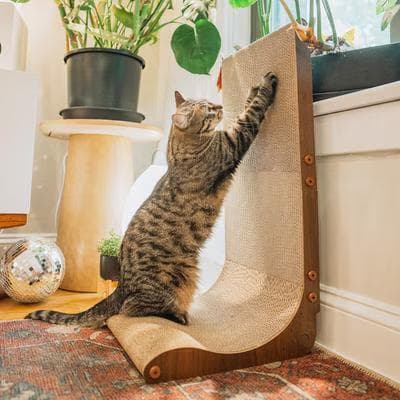
Curved cardboard wall scratcher with a wood frame that protects walls and gives cats a satisfying vertical scratch surface.
Webvet may earn a commission when you click through to Chewy, at no extra cost to you.
Yes, there are genuinely modern aesthetic cat trees, and there are far more of them than there were five years ago. Designer labels such as Mau Pets, Tuft and Paw, and Catastrophic Creations built the category, and mainstream brands including Catit Vesper, New Cat Condos, PetPals, and Frisco now sell wood-toned and furniture-style pieces at ordinary prices. The important thing to understand is that "aesthetic" describes the finish and the silhouette. It says nothing about whether the platforms are deep enough, whether there is a scratching surface, or whether the base will stay upright, and those are the things you have to check yourself.

Treat the word modern the way you would treat "designer" on any other piece of furniture. It tells you what the object is trying to be, not how well it works. A well-made wood-toned tree and a badly made one look nearly identical in a styled product photo, and the difference only shows up in the specification table and in whether your cat is on it three weeks after delivery.
What Your Cat Actually Needs From a Cat Tree
A cat tree is good for cats, and the reasons are behavioral rather than decorative. Climbing furniture gives a cat vertical territory, which is how cats naturally divide space: height is a resource, a high resting spot is a safe place with a full view of the room, and having one lowers the friction in a household with other pets, children, or visitors. A tree also concentrates scratching, stretching, and napping onto an object you chose rather than onto the arm of your sofa. The International Cat Care and AAFP guidance on feline environmental needs treats safe elevated resting places and appropriate scratching outlets as baseline welfare requirements, not enrichment extras.
That gives you a functional floor. Any tree, at any price, in any style, still has to deliver five things:
- Real height. A perch is only a vantage point if the cat can look down on the room. Aim for a top platform at or above the height of your sofa back, and higher if the room is busy.
- Stability. The tree should not rock when a cat lands on the top platform from a run. That means a base wider than the top, or an anti-tip strap into the wall, or both.
- A vertical scratching surface. At least one post or panel tall enough for a full-body stretch, which for most adult cats means roughly 30 inches of uninterrupted vertical material.
- Somewhere soft or enclosed. A cushion, a hammock, a cubby, a felt cradle. One warm surface is enough to change how a tree gets used.
- Platforms your cat fits on. Wide and deep enough to lie down fully stretched out, not just to sit upright.
| Functional requirement | What to look for in the product listing | The common modern-design failure |
|---|---|---|
| Vantage point | Total height, and the height of the top perch specifically | Sculptural pieces list total height while the usable top perch sits much lower |
| Stability | Base dimensions, total weight, and whether an anti-tip strap is included | Tall narrow silhouette with a base no wider than the top platform |
| Scratching surface | Sisal rope or sisal fabric, post length, and whether posts are replaceable | Scratching surface removed entirely for a cleaner look |
| Soft resting spot | A cushion, hammock, or cubby, ideally with a removable washable cover | Bare wood or bare rattan platforms with nothing to lie on |
| Platform size | Platform width and depth in inches, not just "large" or "spacious" | Perch depth under 12 inches on a piece marketed for all cats |
| Load capacity | A published weight rating per platform or per shelf | No weight figure published anywhere in the listing |
Keep the checklist next to you while you browse and it will do most of the filtering. If you want the wider category background before you shop, our guide to cat trees and scratching posts covers what each component is for and how the pieces fit together.
The Design Versus Function Tradeoff
Here is the tradeoff stated plainly. Every design decision that makes a tree look more like furniture removes something the cat was using. Carpet comes off, so grip and warmth go with it. Cushions come out, so the soft resting spot goes. Posts get slimmer, so the scratching surface shrinks. The base gets tucked in, so stability drops. The footprint narrows, so the platforms get shallower. None of these are dealbreakers on their own. Stacked together on one minimalist piece, they produce a beautiful object that the cat treats as an obstacle.
It helps to know what the maximum-function, minimum-design end of the market looks like, because it is the benchmark every stylish tree is quietly being measured against. Something like the Yaheetech Multi-Level 63-in Plush Cat Tree is over five feet tall, plush from top to bottom, has multiple sisal posts and several enclosed and open resting spots, and costs a fraction of a designer piece. Cats love this kind of tree. It is also unmistakably a cat tree, which is exactly the problem you are trying to solve, and everything you give up moving away from it has to be given back deliberately.
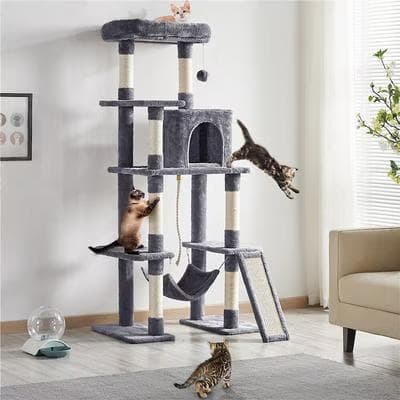
63-inch multi-level cat tree with plush perches, a condo, a hammock, sisal scratching posts, and a dangling toy. Dark gray.
Webvet may earn a commission when you click through to Chewy, at no extra cost to you.
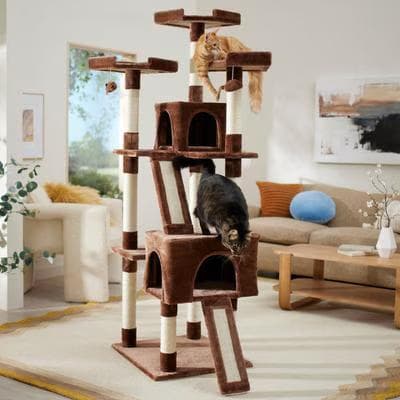
The Frisco 72-in Faux Fur Cat Tree & Condo is another useful function-first benchmark when height and soft resting space matter more than a furniture-like finish.
Webvet may earn a commission when you click through to Chewy, at no extra cost to you.
The single most useful thing to understand is why bare wood gets ignored. Cats choose resting surfaces for thermal comfort and grip, and their comfortable temperature range sits meaningfully above a normal room. A hard flat plank pulls heat away from a lying cat and gives claws nothing to catch when they land or turn on it. A sofa cushion does the opposite on both counts. This is not a preference you can train around, and it is the reason a five hundred dollar all-wood minimalist tree can sit unused next to a twenty dollar fleece bed that gets slept in daily.

The fix is small. One soft insert on the platform your cat can already reach, in a material that traps a little warmth, converts most bare-wood trees into used furniture. Sheepskin, fleece, or a folded blanket the cat already sleeps on all work, and none of them ruin the look of a wood-toned piece the way a printed plush cover would.
Multi-cat homes have their own version of this tradeoff, and it is where the most expensive mistakes happen. One tall statement tree in a two-cat home is a single resource, and a single resource is something one cat can control. The AAFP and ISFM environmental needs framework is explicit that key resources should be provided in multiples and physically separated, and resting places count. In practice, plan on one perching option per cat plus a spare, spread across different heights and ideally different walls or rooms, rather than one impressive tower with several levels. Two modest wood-toned pieces at opposite ends of a living room serve two cats far better than one sculptural centerpiece, and a cat should never have to pass another cat to reach the only route up.
Modern Cat Tree Style Families
No competitor page organizes this category, which is why shopping for it feels like scrolling forever. Sorting modern trees into style families makes the tradeoffs visible before you fall in love with a photograph.
Minimalist and Scandinavian
A minimalist cat tree strips the piece down to its structure: pale birch or oak, a couple of clean platforms, one slim post, no cubbies, no plush, no visible hardware. The appeal is obvious in a Scandinavian or Japandi room, and this family is the sharpest case of the design tradeoff in the whole category. Minimalist trees are the most likely to arrive with bare platforms, the narrowest perches, and a footprint too small for their height. Buy one only if you plan to add a soft insert and confirm the perch is deep enough, and treat any minimalist piece with no scratching surface as an incomplete setup that needs a separate post or panel nearby.
Mid-century modern and retro
A mid-century modern cat tree borrows from 1950s and 1960s furniture: tapered solid-wood legs splayed at an angle, warm walnut or teak tones, rounded felt or upholstered cradles, and brass or black metal hardware. A retro cat tree is the same idea with more color and pattern. This family tends to be the best compromise in the whole category, because the tapered-leg base is genuinely wide and stable, the cradles and pods are soft by design, and the wood is usually solid rather than laminated particleboard. Pieces such as the Catit Vesper V-High Base bring the walnut-toned, low-profile look at a mainstream price.

Wood-toned freestanding and natural wood
The largest family and the easiest to buy well. A natural wood cat tree uses solid timber, plywood with a real veneer, or a wood-look laminate for the platforms and structure, with sisal-wrapped posts and neutral fabric inserts. Because this family keeps the traditional tower geometry, it usually keeps the function too: real post lengths, deep platforms, and a base with actual width. This is the safest place to shop if you want a modern cat tree that needs no compensating.
Furniture-style hybrids
Side tables with a cubby, consoles with steps, cabinets that hide a litter box, benches with a scratch panel. Function per square foot is excellent and the piece disappears into the room. The catch is height. Most hybrids top out at coffee-table or console height, which gives a cat a resting spot but not a vantage point, so plan to pair one with a higher perch elsewhere in the room.
Sculptural and statement pieces
This is where the cute cat tree and whimsical cat tree searches land. A flower cat tree is the dominant silhouette in this family: a central post with tiered platforms shaped as petals or leaves, usually with a plush or felt cushion in each cup. They photograph beautifully and they are frequently sold in sizes better suited to a kitten than an adult cat. Check the petal diameter against your cat, check the base width against the total height, and be honest about whether the cups are deep enough to hold a fully stretched adult rather than a curled kitten.
| Style family | Scratching surface | Soft resting spot | Stability | Footprint | Typical cost |
|---|---|---|---|---|---|
| Minimalist / Scandinavian | Often minimal or absent | Rarely included | Weakest, tall and narrow | Small | Mid to high |
| Mid-century / retro | Usually one sisal post | Felt or upholstered cradle | Strong, splayed wide base | Medium | Mid to high |
| Wood-toned freestanding | Sisal posts, often several | Cushions and cubbies common | Good, wide base | Medium to large | Low to high |
| Furniture-style hybrid | Panel or post on one face | Cubby or bench cushion | Excellent, low center of gravity | None extra, doubles as furniture | Mid |
| Sculptural statement | Varies, often one wrapped post | Petal or pod cushions | Varies, check base width | Small to medium | Low to high |
| Wall-mounted modular | Add-on panels only | Hammocks and padded shelves | Depends entirely on installation | Zero floor space | Mid, plus install effort |
If none of these families fits your room, the honest answer may be that you do not need a tree at all. A window perch such as the Coziwow Cat Window Perch delivers the single thing cats want most from a tree, a warm elevated view of the outside world, without adding a piece of furniture to the floor.
Materials: What Wood, Sisal, and Fabric Actually Do
Materials are where the price differences live and where most listings get vague, so it pays to know what each one does under a cat.
Modern cat trees are typically built from solid pine, poplar, birch, oak, walnut, acacia, or rubberwood, or from a plywood or MDF core wrapped in a wood veneer or a wood-look laminate. Solid hardwoods such as oak, walnut, and acacia are the heaviest and most rigid, which is what you want under a large cat and what most of the designer tier is charging for. Pine and poplar are softer and cheaper and dent, but they hold screws well and keep the same look. Plywood is genuinely strong for platforms and is not a downgrade. Particleboard with a printed foil finish is the one to avoid on any load-bearing part, because it fails at the fastener under repeated impact and cannot be repaired.
- Sisal rope is wound around a post and is the most durable common scratching surface. It is replaceable on better trees, which is a real feature worth paying for.
- Sisal fabric is a flat woven panel. It looks tidier on a minimalist piece and wears differently, shedding fewer loose fibers but usually lasting less time than rope under a heavy scratcher.
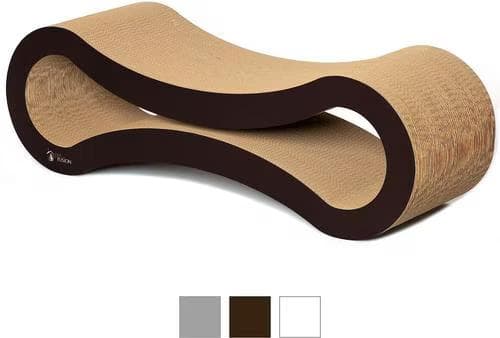
- Cardboard is a legitimate scratching substrate that many cats prefer, and it is the material behind most of the slim modern scratching panels. It sheds and needs replacing, which is a maintenance question rather than a quality one. The PetFusion Ultimate Cat Scratcher Lounge is a curved cardboard option that also works as a resting surface.
Webvet may earn a commission when you click through to Chewy, at no extra cost to you.
- Rattan and woven cane appear on statement pieces and hold up poorly to determined claws. Treat them as decorative surfaces, not as the scratching surface.
- Faux fur and plush are the warmest and grippiest option and the least modern-looking. Confined to a removable cushion, they solve the softness problem without dominating the piece.
- Boucle, felt, and neutral woven upholstery are the modern compromise. They are warm enough to be chosen and clean enough to look like furniture. Look for removable, washable covers.
Cats do not need carpet specifically, but they do need something with warmth and grip, and carpet is simply the cheapest way manufacturers have historically delivered both. A wood-toned tree with felt cradles, a fleece cushion, or a padded hammock meets the same need without a square inch of carpet on it. What cats will not do reliably is choose a hard, cold, smooth surface for a long nap when a softer option exists in the same room, so the practical rule is that every tree needs at least one surface that is soft, and it does not matter what that surface is made of.

The one material decision you cannot compensate for later is dropping the scratching surface. Scratching is not optional behavior: cats scratch to condition their claws, to stretch the whole body, and to leave visual and scent marks in places that matter to them. A modern tree that deleted its posts for a cleaner silhouette does not remove the urge, it relocates it, usually to the nearest upright textured thing, which in a design-conscious home is normally the sofa or a rug. If you fall for a piece with no scratching surface, budget for a separate post or wall panel at the same time and put it directly beside the tree.
Height, Footprint, and Placement in a Real Room
A modern cat tree should be tall enough to give a real vantage point, which in practice means a top perch somewhere between about three and six feet for most homes. Anything under roughly three feet is a resting spot rather than a lookout, which is fine as a second piece but will not satisfy a cat who wants to survey the room. Above six feet you gain very little for an average cat and you add meaningful tip-over risk, harder cleaning, and a harder descent for older cats. The number that matters more than total height is the height of the highest usable perch, because sculptural pieces frequently quote an overall figure that includes structure the cat cannot sit on.
Footprint is the constraint most people underestimate. A stable tree needs a base at least as wide as its widest platform, and a tall one needs more. Measure the floor space honestly before you buy, and if the answer is that nothing tall fits, that is useful information rather than a defeat: a shorter piece placed on top of existing furniture, a wall route, or a window perch all produce height without the base. Readers working with genuinely tight rooms will get more out of our guide to small cat trees, which handles the sizing math for compact spaces.
Placement decides whether any of this gets used, so put a modern cat tree where three conditions overlap: next to or facing a window, with a clear line of sight into the room the household actually occupies, and away from high-traffic doorways where a cat would be startled off it. A window is the strongest single draw because it supplies daylight warmth and outdoor movement to watch. The room matters just as much: a tree in a spare bedroom gets used far less than the same tree in the living room, which is the quiet argument in favor of buying an attractive one. If you like how it looks, it goes in the room the cat wants to be in.

A few placement details that repeatedly make the difference:
- Leave the top perch with a clear approach. A cat that has to squeeze past a curtain or a lamp to land will stop using the top level.
- Do not put the tree directly against a heat vent or in permanent direct afternoon sun in a hot climate. Warm is good, hot is avoided.
- In a multi-cat home, split the pieces across walls or rooms so that no cat has to walk past another to climb.
- If you have a senior cat, place at least one perch reachable in two short steps rather than one long jump.
All of which is why a window perch is such an efficient add-on, and sometimes a complete answer on its own. A padded lounger such as the K&H Window Lounger Cat Perch puts a soft, warm resting surface directly at the glass, which is precisely the combination cats seek out, and it costs a fraction of a tree while taking no floor space at all.
Will It Hold Your Cat? Stability, Weight, and Platform Size
A modern cat tree will hold a large cat, but only if you check three numbers before buying rather than after. The first is the published weight rating, per platform or per shelf. The second is platform depth and width in inches. The third is the base footprint relative to total height. Design-led trees skew tall and slim, which is the least forgiving geometry for a heavy cat, and a fifteen-pound cat landing on a top perch delivers considerably more force than fifteen static pounds. If a listing publishes none of those three numbers, that absence is itself the answer.
Platform sizing is where most of these purchases go wrong, and the fix is a tape measure rather than a size label. Measure your cat from the nose to the base of the tail while they are stretched out. A perch should be at least that long in one direction and wide enough that the cat is not bracing against the edge. Then look at the product photos with that number in mind.
Here is what a too-small perch looks like in use, and you can spot it in a listing photo before you buy:
- Hind legs or the tail hanging off the edge while the cat is lying down.
- One paw draped over the side because there is nowhere to put it.
- The cat sitting upright in a loaf rather than lying stretched out, on every visit.
- Constant readjusting, or turning around two or three times and then leaving.
- The cat choosing a platform lower down that happens to be wider than the top one.

Anti-tip hardware deserves the same treatment as it gets on a bookcase. Any tree taller than about four feet, and any tree at all in a home with a heavy cat, a bouncy cat, a kitten, or a small child, should be strapped to the wall. Most quality trees include a strap and a wall plate. If yours does not, a standard furniture anti-tip kit works, and it should go into a stud rather than into drywall alone. This is a ten minute job that removes the worst-case outcome entirely.
If your cat is at the larger end (a Maine Coon, a Ragdoll, a big domestic shorthair over about fifteen pounds), the load-bearing math deserves its own treatment: platform depth, base width, post diameter, and rated capacity all need to scale together. Our guide to cat trees for large cats works through those numbers in detail, and it is the page to read before you commit to a slim designer silhouette for a big cat.
Wall-Mounted Systems and Other Alternatives to a Floor Tree
The most common alternative to a cat tree is a wall-mounted system: a set of floating shelves, bridges, ramps, and hammocks arranged into a climbing route across a wall. It delivers height and territory with no floor footprint at all, which is why it dominates modern cat furniture photography. Other alternatives include window perches, a tall standalone scratching post paired with an existing bookshelf or wardrobe top, a stair-adjacent shelf run, and cat-safe rearranging of furniture you already own so the cat can climb it in stages.
Choosing a good alternative to a cat tree comes down to which part of the tree's job you actually need to replace. If your cat mostly wants a warm view, a window perch is the better product and it costs far less. If your cat wants altitude and routes, a wall system beats almost any freestanding tree. If your cat scratches furniture, a single tall sisal post or wall panel solves that specific problem without buying a tower at all. And if you are trying to solve territory friction between two cats, more separate perches at different heights will outperform one taller piece every time. The SmartCat Ultimate Scratching Post is a practical full-height sisal companion for that setup.
Wall-mounted cat shelves are safe when they are installed correctly, and genuinely dangerous when they are not. The rules are short and they are not optional:
- Mount into studs wherever possible. In most homes studs are 16 inches on center. Find them with a stud finder, not by knocking.
- Where a stud is not available, use a rated anchor. Heavy-duty toggle bolts hold in drywall. Plastic expansion plugs do not hold up to repeated dynamic impact.
- Read the published weight rating and leave headroom. A cat landing on a shelf momentarily loads it well above its body weight, so a shelf rated close to your cat's weight is not rated well enough.
- Cover the surfaces. Bare sealed wood is slippery. Carpet pads, sisal, or felt on each shelf give claws something to grip on landing.
- Design the descent, not just the climb. Cats will climb almost anything. Coming down is where injuries happen, so build a staircase of steps no more than about a foot and a half apart rather than a set of isolated islands.
- Keep every shelf reachable from something. No shelf should require a leap from the floor.

Two honest caveats before you drill. First, a wall system is a renovation-grade commitment: it puts real holes in your wall, it is not coming with you easily when you move, and reconfiguring it means patching and repainting. Second, and more important, a wall route is a bad fit for some cats. Senior cats, cats with arthritis or any diagnosed joint disease, overweight cats, and declawed cats should not be given a high route whose only exit is a jump. Declawing removes the last bone of each toe and can leave a cat with reduced grip and lasting discomfort, and degenerative joint disease is common in older cats and often invisible until a jump goes wrong. For those cats, build low and build ramps, or skip the wall entirely and use furniture-height perches.
What a Designer Cat Tree Costs, and the Cheaper Ways In
Designer modern cat trees generally run from a few hundred dollars into the high hundreds, mainstream wood-toned trees sit in the low-to-mid hundreds, and function-first plush towers sit below that. The question worth answering is what the top tier actually buys.
Mau cat trees are worth it for a specific buyer, and not for everyone. What you are paying for at that tier is real: solid wood rather than laminated particleboard, published dimensions and weight ratings, replaceable scratching posts and washable covers, finish quality that holds up in a room where you can see it up close, and a design that was resolved rather than assembled. What you are not paying for is any guarantee that your cat will use it. A designer piece with bare platforms and a slim base has exactly the same problems as a cheap one with bare platforms and a slim base, and cats do not price-check. Buy at that tier if the piece will live somewhere you look at every day and you want it to survive a decade, and pair it with a soft insert on day one.
| Tier | What the money buys | What it does not buy | Best for |
|---|---|---|---|
| Designer (high hundreds) | Solid hardwood, published specs, replaceable parts, resolved design, longer service life | Any guarantee your cat uses it, and often not extra platform depth | A visible room where the piece is furniture first |
| Mid-range wood-toned (low to mid hundreds) | Real wood or veneer, sisal posts, decent platform sizes, wide bases | Fine joinery, premium finishes, replaceable components | Most buyers, most rooms |
| Function-first plush (budget) | Maximum height, softness, and platform count per dollar | Any chance of looking like furniture | Spare rooms, catios, and cats who need options |
| Wall-mounted modular (mid, plus install) | Zero floor footprint and the strongest visual result | Portability, and suitability for senior or mobility-limited cats | Renters who can patch, owners who will not move soon |
If you like the designer look and not the designer price, the mau cat tree dupe route is legitimate and works. Look for the same three things the expensive pieces get right rather than the same silhouette: solid or veneered wood on load-bearing parts, a base wider than the tallest platform, and a published weight rating. Solid-wood makers such as the New Cat Condos Deluxe Cat Tower deliver real timber construction at a middle price with none of the boutique branding. Buying a plain wood-toned tree and adding your own sheepskin, felt pad, or linen cushion also closes most of the visual gap for very little money, because the fabric is what reads as cheap in photographs, not the wood.
Budget Modern Cat Trees and IKEA Hacks
There are modern cat trees that work with IKEA furniture, and this is the cheapest legitimate route into the wall-mounted look. The approach is to use IKEA shelving as the structure and add cat-appropriate surfaces yourself: floating wall shelves mounted in a staggered staircase, a bookcase turned into a climbing route by leaving alternating cubes empty, a shelf unit topped with a cushion so the top becomes a perch, or a bench with a sisal panel fixed to one end. The parts are inexpensive, they already match a modern room, and the result is fully modular.
Two rules make the difference between an IKEA hack and a hazard:
- Anchor everything into studs, and use the wall bracket the shelf was sold with. Consumer shelving is rated for static books, not for a cat landing at speed, so treat the published load figure as a ceiling and stay well under it.
- Add grip to every surface a cat lands on. Sealed laminate is slippery. Adhesive carpet tiles, sisal mats, or felt pads cut to size fix it for a few dollars per shelf.
Other budget routes that hold up: put a cushion on top of a wardrobe or a sturdy bookcase you already own and add a step to reach it, buy one good wood-toned tree instead of two mediocre ones, or buy a plain function-first tower for the spare room and a single attractive piece for the living room. A well-reviewed budget tower such as the Frisco 72-in Faux Fur Cat Tree gives a cat more usable height and softness per dollar than anything in the design tier, which makes it a sensible companion piece somewhere it will not be on display. If you want the tower-format comparison specifically, our roundup of the best cat towers covers the taller multi-level pieces in depth.
When Your Cat Ignores a Beautiful Cat Tree
This is the fear that keeps design-led shoppers from buying, and it is a real outcome. Cats ignore expensive cat trees for reasons that are almost always fixable and almost never about the price tag: the tree is in the wrong room, the surfaces are hard and cold, the platforms are too small to lie on, the climb is too big a step for that particular cat, or the tree smells like a factory and nothing like home. A brand-new object in an unfamiliar corner is not attractive to a cat. It is a change in the environment, and cats treat changes cautiously until something makes the object worth approaching.

Work through this sequence in order, because it runs cheapest and easiest first and most cats are recruited in the first two steps:
- Move it. Put the tree where the household actually spends time, ideally beside a window. This costs nothing and fixes more rejected trees than anything else on the list.
- Add something soft. A sheepskin, fleece pad, or folded blanket on the main perch. Warmth and grip are the two things bare wood cannot give.
- Transfer familiar scent. Use a blanket the cat already sleeps on, or rub a soft cloth on the cat's cheeks and then on the platforms. Skip the harsh cleaners on a new tree.
- Add a scratching surface if there is not one. A sisal post or a wall panel placed directly against the tree turns it into a destination rather than a shelf.
- Shorten the climb. A stool, an ottoman, a low side table, or a purpose-made step next to the tree converts one big jump into two small ones. This matters most for kittens, seniors, and heavy cats.
- Make the top worth reaching. Feed a few treats up there, run a wand toy across the platforms, or move a favorite toy to the top perch. Reward the arrival, do not lift the cat onto it.
- Give it three weeks. Cats commonly investigate new furniture at night and on their own schedule. Rearranging the tree every three days resets the process.
If none of that works, look again at platform size with a tape measure. A perch a cat physically cannot lie down on will never be a napping spot no matter how well it is placed, and that is the one problem in this list you cannot retrofit.
One thing to rule out first. A cat tree is enrichment, not veterinary care, and a change in climbing behavior is a medical signal. If a cat who used to jump and climb suddenly stops, hesitates before jumping, lands heavily, or starts using only the lowest level, that is a reason to book a veterinary exam rather than to blame the furniture. Arthritis, injury, weight gain, and vision changes all present exactly this way, and they are treatable when they are caught.
Modern Cat Tree Questions, Answered
Frequently Asked Questions
Is a cat tower the same as a cat tree?
In everyday use the two words describe the same product, and most retailers use them interchangeably. Where a distinction exists, "tower" usually implies a taller multi-level unit with a small footprint, while "tree" is the general category term covering everything from a two-level perch to a six-foot condo. If you are shopping the taller end specifically, our guide to the best cat towers compares those units directly: https://www.webvet.com/best-cat-towers/
What size cat tree do I need for a large cat?
Large cats need more than a taller tree. They need deeper platforms, a wider base, thicker posts, and a published weight rating that leaves real headroom over the cat's actual weight, because a heavy cat landing from a jump loads a platform well above its static weight. The sizing math is detailed enough to deserve its own page, and we have worked through the numbers here: https://www.webvet.com/cat-trees-for-large-cats/
How do I introduce a new cat tree so it actually gets used?
Put it in place and leave it alone for a few days rather than lifting your cat onto it. Add a blanket that already smells like your cat, play with a wand toy across the platforms so climbing happens by accident, and reward the cat for arriving on it rather than carrying them up. Most cats investigate new furniture overnight, so give it two or three weeks before you judge the result.
Is it safe to buy a used modern cat tree?
It can be, with two conditions. Confirm the previous cats were healthy, since fabric and sisal can hold parasite eggs and infectious material, and inspect every joint and fastener for movement before you put a cat on it. Clean or replace all fabric, and steam or discard anything porous you cannot wash. A solid wood tree with replaceable posts and washable covers is the safest secondhand buy.
How do I clean a wood and fabric cat tree without wrecking it?
Vacuum the fabric weekly with an upholstery attachment, wash removable covers on a gentle cycle, and wipe wood surfaces with a barely damp cloth and dry them immediately, since standing water swells veneer and laminate at the seams. Skip bleach, pine oil, and strongly scented cleaners entirely, because cats are sensitive to several of those and a chemical smell is a reliable way to make a cat abandon a tree.
Can a modern cat tree work in a studio or a small apartment?
Yes, and the format matters more than the size. Furniture-style hybrids, wall-mounted routes, and window perches all give a cat height without consuming floor space, and a shorter piece placed on top of existing furniture achieves the same thing for nothing. Our small cat trees guide handles the compact sizing and placement decisions in detail: https://www.webvet.com/small-cat-trees/
When should a cat tree be replaced?
Replace or repair a tree when the structure moves. Wobble at the joints, a post that spins, split particleboard around a fastener, or a base that lifts when a cat lands are all reasons to retire it, because a tree that shifts underfoot teaches a cat not to trust it. Fabric and sisal wearing out is not a replacement trigger on a well-made tree, since those are the parts good manufacturers sell separately.
My cat scratches the sofa even though there is a tree in the room. What now?
Move the scratching surface to the sofa rather than moving the cat to the tree. Cats scratch in places that matter to them, so put a tall sisal post or a wall panel directly beside the spot being scratched, make that surface tall enough for a full stretch, and cover the sofa arm temporarily so it is less rewarding. Regular nail trims reduce the damage while the habit shifts.
Sources

Editor
The Webvet Editorial Team is the in-house group of pet-care editors and writers behind Webvet, operated by Smart Pet Collective. The team researches, writes, and maintains Webvet's pet health, behavior, and medication content. Every article follows a defined editorial process: research from reputable veterinary and scientific sources, careful drafting, mandatory review of medical content by a credentialed veterinarian, and dated publication. Health and medication articles are medically reviewed by a licensed veterinary professional before they go live and are kept current over time.


