Best Small Cat Tree Picks for Apartments and Studios
In a small apartment the constraint is floor area, not ceiling height. Here are the base dimensions to shop by, the four small-space formats compared, and how window perches and wall shelves stack up against a compact tree.

This article contains affiliate links. Webvet may earn a commission when you buy through them, at no extra cost to you.
A small cat tree is not a compromise in an apartment. It is usually the better buy, because the constraint in a studio, a condo, or a spare bedroom is floor area, not ceiling height. A compact tower on a 16-inch base gives your cat more usable territory per square foot than a wide, low platform ever will, and it leaves the walkway clear.
The problem is that "small" on a product listing almost always describes height and almost never describes footprint. Two trees advertised as compact can differ by a full foot of base width. This guide gives you the numbers to shop by, compares the four small-space formats that actually work, and covers the two substitutes most buyers never consider: window perches and wall-mounted shelf runs.
- 1Shop the base dimensions, not the height. A genuinely small cat tree has a base footprint of roughly 20 by 20 inches or less and a height under about 40 inches.
- 2Vertical space is cheaper than floor space, so a taller narrow tower usually beats a short wide one for the same square footage.
- 3A window perch takes zero floor area, but suction-cup models have a stated weight limit and fail on dirty, textured, or cold glass.
- 4A wall shelf run mounted into studs or rated drywall anchors is the highest-value vertical upgrade in a room with no spare floor at all.
- 5A narrow base under a heavy top perch is the tipping combination to avoid, so anchor any tall, slim tower with an anti-tip strap.
- 6One compact tree is not enough for two or three cats. Add vertical stops in different rooms rather than one larger tree in the same corner.
- 7Retighten every bolt after the first two weeks. Flat-pack particleboard trees loosen fast once a cat starts launching off them.
What Counts as a Small Cat Tree?
A small cat tree is one with a base footprint of about 20 by 20 inches or less and an overall height under roughly 40 inches. That definition is deliberately built on the base, because the base is what consumes your room. Height is what the marketing copy sells you, and height is the one dimension that costs you nothing in a small apartment.
How tall should a small cat tree be? For most healthy adult cats, 28 to 40 inches is the useful window. That range clears the back of a sofa, puts a cat above human eye level when you are seated, and still lets the cat jump down in one controlled hop rather than a scramble. Below about 24 inches you are buying a footstool with carpet on it, and the cat gains almost no real vertical advantage. Above 48 inches on a base under 20 inches wide, stability becomes the limiting factor rather than the cat's willingness to climb.

Three specs are worth writing down before you shop:
- Base footprint. The length and width of the bottom platform, in inches. This is the number to match against your measured corner.
- Overall height. Floor to the top of the highest perch, not to the tip of a dangling toy.
- Weight capacity. Usually stated per perch or for the whole unit. If a listing does not publish one, treat that as information.
Webvet may earn a commission when you click through to Chewy, at no extra cost to you.
Why Vertical Space Beats Floor Space in a Small Apartment
Cats use rooms in three dimensions. Feline environmental guidance from veterinary bodies including the American Association of Feline Practitioners consistently treats elevated resting places as a core resource rather than a luxury, alongside food, water, litter, and safe hiding spots. In a 500-square-foot studio you cannot add floor. You can almost always add height.
That reframes the whole purchase. A 38-inch tower on a 16-inch square base occupies about 1.8 square feet of floor and delivers three separate resting stops. A wide two-tier lounger occupying 4 square feet might deliver two. The taller tree wins on territory per square foot, and it also keeps your cat out of the traffic lane between the sofa and the kitchen.
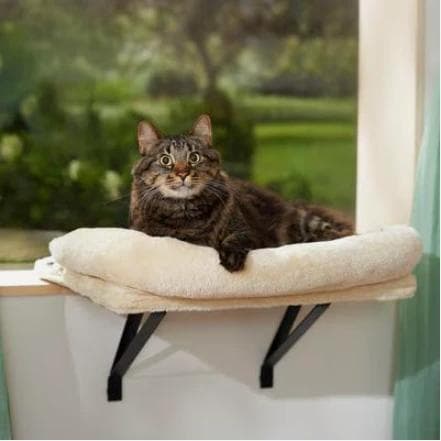
The cheapest vertical stop of all costs no floor space whatsoever. A window-mounted shelf such as the Frisco Plush Cat Window Perch hangs on the glass or the frame and creates a sunlit resting spot in a room that had no room left. In a genuinely tight apartment, pairing one compact tower with one window perch usually beats buying a single larger tree.
How many vertical stops do two cats actually need?
Is one small cat tree enough for two cats in an apartment? Generally no. Multi-cat households do better when resources are distributed rather than stacked in one place, because a single tree forces cats to negotiate the same three perches and the most confident cat tends to claim the top. Two cats in a one-bedroom want at least three or four separate vertical stops spread across two rooms. The fix is rarely a bigger tree. It is a second small tree, a window perch, or a short run of wall shelves somewhere the first tree is not.
| Format | Floor footprint | Typical height | Typical stated capacity | Best for |
|---|---|---|---|---|
| Compact tower | About 1.5 to 2.5 sq ft | 28 to 40 in | 15 to 30 lb per perch | A corner or a gap beside the sofa |
| Corner tree | About 1.2 to 2 sq ft (angled base) | 30 to 45 in | 15 to 25 lb per perch | Rooms with no free straight wall |
| Window perch | None | Sill height | Commonly 20 to 50 lb, always check the listing | Sunlight, zero floor cost, single cat |
| Wall shelf run | None | Any height you mount it | Depends on anchor and stud, often 20 to 40 lb per shelf | Maximum vertical gain in the smallest room |
Capacity and footprint figures above are typical ranges across the category, not guarantees. Confirm both against the specific listing before you order, and note that a stated capacity is a static rating rather than a measure of what a cat's landing force does to the structure.
Window Perches and Wall Shelves as Real Small-Space Substitutes
What can I use instead of a cat tree? The two substitutes that genuinely replace a tree rather than merely supplement it are a window perch and a run of wall-mounted shelves. Both take zero floor area. Both give the cat elevation, a view, and a defensible resting place, which are the three things a tree actually provides. What they do not provide is a scratching surface, so plan to add one separately. For a broader look at the standard formats, our guide to cat trees and scratching posts covers the full category.

Window perches: the zero-footprint vertical stop
Is a window perch a good substitute for a small cat tree? For a single adult cat in a room with a suitable window, yes, with three honest caveats. Suction-cup models publish a weight limit that you should check against your cat's actual weight rather than an estimate. Suction fails on dirty glass, on textured or frosted panes, and in cold weather when the cup stiffens and the glass contracts. And a perch gives no scratching outlet, so it does not replace a post.
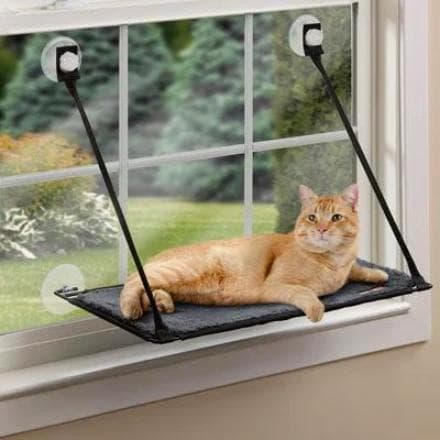
If your glass is textured, if you rent and cannot risk a failure, or if you simply want a mount that does not depend on suction, a frame-mounted model like the K&H EZ Mount Cat Window Perch transfers the load to the window frame instead of the pane. Frame and sill mounts are also the safer pick for heavier cats, because the failure mode of a slipping suction cup is a fall.
Webvet may earn a commission when you click through to Chewy, at no extra cost to you.
If you do go with suction cups, mount them properly:
- Clean the glass with plain water or glass cleaner and let it dry fully. Any film breaks the seal.
- Press each cup down hard and lock the levers if the model has them.
- Load the perch with a hand press before the cat uses it, then re-check the cups after 24 hours.
- Re-seat the cups monthly, and more often in winter.
Platform size matters more than buyers expect. A cat that sprawls needs a longer platform than one that curls, and an undersized perch gets used once and abandoned. Compare the listed platform dimensions before you order, and measure your sill width first.
Wall shelf runs: the highest vertical gain per square foot
A staggered run of three or four wall shelves turns dead wall into a climbing route without touching the floor. It is the single best answer for a room where nothing else fits, and it is the option no competing guide takes seriously. Get the mounting right:
- Find the studs. Anchor into framing wherever possible. Where you cannot, use drywall anchors rated well above the combined weight of the shelf and the cat, and follow the anchor manufacturer's stated limit.
- Stagger the rise. Space steps 10 to 14 inches apart vertically and offset them horizontally so the cat steps rather than leaps. For an older or arthritic cat, tighten that spacing to 8 to 10 inches and keep the first step within an easy hop of the floor.
- Add grip. Bare finished wood is slick. A carpeted or sisal-topped surface lets a cat land and pivot without sliding off.
- Plan the exit. Every route needs a safe way down. A dead-end top shelf with no descending step is how cats get stuck.
- Keep it away from the stove, the litter box, and anything breakable below.
The Best Small Cat Trees for Apartments and Tight Corners
What is the best cat tree for a small cat? The best one is whichever model's base fits the space you measured while still publishing a real weight capacity and offering a full-stretch scratching surface. Beyond that, prioritize in this order: a base at least as wide as your cat is long from nose to tail base, a top perch with a raised lip or bolster so the cat feels enclosed, sisal rather than carpet on the scratching post, and a top height that clears your sofa back.
Formats worth shortlisting in a small room:
- Compact two-tier condos. A cube-plus-perch layout like the IRIS Rusty Paws 2-Tier Cat Tree Condo gives a hiding box and a lookout in under 2 square feet.
- Cube towers. Minimalist boxes such as the Vesper V-Box Small read as furniture rather than pet gear, which matters in a studio where the tree sits in your living room.
- Post-and-perch trees. A single sisal column with one top platform is the smallest genuinely useful format, and it is the best value if your cat mainly wants a scratching outlet plus one high seat.
If none of these fits the space you measured, the smallest useful option is not a tree at all. A window-mounted platform such as the Coziwow Cat Window Perch delivers a resting stop at zero floor cost, which is the only format that fits a corner you do not have. If you want more height and more perches instead, our roundup of the best cat towers covers the full-size end of the category.
Narrow and Corner Cat Trees for Rooms With No Spare Wall
A corner tree uses an angled or triangular base to sit flush in the 90-degree angle between two walls, which is usually the most wasted space in a small room. A narrow tree does the same job in the gap beside a sofa arm or between a bookcase and a door frame. Both formats trade platform size for footprint, so expect smaller perches than a square-based tower of the same height.

Are small cat trees good for senior cats? They can be excellent, provided the layout is right. Older cats benefit from staying elevated for the same reasons younger cats do, but a tall tree with widely spaced platforms asks for jumps that an arthritic cat cannot make comfortably. Look for closely spaced steps (8 to 12 inches of rise), a ramp or a low first platform, wide stable perches rather than narrow ones, and a total height nearer 24 to 30 inches. Skip suspended hammocks, which wobble under a cat with reduced hind-limb strength.
One important caveat: hesitancy to jump, missed landings, or a cat that has stopped going to a favorite high spot are common early signs of osteoarthritis, which is under-recognized in cats. Do not assume a shorter tree is the whole answer. Have your veterinarian assess mobility changes before you rearrange the furniture around them.
Scratching Posts, Hammocks, and Which Features Earn Their Footprint
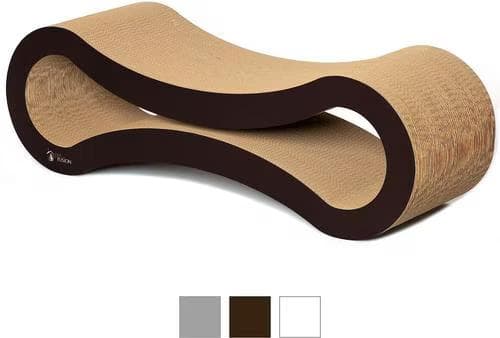
Does a small cat tree need a scratching post? Yes, and this is where compact trees most often fail. Scratching is a normal maintenance and marking behavior, not a bad habit, and a post only works if the cat can stretch to full length against it. Many small trees mount a 12-inch sisal segment between two platforms, which is too short for an adult cat to stretch into. If the post is interrupted by a perch at 14 inches, your cat will keep using the sofa. For cats that prefer horizontal cardboard, the PetFusion Ultimate Cat Scratcher Lounge adds a separate scratch-and-rest surface.
Webvet may earn a commission when you click through to Chewy, at no extra cost to you.

When the tree's own post is too short, mount the scratching surface on the wall instead. A wall-mounted panel like the Necoichi Premium Comfort Cat Scratcher Wall lets a cat stretch vertically to full length while using no floor at all, which solves the exact weakness of the compact-tree format.
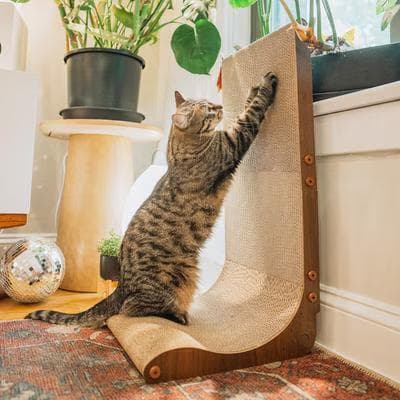
Curved cardboard wall scratcher with a wood frame that protects walls and gives cats a satisfying vertical scratch surface.
Webvet may earn a commission when you click through to Chewy, at no extra cost to you.
Rank the rest of a small tree's features by whether they earn the floor they cost:
- Full-height sisal post. Earns its space every time. Sisal rope wears far better than carpet under claws and gives a texture cats reliably prefer. Look for an uninterrupted run of at least 24 inches.
- Enclosed cube or condo. Earns its space for a shy cat or a multi-cat home, because a hiding spot at height is a genuine resource.
- Hammock. Earns its space when it replaces a platform rather than adding a tier. A model such as the TRIXIE Baza Cat Tree uses the space under a perch that would otherwise be dead air. Skip hammocks for senior or heavy cats.
- Dangling toys. Almost never earn their space. They are ignored within a week and add nothing structural.
Small Cat Trees for Large Cats: Weight Capacity in a Compact Base
Can a small cat tree hold a large cat? Often yes, but the specification that matters is not the whole-unit weight capacity. It is the relationship between base width and top-perch height. A 12-pound Maine Coon landing on a 40-inch top perch delivers far more force than its static weight, and a narrow base under a tall top perch is exactly the combination that tips. A wider base with a slightly lower top is structurally the safer buy for a heavy cat, even if the listing quotes the same capacity.

Screen compact trees for a big cat this way:
- Perch size versus cat size. The top platform should be at least as long as your cat from nose to the base of the tail. Overhang means the cat has to balance instead of settle.
- Base width versus height. As a working rule, keep the base at least half the overall height in width for any tree a heavy cat will jump onto.
- Solid wood or thick engineered board over thin particleboard, and bolts rather than dowels at the post joints.
- A published per-perch rating, not just a total. A tree rated for 40 pounds overall may still have a top platform rated far lower.
- An anti-tip strap included or an anchor point provided. For a heavy cat on a slim tower, this is not optional.
If your cat is at the upper end of the size range, a purpose-built option from our guide to cat trees for large cats is a more honest fit than forcing a compact model to do the job.
Modern and Minimalist Small Cat Trees
Small-space buyers and design-led buyers overlap heavily, because a tree in a studio is living-room furniture whether you wanted it to be or not. Minimalist cube towers, felt-and-plywood builds, and natural-wood frames all shrink the visual footprint even when the measured footprint is unchanged, and they tend to use solid panels rather than carpeted particleboard.
If finish and silhouette are driving your decision as much as dimensions, our dedicated guide to modern cat trees covers the design-led end of the market in detail, including which materials hold up to daily claw contact.
Where to Put a Small Cat Tree and How to Keep It Stable
Where should a cat tree go? Beside a window with an actual view, against a wall rather than free-standing, and out of the main walkway. Cats want to watch, and a tree facing a blank wall gets ignored no matter how well built it is. In a studio, the highest-value spot is usually the corner nearest a window where the tree does not narrow the path between the door, the kitchen, and the bed.
Placement rules that hold up in a one-bedroom:
- Window sightline first. A view of a street, a feeder, or a garden is what makes a perch a destination.
- Out of the traffic lane. A tree that gets bumped daily is a tree the cat learns to avoid.
- Well away from the litter box. Cats separate resting and toileting areas, and putting them together suppresses use of both.
- Against a wall, in a corner if possible. Two walls of contact halve the tipping risk before you anchor anything.
- Not directly beside a door that swings into it, and not under a shelf the cat can use to bypass the tree entirely.
How do you keep a narrow cat tree from tipping over? Anchor it. A tall, slim tower is the one cat furniture format with a real structural failure mode, and the fix is inexpensive:
- Run an anti-tip strap or furniture-anchor bracket from the top section of the tree into a wall stud. Many trees ship with one, and a standard furniture anti-tip kit works if yours did not.
- Choose a wider base to begin with if your cat launches rather than steps.
- Retighten every bolt after two weeks and then every few months. Flat-pack particleboard compresses at the joints and a wobble that starts small gets worse quickly.
- Press hard on the top perch with one hand before you let the cat use it. If it rocks, it is not finished.
- Level the base with thin shims on uneven floors rather than accepting a lean.
Buying Checklist: What to Measure Before You Order
How do you measure whether a cat tree will fit? Measure the space first and shop second, which is the reverse of what most buyers do. Take the width and depth of the corner or gap at floor level, then check the ceiling clearance and, critically, the swing path of any nearby door. Write those three numbers down and treat any listing that does not publish a base dimension as unshoppable.
| What to measure | Where to measure it | What to compare it against |
|---|---|---|
| Corner or gap width | At floor level, wall to wall or wall to furniture | Base length and width in the listing |
| Depth from the wall | Floor level, wall out to the walkway edge | Base depth, plus 2 in of clearance |
| Ceiling or shelf clearance | Floor to the lowest obstruction above | Overall height, plus room for a sitting cat |
| Door swing path | Arc of the door across the floor | Base outline, which must sit fully clear |
| Your cat, nose to tail base | Cat standing relaxed | Top perch length |
Two habits save most returns. Tape the base outline on the floor with painter's tape before you order and live with it for a day, and check the shipping box dimensions against your stairwell or elevator if you are in a walk-up.
When a small cat tree is the wrong call
A compact tree is the wrong answer in three situations. If you have three or more cats, the footprint you save is outweighed by the competition you create, and you are better served by distributed perches or a full-size tower. If your cat is over about 15 pounds and likes to launch, a compact base is fighting physics. And if your cat has diagnosed mobility problems, the priority is a low, wide, stable route to one good resting spot rather than a tree at all. Sizing up or going modular is not a failure of the small-space plan. It is the plan working.
Frequently Asked Questions
What is the best cat tree for a small cat?
The best small cat tree is the one whose published base dimensions fit the corner you measured, with a top perch at least as long as your cat and an uninterrupted sisal post tall enough for a full stretch. Compact two-tier condos and cube towers both work well in under two square feet. Prioritize a published weight capacity over platform count, because three cramped perches serve a cat worse than two usable ones.
How tall should a small cat tree be?
For most healthy adult cats, 28 to 40 inches is the practical range. That height clears a sofa back, puts the cat above seated human eye level, and still allows a controlled jump down. Under 24 inches the cat gains almost no vertical advantage. Over about 48 inches on a base narrower than 20 inches, stability becomes the limiting factor, so anchor it to the wall.
Can a small cat tree hold a large cat?
Frequently yes, but check base width against overall height rather than trusting the headline capacity. A heavy cat landing on a high perch generates far more force than its resting weight, and a narrow base under a tall top perch is the classic tipping setup. Aim for a base at least half the tree's height in width, a per-perch rating rather than a whole-unit one, and an anti-tip strap into a stud.
What can I use instead of a cat tree?
A window perch and a staggered run of wall-mounted shelves are the two genuine substitutes, because both deliver elevation and a view at zero floor cost. Neither provides a scratching surface, so pair them with a post or a wall-mounted scratching panel. A cleared bookshelf top, a sill widened with a mounted board, and a dresser near a window all work as partial stand-ins.
Where should a cat tree go?
Beside a window with a real view, against a wall or in a corner, and outside the main walkway. Keep it well away from the litter box, since cats separate resting and toileting areas and crowding them suppresses use of both. In a studio, the corner nearest a window is usually the best spot because it adds a destination without narrowing the path between the door, the kitchen, and the bed.
Does a small cat tree need a scratching post?
Yes, and the post has to be tall enough to matter. Scratching is normal maintenance and marking behavior, and a cat needs to stretch to full length against the surface for the post to satisfy it. Many compact trees interrupt the sisal at 12 to 14 inches with a platform, which makes the post useless. Look for an uninterrupted sisal run of at least 24 inches, or mount a wall panel instead.
Are small cat trees good for senior cats?
They can be, if the steps are close together. Choose 8 to 12 inches of rise between platforms, a low or ramped first step, wide stable perches, and a total height nearer 24 to 30 inches. Skip suspended hammocks. Reluctance to jump or abandoning a favorite high spot can signal feline osteoarthritis, so have your veterinarian assess mobility changes rather than assuming furniture is the fix.
Sources

Editor
The Webvet Editorial Team is the in-house group of pet-care editors and writers behind Webvet, operated by Smart Pet Collective. The team researches, writes, and maintains Webvet's pet health, behavior, and medication content. Every article follows a defined editorial process: research from reputable veterinary and scientific sources, careful drafting, mandatory review of medical content by a credentialed veterinarian, and dated publication. Health and medication articles are medically reviewed by a licensed veterinary professional before they go live and are kept current over time.


