Cat Tree Buying Guide: What Your Cat Actually Needs
Most cat trees get ignored for one of five reasons. This vet-informed buying guide covers post height for a full stretch, the one-hand stability test, sisal versus carpet versus cardboard, orientation, and placement that works.

This article contains affiliate links. Webvet may earn a commission when you buy through them, at no extra cost to you.
A cat tree is not furniture for your cat the way a bed is furniture for you. It is a stand-in for the branches, ledges, and rough bark that an outdoor cat would use every day to climb, watch, stretch, and file down its claws. When you buy one that meets those needs, the cat uses it within days. When you buy one that misses them, the box sits in the corner and the sofa keeps getting shredded.
Most people arrive at this decision twice. The first time they buy on looks and price. The second time they arrive after the cat ignored it, and they want to know what they got wrong. This guide is written for both readers: it gives the specific decision rules (height, base stability, surface, orientation, placement, and count) plus an ordered way to diagnose a tree your cat has already rejected, so you are not buying the same mistake in a different color.
- 1A scratching post has to be tall enough for your cat to stretch out fully with front paws overhead and back feet still on the floor, which for an average adult cat means roughly 32 inches at minimum.
- 2Stability beats height every time. Push the top perch sideways with one hand: if the base lifts off the floor or the tower rocks visibly, your cat will not commit full weight to it.
- 3Sisal fabric is the most durable and most widely accepted scratching surface, while carpet is the riskiest choice because it teaches a cat that carpet is a legal target.
- 4Watch the claw marks on your damaged furniture to learn whether your cat scratches vertically, horizontally, or on an angle, then buy that orientation instead of guessing.
- 5Plan on one scratching option per cat plus one, spread across the rooms your cats actually use rather than clustered in a single corner.
- 6Placement beats persuasion. A tree next to the sofa arm your cat already targets will get used, and the same tree in a spare bedroom will not.
- 7Scratching is normal, necessary maintenance behavior, not spite or defiance, and declawing is not the fix for it.
What a Cat Tree Actually Does for a Cat
Indoor cats live in a space that is safe, warm, and behaviorally flat. A house has almost no vertical structure a cat can legitimately own, very few surfaces worth scratching, and no elevated place to sit and watch the room from a distance. A cat tree solves all three at once, which is why it is one of the highest-value single purchases in an indoor cat's environment. The Ohio State Indoor Pet Initiative's cat enrichment resources treat elevated resting spots and appropriate scratching surfaces as basic environmental needs rather than luxuries.
The value breaks down into four distinct jobs:
- Vertical territory. Cats expand their range upward, not just outward. A tall structure effectively adds usable square footage to a small home and gives a cat somewhere to be that is not the floor.
- A vantage point. Height lets a cat see the room, the doorway, and often the window without being in the middle of traffic. That combination of visibility and distance is what makes a high perch calming rather than exposed.
- A legal scratching surface. A tree with a proper post gives your cat somewhere to do the claw maintenance it is going to do regardless of what you provide.
- A private resting spot. Perches, cubbies, and hammocks are resources a cat can hold, which matters enormously in a home with more than one cat.
Do cats really need a cat tree?
Cats do not literally require a branded cat tree, but they do need what a good one provides, and most homes do not provide it any other way. An indoor cat needs somewhere elevated to rest, somewhere it can retreat to that other pets and small children cannot easily reach, and a sturdy surface it is allowed to scratch. If your home already offers a tall cat-safe shelf, a wide window ledge, and a dedicated scratching post the cat actually uses, you have covered the need. If your cat is currently claiming the top of the refrigerator and the arm of the couch, that is your cat telling you the need exists and is unmet.
Why do cats scratch?
Scratching is maintenance and communication, not misbehavior. Cats scratch for four overlapping reasons, none of which involve punishing you for coming home late:
- Claw care. Dragging claws down a rough surface helps shed the worn outer nail sheath and expose the sharper layer underneath. You can often find the discarded crescent-shaped husks around a well-used post.
- Stretching. A full vertical scratch extends the shoulders, spine, and forelimbs. It is one of the few full-body stretches an indoor cat gets.
- Scent marking. Cats have scent glands between their toes, so scratching deposits scent along with the visible marks. That is why a cat often scratches in doorways, at room boundaries, and near where it sleeps.
- Visual marking. The shredded surface itself is a signal that persists after the scent fades.
Because scratching is driven by the cat's own body and social needs, you cannot train it away. VCA Animal Hospitals' pet health library frames destructive scratching as a redirection problem: the behavior stays, and your job is to give it a better target than your furniture.
What is the difference between a cat tree and a cat tower?
Functionally, almost nothing. Cat tree, cat tower, cat condo, and cat furniture are largely interchangeable marketing labels rather than defined product categories, and the same item is often listed under two of them by two different retailers. In casual use, "tower" tends to imply a taller, narrower multi-level unit, "condo" implies an enclosed cubby or box the cat can sit inside, and "tree" is the generic term for anything with posts and platforms. Ignore the label and read the specifications instead: total height, platform dimensions, base footprint, covering material, and the number and height of the scratching posts. Those five numbers tell you far more than the product name does.
A tall multi-level tower such as the Yaheetech Multi-Level 63-in Plush Cat Tree bundles all four jobs into one footprint: full-height scratching posts, stacked perches at different elevations, an enclosed condo, and a hammock. That bundling is the main argument for a tree over a standalone post, especially if you only have room for one piece.
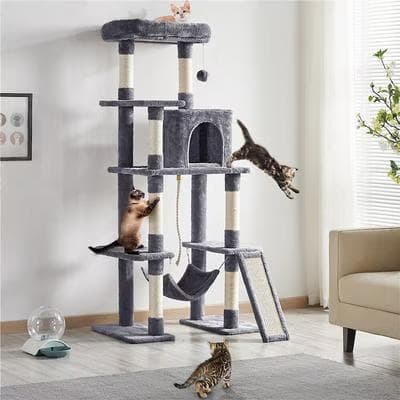
63-inch multi-level cat tree with plush perches, a condo, a hammock, sisal scratching posts, and a dangling toy. Dark gray.
Webvet may earn a commission when you click through to Chewy, at no extra cost to you.
How Tall Should a Cat Tree and Scratching Post Be?
Height is the single specification most often gotten wrong, and it is the one that most often causes a cat to keep using the couch. The failure is subtle: a 20-inch post looks tall enough sitting on the floor, but the cat cannot fully extend on it, so the couch arm still offers a better stretch. The cat is not being stubborn. It is choosing the surface that does the job.

How tall should a scratching post be for a cat to fully stretch?
The rule is behavioral, not numeric: the post must let your cat reach up with front paws overhead while the back feet stay on the floor, with several inches of surface left above the paws. Humane World for Animals' pet care resources make full-stretch height and a wobble-free base the two defining features of a post cats will actually use. For an average adult domestic cat, that works out to roughly 32 inches of scratchable surface as a practical floor. Larger cats and long-bodied breeds need more.
Rather than trusting the box copy, measure your own cat. Here is the method:
- Stand your cat next to a door frame or a bare wall while it is relaxed and already stretching, or lure a stretch by holding a wand toy just above its reach.
- Mark the highest point the front paws reach at full extension while the back feet are still flat on the floor. A strip of painter's tape on the frame works well.
- Measure from the floor to that mark.
- Buy a post whose scratchable surface extends at least two to three inches above that measurement.
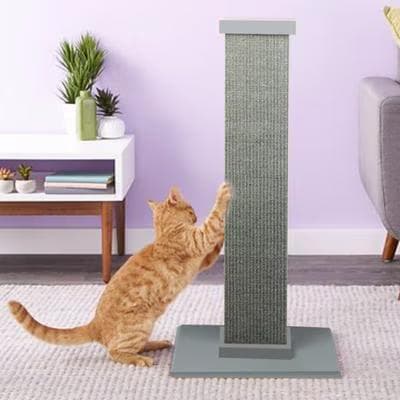
That last distinction matters. Many trees list a total height of 60 inches but wrap sisal on only the bottom 18 inches of each post, with plush covering the rest. The number that counts is the length of continuous scratchable material, not the height of the tower. A dedicated post like the SmartCat Ultimate Scratching Post is built around this idea: it is a tall single column wrapped in sisal fabric from near the floor to near the top, so an adult cat gets a full stretch anywhere along it.
Webvet may earn a commission when you click through to Chewy, at no extra cost to you.
How tall should a cat tree be?
For climbing and perching, taller is generally better, with two limits. The first limit is stability, covered in the next section: a tall tree on a small base is worse than a short tree on a wide one. The second limit is your cat. Kittens, seniors, overweight cats, and cats with joint pain need the steps between platforms to be short even if the total height is significant.
Use these working numbers when you compare listings:
- Scratchable post length: at least 32 inches of continuous surface for an average adult cat, more for a large breed.
- Step between platforms: roughly 10 to 14 inches for a healthy adult cat, and closer to 8 to 10 inches for kittens, seniors, or any cat with stiffness.
- Top perch height: high enough to see over the furniture in the room, which in most living rooms means the top perch clearing about 40 inches.
- Ceiling clearance: leave at least 12 inches above the top perch so a cat sitting upright is not pressed against the ceiling.
Base Stability: The Feature Most Buyers Miss
A cat launching onto a perch delivers a sharp sideways load, and a cat scratching at full stretch pulls hard against the top of the post. If the structure answers either of those with a wobble, most cats will stop trusting it. This is the most common reason a perfectly tall, perfectly nice-looking tree gets abandoned after a week.

The one-hand wobble test
You can run this in a store aisle or on an assembled tree at home, and it takes five seconds:
- Place one hand flat on the top perch, as high as the structure goes.
- Push sideways with steady, moderate pressure, roughly the force of leaning on a countertop.
- Watch the base, not the top.
The result is binary:
- Pass: the tower flexes slightly and springs back, and every edge of the base stays in contact with the floor.
- Fail: any corner of the base lifts off the floor, the tower rocks back and forth after you release, or you hear joints creaking and shifting.
A fail is not something you fix with a rug or a shim. It means the base footprint, the base mass, or the hardware is undersized for the height, and a cat jumping onto the top perch will produce a much sharper load than your hand did.
Three separate levers on stability
Buyers tend to treat stability as one property. It is actually three, and a good tree gets at least two of them right:
- Base footprint. The width and depth of the bottom platform relative to the total height. A tall tree on a narrow base is a lever working against you. As a rough guide, the base should be wide enough that a plumb line dropped from the outer edge of the top perch still lands inside the base.
- Total weight. Mass resists tipping. A tree built on thick particleboard or solid wood with a heavy base panel simply does not move the way a lightweight hollow-core unit does. Shipping weight in a product listing is a useful proxy: two trees of the same height with a 20-pound difference in shipping weight are not the same product.
- Wall anchoring. A strap or bracket that ties the top of the tree to a wall stud removes the tipping question entirely.
Should a cat tree be anchored to the wall?
Anchor it whenever the tree is tall and narrow, whenever you have a large or enthusiastic cat, and always if there are children or dogs in the house. A wall anchor converts a freestanding tower into a fixed structure, so even a hard sideways launch cannot tip it. Many taller trees ship with a strap or bracket in the hardware bag, and if yours did not, a furniture anti-tip kit from a hardware store does the same job. Fasten into a wall stud rather than drywall alone, leave the strap snug rather than slack, and recheck it when you retighten the tree's hardware. If you rent and cannot drill, favor a shorter tree with a genuinely heavy, wide base instead of a tall one you cannot secure.
How much weight can a cat tree hold?
Most manufacturers publish a limit, but read it carefully, because listings usually state a per-platform capacity rather than a whole-tower capacity, and the top perch is often rated lower than the base platform. Treat the published number as the ceiling for a single cat, not for two cats sharing a perch. If you have a large breed or a multi-cat home, look for a listing that states the capacity explicitly, and add margin: a cat landing from a jump momentarily loads a platform with more force than its standing weight. If a listing gives no capacity figure at all, that absence is information. A manufacturer confident in the hardware usually publishes the number.
Sisal vs Carpet vs Cardboard: Choosing the Right Scratching Surface
Surface is where preference genuinely varies between individual cats, but the durability and mess differences are objective, and one popular option carries a real drawback that product listings never mention.

| Surface | Durability | Mess | Replaceable | Typical cat preference |
|---|---|---|---|---|
| Sisal fabric | Highest. Frays into a scratchable nap instead of shredding apart | Low. Sheds very little | Sometimes, on posts with wrap kits | Very high. The most consistently accepted surface |
| Sisal rope | High. Outlasts carpet by a wide margin | Moderate. Sheds fibers as it wears | Yes on many posts. Rope wraps are widely sold | High. Coarser texture that many cats favor |
| Low-pile carpet | Moderate. Pulls into loops and bare patches | Low to moderate | Rarely | Moderate. Accepted, but it competes with your floor |
| Corrugated cardboard | Lowest. Consumable by design | Highest. Produces steady confetti | Yes. Refill inserts are inexpensive | Very high, especially for horizontal scratching |
| Bare wood or bark-look | High. Very slow to wear | Low | No | Variable. Some cats love it, others ignore it |
Is sisal or carpet better on a cat tree?
Sisal is the better choice for the scratching posts, and it is not close. Sisal fabric holds up to repeated hard scratching, frays into a texture that gets more appealing as it wears rather than less, and gives claws the resistance that makes a scratch satisfying. Carpet wears into pulled loops and bald patches much faster, and worn carpet stops delivering the drag a cat is looking for. Carpet still has a role as a covering for perches and platforms, where cats rest rather than scratch, and plush or faux fur is fine there too. The rule to carry away: sisal on anything meant to be scratched, soft covering on anything meant to be slept on.
Cardboard sits at the other end of the trade-off. It is the least durable and the messiest surface by a wide margin, and it is also one of the most enthusiastically used, particularly for horizontal and angled scratching. Because refill inserts are cheap and the panels are consumable by design, a cardboard scratcher is best understood as a supplement to a sisal post rather than a replacement for it. A vertical cardboard panel such as the Necoichi Premium Comfort Cat Scratcher Wall is designed to sit against a wall, which makes it a practical way to cover a specific wall or corner your cat has already claimed without adding another full tower to the room.
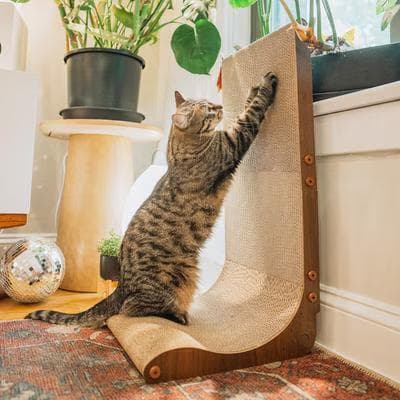
Curved cardboard wall scratcher with a wood frame that protects walls and gives cats a satisfying vertical scratch surface.
Webvet may earn a commission when you click through to Chewy, at no extra cost to you.
The carpet caveat nobody mentions
Here is the part product pages leave out. A carpet-covered scratching post teaches your cat, accurately, that carpet is a surface it is allowed to destroy. In a home with wall-to-wall carpet or area rugs, that is a lesson you do not want taught. Cats generalize by texture, not by which object you designated. If your cat has ever scratched the carpet at the base of the stairs or worked at a rug edge, a carpet post makes that worse, not better. In a carpeted home, choose sisal or cardboard and treat carpeted posts as a nonstarter.
Vertical, Horizontal, or Angled: Match the Scratcher to Your Cat
Cats have individual orientation preferences, and buying the wrong one is a common and completely avoidable miss. A cat that prefers to scratch flat on the ground will walk past the tallest, best-built vertical post you can buy.

Do cats prefer vertical or horizontal scratchers?
Vertical scratching is the more common preference overall, which is why upright posts dominate the market, but a substantial minority of cats prefer horizontal or angled surfaces, and plenty of cats use both depending on context. Rather than guessing which camp your cat belongs to, read the evidence already in your living room. Cats that scratch horizontally usually target rugs, doormats, the carpet at the base of stairs, or the flat seat cushion of a chair. Cats that scratch vertically target sofa arms, chair backs, door frames, and speaker cabinets. Providing both orientations is the safest approach for a new cat or a household where you have not observed a clear pattern.
The orientation audit
Before you buy anything, spend two minutes looking at the furniture your cat has already damaged. The claw marks tell you what to buy:
- Marks running top to bottom on a sofa arm or chair back mean a vertical preference. Buy a tall post or a tree with full-length posts.
- Marks running front to back on a rug, mat, or flat cushion mean a horizontal preference. Buy a flat pad or a floor-level scratcher.
- Marks on a slope, such as the side of a recliner footrest or a stair riser, mean an angled preference. Buy a wedge or ramp-style scratcher.
- Marks in more than one orientation mean your cat uses both. Provide both, in different rooms.
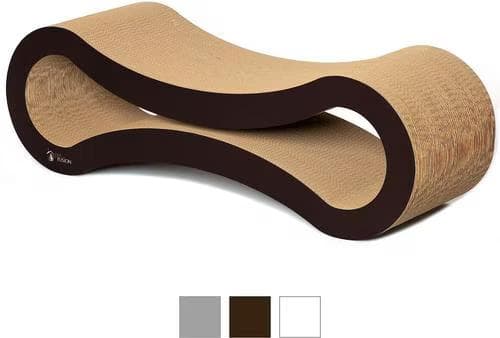
An angled or curved cardboard scratcher such as the PetFusion Ultimate Cat Scratcher Lounge covers the middle case well, because the curve gives a cat both a shallow slope and a near-flat section on the same piece. It also doubles as a resting spot, which increases the odds a cat commits to it.
Webvet may earn a commission when you click through to Chewy, at no extra cost to you.
One more practical point: match the texture as well as the angle. If your cat's chosen victim is a tightly woven upholstery fabric, sisal fabric is a closer match than loose rope. If it is a loop-pile rug, cardboard tends to be the closer analogue.
How Many Cat Trees and Scratching Posts Does Your Cat Need?
The instinct in a multi-cat home is to buy one impressive tower and consider the problem solved. That is the wrong shape of solution. Cats time-share and avoid rather than negotiate, and a single resource in a single room is something that can be monopolized.

How many scratching posts does one cat need?
The practical rule is one scratching option per cat plus one, distributed across the rooms your cats actually spend time in rather than lined up in a corner. For a single-cat home that means two scratching surfaces, ideally in two different rooms and in at least two different orientations. For two cats it means three, and so on. This mirrors the resource-distribution principle in the American Association of Feline Practitioners' feline practice guidelines, which treat multiple and separated key resources as a core environmental need rather than an optional upgrade.
Distribution is the part people skip, and it is the part that matters most:
- Put scratching surfaces where the cats already are, which usually means the main living room, near the primary sleeping spots, and near any doorway a cat regularly marks.
- Separate them enough that one cat sitting at one resource does not block another cat's access to the second.
- Vary the orientation across the set so one cat's preference does not exclude another's.
- Count perches the same way. Two cats sharing one tree is a resource with a queue.
Perches are the cheapest resource to duplicate, because they do not need floor space. A mounted option such as the Frisco Plush Cat Window Perch puts an elevated resting spot in a second room without adding another tower, which is often the difference between two cats sharing one contested perch and each having its own. Be clear about what that does and does not solve: a window perch adds a resting spot and a sightline, but it is not a scratching surface and it is not a climbing structure, so it supplements your posts and trees rather than replacing them.
Do cat trees help reduce tension between cats in the same home?
They genuinely can, and vertical space is one of the more effective low-effort interventions in a tense multi-cat household. Height gives cats a way to increase social distance without leaving the room, lets a lower-confidence cat sit above the traffic instead of being cornered, and adds usable positions so two cats can occupy the same space without direct confrontation. It also creates time-sharing options: cats often rotate through preferred spots at different hours rather than competing for them simultaneously. A cat tree is not a treatment for genuine inter-cat aggression, and persistent fighting, blocking, or stress-related signs warrant a conversation with your veterinarian. But adding separated vertical resources is a reasonable first step and frequently takes the edge off low-grade friction. If you are choosing a multi-level unit specifically for a two-or-three-cat household, our guide to the best cat towers compares the multi-level layouts that hold more than one cat comfortably.
Where to Put a Cat Tree So Your Cat Uses It
Placement is where good purchases go to die. A well-built, correctly sized tree in the wrong room gets ignored, and the identical tree three feet from the sofa arm gets claimed the first afternoon.

Where should I put a cat tree in my house?
Put it where your cat already chooses to be, not where it looks best to you. Three placement rules cover nearly every home:
- Next to the target. If your cat scratches the left arm of the sofa, the post goes beside the left arm of the sofa. Not across the room, not in the hallway. You can move it a few inches at a time later once the habit is established.
- Near a sleeping spot. Cats very often scratch immediately after waking. A post within a few steps of a favorite nap location catches that moment.
- In a social room with a sightline. Cats want to be near their people, and a perch that looks out over the room, the doorway, or a window earns far more use than one facing a wall. A window view adds moving stimulus, which is why window-adjacent placement is consistently the highest-use spot in most homes.
Two placements to avoid: the spare bedroom nobody enters, and a narrow doorway or hallway chokepoint where a nervous cat can feel trapped while resting.
A perch with a clear view of the room entrance is also a practical tool for a cat that gets tense around visitors. Height plus distance gives a wary cat somewhere to observe from instead of fleeing, which is part of why elevated retreats come up in our guidance on cat behavior around guests. Position the tree so the cat can see the doorway a guest will come through without being adjacent to it, and leave a clear escape route from the base to the rest of the house.
Why does my cat scratch the couch instead of the scratching post?
Because the couch is currently winning on at least one specification the post is losing on, and there are only five candidates. Work through them in this order, because fixing an early one often makes the later ones irrelevant:
- Height. Can the cat fully extend on the post with back feet on the floor? The sofa arm lets it stretch, and a short post does not. This is the most common single cause.
- Stability. Does the post move when scratched? Run the one-hand wobble test. A couch never wobbles, which makes it the safer choice from the cat's point of view.
- Surface. Is the post covered in something worth scratching? Compare it to what the cat picked. Worn carpet on a post loses to tight upholstery on an arm.
- Orientation. Is the post the same orientation as the claw marks on the furniture? A vertical post does nothing for a horizontal scratcher.
- Location. Is the post where the cat wants to scratch? A post in the corner loses to a sofa arm beside the cat's favorite nap spot every time.
Run that sequence before buying a second tree. Most rejected trees fail on one of the first two, and a rejected tree that fails on location can often be fixed by moving it six feet.
Sizing a Cat Tree for Large Cats and Multi-Cat Homes
Large cats break the assumptions built into standard trees. A Maine Coon, Ragdoll, or a solidly built domestic shorthair over about 15 pounds needs more platform, more post, and more base than a tree designed around a 9-pound cat provides.

Three rules cover the sizing question:
- Platform wider and longer than the cat lying down. Measure your cat stretched out on its side, then require the top platform to exceed that in both directions. A cat that has to tuck its limbs to fit will use the perch briefly and then stop.
- Verified weight capacity. Look for a published per-platform capacity that clears your cat's weight with real margin, and be skeptical of listings that publish no figure at all.
- Base and hardware scaled to the load. Large cats land harder. Thicker posts, bolt-through hardware rather than short wood screws, and a heavy wide base matter more here than on a tree for a small cat.
For a full comparison of oversized platforms, weight ratings, and the heavy-duty builds that hold up to a big cat, see our dedicated guide to cat trees for large cats, which covers model-level sizing in a way this pillar deliberately does not.
Cat Trees for Small Apartments and Tight Corners
A small home is an argument for a cat tree, not against one. Floor space is what you are short of, and vertical space is precisely what a tree converts into usable territory. A cat that has three elevated positions in a studio apartment has meaningfully more environment than a cat with none.

The rules for a tight space:
- Go vertical, not wide. Choose the tallest tree you can safely secure rather than the widest. Height is free floor space.
- Prioritize a narrow footprint with anchoring. A narrow base normally fails the wobble test, so in a small space, wall anchoring stops being optional and becomes the thing that makes a narrow tree viable.
- Use corners. A corner supports two sides of the structure and is usually the least useful floor area in the room.
- Do not skip the post to save space. A tree with plush perches and no real scratching surface just relocates the furniture problem.
- Stack the functions. In a small home, one unit that provides a full-height post, a perch, and a window sightline beats three separate items.
Window-mounted perches are the classic small-space solution because they use zero floor area. Something like the K&H EZ Mount Cat Window Perch attaches directly to the glass with suction cups, which puts a resting spot in the best-lit part of the room without consuming a square foot of floor. The same caveat applies as before: it is a perch, not a scratcher, so pair it with a proper post. If you want compact and narrow-footprint trees compared model by model, our roundup of small cat trees covers that ground.
Modern Cat Trees That Fit Your Decor
There is nothing wrong with wanting a cat tree that does not look like beige carpet-covered scaffolding. Design-led trees in wood, felt, and neutral fabrics have gotten genuinely good, and a piece you are happy to keep in the living room will end up better placed than one you exile to a back bedroom. Placement is a functional variable, so aesthetics are not purely vanity.
The functional floor does not move, though. A design-first tree still has to pass the same three tests:
- Height. Does it include a scratching surface long enough for a full stretch, or are the "posts" decorative stubs under 20 inches?
- Stability. Does it pass the one-hand wobble test? Sculptural silhouettes and slim wooden legs often trade base footprint for looks.
- Surface. Is the scratchable material sisal or another durable option, or is the whole thing finished in the same soft fabric as your sofa?
If a design piece fails on height, you can often fix it by adding one tall dedicated post elsewhere in the room and letting the design piece handle perching. If it fails on stability, anchor it or pass. For design-led picks evaluated against exactly these criteria, see our guide to modern cat trees.
Cat Trees for Kittens, Senior Cats, and Cats With Mobility Issues
Total height is the wrong specification for these cats. What matters is how the height is divided up, because a cat that cannot get to the top perch safely will not use the tree at all.

The access specification
Whatever the total height, look for these features when the cat is very young, elderly, overweight, or stiff:
- A low first step, ideally under about 10 inches from the floor, so getting on board does not require a jump.
- Closely spaced platforms, roughly 8 to 10 inches apart, so the climb is a series of steps rather than a series of leaps.
- A ramp or ladder as an alternative route to at least one resting level.
- Wide, flat platforms with a rim or bolster, so the cat is not balancing on a small disc.
- A ground-level horizontal scratcher, because a cat that can no longer stretch upward comfortably still needs to scratch.
- A non-slip covering and a rug underneath, since hard floors punish a missed landing.
Can kittens use a tall cat tree safely?
Kittens are capable climbers and generally take to trees quickly, but they are much better at going up than coming down, and they misjudge descents. A tall tree is fine for a kitten provided the levels are closely spaced so there is always a short step down, the platforms are wide enough for a clumsy landing, and there is soft flooring or a rug at the base. Avoid trees with a big unbroken drop from the top perch to the floor, check that any hammock straps and hanging toys are secure, and supervise early sessions. Remove or shorten dangling toy strings, since a kitten that chews and swallows string can develop a serious intestinal obstruction.
Do older or arthritic cats need a different kind of cat tree?
Yes, and the difference is in access rather than height. Degenerative joint disease is common in older cats and often shows up as reduced jumping, hesitation before climbing, or choosing lower resting spots, long before anything looks like limping. A tree with a low first step, closely spaced levels, and a ramp lets a stiff cat keep using vertical space it would otherwise give up. Add a ground-level horizontal scratcher too, since reaching overhead for a full vertical stretch may have become uncomfortable.
Treat a sudden change as a medical question, not a furniture question. A cat that used to reach the top perch and now stops halfway, or stops jumping onto the bed, is telling you something about pain or mobility. Our articles on why a cat stops jumping and arthritis relief for cats cover what to watch for, and any noticeable change in how your cat moves is worth raising with your veterinarian rather than working around with equipment alone.
How to Get Your Cat to Use a New Cat Tree
Assume nothing about the first 48 hours. Some cats claim a new tree immediately, and plenty of cats circle it suspiciously for days. Both are normal. What matters is that you build the association deliberately instead of waiting and hoping.
The introduction sequence
Work through these in order:
- Place it correctly first. Everything below fails if the tree is in the wrong room. Start it beside the furniture your cat already uses, even if that is not where you eventually want it.
- Let it acquire the household smell. Leave it in place for a day before pushing. Rubbing a cloth on your cat's cheeks and then on the perches transfers familiar scent.
- Play at the base and up the post. Drag a wand toy along the floor near the base, then up the post so the cat's claws land on the sisal by accident. Let the cat catch the toy on the platform.
- Feed and reward at the tree. Put treats on each platform, and move a favorite meal or a puzzle feeder next to it for a few days.
- Use catnip or silver vine on the post, not on the perch. Catnip does not work on every cat, and a meaningful share of cats show no response at all. Silver vine is a common alternative that many non-responders do react to, so if catnip does nothing, it is worth trying before you conclude your cat is not interested.
- Never press your cat's paws onto the surface. Forcing the motion produces avoidance, not learning, and it is the single fastest way to make a cat distrust a new post.
- Make the old target temporarily less appealing. Double-sided tape, a smooth plastic guard, or a taut fitted cover on the sofa arm removes the reward while the new post is being established.
- Reward every use for the first two weeks, then fade the treats. Once the post is genuinely established, remove the furniture deterrents gradually rather than all at once.
How do I get my cat to use a new cat tree?
The short version is that you make the tree the easiest and most rewarding option in the room and simultaneously make the old target boring. Put the tree beside the spot your cat already scratches or sleeps, play at its base with a wand toy so claws contact the post during normal play, leave treats on the platforms, and apply catnip or silver vine to the scratching surface rather than the perch. Never lift your cat and drag its paws down the post. At the same time, cover or tape the furniture your cat has been using so it stops paying off. Most cats convert within one to two weeks with that combination. If yours has not after a fair trial, go back through the five-point diagnostic (height, stability, surface, orientation, location) before assuming the cat is the problem. Our deeper troubleshooting guide for a cat that won't use the scratching post walks through the stubborn cases.
What to Expect at Each Cat Tree Price Point
Price differences on cat trees are not arbitrary, and they are not mostly about looks. Four things drive cost: the core material, the covering, the mass of the base, and the quality of the hardware. Knowing which of those a given tree spent money on tells you whether a bargain is a bargain.
| Price tier | Typical build | Base and hardware | What you are giving up | Best for |
|---|---|---|---|---|
| Budget | Hollow cardboard tube posts, thin particleboard platforms, thin faux fur | Light base, short wood screws | Longevity and wobble resistance. Often fails the sideways push at full height | A single small adult cat, or a short unit under about 3 feet |
| Mid range | Solid or thick particleboard, denser plush, real sisal on full-length posts | Heavier base panel, better fasteners, wall strap often included | Premium materials and design, not function | Most households. The value sweet spot for a full-size tree |
| Premium | Solid wood or plywood frame, sisal fabric wraps, replaceable components | Heavy wide base, bolt-through hardware, anchoring included | Nothing functional. You are paying for durability and appearance | Large cats, multi-cat homes, and anyone who wants the piece in a main living room |
How much should I spend on a cat tree?
Spend enough to clear the functional floor, and treat anything past that as optional. In practice that means a mid-range full-size tree for most households, because that is the tier where you reliably get full-length sisal posts, a base heavy enough to pass the wobble test, and hardware that stays tight. A very cheap tall tree is usually a false economy: the failure mode is not that it breaks, it is that it wobbles, the cat declines to use it, and you buy a second one. A very cheap short unit, on the other hand, can be perfectly fine, because a low tree on a wide base is inherently stable.
Two ways to spend less without losing function:
- Buy one good tall post plus a cheap cardboard scratcher instead of one mediocre tree. Two correct items beat one compromised one.
- Prioritize replaceable wraps. A tree whose sisal can be re-wrapped costs more once and then stops costing you, while a sealed-construction tree becomes landfill when the posts shred.
If you want the perching and climbing without paying for a premium finish, a straightforward full-size unit like the Frisco 72-in Faux Fur Cat Tree & Condo is the shape of tree most mid-range buyers end up with: real height, multiple levels, sisal posts, and a base with enough mass to stay planted.
Cat Tree Safety, Assembly, and When to Replace It
A cat tree is a piece of load-bearing furniture that gets hit hard every day. It needs the same periodic attention you would give a bookshelf that someone climbs.
Assembly and ongoing checks
- Tighten everything twice. Assemble fully, use the tree for a week, then go back and retighten every bolt. New assemblies settle, and the first re-tighten is the one people skip.
- Recheck quarterly. Put it on the same schedule as changing furnace filters. A wobble that develops over months is easy to miss day to day.
- Hunt for exposed staples. Carpet and plush are usually stapled on. As covering wears, staples surface, and a staple at claw height is a real injury risk.
- Deal with dangling toys. Hanging balls on elastic and dangling strings are the most common hazard on an otherwise safe tree. Remove any string a cat can chew loose, since swallowed string can cause a serious and surgical intestinal problem.
- Check hammock straps and fabric slings for fraying at the attachment points, because those fail suddenly rather than gradually.
- Confirm the wall anchor is still snug every time you check the hardware.
How do I clean a cat tree?
Vacuum it weekly with an upholstery attachment, working the crevices where platforms meet posts, because that is where hair and dander collect. For spot cleaning, use a pet-safe enzymatic cleaner on soiled fabric and blot rather than soak, since most cat trees are built on particleboard that swells permanently if it gets wet. Remove and machine wash any covers that are designed to come off, following the label. A lint roller or a rubber grooming glove pulls embedded hair out of plush far better than a vacuum alone does. Let everything dry completely before your cat gets back on it, and if the tree has an odor problem that cleaning does not fix, the covering rather than the structure is usually the part that needs replacing.
When to replace, and when to just re-wrap
Replace the whole tree when the structure is compromised: platforms that flex under weight, joints that will not stay tight, a base that has cracked or delaminated, or a wobble that anchoring does not solve. Do not replace the whole tree for shredded sisal. On many posts the wrap is replaceable, and rope or sisal-fabric wrap kits are inexpensive. Re-wrapping restores the exact thing the cat cared about at a fraction of the cost, and it is worth checking whether a tree offers that before you buy, because it changes the long-term economics of the purchase.
Is it OK to buy a used cat tree?
It can be, with real caveats, and they are worth taking seriously. The first is scent: a used tree carries another cat's scent marking on porous surfaces, and some cats refuse a tree that smells like an unfamiliar cat. The second is hygiene, and it is the more important one. Sisal, carpet, and plush cannot be reliably disinfected, and some feline infectious agents persist in the environment for a long time on porous materials. The third is structural fatigue you cannot see, since the previous owner's cat already put years of load into the joints. If you do buy used, buy from a household you know, one whose cats are healthy and vaccinated, then replace the wraps and any removable covers, clean the hard surfaces thoroughly, and run the wobble test before your cat ever touches it. If you cannot verify the source, a new budget tree is the safer purchase.
Claw Care and Scratching Damage
A good scratching setup dramatically reduces furniture damage, but it does not eliminate claw maintenance from your side of the arrangement, and it is not a substitute for the one intervention that is genuinely off the table.
Should I declaw a cat that scratches the furniture?
No. Declawing is not a nail trim. The procedure, onychectomy, amputates the last bone of each toe, and it carries risks of chronic pain, altered gait, and behavior changes including litter box avoidance and increased biting. The American Veterinary Medical Association discourages elective declawing and treats it as a last resort after alternatives have failed, and the American Animal Hospital Association's position and resources oppose elective declawing of domestic cats outright. Several countries and a growing list of North American jurisdictions have banned or restricted it.
The alternatives work, and they are the same ones this guide has been building toward:
- Provide correctly sized posts in the right surfaces and orientations, in the right places.
- Trim nails on a regular schedule so the sharp tips do less damage.
- Use temporary deterrents on furniture while a new post is being established.
- Consider soft vinyl nail caps applied over trimmed claws for a cat that damages furniture despite a good setup.
- Talk to your veterinarian if scratching suddenly escalates, since a change in behavior can reflect stress, pain, or a skin problem rather than a furniture preference.
A post does not replace nail trimming
These two things do different jobs. Scratching sheds the worn outer sheath and keeps the claw functional. Trimming shortens the tip, which is what limits snagging on fabric and reduces the depth of any damage. A cat with a well-used post still grows claws, and most cats do well with a trim every two to four weeks. Older cats need it more often, not less, because they scratch less and their claws can overgrow to the point of curling into the paw pad. If you are setting up a routine or looking for clippers that suit your cat's size and temperament, our guide to cat nail clippers covers the tools and the technique.
Frequently Asked Questions About Cat Trees
Frequently Asked Questions
What is the best cat tree for large cats?
There is no single best model, but there is a clear specification. A large cat needs a top platform wider and longer than its body when lying stretched out, a published per-platform weight capacity with real margin above the cat's weight, thicker posts, bolt-through hardware rather than short wood screws, and a heavy wide base. Height matters less than platform area and load rating. Our guide to cat trees for large cats at https://www.webvet.com/cat-trees-for-large-cats/ compares specific heavy-duty builds against those numbers.
Which cat tower is best for a multi-cat home?
Look for genuinely separated resting levels rather than a tall stack of small discs, since two cats need positions that do not force them into each other's space. Multiple full-length scratching posts on the same unit help, as does a mix of open perches and enclosed cubbies so cats with different preferences each get something. Remember that one tower is still one resource, so plan on additional scratching options elsewhere in the home. Our best cat towers roundup at https://www.webvet.com/best-cat-towers/ compares multi-level layouts on exactly those points.
What is the best cat tree for a small apartment?
The right answer in a small space is tall and narrow rather than short and wide, secured to the wall so the narrow base is not a stability problem. Prioritize a full-length scratching post, one perch with a window or doorway sightline, and a corner position that wastes the least usable floor area. Skip units that trade the scratching surface for extra plush levels. Our small cat trees guide at https://www.webvet.com/small-cat-trees/ covers compact and narrow-footprint models in detail.
What makes a cat tree modern?
Usually the materials and silhouette: real or engineered wood instead of carpet-wrapped particleboard, neutral felt or woven fabric instead of faux fur, and a cleaner geometric shape. None of that is functional on its own. A modern tree still needs a scratching surface long enough for a full stretch, a base that passes the sideways push test, and durable material on anything meant to be scratched. Our modern cat trees guide at https://www.webvet.com/modern-cat-trees/ evaluates design-led options against those requirements.
Are flower cat trees actually good for cats?
They can be, but the shape adds risk on two of the three tests that matter. Novelty silhouettes such as flower, cloud, and mushroom designs often use small round platforms that a medium or large cat cannot lie on comfortably, and slim decorative stems that reduce base footprint. Check that the petals or pads are wide enough for your cat's body, that the trunk includes a genuine full-length scratching surface, and that the whole thing passes the wobble test. Our modern cat trees guide at https://www.webvet.com/modern-cat-trees/ assesses novelty shapes against the same criteria.
Are cute cat trees as sturdy as plain ones?
Not automatically, and design-led pieces are more likely than plain ones to trade base width and post length for appearance. That does not make them bad purchases, it makes them purchases you have to check. Run the same three tests on any decorative tree: measure the continuous scratchable surface, push the top perch sideways and watch the base, and confirm the platform fits your cat lying down. If a piece is stable and attractive but the posts are decorative stubs, add one tall dedicated post elsewhere in the room.
Do I still need to trim my cat's nails if they use a scratching post?
Yes. Scratching and trimming do different jobs. Scratching sheds the worn outer sheath and keeps the claw healthy and functional, while trimming removes the sharp tip, which is what actually reduces snagging on upholstery and limits damage. Most cats do well with a trim every two to four weeks, and senior cats often need it more often because reduced scratching allows claws to overgrow and curl toward the pad. Our guide to cat nail clippers at https://www.webvet.com/cat-nail-clippers/ covers tools and technique.
Sources

Editor
The Webvet Editorial Team is the in-house group of pet-care editors and writers behind Webvet, operated by Smart Pet Collective. The team researches, writes, and maintains Webvet's pet health, behavior, and medication content. Every article follows a defined editorial process: research from reputable veterinary and scientific sources, careful drafting, mandatory review of medical content by a credentialed veterinarian, and dated publication. Health and medication articles are medically reviewed by a licensed veterinary professional before they go live and are kept current over time.


