Best Cat Wheel Choices: Fit, Training and Tradeoffs
A cat wheel is a trial, not a promise of daily running. Compare four options, understand the measurements that matter and use a practical plan to judge comfort and value.

This article contains affiliate links. Webvet may earn a commission when you buy through them, at no extra cost to you.
A cat wheel can give an interested indoor cat another way to move, but buying one is a trial, not a guarantee of daily running. The useful choice depends on the cat, the wheel's running space, your room and whether you can introduce it patiently without forcing participation.
This guide compares four current product approaches and the checks that matter before ordering. It is based on published product information and practical selection criteria; we have not tested these wheels or measured their noise.
Claims such as “silent,” “pinch-proof” or “reduces anxiety” should not substitute for verified dimensions, assembly instructions and your own cat's response.
Is a cat wheel worth buying for your cat?
Compare the inner running diameter, usable track, base and moving parts, not just the headline wheel size. Check assembled-return terms before purchase, train in small voluntary steps, and keep the wheel only if your cat uses it comfortably and it fits your household.
A wheel is most promising when your cat enjoys active exploration and you can make it part of a varied routine. It may be less useful for a cat that prefers quiet observation, avoids moving surfaces or has mobility concerns that need veterinary assessment. Breed labels and energetic videos cannot predict an individual cat's acceptance.
Before shopping, watch how your cat plays. Do they return to an activity after a pause? Are they comfortable stepping onto new surfaces? Can you reward a small action without creating frustration? Those observations help plan training, although they still do not guarantee that the wheel will be used.
Use this initial suitability check:
- You have a stable location with clear space around the moving wheel.
- You can supervise initial exploration and interrupt unsafe use.
- You are willing to teach gradually rather than placing the cat into motion.
- You have checked return conditions for an assembled or used product.
- You are comfortable with the possibility that the cat prefers another activity.
A wheel is not required for a good indoor environment. Cats also need scratching, resting choices, interaction and opportunities to hunt through play. VCA's enrichment guidance emphasizes a range of resources rather than one piece of equipment.
Consider health and mobility first
If your cat has pain, reduced jumping, an altered gait, breathing difficulties or another relevant condition, discuss exercise with your veterinarian before introducing a wheel. Do not use a wheel to diagnose fitness or to make a reluctant cat “work through” discomfort.
Likewise, a wheel is not a stand-alone weight-loss plan. Food intake, body condition, health and comfortable activity need to be considered together. Avoid buying a device because its listing promises a particular medical result. The concrete benefit you can evaluate at home is whether your cat voluntarily engages in comfortable movement.
If the concern is simply “my cat seems bored,” start with the observations in our bored-cat guide. A wheel solves a particular movement opportunity. It does not fix a blocked litter-box route, household conflict or lack of social contact.
Price the whole ownership decision
The purchase price is only one part of the cost. Check shipping, assembly time, replacement tread and rollers, cleaning needs and the cost of returning a bulky used item. A cheaper wheel that cannot be returned after a sensible trial may be a more expensive experiment than it first appears.
Write down the last date for a return and what condition the seller requires. Ask whether assembly or use changes eligibility. Keep packaging until you have made the decision if the return instructions require it, while storing it safely away from pets.
A trial policy described on a manufacturer site may differ from the retailer's policy.
Match the purchase to the real household
For a very active cat in a busy home, the first question is often where the wheel can stay. If its only location is a doorway or a narrow passage used by children and other pets, start with another activity.
A wheel needs a predictable operating area, not a space that becomes available only when everyone else moves out of the way.

- For a quieter cat, interest is the uncertainty. Do not pay extra for speed-oriented marketing when you have not established whether the cat will step onto a moving surface. Favor a purchase channel with clear trial conditions, and keep the introduction gentle.
- A short comfortable walk can be a useful activity without becoming a vigorous run.
Account for other cats and future growth
For a multi-cat household, assess each cat separately. One enthusiastic user does not tell you whether the other is interested, intimidated or physically comfortable. Plan initial sessions so a second cat cannot jump onto the wheel unexpectedly or block the exit.
Keep other resting and play options available so the wheel does not become the only valued resource.
A kitten's current size should not determine a purchase intended for adulthood. Check the manufacturer's age and use guidance, allow for growth and avoid chasing maximum speed. If you are unsure what activity is appropriate for a young or medically vulnerable cat, ask the veterinarian before training.
Compare new and used wheels carefully
A used wheel can reduce the initial price, but the missing information may be important. Ask for the model, generation, original instructions and a list of replaced or modified parts. Look for a complete base, intact tread and the correct fasteners. A photograph of the wheel assembled is not enough to confirm those details.
Before paying, establish whether replacement parts are still sold and whether the manufacturer supports that generation. Do not assume a current pad or roller fits an older model with a similar name.
- Check whether you can inspect the wheel in person and operate it without a cat, and avoid a purchase that depends on improvising an unknown missing component.
- Clean a used wheel according to its material and manufacturer instructions before introducing it. Keep the cat away until cleaning is complete and all surfaces and parts are ready for use. If the product's history or mechanical condition remains uncertain, an apparently low price may not be a useful saving.
Cat wheel options to compare
These options represent different construction and feature choices. Confirm the exact model, current dimensions and instructions before buying. Color variants should not be treated as independent product picks, and similarly named models may use different bases or running surfaces.
| Product | Main distinction to assess | What needs checking before purchase |
|---|---|---|
| One Fast Cat Gen 7 Wheel | Plastic wheel with replaceable pad choices | Inner diameter, chosen pad material and available replacement parts |
| Coziwow Exercise Wheel with Lock and Teaser | Wooden wheel with a locking feature and removable carpet | Exact running dimensions, lock instructions and teaser supervision |
| YODOLLA Exercise Wheel Cat Scratcher | Detachable carpeted runway and wheel lock | Inner running dimensions, runway attachment and base stability |
| RYPetmia Exercise Wheel with Interactive Toy | Detachable runway and included interactive toy | Complete footprint, usable running space and accessory supervision |
One Fast Cat Gen 7 Cat Exercise Wheel
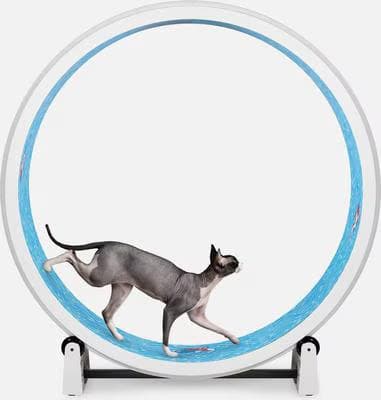
Compare the Gen 7 wheel’s usable running diameter and replaceable tread with your cat and available space.
Webvet may earn a commission when you click through to Chewy, at no extra cost to you.
The One Fast Cat Gen 7 Wheel is a useful starting comparison because its manufacturer distinguishes outer and inner diameter: 48 inches outside and 43 inches inside.
That distinction matters because the cat moves on the inside surface. Comparing only a large number in a headline can make differently measured products look equivalent.
Choose the running-surface variant
| One Fast Cat Gen 7 measurement | Manufacturer figure | Decision it supports |
|---|---|---|
| Usable running diameter | 43 inches | Compare inside space, not the 48-inch outside rim |
| Running-track width | 11 inches | Check usable side-to-side room separately |
| Assembled dimensions | 48 × 13 × 50 inches | Mark floor width/depth and check overhead clearance |
| Assembled weight | 28 pounds | Plan moving and cleaning the assembled wheel |
| Published supported cat weight | Up to 25 pounds | Stay within the stated limit; weight alone does not establish gait comfort |
One Fast Cat’s current product specifications distinguish the selected foam tread from felt: foam can be wiped with a damp towel, while felt can be vacuumed. Both are replaceable. That is a practical choice between cleaning methods, not evidence that one wheel runs faster or quieter.
For example, the 13-inch base depth may fit beside a sofa while the 48-inch width blocks a nearby cabinet. Mark both dimensions before delivery, then reserve the maker’s required operating clearance. A footprint fitting between furniture does not establish a clear route off the moving track.
The selected retailer variant is White with Koi Pond Foam Pads. The manufacturer offers different tread materials, so match the pad type in the listing to what you want to maintain and replace. Do not assume a felt-pad review describes the foam-pad version's cleaning or wear exactly.
- A useful fit: an owner who wants clearly stated inner-diameter information and is prepared to maintain replaceable running surfaces.
- Check carefully: the footprint, pad choice, parts availability and the seller's return terms. A wheel's popularity does not establish that a particular cat will use it.
Coziwow Exercise Wheel with Lock & Teaser Cat Treadmill
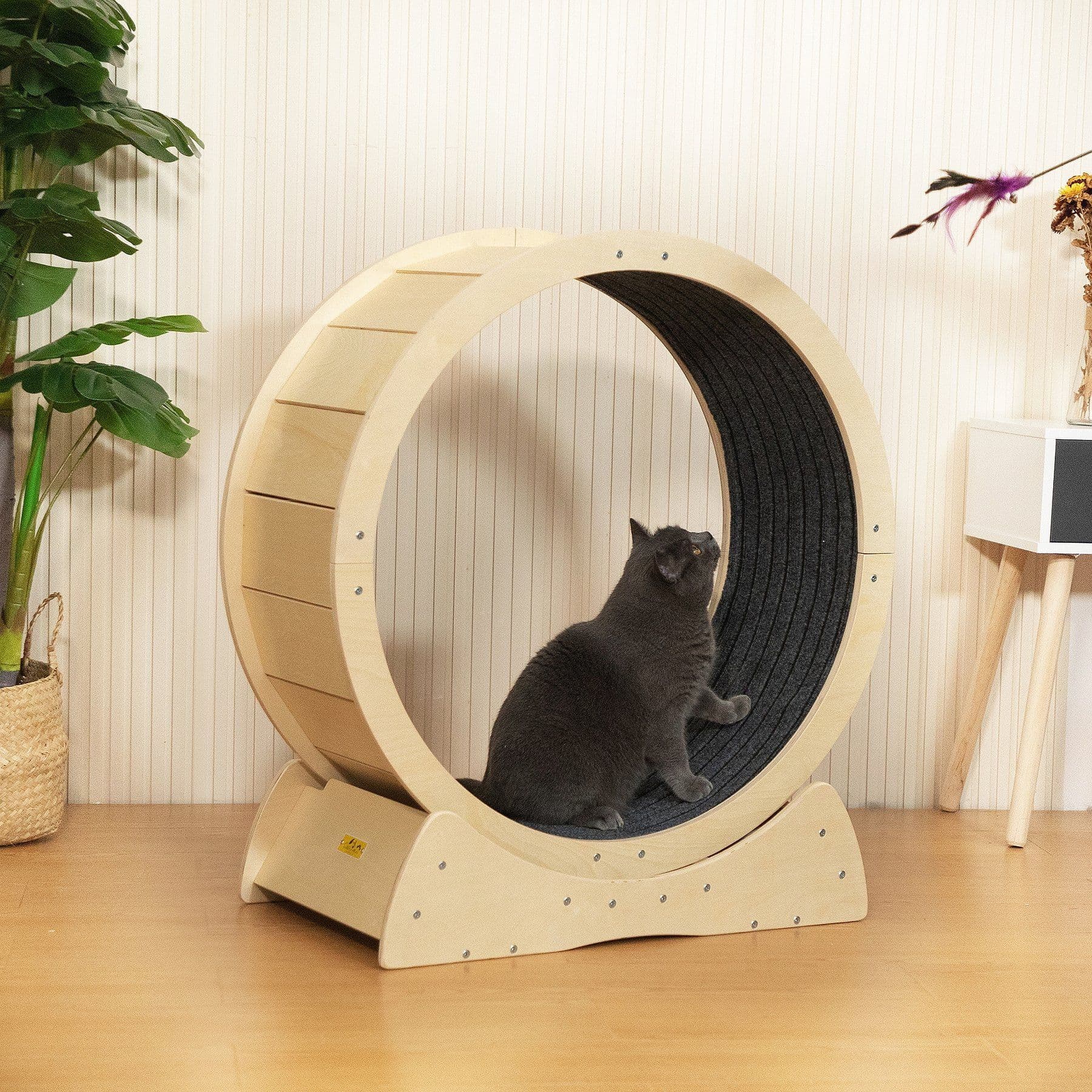
Compare this wheel with a lock and teaser against your cat’s usable running space and the room available at home.
Webvet may earn a commission when you click through to Chewy, at no extra cost to you.
The Coziwow Exercise Wheel with Lock and Teaser combines a wooden wheel, carpeted running surface and a locking feature. The removable carpet described in the current listing may be useful when cleaning and replacement are priorities. Match the exact listing to its manual rather than borrowing measurements from another Coziwow wheel.
A lock can help control when a wheel is available if used as instructed. It is not a reason to place the cat onto a moving wheel or to restrain the animal.
- Before training, learn how the mechanism works with no cat on the device and confirm that it does not create an exposed snag point.
- The included teaser is a separate supervision decision. A hanging or string-like toy may be unsuitable for unattended access, especially for a cat that chews accessories. Follow the product guidance and use a safe training reward that does not draw the cat into rollers or an awkward exit.
- A useful fit: a buyer interested in a wooden design with a removable running surface and controlled access.
- Check carefully: inner diameter, usable track width, lock operation and replacement carpet. Do not interpret a large advertised weight capacity as proof of comfortable running geometry.
YODOLLA 38.2-in Exercise Running Wheel Cat Scratcher, Natural
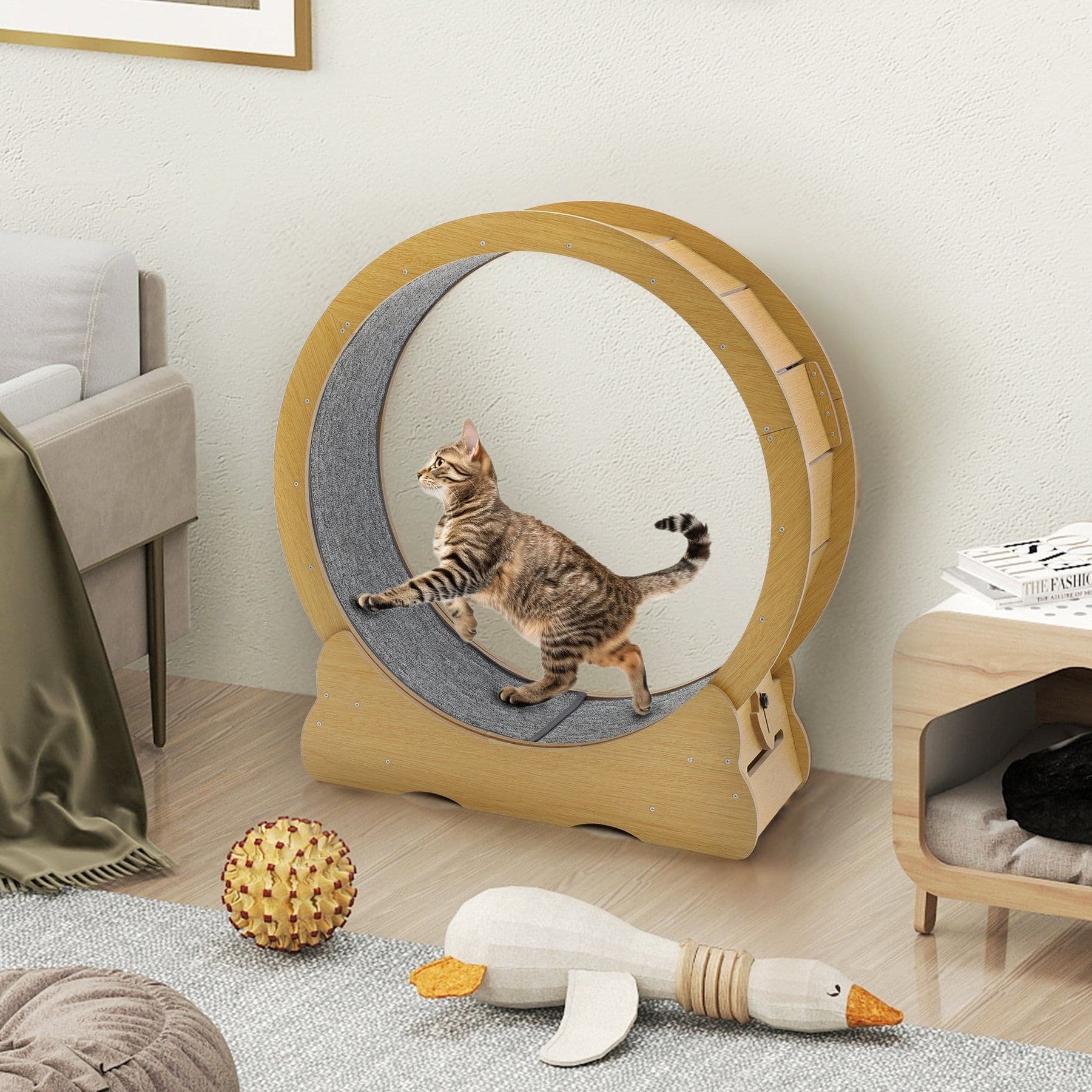
Compare the detachable carpeted runway and locking mechanism with the cat’s fit and maintenance needs.
Webvet may earn a commission when you click through to Chewy, at no extra cost to you.
The YODOLLA Exercise Wheel Cat Scratcher has a detachable carpeted runway and a locking mechanism according to the selected catalog description. Those are useful maintenance and access-control features to assess. Check how the carpet is removed and secured again before treating easy cleaning as a reason to choose this model.
The 38.2-inch figure in the product name should not be assumed to be the usable inner running diameter. Ask for the exact dimension drawing and compare the cat's natural movement with the available running space. A smaller external footprint is not an advantage if it compromises the running surface.
The seller also uses quiet-operation language, but this comparison has no independent decibel measurements. Inspect the base, flooring and assembly instructions, and judge sound during a voluntary trial rather than assuming a quiet label establishes performance in your room.
RYPetmia Indoor Cat Exercise Wheel with Interactive Toy, Grey, 44.5 x 14.5 x 47.2-in
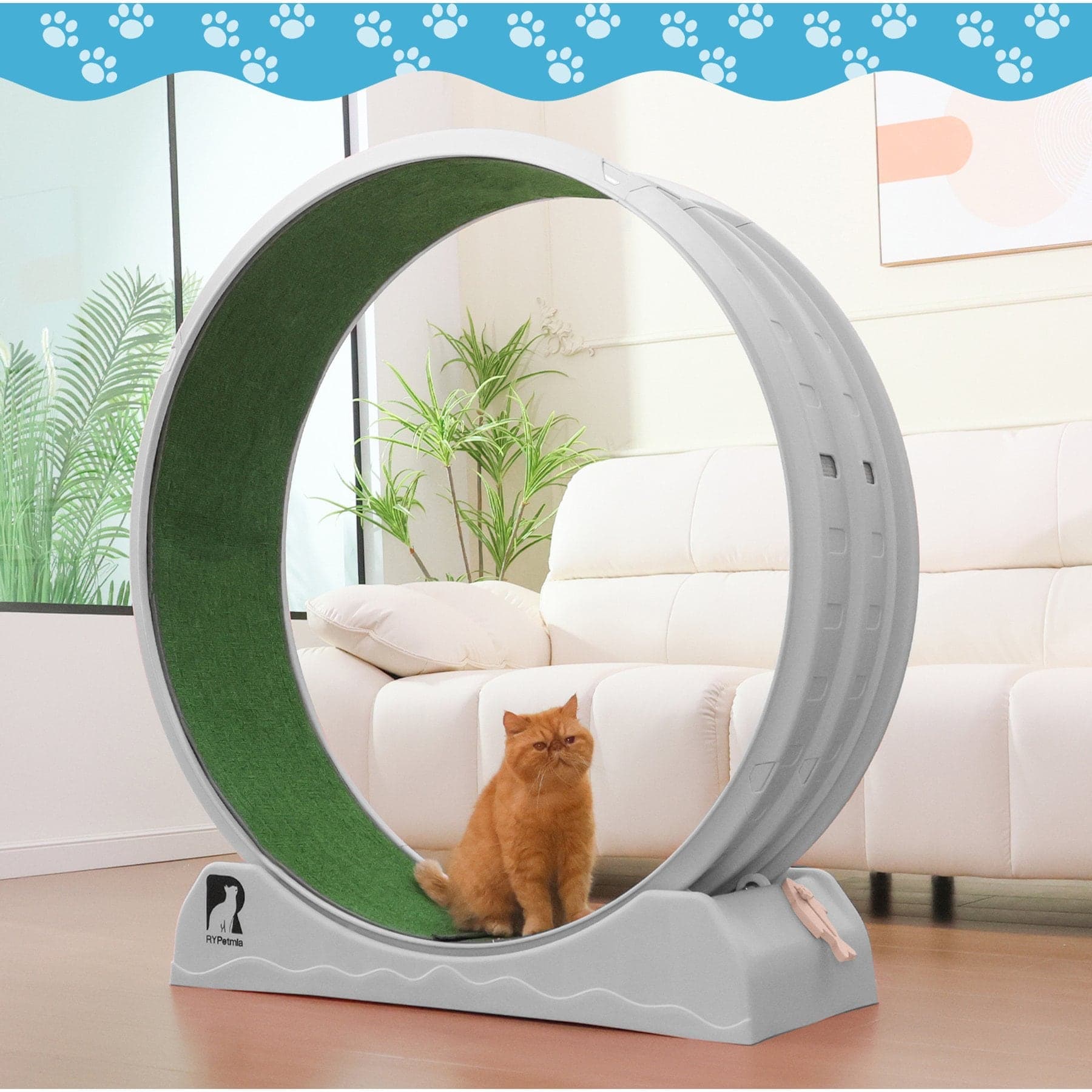
Compare the selected wheel’s complete footprint, detachable runway and included interactive toy.
Webvet may earn a commission when you click through to Chewy, at no extra cost to you.
The RYPetmia Exercise Wheel with Interactive Toy is the selected Grey variant with an advertised 44.5-by-14.5-by-47.2-inch overall size. The catalog describes a detachable runway and an interactive toy. Keep the complete footprint separate from usable running diameter when comparing it with the other wheels.
Decide whether the extra toy supports how you intend to introduce the wheel. Supervise it as an accessory, inspect attachments and remove it as the instructions allow if the cat chews or becomes tangled. The wheel should remain useful without encouraging frantic pursuit beside moving parts.
Check the runway's attachment and replacement instructions, assembly requirements and parts support before ordering. Claims that a wheel suits every cat or produces health benefits do not establish fit for your individual cat. Use the same voluntary introduction and return-window assessment as for the other options.
What about Ferris and Nordic Beast wheels?
Both are useful comparison points when shopping beyond this shortlist. ZiggyDoo's Ferris G5 page specifies a 48-inch inner diameter, while its assembled outside dimensions are larger. That illustrates why inner and outer measurements cannot be mixed in a comparison table.
Nordic Beast: compare the actual model
Nordic Beast’s 48-inch XL model was listed at $199.99 USD on the manufacturer’s site on September 26, 2026. Its stated running-track width is 15.7 inches and its maximum supported weight is 45 pounds. These are manufacturer specifications, not results of our own testing.
The listed 48-inch diameter does not establish the usable inside diameter. Confirm that measurement before comparing it with One Fast Cat’s stated 43-inch inner diameter. Nordic Beast lists replaceable hook-and-loop carpet; compare the actual replacement cost and return terms for your purchase channel.
These are alternatives to investigate, not evidence that a larger or more expensive wheel automatically improves every cat's experience. Product fit includes the cat's comfortable movement, the room and maintainability.
Measure running space and check moving parts
Separate four measurements: inner running diameter, track width, assembled outer dimensions and required clear space. The first two affect the surface the cat uses; the other two affect where the equipment can operate.
Ask for a dimension drawing when a listing is unclear. If a seller gives only “48-inch wheel,” ask what is being measured. A base, rim or decorative panel can increase the outside size without increasing usable running space.
Observe comfortable movement
Your cat should be able to move naturally on the track without appearing cramped, slipping or repeatedly stepping off an edge. Do not push for running speed while learning whether the size and surface suit the animal. Stop and reassess if movement looks awkward or the cat shows discomfort.
There is no one diameter that can be declared ideal for every cat from body weight alone. Body length, gait and the actual inner curve matter. Manufacturer guidance is a starting point; medical or mobility questions belong with the veterinarian who knows the cat.
Check the base and pinch areas
Read the assembly instructions before the cat approaches. Identify moving rollers, gaps between wheel and base, pad edges and locking parts. Check for exposed fasteners or attachments that could catch a claw. A listing saying “safe” does not remove this inspection.
- Place the wheel on a stable surface as instructed.
- Keep it clear of curtains, cords and objects that could enter the moving parts.
- Leave room for the cat to step off without landing against furniture.
- Prevent other pets or children from interfering during training.
- Stop use if the wheel shifts, derails, scrapes unexpectedly or becomes unstable.
Do not add improvised padding or a homemade guard that interferes with the wheel's motion. Contact the manufacturer about approved adjustments. A modification intended to solve one problem can create a new gap or obstruction.
Judge noise in your own room
There is no verified noise ranking in this guide. Sound depends on the wheel, assembly, surface beneath it, room and how the cat uses it. “Quiet” and “silent” in product copy are not standardized measurements.
Think about the household's practical tolerance. A wheel beside a bedroom wall may be more disruptive than the same wheel in another room. A pad under the base should only be used if compatible with the manufacturer's stability instructions. Do not trade a stable base for a softer sound without checking the effect.
After assembly, operate the wheel as instructed with no cat present and listen for unusual scraping or clicking. Resolve mechanical problems before training. During the trial, note whether ordinary use is acceptable for people sharing the space. A wheel that is moved into storage every night may become too inconvenient to use consistently.

Separate material choices from performance promises
A plastic wheel may be convenient to wipe, while a wooden wheel may fit the room's appearance. Neither material alone establishes stability, comfort or long-term durability. The frame, joints, base, surface and maintenance instructions need to be evaluated together.
Cardboard running or scratching wheels are a different ownership proposition from a rigid wheel with replaceable pads. Check how the surface wears, whether it can be cleaned and how the whole product is replaced when damaged. Do not compare a small scratching-style wheel with a full-size running wheel only by price.
Separate indoor and special-use designs
Indoor and outdoor use should also remain separate. A wheel that looks sturdy in a photograph is not automatically designed for rain, humidity or direct sun. Unless the exact manufacturer specifies outdoor use and the required conditions, place it indoors.
Do not move an indoor wheel into a catio and assume the enclosure roof makes the environment equivalent to a room.
A wall-mounted or homemade wheel creates additional structural and moving-part questions. This guide does not provide a DIY engineering plan. If you are considering such a system, obtain the exact design and installation requirements rather than transferring advice from a freestanding product. A different support system changes the safety assessment.

Make a measurement note that prevents mistakes
Then mark the assembled footprint on your floor using a safe temporary method, with the cat kept away from loose tape or materials. Check doors, walking routes and cleaning access. Stand where you would supervise training and picture the cat stepping off on either side.
- This does not simulate the wheel's movement, but it can expose a room-fit problem before delivery.
- For example, a nominally narrow wheel may still interfere with a cupboard door because its base projects outward. Another may fit the floor but leave no comfortable place for the cat to exit. Those are useful reasons to rule a product out even when its running diameter is attractive.
Cat wheel size chart: compare usable diameter
These manufacturer-reported examples show why an outside measurement is not enough. Check the exact current model before buying; this is a size-reference comparison, not a test of how either wheel fits every cat.
| Wheel reference | Reported inside running diameter | What the number helps you compare |
|---|---|---|
| One Fast Cat | 43 inches | Usable diameter differs from its 48-inch outside diameter |
| ZiggyDoo Ferris | 48 inches | Compare the running space separately from the complete base footprint |
The One Fast Cat product page and Ferris manufacturer listing are the sources for these measurements. Neither number replaces a cat-specific suitability assessment or checking track width and weight limits.
Compare large-cat fit with a measurement worksheet
The best cat wheel for large cats is a model that provides adequate usable running space and stable support for the individual cat. An extra-large label alone does not establish that fit. Inner diameter, track width and the manufacturer's stated limits need to be compared separately.
If you encounter a Nordic Beast 48 XL listing, verify what the number measures against the manufacturer's current documentation. Do not treat an outside diameter as equivalent to usable inside space. The same caution applies to every brand, including familiar models sold by several retailers.
- Is the quoted diameter inside the running track or outside the wheel?
- What is the usable track width after rims or guards are accounted for?
- What is the complete assembled footprint, including the base and projecting accessories?
- Which weight or use limits does the maker state, and where are those limits documented?
A seller question that makes four listings comparable
Send one specific question when a listing is incomplete: “For this model and variant, what are the inside running diameter and clear track width, and can I buy its complete replacement tread?” Save the reply with the listing. An outside dimension is not an answer to the inside-diameter question.
| Shortlisted wheel | Known distinction | Most consequential unresolved comparison |
|---|---|---|
| One Fast Cat Gen 7 | Published inner diameter and replaceable foam/felt surfaces | Which tread and return policy apply to the selected seller |
| Coziwow Lock & Teaser | Removable carpet and access lock | Exact inner diameter, track width and replacement-carpet availability |
| YODOLLA 38.2-inch | Detachable carpet and wheel lock | Whether 38.2 inches describes the outside; obtain inside measurement |
| RYPetmia Grey | 44.5 × 14.5 × 47.2-inch advertised overall size | Inside running diameter and replacement-runway availability |
Do not rank an unreported dimension as smaller, or fill it from a similarly photographed model. If the seller cannot clarify running space before the return window starts, that uncertainty is a reason to favor a documented option, especially for a large cat.
One Fast Cat’s generation guide is useful for secondhand purchases. Establish the generation before ordering pads or a base. A seller calling an old wheel “One Fast Cat” has not yet identified which parts it needs.
Include maintenance in the purchase comparison
A low purchase price can be less useful if an ordinary wear part cannot be replaced. Check the cost and availability of a complete tread replacement, the cleaning method, shipping for parts and whether you can perform the prescribed maintenance. Compare like-for-like parts rather than a single pad against a full set.
Teach your cat to use a wheel
Begin with the wheel stationary and the cat free to leave. Reward looking, sniffing or stepping near it. You are building familiarity, not trying to produce a running video on the first day.
- Let the cat investigate the area. Keep the environment quiet and avoid crowding the approach.
- Reward a small voluntary step. Offer a reward where the cat can reach it comfortably without stretching into a moving part.
- Introduce slight movement gradually. Follow the manufacturer's training instructions and stop if the cat startles or loses footing.
- Build short sequences. A few comfortable steps are useful progress. End before the cat becomes frustrated.
- Allow independent choice. Over time, look for the cat returning voluntarily rather than participating only under constant luring.
Never spin the wheel with the cat inside to “show them how.” Do not hold the cat on the track or block the exit. If the cat jumps off, treat that as information about the session and setup, not disobedience.
Choose rewards thoughtfully
A small part of the usual food allowance can be used if food rewards suit the cat. Account for training food in the daily feeding plan. A toy may motivate another cat, but keep it away from moving parts and avoid frantic leaps. Follow toy supervision guidance, especially for strings and feathers.
Place the reward to encourage comfortable stepping, not twisting or overreaching. If the cat is more interested in jumping off to reach your hand, make the task easier. Reward being on the stationary surface before asking for movement.

Keep sessions short enough to remain calm. There is no universal deadline for wheel acceptance. Some cats progress quickly, others need many small exposures, and some never choose it. Repeating an unsuccessful session for longer does not necessarily make it more effective.
Troubleshoot without forcing
If the cat avoids the wheel, check whether it moved unexpectedly, made an alarming noise or sits in a busy route. Return to stationary investigation after resolving the issue. If they stand on it but do not walk, reward small comfortable shifts rather than increasing speed.
If the cat paws at the wheel from outside, make sure that behavior does not put feet near the rollers. Redirect calmly to a safe approach and supervise. If another cat interrupts, train separately so each animal can decide without competition.
| Training observation | First thing to check | Sensible adjustment |
|---|---|---|
| Avoids the whole area | Noise, traffic or an earlier startle | Quiet location and stationary exploration |
| Steps on, then immediately exits | Footing, movement and reward position | Easier stationary reward and unobstructed exit |
| Runs only while heavily lured | Whether the cat returns independently | Record voluntary use before deciding value |
| Scrambles or slips | Surface, assembly and suitability | Stop, inspect and resolve the cause |
| Another cat blocks access | Household competition | Separate supervised sessions and resources |

Training should not become a reason to postpone a return decision indefinitely. Use the seller's actual deadline and keep enough time to arrange a return if the product does not suit the cat or home.
Stop a session while it is still comfortable
End after a small successful action rather than pushing for a longer sequence every time. Put the reward away, allow the cat to leave and return to an ordinary activity. If your wheel has an approved way to lock or restrict access between sessions, use it as instructed.
If the cat starts biting at the tread, attacking the base or repeatedly jumping across the wheel, stop and reassess the setup. These behaviors may create a mechanical or ingestion risk even if the cat looks enthusiastic. Do not reward increasingly frantic behavior because it resembles exercise.
Keep observations descriptive. “Walked several steps with a loose posture, stepped off and returned later” is more useful than “loved it.” “Hid when it moved” tells you to reduce the challenge or reconsider suitability. That record makes it easier to discuss a concern with the manufacturer, veterinarian or qualified behavior professional if you need help.
Do cats actually like cat wheels?
Some cats choose to walk or run on a wheel after gradual introduction, while others never use it. Voluntary repeat use is more informative than being placed on the track or following a treat once. Stop trying to persuade a reluctant cat and offer another activity that fits their preferences.
Maintain the wheel and judge whether it helps
Inspect the equipment on the manufacturer's schedule and whenever you notice a change in sound, movement or stability. Check the running surface, pad edges, fasteners, base and rollers. Remove hair and debris according to the care instructions and keep cleaning products away from the cat until surfaces are ready for use.
Do not continue using a wheel with loose tread, damaged parts or an unexplained mechanical change. Get approved replacements and instructions. A repair that looks neat is not necessarily safe around moving parts.
Use a return-window trial log
Record a few observations after each opportunity. The aim is to distinguish sustained voluntary value from one exciting session. A simple note can include the date, whether the cat approached, what they did, and how they behaved afterward.
- Voluntary approach: Did the cat return without being carried or repeatedly called?
- Comfortable movement: Were steps controlled, with no slipping or awkward posture?
- Easy exit: Could the cat stop and step away without interference?
- Household fit: Was the location, sound and cleaning manageable?
- Repeat interest: Did the cat choose the wheel again on another occasion?

An owner-lured sprint can be enjoyable, but it does not establish that the wheel will be a regularly used enrichment resource. Compare repeated experiences. If the cat consistently ignores it and enjoys a simpler game, that is a useful outcome of the trial rather than a training failure.
Keep alternatives in the routine
Continue interactive play, comfortable resting options and opportunities to scratch and explore. A wheel mostly offers repeated forward movement. It does not supply all the stalking, hiding, climbing and social choices a cat may enjoy.
Cat wall shelves can add an accessible vertical route when the wall and installation suit it. A secure catio offers controlled outdoor observation. Both require their own planning and are optional; neither needs to be added merely because the wheel did not work out.
If your cat is restless or withdrawn outside the wheel context, consider household resources and cat stress relief. Do not interpret every behavior as an energy surplus. Persistent changes warrant individualized veterinary or behavioral advice.

Decide what to keep
Keep the wheel when the cat uses it comfortably, the setup remains stable and maintenance fits your household. Reconsider it when it creates conflict, cannot be placed appropriately or offers little value after a patient trial. Review return conditions before the deadline, not after it has passed.
Questions about cat wheel
Frequently Asked Questions
Are cat wheels good for your cat?
They can provide an additional movement opportunity for cats that use them comfortably and voluntarily. They are optional and do not replace a varied environment or individualized exercise advice for a cat with health concerns.
How do I know if my cat will use a cat wheel?
You cannot know for certain before a trial. Interest in activity and new surfaces may help you plan training, but acceptance varies. Check return terms, introduce the wheel gradually and look for repeat voluntary use.
Are cat wheels worth the money?
They may be worthwhile when the cat uses them, the home has an appropriate space and maintenance is manageable. Include replacement parts, shipping and return costs in the decision. A wheel that stays unused is not made valuable by a long feature list.
What is the best cat wheel to buy?
Compare exact inner diameter, track width, base design, maintenance and support for your cat and room. The four options here serve different preferences; there is no universal winner independent of fit and the cat's response.
How big of a cat wheel should I get for my cat?
Use the inner running diameter and track width, not just the outside size. The cat should move comfortably without appearing cramped or slipping. Check manufacturer guidance and ask your veterinarian about relevant mobility concerns rather than choosing from body weight alone.
Why do cats like cat wheels so much?
Some cats enjoy the movement and repeated activity. Others show little interest or dislike a moving surface. Do not assume enthusiasm seen in another cat predicts your own cat's preference.
What is the quietest cat wheel for indoor cats?
This guide has no standardized noise testing and does not name a quietest model. Assembly, floor, room and use affect sound. Check mechanical condition and judge ordinary operation in your home during the return window.

Editor
The Webvet Editorial Team is the in-house group of pet-care editors and writers behind Webvet, operated by Smart Pet Collective. The team researches, writes, and maintains Webvet's pet health, behavior, and medication content. Every article follows a defined editorial process: research from reputable veterinary and scientific sources, careful drafting, mandatory review of medical content by a credentialed veterinarian, and dated publication. Health and medication articles are medically reviewed by a licensed veterinary professional before they go live and are kept current over time.


