Interactive Cat Toys: How to Play So Your Cat Actually Engages
Most interactive cat toys fail on technique, not price. A vet-reviewed guide to moving a wand so it reads as prey, structuring a session that ends on a catch, choosing electronic toys that hold attention, and fixing a cat who ignores the toy.

This article contains affiliate links. Webvet may earn a commission when you buy through them, at no extra cost to you.
Interactive cat toys are the ones that cannot work on their own. Either a person drives them (wands, teasers, lures, laser pointers) or a mechanism reacts to the cat (motion-activated toys, motorized track balls, randomised movers). A plush mouse lying on the rug does not qualify, no matter what the packaging on the bag says.
That distinction is the reason so many interactive cat toys get bought, tried once, and abandoned in a basket by the door. They fail on technique far more often than they fail on price. A wire wand costing a few dollars, moved like a real animal, will out-engage a far more expensive gadget dragged in a straight line across the carpet. What follows is the part almost nobody explains: the motion library that makes a lure read as prey, how to build a session so the hunt actually finishes, which motion-response toys hold attention, and what to do when your cat stares at the toy and refuses to move.
- 1Interactive toys split into two groups: human-driven toys that need you holding the other end, and cat-responsive toys that react to the cat's own movement, and only the first group reliably holds attention over months rather than days.
- 2Cats commit to motion that behaves like prey, which means moving the lure away from the cat rather than toward her, changing height and speed, and pausing dead still long enough for her to decide to pounce.
- 3Two short sessions a day, roughly ten to fifteen minutes each, do more for an indoor cat than an open bin of toys sitting on the floor around the clock.
- 4Every session should end with a catch the cat can physically pin and bite, followed by a meal or a few treats, because an unfinished hunt leaves a cat wound up instead of satisfied.
- 5Laser pointers cause more play frustration than any other toy because the dot can never be caught, so finish every laser session on a solid toy your cat can trap under her paws.
- 6Keep most of what you own out of sight and rotate a small set every week or two, because novelty is what your cat responds to when a brand new toy suddenly works.
- 7Wands, strings, feathers and bells are supervised-only equipment, and a cat who suddenly loses interest in play that used to work needs a veterinary exam rather than a different toy.
What Makes a Cat Toy Interactive
An interactive cat toy is any toy that cannot perform on its own. Either a person drives it (a wand, teaser, lure or laser) or a mechanism responds to the cat (motion-activated, motorised track, randomised movement). The defining feature is simple: the toy changes what it does in response to something outside the cat, so it never behaves identically twice.
That definition matters because the label gets applied to almost everything in the cat aisle, including products designed for the exact opposite purpose. Collections titled "independent play" sit alongside wands under the same heading, and a shopper looking for something to do with their cat ends up buying something the cat is meant to use alone. The two categories solve different problems, and buying the wrong one is the most common way this goes wrong.
Human-driven toys
These need a person on the other end for the entire session. Wands with a feather or fabric lure, telescopic teasers, wire toys with a flexible tip, ribbon lures on a rod, and laser pointers all live here. They are the only category where you control speed, direction, height, hiding and the moment of the catch, which is why they produce the most complete play sessions and why they also produce the most disappointing ones when the person moves them badly.
Cat-responsive toys
These react to the cat rather than to you. A motion-activated toy wakes when the cat approaches. A motorised track ball changes direction when a paw hits it. A concealed-motion toy makes a fabric cover twitch on an unpredictable schedule. These are interactive cat toys that move in response to the cat rather than on a fixed loop. They genuinely respond, which makes them meaningfully different from a static object, but their range of behaviour is fixed and most cats learn it within a few sessions.
What is not interactive
A catnip mouse on the floor, a crinkle ball in a basket, a scratcher, a bed and a plain tunnel are all enrichment, and some of them are excellent. None of them is interactive, because nothing about them changes. Leaving twenty of them out permanently does not add up to one ten-minute wand session, and understanding that is the difference between a house full of ignored toys and a cat who comes running when she hears the closet door.
Telling them apart before you buy
- If the listing describes a toy as being for independent or solo play, it belongs in the second group no matter what the category heading says.
- If the toy has a handle, a rod or a trigger, a human is required and it belongs in the first.
- If it has a battery, a sensor or a motor, it responds to the cat but its behaviour is fixed and finite.
- If nothing on it moves without a paw, it is enrichment rather than an interactive toy, and it should be priced and rotated accordingly.
| Toy type | What drives it | What it is best at |
|---|---|---|
| Wand and teaser toys | You, continuously | The full stalk, chase and catch sequence |
| Rod-and-lure or ribbon toys | You, continuously | Long ground chases and air work |
| Laser pointers | You, continuously | Fast pursuit with no possible catch |
| Motion-activated toys | The cat's own approach | Short solo bursts between sessions |
| Motorised track and circuit toys | Batteries plus a paw strike | Repeatable swatting and pawing |
| Kicker and catch toys | The cat, after you throw or drop them | Finishing a hunt with a real capture |
If you own nothing yet, the honest starting point is one decent wand rather than an assortment. Something like the Frisco Bird with Feathers Teaser Wand Cat Toy with Catnip, Blue gives you a rod, a length of line and a feathered lure, which is all the equipment the entire technique section below requires. Everything else on this page is a refinement of that one object in your hand.
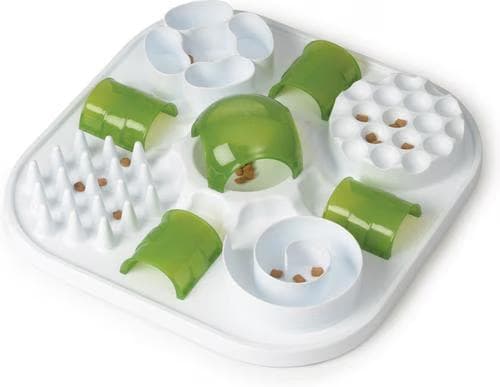
Webvet may earn a commission when you click through to Chewy, at no extra cost to you.
Why Interactive Play Beats Leaving Toys on the Floor
What toys do cats never get bored with? Honestly, none of them, at least not on their own. The toys that look immune to boredom are the ones that never behave the same way twice: a wand in a human hand, a lure that vanishes behind a chair and reappears somewhere unexpected, a track ball whose direction depends on how hard the cat hit it, and any toy that spends most of its life in a cupboard and only comes out every couple of weeks. Novelty is a property of how a toy is used, not a property of the toy.
A cat evaluates an object the way a predator evaluates a target. Movement, sound, size, texture and unpredictability all feed the decision to commit. A toy lying still on the floor scores zero on the first and last of those, which is why the mouse that thrilled her on day one is furniture by day four. This is ordinary habituation, not a defect in the toy and not a defect in your cat.
What changes the moment you pick the toy up
- Direction becomes unpredictable, so the cat has to track rather than remember.
- Speed can drop to nothing, which is what actually triggers the crouch and the commit.
- The lure can disappear behind an obstacle, which is the single most reliable way to convert a watching cat into a hunting one.
- The catch can be granted or withheld, so the session has an arc instead of a flat line.
- You can read the cat and adjust, which no battery-powered toy can do.
An indoor cat has no other outlet for this. Outdoor hunting opportunity is replaced by a bowl that fills on schedule, and the hunting behaviour does not disappear just because the calorie problem was solved. It shows up instead as ankle attacks at 5am, over-grooming, yowling at the window, or the flat, sleepy disengagement that owners describe as a lazy cat. Structured play is the sanctioned outlet, and it is also the cheapest behavioural intervention available to most households.
If boredom is the underlying complaint rather than toy selection, the full workup for an understimulated indoor cat lives on our guide to toys for a bored indoor cat, and the broad category comparison sits with the best cat toys overall. This page stays on the part those two hand off: what to do once the toy is in your hand.
How to Move a Wand So It Reads as Prey
This is the section that changes results, and it is the one almost no cat toy guide contains. The toy is a prop. What your cat is responding to is a performance, and most people unknowingly perform the one behaviour no prey animal on earth exhibits: running directly at a predator.
The single rule that fixes most sessions
Move the lure away from your cat, never toward her. A mouse that notices a cat does not charge the cat. It freezes, then bolts for cover in the opposite direction. When you wave a feather in your cat's face, you are showing her something no real animal does, and her brain correctly categorises it as not-prey. Drag the lure away along the floor, let it skitter around a corner, and the same cat who ignored the toy thirty seconds ago will drop into a crouch.
The motion library
- Drag, do not dangle. Keep the lure in contact with the floor for ground-focused cats, moving in short bursts of a few inches followed by stillness. Continuous smooth motion is the least interesting thing a lure can do.
- Pause dead still for three to five seconds. This is the step people skip. Cats commit during the pause, not during the movement. Watch for the rear-end wiggle, then hold absolutely still until she launches.
- Break the line of sight. Pull the lure behind a sofa leg, a doorway, a box or a rug edge, hold it there for a beat, and bring it out somewhere she is not looking. Disappearance is the strongest trigger in the whole library.
- Change the height to match the target. Keep it on the ground for cats that hunt rodents and lift it into arcs above head height for cats that hunt birds. Most cats have a clear preference and will show it in the first two minutes.
- Vary the speed, not just the path. Slow creep, sudden dart, freeze, twitch. Erratic beats fast. A lure moving at a constant speed in a constant direction is a machine, and cats read machines.
- Let her land real catches. Give her the lure several times per session and let her hold it, bite it and rabbit-kick it for a few seconds before you pull it away again. A hunt that never succeeds is not a game, it is a tease, and cats disengage from it.
- Add texture and sound sparingly. A lure that rustles across paper or ticks over a hard floor gives her an audio track to hunt by. Constant bell noise, on the other hand, becomes background within a minute.

Match the movement to how your cat hunts
Cats specialise. Some are ground stalkers who want everything at floor level, under rugs and around furniture legs. Others are air chasers who want the lure lifted, arced and flicked above their heads so they can rear up and swat. A third group are ambushers who will not chase at all in the open but will explode out of a box or a tunnel mouth the moment the lure passes.
Running the wrong style is a common reason a perfectly good toy looks like a failure. If your cat watches a floor drag with mild interest, spend one session doing nothing but arcs above her head, and one session doing nothing but passes across a tunnel mouth or the gap under a chair. The style she responds to will be obvious, and from then on you can build most of the session around it while using the other two as variety.
Reading your cat mid-session
The signals are unambiguous once you know them, and they tell you when to speed up, when to freeze, and when to stop entirely.
- Crouch with lowered shoulders and forward ears: she has committed. Freeze the lure and let her close the distance.
- Rear-end wiggle and planted back feet: the launch is imminent. Do not move the toy.
- Tail tip flicking while the body is still: focused arousal. Keep going, keep it unpredictable.
- Pupils fully dilated with a wide-open stance: high arousal. Still fine, but start planning the catch.
- Ears rotating back or flattening, tail lashing side to side, sharp chirps: over-arousal. Slow the lure right down and let her win.
- Sitting up, grooming, or looking away: she is done. End on a catch rather than pushing for more.
For a fuller reference on what your cat's ears, tail and posture mean outside of play, see our guide to reading your cat. During a session, those signals are the difference between a satisfying hunt and a cat who redirects onto your hand.

What to put on the end of the wand
The lure is the part that determines whether your cat cares. Feathers read as birds. Long fabric strips and faux-fur tails read as rodents. Crinkle strips and paper-textured lures add sound. Small stuffed toys give a substantial catch to bite and kick. Most cats have a strong preference, and the cheapest way to find it is to buy replaceable lures for one wand rather than four complete wands.
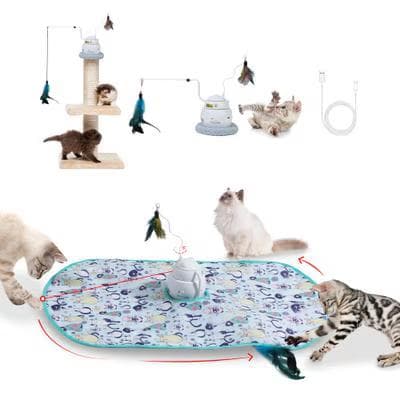
Webvet may earn a commission when you click through to Chewy, at no extra cost to you.
Scent is the other lever, and it is the one people forget. Catnip response is inherited, a meaningful share of cats do not react to it at all, and kittens generally do not respond until they are several months old. Silvervine often works on cats that ignore catnip entirely, which makes a loose attractant such as SmartyKat Silvervine Cat Attractant Catnip, 2-oz canister genuinely useful: you can refresh a tired fabric lure rather than replace it, and you can test whether your cat is a silvervine responder before committing to a whole shelf of scented toys. The full comparison of catnip, silvervine and the other attractants sits in our guide to catnip and silvervine toys.
Change the lure inside the session, not once a month
A single wand with three lures in your pocket is a more capable toy than three wands. When your cat's interest starts to sag around the eight-minute mark, unclip the feather and clip on a fabric tail without stopping the session. The change in silhouette, weight and sound reads as a different animal, and cats that reliably quit at five minutes will often run another five for a new target.
There is a limit to this. Swapping lures every thirty seconds turns the session into a series of interruptions and teaches your cat that the interesting thing is your hands rather than the lure. One change mid-session is usually enough, and two is the practical maximum before you are better off ending on a catch and playing again later in the day.
The Laser Pointer Problem and How to Fix It
Laser pointers are the most reliably engaging interactive toy on the market and the most likely to leave a cat worse off than before you started. The reason is structural: a laser dot cannot be caught. The cat runs the stalk, runs the chase, executes a perfect pounce, and closes her paws on bare floor. Do that for ten minutes and the hunting sequence never resolves.
The result in some cats is obvious. They keep searching the wall after you have put the pointer away, stare at the spot where the dot lived, or start pouncing on reflections and shadows for hours afterwards. Others handle it fine. The difference is not predictable in advance, which is why the safest approach is procedural rather than a judgement call.
How to run a laser session correctly
- Keep sessions short, a few minutes at most, and treat the laser as a warm-up rather than the whole workout.
- Land the dot on a physical toy at the end, a kicker, a plush mouse or the wand lure, and switch the laser off the instant her paws hit it so the toy is what she caught.
- Follow the catch immediately with food, exactly as you would with a wand session.
- Never aim the beam at your cat's eyes, at your own, or at anyone else's, and keep pointers stored where a curious cat cannot knock one on.
- If your cat shows searching behaviour, pacing or reflection-chasing in the hours after a session, retire the laser and switch to a wand permanently. There is no benefit worth that trade.
Ways to keep the speed without the frustration
The appeal of a laser is that it produces flat-out sprinting, which is hard to generate with a wand in a small flat. You can get most of that speed back without the uncatchable-target problem.
- Run a long line wand down a hallway so your cat gets a genuine straight-line sprint with something real at the end of it.
- Throw a light, catchable toy for cats that will chase and carry, which a surprising number will do once they learn the game.
- Use a track or circuit toy for the fast pawing element and keep the wand for the chase, so the two toys cover different parts of the sequence.
- Move the session onto a floor with grip. Cats sprint far more willingly on a rug than on laminate, and a cat who skids once often refuses to run flat out on that surface again.
Building a Play Routine for an Indoor Cat
How do I keep my cat entertained for hours? You do not, and chasing that goal is what leads to a house full of ignored toys. Cats are not built for sustained activity. A wild cat's hunting day is a series of short, intense bursts separated by long rests, and a healthy indoor cat's day should look the same. Two well-run sessions of ten to fifteen minutes, timed to when your cat is naturally active, will do more than any amount of equipment left out all day. The rest of the day is supposed to be sleeping.
What are the most stimulating cat toys for indoor cats? In practice it is a short list: a wand with interchangeable lures, because it is the only toy that can run the full hunting sequence; a motion-response toy for the hours you are busy; a puzzle or foraging toy that makes her work for food; and a rotating set of catchable floor toys she can carry, kick and stash. Stimulation comes from the variety of behaviours those four categories demand, not from the number of objects in the basket. The best interactive cat toys for indoor cats combine those functions, while interactive cat toys for bored cats should add food work or rotation rather than just more motion.
Time the sessions to your cat's clock
Most cats are crepuscular, meaning their natural activity peaks arrive around dawn and dusk. Playing at those windows works with the cat instead of against her, and a session late in the evening is the single most effective fix for the cat who wakes the house at 4am.
| When | Why it works | Roughly how long |
|---|---|---|
| Before breakfast | Uses the natural dawn activity peak and makes food the reward for the hunt | 10 to 15 minutes |
| Late afternoon or early evening | Catches the second activity peak, before the household winds down | 10 to 15 minutes |
| Just before your bedtime | Burns the overnight energy that otherwise arrives at 4am | 5 to 10 minutes, optional |
Structure every session the same way
- Warm up. Slow, low, small movements at floor level for the first minute while she decides to engage.
- Stalk. Freeze often. Let her set up, crouch and choose her moment.
- Chase. Longer runs, direction changes, disappearances behind furniture. This is the cardio.
- Catch. Let her win several times through the session and once decisively at the end. She should get to hold, bite and kick the lure.
- Eat. Serve a meal, part of a meal, or a few treats within a minute of the final catch.
That last step is not sentimental. The hunting sequence in cats runs stalk, chase, catch, kill, eat, and ending on food is what signals the sequence is complete. Skip it and you get a cat who is still switched on twenty minutes later. Our guide to finishing the hunt with a feeding puzzle covers the food half of that step in detail, and puzzle toys for mental work covers the play puzzles that pair well with a wind-down.
How to tell the routine is working
Owners often cannot say whether play is helping, because they are watching the session rather than the rest of the day. The evidence shows up outside the ten minutes.
- Your cat starts appearing when you pick up the wand, or waits in the room where sessions happen at the usual time.
- The 4am wake-ups, ankle ambushes and pre-dinner yowling reduce within a week or two of a consistent evening session.
- She settles and grooms after a session instead of pacing, which is the clearest sign the sequence resolved properly.
- Sessions get longer on their own over a few weeks as her stamina improves, particularly in an out-of-condition indoor cat.
- She starts initiating, bringing a toy to you or performing an obvious play-invitation stretch and roll.
If two weeks of consistent, correctly run sessions produce none of that, the problem is no longer the routine. Work through the troubleshooting section below, and if she used to play and now does not, treat it as a medical question rather than a scheduling one.

The catch itself needs something with substance to it. A cat cannot bite and kick a laser dot, and a bare wand tip is a thin consolation prize. A supply of small, throwable, bite-sized floor toys such as the Fashion's Talk 18 Piece Plush Catnip-Filled Mice Cat Toys solves two problems at once: they give you something to land a laser session on, and they cover the between-session hours as a rotation set you can pull three at a time from a drawer instead of leaving all eighteen on the floor.
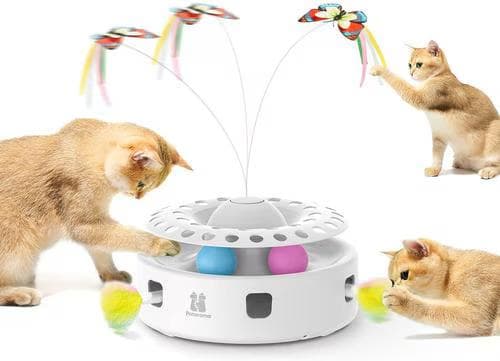
Webvet may earn a commission when you click through to Chewy, at no extra cost to you.
Electronic and Motion-Response Toys That Answer Back
Electronic interactive cat toys sit in the second half of the category. They do not need you holding them, but they are not passive either. A motion sensor wakes the toy when the cat comes near. A motorised track sends a ball around a circuit that changes speed when a paw connects. A concealed-motion toy runs a wand tip under a fabric cover on an unpredictable timer so the cat is hunting a bulge that moves like something alive under a blanket. Current multi-pattern examples include the PawsPik Interactive 4-in-1 Laser & Hide & Seek Rechargeable Automatic Cat Exercise Toy and the Potaroma 3 in 1 Automatic Interactive Butterfly Cat Toy; inspect moving parts before each session and supervise until you know how your cat responds.
They earn a place in the house, and they are also oversold. The honest position is that they supplement human-driven play and never replace it, because the range of behaviour a battery-powered toy can produce is fixed. Your cat will map it, and once she has mapped it the toy stops being unpredictable.

The main types and how they behave
| Type | How it responds | Where it disappoints |
|---|---|---|
| Motion-activated movers | Wakes and moves when the cat approaches, sleeps otherwise | Short battery life and a small repertoire the cat learns fast |
| Motorised track and circuit toys | A ball loops a track and reacts to paw strikes | Loud on hard floors, and easy for a cat to shove under furniture |
| Concealed-motion toys | A hidden wand tip twitches under fabric on a timer | The fabric cover frays and the motor noise gives away the pattern |
| Randomised rolling balls | Self-propelled, changes direction on impact | Gets stuck against walls and under sofas, which teaches the cat to give up |
| Motion-activated laser units | Projects a moving dot on a timer | Same uncatchable-target problem as a handheld laser, without a person to end it on a toy |
The last row on that table deserves a note rather than a flat dismissal. A hands-free unit like the PetSafe Zoom Rotating Laser Cat Toy moves the dot for you, which is an easy way to get a cat sprinting when your hands are full, and plenty of cats will chase one hard. It still cannot be caught, though, so use it the way you would use a handheld pointer: keep the session short, stay in the room while it runs, and put a solid toy where the beam finishes so the hunt ends on something she can pin. A cat who searches the wall or chases reflections afterwards should not be given one at all.
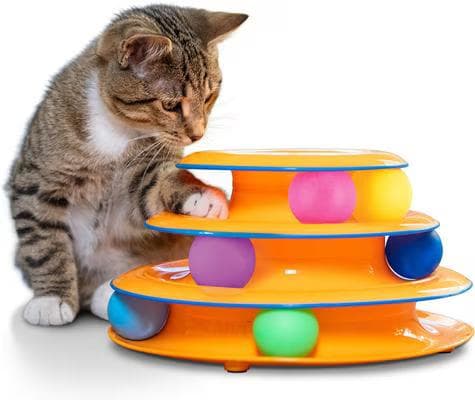
Webvet may earn a commission when you click through to Chewy, at no extra cost to you.
Which cats actually respond to them
Confident, high-energy cats and most kittens take to motion-response toys immediately. Timid cats often do the opposite: a toy that lunges at them without warning is genuinely startling, and one bad first impression can make the object permanently suspect. Older cats and cats with mobility changes usually prefer slower, floor-level movement they can reach without leaping.
Noise is the practical limiter in most homes. Track toys on a wooden floor are far louder than they seem in a shop, and a toy that runs at 3am because the cat brushed past the sensor will get unplugged within a week. Put the noisy ones on a rug, and choose models where you can switch the sensor off rather than only the motor.
Introducing a motion toy to a cautious cat
A confident cat needs no introduction. A timid one does, because the first impression is difficult to undo and a toy that lunges unannounced can become a permanent no-go object in the room where it lives.
- Put the toy in the room switched off for a day or two so it becomes ordinary furniture before it ever moves.
- Switch it on for the first time while your cat is at a distance and facing it, never behind her and never while she is eating, sleeping or using the litter box.
- Run it for under a minute the first few times, then switch it off while she is still interested rather than waiting for her to leave.
- Sit nearby for the first sessions. Many cats will investigate an unfamiliar moving object with a person present who they would avoid alone.
- If she leaves the room, move the toy somewhere with more escape routes and a clear exit, and try again in a few days.
Placement matters more than most people expect. A motion toy shoved against a wall or wedged under a sofa stalls constantly, and a cat who watches a toy stall three times in a row stops investigating it altogether. Give it open floor, a rug for traction and grip, and enough clearance that it cannot trap itself, and the same toy that looked like a dud will run for weeks.
If your real question is what runs while you are out of the house rather than what supplements your sessions, that decision belongs with our guide to motion-activated toys that run without you, which covers timers, safety and the models that hold up unsupervised.
Choosing Your First Interactive Toys
What are the best interactive cat toys? For nearly every household the answer is a wand with a replaceable lure, chosen for the way your particular cat hunts, plus a small handful of supporting pieces. A wand is the only toy that can run the entire stalk, chase and catch sequence under your control, which makes it the highest-value object in the house. Everything else, including every electronic toy on the market, is a supplement to it. Buy one good wand before you buy five of anything else.
What not to buy first
Most first-time toy budgets get spent in exactly the wrong places, and the wasted money is predictable enough to list.
- A multipack of plush mice as your main purchase. They are useful as catch objects and rotation stock, but eighteen static toys do not do the work of one wand.
- An expensive electronic toy before you own a wand. You are buying the supplement before the thing it supplements.
- A wand with a glued-on lure. The lure is the consumable. If it cannot be replaced, you are buying the rod again every time.
- Anything with long ribbon, tinsel or elastic sold as a leave-out toy. String belongs on supervised equipment only, whatever the packaging suggests.
- A second and third wand before you know your cat's hunting style. One wand and three different lures gives you more information for less money.
- Scented toys bought in bulk before you know whether your cat responds. Test the response with a loose attractant on a toy you already own first.
What actually separates a good wand from a bad one
- Rod length. Longer rods keep your hand out of the play zone and stop the cat associating your fingers with the lure. Short rods encourage hand-grabbing.
- Line material and length. Elastic line gives lifelike bounce, plain cord gives you precise control. Anything long enough to loop around a chair leg is long enough to get tangled, so check it for fraying every session.
- Lure attachment. A clip or swivel means you can change lures. A permanently glued lure means the whole toy is disposable the moment the feathers come off.
- Replaceable parts. Feathers shed, fabric tears, and cats destroy the lure they love most. A wand with sold-separately refills lasts years.
- Weight and balance. You will be holding this for fifteen minutes. A rod that is heavy at the tip makes precise, twitchy movement tiring, and tired hands produce boring motion.
A realistic starter set
| Piece | Why it earns a place | What to look for |
|---|---|---|
| One feather or fabric wand | Runs the full hunting sequence under your control | Long rod, swivel clip, replaceable lures |
| Three or four catchable floor toys | Gives her something to pin, bite and kick at the end | Light enough to carry, no glued-on parts |
| One scent attractant | Refreshes tired lures and tests catnip versus silvervine response | Loose form so you can apply it to what you own |
| One motion-response toy | Covers short bursts when you are busy | Adjustable or defeatable sensor, sold-separately parts |
| Vertical terrain | Gives the wand somewhere to go and the cat somewhere to ambush from | Sturdy base, multiple heights, sisal on the posts |
That last line is the one people leave off the list, and it changes what a wand can do more than any lure does. A cat who can climb, perch and drop has three dimensions to hunt in instead of two, and a tall multi-level piece like the Yaheetech Multi-Level 63-in Plush Cat Tree, Dark Gray turns a flat living room into terrain: you can run the lure up a post, across a platform and off the far side, and an ambush-style cat suddenly has somewhere legitimate to launch from. Height also gives a nervous cat an exit route, which matters in multi-cat homes where one cat wants to play and another wants out of the way.
A few named toys come up constantly and are worth knowing by category rather than by brand loyalty. Simple wire wands with a flexible tip, sold under names like the Cat Dancer toy, produce an erratic vibration that is genuinely hard to replicate with a rigid rod. Track-and-ball circuit toys such as the Catstages Tower of Tracks Interactive Cat Toy give a cat something to paw at solo, though the repertoire is fixed and most cats learn it quickly, so treat it as cover for the hours between sessions rather than a replacement for one. A collapsible fabric tunnel is not interactive on its own, but it is the single best accessory for wand play because it creates the hiding places the motion library depends on.
For the full category comparison, including plush, chew, scratcher and puzzle picks that sit outside the interactive definition, see our roundup of the best cat toys overall. If you are buying for a cat under a year old, session length, lure size and string safety all change, and those adjustments are covered in toys sized for kittens.
When Your Cat Ignores the Toy
This is the most common reason anyone searches for interactive cat toys in the first place, and it is almost never a defect in the cat. Work through the causes in order, because the fixes get progressively more involved and the first two solve most cases.
She watches but will not commit
Nine times out of ten the lure is moving too much and too fast. Cats commit during stillness, not during motion. Drag the lure away from her, stop dead, and count to five without twitching. If she still will not move, take the lure out of her sight line entirely, behind a chair leg or a doorway, and let it reappear somewhere unexpected. The disappearance does more than any amount of waving.
The second most common cause is that she is being asked to hunt in the open. Many cats will not launch an attack across bare carpet with nothing to hide behind. Put a cardboard box, a fabric tunnel or a draped towel in the play area and run the lure past the opening.
She quits after two minutes
Short sessions are not automatically a failure. If she chases hard for ninety seconds, lands a catch, and walks away satisfied, that was a complete hunt and the correct response is to stop. If she quits looking frustrated instead, the usual cause is that she has not been allowed to catch anything. Give her three or four real captures early in the session and watch the stamina change.
Weight and body condition matter here too. An overweight indoor cat genuinely tires faster, and the fix is shorter, more frequent sessions rather than pushing a single long one.
She plays for you but ignores everything else
That is not a problem, that is the category working as designed. Human-driven toys hold attention because a human is unpredictable. Expecting solo toys to produce the same engagement is the mistake, and it is why filling the floor with plush mice does not help.
She only plays at 3am
This is a scheduling problem, not a toy problem. A cat with no daytime outlet banks her energy and spends it during her natural night-time activity window, and the household experiences that as a cat sprinting across the bed at 3am. The fix is a genuine session in the late evening, run to a real catch and followed by her last meal of the day, rather than a token two minutes before you switch the lights off.
Give it a fortnight before you judge whether it worked, and resist the obvious mistake of getting up to play at 3am. Any attention at that hour, including telling her off, teaches her that 3am is when the household becomes available.
She brings you the toy
A cat who carries a wand lure or a plush toy to your feet and drops it is asking for a session. Take the invitation, because ignoring it repeatedly is how a cat stops asking. If she does this with a specific toy, that toy is telling you her preference more clearly than any buying guide can, so build the next few sessions around it and use the rest of the collection as variety.
She used to play and now does not
Treat this differently from every other case on this list. A change in an established behaviour is information, not a preference, and the section on the medical boundary below explains what to do about it.
One cat monopolises the wand in a multi-cat home
Run separate sessions in separate rooms with the door shut. Two wands in one room usually produces one cat playing and one cat watching from a shelf, and the watching cat is often the one who needed the session most. If the tension between them extends beyond play, our guides to lowering everyday stress and cat anxiety cover the wider household picture.
Play Safely and Rotate What You Own
Interactive toys carry real risks that static toys do not, and both of them come from the same source: the equipment that makes a wand work is string, and the parts that make it attractive are small and detachable.
The safety checklist
- Check the lure for loose feathers, cracked plastic and detaching bells before each session, and bin the lure rather than the wand when it starts shedding.
- Inspect the line where it meets the rod and where it meets the lure. That is where fraying starts.
- Never use hands or feet as toys, at any age.
- Keep laser beams away from all eyes, human and feline, and switch the pointer off before you set it down.
- Supervise every session with any string toy, without exception.
- Give electronic toys the same treatment as any toy with a battery compartment: check that the compartment is screwed shut, and retire a toy whose casing has cracked.
Rotation is how you manufacture novelty
Most households own plenty of toys and present all of them at once, permanently. That guarantees habituation. The fix costs nothing.
| Group | What lives there | Handling |
|---|---|---|
| In circulation | Three to five floor toys plus the current lure | Out where the cat can reach them |
| In storage | Everything else, in a closed box | Rotated in every one to two weeks |
| Supervised only | Wands, rods, ribbons, string lures, lasers | Locked away between sessions, always |
| Retired | Shedding feathers, frayed line, cracked plastic | Binned rather than repaired |
A toy that has been out of sight for two weeks reads as new when it comes back, particularly if you refresh it with an attractant first. Rotation is also how you find out what your cat genuinely prefers, because preference is much easier to spot in a set of four toys than in a heap of twenty.
One exception is worth respecting. If your cat has a single toy she carries, sleeps with or grooms, leave it out permanently and rotate around it. That object has stopped being a toy and become part of her territory, and removing it to force novelty gains nothing and costs her something.
What to do with a chewed or damaged toy
- Bin it rather than repairing it. A lure that has been sewn back on once will come off again, usually mid-pounce and out of your sight.
- Check the rest of the set when you find one failure, because toys bought together tend to fail together.
- Count the parts. If a bell, an eye or a plastic clip is missing rather than loose, search for it and assume your cat may have swallowed it if you cannot find it.
- Note which toys your cat destroys. A cat who consistently shreds fabric and swallows the stuffing needs solid, single-piece toys rather than plush, and that is a preference worth designing around rather than fighting.

When You Are Not Home: Where Interactive Play Ends
It is worth being blunt about this, because a lot of marketing is not. Nothing you can leave running replaces a person on the other end of a wand. Self-running toys extend the good hours in a cat's day, they do not substitute for the fifteen minutes that actually satisfy the hunting sequence, and no toy of any price ends a session with food.
What a well-chosen unsupervised setup can do is real, though. It can break up a long afternoon, give a bored cat something to investigate, and take the edge off the pre-dinner window when door-dashing and ankle-hunting peak. The rules are narrow: nothing with string, nothing with a detachable small part, nothing that can trap a paw, and nothing that runs a laser with no person present to end it on a catchable toy.
Because the buying decision for unattended toys turns on completely different criteria (timers, auto-shutoff, chew resistance, stability), that whole comparison lives on our guide to motion-activated toys that run without you. Use it for the away-from-home hours, and use this page for the hours you are there.
Cheap things that work while you are out
- A cardboard box with two openings cut into it, moved to a different spot every few days.
- A paper bag with the handles cut off, which is the classic and still one of the most reliably interesting objects in any house.
- A portion of the daily food ration scattered into a foraging mat or hidden in two or three spots so she has to search for it.
- A clear view of something moving outside, whether that is a window perch, a bird feeder in range, or simply a blind left open at the right height.
- The rotation box, opened for thirty seconds before you leave so a fresh set of floor toys is out for the day.
None of that replaces a session. All of it makes the gap between sessions less empty, and it costs almost nothing compared with another motorised toy that will be under the sofa by the end of the month.
Kittens, Seniors, and Multi-Cat Homes
The motion library is the same at every life stage. What changes is intensity, session length, lure weight and how much recovery time the cat needs afterwards.
Kittens
Kittens play in short, frequent, chaotic bursts and will happily overdo it. Plan for four to six sessions of a few minutes each rather than two long ones, use light lures they can actually lift, and keep the wand low so they are not repeatedly landing hard from height while their joints are still developing. Kittens are also the group most likely to swallow string, so supervision is not a suggestion at this age. Detail on age-appropriate sizing and safety is in our guide to toys sized for kittens.
Senior cats
Older cats still want to hunt, and assuming otherwise is how a senior cat's world quietly shrinks. Keep the lure low and slow, favour ground drags over high arcs, and put the session on a rug rather than a slick floor so she is not bracing on a surface with no grip. Shorter and more frequent is the right shape. Two five-minute sessions beat one ten-minute session for a cat with any stiffness.
Multi-cat households
- Run sessions individually, in separate rooms, with the door closed.
- Give the less confident cat the first session of the day, when the house is quiet.
- Use two wands only if you have two people, and keep the cats far enough apart that neither is defending a lure.
- Watch for one cat blocking a doorway or a stairwell during play, which is a social problem rather than a play problem.
- End every cat's session with their own food, in their own spot.
When a Sudden Drop in Play Is Medical
This is the boundary a shopping list cannot draw for you. A cat who has always been indifferent to toys is a technique problem or a preference problem. A cat who played happily last month and will not now is a clinical question, and no new toy will answer it.
Signs that warrant a veterinary appointment rather than a purchase
- A clear drop in interest in play that used to reliably work, especially over weeks rather than a single off day.
- Reluctance to jump up or down from surfaces she used to use without hesitation, or hesitating before a jump she then makes.
- Stiffness, limping or an altered gait after a session that was not there before.
- Landing heavily or missing a target she would previously have caught.
- Sleeping noticeably more, hiding, or withdrawing from household routines she used to join.
- Any of the above alongside changes in appetite, litter box habits, grooming or weight.
Cats conceal pain extremely well, and osteoarthritis in particular is both common in older cats and easy to mistake for slowing down with age. Reduced play is often the first thing an owner notices, well before an obvious limp appears. That is a good reason to treat it as a symptom and get an exam, not a reason to panic. For what normal ageing looks like against what is not, our guide to senior cat mobility changes is the place to start, and your veterinarian is the place to finish.
What to bring to the appointment
Vets get far more out of specifics than out of "she seems slower", and play is unusually easy to describe precisely because it happens on a schedule.
- When the change started, and whether it was sudden or gradual over weeks.
- What she used to do in a session and what she does now, described as behaviour rather than mood.
- Whether she still starts the chase and stops early, or no longer starts at all. Those point in different directions.
- Which surfaces and heights she now avoids, including furniture she used to jump to and the litter box if it has a high side.
- A short phone video of a session. Thirty seconds of real movement is worth more than any description, and gait changes that are invisible in the consulting room often show up clearly on film.
Frequently Asked Questions
What are the best interactive toys for cats?
A wand with a replaceable lure is the best interactive toy for almost every cat, because it is the only category that lets you run the full stalk, chase and catch sequence under your own control. Choose the lure to match how your cat hunts: feathers for cats that chase birds and arcs, fabric tails and faux fur for cats that stalk along the floor. After that, a small set of catchable floor toys for the end of each session, one motion-response toy for the hours you are busy, and a scent attractant to refresh tired lures will cover almost every household.
How do I keep my cat entertained for hours?
You should not aim to. Cats hunt in short intense bursts and then rest, and a healthy adult cat sleeps for a large part of the day by design. Two structured sessions of ten to fifteen minutes, timed to the natural activity peaks around dawn and dusk, satisfy a cat far more completely than toys left out around the clock. If you need to cover longer stretches, use foraging and puzzle feeding to spread mental work through the day rather than trying to extend a single play session past the point where your cat has already finished.
What toys do cats never get bored with?
None of them permanently, which is why the question is worth reframing. The toys that appear boredom-proof are the ones that never repeat themselves: a wand in a human hand, a lure that disappears and reappears, and any toy that spends most of its life in a cupboard and only comes out every week or two. Novelty comes from how a toy is used and how often it is out of sight, not from the object itself. Rotating a small set is more effective than owning a large permanent collection.
What are the most stimulating cat toys for indoor cats?
Four categories cover it. A wand with interchangeable lures, because it runs the complete hunting sequence. A motion-response toy that reacts to your cat's approach, for the hours you cannot play. A puzzle or foraging toy that makes her work for food and adds mental effort to eating. And a rotating handful of catchable floor toys she can carry, bite and kick. Stimulation comes from the range of behaviours those categories demand, not from the number of toys sitting in the basket.
How long should an interactive play session last?
Ten to fifteen minutes is the practical target for a healthy adult cat, twice a day, though a session that ends after five minutes with a satisfied cat walking away from a catch is a complete session and not a failure. Kittens do better with four to six shorter bursts, and senior cats or cats carrying extra weight usually do better with two or three short sessions than one long one. Always end on a catch and food rather than on the clock.
Are electronic interactive cat toys safe to leave out?
Only the ones with no string, no small detachable parts and no way to trap a paw, and even those benefit from being switched off rather than left running unattended. Never leave a wand, ribbon or any string-based toy accessible between sessions, and never leave an automatic laser unit running with nobody present, because the cat has no way to finish the hunt on something she can physically catch. Check battery compartments are secured and retire any toy with a cracked casing.
Do laser pointers frustrate cats?
They frustrate some cats and not others, and the difference is not predictable in advance. The problem is structural rather than a matter of quality: a dot cannot be caught, so the hunting sequence never resolves. Keep laser sessions short, always land the beam on a solid toy your cat can pin and switch the laser off the moment she catches it, then follow with food. If your cat searches walls, chases reflections or paces after a session, retire the laser and use a wand instead.
How often should I rotate my cat's toys?
Every one to two weeks is a good rhythm for most households. Keep three to five floor toys in circulation, store everything else in a closed box out of sight, and swap the sets on a schedule rather than waiting until your cat visibly loses interest. A toy that has been away for two weeks reads as new when it returns, and refreshing it with catnip or silvervine first makes the effect stronger. Wands, ribbons and lasers sit outside this rotation entirely, because they are supervised-only equipment stored away between every session.
Sources

Editor
The Webvet Editorial Team is the in-house group of pet-care editors and writers behind Webvet, operated by Smart Pet Collective. The team researches, writes, and maintains Webvet's pet health, behavior, and medication content. Every article follows a defined editorial process: research from reputable veterinary and scientific sources, careful drafting, mandatory review of medical content by a credentialed veterinarian, and dated publication. Health and medication articles are medically reviewed by a licensed veterinary professional before they go live and are kept current over time.


