Motion Activated Cat Toys: What Works When You Leave
Motion activated cat toys wake on a sensor, run a short burst, then sleep. Here is how the triggers work, what the battery really covers, which cats ignore them entirely, and what has to be put away before you leave the house.

This article contains affiliate links. Webvet may earn a commission when you buy through them, at no extra cost to you.
Motion activated cat toys sit dark and still until a cat moves within range, then wake up, run a short burst of movement, and drop back to standby. That is the whole promise, and it is why people search for them: something that plays with the cat when nobody is home to hold the other end of a wand. They do work, for some cats, in bursts of a few minutes at a time, on a schedule the toy chooses rather than the one you would.
What the product listings leave out is the part that decides whether the money was well spent. How the sensor triggers, how long the toy runs before it needs power again, whether your particular cat will engage with it at all, and what is safe to leave on the floor of an empty house. This guide answers those four in order, and it states the limit plainly up front, because the limit does not move: a self-powered toy supplements human-led play and never replaces it.
- 1Motion activated cat toys use a proximity or infrared sensor to wake when a cat comes close, run a short burst of movement, then return to standby until something triggers them again.
- 2Timer based toys and always-on toys are different products sold under the same search term, and only the motion woken kind is designed for a house with nobody in it.
- 3Nearly every self-powered toy moves in bursts rather than continuously, so no automatic toy covers a full eight-hour workday regardless of what the battery claim says.
- 4Young adults and cats with strong prey drive engage most readily, while senior or arthritic cats, low prey drive cats, and noise-sensitive cats often watch from across the room and never approach.
- 5Anything with loose string, long feathers, or small detachable parts belongs in a drawer before you walk out the door, and only sealed one-piece toys should stay out unattended.
- 6A toy the cat can never catch, an automatic laser above all, can leave a cat wound up instead of satisfied because the hunting sequence never gets to finish.
- 7Ten minutes of daily wand play that ends with the cat catching something does more for a bored cat than any battery-powered toy on the shelf.
How motion activated cat toys actually work
Retail listings use motion activated, automatic, electronic, and interactive as though they were interchangeable words. They are not, and the difference is the entire decision. An interactive toy in the strict sense is one you hold. Electronic interactive cat toys use a motor and respond to the cat or to a programmed pattern. An automatic toy moves without you. Only a motion activated toy waits for the cat before it does anything, which is the behavior that matters when the room is empty for hours at a time. The best motion activated cat toys pair that cat-triggered wake-up with a short run and automatic sleep mode.
The contrast is easiest to see with a wand. Something like the Frisco Bird with Feathers Teaser Wand Cat Toy with Catnip, Blue moves because your wrist moves it, which means it can hesitate when the cat freezes, dart away when the cat commits, and let itself be caught at the end. A motion activated toy has to approximate all of that with a sensor and a small motor, and it never reads the cat. It only knows that something moved nearby.
The three ways an automatic toy turns itself on
- Motion woken. A proximity or infrared sensor detects movement within a short range, usually a foot or two, and starts the motor. The toy runs its burst, then goes back to sleep. This is the design that suits an empty house, because it does not spend its battery on an empty room.
- Timer based. The toy runs on a fixed cycle whether or not a cat is present. It wakes, moves, pauses, and repeats until the power runs out. It is more predictable and much less efficient.
- Always-on or manual. You switch it on and it runs until you switch it off. This is the wrong answer for a workday, because it will be flat long before you get home and it can rattle around an empty room for hours with nobody watching.
The five self-powered formats
- Rolling or self-propelled ball. A weighted ball with an internal motor that changes direction when it hits something. The motion pattern is a random roll: short runs, sudden turns, unpredictable pauses. Best on hard floors, where it can actually move.
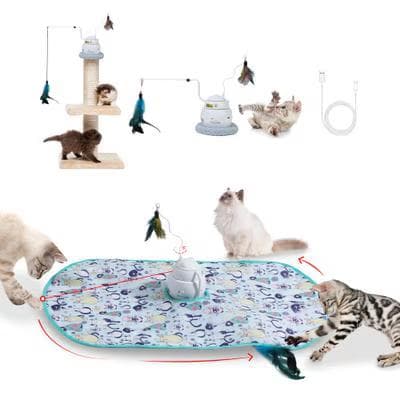
- Concealed motion mat or tunnel. A fabric mat or tube with a wand travelling underneath, so the cat sees a lump darting under the surface and cannot see what makes it move. The pattern is a concealed dart, which reads as hidden prey and is the single most convincing motion for a cat with a real prey drive.
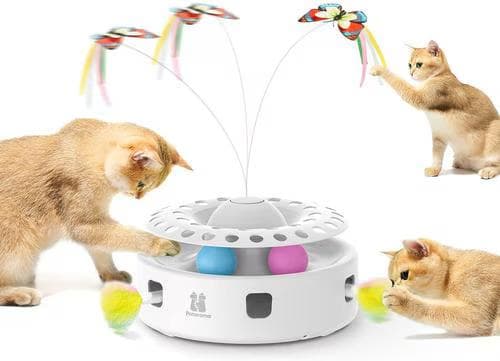
- Rotating feather base. A weighted disc with an arm that sweeps a feather or ribbon in a circle at floor level. The pattern is a rotating arc, sometimes with a stutter built in. Easy to catch, which is a strength and a weakness at once. The Potaroma 3 in 1 Automatic Interactive Butterfly Cat Toy is a current example; inspect its attachments before every supervised session.
- Moving fish or plush kicker. A soft toy with a vibration motor that flops and twitches when touched. It invites the bunny-kick grab rather than the chase, which suits cats who wrestle more than they sprint.
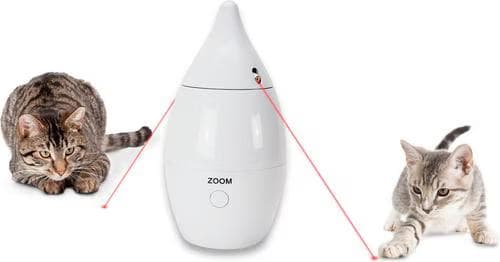
- Automatic laser. A wall-powered or battery unit that projects a dot in shifting patterns across the floor and walls. The PetSafe Zoom Rotating Laser Cat Toy is a widely sold example of the rotating kind. It is the format cats chase hardest and the one with the biggest behavioral catch, covered later in this guide. The PawsPik Interactive 4-in-1 Laser & Hide & Seek Rechargeable Automatic Cat Exercise Toy is another multi-mode option, but its laser play still needs to finish on a physical toy the cat can catch.
Webvet may earn a commission when you click through to Chewy, at no extra cost to you.
So do motion activated cat toys actually work? For the right cat, yes, with two honest caveats. They reliably produce short bursts of genuine chasing in cats who are already inclined to hunt, and the unpredictable pause built into better models is the reason: a toy that stops moving at random intervals holds attention far longer than one that runs at a steady speed. What they do not do is entertain a cat for hours, and they do not create interest in a cat who has none. Engagement is also perishable. A toy that produces a frantic first week frequently gets ignored by the third, which is a rotation problem rather than a product defect.
Webvet may earn a commission when you click through to Chewy, at no extra cost to you.
Batteries, charging, and how long a play session lasts
This is the number almost nobody publishes. Read through the buying guides and the product listings and you will find charging ports, motion patterns, and color options, but hardly ever a straight answer to how long the toy actually moves before it needs power again. The single most consequential detail for a home-alone purchase is the one missing from the category.

How long the batteries last in an automatic cat toy depends far less on the cell than on how the toy behaves between triggers. A rechargeable ball that sleeps between bursts and only wakes when a cat approaches can stretch a single charge across several days of light use, because it spends most of its life drawing almost nothing. The same cell in an always-on toy is flat in an afternoon. Replaceable AA and AAA formats generally last longer in calendar terms simply because their motors are smaller and their cycles shorter, and because you can swap in fresh batteries in ten seconds rather than waiting on a cable. When a listing publishes no run time figure at all, and most do not, assume short. Assume a burst measured in minutes, not a session measured in hours, and plan to put the toy on the charger the same way you plan any other weekly household task.
| Format | Power source | Typical charging pattern | Shuts itself off | What that means for a workday |
|---|---|---|---|---|
| Rolling or self-propelled ball | Built-in rechargeable cell, USB cable | Charge overnight, top up every few days of daily use | Usually yes, after an idle period | Covers scattered bursts, not the whole day |
| Concealed motion mat or tunnel | Replaceable AA or AAA batteries | Swap batteries, no cable needed | Often on a fixed timed cycle | Runs longest of the powered formats because the motor is small |
| Rotating feather base | Replaceable batteries or built-in cell | Varies widely by model | Commonly yes, on a timed cycle | Short bursts only, and the feather is a put-away part |
| Moving fish or plush kicker | Built-in rechargeable cell, USB cable | Charge between sessions | Yes, motion woken with a standby state | Suits a cat who kicks and bites rather than chases |
| Automatic laser | Wall power or built-in cell | Mains models never need charging | Yes, on a fixed timed cycle | Runs reliably, but the target can never be caught |
| Non-powered track or spring toy | None | Nothing to charge | Not applicable | Available all day, driven entirely by the cat |
The comparison above is drawn from published product specifications and from how each format behaves as a category, not from bench testing, and individual models vary. Treat it as a way to read a listing rather than a promise about a specific toy.
There is one more entry worth adding to any household that relies on a powered toy: a backup with no battery in it at all. A bag of soft toys such as the Fashion's Talk 18 Piece Plush Catnip-Filled Mice Cat Toys never runs out of charge, never needs a cable, and can be scattered in different rooms so there is always something to find. A track toy such as the Catstages Tower of Tracks Interactive Cat Toy fills the same gap from the other direction: the balls stay captive inside their rings, so there is nothing to charge and nothing to come loose, though a cat who wants unpredictable movement works out soon enough that the ball is not going anywhere. When the powered toy is dead on the charger, that is what the cat has.
Webvet may earn a commission when you click through to Chewy, at no extra cost to you.
Auto shut-off, sleep mode, and what happens when nobody is home
Auto shut-off is the feature that decides whether a toy is usable for a workday, and it is the one almost nobody explains. A listing may say the toy shuts itself off, but it rarely says what that means in practice: how long the burst lasts, how long the rest between bursts lasts, and whether the toy is quietly drawing power the whole time it waits.

Do automatic cat toys shut off by themselves? Most modern ones do, and they do it in one of two ways. A timed model runs a fixed burst, commonly a few minutes, then powers down for a set rest period before the next cycle. A motion woken model runs its burst and then drops into a low-power standby, staying dark until a sensor is triggered again. The second behavior is the one you want for an empty house, because it rations the battery across the whole day instead of spending it in the first hour. A toy with no shut-off at all is the worst possible choice for the situation people buy these toys for. It will be flat by lunchtime, and until then it will be moving whether or not any cat is interested.
Owner complaints about these toys cluster into four recurring problems, and three of them trace straight back to shut-off behavior:
- It gets ignored after a week. Constant availability kills novelty. A toy that is always on the floor stops being an event. Put it away between uses and bring it out on a rotation with two or three other toys.
- It dies in the middle of a session. Usually a timed or always-on toy that has been running to an empty room, or a rechargeable cell that never got put back on the cable.
- The cat can never catch it. A design problem rather than a power problem, and the most important one in this guide.
- It wakes the household at three in the morning. A motion woken toy left switched on will happily trigger at any hour a cat wanders past it.
Automatic cat toys for when you are away
Can you leave an automatic cat toy running while you are at work? Running, no. Available, yes, if it is the right kind of toy and the room is set up for it. A motion woken toy left switched on in a cat-safe room is a reasonable thing to do, because it costs almost nothing between triggers and it gives the cat something to find when it wakes up. What you cannot do is expect it to be moving when you get home, or expect it to have filled the day. An always-on or timed toy left running for eight hours will be flat within a fraction of that and will have spent most of its charge performing to an empty room.
It also helps to be realistic about how much of that workday the cat is even awake for. Adult cats sleep for most of the day, and how much cats sleep reframes the entire home-alone question: you are not filling eight hours of boredom, you are supplying two or three short windows of activity that happen at times you cannot predict. A toy that wakes on demand serves those windows well. A toy that has to be running when the window opens almost never is.
Set the room up before the toy matters:
- Pick a hard floor. Rolling and self-propelled formats stall on thick carpet and burn their charge fighting the pile.
- Close the door on hazards. Cords, blind pulls, houseplants, and open toilets are the ordinary risks in any room a cat spends unsupervised hours in, and a moving toy pulls the cat into corners it would otherwise ignore.
- Clear a run. A toy that immediately wedges under the sofa is a toy that stopped working two minutes after you left.
- Give the cat somewhere else to be. Most cats spend the workday watching, not hunting. A window spot near a bird feeder does more per hour than any motor, and something like the Frisco Plush Cat Window Perch with Removeable Bolster, Cream turns a bare sill into a place a cat will actually settle.
Webvet may earn a commission when you click through to Chewy, at no extra cost to you.
One important caveat before you buy anything for the empty-house problem. If your cat is not bored but distressed when you leave, pacing, vocalizing, toileting outside the box, or refusing food until you return, a toy is the wrong intervention entirely. That pattern is a welfare question rather than an enrichment one, and the cat anxiety guide is where to start instead.
Supervision and safety before you leave the room
Buying guides for this category routinely recommend toys with feathers, ribbons, and small detachable parts, and they recommend them for cats who will be alone with those parts for hours at a time. What they almost never mention is swallowing. That gap is the reason this section exists.

Are motion activated cat toys safe to leave out unsupervised? Some are. The test is not the brand or the price, it is whether anything on the toy can come off, wrap, or be swallowed. A sealed one-piece ball with no attachments and a closed battery compartment is a reasonable thing to leave on a hard floor in a cat-proofed room. A toy with a feather on a string, a clip-on tail, a glued-on pom, or a battery door that pops open is a supervised-play item only, no matter how good the motion is.
Safe to leave out unattended:
- Sealed one-piece movers with no attachments and a screwed or latched battery compartment
- Non-powered track and spring toys with captive balls
- Sturdy plush kickers with no dangling ribbons or loose thread
- Anything you have already watched the cat use hard for a full session without a piece coming loose
Put away before you walk out the door:
- Wand toys, feather attachments, and anything on a string, ribbon, or elastic
- Small detachable parts: clip-on tails, pom-poms, plastic eyes, replaceable feather heads
- Charging cables, which are a chew and strangulation risk in their own right and should never be left plugged in and trailing
- Any toy with a cracked shell, a loose battery door, or a part the cat has already started to work loose
The room matters as much as the toy. Give the toy a hard floor with clear space, close the door on cables and blind cords, and check that there is no gap under furniture that a moving toy will disappear into and pull the cat after it. If you have a cat who chews soft goods, and some cats reliably do, no attachment-bearing toy stays out, full stop. Kittens raise the bar further, because they mouth everything and are small enough to get into the spaces adult cats cannot; sizing and life-stage supervision rules live in the kitten toys guide.
Which cats engage with automatic toys and which ignore them
Almost nothing written about this category tells you which cats do not engage with automatic toys. It is all written as though every cat plays the same way, which is exactly why so many of these toys end up in a cupboard within a fortnight of arriving.

Which cats ignore automatic cat toys? The reliable non-starters are senior and arthritic cats, for whom a fast erratic mover is uncomfortable rather than interesting; low prey drive cats who were never much for chasing anything; noise-sensitive or nervous cats, who read a motor whine and a sudden start as a threat and give the toy a wide berth; and cats who need to catch what they chase, who will engage for a minute and then disengage in obvious frustration. Food-motivated cats are a fifth group: they will generally choose a foraging challenge over a moving object every time. Watching from a distance without approaching is the tell in every one of these cases, and it means the answer is a different kind of enrichment rather than a faster toy.
| Cat profile | Format that usually fits | Format to avoid | What to try instead when nothing lands |
|---|---|---|---|
| Young adult, high prey drive | Self-propelled ball or concealed motion mat | Slow rotating feather that is caught in seconds | Rotate two toys weekly so neither goes stale |
| Sound-driven hunter | Motion-triggered crinkle or chirp toys | Silent rolling ball | Pair a quiet mover with a crinkle tunnel |
| Food-motivated cat | Nothing powered | Any toy competing with a food source | A feeding puzzle at the same time each day |
| Senior or arthritic cat | Low, slow, floor-level movers | Fast erratic balls and anything that demands a jump | Short, gentle wand sessions at ground level |
| Low prey drive cat | Scent-driven static toys | Anything battery powered | Silvervine or catnip on a plush toy |
| Noise-sensitive or nervous cat | Nothing motorized | Motor whine, hard-floor rattle, abrupt starts | Window perch, scent enrichment, quiet foraging |
| Multi-cat household | One toy per cat, in separate rooms | A single shared mover | Supervised sessions until you know who guards what |
Watch the cat rather than the toy when you are judging engagement. A cat with dilated pupils, forward ears, and a low crouch is hunting. A cat with a twitching tail tip, flattened ears, and a hard stare is over-aroused and heading for a swipe. A cat who leaves the room has told you the answer. Reading cat body language is the difference between a toy that is working and one that is winding the cat up.
If your cat falls into the ignore column, scent is usually the more productive lever. A sprinkle of SmartyKat Silvervine Cat Attractant Catnip, 2-oz canister on a plain plush toy reaches a different response system than motion does, and it reaches some of the cats that catnip alone misses. If you would rather buy the scent already inside the toy, the Yeowww! Catnip Yellow Banana Cat Toy is a firm catnip-stuffed kicker that gives the back feet something to work against, which suits a cat who would rather wrestle than sprint. It only does anything for a cat who responds to catnip at all, so let the first session decide before you buy a second one. The catnip toys guide covers which cats respond, why a sizeable minority do not respond at all, and how silvervine changes the odds.
Why an automatic toy does not replace interactive play
You will see this stated in one throwaway sentence and then dropped: an automatic toy should not replace interactive playtime. Almost nobody says why. Here is the reason behind that sentence, because the reason changes how you use the toy.

Cat play is a compressed hunting sequence, and it runs in a fixed order: stare, stalk, chase, pounce, catch, bite, and then a final settling once the prey is subdued. Every stage sets up the next, and the sequence is designed to end. A cat who completes it typically grooms, eats, and sleeps. A cat who is interrupted before the catch stays switched on, and that leftover arousal is where redirected swatting, midnight sprinting, and biting the nearest ankle come from.
Here is where each self-powered format breaks the chain:
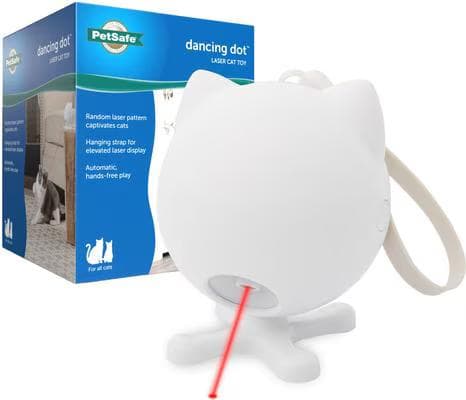
- Automatic laser. Breaks it hardest. A dot can be stalked and chased but never caught, never bitten, and never subdued. The cat can run the first four stages indefinitely and never reach the fifth. That is true of every unit in the format, a popular one like the PetSafe Dancing Dot Laser Cat Toy included, which is why a laser earns its place as a short burst you are there to close out rather than as the toy you leave running. If you use one, always end the session by landing the dot on a physical toy the cat can grab, so the sequence closes on something real.
- Self-propelled ball. Catchable in principle, but the moment a paw pins it the motor keeps pushing and the ball squirts away again. Many cats read that as the prey escaping and re-engage; some read it as failure and quit.
- Concealed motion mat. The best of the powered formats for completion, because the cat can trap the moving lump under the fabric and feel it stop.
- Rotating feather base. Easily caught, which is why cats often lose interest fast. The sequence completes on the first pounce and there is nothing left to do.
- Plush kicker. Completes the catch and bite stages well, which is exactly why cats who wrestle more than they sprint tend to like them.

So do automatic cat toys replace playing with your cat? No, and the reason is structural rather than sentimental. A motorized toy can supply movement, but it cannot read the cat, cannot hesitate when the cat freezes, cannot let itself be caught at the right moment, and cannot end the session deliberately. Those are the parts of play that turn arousal into satisfaction. The fix is small: ten to fifteen minutes a day with a wand, moved like prey rather than waved like a flag, drawn away from the cat and never toward it, allowed to be caught two or three times, and finished with a real catch before a meal. That is the session an automatic toy supplements. Full technique, timing, and toy choice for that session belong to the interactive cat toys you play with together guide.
Choosing and buying an automatic cat toy
What should you look for when buying an automatic cat toy? Work through the listing in this order, because the specs that matter are rarely the ones on the front of the box:
- Trigger type. Confirm it is motion woken rather than always-on. If the listing does not say, assume the worse case and expect it to burn its charge unattended.
- A stated shut-off or sleep behavior. A model that tells you what it does after a burst has thought about the empty-house case. One that says nothing usually has not.
- Power source and swap effort. Rechargeable is convenient right up until the cable is on the wrong floor of the house. Replaceable batteries are less elegant and far more reliable for a toy you want available every day.
- Attachment count. Every feather, string, clip, and pom is one more thing to put away. A toy you want to leave out should have none.
- Noise. Motor whine and a plastic shell rattling across floorboards are the two most common reasons a nervous cat never approaches. If the listing has a video, listen to it.
- Surface fit. Rolling formats need hard floors. Mat and tunnel formats work anywhere.
- Obstacle behavior. Better models change direction on contact instead of grinding against the skirting board until the battery dies.
- Repairability. Feather heads and battery doors wear out first. A model that sells replacements lasts a year longer than one that does not.
Two products worth knowing by format rather than by brand loyalty: the SmartyKat Hot Pursuit Electronic Concealed Motion Cat Toy is the archetype of the concealed motion mat, and the Catit Groovy Fish is the archetype of the plush kicker with a vibration motor. If you want the whole category rather than the self-powered corner of it, the best cat toys guide covers wands, puzzles, scratchers, and plush alongside the powered options.
Buy one toy, not three. Rotation only works if the cat has not already seen everything you own.
What automatic cat toys cost and what the price buys
Are cheap automatic cat toys from Amazon any good? Some are, and the price is a poor predictor on its own. What price does reliably buy is documentation and durability rather than better play. A budget toy and a premium toy often produce a similar first week; the difference shows up in month three, when the cheap motor has slowed, the shell has cracked, or the toy has been ignored because it only ever did one thing.
| Price band | What the tier typically includes | Where it falls short |
|---|---|---|
| Budget | One motion pattern, replaceable batteries, light plastic shell, no documented shut-off | Motor noise, short life under heavy play, no published run time |
| Midrange | Rechargeable cell and USB cable, randomized motion, a stated auto shut-off or sleep mode | Attachments still need putting away, replacement parts rarely sold |
| Premium | Obstacle sensing, multiple speeds, schedule or app control, sturdier housing, published charge specs | Costs more than most cats' engagement justifies, and still cannot be caught |
The bands above reflect how current retail listings cluster rather than any fixed price, and listings change constantly. Read them as a guide to what to expect at each level, not as a quote.
The most common expensive mistake is buying up a tier to solve an engagement problem. If the cat ignored the budget rolling ball, a premium rolling ball with three speeds will usually be ignored too, because the objection was to the format and not to the build quality. Change format or change approach before you change price.
Toys for a bored indoor cat
If you landed here because the cat is bored rather than because you specifically wanted something motorized, the self-powered category is a narrow slice of the answer and probably not the best place to start. Boredom-driven toy selection for indoor cats, including the non-powered options that outlast every battery, is covered in cat toys for bored indoor cats.
For solo time specifically, play puzzles are the other genuine option and often the better one, because the cat sets the pace and there is nothing to charge. Difficulty tiers and how to introduce one without frustrating the cat are covered in cat puzzle toys for solo play.
One search variant worth closing off: outdoor motion activated products sold for cats are almost entirely deterrent sprinklers designed to repel cats from gardens. They are a different product with the opposite purpose, and nothing in this guide applies to them.
Motion activated cat toy questions
Frequently Asked Questions
How long do the batteries last in an automatic cat toy?
It depends far more on the toy's idle behavior than on the battery itself. A motion woken toy that drops into standby between bursts draws almost nothing while it waits, so a single charge or battery set can spread across several days of ordinary use. The same power in an always-on toy is gone in an afternoon, because the motor runs whether or not a cat is in the room. Most listings publish no run time figure at all, so plan for bursts measured in minutes and put charging on a weekly household routine.
Do automatic cat toys shut off by themselves?
Most current models do, in one of two ways. Timed models run a fixed burst, commonly a few minutes, then rest for a set period before cycling again. Motion woken models run their burst and then drop into a low-power standby until the sensor is triggered again. The second behavior is what you want for a workday, because it rations power across the whole day instead of spending it in the first hour. A toy with no shut-off is the wrong choice for an empty house, and the listing should tell you which kind you are buying.
Are motion activated cat toys safe to leave out unsupervised?
Some are. The test is whether anything can come off, wrap, or be swallowed. A sealed one-piece mover with no attachments and a latched battery compartment is reasonable to leave on a hard floor in a cat-proofed room. Anything with a feather, string, ribbon, clip-on tail, or loose battery door is a supervised-play item only, and charging cables should never be left plugged in and trailing. Swallowed string is a genuine emergency rather than a wait-and-see problem, so put string-bearing toys away before you leave.
Which cats ignore automatic cat toys?
Senior and arthritic cats, for whom fast erratic movement is uncomfortable rather than interesting. Low prey drive cats who were never inclined to chase. Noise-sensitive or nervous cats, who read a motor whine and a sudden start as a threat. Food-motivated cats, who choose foraging over movement almost every time. And cats who need to catch what they chase, who engage briefly and then quit in visible frustration. Watching from across the room without approaching is the shared tell, and it means a different kind of enrichment rather than a faster toy.
Can you leave an automatic cat toy running while you are at work?
Running, no. Available, yes. Leaving a motion woken toy switched on in a cat-safe room is sensible, because it costs almost nothing between triggers and gives the cat something to find whenever it wakes. Expecting it to still be moving when you get home is not realistic, and an always-on or timed toy left for eight hours will be flat long before then. Remember that adult cats sleep through most of the workday, so you are serving two or three short activity windows rather than filling the whole day.
Do automatic cat toys replace playing with your cat?
No. A motor can supply movement, but it cannot read the cat, hesitate when the cat freezes, let itself be caught at the right moment, or end the session deliberately. Those are the parts that let a cat finish the hunting sequence and settle afterward. Ten to fifteen minutes a day with a wand, drawn away from the cat rather than toward it, allowed to be caught a few times and finished with a real catch before a meal, does more than any automatic toy. Treat the automatic toy as a supplement to that session.
Are automatic cat toys safe for kittens?
Kittens need tighter rules than adult cats, because they mouth almost everything, they are small enough to get behind and under furniture a moving toy disappears into, and they have not yet learned to moderate a pounce. Sealed one-piece toys with no attachments are the only category worth considering unsupervised, and even then supervision is the safer default at that age. Kitten-specific sizing, material, and life-stage supervision rules are covered in the kitten toys guide.
Do puzzle toys keep a cat busier than automatic toys?
Usually yes, for solo time. A puzzle lets the cat set the pace, rewards persistence, has nothing to charge, and does not go dead partway through the afternoon. An automatic toy produces more intense bursts but shorter total engagement, and it depends on the cat being in a hunting mood at the moment it triggers. Many households do best with both: a puzzle for the long empty stretch and a motion woken toy for the burst. Difficulty tiers and introduction technique are covered in the cat puzzle toys guide.
Sources

Editor
The Webvet Editorial Team is the in-house group of pet-care editors and writers behind Webvet, operated by Smart Pet Collective. The team researches, writes, and maintains Webvet's pet health, behavior, and medication content. Every article follows a defined editorial process: research from reputable veterinary and scientific sources, careful drafting, mandatory review of medical content by a credentialed veterinarian, and dated publication. Health and medication articles are medically reviewed by a licensed veterinary professional before they go live and are kept current over time.


