The Best Cat Toys, Chosen by How Cats Actually Play
Cats play in five stages, and most toys only cover one of them. Here is how to match wand, solo, scent, and puzzle toys to the prey sequence, how often to rotate them, and which ones are never safe to leave out.

This article contains affiliate links. Webvet may earn a commission when you buy through them, at no extra cost to you.
The best cat toys are the ones that let a cat finish a hunt. Cats play through a five stage prey sequence (stare, stalk, chase, pounce, and the kill bite), and a toy holds a cat's attention only when it satisfies a stage that cat is still trying to complete. That is why a household can own twenty toys and still have a restless cat. Almost all twenty cover the same one or two stages, and the rest of the sequence never gets finished.
So the useful question is not which product scored highest on somebody's list. It is which stages your cat is missing, whether you have to be holding the toy for those stages to happen at all, and what should never be left on the floor unsupervised. This guide sorts the major toy types against the prey sequence, gives you a rotation habit so novelty stops running out, and hands the deeper picks to the guides that own them.
- 1Cats hunt in five stages (stare, stalk, chase, pounce, and the kill bite), and a toy fails when it only repeats a stage your cat has already had enough of.
- 2Wand toys outperform every other category because a person holding one can drive all five stages in a single session, which nothing a cat has to start alone can do.
- 3A workable household set is two or three human held toys, a handful of solo toys the cat can carry and rabbit kick, and one puzzle that makes the cat solve something.
- 4Two short sessions a day of roughly ten to fifteen minutes, each ended on a catch the cat can physically hold and bite, beats an hour of toys lying on the floor.
- 5Keep four or five toys out at a time and swap them from a stored bin every week or two, because novelty loss rather than poor quality is why most toys stop working.
- 6String, ribbon, tinsel, and hair ties carry the highest ingestion risk in the house and belong in a closed drawer between supervised sessions.
- 7A cat that suddenly plays less is far more often reporting pain, stiffness, or illness than expressing an opinion about the toy.
The best cat toys, matched to how cats play
Every cat toy sold falls into three functional groups. Human held toys are lures you drive: wands, teasers, and strings on a rod. Solo toys are objects a cat can operate alone: mice, balls, kickers, tunnels, and scent toys. Problem solving toys make the cat work for an outcome: puzzles, treat balls, and activity boards. A complete collection carries all three, because no single group covers the whole prey sequence on its own.
What are the highest rated cat toys?
The categories that earn the strongest and most consistent owner ratings are the simple ones: feather teaser wands, catnip and silvervine plush, kicker toys, food puzzles, and collapsible fabric tunnels. Complexity and price track poorly with satisfaction, because a rating mostly reflects whether the cat engaged at all rather than how the toy was engineered. A classic feather teaser like the Frisco Bird with Feathers Teaser Wand Cat Toy with Catnip, Blue keeps turning up near the top of those lists for one reason: a person holding it can run stare, stalk, chase, and pounce in a single unbroken sequence, then drop it for the bite.
Webvet may earn a commission when you click through to Chewy, at no extra cost to you.
Those five categories hold up because between them they cover the entire hunt. Here is the sequence a cat is trying to complete, what each stage needs from a toy, and how the gap shows up in the living room when a stage never gets finished.
| Prey stage | What the cat needs from a toy | Solo or interactive | What it looks like when this stage is skipped |
|---|---|---|---|
| Stare | Movement at a distance that appears and disappears, like a lure edging out from behind a chair leg | Either | The cat watches birds at the window but never commits to the toy in the room |
| Stalk | Cover to crouch behind and a target that moves away rather than toward the cat | Interactive | The cat freezes in the doorway and will not close the distance |
| Chase | Fast, low, erratic travel across the floor with sudden direction changes | Either | The cat starts, gives up within seconds, and walks off |
| Pounce | A target that lands and holds still long enough to be pinned under the front paws | Either | The cat swats, misses repeatedly, and quits frustrated |
| Kill bite | Something it can grab, bite, and rabbit kick with the hind legs | Solo | The cat redirects onto ankles, wrists, and passing hands after play |
Read down that last column and most owners can diagnose their own cat in one pass. Ankle ambushes after a laser session are a missing kill bite. A cat that watches a toy from six feet away and refuses to approach is missing cover for the stalk. Most top 10 cat toys lists and best cat toys 2026 roundups rank products against each other, which is the wrong axis. The gap in your cat's day is a stage, not a brand.
A starter set for one indoor adult cat looks like this, and it is smaller than most people expect:
- Two or three wands with different lures (feather, fabric strip, and something that skitters rather than flies).
- Four to six solo toys the cat can carry in its mouth and kick with the hind legs.
- One tunnel or open paper bag for cover during the stalk.
- One puzzle or treat dispensing toy the cat has to solve.
- One scent toy that can be refreshed rather than replaced.
Everything else is a variation. Buying a twelfth crinkle ball does not add a stage; it adds another copy of the pounce.
Wand and chase toys: the prey sequence in your hand
What toy do cats like the most? Wand toys, and not by a narrow margin. A wand is the only toy category a human can drive through all five stages of the hunt, which means it is the only category that can deliver a complete, satisfying sequence on demand rather than by luck. Everything else covers a fragment. A ball rolls, so it serves the chase. A mouse can be bitten, so it serves the kill. Only a wand in a person's hand can hide behind a chair, creep out, dart away, freeze, and then be caught.

That is also why technique matters more than the toy. The most common mistake is waving the lure at the cat's face, which is the one movement no prey animal makes. Prey flees. Drive the lure the way a mouse or bird would move:
- Start the lure out of sight behind furniture and let only part of it show.
- Move it away from the cat in short bursts along the floor, never toward the cat.
- Freeze completely when the cat locks on, and let the tension build.
- Break sideways so the cat has to change direction mid chase.
- Let the lure land and stay still so the cat can pounce and pin it.
- Finish by letting the cat hold the catch and bite it for several seconds before you pack the wand away.
Two sessions a day is a reasonable target for a healthy adult cat, roughly ten to fifteen minutes each, ideally one in the morning and one in the evening when cats are naturally most active. Short and complete beats long and formless. A session that runs three minutes and ends with the cat panting slightly and carrying its catch away has done more than twenty minutes of half hearted waving.
Two wands come up by name more than any others. The Cat Dancer Interactive Cat Toy is a simple bent cardboard tube threaded on springy steel wire, and the reason a cat dancer toy works so well is the wire: it moves unpredictably with almost no input, which is much closer to real prey than a rigid rod. Da Bird is the other long running name in this category, built around a feather assembly that spins as it falls. Both are cheap, both are string based, and both belong in the drawer when the session ends.
Solo play while you are out
Solo play is the part of the sequence a cat can complete without you. Specifically, it is the kill bite: an object the cat can grab, carry, bite, and rabbit kick with the hind legs. Small plush mice are the archetype because they are mouth sized, light enough to be flung and chased, and cheap enough to scatter through the house so the cat keeps finding them. A multipack like the Fashion's Talk 18 Piece Plush Catnip-Filled Mice Cat Toys exists for exactly that reason, since half of them will end up under the sofa within a week.

Kicker toys are the same idea at a larger scale. A long plush cylinder such as the Kong Kickeroo gives the hind legs something to work against, which is the movement cats use to finish real prey and the movement that hands and forearms most often stand in for. If your cat grabs your arm and kicks it, the fix is not discipline. It is a kicker toy left where the ambushes happen.
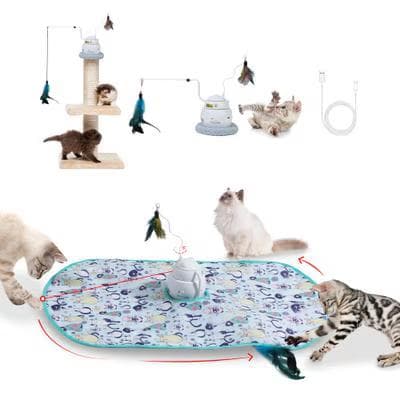
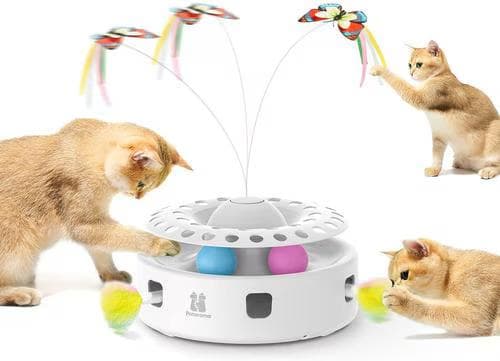
What solo toys cannot do is start the hunt. A mouse on the floor does not stalk, flee, or change direction, so a cat that only has solo toys never gets stages one through three. A track toy such as the Catstages Tower of Tracks Interactive Cat Toy gets partway there, since the ball moves when the cat swats it and cannot be swallowed or batted under the sofa, though it still waits to be started rather than fleeing on its own. Motion activated and battery driven devices try to close that gap while you are out, and some do it well. That whole category, including which ones actually trigger a chase and which ones cats ignore by day three, belongs to our guide to automatic cat toys. Current examples include the PawsPik Interactive 4-in-1 Laser & Hide & Seek Rechargeable Automatic Cat Exercise Toy and the Potaroma 3 in 1 Automatic Interactive Butterfly Cat Toy; supervise early sessions and remove any loose attachments afterward.
Webvet may earn a commission when you click through to Chewy, at no extra cost to you.
Leave the right things out and put the rest away. A safe unattended set looks like this:
- Plush mice and kickers with no glued on eyes, bells, or plastic noses that can be chewed loose.
- Solid balls too large to swallow, including ping pong balls and crinkle balls.
- Tunnels, boxes, and paper bags with the handles cut off.
- Battery powered toys only if the battery compartment screws shut.
- Nothing with a string, ribbon, feather stalk, or wire attached, and no wand of any kind.
Owners often ask what a cat is actually experiencing during those hours. Play is only one input, and for cats that pace, vocalize, or over groom when the house empties, the real subject is stress rather than boredom. Our article on cat anxiety when left alone covers what separation distress looks like and what helps, which is a different problem from an under stimulated cat with nothing to chase.
Interactive toys you play with together
Interactive means a human is part of the toy. That includes wands, lures, laser pointers, and any game where the movement comes from you, and it is the half of the collection that indoor cats are most often short of. Environmental enrichment guidance from feline veterinary groups consistently treats human directed play as a daily need rather than an optional extra, in the same category as vertical space and safe resting places.

The signal that a session is working is in the cat's body, not the clock. During good play the pupils widen, the ears swivel forward, the tail tip twitches, and the hind feet shuffle before a pounce. The signals that a session has tipped over are different: a thrashing tail, ears rotating flat or sideways, skin rippling along the back, and a hard stare that no longer follows the toy. That is overstimulation, and continuing past it is how play aggression gets rehearsed. Our guide to reading your cat's body language breaks those signals down in detail.
Three rules keep interactive sessions productive:
- Never let hands, feet, or clothing become the toy, even with a kitten, because a cat cannot tell which arm is the game later.
- Stop while the cat still wants more rather than when it is exhausted, so the association with the toy stays positive.
- End every session with a catch the cat can hold, then feed shortly afterward if the schedule allows, which mirrors the hunt and eat pattern cats settle into naturally.
Choosing between specific wands, teasers, tracks, and app driven devices is a longer decision than this section can carry. Our roundup of interactive cat toys works through the picks by household type, including what to buy when nobody has twenty minutes to spare.
Stimulating toys for indoor cats
What is the most stimulating toy for cats? It depends which kind of stimulation is missing, because the two are not interchangeable. Physical stimulation is the sprint and the leap, and a wand toy delivers it better than anything else. Mental stimulation is problem solving and novel sensory input, and that comes from puzzles, scent, texture, and changing surroundings. A cat that gets one and not the other stays restless, which is why the best cat toys for mental stimulation are rarely the same objects as the ones that make a cat run.
Scent is the cheapest mental stimulation available and the one most owners underuse. A loose catnip or silvervine attractant such as SmartyKat Silvervine Cat Attractant Catnip, 2-oz canister turns a toy the cat has stopped noticing back into a novel object, which means a canister can extend the life of a dozen toys instead of replacing them. Rub it into a plush mouse, a scratching pad, or the inside of a cardboard box and the cat has a new thing to investigate without a new thing entering the house.
For an indoor cat, the room does as much work as the toys. The best cat toys for indoor cats are the ones that use the space you already have, and the best stimulating cat toys for indoor cats tend to be the ones that add height, cover, or a view rather than another object on the floor:
- Vertical routes: shelves, a tall cat tree, or a cleared bookcase top so the cat can move above eye level.
- Window access with a perch and, if you can, a feeder or bird bath positioned outside it.
- Cover at floor level: tunnels, open boxes, and paper bags that create stalking lanes across a room. A collapsible option like the Frisco Foldable Play Tunnel with Mesh Cat Toy, Baltic Teal folds away when you need the floor back, but put it along a route the cat already walks, because a tunnel parked in an unused corner gets ignored.
Webvet may earn a commission when you click through to Chewy, at no extra cost to you.
- Texture variety: sisal, cardboard, carpet, and crinkle material, since cats sample surfaces with paws and claws.
- Rotating scent objects, including a fresh cardboard box, which is genuinely novel for a few days and costs nothing.
When people go looking for stimulating cat toys for indoor cats, the underlying problem is almost always the same: a cat with plenty of objects and nothing to do. Objects are not activities. A toy becomes an activity when it moves, hides food, smells new, or has a person on the other end of it.
When boredom is the real problem
Some cats do not need a better toy. They need more to do, and the toy is the last thing anyone checks. Boredom in a cat rarely looks like lying around. It looks like activity aimed at the wrong target:
- Yowling at night, or pacing between rooms with no destination.
- Over grooming, often down to a thin or bald patch on the belly or flank.
- Counter surfing and pushing objects off shelves deliberately while watching you.
- Ambushing ankles, hands, or a housemate cat with no warning and no wind down.
- Eating out of restlessness rather than hunger, and asking for food between meals.
Those behaviors also overlap with stress, pain, and simple habit, so the sequence matters. Rule out a medical cause with a vet first if the change was sudden, then look at the day the cat is having: how many minutes of directed play, how much vertical space, how much of the food comes from a bowl, and how much of the house the cat actually uses.
Scratching is a common casualty of this confusion. Owners buy toys to fix furniture damage, but scratching is a marking and stretching behavior, not a play behavior, and no toy replaces an appropriate post. If that is the actual issue, our article on what to do when a cat won't use the scratching post is the right place to start.
For a full enrichment plan, including how to structure a day for an understimulated indoor cat, see our guide to the best cat toys for bored cats and the wider fixes in toys for a bored indoor cat.
Catnip and scent driven toys
Catnip is not the only option, and it is not universal. Response to catnip is inherited, and a real share of cats show no reaction to it at all, which is worth knowing before you conclude your cat is broken. Trying a different attractant is a more sensible next step than buying a third catnip mouse, because these plants work through different compounds:
- Catnip, sold loose, as a spray, or stuffed into plush toys, and the one most owners try first.
- Silvervine, sold as chew sticks, powder, and dried fruit galls, and often effective in cats that ignore catnip entirely.
- Valerian root, strongly stimulating for some cats and pungent enough that most people keep it in a sealed jar.
- Tatarian honeysuckle, usually sold as wood chips or shavings, and worth trying as a third option.
How the response looks also varies. Some cats roll, rub, and drool in a loose, sociable state. Others go still and quiet. A few get aroused enough to swat, which is a signal to give them space rather than keep offering the toy. The effect typically fades within minutes and cats then need a break of an hour or two before it works again, so leaving a catnip toy out permanently is the fastest way to make it stop working. That is also the argument for a catnip toy the cat can kick rather than just sniff. Something like the Yeowww! Catnip Yellow Banana Cat Toy is long enough to be grabbed with the front paws and worked with the hind legs, so a responder gets the scent and the kill bite from one object, and a cat that ignores catnip is still left with a usable kicker.
Webvet may earn a commission when you click through to Chewy, at no extra cost to you.
Scent toys are also the easiest place to add a second function. Chewing is a real need in cats, especially young ones and cats with no access to grass, and silvervine sticks give them something appropriate to gnaw on. A product like the SunGrow Silvervine Teething Chew Sticks Dental Treat & Feather Cat Toy with Catnip, 5 count pairs the chew with a feather, which is a reasonable bridge between a scent object and a play object. Chew sticks do shed fibers as they get worked, so they belong in the supervised pile rather than the leave out pile, and they should be replaced once they splinter.
Which attractant to buy, how the responses differ, and what to do with a cat that reacts to none of them is a full topic on its own. Our guide to catnip toys covers the alternatives and the non responders.
Puzzle toys that make cats work
A puzzle toy asks the cat to solve something before it gets a reward, and it is the only toy category that reliably tires a cat out mentally rather than physically. That makes puzzles the counterweight to wand play in a well built collection, particularly for cats that are physically fit, bored by mid afternoon, and inclined to invent their own entertainment on the kitchen counter.

There is a distinction worth keeping straight. A play puzzle is enrichment the cat solves for a small treat or a toy, used in short sessions. A feeding puzzle replaces the food bowl and delivers part or all of the daily ration through work, which changes how a cat eats rather than how it plays. Both are useful and they are not substitutes, and our guide to cat puzzle feeders covers the feeding side including how to transition a cat that has always eaten from a dish.
Start easier than you think you need to. A cat that fails a puzzle twice usually abandons it permanently, so the first version should be nearly free:
- Level one: treats visible and reachable with one paw, such as an open muffin tin or a wide mouthed ball that spills easily.
- Level two: treats visible but needing a deliberate move, like a rolling ball with a narrower opening or a sliding lid board.
- Level three: treats hidden, requiring the cat to remember where they were and use a sequence of moves, which is what boards like the Trixie Activity Board are built for.
- Level four: foraging spread through the room so the cat has to search rather than solve.
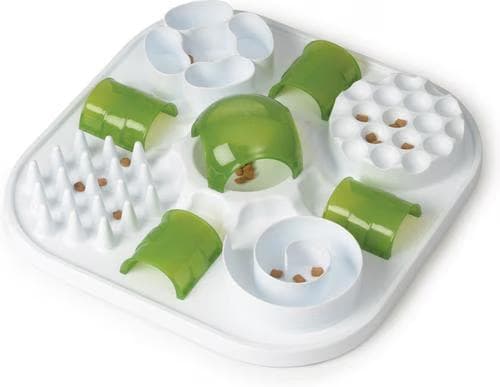
If you are shopping for that second level, the Catit Play Treat Puzzle Cat Toy, Green is the shape of thing to look for: treats the cat can see, sitting where a deliberate paw is needed to get them out. Keep it as the step up rather than the first purchase, because a cat that gets defeated twice tends to stop trying instead of practicing.
Move up a level only once the cat is finishing the current one quickly and without walking away. Selecting between board puzzles, rolling dispensers, and foraging mats is covered in our guide to cat puzzle toys.
Kittens need different toys
Kittens run the same prey sequence, but they run it constantly, clumsily, and with no sense of what is safe to swallow. Size is the first filter: anything small enough to fit entirely in a kitten's mouth, and anything with a bell, glued eye, pom pom, or feather that can be pulled free, is a swallowing risk in a way it may not be for a sedate adult.
The second difference is bite redirection. Kittens learn bite inhibition through play with littermates, and a single kitten in a home with no feline playmate practices on hands instead. The fix is to always have a toy between your skin and the kitten's teeth, and to end the game the instant teeth land on you rather than pulling away, which only triggers a stronger chase.
The third is supervision. Kittens should have wands, strings, and anything with attachments only while you are holding the other end, and a plain set of solid, unbreakable objects the rest of the time. Sizing, bite redirection, and what is safe to leave with a kitten alone are covered properly in our guide to kitten toys.
Toys for older cats
Senior cats still run the whole prey sequence. They just run it lower, slower, and in shorter bursts, and the mistake owners make is reading that as disinterest and quietly stopping the sessions. The best cat toys for older cats are the ones that move the hunt down to floor level and take the jumping out of it.

Adapt the session instead of quietly dropping it:
- Keep the lure on the ground and drag it, so a swat and a pin count as a successful catch.
- Run more sessions, each shorter, rather than one long one, since stamina fades faster than interest.
- Choose lightweight wands the cat can catch without a full body lunge, and soft targets that do not need force to grip.
- Put targets at heights the cat can reach from a sit, not a leap, and add a step or ramp to any perch it used to jump onto.
- Favor scent and puzzle work, which stay rewarding when the body slows down.
That distinction matters because reduced play is one of the earliest visible signs of pain or illness in cats, who hide both extremely well. Our article on senior cat mobility covers what is normal aging and what is not.
Toy safety and the rotation habit
Most toy injuries do not come from bad products. They come from good products left out unsupervised, and the single most dangerous category is the one almost every toy list recommends without a caveat: anything long and thin.
The rest of the safety routine is a habit rather than a rule book. Check toys before and after every session:
- Before play, tug every feather, bell, pom pom, plastic eye, and ribbon to confirm nothing is working loose.
- After play, count the wands, strings, and small parts back into the drawer, including the piece that came off mid session.
- Retire any toy with exposed wire, split seams, loose stuffing, or a chewed through battery cover.
- Never leave a wand hanging off a door handle or chair back, which is the most common way cats get to one alone.
- Keep hair ties, elastics, rubber bands, and sewing thread off counters and out of open bins entirely, since cats seek them out.

Rotation is the other half, and it is the cheapest upgrade available. Cats habituate fast: a toy that sits in the same spot for a month stops registering as an object worth investigating. The fix costs nothing.
- Pick four or five toys as the active set and put everything else in a closed bin.
- Swap the active set every one to two weeks, returning the old set to the bin rather than throwing it out.
- Keep the bin closed so stored toys hold their scent and stay novel.
- Refresh returning toys with catnip or silvervine before they go back out.
- Exempt the toys you control, since wands, puzzles, and anything you drive do not need rotating; they are new every time you pick them up.
If a toy comes back out of the bin and the cat still ignores it after two tries, it is not a rotation problem. Either the toy covers a stage your cat already has plenty of, or it is the wrong texture and weight for that cat's mouth. Pass it on and buy something from a different stage instead.
| Toy type | Safe to leave out unsupervised | Replace or retire when |
|---|---|---|
| Wand and teaser toys | No, never | Wire is exposed or the lure is chewed through |
| Plush mice and kickers | Yes, if nothing is glued on | Seams split or stuffing is coming out |
| Balls and crinkle balls | Yes, if larger than a mouthful | Cracked, sharp edged, or crushed flat |
| String, ribbon, and tinsel | No, never | Any fraying at all, or simply retire it |
| Puzzle and treat toys | Yes, if no small removable parts | Parts loosen or the cat has fully mastered it |
| Silvervine and chew sticks | No, supervised only | Fibers splinter or pieces break off |
| Laser pointers | No, never left running | Any session that cannot end on a physical catch |
Frequently Asked Questions
How long should I play with my cat every day?
Aim for two structured sessions a day of about ten to fifteen minutes each, ideally around dawn and dusk when cats are naturally most active. What matters more than total minutes is that each session runs a complete sequence and ends with a catch the cat can hold and bite. Many cats settle for a long nap afterward, which is the sign you got it right. Older cats and cats recovering from illness do better with three or four shorter sessions spread across the day rather than two longer ones.
Why does my cat ignore a toy after a day or two?
Two reasons, and they need different fixes. The first is habituation: a toy left in the same place stops being novel, which is solved by rotating a small active set in and out of a closed bin every week or two and refreshing toys with a scent attractant before they return. The second is that the toy only covers a stage your cat already gets plenty of. If your cat has six pounce toys and no way to stalk, a seventh pounce toy will be ignored no matter how new it is.
Are laser pointers bad for cats?
Lasers are not harmful in themselves as long as the beam is never aimed at eyes, but laser only play is a genuine problem. The cat completes stare, stalk, chase, and pounce, then finds nothing under its paws, so the sequence never closes. Over time that unresolved arousal shows up as pacing, restlessness, and redirected ambushing of ankles. Used properly a laser is fine: land the dot on a physical toy, switch it off while the cat is on top of that toy, and let the cat finish with a real catch.
Are string and ribbon toys safe for cats?
Only under direct supervision, with the string put away the moment the session ends. Swallowed string, ribbon, tinsel, floss, and hair ties can form a linear foreign body that bunches the intestine and requires emergency surgery, and cats are strongly drawn to exactly these items. Wand toys with string are excellent play tools while you are holding them and unacceptable risks lying on a floor. If you ever see string coming from your cat's mouth or rear, do not pull it. Go straight to a veterinarian.
What are the best cat toys for indoor cats?
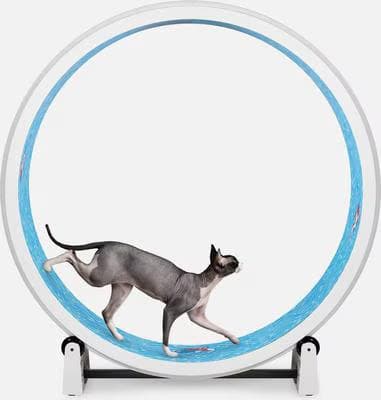
The set that covers what an indoor life removes: a wand for the hunt, solo toys for the kill bite, a puzzle for problem solving, and cover and height for stalking and surveying. Indoor cats are usually short on stalking cover and vertical routes rather than short on objects, so tunnels, boxes, shelves, and a window perch often change more than another purchase does. Scent rotation with catnip or silvervine is the cheapest way to keep the objects you already own interesting. For a healthy, high-energy cat that prefers sustained running, the One Fast Cat Gen 7 Exercise Wheel adds a different form of indoor exercise, though it needs a stable setup and a gradual introduction.
Do two cats still need me to play with them?
Yes. Cats that live together may wrestle and chase each other, but social play between cats is not the same as hunting, and it does not deliver the stalk and catch sequence a wand does. Multi cat households also need separate sessions in many cases, because a confident cat will monopolize the toy while a shyer one watches from the edge of the room. Play with each cat individually when you can, and watch for the quiet one being crowded out.
Do all cats like catnip?
No. The catnip response is inherited, and a meaningful share of cats show no reaction at all, including many kittens who typically do not respond until they are several months old. A non responder is not unusual and not a problem. Silvervine, valerian, and Tatarian honeysuckle act through different compounds, and cats that ignore catnip often respond strongly to one of them, so trying a different attractant is a better next step than assuming your cat dislikes scent toys.
Sources

Editor
The Webvet Editorial Team is the in-house group of pet-care editors and writers behind Webvet, operated by Smart Pet Collective. The team researches, writes, and maintains Webvet's pet health, behavior, and medication content. Every article follows a defined editorial process: research from reputable veterinary and scientific sources, careful drafting, mandatory review of medical content by a credentialed veterinarian, and dated publication. Health and medication articles are medically reviewed by a licensed veterinary professional before they go live and are kept current over time.


