Kitten Toys by Age: Safe Picks From 8 Weeks to 6 Months
Kitten toys sorted into four age bands, from an eight-week-old's first crinkle ball to a six-month-old's teething chews, with the string and small-parts hazards that matter for a small mouth, the fix for hand biting, and when catnip finally starts working.

This article contains affiliate links. Webvet may earn a commission when you buy through them, at no extra cost to you.
The right kitten toys depend less on what looks fun in the aisle and more on how old your kitten is this week. A nine-week-old has soft baby teeth, clumsy back legs, and a mouth small enough that one loose bell is a genuine choking risk. A five-month-old is a coordinated hunter with adult teeth pushing through and enough jaw strength to shred a thin plush in an afternoon. Buying for the wrong stage is how owners end up with a bin of ignored toys and a kitten who has decided hands are the best toy in the house.
This guide sorts kitten toys into four age bands, says plainly which ones are safe to leave on the floor and which come out only while you are watching, and covers the three problems that send new owners searching at 11pm: biting, teething, and string. It also settles the catnip question, because most young kittens ignore catnip completely and the toy is almost never the reason.
- 1Match the toy to the developmental stage rather than the price, because an eight-week-old and a six-month-old are physically different animals with different mouths, different coordination, and different risks.
- 2Play is how a kitten learns bite inhibition, which is the ability to control jaw pressure, and a kitten raised without litter-mates has to learn it from you and from the toys you choose.
- 3Hands, fingers, feet, and ankles are never toys, and a kitten who is allowed to practice on skin at ten weeks will still be doing it at ten months when the teeth are far bigger.
- 4String, ribbon, thread, tinsel, elastic, and hair ties are a different category of danger from a loose bead, because a swallowed strand can anchor at one end and bunch the intestine along its length.
- 5Wand toys are supervised-only equipment that goes into a closed container between sessions, while solid one-piece balls and sturdy kicker toys are the things that can safely stay on the floor.
- 6Most kittens show no catnip response until somewhere between three and six months, and a meaningful share of cats never respond at any age because the reaction is inherited.
- 7Teething runs roughly from three to seven months, and the fix is a legal chew object plus consistent redirection, not tolerating a kitten who gnaws on cords and fingers.
Kitten toys by age: 8 weeks to 6 months
Every other decision on this page hangs off one question: what can your kitten physically do right now. Motor control, jaw strength, and tooth stage all change month to month during the first half-year, and a toy that is perfect at four months can be dangerous at nine weeks. The table below is the framework the rest of this guide uses, and the same age bands come back in every section that follows.
| Age band | Coordination and motor skill | Tooth stage | Toys that fit | Supervision level |
|---|---|---|---|---|
| 8 to 12 weeks | Short bursts, wobbly turns, pounces that overshoot the target | Deciduous (baby) teeth all in and needle sharp | Lightweight crinkle balls, mouse-sized soft plush, paper bags with the handles cut off | Watching for anything with a strand, a bell, or a glued part |
| 12 weeks to 4 months | Real jumping, sharper aim, first true stalking sequences | Baby teeth still in, adult teeth beginning to move | Feather wands, springs, tunnels, ball tracks, first kicker toys | Wand and tunnel play supervised, solid balls fine alone |
| 4 to 6 months | Fast, accurate, capable of climbing and long horizontal chases | Adult teeth erupting, chewing urge peaks | Larger kicker toys, sturdier plush, chew-safe teething items, treat rollers | Chew items checked weekly for damage |
| 6 to 12 months | Adult speed and strength in a body that still wants to play like a kitten | Adult set usually complete | Adult toy sizes, puzzle feeders, heavier wands with reinforced attachments | Standard adult toy checks |
So what toy do kittens like the most? Across nearly every kitten, the answer is a feather wand held by a person, because it moves unpredictably and a human hand can make it behave like prey in a way no static object can. A Frisco Bird with Feathers Teaser Wand Cat Toy with Catnip, Blue is the shape most kittens respond to on the first try: a light lure at the end of a line, far from your fingers. Second place is usually the cheapest thing in the room, a crumpled paper ball, because it skitters and stops the way a mouse does.
Webvet may earn a commission when you click through to Chewy, at no extra cost to you.

8 to 12 weeks
A kitten this age has just been weaned and is still assembling basic coordination. Play comes in 30-second explosions followed by a hard crash, so leave short, light, easy-to-move objects on the floor rather than anything that needs strength or precision. Everything at this stage should be too large to swallow and made in one piece, because a mouth this small can get a bell, a glued-on eye, or a plastic tab behind the back teeth before you have crossed the room. This is also the band where a paper bag with the handles cut off out-earns anything expensive.
12 weeks to 4 months
Jumping arrives, aim improves, and the full predatory play sequence starts showing up: stalk, chase, pounce, grab, bite, kick. This is the point where wand play becomes the centerpiece of the day and where kicker toys start earning their place, because a kitten needs somewhere legal to do the back-leg bunny kick. It is also when biting problems get established or get solved, so the hands-are-not-toys rule matters more this month than it ever will again. Tunnels and ball tracks land well here because they reward the new speed.
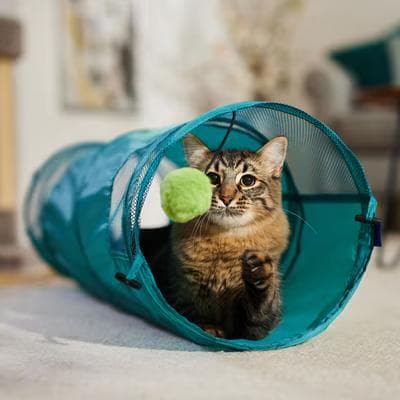
A tunnel is the one piece of structure worth adding in this band, since it gives a kitten somewhere to hide, ambush from, and burst out of at full speed. Something like the Frisco Foldable Play Tunnel with Mesh Cat Toy, Baltic Teal folds down when you want the floor back, though be prepared for a kitten to walk past a new tunnel for a few days before it works out what the thing is for. Retire any fabric tunnel once claws start pulling the mesh into loose threads, because loose strands belong in the string category rather than the toy pile.
Webvet may earn a commission when you click through to Chewy, at no extra cost to you.
4 to 6 months
Adult teeth are coming through and the chewing urge peaks, which is why owners who had no toy problems suddenly find charger cables and houseplants under attack. Toys need to get bigger and tougher: a kicker toy the length of the kitten's own body, plush with stitched seams rather than glued trim, and a purpose-made chew item that is legal to gnaw. Coordination is now good enough that a kitten will catch a wand lure reliably, so sessions need to end in a real catch or the kitten stays wound up.
6 to 12 months
The body is close to adult size but the brain still wants kitten-grade play, which is the stage most owners misread as bad behavior. Toy sizes should move up to the adult range and anything that has been chewed thin over the last three months should be retired. This is the natural moment to introduce puzzles and food-dispensing toys, since the patience and the paw control are finally there.
Kitten toys for biting and what play teaches
Kittens do not learn bite pressure from instinct, they learn it from feedback. In a normal litter, kittens wrestle constantly, and when one bites too hard the other yelps and the game stops dead. That loop, repeated hundreds of times through litter-mate play in the weeks right after weaning, is how a kitten calibrates its jaw. The technical name is bite inhibition, and it is the single most useful thing play teaches.
The best kitten toys to stop biting are soft kickers and plush prey you can redirect onto before teeth reach skin. A kitten who left the litter early, or who is the only cat in a quiet house, misses most of that feedback and arrives with an uncalibrated mouth. Which is why so many searches for kitten toys for biting come from owners of a single hand-raised kitten. Why does your kitten bite your hands during play? Almost always because hands have been the moving target: a wiggling finger under a blanket, a hand batted away during a wrestle, a wrist grabbed while you were reading. To a kitten, a moving hand is prey, and it has no way to know that this particular prey is attached to the person who feeds it.

The rule is simple and it has no exceptions: hands are not toys. Not once, not when the kitten is small, not when it is cute. Every session where skin is the target teaches the kitten that skin is fair game, and the lesson does not expire when the teeth grow.
When a kitten does latch on, run the same four steps every time:
- Stop moving the hand completely. A hand that jerks away is a hand that is behaving exactly like fleeing prey, which makes the grip tighter.
- End the game. Stand up, disengage, and give it 20 to 30 seconds of nothing. Silence and stillness are the feedback a litter-mate would have given.
- Offer the legal target. Put a kicker toy or a plush mouse into the paws that were on your wrist, so the kitten has somewhere to finish the sequence it started.
- Restart only after the kitten has reset. If it is still wide-eyed with a lashing tail, wait longer.
A pack of soft, kitten-sized plush mice makes step three much easier, because you need one within reach in every room where play happens. Something like the Fashion's Talk 18 Piece Plush Catnip-Filled Mice Cat Toys exists to be scattered and grabbed, and to be honest about it, the catnip filling will do nothing at all for a kitten under three months. The value at this age is a soft, bite-sized, one-piece object the kitten can carry and kick instead of your hand.
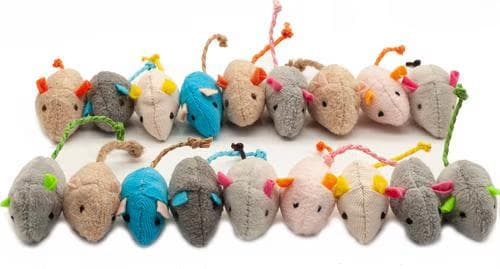
Pack of 18 soft plush mice filled with catnip to spark batting, pouncing, and play.
Webvet may earn a commission when you click through to Chewy, at no extra cost to you.
So how do you tell a cat no? Not by tapping the nose, scruffing, blowing in the face, or pushing the kitten away, because all four read as either a return move in the game or as a threat, and both escalate. The functional version of "no" for a cat is the removal of the thing it wants: the game stops, the attention stops, you leave. Consistency is what carries the message, and it works because it mirrors what a litter-mate would do. Learning to read the tail flick, flattened ears, and skin twitch that come before a bite lets you end the session before the grab happens, and our guide to reading cat body language covers those signals in detail.
Teething toys and what a kitten can safely chew
Kittens get two full sets of teeth. The deciduous set is usually complete by around six to eight weeks, and from roughly three to four months those baby teeth start being pushed out by the adult set, a process that is typically finished somewhere around six to seven months. Swallowed baby teeth are normal and harmless. What is not normal is a four-month-old chewing electrical cords, and that behavior is usually a teething kitten looking for counter-pressure on sore gums.
What can a teething kitten safely chew on? The workable options are a purpose-made cat teething toy in soft rubber or woven natural fiber, a silvervine or matatabi chew stick, a chilled damp washcloth offered under supervision and taken away when it starts to fray, and dental-textured kibble or a vet-approved dental treat at meal times. The rule that ties them together is that the object should give slightly under tooth pressure, should be too large to swallow, and should not shed fibers or splinters when chewed.

Keep these away from a teething kitten entirely:
- Electrical cords and phone chargers, which are the most common serious teething casualty and a burn and electrocution risk.
- Hard nylon dog chews and antlers, which are built for a dog's jaw and can fracture a kitten's developing tooth.
- Rawhide, which softens and swells and is not formulated for cats.
- Houseplants, several of which are toxic to cats, with lilies being an emergency in even trace amounts.
- Your fingers, even when the kitten is gentle and it looks like affection.
Silvervine chew sticks are worth knowing about for a second reason: silver vine works on a large share of cats that do not react to catnip at all, so a stick can hold the interest of a kitten that ignores every catnip toy in the house. A pack like SunGrow Silvervine Teething Chew Sticks Dental Treat & Feather Cat Toy with Catnip, 5 count covers the chewing urge and the sensory side at once, and sticks are cheap enough to replace the moment one starts to splinter. Use this feathered chew only under supervision, inspect the feather attachment before every session, and discard it if any part loosens.
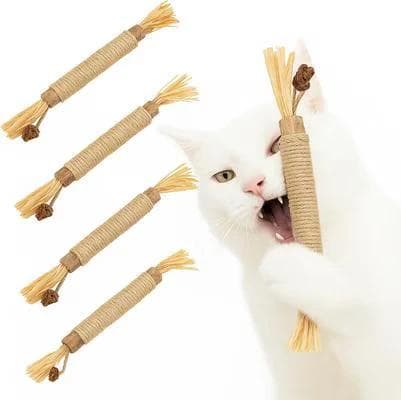
Silvervine and catnip dental chew sticks that give cats a safe, satisfying outlet for biting and chewing while helping scrape away plaque.
Webvet may earn a commission when you click through to Chewy, at no extra cost to you.
Call your vet if a baby canine is still in place next to a fully erupted adult canine after about six months, if the gums bleed persistently, or if your kitten stops eating, drops food, or paws at its mouth repeatedly. Retained baby teeth crowd the adult set and are a routine thing for a vet to check at the spay or neuter appointment.
String, small parts, and the toys to put away between sessions
String is not a small-parts problem, it is a surgical one. When a cat swallows a bead it usually either passes or lodges in one place. When a cat swallows a strand of string, ribbon, thread, or tinsel, one end frequently catches, often around the base of the tongue or at the stomach outlet, while the gut keeps trying to move the rest along. The intestine then bunches up along the trapped strand like fabric gathering on a drawstring, and the string can saw into the bowel wall. Vets call this a linear foreign body, and it is one of the most serious emergencies in feline medicine.
That is the reason the answer to "are wand and string toys safe for kittens?" is a qualified yes. A wand is the best interactive toy you can own and it is also a length of cord attached to something a kitten wants to eat. It is safe while you are holding the handle and it is dangerous the moment it is left on the rug, because a kitten alone with a wand will chew the line. Wands are supervised-only equipment, full stop, and they go away between sessions.
So what toys are not safe for kittens? These are the ones to keep out of reach or out of the house:
- Yarn, thread, dental floss, ribbon, gift string, tinsel, and elastic hair ties, all of which are linear foreign body risks.
- Rubber bands and the plastic rings from milk jugs, which are swallowed whole surprisingly often.
- Anything with a bell, googly eye, plastic tab, or glued-on feather that moves when you tug it hard with a fingernail.
- Small hard items that fit entirely inside a kitten's mouth, including bottle caps, coins, earplugs, and jewelry.
- Plastic bags, which are both a suffocation risk and something many cats like to lick and chew.
- Toys that have already been chewed open, since the stuffing and any internal squeaker are now loose parts.

Build the storage habit on day one, because it is the single rule most likely to keep your kitten out of surgery. A closed bin, a drawer, or a lidded basket on a shelf works: the test is whether the kitten can get the wand out without you. Loose ribbon, spare shoelaces, and craft supplies belong in the same place. The category to think about here is not "expensive versus cheap," it is supervised only versus leave out, and every toy you own falls into one of those two piles.
Wand play versus toys a kitten can use alone
How long should you play with your kitten each day? Aim for a total of around 30 to 45 minutes of active interactive play, split into three to five short sessions rather than one long one, because a kitten's stamina runs in bursts and a 10-minute session that ends well beats a 30-minute one that ends with a wound-up kitten. Two of those sessions should land in the early morning and the hour before you go to bed, which are the natural activity peaks, and following a session with a meal gets you the hunt-eat-groom-sleep cycle that produces a kitten who actually settles.
Wand movement is what separates a session that works from a toy the kitten ignores. Prey does not fly at a predator's face, and dangling a feather directly in front of a kitten is the most common reason a kitten ignores the toy you just bought:
- Move the lure away from the kitten and across its field of view, never toward it.
- Let it disappear behind a chair leg or under the edge of a rug, then twitch it, then hold still. Stillness is what triggers the pounce.
- Give the kitten a few real catches during the session rather than yanking the lure away every time it commits.
- Always end on a catch the kitten gets to hold, bite, and bunny-kick, then feed. A session that ends with the toy snatched away is the one that turns into ankle attacks an hour later.
Which toys are safe to leave with a kitten unsupervised? Solid one-piece balls, sturdy kicker toys with stitched rather than glued seams, ball-and-track units too large to move into a hiding spot, and cardboard scratchers and boxes. What makes them safe is the absence of anything that can detach: no cords, no strands, no glued trim, no rattling internal parts a kitten can chew out. Perches and window seats belong on the same list, since a mounted Frisco Plush Cat Window Perch with Removeable Bolster, Cream gives a kitten somewhere to spend the long stretches between play sessions with nothing to swallow at all.
| Toy type | Verdict | Why |
|---|---|---|
| Feather or string wand | Supervised only | The line is a linear foreign body risk once you let go of the handle |
| Solid rubber or foam ball | Leave out | One piece, nothing to detach, too big to swallow |
| Kicker toy with stitched seams | Leave out | Check monthly for opened seams and loose stuffing |
| Spring toys and plastic coils | Supervised only | Small enough to swallow and easy to chew into fragments |
| Cardboard box, tunnel, scratcher | Leave out | Shed harmless flakes, no ingestible parts |
| Small plush mouse | Leave out until it opens | Retire it the moment stuffing or an internal squeaker is exposed |
| Treat ball or food roller | Leave out | Rinse and dry it so old food does not build up inside |
Rotate the leave-out pile rather than putting everything down at once. Keep four or five items available, swap in different ones every few days, and store the rest out of sight. A toy that has been gone for a week comes back interesting, which is the cheapest way to get kitten toys to keep them busy without buying more of them. Kittens also sleep an enormous amount between these bursts, and our guide to how much cats sleep explains why the crash after a good session is a sign the play worked.
Motion-activated and automatic toys around a kitten
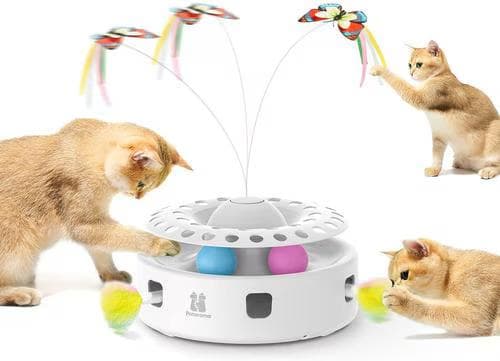
Battery-powered and motion-activated toys can hold a kitten's attention, but they carry two kitten-specific caveats: the moving parts and battery compartments are exactly the sort of small components a young mouth investigates, and a device that runs on its own will keep running when a kitten gets overstimulated and nobody is there to end the session. Treat them as supervised equipment through the first six months rather than a babysitter. If you want to compare the hardware itself, the sensors, run times, and the models built to survive a cat, our guide to automatic cat toys covers that category properly. A product such as the Potaroma 3 in 1 Automatic Interactive Butterfly Cat Toy belongs in that supervised category for a young kitten, not in an unattended room.
When catnip starts working and what to use before it does
At what age does catnip start working on kittens? For most cats the catnip response appears somewhere between three and six months, and it is common for a kitten under three months to walk past a fresh catnip toy with no reaction whatsoever. The response is triggered by nepetalactone, the volatile compound in the plant, and sensitivity to it is an inherited trait, which is the second half of the answer: a meaningful share of cats never respond at any age, no matter how old they get or how fresh the catnip is. An indifferent kitten is not a defective kitten, and the toy is not a dud.

While you are waiting out that age gate, these are the alternatives worth trying:
- Silver vine (matatabi), which reaches a larger proportion of cats than catnip does and often works on cats that ignore catnip completely.
- Tatarian honeysuckle wood, sold as small sanded blocks that a kitten can rub and chew.
- Valerian root, which produces a similar rolling and rubbing response in some cats.
- Plain texture and sound: crinkle material, sisal, corrugated cardboard, and a lightweight ball with a rattle sealed inside.
- Food. Before the catnip response arrives, a treat inside a roller is far more motivating than any herb.
Once the response does arrive, catnip becomes a genuinely useful tool for getting a cat onto a scratching post or into a carrier. Product selection, potency, and the difference between loose herb, sprays, and stuffed toys are covered in our guide to catnip toys.
Homemade kitten toys that are actually safe
Searches for kitten toys DIY spike right after adoption, and for good reason: some of the best kitten toys cost nothing. The catch is that homemade is exactly where small-mouth hazards hide, because a household object has not been through any safety screening at all. These are the homemade ideas that hold up:
- A tightly crumpled ball of printer paper, roughly walnut sized, remade whenever it softens.
- A cardboard box with two doorways cut in opposite sides, which doubles as a hiding spot.
- A paper bag with the handles cut off completely, never a plastic bag.
- An empty cardboard tube stuffed loosely with a strip of paper the kitten has to fish out.
- A large cardboard tube taped into a low arch as a tunnel, replaced when it collapses.
- A muffin tin with a treat under two of the cups and a table-tennis ball resting in each, which is a first foraging puzzle.
Skip these homemade ideas outright, no matter how often they show up in craft roundups: anything built on yarn, string, twine, ribbon, or elastic; toilet roll tubes cut into rings, which get stuck around a jaw or a leg; foil balls, which tear into swallowable flakes; toys made from socks with buttons or beads attached; and anything using a wine cork, which chips into fragments a kitten will swallow. Homemade toys get the same fist test as bought ones, and they get thrown away sooner, because paper and cardboard fall apart faster than plastic does.
Where to buy kitten toys and what each tier stocks
Where is the cheapest place to buy kitten toys? On sticker price, general-merchandise stores like Walmart and Target usually win for basics such as balls, mice, and simple wands, while online marketplaces win on multipacks and on anything specialized. But the cheapest toy is the one your kitten actually uses, and a $4 wand that gets played with every night is better value than a $2 bin of pieces that stay on the floor untouched. Buying two or three things your kitten engages with beats buying twelve it ignores.
| Where to buy | Strongest for | Weakest for | Best used when |
|---|---|---|---|
| Big-box pet chains (PetSmart, Petco) | Handling a toy before you buy it, seasonal kitten sections, teething items | Narrower online-only ranges, higher prices on basics | You want to judge size and seam quality in person |
| General merchandise (Walmart, Target) | Lowest sticker price on balls, mice, and simple wands | Thin selection of kitten-specific and teething items | You need cheap consumables you expect to replace |
| Online pet retailers | Depth of range, reviews, sturdy kicker toys, refill parts | You cannot judge size or seam strength before it arrives | You know the category you want and need options |
| Marketplaces (Amazon and similar) | Multipacks and starter kit bundles at the lowest per-piece cost | Wildly variable quality control between sellers | You are stocking a scatter pile and expect to cull it |
The shopping results for kitten toys are dominated by large multipacks, typically an 18 to 34 piece starter kit sold on piece count. These are reasonable value if you treat them as raw material rather than as a finished set. Expect a handful of plush mice, several plastic springs, a few crinkle balls, one or two feather wands, and a scattering of tiny bells and pom-poms. Sort the whole thing on a table before your kitten ever sees it, and remove before use anything on the list below.
- Loose bells, pom-poms, and any item small enough to fit fully inside a kitten's mouth.
- Feathers or trim held on with glue rather than stitching, which pull off on the first serious chew.
- Plastic springs, which are a common inclusion and a common swallow.
- Any length of cord, elastic, or string that is not attached to a wand handle you will be holding.
- Anything with a googly eye, a plastic tag, or a stiff quill.
What is left after that cull is usually five or six genuinely useful items, which is roughly what a kitten needs anyway.
Moving on from kitten toys as your cat matures
Somewhere between nine and twelve months the picture changes: your cat gets stronger, sleeps in longer blocks, and starts ignoring the small light toys that used to trigger a full chase. That is the moment to size up. Retire everything that has been chewed thin, move to heavier wands with reinforced attachment points and larger kicker toys, and hand off the general-category shopping to our best cat toys guide, which covers the adult range in depth. Puzzles are also finally worth introducing at this point, and the tiers and introduction sequence are laid out in our guide to cat puzzle toys.
Interactive and electronic toys for grown cats
Once the supervision rules relax, the electronic category opens up: track balls with motion sensors, powered teasers, and units built to run a short program and stop. Adult cats also tolerate louder and faster toys than a twelve-week-old does. The comparison of what holds an adult cat's attention, what breaks in a month, and what is worth the price sits in our guide to interactive cat toys.
Boredom toys for adult indoor cats
Boredom in an adult indoor cat looks different from kitten energy. It shows up as overeating, overgrooming, night yowling, and picking fights with the furniture rather than as sprinting laps at 6am, and the fix leans more on environment and foraging than on a new plush mouse. Our guide to toys for bored indoor cats covers that shift, including vertical space and food-based enrichment.
Kitten toy questions
Frequently Asked Questions
What is the 3-3-3 rule for kittens?
The 3-3-3 rule is a shelter and rescue guideline for how a newly adopted cat settles in: roughly three days to decompress and stop hiding, three weeks to learn the household routine and start showing real personality, and three months to feel genuinely at home. It is a rule of thumb rather than a veterinary finding, and kittens often move faster than adult rescues. For toys, the practical takeaway is not to worry if a new kitten ignores everything you bought during the first few days. Put one or two quiet items near its safe spot, skip loud or fast toys entirely, and start real wand sessions once it is exploring on its own.
Do puzzle toys work for kittens?
Yes, but timing matters. Most kittens do not have the paw control or the patience for a real puzzle until around five to six months, and a puzzle introduced too early just becomes a piece of furniture the kitten walks past. Start with the easiest possible version, a treat visible under an open cup or a simple rolling treat ball, so the first attempt succeeds. Difficulty tiers, how to step a cat up through them, and what to do when a cat gives up are covered in our guide to cat puzzle toys.
Why will my kitten not use the scratching post?
Usually the post is the wrong height, the wrong material, or in the wrong room. Cats want to stretch to full length while scratching, so a post shorter than the cat's stretched body gets ignored, and many cats prefer sisal or corrugated cardboard over carpet. Placement matters as much as the post: a scratcher in a spare bedroom loses to the arm of the sofa in the room where the family sits. Our guide to what to do when a cat will not use the scratching post walks through diagnosing preference and redirecting the habit.
How much should a kitten sleep between play sessions?
A lot, and the hard crash right after a good play session is a sign the session worked rather than a sign something is wrong. Kittens cycle rapidly between explosive activity and deep sleep, and the total daily sleep figure for a young kitten is far higher than most new owners expect. Play, food, grooming, and sleep run as one sequence, which is why feeding right after a wand session so reliably produces a settled kitten. Our guide to how much cats sleep has the life-stage numbers.
Are laser pointers safe for kittens?
They are safe for the eyes as long as you never shine the beam directly at the face and you use a pet-marketed pointer rather than a high-powered industrial one. The real problem is behavioral: a laser dot can never be caught, so the kitten completes the stalk and chase but never gets the grab, bite, and kick that finish the hunting sequence, which leaves some cats frustrated or fixated. If you use one, always end the session by landing the dot on a physical toy or a scattered treat so the kitten gets a real catch.
How many kitten toys does a kitten actually need?
Far fewer than the multipacks suggest. A working set is one wand you hold, one or two solid balls, one kicker toy sized to the kitten's body, one chew item once teething starts, a cardboard box or tunnel, and a scratcher. That is six items, and rotating them beats owning thirty. Keep four or five out at a time, store the rest, and swap every few days so a familiar toy comes back interesting instead of buying something new every week.
When should I replace or throw away a kitten toy?
Retire a toy the moment a seam opens and stuffing or an internal squeaker is exposed, when feathers or trim start pulling free, when a plastic part cracks or a bell works loose, or when a chew item begins to splinter or shed fibers. Run a quick check over the leave-out pile once a month and over chew items weekly, since a four-month-old with new adult teeth destroys things far faster than a ten-week-old does. Anything you would not hand to the kitten new goes in the bin, not back on the floor.
Sources

Editor
The Webvet Editorial Team is the in-house group of pet-care editors and writers behind Webvet, operated by Smart Pet Collective. The team researches, writes, and maintains Webvet's pet health, behavior, and medication content. Every article follows a defined editorial process: research from reputable veterinary and scientific sources, careful drafting, mandatory review of medical content by a credentialed veterinarian, and dated publication. Health and medication articles are medically reviewed by a licensed veterinary professional before they go live and are kept current over time.


