Catnip Toys: Why Some Cats Ignore Them (and What Works)
Catnip toys work on most cats and do nothing for the rest, because sensitivity is inherited. Here is how nepetalactone works, how to test your own cat, when kittens start reacting, how to refresh a flat toy, and which alternatives reach non-responders.

This article contains affiliate links. Webvet may earn a commission when you buy through them, at no extra cost to you.
Catnip toys for cats work by smell, not by taste. The dried leaves and stems sealed inside them give off a volatile compound called nepetalactone, the cat breathes it in, and for the next few minutes you get the familiar show: sniffing, cheek rubbing, rolling, a little drooling, and hard kicking with the back feet. That is the whole mechanism. What no product page tells you at checkout is that a large minority of cats get nothing at all from it, and that this is inherited rather than proof you bought weak catnip.
That single fact should change what you buy. For a cat that responds, catnip toys are the cheapest enrichment on the shelf, and a two dollar stuffed mouse will out-perform most battery-powered gadgets. For a cat that does not respond, no amount of organic, extra strength, or freshly harvested catnip will move the needle, and the productive step is to change plants entirely. What follows is how the response works, a short test you can run today, when kittens start reacting, how long a session lasts, why a toy goes flat, how to bring it back, and the three alternatives with published research behind them.
- 1Catnip toys act on a cat's sense of smell, and the active compound nepetalactone triggers a short behavioural response that usually runs five to fifteen minutes.
- 2Sensitivity to catnip is an inherited trait, so a cat that ignores a fresh toy is not being difficult and the product is not defective.
- 3Kittens generally show nothing until somewhere between three and six months of age, which means a young kitten's blank reaction settles nothing either way.
- 4After a response most cats need roughly thirty minutes to two hours before the same toy works again, so leaving one out all day wastes the effect.
- 5Silvervine is the first alternative to try for a non-responder, followed by Tatarian honeysuckle and then valerian root, and published research shows most catnip non-responders do react to silvervine.
- 6Catnip itself is neither toxic nor addictive, but the toy wrapped around it can be a chewing and swallowing hazard, which is what supervision is genuinely for.
- 7A toy that used to work and now does nothing is almost always flat rather than finished, and refreshing or refilling it costs a fraction of replacing it.
How catnip toys work and why some cats do not respond
Catnip is Nepeta cataria, a hardy member of the mint family that grows like a weed across most of North America and Europe. Its leaves and stems hold nepetalactone in tiny volatile oil glands. When a cat sniffs a toy stuffed with dried catnip, that compound reaches receptors in the nasal tissue and sends a signal onward to the olfactory bulb and from there to areas of the brain involved in emotion and instinctive behaviour. The result is a brief, self-limiting burst of play and scent-marking behaviour that looks like excitement rather than sedation. Nothing is being absorbed through the stomach and nothing is being digested. The cat is reacting to a smell, which is why a sealed toy in a drawer does nothing and an opened one across the room can bring a cat running.
Because the trigger is scent, the toy itself is mostly a delivery device. The classic version is a small stuffed mouse, and a bulk pack such as the Fashion's Talk 18 Piece Plush Catnip-Filled Mice Cat Toys is one of the least expensive ways to find out whether your cat is a responder while keeping enough spares to rotate, since these are the toys that end up under the sofa within a week.
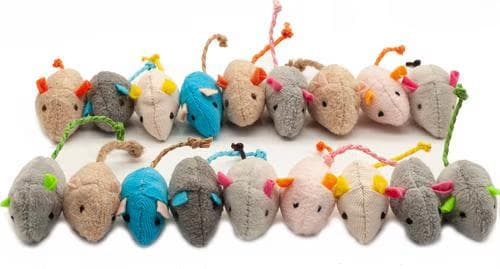
Pack of 18 soft plush mice filled with catnip to spark batting, pouncing, and play.
Webvet may earn a commission when you click through to Chewy, at no extra cost to you.
What the catnip response actually looks like
Owners frequently mistake mild curiosity for a response. A cat that walks over, sniffs a toy, and wanders off has not reacted. The genuine catnip response is a recognisable sequence, and most responders show at least three of these:
- Intense sniffing of the toy, often followed by licking or chewing at the fabric.
- Cheek, chin, and forehead rubbing against the toy, which deposits scent and picks the compound up onto the fur.
- Head shaking or a rapid head twitch after a deep sniff.
- Rolling, flipping onto the back, and clutching the toy against the chest.
- Bunny kicking, where the hind feet rake the toy while the front paws hold it.
- A short burst of running, hunting-style pouncing, or chirping and trilling.
- An abrupt loss of interest at the end, with the cat walking away mid-session.

Sniffing and eating are not the same event. Inhaled nepetalactone tends to produce the animated, playful reaction described above. Cats that chew and swallow dried catnip often go the other way and become mellow, sprawled, and sleepy for a while. Neither version is a problem in ordinary amounts. If your cat's reaction reads as agitated rather than playful, with flattened ears, a lashing tail, or swatting when you approach, that is overstimulation rather than enjoyment, and our guide to reading cat body language covers how to tell the difference before a play session turns into a bite.
Why some cats never respond, no matter what you buy
Responsiveness to catnip is inherited. A cat either has the trait or does not, and no brand, harvest date, or price point changes that. Published veterinary estimates vary in exactly where they land, but they cluster around half to three quarters of adult cats showing the classic response, which leaves a substantial minority showing nothing. In a 2017 study published in BMC Veterinary Research, Sebastiaan Bol and colleagues tested a hundred domestic cats and reported that roughly two thirds responded to catnip, meaning about one cat in three did not.
So do catnip toys actually work? For most cats, yes, reliably and immediately, which is why the format has survived for a century. For the rest, they do nothing at all and never will, and that is a genetic coin flip rather than a failure of the toy. The practical consequence is that you should confirm which camp your cat sits in before you spend money on a shelf of catnip products, because a non-responder will ignore an expensive organic kicker exactly as thoroughly as a cheap mouse. Testing costs almost nothing and takes an afternoon.
Here is the test, using loose dried catnip rather than a sealed toy so you can rule out a weak fill:
- Pick a quiet moment when your cat is awake, relaxed, and not hungry, and choose a familiar surface such as a rug or a scratching post.
- Crush a small pinch of dried catnip between your fingers to release the oils, then scatter it on the surface and step back.
- Watch for five minutes without interacting, and note whether you see cheek rubbing, rolling, bunny kicking, or head shaking, rather than a single sniff.
- Time the reaction if you get one, and note when the cat disengages.
- Wait at least two hours, then repeat once on a different day before drawing any conclusion.
How long the catnip response lasts and how often to offer a toy
A catnip session is short by design. Most cats show the full response for about five to fifteen minutes, and then it ends on its own whether or not the toy is still there. After that the cat enters a refractory period, commonly described as roughly thirty minutes to two hours, during which the same catnip will produce little or nothing. This is the answer to how long cats should play with catnip toys: you do not need to enforce a time limit, because the cat self-limits, but you do need to remove the toy afterwards. Leaving a catnip toy on the floor permanently means the cat spends most of the day walking past a smell it has stopped noticing, and the novelty that made the toy work disappears.
Catnip play is also solo and passive, which is its main limitation. The cat entertains itself for ten minutes, and then it is over. Between sessions, most indoor cats need something you drive, and a wand toy that carries both elements is a sensible bridge: the Frisco Bird with Feathers Teaser Wand Cat Toy with Catnip, Blue gives you a human-led chase sequence with a catnip element attached, which is far closer to the hunting pattern cats actually need. Our guide to interactive cat toys covers how to structure those sessions so they end in a catch rather than in frustration.
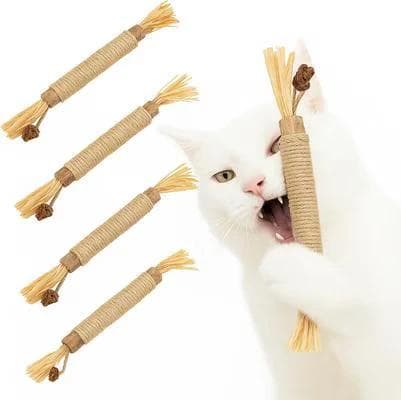
Silvervine and catnip dental chew sticks that give cats a safe, satisfying outlet for biting and chewing while helping scrape away plaque.
Webvet may earn a commission when you click through to Chewy, at no extra cost to you.
A workable rhythm looks like this:
- Offer a catnip toy once a day or every other day rather than leaving one out continuously.
- Let the session end naturally, then pick the toy up and store it in a sealed container or bag.
- Keep two or three catnip toys in rotation and swap which one appears, so no single toy becomes background furniture.
- Skip catnip entirely on days when the cat is already unsettled by visitors, travel, or a vet appointment.
When kittens start responding to catnip, and when older cats stop
Very young kittens almost never react to catnip, and this is the single most common reason an owner wrongly concludes their cat is a non-responder. Veterinary sources generally place the onset somewhere between about three and six months of age, and a kitten under three months typically shows nothing at all. If you tested an eight week old kitten and got a blank, you learned nothing except that the kitten is eight weeks old. Retest at six months, and again after the first birthday if you want to be certain, because the trait simply has not switched on yet in a very young animal.

While you wait for the trait to appear, a kitten still needs the play that a catnip toy would otherwise prompt. Focus on:
- Light wand toys that let a kitten chase, stalk, and catch several times a day in short bursts.
- Small, soft objects that can be carried in the mouth, since carrying and hoarding is normal kitten behaviour.
- Toys with no string, ribbon, or small glued-on parts, because kittens chew far more indiscriminately than adults.
Our kitten toys guide covers the age-appropriate options in more detail, including which formats are worth keeping once the kitten grows into them.
At the other end of life, many cats keep responding to catnip well into old age, and there is no fixed point at which the trait stops working. What does change is the physical performance around it. A senior cat with stiff joints may sniff and rub enthusiastically and skip the rolling and bunny kicking entirely, and that is still a response. A sudden, complete loss of interest in everything a cat used to enjoy, catnip included, is not a catnip question at all and is worth raising with your vet rather than solving with a new toy.
Types of catnip toys and which one suits your cat
The best catnip toys for cats match the format to the behavior you want. Once you know your cat responds, the useful decision is format before product. Different catnip toys deliver the same compound in ways that suit different behaviours, and buying a wand for a cat that only wants to wrestle is how a drawer of ignored toys accumulates.
| Format | What it delivers | Suits the cat that |
|---|---|---|
| Kicker toy | A long fabric tube the cat can grip with the front paws and rake with the hind feet | Wrestles, bunny kicks, and plays rough with your forearm |
| Plush mouse | A small, carryable prey-shaped object to bat, toss, and hoard | Bats things under furniture and carries toys around the house |
| Refillable pouch toy | A sewn toy with a zip or velcro opening for fresh catnip | Belongs to an owner tired of replacing flat toys |
| Catnip spray | A liquid you apply to an existing toy, scratcher, or bed | Already has toys that need reviving, or dislikes fabric fills |
| Catnip scratcher | Cardboard or sisal with catnip worked into the surface | Needs redirecting from the sofa to a legitimate scratching surface |
| Wand with a catnip pod | Human-led chase play plus a scent element | Needs you in the session and will not self-start |
| Chew stick | A firm plant material to gnaw rather than shred | Chews toys apart and needs something built for teeth |
The kicker is the format most owners underrate. Cats that grab your arm and rake it with their back feet are performing a normal predatory sequence on the wrong target, and a long fabric kicker gives that behaviour a legal home. A banana-shaped kicker such as the Yeowww! Catnip Yellow Banana Cat Toy is made for exactly that grip, though it only suits the wrestlers: a cat that just bats and carries small toys will walk past it. A catnip plush toy shaped like a mouse serves the opposite instinct, which is carrying and stashing small prey, and they are best bought in quantity because they get lost. Refillable pouch toys cost more at purchase and less over a year, and they are the right default for a confirmed responder. Catnip spray suits a cat that reacts to scent but is not interested in fabric, and it is the only format that lets you put catnip on something the cat already likes, such as a cardboard scratcher or a window perch.
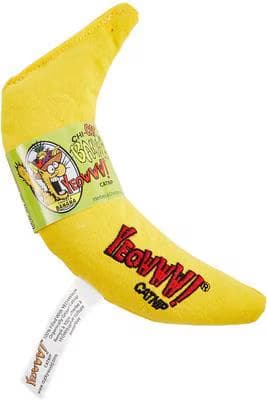
Webvet may earn a commission when you click through to Chewy, at no extra cost to you.
Indoor cats deserve one specific note. The best catnip toys for indoor cats are the ones that produce movement rather than just a scent event, because an indoor cat's problem is usually a shortage of physical activity rather than a shortage of stimulation. That points to kickers, scratchers, and wand pods over a plain scented plush.
Chew and dental formats
A minority of cats treat every soft toy as something to dismantle, and for them a fabric toy is a losing proposition. Firm plant-material chews are built for that behaviour, and the SunGrow Silvervine Teething Chew Sticks Dental Treat & Feather Cat Toy with Catnip, 5 count pairs a chewable stick with a feather attachment, which also happens to be a useful bridge if you suspect your cat is a catnip non-responder. Supervise chew formats the same way you would supervise any toy that a cat can break pieces off, and retire a stick once it has splintered or worn down to a swallowable size.
Refillable catnip toys and how to refresh catnip that has gone flat
The most common complaint about catnip toys is that they stopped working. In almost every case the cat has not changed and the toy has not broken. The nepetalactone that drives the response sits in volatile oil, and volatile means exactly what it sounds like: the compound evaporates. Air, light, heat, humidity, and handling all drive it off, so a toy left on the floor for three months contains a fraction of the active compound it shipped with. A bag of loose catnip stored open on a warm shelf goes the same way.
That makes freshness a maintenance job rather than a purchase decision:
- Buy loose catnip in a resealable bag or tin, and transfer it to an airtight glass jar as soon as you open it.
- Store the jar somewhere cool, dark, and dry. A cupboard away from the oven is fine, and the freezer extends it further.
- Crush a pinch between your fingers before every use, because breaking the dried leaf releases oil that intact leaf holds onto.
- Refill or re-dose a working toy roughly every two to four weeks with normal use, and sooner if the cat's reaction is visibly weaker.
- Put toys away between sessions in a sealed bag or container, which slows the loss more than anything else on this list.
- Rotate two or three toys rather than running one into the ground, so each spends most of its life sealed.

Refillable toys are the cheaper long-term answer, and they are worth seeking out specifically. Look for a zip or velcro opening large enough to get a spoon into, an outer fabric that survives a wash, and an inner pouch that holds fill without leaking through the seams. If you would rather not buy one, a plain cotton sock with a spoonful of crushed catnip and a tight knot works, as does an old wool sock with the toe cut off and re-tied, and both can be opened and re-dosed indefinitely. That is the honest version of a homemade catnip toy: a refillable container, not a sewing project.
Refreshing has a limit, and there is a point where a toy should be binned rather than saved. Throw a catnip toy away when:
- A seam has opened and stuffing or fill is coming out, even slightly.
- The cat has chewed through to a bell, plastic eye, rattle, or wire, or any of those parts is now loose.
- Any string, ribbon, elastic, or feather attachment is fraying or partly detached.
- The fabric has gone stiff and matted with saliva to the point that it cannot be washed clean.
Silvervine, valerian, and honeysuckle for cats catnip does nothing for
If your cat has failed the test twice, the answer is not stronger catnip. It is a different plant. Three alternatives have real published evidence behind them, and the first one to try is silvervine, an Asian vine whose dried fruit galls are ground into a powder that a great many catnip non-responders react to. The simplest way to trial it without replacing any toys is a loose attractant such as the SmartyKat Silvervine Cat Attractant Catnip, 2-oz canister, which you sprinkle onto a toy, scratcher, or mat your cat already owns and observe exactly as you did with the catnip test.
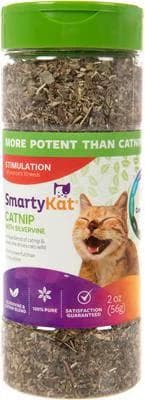
A silvervine and catnip blend that excites even cats who ignore plain catnip, great for redirecting energy into healthy play.
Webvet may earn a commission when you click through to Chewy, at no extra cost to you.

In the 2017 BMC Veterinary Research study cited earlier, the researchers tested the same hundred cats against four plants. Silvervine drew a response from close to eight in ten cats, catnip from roughly two thirds, and Tatarian honeysuckle wood and valerian root each from around half. The finding that matters most for a disappointed owner is what happened inside the catnip non-responder group: about three quarters of the cats that ignored catnip still responded to silvervine, and roughly half responded to Tatarian honeysuckle. A cat that is indifferent to catnip is therefore not a cat that cannot be reached by plant-based enrichment at all.
| Plant | Active compounds | What the research shows | Sold as | Best for |
|---|---|---|---|---|
| Catnip (Nepeta cataria) | Nepetalactone | Around two thirds of cats respond; the trait is inherited | Loose dried leaf, stuffed toys, sprays, scratchers | The default first try for any cat |
| Silvervine (Actinidia polygama) | Nepetalactol, actinidine, dihydroactinidiolide | Highest response rate of the four tested, and most catnip non-responders react to it | Powder, sticks, fruit galls, stuffed toys | The first thing to try after catnip fails twice |
| Tatarian honeysuckle (Lonicera tatarica) | Actinidine in the wood | Around half of cats respond, including many catnip non-responders | Wood chews, sawdust-filled toys, sprays | Chewers, and cats that ignored both catnip and silvervine |
| Valerian root (Valeriana officinalis) | Actinidine | Around half of cats respond; the smell is strongly unpleasant to most people | Dried root, stuffed toys | A last plant to try, if you can tolerate the odour |
Silvervine also works slightly differently from catnip. Cats respond to more than one active compound in it, which is part of why the response rate is higher, and the dominant one, nepetalactol, was identified by Japanese researchers in a 2021 paper as the compound driving the rubbing behaviour. That study also reported that rubbing transfers the compound onto the cat's fur, where it appears to deter mosquitoes, which reframes the whole rolling routine as something more functional than a high. Silvervine is sold in several forms, and the sticks tend to suit chewers while the powder suits cats that prefer to rub and roll.

Work through the alternatives in order rather than buying all of them at once:
- Silvervine first, as powder or a stick, since it has the highest reported response rate and reaches the most catnip non-responders.
- Tatarian honeysuckle second, especially for a cat that likes to gnaw, since the active material is the wood itself.
- Valerian root last. It reaches a similar share of cats, but the smell is genuinely offensive to most people and few owners want it in the living room.
- If all four plants draw a blank, stop buying scent products. That cat needs human-led play and environmental change instead, not another jar.
Are catnip toys safe, and can you leave a cat alone with one
Are catnip toys safe for cats? For the overwhelming majority, yes. Catnip is not toxic, it is not addictive in any pharmacological sense, there is no withdrawal, and a cat cannot overdose on the scent because the response shuts off on its own. The realistic downside of eating a lot of it is a mildly upset stomach, with vomiting or loose stool that settles within a day. Kittens under three months will not react but are not harmed by exposure either. Cats that are pregnant, on medication, or being managed for a diagnosed condition are the one group worth clearing with your vet first, simply because catnip is a stimulant-like plant and your vet knows the rest of the picture.
The veterinary position on catnip is consistently positive and consistently narrow. Vets and feline welfare bodies treat catnip as environmental enrichment: a cheap, low-risk way to prompt play, encourage a cat to use a scratching post instead of the sofa, and add variety to an indoor environment. What veterinary guidance does not do is treat catnip as medicine. It is not a treatment for anxiety, pain, travel stress, or behaviour problems, and a cat with a genuine stress issue needs a proper plan rather than a scented mouse. If that is what brought you here, our guide to cat calming products covers the products actually designed for the job and what the evidence says about each.
Whether you can leave a cat alone with a catnip toy depends entirely on how the toy is built, not on the catnip. Judge it by construction:
- Safe to leave out: a single-piece sewn fabric toy or kicker with no attachments, no bell, no glued eyes, and intact seams.
- Safe to leave out: a cardboard or sisal catnip scratcher, checked occasionally for shredded edges.
- Put away after every session: anything with string, ribbon, elastic, feathers, or a wand attached.
- Put away after every session: toys containing a rattle, bell, or hard plastic insert, and any toy the cat actively chews apart.
- Never leave out: a toy with an open seam, a loose part, or fill the cat has begun pulling free.
Where to buy catnip toys and what the label should tell you
Catnip toys are sold nearly everywhere, which is exactly why quality varies so widely. Pet specialists such as Chewy and Petco carry the widest range of formats, Amazon has the deepest supply of bulk multipacks and the least consistent quality control, supermarkets and pharmacies stock a narrow selection of the cheapest plush options, and independent makers on craft marketplaces tend to sell the better refillable toys and organic loose catnip. Price is a poor guide on its own. A cheap mouse packed with fresh catnip will outperform a boutique toy that has been sitting in a warehouse for two years.
The label tells you more than the price does. Check for:
- The plant named properly, ideally with the Latin name, so you know whether you are buying catnip, silvervine, or a blend of both.
- The fill material, since some toys use a small amount of catnip mixed into polyester stuffing while others are packed with leaf.
- Whether the toy is refillable, and whether replacement fill or sleeves are sold separately.
- Attachments, listed honestly: bells, feathers, ribbons, and glued eyes all change how the toy can be used.
- A harvest or best-before date on loose catnip. Undated loose catnip of unknown age is the most common cause of a disappointing first test.
- Marketing language you can ignore. Extra strength, maximum potency, and similar claims are unregulated and mean nothing measurable.
When a catnip toy is not the answer
Catnip solves a narrow problem. It adds a short, self-directed burst of stimulation to a cat's day, and that is all it does. If the underlying issue is an under-stimulated indoor cat, a scented mouse will not fix it, and the same complaints will return within a week. Route yourself to the right guide instead:
- If your cat is bored, destructive, or waking you at 4am, the fix is a daily play structure rather than a scent. Start with cat toys for bored indoor cats.
- If you want a general shortlist across every toy category rather than the catnip question specifically, our best cat toys guide is the place to begin.
- If your cat eats too fast or needs mental work at mealtimes, that job belongs to cat puzzle feeders rather than to a catnip toy.
- If your cat is a confirmed non-responder and the alternatives also drew a blank, human-led play is the substitute, and cat puzzle toys give a solo outlet that does not depend on scent at all.
Catnip toy questions
Frequently Asked Questions
Do catnip toys actually work?
They work reliably on most cats and not at all on the rest, because sensitivity to catnip is inherited. Published estimates put the responder share at roughly half to three quarters of adult cats, so a meaningful minority get nothing from any catnip product regardless of brand or freshness. Test your own cat twice on separate days with freshly crushed loose catnip before you conclude anything, and remember that kittens under three months and cats still inside the refractory window will look like non-responders even when they are not.
How long should cats play with catnip toys?
You do not need to impose a limit, because the response is self-limiting. A typical session runs about five to fifteen minutes and then ends on its own, after which most cats need somewhere between thirty minutes and two hours before the same catnip will work again. The useful rule is not about session length but about access: pick the toy up when the session ends, store it sealed, and offer it once a day or every other day rather than leaving it on the floor permanently.
Can I leave my cat alone with a catnip toy?
It depends on the toy, not the catnip. A single-piece sewn fabric toy or kicker with no bell, no glued eyes, no ribbon, and intact seams is generally fine to leave out, as is a cardboard catnip scratcher. Anything with string, ribbon, elastic, feathers, a wand, or a hard rattle inside should come up after every session, because those are the parts that get chewed off and swallowed. Retire any toy with an open seam rather than refilling it.
What do vets think of catnip?
Veterinary and feline welfare guidance treats catnip as useful environmental enrichment rather than as a medicine. It is cheap, low risk, and genuinely helpful for prompting play, redirecting scratching onto a legitimate surface, and adding variety to an indoor cat's day. The limits are equally clear in that guidance: catnip is not a treatment for anxiety, pain, or any diagnosed behaviour problem, it will not work on a third of cats, and a cat with a real stress issue needs a proper plan from your vet rather than a scented toy.
Are catnip toys ok for cats?
Yes, for almost all of them. Catnip is not toxic and not addictive, and the worst realistic outcome of a cat eating a large amount is a day of mild vomiting or loose stool. Kittens under about three months simply will not react, which is normal rather than concerning. The real hazards sit in the toy: swallowed bells, plastic eyes, stuffing, and above all string or ribbon, which can cause a serious intestinal obstruction. Clear catnip with your vet first for a pregnant cat or one on medication.
Are refillable catnip toys worth it?
For a confirmed responder, yes. Catnip loses potency because the active compound sits in a volatile oil that evaporates with exposure to air, light, heat, and handling, so every catnip toy fades whether or not the cat destroys it. A refillable toy with a zip or velcro pouch lets you re-dose it every few weeks for the cost of a spoonful of loose catnip instead of buying a new toy. Look for a wide opening, a washable outer fabric, and a pouch that does not leak fill through the seams.
Do catnip toys work on kittens?
Usually not at first. The catnip response typically appears somewhere between three and six months of age, and a kitten younger than three months normally shows nothing at all. A blank reaction from a young kitten tells you nothing about whether it will be a responder as an adult, so retest at around six months. In the meantime, give a kitten light wand play and soft carryable toys with no string, ribbon, or small glued-on parts, since kittens chew far less selectively than adult cats.
Sources

Editor
The Webvet Editorial Team is the in-house group of pet-care editors and writers behind Webvet, operated by Smart Pet Collective. The team researches, writes, and maintains Webvet's pet health, behavior, and medication content. Every article follows a defined editorial process: research from reputable veterinary and scientific sources, careful drafting, mandatory review of medical content by a credentialed veterinarian, and dated publication. Health and medication articles are medically reviewed by a licensed veterinary professional before they go live and are kept current over time.


