The Best Cat Toys for Bored Cats, and the Enrichment They Cannot Replace
The best cat toys for bored cats are the ones that let a cat finish a hunt. Here is the short list, how to tell boredom from stress or a medical cause, a two-week rotation schedule, and the enrichment no toy can replace.

This article contains affiliate links. Webvet may earn a commission when you buy through them, at no extra cost to you.
The best cat toys for bored cats are the ones that let a cat finish a hunt: a wand you drive yourself, a food puzzle she has to solve before she eats, and a small rotating stock of prey-shaped toys she can carry, kick, and finally catch on her own. A toy that only sits on the floor asks nothing of her, and a cat who is bored is bored precisely because nothing is asking anything of her.
That is the part most buying guides skip. Indoor cats do not get bored because they own too few toys. They get bored because the day has no hunting in it, food arrives in a bowl with no effort attached, and the room offers nowhere high to sit and survey. Toys are one input into that, and a good one. They are not the whole fix, and this guide is honest about where the line sits.
- 1A human-driven wand toy is the single highest-value purchase for a bored indoor cat, because it is the only toy that produces genuinely unpredictable prey movement.
- 2Every published sign of boredom (night vocalizing, overgrooming, sudden aggression, sleeping more, knocking things off shelves) is also a sign of stress or of a medical problem, so triage comes before shopping.
- 3Toy rotation works because novelty, not quantity, is what restores interest, and a two-week cadence with a closed storage bin is enough to make toys your cat already owns feel new.
- 4Food puzzles are daily enrichment rather than play, because they attach effort to something your cat is going to do anyway, and they are the safest thing to leave out unattended.
- 5Vertical territory counts as play space, and a cat who cannot get above human head height in the rooms she uses is under-enriched no matter how full the toy basket is.
- 6Sudden onset or escalation of any behavior change is a veterinary question before it is a shopping question, especially in cats over about seven years old.
- 7Toys alone do not fix an under-enriched home, and play cadence, feeding style, vertical space, and a predictable routine do more work than any single product.
Best cat toys for bored cats: the short list
So what are the best interactive cat toys for bored cats? Start with a feather wand that you run yourself, twice a day, for about ten minutes a session. A wand is the only toy category where a human supplies genuinely unpredictable movement, and unpredictability is exactly what a bored cat is missing. Every other item on this list supports that habit rather than replacing it, which is why the wand is the purchase to make first if you only make one.
Here is the short list, labelled by the job each toy does rather than by score:
- A feather or ribbon wand toy. The daily hunt. You control the speed, the pauses, and the moment your cat is allowed to win. This is the anchor purchase.
- A food puzzle or foraging toy. Daily mental work attached to a meal your cat was going to eat anyway. Non-optional if your cat free-feeds from a bowl.
- A handful of small kickable prey toys. Solo play, carrying, bunny-kicking, and the "kill" phase your cat finishes without you. These are the ones that rotate.
- A cat tree or a set of wall shelves. Climbing, jumping, and a high place to watch from. This is play equipment, not furniture.
- A window perch with a view. Passive observation, which is a real form of stimulation for an indoor cat and costs you nothing to run.
- A cardboard box, replaced when it gets shabby. Free, endlessly interesting, and the only item here your cat will ambush from without being asked.
For the anchor purchase, a simple feathered teaser like the Frisco Bird with Feathers Teaser Wand Cat Toy with Catnip, Blue does the job: a flexible wand, a lightweight bird lure that flutters when you flick it, and enough catnip in the toy to interest cats who respond to it. What matters far more than the brand is that you keep it in your hand and out of the toy basket, because a wand left on the floor is just a stick.
Webvet may earn a commission when you click through to Chewy, at no extra cost to you.
If you buy nothing else, buy a wand and a food puzzle. Those two cover the two halves of the predatory sequence your cat is missing indoors: the chase, and the reward at the end of it. For a wider comparison of every category on the market, our full cat toy roundup breaks the whole shelf down by type.
Is it boredom, stress, or something medical?
Here is the uncomfortable part of helping an extremely bored cat: the behaviors that send owners shopping for toys are the same behaviors that show up with anxiety, pain, and endocrine disease. Excessive meowing at night, overgrooming a patch of belly bare, sudden aggression, hiding, destructive scratching, and sleeping far more than usual all appear on every "signs of boredom" list online, and every one of them appears on the anxiety and the veterinary lists too. Triage first, then shop.

The distinguishing feature is usually context and timing rather than the behavior itself. A bored cat's problem behavior tends to be goal-directed, targeted at you or at something interesting, and it stops the moment something better is on offer. A stressed cat's behavior tends to be avoidant, triggered by a specific thing in the environment, and it does not switch off when you produce a toy. A medical problem tends to arrive suddenly, get worse rather than better, and bring a change in appetite, drinking, litter box use, or grooming along with it.
| What you see | Points to boredom | Points to stress or a medical cause |
|---|---|---|
| Vocalizing at night | Stops when you get up and play, happens most on days with no play, usually near you or near a door | Constant, disoriented, or in an older cat with weight loss and a big appetite, which can point to hyperthyroidism |
| Overgrooming one area | Rare as a boredom-only sign, coat is otherwise even, cat is easy to interrupt | Bald patch over a specific spot, skin is inflamed, cat resents handling there, which can point to pain, allergy, or anxiety |
| Sudden aggression | Ambush play at ankles, dilated pupils, tail up, resets into play with a wand | Defensive posture, growling, triggered by a person or another cat, or pain on being touched in one place |
| Sleeping more than usual | Wakes readily and engages fully when play starts | Hides in new places, will not engage, appetite or litter box habits have changed alongside it |
| Knocking objects off shelves | Happens when you are present or about to feed, cat watches for your reaction | Paired with restlessness, pacing, or weight loss in a cat over about seven |
| Not eating properly | Eats fine, just eats fast and then looks for something to do | Skipping meals, drooling, turning away from a favorite food, or losing weight |
Two rules make this usable. First, anything sudden is a veterinary question, not a shopping question. Second, anything that has been slowly getting worse over weeks is also a veterinary question, because slow escalation is how pain and endocrine disease present in cats. If the signs are steady, longstanding, and switch off the moment you produce a wand, you are probably looking at boredom, and the rest of this guide applies.
If the picture looks more like fear than tedium, start with anxiety rather than boredom and work through the practical levers in our guide to cat stress relief. If you are not sure how to read the signals in the first place, reading your cat's body language is the place to start, and if the sleeping is what worries you, check the baseline first in how much sleep is normal before concluding anything.
Vertical territory is play, not furniture
Before another toy comes into the house, look at the room from your cat's eye level. Cats resolve tension by moving up, they hunt from height, and they choose to rest where they can see the entrances. The veterinary environmental-needs guidance published by the American Association of Feline Practitioners treats safe elevated resting places and separated key resources as basic requirements, not luxuries. A room with no route above human waist height gives a cat nothing to do with her body except pace it.

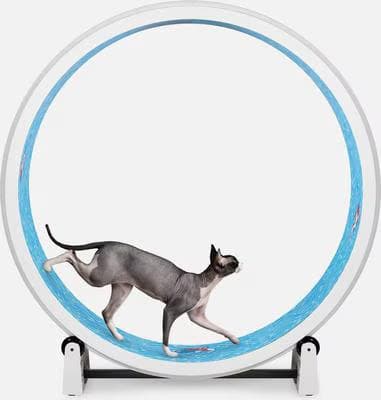
Vertical space earns its place in a toy guide because climbing is play. A cat who has to plan a route, judge a gap, and land it is doing something physically and cognitively demanding, and she will do it repeatedly without you being involved. A tall multi-level tree parked next to a window does three jobs at once: climbing, a high lookout, and a scratching surface. A Yaheetech Multi-Level 63-in Plush Cat Tree, Dark Gray is the kind of thing that fits: tall enough to be worth climbing, with more than one platform so the route has decisions in it. For a healthy cat that prefers steady running to climbing, the One Fast Cat Gen 7 Exercise Wheel can add another self-directed movement option, provided it is stable and introduced gradually.
Placement decides whether it gets used at all:
- Put it where the cat already spends time, not in the spare room. Cats use vertical space in the rooms where the household is.
- Put it near a window if you possibly can. A view turns a resting platform into an activity.
- Give the top platform a clear line of sight to the door. Cats choose lookouts, not corners.
- In a multi-cat home, provide more than one high spot per room so nobody has to negotiate for it.
- If your cat ignores it entirely, treat it as a placement or surface problem rather than a taste problem. The same logic that applies when a cat won't use the scratching post applies here.
Toy types that actually stimulate an indoor cat
The best cat toys for indoor cats cover several prey patterns rather than repeating one toy shape. The most useful way to answer what are some good toys for cats to relieve boredom is to stop sorting by product and start sorting by prey. Domestic cats hunt several different prey shapes, each of which triggers a different movement pattern, and a toy basket full of eleven variations on the same fuzzy mouse is a toy basket with one idea in it. Cover the four categories below and you have covered nearly everything an indoor cat's brain is looking for.
- Flying prey. Feathered wands, bird lures, anything that moves in an arc above the cat's head. Triggers the rear-up, the vertical leap, and the mid-air grab. The most physically demanding category and the one most cats respond to first.
- Ground-scurrying prey. String or worm-style teasers dragged along the floor and around corners, plus small toys flicked across a hard surface. Triggers the belly-down stalk and the pounce. Best for cats who ignore anything overhead.
- Chase-and-kill prey. Small kickable mice, crinkle balls, and stuffed kickers a cat can grab, hold, and rabbit-kick with the back feet. This is the category that finishes the sequence, and it is the one your cat can run alone.
- Forage. Food puzzles, treat balls, snuffle mats, and hand-scattered kibble. Triggers searching and problem solving rather than chasing, and it is the only category that can fill time on a repeating daily basis.
Stimulation for an indoor cat means variety across those four, not volume within one. The best stimulating cat toys for indoor cats span several prey patterns, and the best cat toys for mental stimulation are usually puzzles and foraging formats rather than another passive plush. A house with a wand, a food puzzle, three small kickers, and a box is better equipped than a house with twenty plush mice. If your cat is the puzzle-solving type specifically, our guide to puzzle toys for play goes deeper on the play-focused end of that fourth category.
One honest note on catnip, because it is in so many of these products. Roughly a third of cats do not respond to catnip at all, and the response is inherited, so no amount of exposure will create it. Many non-responders do react to silver vine instead, which is worth trying before you write your cat off as un-nippable. Our guide to catnip and silver vine toys covers which plants work on which cats.
Toy rotation: the schedule that makes old toys new again
When people ask how do I entertain my bored cat, the honest answer is usually that the toys are already in the house. They have simply been on the floor long enough to become part of the carpet. Cats habituate fast to a static object, and the fix is not a new purchase, it is making the existing toys disappear and come back. Rotation is the cheapest enrichment intervention there is, and almost nobody actually runs it on a schedule.

Here is a four-week cycle that works. Three toys are out at a time. Everything else lives in a closed bin. On the same day each fortnight, the basket empties and refills.
| Week | Out in the basket | Categories covered | Back in the bin |
|---|---|---|---|
| 1 and 2 | Two plush kickers, one crinkle ball | Chase-and-kill, sound novelty | Everything else |
| 3 and 4 | One catnip mouse, one springy coil, one small ball track | Chase-and-kill, ground-scurry, batting | Week 1 and 2 items |
| 5 and 6 | One kicker, one snuffle mat, one paper bag with the handles cut off | Chase-and-kill, forage, ambush | Week 3 and 4 items |
| 7 and 8 | Two fresh catnip toys from the sealed jar, one crinkle tunnel | Scent novelty, ambush | Week 5 and 6 items |
Three things never go into the bin: the wand you drive, the food puzzle, and whatever cardboard box is currently in service. Those are daily infrastructure, not rotating stock. Everything else benefits from a fortnight out of sight.
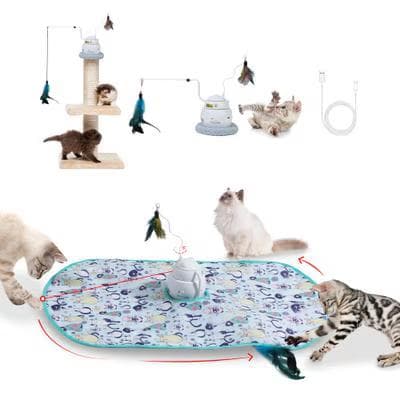
A bag of cheap, small, catnip-filled plush mice is the ideal rotating stock, because you need enough of them for the basket to change character between cycles and because they are consumable. Something like Fashion's Talk 18 Piece Plush Catnip-Filled Mice Cat Toys gives you a large enough pool to keep four cycles genuinely different, and losing three under the sofa is not a problem. The one larger item worth cycling the same way is a track toy she bats at alone, such as the Catstages Tower of Tracks Interactive Cat Toy. It runs on a single mechanism, so plenty of cats solve it and then stop noticing it if it lives on the floor permanently, which is exactly the kind of toy rotation rescues.
Webvet may earn a commission when you click through to Chewy, at no extra cost to you.
Wand and interactive toys: the ones you have to run
A wand only works if you run it like prey rather than like a fan. Prey does not hover in your cat's face. It moves away, it hides behind things, it goes still when it thinks it has been spotted, and then it bolts. Video is full of people waving a feather at a cat's nose and wondering why the cat loses interest in forty seconds. The motion pattern is the whole skill, and it takes about ten minutes to learn.
Run a session like this:
- Start it away from the cat. Drag the lure along the floor at the far side of the room so she has to come and find it.
- Move it away, never toward. Prey retreats. A toy driven at a cat's face triggers defence, not hunting.
- Use cover. Take the lure behind a chair leg, under a rug edge, around a doorframe. Disappearing is what holds attention.
- Freeze. Two or three seconds of complete stillness while she stares is what loads the pounce. Constant motion is the most common mistake.
- Let her win, several times. She has to actually catch it, hold it, and kick it. A hunt with no capture is a frustrating hunt.
- End on a catch, then feed. Finishing with a meal or a few treats closes the natural sequence of chase, catch, and eat.
Two sessions a day of about ten to fifteen minutes each will do more for a bored cat than any purchase in this article. If you would rather not steer at all, a classic Cat Dancer, which is nothing more than a stiff wire with rolled cardboard on the end, produces erratic motion almost by accident and is the easiest wand to run badly and still get a result.
For the full comparison of wands, teasers, and powered interactive toys, including which suit multi-cat households, see our guide to interactive and wand toys.
Food puzzles: enrichment that works every single day
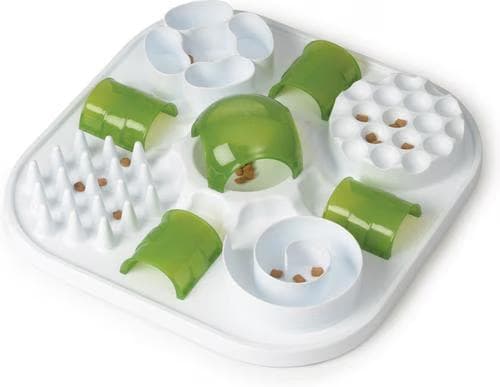
A food puzzle is the highest-yield change most owners can make, because it attaches effort to something your cat is going to do anyway. A bowl of kibble is thirty seconds of activity. The same portion loaded into a puzzle can be twenty minutes of searching, batting, and problem solving, repeated at every meal, without you being in the room.

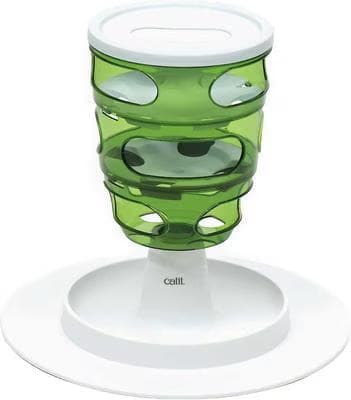
Start easier than you think you need to. This is where most food puzzles fail: the owner buys a difficult one, the cat tries twice, gets nothing, and never touches it again. A cat who has eaten from a bowl her whole life has no reason to believe food comes out of a plastic object, and you have to prove it. The Catit Senses 2.0 Food Tree Cat Feeder sits at that easy end, because she works the dry portion down through the feeder instead of finding it waiting in a bowl, which is a small enough step for a cat who has never had to earn a meal.
Webvet may earn a commission when you click through to Chewy, at no extra cost to you.
- Begin with a puzzle that leaks food when it is nudged, or a muffin tin with kibble in open wells, so the first attempt succeeds immediately.
- Use her normal meal, not treats, so the puzzle carries real value.
- Leave the bowl available alongside it for the first few days, then reduce what is in the bowl.
- Only increase difficulty once she is emptying the current puzzle reliably.
- Wet-food feeders and lick mats work for cats who will not eat dry food.
A beginner-friendly slider puzzle such as the Nina Ottosson Buggin' Out is a reasonable first step up once nudge-and-leak feeders are too easy. For choosing between designs, difficulty levels, and dry versus wet options, our guide to food puzzles and puzzle feeders covers the feeding side in full. That is a different job from a play puzzle, and the distinction is worth keeping straight: a feeding puzzle replaces the bowl, a play puzzle occupies an idle hour. If it is the play version you want, the Catit Play Treat Puzzle Cat Toy, Green does that job with treats rather than meals, and it is worth loading it with something she genuinely likes so the first few attempts are obviously worth the effort.
Webvet may earn a commission when you click through to Chewy, at no extra cost to you.
Toys your cat can run alone while you are out
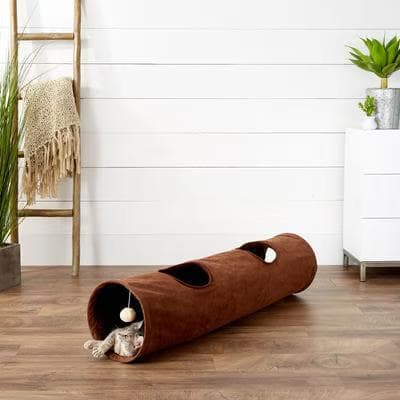
Solo toys are worth having, as long as you are honest about what they do. They cannot replicate the unpredictability of a human hand, so they will not hold a cat's attention the way a wand does. What they can do is give the day some texture between your play sessions, and passive stimulation is genuinely valuable for a cat who spends eight hours alone. A tunnel is the most useful of them, because she can hide in it, ambush out of it, and rattle around inside it without anyone holding anything. The Frisco 47-in Foldable Crinkle Play Tunnel with 2 Windows crinkles as she moves through it, the side windows keep it from being a dead end, and it folds away when you want the floor back.
Webvet may earn a commission when you click through to Chewy, at no extra cost to you.
The most reliable unattended enrichment is not a toy at all. It is a window with something happening outside it and a comfortable place to watch from. A padded ledge like the Frisco Plush Cat Window Perch with Removeable Bolster, Cream turns a windowsill your cat cannot fit on into a place she will spend hours, and a bird feeder positioned outside that window costs almost nothing to add.
Unsupervised play has its own safety rules, and they matter more than the toy choice:
- String, ribbon, yarn, tinsel, hair ties, and elastic never stay out. Swallowed linear material can bunch the intestine and become surgical, which is why every wand with a string goes in a drawer when the session ends.
- Inspect feathers, pom-poms, googly eyes, and glued-on parts weekly, and bin the toy the moment a part is loose. Small hard components are choking and obstruction risks.
- Battery compartments must be screw-closed, not clip-closed. Button batteries are a genuine emergency if swallowed.
- Food puzzles are the safest unattended option, because there is nothing on them small enough to come off.
- Anything with a cord, a charging cable, or a mains plug is supervised play only.
For the actual hardware decision on motion-activated and electronic toys, including which ones stop on their own and which run the batteries flat in a day, see our guide to toys that run while you are out.
Which toys hold up for months, and which burn out in a week
The question of what toys cats never get bored with has a clean answer, and it is not a brand. Toys hold interest when they change between sessions and when they end in a reward. Toys burn out when they present the identical experience every time and give the cat nothing at the end. That single mechanism explains almost the entire durable-versus-disposable split.
| Holds interest for months | Why it lasts | Burns out in a week | Why it fails |
|---|---|---|---|
| Human-driven wand | The motion is different every session and the cat is allowed to catch it | Laser pointer used alone | Nothing is ever caught, so the hunt never resolves |
| Food puzzle | Delivers a real food reward, and difficulty can be raised as skill grows | Static plush mouse left on the floor | Identical every time, and it becomes part of the scenery within days |
| Cardboard box or paper bag | Cheap enough to replace often, so it is always novel, and it supports ambush | Single-pattern battery toy | One repeating motion path, which a cat predicts after a few sessions |
| Rotated catnip or silver vine toys | Scent novelty resets each cycle when stored sealed | Un-rotated catnip toys | The oils fade with air exposure and stop registering |
| Window view with outdoor activity | The content genuinely changes all day | Oversized plush the cat cannot carry | Cannot be picked up or kicked, so the kill phase is impossible |
Laser pointers deserve a specific caveat, because they are popular and they are the most common cause of the pattern where a cat plays hard and then seems unsettled afterwards. The dot cannot be caught. If you use one, land it on a physical toy or a scatter of treats at the end of every session so the hunt actually finishes. Some cats never settle with one at all, and for those cats a wand is the better tool.
How we picked, and what a good cat toy has to do
There is no ranked top ten here, because a ranked list of products cannot tell you whether the thing you already own is the problem. Instead, every toy named in this guide had to clear the same four criteria, and you can apply them to anything you are looking at in a shop.
| Criterion | What it means | Fails when |
|---|---|---|
| Triggers a real prey pattern | Moves like something a cat would hunt: flying, scurrying, or hiding | It only moves when the cat pushes it, in one predictable way |
| Ends in a capture | The cat can grab, hold, and kick it, or gets food out of it | Nothing is catchable, as with a laser dot on a wall |
| Survives an adult cat | Seams, glue joints, and small parts hold up to teeth and claws | Eyes, feathers, or bells detach within a few sessions |
| Safe to leave out, or clearly not | Either it has no loose or stringy parts, or it obviously belongs in a drawer | Ribbon, elastic, or clip-closed battery doors |
If you want the undifferentiated year-by-year comparison of what is on the market, including the top-ten style breakdowns, that lives on our full cat toy roundup rather than here. This guide is about the bored cat specifically, and for a bored cat the criteria above matter more than the ranking.
Matching toys to a senior, lazy, or low-energy cat
The best cat toys for older cats and the best cat toys for lazy cats fit the reason activity dropped rather than simply moving more slowly. A cat labelled lazy is usually one of three things: a cat whose play style nobody has found yet, a cat carrying more weight than her joints want to lift, or a cat in pain. Osteoarthritis is extremely common in older cats and it is easy to miss, because cats compensate by simply doing less rather than by limping. Before you conclude your cat does not like toys, check whether she has quietly stopped jumping onto surfaces she used to reach.

Once pain has been ruled out or is being treated, adjust the play rather than abandoning it:
- Keep everything at floor level. A senior cat will engage with a lure dragged along the ground long after she has stopped leaping for one held overhead.
- Shorten the sessions and add more of them. Three five-minute sessions beat one fifteen-minute session for a cat with less stamina.
- Slow the movement down. Older cats track slower prey more easily, and a lure moved at half speed gets far more engagement.
- Use scent and food rather than speed. Snuffle mats, treat-dispensing balls, and silver vine work without any athletic demand.
- Put the resources where she is. Low ramps, a step up to the sofa, and a heated bed at floor level keep her using the room.
- Overweight cats need the same slow, floor-level start, plus a portion-controlled food puzzle so the enrichment and the weight plan pull in the same direction.
If a previously athletic cat has stopped jumping, read senior cats and mobility before you change anything else. Younger cats at the other end of the scale have their own profile, and the shorter, more frequent bursts a kitten needs are covered in our guide to kitten toys.
Free and DIY enrichment that beats buying another toy
Some of the most effective DIY cat toys for bored cats cost nothing and are already in your kitchen. This is not a budget compromise. Novelty and foraging are the two mechanisms that actually move the needle, and both are free.
- Scatter feeding. Take a portion of the day's kibble and throw it across a room or hide it in five spots. Your cat has to search for her food, which is what she was built to do.
- Cardboard boxes. Cut two entrances so it is not a dead end, put it where the household walks past, and replace it when it collapses. It is an ambush post, a hiding place, and a scratching surface.
- Paper bags with the handles cut off. Enormous value for a piece of packaging. Cut the handles so nothing can get caught around a neck.
- Toilet roll tubes with kibble inside. Fold the ends, let her work it out. A disposable food puzzle that costs nothing.
- A muffin tin and some ping pong balls. Kibble in the wells, balls on top. A beginner foraging puzzle for about the price of nothing.
- Rearrange something. Move a chair, open a door that is usually shut, bring in a cardboard tube from a delivery. Environmental novelty is enrichment on its own.
Two safety notes on homemade toys. Nothing with string, elastic, rubber bands, or twist ties stays out unsupervised, and nothing small enough to swallow whole belongs in a DIY toy at all. Beyond that, the household recycling is a better enrichment budget than most toy aisles.
A weekly enrichment plan you can actually keep
The real answer to how to entertain a very bored cat is a routine rather than a purchase. Cats respond to predictability, and a plan that runs on the same rhythm every day beats an intense weekend of attention followed by five quiet days. Here is a week that takes about twenty-five minutes a day and covers every category in this guide.
Every weekday:
- Morning, ten minutes. Wand session before you leave, run as prey, ending in a catch. Feed breakfast immediately afterwards so the sequence closes.
- Morning, one minute. Load the food puzzle with the day's dry portion and leave it out instead of the bowl.
- Midday, zero minutes from you. Window perch, open blind, bird feeder outside if you have one. This is the passive stretch.
- Evening, ten to fifteen minutes. The bigger session. Wand again, or a chase toy along the floor, ending in a catch and then dinner.
- Before bed, two minutes. Scatter a small handful of kibble across a room so there is something to hunt at three in the morning.
Once a fortnight: swap the basket. Three toys out, everything else in the sealed bin, following the rotation table above.
Once a month: change something in the environment. A new box, a shelf moved, a different route up to the high platform, a fresh cardboard scratcher in a new spot.
If you can only manage one thing on a bad day, make it the evening wand session followed by dinner. The play-then-eat sequence is the single highest-value two minutes in the plan, and it is also the one most likely to buy you an uninterrupted night.
What toys cannot fix
Here is the honest close. If your cat is bored in a home with no vertical routes, food that arrives free in a bowl, no play cadence, and an unpredictable daily rhythm, another toy will change nothing. It will get four days of interest and then join the others under the sofa, and you will conclude that your cat does not like toys.
Four inputs actually move a bored indoor cat, and the toy is one of them:
- Play cadence. Two short, human-driven sessions a day, at roughly the same times, ending in a catch and a meal.
- How food is delivered. Effort attached to eating, through puzzles, scatter feeding, or hidden portions, instead of a full bowl at all times.
- Vertical and hiding options. Somewhere high to watch from and somewhere enclosed to retreat to, in the rooms the household actually uses.
- Routine predictability. Meals, play, and quiet happening on a rhythm the cat can anticipate.
Get those four right and almost any decent toy works. Get them wrong and no toy does. If your cat has started making serious efforts to get out of the house, that is usually this conversation arriving in its loudest form, and our guide to cats that try to get outside picks up from there.
Frequently Asked Questions
What is the best cat toy for bored cats?
A feather wand you operate yourself is the best single toy for a bored cat, because it is the only category where a human supplies unpredictable prey movement. Run it twice a day for about ten minutes, move the lure away from your cat rather than at her, use furniture as cover, and let her actually catch it several times per session. Pair it with a food puzzle for daily mental work, and add a few small kickable toys she can finish a hunt with on her own.
What are some good toys for cats to relieve boredom?
Choose by prey category rather than by product. Flying prey means feather wands and bird lures that move above her head. Ground-scurrying prey means string or worm-style teasers dragged along the floor and around corners. Chase-and-kill prey means small mice and crinkle balls she can grab, carry, and rabbit-kick. Forage means food puzzles, treat balls, and scattered kibble. A house covering all four with six items is better equipped than a house with twenty variations on the same plush mouse.
How do I entertain my bored cat?
Rotate what she already owns before you buy anything else. Keep three toys out at a time and everything else in a closed bin, then swap the basket on the same day every fortnight. Cats habituate quickly to a static object, so a toy that has been on the floor for a month has effectively stopped existing. Two weeks out of sight is enough to restore its novelty. The wand, the food puzzle, and the current cardboard box are daily infrastructure and never rotate out.
How to entertain a very bored cat?
Build a routine rather than buying more. Ten minutes of wand play before you leave in the morning, followed immediately by breakfast. The day's dry portion loaded into a food puzzle instead of a bowl. A window perch with a view for the middle of the day. A longer ten to fifteen minute session in the evening that ends in a catch and then dinner. A handful of kibble scattered across a room before bed. That takes about twenty-five minutes a day and covers hunting, foraging, and observation.
What toys do cats never get bored with?
Toys that change between sessions and end in a reward. Human-driven wands stay interesting because the motion is different every time and the cat is allowed to win. Food puzzles last because there is a real food payoff and the difficulty can rise with skill. Cardboard boxes work because they are cheap enough to replace constantly. Rotated catnip toys stored in a sealed jar keep their scent novelty. What burns out fastest is anything with one repeating motion pattern and no capture at the end.
How to help an extremely bored cat?
Rule out the alternatives first. Night vocalizing, overgrooming, sudden aggression, hiding, and sleeping more are all listed as boredom signs, and every one of them is also a stress or medical sign. If a behavior started suddenly, has been getting worse, or came with a change in appetite, drinking, weight, or litter box use, see your veterinarian before buying anything, particularly in a cat over about seven. If the signs are longstanding and stop the moment you produce a wand, treat it as boredom and start with daily play plus a food puzzle.
How long should I play with my indoor cat each day?
Aim for two sessions a day of roughly ten to fifteen minutes each, ideally morning and evening, rather than one long session. Cats hunt in short bursts with rest in between, so several brief, intense sessions match their natural pattern far better than a single marathon. Older cats and cats with joint pain often do better with three or four sessions of about five minutes at floor level. Consistency at the same times of day matters more than total minutes.
Are puzzle feeders good for cats?
Yes, for most cats, provided you start easy enough. A puzzle feeder turns a thirty-second bowl of food into fifteen or twenty minutes of searching and problem solving, and it works at every meal without your involvement. The common failure is starting too hard: the cat tries twice, gets nothing, and never returns. Begin with a feeder that leaks food when nudged, use her normal meal rather than treats, keep a bowl available for the first few days, and only raise the difficulty once she empties the current one reliably.
Sources

Editor
The Webvet Editorial Team is the in-house group of pet-care editors and writers behind Webvet, operated by Smart Pet Collective. The team researches, writes, and maintains Webvet's pet health, behavior, and medication content. Every article follows a defined editorial process: research from reputable veterinary and scientific sources, careful drafting, mandatory review of medical content by a credentialed veterinarian, and dated publication. Health and medication articles are medically reviewed by a licensed veterinary professional before they go live and are kept current over time.


