Cat Puzzle Toys: Levels, DIY Builds, and Safe Picks
Cat puzzle toys work when they match your cat's current skill. Here is the beginner to advanced ladder with objective move-up and move-down criteria, which formats take wet food, three DIY builds, and how to start without frustration.

This article contains affiliate links. Webvet may earn a commission when you buy through them, at no extra cost to you.
Cat puzzle toys hide food behind a physical problem the cat has to solve by rolling, pawing, sliding, tipping, or digging, and they work because they hand back the searching half of hunting that a food bowl takes away. The right one is not the cleverest thing on the shelf. It is the one your cat can beat today, with a clear route to something harder next month.
That distinction matters, because most pages on this subject blur two different products together. A mealtime puzzle feeder replaces the bowl and holds whole meals, and if that is what you came for, our guide to puzzle feeders for mealtimes covers portioning, bowl conversion, and feeder picks. This page is about play: treat-sized portions, short sessions, difficulty that climbs, and enrichment you can build tonight out of a cereal box.
- 1A cat puzzle toy is a play and enrichment tool loaded with treats, while a puzzle feeder replaces the bowl and holds whole meals, and those two jobs need different products.
- 2Start a full level below what you think your cat can handle, because most failed puzzle purchases are a cat who was handed an advanced board on day one.
- 3Move up only when your cat empties the puzzle without being re-baited, uses its paws rather than only its nose, and finishes inside a few minutes across three sessions in a row.
- 4Move down the moment your cat walks away inside a minute, paws once and quits, sits and stares at it, or starts guarding it from other pets in the house.
- 5Open trays, silicone lick mats, and shallow wells take wet food and lickable purees, while enclosed maze channels, rolling balls, and fabric snuffle mats are realistically dry-and-treat only.
- 6Anything that has held wet food gets washed the same day, because narrow channels and fabric hold residue that sours and grows mould faster than owners expect.
- 7Three of the best beginner puzzles cost nothing: a bundle of toilet-roll tubes in a shallow box, an egg carton forager, and a muffin tin with treats hidden under a few balls.
What cat puzzle toys are (and how they differ from puzzle feeders)
Every product in this category does the same basic thing: it puts food behind an obstacle so the cat has to work for it. What separates a puzzle toy from a puzzle feeder is the job you are asking it to do, and the job changes the specification you should shop to.
- A puzzle toy is loaded with treats or a small handful of kibble, used for five to fifteen minutes at a time, and chosen to be solvable but not instant. It is enrichment, and it sits alongside normal meals rather than replacing them.
- A puzzle feeder is loaded with a measured meal, used at feeding time, and chosen for capacity, portion control, and how easily it cleans. It replaces the bowl.
- One object can occasionally do both, which is where the confusion on this topic starts. A large multi-compartment board can hold a meal. A small treat ball cannot, and trying to feed a cat from one is how owners end up with kibble under the sofa and a hungry cat at midnight.
A puzzle covers the seek, find, and work-for-it part of predatory behavior. It does not cover the chase, and cats need both halves. A feather wand such as the Frisco Bird with Feathers Teaser Wand Cat Toy with Catnip, Blue supplies the sprint-and-pounce side in ten minutes a day, and a routine that pairs the two beats either one alone. If you are still deciding what belongs in the toy box overall, start with our guide to choosing cat toys, and for wand, laser, and motion formats specifically, see interactive toys for active play.
Webvet may earn a commission when you click through to Chewy, at no extra cost to you.
Why puzzle toys work for cats
Are puzzle toys good for cats?
Yes. Puzzle toys are good for most cats because they restore the foraging work that indoor life removes, and that work turns eating from a ten-second event into a mental task. Cats who forage for part of their food are typically calmer, less fixated on the kitchen, and less likely to invent their own entertainment at three in the morning.
A cat who hunts for a living does not encounter food. It looks for food, fails several times, succeeds occasionally, and eats a series of small meals spread across the day and night. Indoor life deletes every step of that sequence except the last one. Veterinary guidance on feline environmental needs, including the practice guidelines published by the American Association of Feline Practitioners and the indoor-cat resources from Ohio State, consistently treats the opportunity to express hunting and foraging behavior as a core need rather than an optional extra.
That is the mechanism. Here is what owners typically notice once a cat is working for part of its food:
- Eating slows down, which matters most for the cat who inhales a bowl and brings it back up on the rug ten minutes later.
- Daytime hours fill up in a species-appropriate way, so there is less door-scratching, less counter-surfing, and less shredding of the houseplants.
- Nervous cats get a predictable, controllable task, which is one of the few forms of enrichment that a shy cat will engage with while people are in the room.
- Overweight cats get activity attached to food rather than activity they have to be persuaded into.
- Cats who beg constantly often beg less, because the food arrives as an event with a beginning and an end instead of as a bowl that is always there.
What puzzles do not do is fix a medical problem or replace human interaction. If the underlying issue is general under-stimulation, the wider fix list lives in our guide to boredom in indoor cats, and puzzles are one tool from that list rather than the whole answer.
Treat-dispensing puzzles: rolling, foraging, and sliding formats
Treat puzzles for cats fall into a handful of physical families, and the family matters more than the brand, because each one asks the cat to do something different with its body. Reading the format tells you the difficulty before you read the box.
- Rolling and mobile puzzles, meaning treat balls, wobblers, and weighted eggs. The cat bats the object, it moves, and food falls out of a hole. This is the lowest skill floor in the category and the easiest first purchase. It needs a hard floor to work properly, and it is noisy on laminate at 4am.
- Snuffle and lick surfaces, meaning fabric snuffle mats and textured silicone lick mats. These ask for nose and tongue work rather than paw work, which makes them the gentlest entry point of all. Lick mats are also the one format that takes wet food comfortably.
- Open trays and wells, meaning a flat board with shallow depressions the cat has to reach into. A genuine first step up from a mat, because the cat has to commit a paw rather than just a face.
- Slider boards and lidded channels, where the cat must push a cover sideways with a paw before the food underneath becomes available. This is the first real two-step problem in the category: move the thing, then take the food.
- Forager boxes and digging puzzles, usually a box with holes in the top and internal barriers, sometimes cardboard and sometimes moulded plastic. They suit cats who like to shred and dig, and they are the format most likely to survive a bored cat at 2am.
- Multi-compartment stationary boards, which combine wells, cones, sliders, and tipping levers on a single surface. Several mechanisms at once, which is why they belong at the top of the ladder rather than at the start.

Where you put a treat puzzle for cats changes how well it works. Rolling formats need hard flooring and an open run of at least a few feet, or the ball wedges under furniture within a minute and the cat gives up. Stationary boards want a corner where the cat can sit with its back protected. In a multi-cat home, run more than one station and separate them properly, including vertically, because a cautious cat will often work a puzzle on a platform of a cat tree such as the Yaheetech Multi-Level 63-in Plush Cat Tree, Dark Gray when it will not settle to eat on the floor beside a housemate.
Webvet may earn a commission when you click through to Chewy, at no extra cost to you.
The cat puzzle difficulty ladder: beginner, intermediate, advanced
This is the part almost nobody publishes, and it is the part that decides whether the puzzle you buy gets used for years or shoved in a cupboard by Thursday. Treat difficulty as a ladder with three rungs, and treat your cat's position on it as a fact you measure rather than a guess you make in a shop.
- Beginner. Food is visible, reachable, and released by one simple action. Treat balls, lick mats, snuffle mats, and open trays live here. The cat needs no technique, only the idea that food comes out of objects.
- Intermediate. Food is partly hidden and needs a deliberate paw movement, usually one that changes the puzzle before the food is available. Slider boards, forager boxes, and shallow maze channels live here.
- Advanced. Food is fully hidden, several different mechanisms appear on one puzzle, and the cat has to sequence actions or remove parts. Multi-compartment boards and graded level three products live here.
Move a cat up a rung only when all three of these are true, and check them across sessions rather than on one lucky evening:
- The cat empties the puzzle without being re-baited partway through.
- The cat uses its paws deliberately rather than only nosing at the food or knocking the puzzle over.
- The cat finishes inside roughly five minutes on three consecutive sessions.
Move a cat down a rung the moment any of these show up, and do it without waiting to see whether the cat works it out:
- It walks away inside a minute, or does not approach the puzzle at all on two consecutive attempts.
- It paws once, stops, and grooms itself, which is a displacement behavior rather than a rest.
- It sits and stares at the puzzle, or vocalises at you next to it.
- It starts guarding the puzzle from another pet, or gets tense and flat-eared while working it.
Frustration is a level problem, not a cat problem. A cat that quits is not stubborn or unintelligent, it has simply been handed a task above its current skill, and the cost of getting this wrong is that the cat learns puzzles are not worth approaching. That lesson takes far longer to undo than dropping a level takes to fix.
How the graded puzzle lines work (and how to read a level number)
Two brands dominate the level-number conversation. The Nina Ottosson cat puzzle range, sold under Outward Hound, prints a difficulty level on the packaging, and the Trixie cat puzzle and activity strategy games do the same. Those numbers are genuinely useful, with one large caveat: they are internal scales rather than an industry standard, so a level 2 from one maker is not equivalent to a level 2 from another. When you switch brands, start one level below where your cat finished with the old one.
Read the mechanism instead of the number. Three questions settle almost every comparison:
- How many distinct actions does one reward require? Batting is one. Sliding a lid and then reaching in is two. Lifting a cone, then sliding a drawer, then reaching a well is three.
- Can the cat see and smell the food from outside? Visible food is dramatically easier, because the cat does not have to believe there is a reward before it starts working.
- Are there removable parts? Puzzles with lift-out cones or pegs are harder, and they are also the ones to supervise, because a removable part is a part a cat can carry off and chew.
One more practical note on graded lines: many of the best-built products in this category are marketed for dogs and work perfectly well for cats, while some cat-branded puzzles are scaled so small that a large cat cannot get a paw in. Judge the well diameter and the height of any lid against your own cat's paw rather than against the species on the label.
Cat puzzle toy picks by difficulty level
What are the best cat puzzles?
The best puzzles for cats are the ones matched to the rung your cat is actually on, which is why a single ranked list is the wrong shape for this question. For a beginner, the best cat puzzle toys are a rolling treat ball or a lick mat. For an intermediate cat, a slider board or a forager box. For an advanced cat, a multi-compartment board with several mechanisms and removable parts. Buy for the rung, then let the cat earn the next one.
Beginner picks
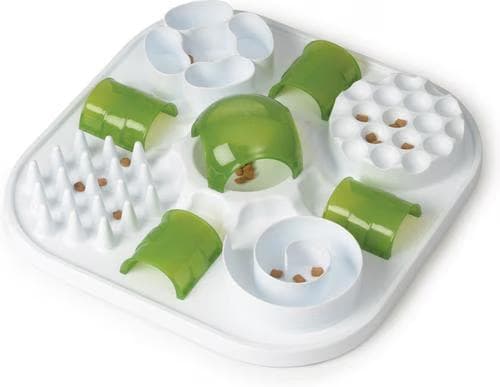
Look for visible food, a single mechanism, and something the cat can knock around without needing accuracy. Rolling dispensers like the PetSafe SlimCat are the archetype, and a plain silicone lick mat does the same job for a cat who prefers licking to batting. A shallow tray with open wells is the third good option and the one that transitions best into paw work. A tube-style board such as the Catit Play Treat Puzzle Cat Toy, Green sits at the top of this rung for the same reason, because the cat has to commit a paw down into a tube rather than sweep at food lying in the open, which is exactly the skill the intermediate rung will ask for. Budget matters less here than most people expect, because the beginner rung is about teaching a concept rather than testing skill.

Intermediate picks
Now the cat has to change the puzzle before it gets fed. Slider-style boards such as the Trixie Brain Mover and the Cat Amazing Sliders sit squarely at this rung, as do cardboard forager boxes with internal barriers. The useful test when you are comparing two products: count the distinct actions required. One action is beginner, two is intermediate, three or more is advanced.
Advanced picks
Advanced boards combine cones you lift, drawers you pull, wells you reach into, and lids you slide, all on one surface. The Nina Ottosson line and larger multi-compartment boards belong here. Advanced does not mean better, and buying at this rung for a cat who has never used a puzzle is the single most common mistake in this category.
| Format | Difficulty rung | Wet food or puree | Cleaning effort | Best-fit cat |
|---|---|---|---|---|
| Rolling treat ball | Beginner | No, dry and treats only | Low, rinse and dry fully | Confident, active cats with hard floors |
| Silicone lick mat | Beginner | Yes, ideal | Low, but wash same day | Seniors, fast eaters, anxious cats |
| Fabric snuffle mat | Beginner | No, dry only | High, machine wash and dry fully | Nose-led and nervous cats |
| Open tray with wells | Beginner to intermediate | Yes, shallow portions | Medium | Cats learning to commit a paw |
| Cardboard forager box | Intermediate | No | Replace rather than wash | Diggers, shredders, chewers |
| Slider board | Intermediate | Only in open channels | Medium | Cats already emptying beginner puzzles |
| Enclosed maze channel | Intermediate to advanced | No, dry only | High, awkward to dry inside | Methodical, patient cats |
| Multi-compartment board | Advanced | Open wells only | Medium to high | Cats who beat sliders without re-baiting |
Not every cat is food-motivated enough to care about any of this. For those cats, the bait can be a toy rather than a treat: a set of small plush mice such as the Fashion's Talk 18 Piece Plush Catnip-Filled Mice Cat Toys tucked into a forager box or under the lids of a slider board gives a play-driven cat a reason to dig, and the mice can be re-scented and reused indefinitely instead of adding calories.
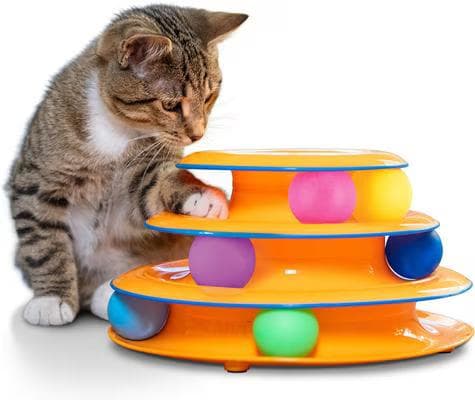
A cat who ignores food-based puzzles in every form needs a different category of toy rather than an easier puzzle. A track toy such as the Catstages Tower of Tracks Interactive Cat Toy gives that cat something to bat at on its own during the day, and it stays where you put it instead of skittering under the sofa. Be straight about its limit, though: the balls never leave the tracks, so there is no catch at the end, and a cat who needs to trap something to feel finished will get more out of ten minutes with a wand.
Webvet may earn a commission when you click through to Chewy, at no extra cost to you.
How to introduce a cat puzzle toy
Introduction is where most puzzles are won or lost, and the protocol is close to the opposite of what instinct suggests. Start absurdly easy, then make it harder, rather than buying something impressive and hoping the cat rises to it.
- Set the puzzle up in its easiest possible configuration. Leave lids off, remove the internal barriers, and put food both inside and scattered on top so there is a free reward for simply approaching.
- Leave the normal bowl exactly where it is for at least the first two weeks. A puzzle is an addition at this stage, never a replacement, and a cat should never have to solve anything to eat a meal.
- Use high-value food rather than the usual kibble. Freeze-dried single-ingredient treats and small pieces of the cat's favorite wet food beat everyday biscuits by a wide margin at this stage.
- Keep sessions short and end them early. Five to ten minutes while the cat is still interested teaches a better lesson than twenty minutes that ends in the cat walking off.
- Add one piece of difficulty at a time. Put a lid on. The next day, add a barrier. Never add two changes in the same session, because if interest drops you will not know which change caused it.
Give a new puzzle two weeks before you judge it. Cats routinely ignore an unfamiliar object for several days and then start working it once it has stopped being new, so an untouched puzzle on day three is not a failed purchase.
Wet food versus dry food in a cat puzzle toy
This is the practical question owners ask most and the one the rest of the internet answers in a single sentence. The honest answer is that the shape of the puzzle decides the food, not the marketing on the box. Anything with a narrow enclosed channel or an absorbent fabric surface is a dry-and-treat product no matter what the listing implies.
| What you want to load | Formats that work | Wash timing |
|---|---|---|
| Lickable puree or mousse | Silicone lick mat, shallow open tray, textured slow plate | Same day, before it dries on |
| Wet food, spooned in | Lick mat, open wells, wide flat tray | Same day, hot soapy water |
| Semi-moist treats | Open wells, slider board with open channels | Within a day or two |
| Dry kibble | Rolling ball, maze channel, forager box, snuffle mat | Weekly, or when crumbs build up |
| Freeze-dried treats | Every format, the most flexible bait there is | As for dry |

Enclosed channels stay dry-only for a reason that has nothing to do with whether the food fits. You cannot get a brush or a finger all the way into a narrow moulded tunnel, so wet residue stays where it lands, and warm residue in a sealed channel sours quickly and grows mould in the corners you cannot see. The same logic rules out fabric snuffle mats for anything moist: the fibres hold it, and rinsing does not remove it. Keep those formats for kibble and freeze-dried treats, and put wet food only on surfaces you can wipe flat.
Cleaning cadence is simple once you split it that way. Anything that held wet food or puree is washed the same day in hot soapy water, or goes in the dishwasher if the maker says it is dishwasher safe. Dry-food puzzles get a weekly wash and, more importantly, a full dry before they are reloaded, because a rinsed treat ball with water trapped inside turns the next handful of kibble into paste. Cardboard builds are not washable at all and should be replaced rather than cleaned.
There is a third thing you can load into a puzzle besides wet food and dry food, and it matters for the cats who shrug at both. Scent works as bait in its own right, so rubbing a pinch of an attractant such as SmartyKat Silvervine Cat Attractant Catnip, 2-oz canister into the surface of a board, or dusting it over the treats, converts a fair number of cats who ignored the identical puzzle unscented. Silvervine is worth trying specifically because a substantial minority of cats do not respond to catnip at all, and many of those cats do respond to silvervine.
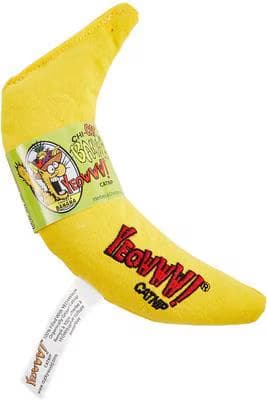
If you have never actually established whether catnip does anything for your cat, a strongly scented catnip toy such as the Yeowww! Catnip Yellow Banana Cat Toy settles the question in a single session. Roughly a third of cats inherit no response at all, and that is a fact about the cat rather than a fault in the toy. A flat no is still useful, because it tells you to bait with silvervine or high-value food instead of buying more catnip products that will sit in a drawer.
Webvet may earn a commission when you click through to Chewy, at no extra cost to you.
DIY cat puzzle toys you can build tonight
Homemade puzzles are not a budget compromise. At the beginner and intermediate rungs they genuinely match bought products, and they have one real advantage: when a cardboard build gets too easy, you can make it harder in thirty seconds with a pair of scissors. These are the three DIY cat enrichment ideas worth building first, and each one carries a ladder rung so it plugs into the same progression as everything above.
Toilet-roll tube bundle (beginner to intermediate)
You need six to ten empty toilet-roll or kitchen-roll tubes and one shallow cardboard box roughly the size of a shoebox lid.
- Stand the tubes upright, packed together, inside the shallow box so they support each other.
- Trim the tubes so they sit no higher than a comfortable paw reach for your cat, roughly the height of the cat's foreleg.
- Drop treats down the tubes, some near the top for a first easy win and some near the bottom.
- Let the cat work it with the box open and visible for the first few sessions.
- To make it harder, fold the top of some tubes closed, or cut a few tubes shorter so the cat has to reach further into others.

Egg carton forager (beginner)
You need one cardboard egg carton with the lid removed.
- Tear off the lid completely so there is nothing to trap a paw or a head.
- Put a treat in each cup, all visible, for the first session.
- Once the cat clears it easily, bury the treats under a scrunched ball of paper in half the cups.
- Next, close a few cups by folding the torn lid card loosely over them.
- Replace the carton when it gets damp, chewed, or torn apart, which is usually after a week or two of regular use.

Muffin tin puzzle (beginner)
You need a metal or silicone muffin tin and a few tennis balls, ping-pong balls, or crumpled paper balls.
- Put a treat in the bottom of most cups, leaving one or two empty so the cat has to check.
- Cover half the cups with balls, leaving the rest open.
- Let the cat clear the open cups first, which teaches the pattern without any obstacle.
- Once that is quick, cover every cup.
- To go further, use heavier balls, or swap in a silicone tin and smear a little wet food in the uncovered cups instead of using treats.
A fourth build worth knowing: a clean plastic bottle with a few kibble-sized holes cut in the sides and the cap left on becomes an intermediate rolling puzzle. Sand or fold any cut edge so it is smooth, and retire the bottle at the first sign of a crack, because cracked thin plastic makes sharp points.
Using puzzles to slow a fast eater
The mechanism is straightforward: a puzzle converts eating from a continuous action into a repeated one. The cat has to reposition, work the mechanism, and take a small amount, then start again, and those forced pauses are what stop a cat from swallowing an entire portion in ninety seconds and bringing part of it back up.
For treat-sized play portions, any beginner-rung puzzle achieves this on its own. Converting whole meals is a different project with real considerations around portion accuracy, feeding multiple cats, wet food handling, and whether the cat will actually eat enough on a slower schedule. That job belongs to a purpose-built feeder rather than a play puzzle, and it is covered properly in our guide to puzzle feeders for mealtimes. Start there if the goal is to replace the bowl rather than to add an activity to the day.
Troubleshooting when a cat puzzle toy is not working
Almost every failure in this category is one of five specific problems, and four of them are fixed by changing the setup rather than the cat.
The cat ignores it completely
Nine times out of ten the puzzle is too hard or the bait is too boring. Strip it back to its easiest configuration, scatter a few treats on top and around the base so approaching it pays immediately, and switch to a high-value food. Also check the location: a puzzle in a corridor, next to a noisy appliance, or beside the litter tray gets ignored by cats who would happily use it three feet away.
The cat tries once, gets frustrated, and quits
Drop a level, today. Watch for the early signals rather than waiting for the walk-off, because tail flicking, flattened ears, sudden grooming, and a hard stare all arrive before a cat gives up entirely, and our guide to reading frustration and stress signals covers what those look like in practice. A cat who quits repeatedly is learning that puzzles do not pay.
The cat only works it when you are watching
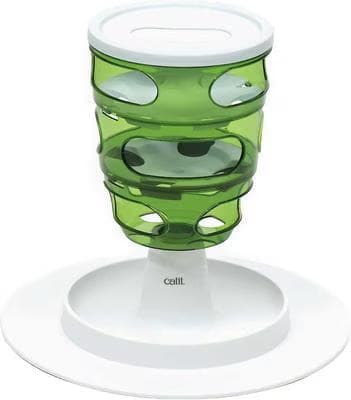
That is usually a confidence issue rather than a performance. Move the puzzle to a spot with a wall behind it and a clear escape route, stay in the room but disengage, and stop touching or repositioning the puzzle mid-session. Some cats also do better with a puzzle they can pin down, since a mobile treat ball that skitters away can be genuinely off-putting to a cautious cat. A stationary dispenser such as the Catit Senses 2.0 Food Tree Cat Feeder suits that cat better, because it stays exactly where you set it and the cat can lean in and work it without chasing anything across the floor. Load it with treats or a small handful of kibble rather than a whole meal and it behaves as a play puzzle rather than a bowl replacement.
The cat rakes the food onto the floor and eats it there
This is a solved puzzle, not a failed one. The cat found the fastest legitimate route to the food. Take it as a signal to move up a rung, choose a format with a lid or a deeper well, or use a weighted stationary board that cannot be tipped. It is not misbehavior, and correcting the cat for it teaches nothing useful.

One cat monopolises every puzzle
Multi-cat homes need one puzzle station per cat plus one spare, spaced far enough apart that no cat has to pass another to reach one. Watch for the quiet form of guarding, which is not hissing but body blocking: one cat standing over a puzzle while another waits, or a cat who simply stops approaching when the confident one is in the room. Vertical separation helps here as much as horizontal distance does, and if a cat that never guarded food suddenly starts, that is worth a call to your veterinarian rather than a training plan.
Keeping puzzles challenging: rotation and levelling up
What toys do cats never get bored with?
Honestly, none. No toy stays novel forever, and any page promising one is selling something. What comes closest is a puzzle that changes: a format that can be made harder, re-baited with a different food, moved to a new room, or swapped out for a week and brought back. Novelty in cats is mostly about change over time, so the schedule beats the object every time.
A rotation routine that works for most households looks like this:
- Keep three to five puzzles in circulation and only two available at any one time.
- Swap the available pair roughly weekly, and store the rest out of sight rather than in a visible pile.
- Change the bait as well as the toy, since the same board with freeze-dried chicken instead of kibble reads as a different experience.
- Move a puzzle to a different room every few weeks, because location is part of what makes it interesting.
- Re-check the ladder every month using the move-up test, and buy or build the next rung only when the cat passes it three sessions running.
Cardboard builds are the cheapest way to keep rotation honest, because you can retire and rebuild them constantly at no cost. That is the strongest argument for keeping DIY cat puzzle toys in the mix even when you own good commercial products.
Safety, and the cats who should not be moved onto puzzles
Puzzles are low-risk, but not zero-risk, and a handful of cats need a different plan entirely.
- Swallowable parts. Anything removable, including cones, pegs, and small lids, needs supervision. Retire a puzzle that is being chewed rather than solved.
- Sharp or cracked plastic. Inspect moulded puzzles monthly, especially at hinge points and along cut DIY edges.
- Dental disease. A cat with painful teeth will avoid hard plastic and may stop eating rather than work at it. Soft surfaces, lick mats, and open trays are the right choice while dental disease is being treated.
- Arthritic and senior cats. Reaching into deep wells and standing to bat a rolling ball are both harder than they look for a stiff cat. Choose flat, ground-level, low-effort formats and keep them off slippery floors.
- Blind and low-vision cats. Scent-led formats work well, meaning strongly aromatic bait, open shallow layouts, and a puzzle that stays in exactly the same place every session.
- Kittens. Size the openings and any loose components to the kitten, not the adult it will become, and supervise everything. Our guide to age-appropriate toys for kittens covers safe sizing in more detail.
Some cats should not be moved onto puzzle-based feeding at all, at least for now. Underweight cats, cats recovering from illness or surgery, cats with any recent change in appetite, and cats with feline cognitive dysfunction all need eating to be as easy as possible, and adding an obstacle can reduce intake at exactly the wrong moment. Treat-level puzzle play is usually still fine for these cats, but their meals should stay in an ordinary bowl unless your veterinarian has said otherwise.
Call your veterinarian rather than adjusting the puzzle if you see any of the following: a sudden change in appetite in either direction, weight loss, a cat who stops eating when the bowl is replaced, food guarding that appears out of nowhere in a cat who never did it, or any cat who eats nothing at all for a day. Cats do not tolerate not eating the way dogs and people do, and a cat who skips meals needs a professional opinion quickly, not a different toy.
Cat puzzle toy questions
Frequently Asked Questions
What is the best toy to stimulate a cat?
It depends which kind of stimulation is missing. Puzzle toys supply the mental, problem-solving, foraging half of a cat's day, and they are the better answer if your cat is bored, eats too fast, or pesters you around food. Wand toys, motion toys, and chase formats supply the physical, predatory half, and they are the better answer if your cat has energy to burn. Most cats need both, and our guide to interactive toys for active play covers the chase side in full.
How often should a cat use a puzzle toy, and how long should a session last?
Once or twice a day is plenty for most cats, in sessions of roughly five to fifteen minutes. The important habit is ending the session while the cat is still engaged rather than waiting for it to lose interest, because the last thing that happens in a session is what the cat remembers about the toy. Two short daily sessions beat one long one, and skipping a day now and then actually helps keep the puzzle novel.
Are cat puzzle toys safe for kittens?
Yes, with size-appropriate builds and supervision. Kittens are enthusiastic and indiscriminate chewers, so avoid anything with removable pegs, cones, or small parts, and skip string, tape, and glue entirely on homemade versions. Shallow trays, lick mats, and simple cardboard foragers all work well from around three months old. Sizing, materials, and age-appropriate options are covered in our guide to age-appropriate toys for kittens.
Is a Nina Ottosson cat puzzle worth the money?
The value is in the graded line and the build quality rather than in any single product being magic. Buying into a range that publishes level numbers makes progression easy, because you can move a cat up without re-researching the whole category, and moulded plastic survives cats who destroy cardboard. If your cat is still on the beginner rung, a basic treat ball teaches exactly the same lesson for a fraction of the price, so buy up the range only once your cat has earned it.
Can two cats share one cat puzzle toy?
Better not to make them. Cats resolve competition with distance rather than negotiation, so one puzzle shared by two cats usually means one cat eats and the other learns to stay away. Run one station per cat plus a spare, spaced well apart and ideally out of sight of each other, and watch for silent body blocking rather than only obvious hissing. If competition persists, feed the puzzles in separate rooms.
Do cat puzzle toys help with weight loss?
They help, but they are a support rather than a plan. Puzzles add gentle activity, slow intake, and make a smaller portion feel like a longer event, all of which help a cat on a reduction diet stay comfortable. What they do not do is create a calorie deficit on their own, and puzzle treats added on top of normal meals will do the opposite. Any actual weight-loss target should be set with your veterinarian and measured on scales.
Are homemade puzzles as good as bought ones?
At the beginner and intermediate rungs, yes, and they are easier to make progressively harder because a pair of scissors changes the difficulty in seconds. The real differences are durability and hygiene: cardboard is disposable rather than washable, it cannot be used with wet food, and it needs replacing as soon as it turns soggy or gets shredded. Commercial boards earn their price at the advanced rung, where multiple mechanisms on one surface are hard to reproduce at home.
Sources

Editor
The Webvet Editorial Team is the in-house group of pet-care editors and writers behind Webvet, operated by Smart Pet Collective. The team researches, writes, and maintains Webvet's pet health, behavior, and medication content. Every article follows a defined editorial process: research from reputable veterinary and scientific sources, careful drafting, mandatory review of medical content by a credentialed veterinarian, and dated publication. Health and medication articles are medically reviewed by a licensed veterinary professional before they go live and are kept current over time.


