Cat Window Perch Guide: Safest Types and Best Picks
The best cat window perch is one that fits the window, supports every cat who may use it, provides a stable sleeping surface, and can be inspected easily. Compare four exact picks and install the right mount safely.

BVMS MRCVS
Medically reviewed by Dr. Pippa Elliott, BVMS MRCVS · Last reviewed

This article contains affiliate links. Webvet may earn a commission when you buy through them, at no extra cost to you.
WebVet may earn a commission from qualifying purchases made through links on this page, at no additional cost to you.
A cat window perch can turn an ordinary window into a resting place, lookout, and source of daily enrichment. The best cat window perch is not simply the one with the softest cover or the strongest-looking frame. It is the one whose mount matches your window, whose stated capacity exceeds the total weight likely to use it, and whose surface and entry route fit your cat.
This guide compares four exact products, including suction-cup and windowsill options. It also shows you how to measure first, choose for a large or senior cat, perform a controlled load check, and know when to stop using a perch.
No mount is universally the safest type. A properly fitted suction perch on compatible smooth glass may be a better choice than a sill mount attached to an unsuitable ledge. A sill-mounted perch can be more practical when the glass is divided, textured, or too small for the required suction-cup spacing.
Best Cat Window Perches
Our four picks cover different window and cat-fit needs. The comparisons below use verified manufacturer or retailer specifications. We did not invent prices, availability, customer ratings, or test results, and we do not treat a visual inspection of a listing as a hands-on safety test.
In a hurry? Here are the four perches we recommend, grouped by the window and the cat each one suits.
- Best sill mount: Frisco Plush Cat Window Perch, the only sill-attached pick here, with a removable plush bolster and a 30-pound stated capacity.
- Best verified capacity: K&H EZ Mount Cat Window Perch, a suction-cup sill with the highest stated load limit in this group.
- Best for a cat who sprawls: K&H Window Lounger Cat Perch, a wider lounger surface for a cat that likes to stretch out rather than curl up.
- Best flexible install: Coziwow Cat Window Perch, which offers two installation approaches, though with a lower stated load limit and a smaller mat.
Every capacity figure below is the manufacturer ceiling, not a promise that your window and your cat are a safe match. Measure the opening, add up the weight of every cat who could pile on at once, and do a controlled load check on the empty perch before you let anyone use it.
Before choosing, measure your actual window and weigh every cat who might climb onto the perch together. Never assume only one cat will use it, and never assume that a product described as “large” fits your particular cat.
The table below compares the four picks by mount type and window fit. It shows each perch mount type, weight limit, the household it suits, and the windows it will not work on, before the detailed reviews, so you can rule out the wrong mount for your window before reading further.
| Product | Mount type | Weight capacity | Verified sleep-surface or size detail | Best household fit | Unsuitable window reason or mismatch |
|---|---|---|---|---|---|
| Frisco Plush Cat Window Perch with Removeable Bolster | Windowsill with hook-and-loop straps; no tools | Up to 30 lb | Assembled baseboard with bolster listed as 22.5 x 16.25 x 4.25 in; overall height 12.25 in | A 3 to 7 in wide sill with 0 to 1.5 in overhang where a plush bed is a priority | The sill falls outside the stated range, combined weight may exceed 30 lb, or the usable cushion area is too small |
| K&H EZ Mount Cat Window Perch | Suction cups on smooth, unobstructed glass | Up to 50 lb | 23 x 12 in removable cover; mounted size 29 x 13.5 x 9 in | A broad smooth pane where fold-up access for blinds matters | The glass is textured, louvered, divided, damaged, or smaller than the stated clear-space requirement |
| K&H Window Lounger Cat Perch | Suction cups on compatible glass | Up to 50 lb | 23 x 12 in sleeping surface | A suction-mounted steel-frame lounger with a removable washable cover | You have not confirmed the exact model's required glass space or your pane is incompatible |
| Coziwow Cat Window Perch with Suction Cups, Natural Wood | Suction cups or screws, depending on installation | Up to 22 lb | Listed mat size 15.55 x 11.61 in; overall dimensions listed as 15.75 L x 7.48 W x 11.81 H in | One cat within the stated limit when a compact wood-look perch suits the window | Combined cat weight may exceed 22 lb, the product will get wet, or the listed dimensions do not fit your installation |
Product fit comes before ranking. The Frisco windowsill mount is the only one of these four centered on a sill attachment rather than suction cups. The two K&H models provide the highest verified stated capacity in this group. The Coziwow model offers two installation approaches but has a lower stated load limit and a smaller listed mat.
Confirm the current model, dimensions, instructions, and availability before ordering, because manufacturers revise hardware and fabric between production runs.
How We Chose These Cat Window Perches
We looked for exact, purchasable products that solve meaningfully different fit problems. Each pick had to add decision value through its mount style, stated capacity, surface, cleaning approach, or window requirements.
The ranking framework was:
- Window compatibility: Can the mount attach to the reader's real pane or sill without ignoring obstructions?
- Verified load information: Does the current source state a weight limit, and does it cover all likely users?
- Usable rest area: Can the cat sit, turn, lie down, and enter without crowding?
- Inspection and cleaning: Can the cover and mount be checked and maintained without guesswork?
- Mismatch clarity: Is it clear who should skip the product?
Manufacturer capacity is a ceiling, not a promise that every cat below it will fit comfortably. A 20-pound cat can be below a 50-pound limit and still find a 23 x 12 inch surface too narrow for a preferred sleeping position. Conversely, a long but light cat may need more surface without approaching the load limit.
We also considered enrichment value. The AAFP and ISFM feline environmental guidelines describe safe places and perches that let cats rest and observe, and they recommend enough room for a cat to stretch. The same guidance recognizes that kittens and older cats may need lower, easier-to-reach levels or ramps. That makes access and usable area part of the product decision, not afterthoughts.
How to Choose a Cat Window Perch
Start with three measurements and one weight calculation. Measure the mounting area, measure the space the perch will occupy when open, note the route your cat will use to enter, and total the weights of all cats who may share it.
- 1Match the mount type to smooth glass, a compatible sill, a suitable wall or frame, or a freestanding location.
- 2Measure window dimensions: pane width and height, sill depth, trim, locks, handles, blinds, curtains, and the perch's open depth.
- 3Compare the total live load of every cat who could climb on together with the manufacturer's stated capacity.
- 4Check sleep-surface length and width, not only the overall product dimensions.
- 5Provide a stable entry route for a large, senior, timid, or mobility-limited cat.
- 6Plan how you will inspect cups, straps, fasteners, fabric, seams, and the glass before use.
Measure the window opening

Treat the window measurement steps as a compatibility check, not a rough estimate. Record the clear pane width and height, sill depth, trim, locks, handles, blind or curtain clearance, and the perch's open depth. Then compare those window dimensions with the current product diagram and manual. A mount that overlaps a divider, film edge, handle, or moving sash does not fit even when the room has enough space.
Measure the clear, uninterrupted glass area rather than the full frame. A divided pane may look wide enough from across the room while offering too little continuous glass for suction cups. Note latches, handles, muntins, raised trim, weather seals, and screens.
Record:
- Clear glass width and height.
- Sill depth and the amount of flat ledge available.
- Distance from the floor or nearest stable landing.
- Open depth into the room, including walking paths and furniture.
- Space needed to operate the window, blinds, curtains, and locks.
- Whether the glass is smooth, textured, divided, louvered, cracked, chipped, or covered with film.
Do not assume a generic glass type from appearance. If the product instructions restrict compatible glass or you are unsure whether the pane can accept the mount and load, ask the window manufacturer, landlord, installer, or a qualified glass professional.
Calculate the total live load
Use the combined weight of every cat who could be on the perch at once. Two 12-pound cats create a 24-pound live load even if the product photo shows one cat. If the total equals or approaches a stated maximum, choose a product with more capacity or prevent shared access rather than inventing your own safety allowance.
A product without a verified weight capacity leaves a key purchase decision unresolved. All four picks in this comparison now have a stated maximum in the current source information reviewed, but verify the specification again if the listing, model, size, or color variant changes.
Check the usable sleeping surface
Overall product dimensions can include supports, cables, cups, or frame parts that a cat cannot lie on. Look for the actual fabric, cushion, mat, or platform dimensions.
Your cat should be able to:
- Place all four paws securely when entering.
- Turn without stepping off an unsupported edge.
- Sit upright without pressing into glass or hardware.
- Lie in a normal preferred position.
- Leave without jumping into cords, furniture edges, another pet, or a busy walkway.
Watch cat body language during the introduction. A loose body, normal grooming, resting, and voluntary returns suggest comfort. Crouching, repeated aborted jumps, pinned ears, rapid retreat, or conflict with another cat signal that the location, entry route, or resource setup needs adjustment.
Plan the entry and exit route
A young athletic cat may jump directly from the floor, but that does not make a high entry appropriate for every user. Place a stable chair, shelf, step, or cat tree nearby when needed. It should not slide, tip, or force the cat to squeeze past a blind cord or hot surface.
For an older cat, use WebVet's guide to senior cat mobility to notice hesitation, stiffness, altered jumping, or pain-related changes. A perch is enrichment only when the cat can enter and leave comfortably.
Frisco Plush Cat Window Perch
Webvet may earn a commission when you click through to Chewy, at no extra cost to you.
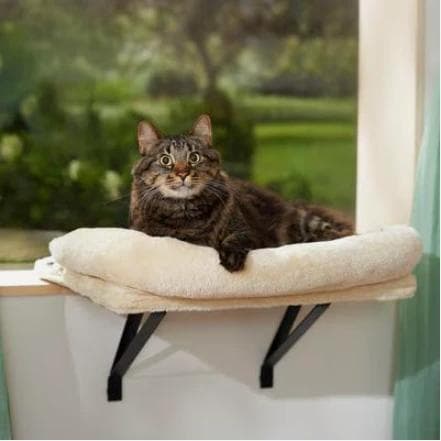
The Frisco Plush Cat Window Perch with Removeable Bolster is the best fit among these picks for a reader who wants a windowsill attachment instead of suction cups. The verified Chewy listing information says it uses hook-and-loop straps, installs without tools, supports up to 30 pounds, and has a removable bolster that can sit on the window side or room side.

The bolster position changes how the bed feels. Placed toward the room, it may create an outer boundary; placed toward the glass, it may provide a padded edge against the window. The cushion cover and bolster cover are listed as removable and machine washable, which simplifies routine fabric cleaning.
Best for
- A conventional sill compatible with the hook-and-loop strap setup.
- A cat who prefers a plush, bed-like surface.
- A home where a removable, repositionable bolster adds useful comfort.
- A reader avoiding a suction-cup installation whose sill is 3 to 7 inches wide with 0 to 1.5 inches of overhang.
Skip or verify first
The listing states a load up to 30 pounds and lists the assembled baseboard with bolster as 22.5 inches long, 16.25 inches wide, and 4.25 inches high, with a 12.25-inch overall assembled height. Those overall measurements do not guarantee that every inch is usable sleep surface, so compare the cushion and bolster layout with the cat's resting footprint.
The current listing specifies a sill width from 3 to 7 inches and an overhang from 0 to 1.5 inches. The sill must also be flat, stable, clean, and compatible with the attachment instructions. A rounded, loose, freshly painted, or frequently damp sill may not provide the same conditions as a flat conventional ledge.
Fit and safety notes
Check that the straps lie flat and remain fully engaged. Make sure the perch does not interfere with closing or locking the window. If the sill surface, strap, seam, frame, or attachment point loosens or degrades, stop use until the cause is corrected.
Do not use the bolster as a substitute for a secure mount. It can change the sleeping boundary, but it is not a railing designed to arrest a fall.
K&H EZ Mount Cat Window Perch
Webvet may earn a commission when you click through to Chewy, at no extra cost to you.
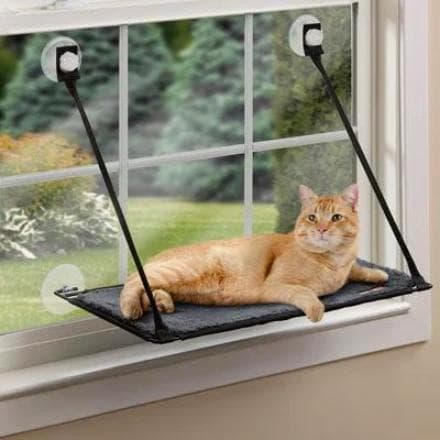
The K&H EZ Mount Cat Window Perch is a strong fit for a broad, smooth pane when you want a suction-cup perch with a verified 50-pound stated capacity and a folding frame. Its removable cover provides a listed 23 x 12 inch sleeping area.

The manufacturer lists a mounted product size of 29 x 13.5 x 9 inches and calls for an unobstructed smooth-glass area at least 29.5 x 14 x 9.5 inches. It specifically says the product is not recommended for textured, louvered, or divided-pane windows.
Best for
- Smooth, undamaged glass with the required clear area.
- One or more cats whose combined weight stays below the stated 50-pound limit.
- A home where folding the perch up helps accommodate blinds or curtains.
- A reader who wants a removable, machine-washable cover.
Skip or verify first
Skip this mount when suction cups would cross pane dividers or sit on textured glass. Also skip a pane with cracks, chips, loose film, an unknown defect, or too little unobstructed area. Do not move cups inward or alter the frame to make a too-small window appear compatible.
The 50-pound rating addresses load, not surface fit or entry comfort. Measure a large cat's normal resting footprint and watch whether the 23 x 12 inch area allows relaxed positioning.
Maintenance note
K&H instructs owners to clean the window and suction cups monthly. Follow the current manual for cup preparation and attachment instead of substituting household chemicals or improvised adhesives. Reinstall and load-check the perch after maintenance.
K&H Window Lounger
Webvet may earn a commission when you click through to Chewy, at no extra cost to you.
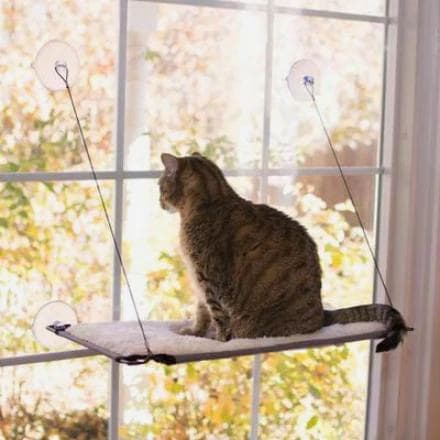
The K&H Window Lounger Cat Perch combines a steel frame, suction-cup mounting, a stated capacity up to 50 pounds, and a listed 23 x 12 inch sleeping surface. It folds to help preserve access to blinds and curtains, and the removable cover is listed as machine washable.

This pick overlaps with the EZ Mount model on capacity and sleep-surface size, so the decision should come down to exact current model construction, pane requirements, and the way each design fits your room. Compare current manuals and listing photos side by side before ordering.
Best for
- Compatible smooth glass.
- A cat or combined cat load below the stated 50-pound maximum.
- A household that values a folding perch and washable cover.
- A window where the exact current model's cup spacing and open depth fit without obstruction.
Skip or verify first
The manufacturer does not publish a minimum clear window dimension for the plain Window Lounger model, so measure your own opening before ordering. A manufacturer page also discusses variants, and variant dimensions should not be transferred to this exact pick without confirmation. Measure your pane, then confirm the current model's required glass space in the manual or listing.
Do not infer compatibility from the 50-pound rating. A strong frame still needs correctly prepared cups, compatible glass, full cup contact, enough clear pane area, and a safe route for the cat.
Multi-cat note
If two cats rest together, total their weights and observe how much of the 23 x 12 inch surface each animal needs. Staying under 50 pounds does not prevent crowding, resource guarding, or one cat pushing past another during entry.
In a multi-cat home, provide more than one desirable rest location rather than expecting a single perch to serve every cat. Separate perches should not be mounted so close that cats must pass directly over one another or can knock each other from an entry route.
 $65 · no membership
Have a health question about your cat?
A licensed vet can assess your cat over video and prescribe online when it's appropriate.
 Talk to a vet
- Licensed vets
- All 50 states
- same-day Rx
Webvet may earn a commission if you book.
Coziwow Cat Window Perch
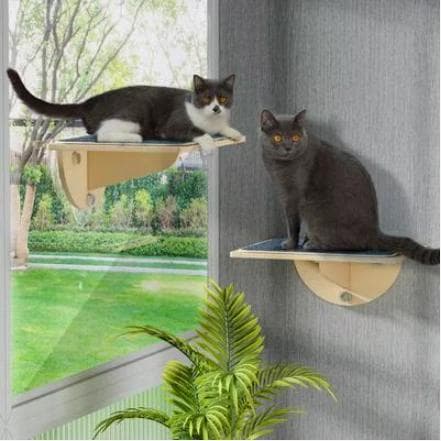
Webvet may earn a commission when you click through to Chewy, at no extra cost to you.
The Coziwow Cat Window Perch with Suction Cups, Natural Wood is the compact, lower-capacity pick in this comparison. The manufacturer describes a wood or composite-board structure with a loop-pile mat and two installation options: suction cups or screws.

Its stated maximum is 22 pounds. The listed mat size is 15.55 x 11.61 inches, while the overall dimensions are listed as 15.75 inches long, 7.48 inches wide, and 11.81 inches high. Because listings can express dimension orientation differently, compare the current diagram with your pane and confirm the usable surface before purchase.
Best for
- One cat whose weight remains below the stated 22-pound maximum.
- A window and room suited to the product's compact listed dimensions.
- A reader who wants a natural wood look and can follow the exact suction or screw installation instructions.
- A home where the removable mat can be kept dry and cleaned according to the current care instructions.
Skip or verify first
Skip this product for cats whose combined live load may reach or exceed 22 pounds. Do not assume that two lighter cats will take turns. If both can access the location, use their combined weight for the decision.
The current Chewy FAQ information reviewed says the removable mat is not machine washable, and the manufacturer says the product should be kept dry and not used outdoors. Confirm care directions before cleaning. Do not soak wood or composite components unless the manual explicitly allows it.
Choose one approved installation method
Use the hardware and layout supplied for the chosen method. A screw installation introduces different questions from suction mounting, including the material receiving the fastener, hidden utilities, lease restrictions, and whether the supplied hardware suits the substrate.
If you cannot identify the substrate or are not authorized to make holes, do not improvise. Choose the approved suction setup on compatible glass or a different no-hole product.
Best Suction-Cup Cat Window Perches
Among these four products, the K&H EZ Mount, K&H Window Lounger, and Coziwow use suction cups. The K&H options have the highest verified stated capacity at up to 50 pounds and offer larger verified 23 x 12 inch resting surfaces. The Coziwow has a lower 22-pound stated maximum and a smaller listed mat, but it also offers an alternate screw installation.
Choose the K&H EZ Mount when its explicitly stated minimum clear-glass requirement fits and the fold-up structure solves a blind or curtain issue. Choose the K&H Window Lounger only after verifying the exact current model's cup layout and glass-space requirement. Choose Coziwow for a cat well within its lower limit and a window suited to its compact structure.
The real product images above show each pick's visible mounting method, but a photo cannot prove compatibility with your pane. A suction-cup label alone does not make products interchangeable. Cup diameter, count, placement, frame geometry, cable angle, clear-glass requirement, and maintenance instructions can differ. Use the image to identify the model and mount, then follow the manual for the exact product in your home.
Best Window Perches for Large Cats
The best cat window perch for a large cat has both adequate stated capacity and enough usable surface. In this group, the two K&H products state support up to 50 pounds and list a 23 x 12 inch sleep surface. That makes them the leading candidates by verified load rating, but not automatic winners for every large cat. The Frisco is another possibility for a single cat below its 30-pound limit when its wider listed baseboard and exact sill range fit, although the bolster reduces some usable resting area.
Use a fit-first large-cat checklist:
- Weigh the cat rather than estimating from breed or appearance.
- Use combined weight if another cat can join.
- Compare the actual sleep surface with the cat's relaxed curled and extended positions.
- Confirm the entry path does not require a tight turn or unstable landing.
- Check that cup spacing fits uninterrupted compatible glass.
- Watch the first voluntary entries from nearby, without lifting or placing the cat on the perch.
A long-bodied cat may need more than 23 inches to stretch fully even if a curled sleeping position fits. A broad cat may dislike a 12-inch depth. If the surface seems marginal, select a larger platform or a different window furniture arrangement instead of relying on the high weight rating.
Large-cat mount dynamics
Heavier cats create greater force when they jump onto a perch than when they lie still. A manufacturer rating remains the governing specification, but correct installation and a stable step-up route can reduce abrupt, awkward landings. Never test the mount by encouraging a large cat to leap onto it immediately.
Position a sturdy intermediate surface so the cat can step or make a short controlled hop. The intermediate surface must not block cup inspection or press against cables, frames, or the window.
Multi-cat load and social fit
Total live load means every likely occupant at the same time. If Cat A weighs 14 pounds and Cat B weighs 12 pounds, the mount may experience 26 pounds when they share it. Compare 26 pounds, not 14, with the stated maximum.
Physical capacity does not settle social safety. A confident cat may block a timid cat's exit, and a narrow perch can force body contact. Provide separate elevated resting choices in different parts of the room and watch for staring, swatting, guarding, or displacement.
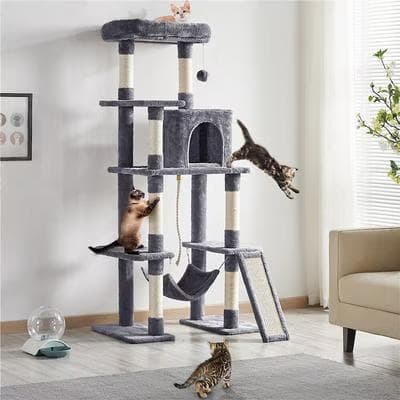
63-inch multi-level cat tree with plush perches, a condo, a hammock, sisal scratching posts, and a dangling toy. Dark gray.
Webvet may earn a commission when you click through to Chewy, at no extra cost to you.
Choose the Right Mount for Your Window
The safest practical mount is the one approved for the exact surface, installed according to its manual, kept within its stated load, and easy to inspect. Renters and homeowners face different constraints, but nobody should make holes or modify a window assembly without knowing what material is involved.

| Mount type | Works best when | Window constraint or common mismatch | What to verify |
|---|---|---|---|
| Suction cups | Glass is smooth, sound, unobstructed, large enough, and allowed by the current manual | Textured or divided panes, films, chips, cracks, too little clear space, neglected cups | Glass compatibility, cup spacing, preparation, stated load, cleaning schedule |
| Windowsill straps or hook-and-loop attachment | Sill is flat, stable, clean, deep enough, and compatible with the supplied attachment | Rounded, narrow, loose, damp, fragile, or unsuitable finished surfaces | Sill dimensions, attachment area, capacity, window operation, lease rules |
| Screw-mounted bracket or shelf | Substrate and hardware are identified and installation is authorized | Unknown wall or frame material, hidden wiring or plumbing, unsuitable anchors, rental restrictions | Stud or substrate, fastener type, load rating, professional help if needed |
| Freestanding window furniture | Floor is level and there is room for a stable tree, bench, or shelf near the view | Wobble, tip risk, blocked exits, cords, heaters, or a busy walkway | Anti-tip instructions, base footprint, total height, access route |
Suction cups
Suction mounts preserve the sill and avoid drilled holes, but they require compatible glass and ongoing care. They are not suitable simply because a window exists. Dividers, texture, damage, film, dirt, or a pane smaller than the required cup layout can prevent full contact.
Sill mounts
A sill-mounted perch can work where the pane is divided or too small for suction cups. Its success depends on the sill and the exact attachment system. Measure ledge depth and inspect paint, veneer, stone, trim, or other finishes before applying straps or hook-and-loop material.
Screws and fixed supports
A fixed shelf can provide a broad platform when correctly engineered and mounted to a suitable structure. It is not automatically safer than a suction mount. The fastener, anchor, substrate, bracket, and installation all have to work as a system.
Never drive screws into a window frame, wall, or trim without confirming that location is approved and free of hidden hazards. Hire a qualified installer when the structure or hardware is uncertain.
Freestanding options
A cat tree, sturdy bench, or purpose-built tower beside a window avoids attaching anything to the glass or sill. It may be the better answer for unusual windows, very large cats, renters, or cats who need stepped access.
Anchor freestanding furniture according to its instructions when applicable. Keep the base out of traffic and make sure opening a window cannot create a gap, screen hazard, or escape route.
How to Install a Suction-Cup Cat Window Perch
Read the current manual from beginning to end before handling the cups. Product-specific directions override a generic guide. The installation and recheck protocol below covers inspection, measurement, preparation, attachment, a controlled load check, voluntary introduction, and an installation recheck schedule. Keep the cat in another room during setup so the first contact is not an uncontrolled live-load test, and stop whenever the glass, hardware, or instructions are uncertain.

Step 1: Inspect the glass and product
Look for cracks, chips, loose film, heavy scratches, texture, dividers, and any obstruction where a cup must sit. Inspect every cup, cable, frame joint, fabric sleeve, seam, and fastener. Do not assemble a product with missing, warped, cut, brittle, or damaged parts.
Confirm the glass is the type and size permitted by the manufacturer. Do not assume a pane is tempered glass because of its location or appearance; glass construction and permitted loads vary. A product manual's surface requirements still control. If you cannot identify the glass, resolve damage, or confirm that the complete cup layout is allowed, ask the window manufacturer or a qualified glass professional before installation.
Step 2: Measure and mark the layout
Use the manufacturer's dimensions and cup spacing. Dry-position the frame without loading it, confirm that every cup lands fully on clear compatible glass, and check the open depth.
Make sure the perch does not:
- Block a required lock or emergency exit.
- Prevent the window from closing securely.
- Press into a blind, shade, curtain, or cord.
- Project into a door swing or busy walkway.
- Place the cat over a sharp corner, hard obstacle, or heat source.
Step 3: Prepare the cups and glass
Follow the exact cleaning and preparation directions for that model. Remove dust, grease, residue, and moisture as directed. Do not apply glue, double-sided tape, oil, petroleum jelly, or another improvised substance unless the manufacturer specifically includes it.

Allow the contact area to reach the condition required by the instructions. Recheck for lint, residue, or an edge crossing film or trim.
Step 4: Attach in the specified sequence
Place cups at the required spacing and press or secure them as instructed. Attach cables and frame components in the order shown in the manual. A cable routed at the wrong angle or a cup shifted to dodge a divider changes how the structure carries load.
Step 5: Perform a controlled load check
Do not use the cat as the test weight. With the area below clear and the perch close to the floor when possible, apply a gradual controlled load that stays within the manufacturer's directions. Watch every cup, cable, joint, and frame edge.

Stop if you see sliding, peeling cup edges, stretching, tilting, cracking sounds, loose hardware, glass movement, or frame deformation. Remove the product and resolve the cause rather than repeating the same setup.
Step 6: Introduce the cat voluntarily
Place a stable entry step nearby if needed. Let the cat investigate without being lifted or placed on the perch. Supervise the first sessions and keep other pets away until the cat has a clear exit.
If the cat paws at cables, chews fabric, crowds the edge, or launches from an unstable angle, interrupt gently and change the setup. The goal is calm resting and observation, not a dramatic jump.
Step 7: Recheck after initial use
Inspect the mount after the first short session and again after the first day. A cup or strap that appears to shift is a stop-use sign. Follow the manufacturer's ongoing cleaning schedule even if the perch has looked stable.
Cat Window Perch Safety Checks
Look at the perch before each use when you enter the room. This does not require disassembly. Confirm that the frame is level, cup edges are fully seated, straps and fasteners lie as intended, and the glass and surrounding area remain unchanged.
Before-each-use visual check
Scan the mount from above, below, and the side. Look for a changed angle, gaps around cups, cords trapped by blinds, a twisted cover, moisture, and anything moved beneath the landing area.
Scheduled maintenance
Follow the exact product schedule. K&H directs owners to clean its suction cups and window monthly. Other products may differ, so record the current manual's interval rather than applying one company's schedule to every perch.
After any cleaning, window work, large temperature change, prolonged absence, or unusual impact, inspect and load-check again before allowing the cat back.
Window and room hazards
A secured perch does not make an open window safe. Screens can loosen or tear and are not a substitute for an escape-rated barrier. Confirm that the window remains closed or otherwise secured for the cat's environment.
Most cats are drawn to the view, the warmth, and the moving air rather than to an open sash, so a closed window with a clean pane already satisfies almost all of that interest. Cats do prefer windows open on a warm, still day, but an open window is only safe behind a secure, well-fitted screen, and screens loosen and tear more often than owners expect. If you cannot verify the screen, keep the window closed while the perch is in use and ventilate the room through a different window the cat cannot reach.
Use WebVet's guide to cat-proofing your home to check nearby cords, plants, cleaners, heat sources, and small objects. Tie up blind cords with an appropriate safety device and keep toxic plants out of reach.

Sun and temperature
Direct sun can make a perch or glass area hot. Check the surface with your hand and provide a cooler retreat and fresh water. Never trap the cat between a hot window and another pet.
In cold conditions, inspect for condensation and drafts. Moisture can affect some materials and may make a nearby sill slippery. Follow care directions and move the perch if the location cannot remain compatible.
Senior Cats, Kittens, and Timid Cats
Environmental guidelines support vertical choice, but access should match the cat's life stage and ability. A senior cat may still enjoy a window view while preferring steps, a lower platform, or a broad freestanding bench.
Senior-cat access and fallback options should be planned before installation, not after a failed jump. Use a stable nonslip step when a short rise is comfortable, lower the destination when possible, or choose a broad freestanding bench or cat tree beside the window. If hesitation, stiffness, pain, or reduced jumping is new, pause the setup and ask a veterinarian before encouraging repeated climbs.

For a senior cat:
- Keep jumps low and predictable.
- Use stable, nonslip intermediate surfaces.
- Provide more than one route when another pet could block access.
- Choose a surface large enough for position changes without a tight turn.
- Ask a veterinarian about new hesitation, stiffness, pain, or reduced jumping.
Kittens are light but impulsive. Supervise them around cords, fabric loops, hardware, and open windows. Reassess fit as the kitten grows, because an installation selected for a small body may no longer provide adequate surface or capacity later.
For a timid cat, place the perch away from loud appliances and traffic. Do not carry the cat onto it. Pair the area with calm exploration and leave an easy retreat route.
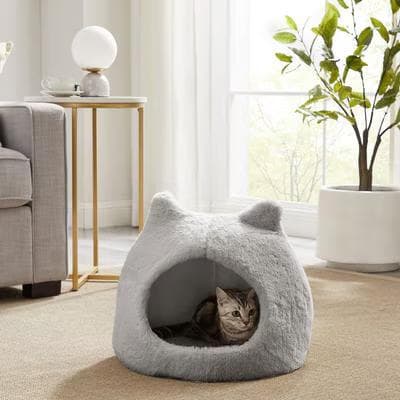
Covered, igloo-style cat bed in soft plush with a water-resistant bottom, giving cats a cozy enclosed spot to curl up. Grey.
Webvet may earn a commission when you click through to Chewy, at no extra cost to you.
Make a Window Perch Part of Daily Enrichment
Window viewing can add visual, scent, and sound interest to indoor life. It works best as one component of a varied environment that also includes play, scratching, hiding, resting, and food-search opportunities.
The AAFP position statement on indoor and outdoor lifestyles emphasizes safe resting places, vertical space, play, and opportunities to forage for indoor cats. A perch can support those needs, but it should not become the only elevated or engaging resource.
WebVet's cat exercises can help you build movement into the day. Place interactive play on the floor or another stable surface rather than encouraging high-speed chasing on a narrow perch.
Reduce frustration and crowding
Avoid positioning bird feeders so close that your cat repeatedly strikes the glass or remains frustrated and highly aroused. Watch the cat's behavior, and close a curtain or redirect activity if outdoor animals trigger prolonged stalking, vocalizing, redirected aggression, or conflict with another household cat.
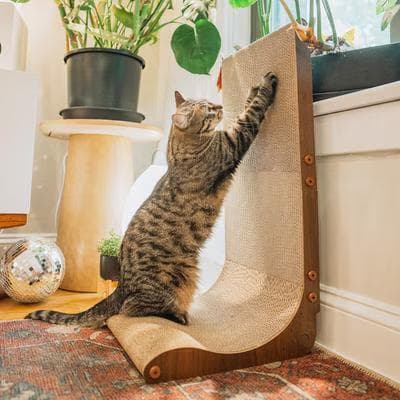
Curved cardboard wall scratcher with a wood frame that protects walls and gives cats a satisfying vertical scratch surface.
Webvet may earn a commission when you click through to Chewy, at no extra cost to you.
Rotate access to desirable views when social tension develops. Two separated window stations are often more useful than two perches crowded onto the same pane.
Alternatives and Specialty Cat Window Perches
The right answer may not be one of the four exact picks. Window shape, lease rules, cat mobility, or combined weight can make another format more appropriate.
Freestanding cat trees near a window
A stable cat tree provides multiple levels and avoids glass attachment. It can suit divided panes and give a senior cat a stepped route. Compare base width, anti-tip instructions, platform dimensions, and total capacity.

The Yaheetech Multi-Level 63-inch Plush Cat Tree is one current freestanding option to compare when glass or sill attachment is not a fit.
Do not press the tree against glass hardware or place it where opening the window creates an escape gap. Anchor it according to its instructions.
Fixed wall shelves
A properly installed wall shelf can provide a broad sleep surface and custom height. The project requires the correct bracket, fastener, and structural substrate. Decorative drywall anchors or unknown trim should not be treated as load-bearing without verification.
Add a nonslip surface and an accessible route. Hire a qualified installer if you cannot identify the wall construction or required hardware.
Heated window beds
A heated perch may appeal to a cat who seeks warmth, but electrical safety becomes part of the decision. Choose a product intended for cats and follow its instructions for cord routing, supervision, inspection, and cleaning.
Keep cords away from chewing and blind mechanisms. A heated bed does not treat arthritis, illness, or poor circulation, and a cat must always be able to move to a cooler place.
Hammock-style perches
Fabric hammocks can create a cradled rest position, but fit still depends on usable area, fabric tension, mount capacity, and how easily the cat exits. Inspect stitching and fabric wear, especially where the hammock connects to cables or frame ends.
Outdoor and enclosed window structures
Do not move an indoor perch outdoors unless the manufacturer approves outdoor use. Sun, rain, wind, temperature, and surface changes can degrade materials or mounts.
A purpose-built enclosed catio is a separate structural project. It needs escape prevention, weather planning, secure anchoring, shade, and safe access. A standard window perch is not a catio.
DIY cat window perches
A DIY shelf can be sized to a particular cat and window, but it shifts responsibility for materials, fasteners, substrate, load, edges, finishes, and inspection to the builder. Do not copy an online plan without confirming that it suits your structure and combined cat load.
Avoid toxic finishes, splintering wood, exposed fasteners, unstable brackets, and dangling fabric. When in doubt, use a tested commercial product or consult a qualified installer.
Common Cat Window Perch Mistakes
Most mistakes begin before installation. Buyers choose from a photo, measure the frame instead of clear glass, or compare capacity without checking the usable sleep area.
Avoid these errors:
- Buying before measuring cup spacing, clear glass, sill depth, and open-room depth.
- Using one cat's weight when two cats can share.
- Treating a manufacturer's maximum load as evidence of surface comfort.
- Moving suction cups away from specified positions to dodge a divider.
- Adding glue or tape that the instructions do not approve.
- Installing over film, texture, moisture, dirt, cracks, or chips.
- Skipping the controlled load check.
- Lifting a frightened or mobility-limited cat onto the perch.
- Forgetting blinds, cords, heat, screens, locks, and escape routes.
- Continuing use after the mount shifts or hardware is damaged.
The most useful shopping question is not “Which perch looks strongest?” It is “Which exact mount can I install and inspect correctly on this exact window for this exact cat?”
A Practical Measurement Worksheet
Write down the following before opening a retailer page:
| Measurement or check | Your result |
|---|---|
| Clear smooth glass width | |
| Clear smooth glass height | |
| Sill depth and flat attachment area | |
| Floor-to-perch entry height | |
| Open depth into the room | |
| Heaviest cat | |
| Combined weight of all possible users | |
| Cat's curled resting footprint | |
| Cat's extended resting length | |
| Glass texture, dividers, film, damage, or unknowns | |
| Locks, handles, blinds, curtains, cords, or screens | |
| Lease or drilling restrictions |
Keep the worksheet until after installation. Compare it with the current manual, then save the manual and purchase information for replacement-part and maintenance questions.
Frequently Asked Questions
Are suction-cup cat window perches safe?
A suction-cup cat window perch can be safe when the glass condition matches the manual, every cup has full contact, the total live load stays below the weight rating, and the owner performs a controlled load test. Safe installation also requires the stated cup spacing, compatible smooth glass, and a clear entry route. Stop use for lifting cup edges, sliding, damaged hardware, glass defects, or any change in alignment.
How do I choose a cat window perch for a large cat?
Choose a cat window perch for a large cat by weighing the cat, totaling every possible simultaneous user, and comparing that load with the manufacturer's stated capacity. Then measure the actual sleep surface and entry height, and confirm that cup spacing fits uninterrupted compatible glass. A high capacity does not help if the platform is too narrow, the pane is too small, or the cat must make an uncomfortable jump.
Can I install a cat window perch without screws?
You can install a cat window perch without screws when the exact no-hole design fits the window. A suction mount needs compatible smooth glass and the required clear cup layout. Some sill products use straps, hook-and-loop material, or a sill clamp instead. Measure first, follow the current instructions, and use a freestanding cat tree when neither no-hole attachment matches the window safely.
How often should I recheck a cat window perch?
Recheck a cat window perch with a quick before each use visual check plus the manufacturer's scheduled recheck, cleaning, and reinstallation guidance. K&H tells owners to clean its window and suction cups monthly. Inspect again immediately after cleaning, window work, an impact, a large temperature change, or any shift in the perch. This combination answers how often to look without replacing the product-specific schedule. Stop use when cups, straps, hardware, fabric, frame, or glass no longer match the approved setup.
The Bottom Line
Choose a cat window perch by matching mount, clear window space, stated capacity, sleep surface, and entry route. The two K&H picks lead this comparison for verified stated load at up to 50 pounds. The Frisco offers a no-tools sill option with a 30-pound stated limit and a specified 3 to 7 inch sill range. The Coziwow offers compact suction or screw installation with a lower 22-pound maximum.
Whichever product you choose, inspect the glass or sill and hardware, follow the current manual, perform a controlled load check without the cat, and stop use when anything shifts or degrades. A measured, maintainable fit creates a better view and a more useful resting place than any ranking alone.
$65 · no membershipHave a health question about your cat?
A licensed vet can assess your cat over video and prescribe online when it's appropriate.
Talk to a vet- Licensed vets
- All 50 states
- same-day Rx
Webvet may earn a commission if you book.

Editor
The Webvet Editorial Team is the in-house group of pet-care editors and writers behind Webvet, operated by Smart Pet Collective. The team researches, writes, and maintains Webvet's pet health, behavior, and medication content. Every article follows a defined editorial process: research from reputable veterinary and scientific sources, careful drafting, mandatory review of medical content by a credentialed veterinarian, and dated publication. Health and medication articles are medically reviewed by a licensed veterinary professional before they go live and are kept current over time.
Veterinarian · BVMS MRCVS
Dr. Pippa Elliott, BVMS, MRCVS, is a veterinarian with nearly 30 years of experience in companion animal practice. Dr. Elliott earned her Bachelor of Veterinary Medicine and Surgery from the University of Glasgow. She was also designated a Member of the Royal College of Veterinary Surgeons. Married with 2 grown-up kids, Dr. Elliott has a naughty Puggle named Poggle, 3 cats and a bearded dragon.


