Best Cat Harnesses: Fit, Adjustability, and Escape Resistance
Compare four cat harnesses by measured fit, closure style, and adjustability, with practical indoor fitting checks and a gradual introduction to supervised outdoor use.

BVMS MRCVS
Medically reviewed by Dr. Pippa Elliott, BVMS MRCVS · Last reviewed

This article contains affiliate links. Webvet may earn a commission when you buy through them, at no extra cost to you.
The best cat harnesses fit your cat’s neck and chest, stay correctly positioned as the cat moves, and have a fastening method your cat can tolerate. Start with measurements rather than an “escape-proof” label. Our four choices cover a cotton wrap, a minimal strap harness, an adjustable mesh design, and a reflective vest set. Each solves a different fitting problem, and every one still needs an indoor trial before outdoor use.
How to choose the best cat harness
You can buy these cat harnesses through the linked product listings or a seller identified by the manufacturer. Compare the exact size, included leash, current price, and return conditions before ordering. A local shop can be useful if it permits a calm fitting, but stock and fitting services need confirmation with that store.
A harness should help you supervise exploration without relying on pressure from a leash attached to a neck collar. It is not a way to make an unwilling cat walk, a substitute for a travel carrier, or equipment for lifting the cat. If your cat enjoys watching the garden but becomes frightened outside, a secure enclosed outdoor space or enrichment at home may suit them better than a walk.
The most useful first question is how your cat tolerates being dressed. A wraparound harness avoids some threading and buckle steps but introduces broad fabric contact and a hook-and-loop closure. A strap design covers less of the body but requires you to identify and adjust several narrow parts. A mesh panel gives a different distribution of fabric and straps; it does not remove the need to check both neck and chest.
- 1Record the neck measurement and chest girth before choosing a size.
- 2Match the closure style to the handling your cat can calmly tolerate.
- 3Treat an indoor backward escape check as part of fitting, not proof that a harness can never come off.
This comparison uses current manufacturer and merchant specifications. We did not test these harnesses on cats, measure comparative escape rates, or verify claims that one design calms every wearer. The distinctions below are practical ones you can check: coverage, fastening, adjustment, included leash, and published size range. A feature may be useful without establishing that the product is universally safer than another well-fitted harness.
For a cat who tolerates a broad wrap, begin with the Kitty Holster. For a lighter strap arrangement with an included bungee leash, compare the PetSafe Come With Me Kitty. The RC Pets Adventure Kitty offers separate neck and waist adjustment with published ranges for both. The Travel Cat True Adventurer combines a vest, adjustable webbing, and reflective trim. Confirm the selected size of each product before making a price comparison.
Do not assume that a kitten needs the smallest label or that a large breed needs the largest. A slim adult and a broad kitten may have different proportions despite similar weights. Likewise, two harnesses labeled Medium may cover different chest ranges. If you already own an ill-fitting harness, note what failed: a loose neck opening, a chest strap behind the wrong part of the body, or a closure that could not overlap properly. That information helps you choose a genuinely different fit.
| Harness | Best fit | Verified distinction | Check before buying |
|---|---|---|---|
| Kitty Holster, Small/Medium | Cat who tolerates a wrap | Cotton body and broad hook-and-loop closures | Neck 9–12 inches; chest 13–17 inches |
| PetSafe Come With Me Kitty, Large | Minimal strap coverage | Nylon, quick-snap buckles, included bungee leash | Use this model’s fitting and stopper instructions |
| RC Pets Adventure Kitty, Medium | Separate neck and chest adjustment | Air-mesh panel, reflective binding, 6-foot leash | Neck 10–15 inches; girth 13–18 inches |
| Travel Cat True Adventurer, Small | Reflective vest and leash set | Adjustable webbing with hook-and-loop fastening and a clip | Confirm the current Small chest chart and closure overlap |

Treat a matching leash as part of the comparison, too. The included leashes differ, and a stretchy leash feels different from fixed webbing. A leash that comes in the box is convenient, but it does not change the harness’s fit. Check the clip, attachment ring, and the manufacturer’s intended setup before connecting anything. Do not substitute a retractable or unusually heavy leash simply because its clip happens to fit the ring.
An “escape-resistant” description is most useful as a prompt to inspect the design. Look for how the neck opening is controlled, whether the cat can withdraw an elbow, and how the harness behaves when the leash direction changes. Published adjustment ranges narrow the choices; they cannot recreate your cat’s shape or behavior. Keep the packaging and instructions until you have completed a calm indoor fit assessment and checked the seller’s return conditions.
Four cat harnesses for different needs
Kitty Holster Cat Harness, Black, Small/Medium
The Kitty Holster Small/Medium is the wraparound choice in this group. The manufacturer describes a cotton body with a metal D-ring and broad hook-and-loop closures. That format is worth considering if your cat tolerates fabric being placed around the torso more readily than a series of narrow straps being arranged. It also gives you a different option from a design that requires a close-fitting opening to pass over the head.
The published Small/Medium range is a neck measurement of 9 to 12 inches and a chest measurement of 13 to 17 inches. Check both dimensions. A cat near the edge of the chest range may still be outside the neck range, and a broad overlap at one closure cannot compensate for a poor fit at the other. Follow the manufacturer’s placement guidance rather than wrapping the harness wherever the fabric seems to reach.
- Choose it for: broad cotton coverage and a wraparound fastening arrangement.
- Check first: neck and chest measurements, closure overlap, and your cat’s response to the sound and feel of hook-and-loop fastening.
- Main tradeoff: more body coverage is not automatically more comfortable; some cats tolerate a strap design better.
The Kitty Holster fitting and care guide is also the place to check the current care instructions and size boundaries. Keep hair and debris out of the fastening surfaces so the closure can engage as intended. Examine the actual fastened garment while your cat stands and takes a few voluntary steps. Fabric that bunches, rotates, or interferes with a foreleg needs attention before you attach a leash.
Kitty Holster leashes are sold separately, so account for that when comparing complete setups. This is a harness choice, not a promise that wrapping a nervous cat will make them calm. If the cat freezes when the fabric closes around the body, loosen the training objective rather than pulling them forward. The first successful session may be simply tolerating the open harness nearby, followed by a reward and putting it away.
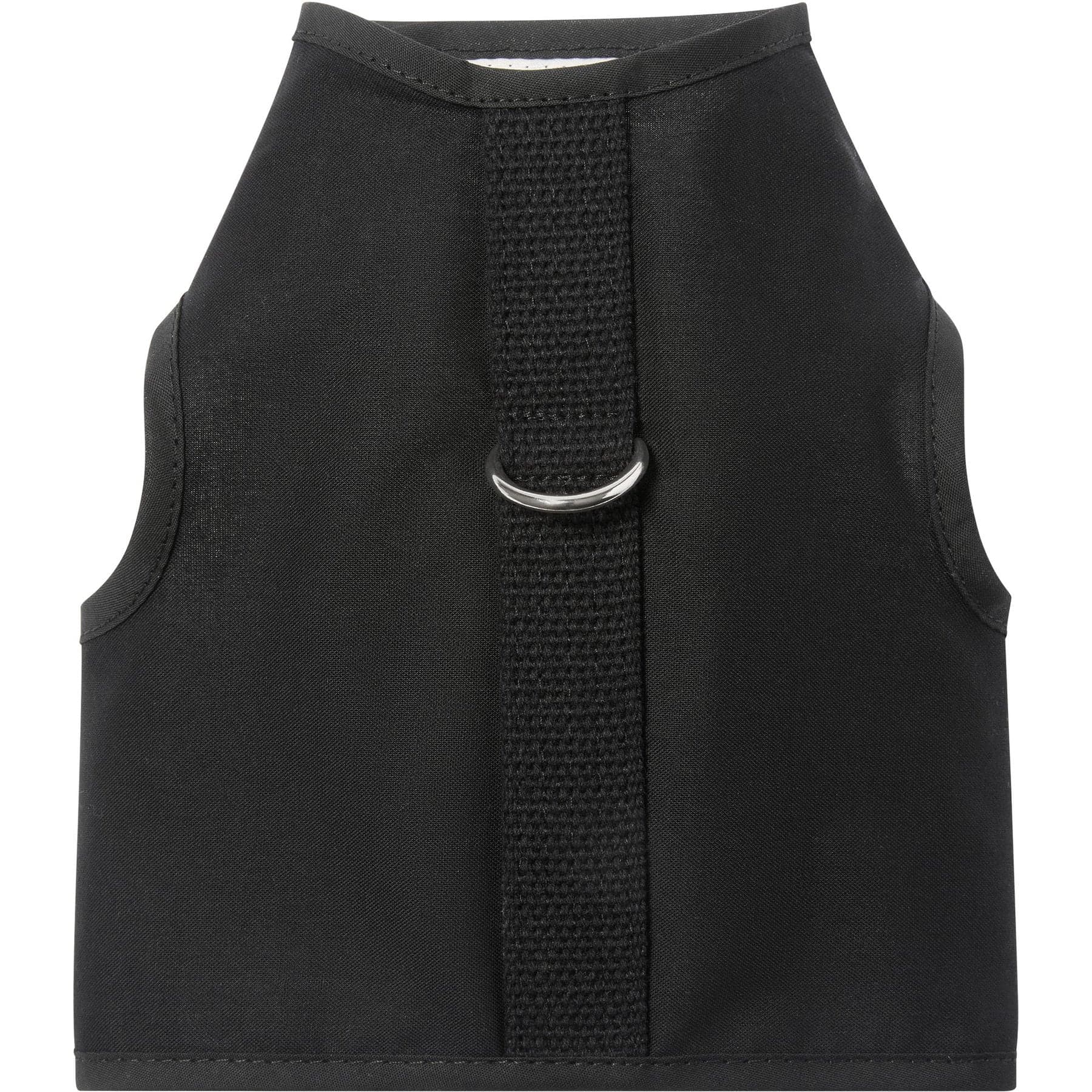
A cotton wrap for cats who tolerate broad coverage and hook-and-loop fastening.
Webvet may earn a commission when you click through to Chewy, at no extra cost to you.
PetSafe Come With Me Kitty Rose & Burgundy Harness & Cat Leash, Large
The PetSafe Come With Me Kitty Large is the minimal-coverage option here. Its nylon straps and quick-snap buckles offer a different feel from a cotton wrap or a broad vest. PetSafe uses a contrasting belly strap to help owners identify the parts, and the set includes a matching bungee leash. Consider it when your cat objects to extensive fabric contact but can tolerate the handling needed to position and adjust straps.
PetSafe also describes a rubber stopper used in fitting the harness. That component has a particular purpose in the manufacturer’s setup; it is not an optional decoration. Read the Come With Me Kitty instructions before placing it on your cat. Check the selected Large size against the current chart rather than transferring a size from another PetSafe product or a dog harness.
- Choose it for: limited body coverage, quick-snap buckles, and a bungee leash included in the set.
- Check first: strap orientation, the stopper position, and the full fitting sequence for this exact model.
- Main tradeoff: narrow straps require careful placement; a stretchy leash does not prevent a cat from backing out of a loose harness.
The bungee section gives the leash some movement under tension. It is not permission to jerk the leash, encourage pulling, or allow a cat to run to the end repeatedly. During practice, keep enough slack for natural movement while preventing the leash from tangling around furniture or the cat’s legs. Your goal is to help the cat become familiar with the attached leash, not to test how much force the system can withstand.
Because there is less fabric, you may find it easier to see where individual straps sit. Use that visibility: inspect the area behind the front legs and check that adjustment hardware remains where the instructions place it. If getting the straps right requires holding a distressed cat still, stop and practice the handling in smaller steps. A simpler-looking harness is useful only if it can be fitted consistently on the cat who will wear it.
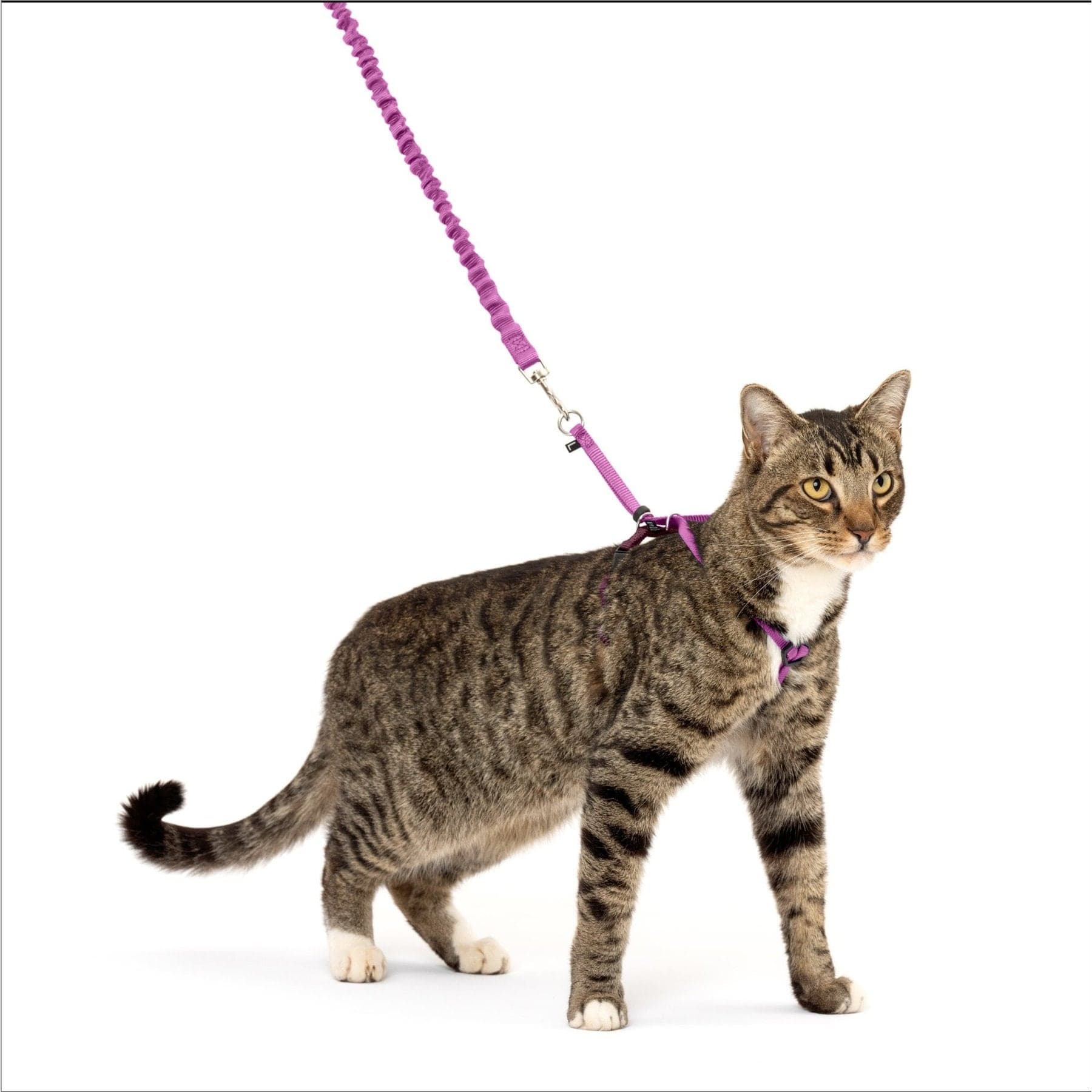
Minimal nylon straps, quick-snap buckles, and a matching bungee leash.
Webvet may earn a commission when you click through to Chewy, at no extra cost to you.
Practice a few voluntary steps in a secure area after checking the fit. Keep the leash slack and stop when the cat becomes uncomfortable.
| Fit-and-tolerance selection framework | What to record or inspect | What changes your choice |
|---|---|---|
| Neck measurement | Follow the selected maker’s measuring position | A matching chest range cannot correct an overly loose neck opening |
| Chest girth | Measure around the widest chest where instructed | Weight and breed labels cannot establish circumference |
| Closure tolerance | Wrap, buckle, or entry sequence the cat can accept | A design that takes prolonged restraint is difficult to use consistently |
| Backward escape check | Observe position during calm movement and a change of direction indoors | A cat may fit while standing yet begin to withdraw when backing up |
| Front-leg clearance | Check straps, panel edges, and room for movement | Rubbing or an elbow entering the opening calls for reassessment |
| Growth or weight change | Repeat measurements and inspect adjustment range | The old size label may no longer describe a suitable fit |
RC Pets Adventure Kitty Reflective Cat Harness & Leash, Black, Medium: 13 to 18-in chest
The RC Pets Adventure Kitty Medium provides a particularly useful two-measurement comparison. RC Pets lists Medium for a girth of 13 to 18 inches and a neck of 10 to 15 inches. Separate neck and waist adjustment lets you evaluate the fit in both places rather than hoping that one chest measurement describes the whole cat. The selected Black version has an air-mesh panel with nylon webbing.
The manufacturer also identifies reflective binding, neck and waist buckles, aluminum-alloy hardware, and an included 6-foot leash. Reflective trim can help visibility when light reaches it, but it does not make a small cat conspicuous in every setting. Plan outings around a suitable environment and your ability to see the cat, rather than using reflective details as a reason to walk near traffic after dark.
- Choose it for: a mesh-panel design with separate adjustment and published neck and girth ranges.
- Check first: both measurements, panel placement between the front legs, and the route of the girth webbing through the back loop.
- Main tradeoff: extra adjustment helps only when every section is positioned and secured correctly.
The RC Pets fitting guide explains the assembly sequence and recommends checking for a snug fit that still allows one or two fingers beneath a strap. Use its instructions for this harness; finger clearance alone is not a universal test for every design. Observe whether the panel remains centered as your cat walks, crouches, and turns. A correctly adjusted circumference can still need a placement correction if the harness rotates.
The 6-foot leash is a specific, useful inclusion for comparing the total purchase with a harness sold alone. It also requires active handling in a small practice area. Gather unused length so it does not trail through chair legs or loop around a paw. Do not wrap the leash around your hand in a way that prevents you from responding smoothly if the cat changes direction. Build familiarity with the harness before adding the full outdoor experience.
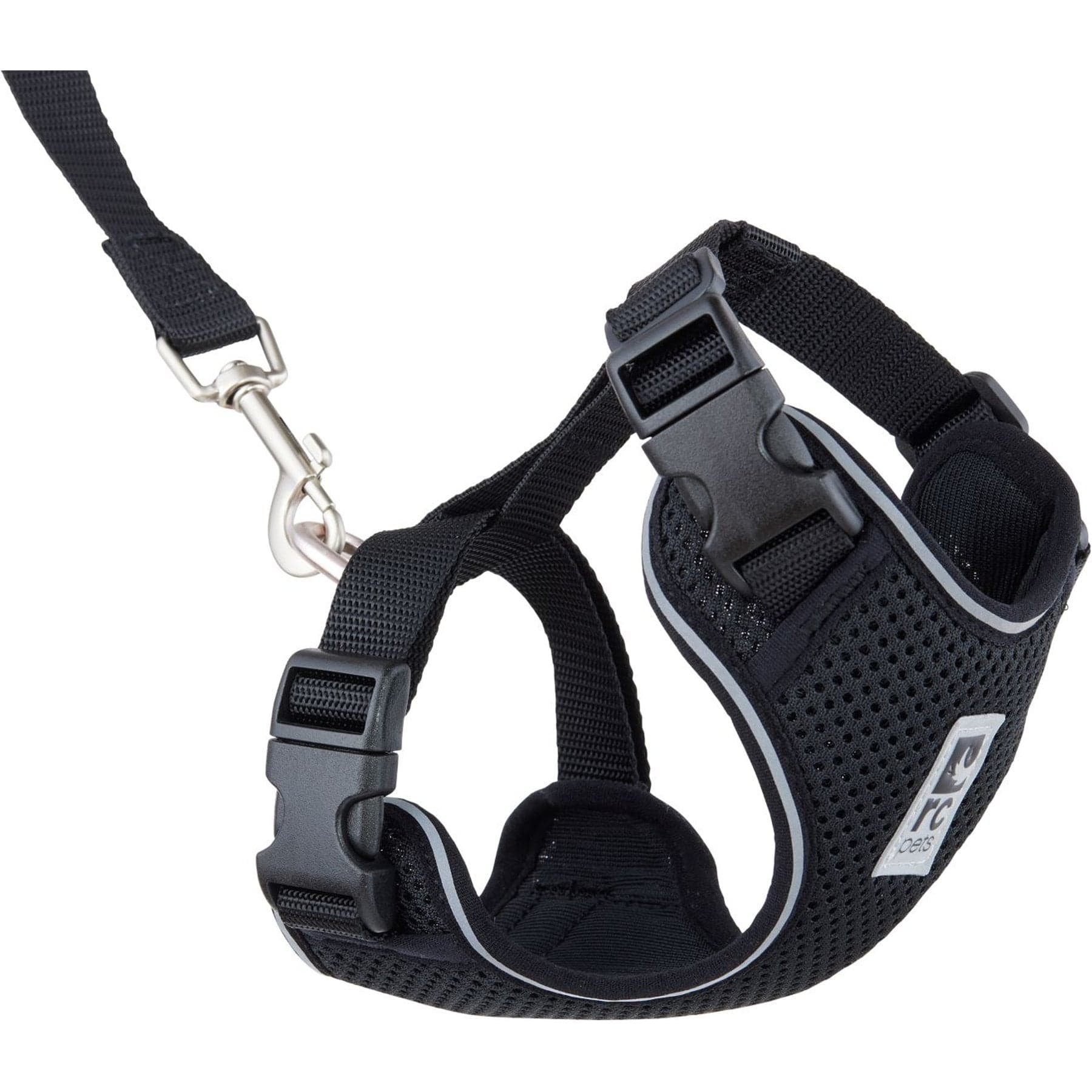
An air-mesh panel with separate neck and chest adjustment and an included 6-foot leash.
Webvet may earn a commission when you click through to Chewy, at no extra cost to you.
Travel Cat The True Adventurer Reflective Cat & Kitten Harness & Leash, Black, Small
The Travel Cat True Adventurer Small combines a vest-style harness with an included leash. The manufacturer describes mesh fabric, reflective trim, adjustable webbing, and both a hook-and-loop fastener and a clip. This makes it a distinct choice for someone who wants vest coverage with more than one fastening element. It does not establish that the extra closure can compensate for an incorrect size.
Travel Cat describes four webbing adjusters and a 4-foot nylon leash on the model page. Before ordering the selected Small, check the current chest-size chart and the instructions for how much fastening overlap is needed. The name “Cat & Kitten” covers intended users across the range; it does not mean that this Small fits every kitten or every adult cat. Growing cats need their fit rechecked rather than simply leaving generous loose space.
- Choose it for: adjustable vest coverage, reflective trim, and a shorter included leash than the RC Pets set.
- Check first: the Small chart, closure overlap, buckle engagement, and whether the cat can move freely in the vest.
- Main tradeoff: several adjustment points give you more to check before each outing; the harness is not guaranteed escape-proof.
Use the True Adventurer manufacturer guide to identify the correct way to put the harness on and set its webbing. Lay it out before calling your cat over so that the first fitting does not become a prolonged search for the right strap. Fasten the components in the intended sequence and inspect them after the cat has moved, rather than judging fit only while the cat is sitting still.
The vest format may appeal if you want a visible, substantial body panel, but your cat’s response matters more than that impression. Watch for persistent crouching, attempts to bite the harness, or reluctance to move that does not improve when you reduce the task. If another format permits a more relaxed fit and training session, it can be the better choice even when this vest has more listed features.
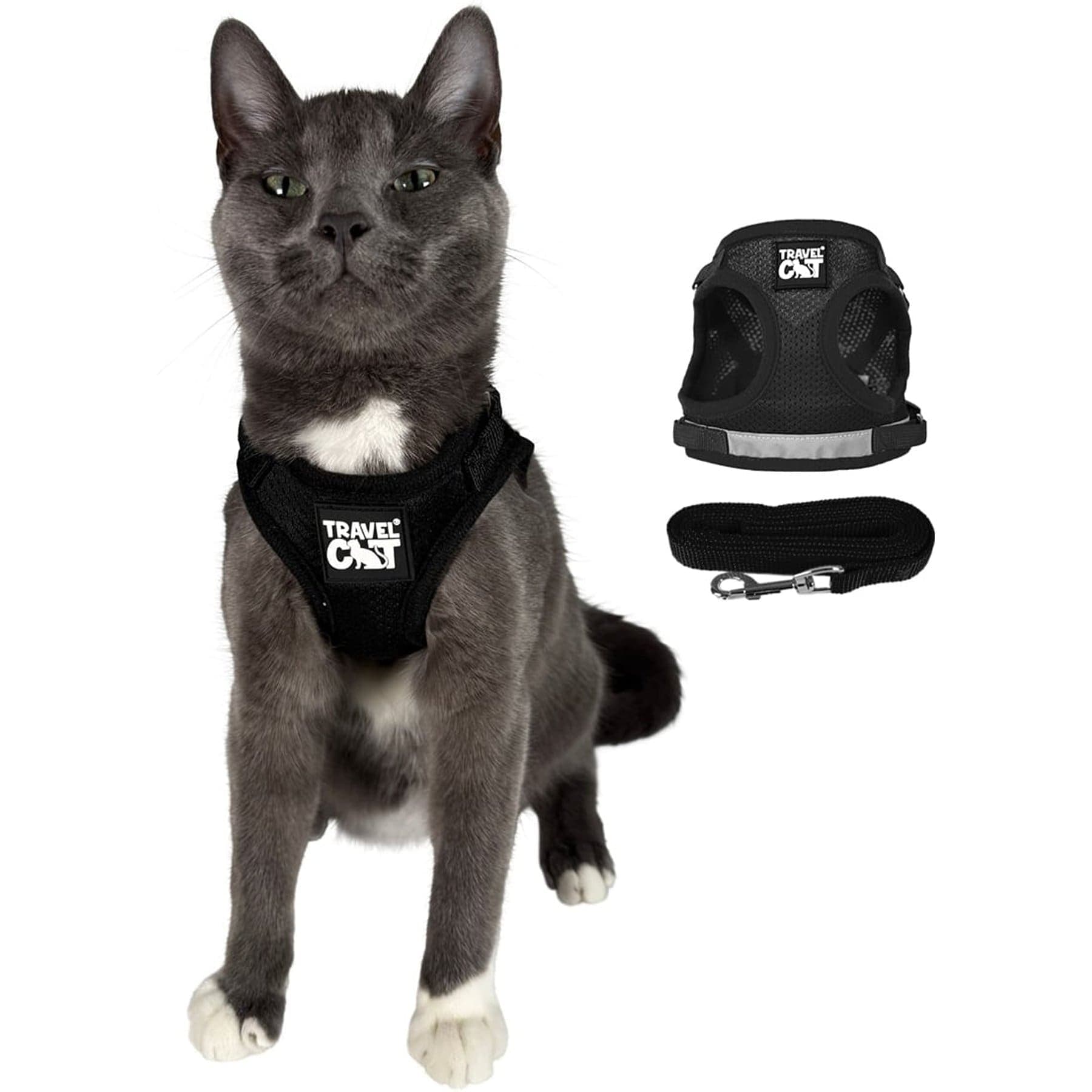
A reflective vest set with adjustable webbing, hook-and-loop fastening, and a clip.
Webvet may earn a commission when you click through to Chewy, at no extra cost to you.
Measure and fit a cat harness
Measure before ordering, then assess the assembled harness on the cat. Those are two different checks. Measurements help you avoid a clearly wrong size; the fitting trial shows how the design sits on a moving animal. Keep a note of the date, neck measurement, chest girth, and selected model so that a later adjustment or replacement starts from something more useful than “Medium fitted last time.”
Measure the neck and chest for a cat harness
Measure the individual cat rather than choosing by breed. A Norwegian Forest Cat, Bengal, British Shorthair, or Savannah can have proportions that differ from the pictured model. A three-legged cat or one with back-leg weakness needs an individual fit and activity assessment with the veterinary team; a walking harness is not rehabilitation support.
Choose a quiet moment when your cat is comfortable standing on a secure surface. Use a flexible measuring tape and follow the product’s directions about where to place it. Do not stretch the cat into a pose or tighten the tape to force a smaller reading. If the cat moves away, break the task into shorter attempts. Having one person offer a reward while another measures can help if the cat is comfortable with both people.
Find the widest part of the chest for the girth measurement, usually behind the front legs as the manufacturer directs. For the neck, use that harness’s specified position rather than assuming a collar measurement is always interchangeable. Read the tape while it lies flat, with the coat accounted for rather than a loop of air hidden beneath long fur. Repeat an uncertain reading before selecting a size.
- Record the neck measurement and chest girth in the same units as the chart.
- Compare both numbers with the exact model and size, including any stated minimum.
- Read the maker’s advice for measurements between sizes; different designs give different guidance.
- Check whether the closure retains adequate overlap and the straps retain useful adjustment.
- Reassess the fit on the cat before using the harness outside.
A broad chest and a narrow neck can be a more important distinction than body weight. A large Maine Coon may need a different shape from another cat of the same weight, and dense fur can make a harness appear closer to the body than it is. Small adults also need a controlled neck opening; reducing the chest setting alone may leave the front too loose. This is why a two-measurement chart is especially helpful.
For example, a cat with a 14-inch chest falls within both the Kitty Holster Small/Medium chest range and the RC Pets Medium girth range listed above. That does not make the two fits interchangeable. You still need the neck measurement, closure placement, and an assessment of how each shape sits behind the front legs. Write down both measurements before deciding between those options rather than choosing whichever listing calls the cat “Medium.”
For kittens, repeat the fit check as they grow. Buying a much larger harness to provide growing room can leave an escape route today. Conversely, a harness that has reached the end of its adjustment range may restrict normal movement as the kitten grows. Keep the chart and model name rather than assuming that the next size in another brand is an equivalent step up.
Wraps, straps, buckles, and entry styles
For a cat harness and lead used in a garden, the same fitting checks apply as indoors; a garden fence does not provide reliable containment for a frightened cat. High visibility trim helps you locate equipment when light reaches it, but does not replace keeping the leash in hand. Before putting a PetSafe harness on your cat, identify this model’s contrasting belly strap, buckles, and rubber stopper in its linked instructions; other harnesses use a different sequence.
Strap and vest formats distribute material differently; neither is universally preferred by cats. There is a practical difference between cat and dog harnesses: a dog harness is not automatically suitable for a cat. Compare feline body proportions, neck and chest fit, and backward escape risk rather than transferring the dog’s size. For a harness-and-leash set, check both components and their attachment instructions. A step-in or opening wrap may help when an over-the-head design is difficult.
The terms vest, jacket, H-style, and step-in describe broad formats rather than a shared safety standard. Look at how the actual product opens and closes. A vest may wrap around the body, require the front paws to be positioned, or have an opening that passes over the head. A strap harness may use several buckles or a distinctive tightening arrangement. Photos are useful for identifying parts, but the instructions establish their intended placement.
Practice closures before dressing the cat
Practice operating the closures away from the cat first. You should know how a buckle releases and where webbing returns through an adjuster before attempting a fitting. With a hook-and-loop closure, check the full contact area for fur and debris. With a buckle, confirm that it engages completely and that its release tabs are not damaged. With webbing, look for twisting or a tail that has slipped from its intended route.
- Broad wraps: consider fabric contact, closure overlap, and the cat’s tolerance of fastening sounds.
- Minimal straps: check orientation, adjustment, and whether a narrow strap approaches an armpit.
- Mesh panels: inspect panel position and the separate webbing rather than assuming the panel controls the fit.
- Step-in or head-entry designs: consider the handling needed to get the cat into the opening without forcing a limb or head.
Leather, decorative trim, or a tactical appearance does not answer those fitting questions. Extra loops and pockets may add bulk without helping a cat explore comfortably. Likewise, a broad full-body appearance does not turn a walking harness into a restraint for nail trimming or a medical procedure. Use equipment for its stated purpose and discuss handling difficulties with your veterinary team rather than repurposing the harness to hold the cat still.
Once fitted, invite a few voluntary steps indoors. Watch from the side and above as the cat turns, sits, and lowers their head toward a reward. The harness should remain in its intended position without rotating markedly, bunching behind the legs, or opening at a closure. Look again after movement. A fit that seemed correct at the start can reveal a problem when the cat changes posture.

Check backward movement without provoking an escape
High-visibility or reflective details can help an owner see equipment, but do not prevent escape. Check quick-release buckles and ordinary fasteners for correct closure. A non-slip or escape-proof claim cannot replace the supervised backward-movement check. Material labels such as vegan leather describe construction, not whether the cat will tolerate the shape.
Cats can reverse direction suddenly, especially when something ahead feels threatening. A harness may start moving toward the head if the cat backs away while the leash pulls forward. During an indoor fitting, observe this possibility in a closed room with an escape route to outdoors secured. Do not deliberately frighten the cat or pull hard to stage an escape test. You are checking movement and position, not trying to overpower the equipment.
Keep the leash loose as you invite the cat to move toward you, then change your position gradually. If the cat backs away, move with them to reduce opposing tension rather than holding a fixed line and dragging forward. Stop if a foreleg begins to slip through an opening or the neck portion shifts toward the ears. Return to the instructions and reassess size, placement, or format before continuing.
- Stop the session if the harness starts to come off, even if a second closure still holds.
- Check whether the issue is adjustment, incorrect assembly, or a shape mismatch.
- Do not solve looseness by tightening until breathing or normal movement is restricted.
- Ask the manufacturer or a knowledgeable veterinary professional for help when the fit remains unclear.
Repeat a brief position check before each outing. Straps can be adjusted accidentally, fasteners can collect hair, and a cat’s body can change over time. A successful indoor trial is evidence that the setup worked in those conditions. It is not a guarantee against escape during panic, climbing, or an unexpected encounter. Choosing the environment carefully remains part of using the harness well.
 $65 · no membership
Have a health question about your cat?
A licensed vet can assess your cat over video and prescribe online when it's appropriate.
 Talk to a vet
- Licensed vets
- All 50 states
- same-day Rx
Webvet may earn a commission if you book.
Harness training and supervised outdoor use
Harnesses can give some cats a way to explore under close supervision, but outdoor walking is not a requirement for a good life. A curious cat who voluntarily investigates equipment may enjoy the process. A cat who remains frightened can benefit from other enrichment. Judge the experience by the cat’s behavior rather than the distance covered or whether other people take their cats on hikes.
There is no single harness brand that veterinarians universally recommend for every cat. For an individual recommendation, bring the cat’s measurements, health considerations, and the harness itself to your veterinary team. Ask about fit, comfort, and whether outdoor exposure is appropriate for that cat. A recommendation for a secure, correctly fitted feline harness should not be read as a blanket endorsement of an unmeasured product or an assurance that all cats want leash walks.

Build an indoor introduction in small steps
Harness desensitization means introducing the equipment at a level the cat can comfortably tolerate, then increasing the task gradually. A cat who falls over, flops, freezes, walks backward, or refuses to move needs an easier step or a different fit, not dragging. If the cat hates the harness or becomes frightened, stop and reassess. It is not kind to persist through distress simply to achieve an outdoor walk.
Start with the harness lying nearby while the cat has a pleasant, ordinary experience, such as a short play session or a reward. Let the cat sniff it or ignore it. Next, practice bringing it near the body and touching briefly before attempting to fasten it. If you rush directly from unfamiliar equipment to full fastening, you may not know whether the problem is the material, the handling, or the closure sound.
Once brief contact is comfortable, try the fitting sequence for a short period. Reward voluntary calm behavior and remove the harness before the cat becomes overwhelmed. There is no universal number of days or minutes that suits every cat. Progress when the current step is comfortable; repeat or simplify it when it is not. Several uneventful introductions can be more useful than one long session that ends in a struggle.
- Introduce the harness as an object without requiring the cat to wear it.
- Practice brief body contact and the sounds of fasteners separately if needed.
- Fit it according to the instructions, reward, and remove it after a manageable interval.
- Invite voluntary movement while checking placement and freedom of movement.
- Attach the leash only after the harness itself is tolerated.
When you introduce the leash, hold it lightly and supervise continuously. Do not let a cat drag it around unattended, where it could catch on furniture. Begin in an uncluttered room with doors and windows secured. Follow the cat’s movements while managing the slack, then invite a short change of direction with a reward or familiar cue. Avoid using tension as the main way to move the cat.
Respond to freezing, flopping, and frustration
If your cat will not stand up in the harness or lies down as soon as it is fastened, remove it and return to an easier introduction after checking the fit. The same applies to a scared cat who backs away from dressing. Harness use becomes unkind when an owner persists through fear or forces movement; it is not inherently cruel when the cat participates comfortably and can stop.
Some cats crouch or stop moving when unfamiliar equipment touches their body. That reaction is not proof that they are being stubborn, and it is not a reason to pull them along. Check for a physical fit problem first: a twisted strap, an edge at the armpit, or restricted movement. Then reduce the task. Removing the harness and returning to a shorter introduction may be more helpful than extending the session.
Persistent attempts to bite at the harness, frantic rolling, repeated hiding, or escalating struggling call for a pause. Learn the broader context through our guides to cat stress relief and cat anxiety. These responses can have several causes; a product change alone may not resolve them. If your cat’s reaction is severe or you suspect pain, ask your veterinarian before continuing.
Avoid making every training session end with the same difficult event. The harness can come out, be investigated, and go away again without a trip outdoors. If fastening is easy but opening the door produces distress, work on the environmental change rather than repeatedly adjusting a harness that already fits. If the cat is relaxed indoors but cannot move naturally in one design, consider a different format after checking its placement.
Plan the first outdoor outing
Choose a quiet, contained setting with a clear route back to safety. Avoid a busy pavement, an off-leash dog area, or a place where the cat could immediately disappear into dense vegetation. Prepare the carrier, leash, and return route before taking the cat out. A first outing can be a brief chance to observe and sniff; it does not need to resemble a dog walk or cover a predetermined route.
Talk with your veterinary team about parasite prevention, vaccination, and other needs associated with outdoor exposure. Those decisions depend on the cat and location. A harness does not protect against those hazards, and reflective trim does not make traffic or unfamiliar animals predictable. Check temperature, ground conditions, and access to shade before the outing, then stay attentive to the cat rather than relying on the equipment to manage the environment.
- Keep your hand on the leash and stay close enough to respond to a change in direction.
- Prevent the leash from wrapping around trees, benches, or the cat’s legs.
- Leave when the cat becomes overwhelmed rather than waiting for a full struggle.
- Use a secure carrier for transport and for a planned return when appropriate.
- Never tether the cat to an object and leave them unattended.

Keep transport and walking equipment separate
A walking harness does not provide enclosed containment in a car, clinic waiting room, or other busy environment. Use a suitable secure carrier for the journey. Do not clip a normal walking harness into a vehicle and assume that it is crash-tested. If you keep a harness on during part of a journey, check the carrier and harness instructions, prevent loose straps or a leash from catching, and supervise the setup.
At the destination, make changes in a secure place. Opening a carrier beside an open car door while sorting out buckles and a leash leaves several things to manage at once. Prepare the harness at home when practical and move deliberately between containment and supervised walking. If the cat cannot tolerate that transition calmly, reconsider whether the outing is appropriate at this stage of training.
Clean, inspect, and retire worn equipment
Follow each maker’s care instructions rather than assuming every cotton, nylon, or mesh harness can be washed the same way. Remove loose hair from closures, check stitching, and inspect rings and clips for damage. Allow the harness to dry before storing it. After cleaning, check the adjustment again: handling the webbing or opening closures can change the setup you previously fitted.
Replace damaged equipment when its closure, stitching, or hardware cannot function as intended. A frayed strap or unreliable buckle is not a training problem to work around. Keep the product instructions with the model and size information so that you can order the correct replacement. When moving to a different design, repeat the fitting and introduction steps even if your cat has worn another harness successfully for years.
Cat harness questions
Frequently Asked Questions
Do vets recommend cat harnesses?
A veterinarian may recommend supervised harness use for a cat who tolerates it and whose health and environment suit outdoor exploration. That is an individual decision, not a universal prescription. Bring the neck measurement and chest girth, describe your plans, and ask the team to check any uncertain fit. A harness should support a comfortable activity; it should not be used to force a frightened cat to walk or replace a secure transport carrier.
What type of harness do cats prefer?
Cats differ. Some tolerate minimal straps better than a broad vest; others accept a wrap but dislike equipment passing over the head. Choose a design that matches the neck measurement and chest girth, then introduce its handling and closure gradually. Watch voluntary movement and behavior rather than assuming that soft fabric or more coverage guarantees comfort. A cat who remains distressed may prefer enrichment that does not require wearing a harness.
What is the safest harness for a cat?
The safest practical choice is a properly fitted feline harness with sound closures and hardware, used under close supervision in an appropriate setting. No model can be promised escape-proof for every cat. Compare the neck measurement and chest girth with the exact chart, check movement and backward escape risk indoors, and inspect the setup before each outing. If the harness shifts toward the head or lets a foreleg slip out, stop and reassess it before outdoor use.
$65 · no membershipHave a health question about your cat?
A licensed vet can assess your cat over video and prescribe online when it's appropriate.
Talk to a vet- Licensed vets
- All 50 states
- same-day Rx
Webvet may earn a commission if you book.

Editor
The Webvet Editorial Team is the in-house group of pet-care editors and writers behind Webvet, operated by Smart Pet Collective. The team researches, writes, and maintains Webvet's pet health, behavior, and medication content. Every article follows a defined editorial process: research from reputable veterinary and scientific sources, careful drafting, mandatory review of medical content by a credentialed veterinarian, and dated publication. Health and medication articles are medically reviewed by a licensed veterinary professional before they go live and are kept current over time.
Veterinarian · BVMS MRCVS
Dr. Pippa Elliott, BVMS, MRCVS, is a veterinarian with nearly 30 years of experience in companion animal practice. Dr. Elliott earned her Bachelor of Veterinary Medicine and Surgery from the University of Glasgow. She was also designated a Member of the Royal College of Veterinary Surgeons. Married with 2 grown-up kids, Dr. Elliott has a naughty Puggle named Poggle, 3 cats and a bearded dragon.
Related reading

Best Cat Litter Mats for Tracking, Cleaning, and Sensitive Paws

Best Cat Carriers for Vet Visits, Travel, and Difficult Loaders

Periodontal Disease in Dogs: Signs, Causes & Proactive Support
