Cat Hairball Blockage Symptoms: When It's an Emergency
Repeated unproductive retching, refusing food, lethargy, and constipation are the four warning signs of a hairball blockage in cats. Learn when it becomes an emergency, how vets diagnose it, and what surgery really involves.

BVMS MRCVS
Medically reviewed by Dr. Pippa Elliott, BVMS MRCVS · Last reviewed

This article contains affiliate links. Webvet may earn a commission when you buy through them, at no extra cost to you.
Cat hairball blockage symptoms come down to four red flags: repeated unproductive retching, refusing food, lethargy, and constipation or straining in the litter box. A cat showing two or more of these signs together may have a hairball lodged in the digestive tract, and that is a veterinary emergency, not a wait-and-see situation.
Most hairballs are unpleasant but harmless. A cat swallows hair while grooming, the hair collects in the stomach, and the cat eventually vomits it up or passes it in the stool. Our guide to hairballs in cats covers that normal mechanism.
This article covers the rare case where the system fails: the wad of hair, called a trichobezoar, moves out of the stomach and wedges in the intestine.
Once hair is lodged in the intestine, nothing you can give at home will move it. Food and fluid back up behind the obstruction, the gut wall becomes inflamed and can lose blood supply, and the cat deteriorates over hours to days. Recognizing the pattern early is what protects your cat.
- 1The four blockage red flags are repeated unproductive retching, not eating, lethargy, and constipation or straining.
- 2A normal hairball comes up within a few minutes of retching; gagging that repeats over hours with nothing produced is not normal.
- 3A suspected blockage is an emergency. Call your vet the same day; do not give gels, oils, or food to 'push it through.'
- 4Vets confirm a blockage with a physical exam plus X-rays or ultrasound, and treat with fluids, endoscopy, or surgery.
- 5Most cats recover well when a blockage is treated promptly; waiting is what turns a treatable problem into a dangerous one.
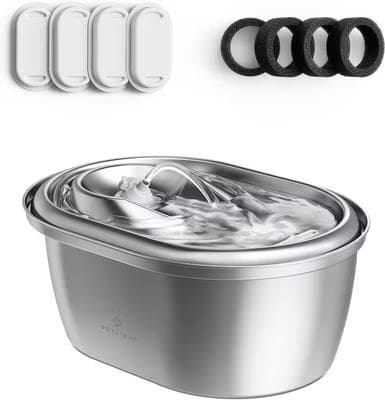
304 food-grade stainless steel pet water fountain, 101 oz. The circulating, filtered water encourages cats to drink more, which supports urinary tract and kidney health.
Webvet may earn a commission when you click through to Chewy, at no extra cost to you.
Hairball blockage symptoms: the warning signs
The warning signs of a hairball blockage are repeated unproductive retching, appetite loss, lethargy, and constipation, often joined by vomiting food or fluid. Any one sign can have other causes; the combination, developing over one to three days, is what points to an obstruction.

Watch for these four load-bearing red flags:
- Repeated unproductive retching. Your cat hacks, gags, and heaves again and again but nothing comes up. This is the single most telling sign that hair is stuck rather than moving.
- Not eating. A blocked gut makes cats nauseated, so they refuse meals or take a lick and walk away. Appetite loss beyond 24 hours is significant in any cat.
- Lethargy. The cat hides, sleeps in unusual spots, stops greeting you, and resists being picked up. Obstructed cats feel genuinely ill and often guard a painful belly.
- Constipation or straining. Little or no stool passes because nothing is getting through. Some cats strain in the box and produce only small, hard pellets or smears of diarrhea around the blockage.

Supporting signs include vomiting food or yellow fluid, a tense or swollen abdomen, drooling, and crying when the belly is touched. VCA Animal Hospitals' clinical overview of trichobezoars (hairballs) in cats lists ongoing vomiting, anorexia, and lethargy as the classic obstruction triad.
If your cat is showing appetite loss with low energy even without retching, our guide to a cat not eating and lethargic walks through the other causes that need ruling out.
Contrast this with normal hairball behavior, because the difference is the whole diagnosis. A cat working on an ordinary hairball retches for a minute or two, produces a damp tube of hair, and goes straight back to breakfast.
The blockage pattern is the opposite: the retching repeats across hours, produces nothing, and the cat gets quieter with each round.
Are cats in pain with a hairball? A routine hairball causes brief discomfort during the retch and nothing more. A lodged hairball is different: intestinal obstruction is painful, and cats show it quietly, by hunching, hiding, and flinching when touched rather than crying out.
Assume a cat with blockage signs hurts, even if it is silent.
If these symptoms are stacking up, skip home treatment entirely and make the call first; every treatment that works on a true blockage happens at the clinic, not in your kitchen.
Which cats are at highest risk
Blockage risk is not evenly distributed. Long-haired breeds like Maine Coons and Persians swallow more hair per grooming session. Cats with itchy skin, fleas, or stress overgrooming lick far more than normal. Seniors have slower gut motility, so hair lingers and felts together.
And any cat with a history of frequent hairballs has, by definition, more chances for one to stick. If your cat fits two or more of those categories, treat the red flags with extra urgency.

A soupy, lickable bisque treat that tempts a cat who has gone off solid food. The high-moisture, aromatic texture is easy to lap up and hard for a picky or recovering cat to resist, and it sneaks in extra hydration.
Webvet may earn a commission when you click through to Chewy, at no extra cost to you.
Where the hair lodges also shapes the picture. A mass stuck at the stomach outlet (the pylorus) tends to cause vomiting shortly after meals, while hair wedged farther down the small intestine produces the classic slow decline: intermittent vomiting, fading appetite, and less and less stool over two to three days.
Your decision timeline: 12, 24, and 48 hours
Owners rarely get a concrete timeline, so here is one. It assumes an adult cat that was healthy yesterday; kittens, seniors, and cats with chronic disease should see a vet sooner.
| Time since signs began | What you're seeing | What to do |
|---|---|---|
| 0 to 12 hours | Occasional gagging, ate a little, otherwise alert | Watch closely. Withhold treats, offer water, and recheck every few hours. Many hairballs pass on their own in this window. |
| 12 to 24 hours | Repeated unproductive retching, skipped two meals, quieter than normal | Call your vet today and book a same-day or next-morning exam. Do not give hairball gel or food to force the issue. |
| 24 to 48 hours | Still no hairball, no appetite, lethargy, little or no stool | This is now presumed obstruction until proven otherwise. Your cat needs an exam and imaging within hours, not days. |
| Any time | Vomiting everything including water, collapse, crying, rapid breathing | Go to an emergency clinic immediately. |
While you wait for the appointment
Once you have called the vet, resist the urge to do something. Do not give hairball gel, oil, food, milk, or any laxative; anything pushed into a blocked gut either comes back up or adds pressure behind the obstruction.
Leave water available unless your cat vomits it back, and let your cat rest wherever it chooses.
Do spend the waiting time gathering the details the vet will ask for: when the retching started and how often it repeats, the last full meal your cat ate, the last stool you can confirm, any vomit and what was in it, and whether anything unusual (string, ribbon, a toy) has gone missing.
String-like objects cause obstructions that mimic hairball blockages exactly, and the answer changes the surgical plan.
Confine your cat to one room with the water bowl and a litter box before you leave for the clinic. It spares you a stressful hunt when it is time to load the carrier, and it gives you one more clean read on whether anything is passing.
 Sponsored
Have a health question about your cat?
Talk to a licensed vet at Dutch over video or message, including nights and weekends.
Use code Pets30
Plans start at $11/month · covers up to 5 pets
- Licensed vets in most states
- Rx for 150+ conditions
- 4.7 on Trustpilot
Why unproductive retching is the red flag
Unproductive retching matters because it means the vomiting reflex is firing but nothing can move. When a hairball sits in the stomach, a few heaves usually eject it.
When the hair has passed into the narrow small intestine and stuck, the stomach keeps trying to vomit against a blocked pipe, so the cat gags over and over with nothing to show for it.
The Cornell Feline Health Center's page on the danger of hairballs makes a second point every owner should know: frequent hacking may have nothing to do with hairballs at all.
Retching that never produces hair can also be a sign of asthma or another respiratory problem, both of which need their own workup. Either way, repeated empty retching earns a vet visit.
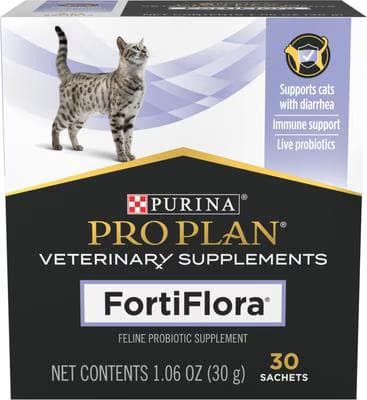
The #1 vet-recommended probiotic for cats. Daily powder sachets support healthy digestion and firmer stools, and can help cats coping with diarrhea or GI upset.
Webvet may earn a commission when you click through to Chewy, at no extra cost to you.
You can often tell the two apart by watching the body. A retching cat crouches low, extends its neck, and heaves with visible abdominal contractions, as if pumping something up from the belly.
An asthmatic cough is shallower and raspier: the cat hunches with its neck stretched but the effort comes from the chest, sometimes ending in a swallow. Take a phone video either way; ten seconds of footage tells your vet more than any description.
One more distinction: a cat that vomits food or bile repeatedly is a different problem from a cat that dry-heaves. Repeated true vomiting has a long list of causes beyond hairballs; our guide to why cats throw up sorts those out.
With a blockage you often see both: empty retching early, then vomiting of anything the cat eats or drinks as the backup worsens.
SponsoredVet care that's always there
Unlimited video calls and messaging with licensed vets for less than a typical vet visit. One membership covers up to five pets.
Use code Pets30
Plans start at $11/month · covers up to 5 pets
- Licensed vets in most states
- Rx for 150+ conditions
- 4.7 on Trustpilot
How long should a hairball take to pass?
A cat that is going to bring a hairball up usually does it within 24 to 48 hours of the first gagging episodes, and the actual retching bout lasts only a minute or two.
Hair that passes the other way moves through the gut with stool over a day or two. Anything beyond 48 hours of on-and-off retching without a result should be escalated to your vet.
That 48-hour figure is a ceiling, not a target. If the red flags stack up sooner, retching plus refused meals plus hiding, escalate sooner; the timeline exists to stop endless watchful waiting, not to delay an obviously sick cat.
The escalation logic is simple: time is the enemy with obstructions. The longer hair sits wedged in the intestine, the more dehydrated the cat becomes, the more the gut wall swells, and the higher the odds that a simple procedure becomes a complicated one.
Cats that see a vet within a day or two of the first red flags have far more options than cats that arrive on day four or five.
Can a hairball kill a cat?
Yes, a hairball can kill a cat, but only in the uncommon case where it causes a complete intestinal obstruction that goes untreated. A fully blocked intestine cannot pass food or water.
The cat becomes dehydrated, electrolytes fall out of balance, and the trapped segment of gut can lose its blood supply, die, and rupture, causing septic peritonitis. That cascade can turn fatal within a few days.

A palatable tuna-flavored oral gel that gently lubricates the digestive tract to ease hairballs and mild constipation in cats.
Webvet may earn a commission when you click through to Chewy, at no extra cost to you.
The reassuring flip side: this outcome is almost entirely preventable with timely care. Hairball obstructions announce themselves with the red flags above, and a cat treated in the first day or two of signs has an excellent chance of a full recovery.
Death from a hairball is a story of delay, not of an untreatable disease.
It is also worth saying that most cats never get anywhere near this point. The average hairball is an annoyance on the carpet, not a threat.
Frequent hairballs, though, mean more chances for one to stick, which is why chronic hairball cats deserve a prevention plan and a vet conversation about why so much hair is going down in the first place.
How vets diagnose and treat a hairball blockage
Getting rid of a hairball blockage is a veterinary job, and it follows a ladder: confirm the obstruction, stabilize the cat with fluids, then remove the hair by the least invasive route that will work. Owners cannot clear a true blockage at home, and attempts to do so with gels or oils waste critical time.

What the visit looks like
Expect triage first, especially at an emergency clinic: a technician checks hydration, temperature, gum color, and heart rate, and a visibly dehydrated or painful cat may go straight to the treatment area for IV fluids before you finish paperwork. That is standard stabilization, not a sign your cat is beyond help.
You will then get a diagnostic and treatment estimate before anything major happens. Three useful questions to ask: Is the obstruction complete or partial? Can we try medical management or endoscopy first? And if surgery is needed, what does the estimate assume about resection?
Clear answers up front prevent painful surprises later, and a good clinic welcomes the questions.
Your vet starts with a history and a hands-on exam, including abdominal palpation. A firm, sausage-shaped mass or a painful, gas-distended gut loop raises suspicion immediately. Next comes imaging: X-rays (radiographs) show gas patterns and blockage-shaped shadows, sometimes with a contrast study to track whether material moves.
Ultrasound can visualize the hair mass itself and check the gut wall. Bloodwork rounds out the picture by measuring dehydration and electrolyte losses.
The treatment ladder
Treatment depends on where the hair sits and how sick the cat is. A partial blockage in a stable cat may respond to hospitalization with IV fluids, anti-nausea medication, and lubricant laxatives, with repeat imaging to confirm the mass is moving.
Hair still in the stomach can sometimes be retrieved with an endoscope under anesthesia, no incision required. A confirmed complete obstruction in the intestine goes to surgery.
Surgery reality: procedure, recovery, and outlook
The operation is a gastrotomy or enterotomy: the surgeon opens the abdomen, locates the mass, makes an incision in the stomach or intestine, and lifts the hair out.
If a section of intestine has already lost its blood supply, that segment is removed and the healthy ends are joined, a bigger procedure with a longer recovery.
Expect one to three days in the hospital afterward, pain medication, a gradual reintroduction of soft food, an incision to protect for about two weeks, and a recheck to confirm healing.
Costs vary widely by region and case complexity, from the low thousands for a straightforward enterotomy at a general practice to substantially more at an emergency or specialty hospital, so ask for an estimate up front.
The survival outlook is genuinely good when owners act early. Cats taken to surgery before the intestine is perforated overwhelmingly recover and go on to live normal lives. The outlook worsens when the gut has ruptured or a large section has died, which is exactly what delay produces.
The honest summary of the surgery-reality question: the operation is routine for veterinary surgeons, the recovery is measured in days to weeks, and the biggest variable in the survival rate is how quickly the cat got help.
What about home remedies?
Home remedies have a real place, but only on the safe side of the line: a cat that is still eating, drinking, and acting normally while working on an ordinary hairball.
In that situation, a petroleum-based hairball gel such as Laxatone, added fiber, and good hydration can help the hair slide through. Our guide on how to help a cat pass a hairball covers exactly what works, what is unsafe, and how to dose.
Once the red flags in this article appear, that window has closed; skip the gel and call the vet.
Preventing the next hairball
A cat that has had a blockage scare should go home with a prevention plan: regular brushing matched to coat type, a hairball-control diet, better hydration, and a check for stress-driven overgrooming. Our full guide to hairball prevention in cats lays out that routine step by step.
Frequently Asked Questions
How do I get rid of a hairball blockage in my cat?
You can't clear a true blockage at home; it requires veterinary treatment. Vets confirm the obstruction with an exam and imaging, then treat with IV fluids and lubricants for partial blockages, endoscopic retrieval for hair still in the stomach, or surgery for a complete intestinal obstruction. Home gels and oils only help ordinary hairballs in cats that are still eating and acting normally.
How long can a cat live with a hairball blockage?
A complete, untreated intestinal obstruction can become life-threatening within about three to five days as dehydration, electrolyte imbalance, and gut-wall damage progress. Partial blockages deteriorate more slowly but still worsen over days. This is why signs lasting more than 24 to 48 hours warrant an urgent vet visit rather than continued watching.
Will a cat with a hairball blockage still poop?
Often not much. With a complete blockage, stool production tapers off and stops because nothing passes the obstruction. With a partial blockage, a cat may pass small, hard pellets or even liquid stool that squeezes around the mass. Straining with little result, in a cat that is also retching and off food, fits the blockage picture.
Can the vet just give my cat something to dissolve the hairball?
No. Hair is keratin, and nothing safe to give a cat dissolves it. Lubricant laxatives can help hair slide through when the blockage is partial and the cat is stable, but a wedged, complete obstruction has to be physically removed by endoscopy or surgery.
The bottom line
Hairball blockages are rare, dramatic, and very treatable when caught early. Memorize the four red flags: repeated unproductive retching, not eating, lethargy, and constipation. One red flag earns close watching; two or more together earn a same-day call to your veterinarian. Your cat cannot tell you a hairball is stuck, but the pattern will.

Editor
The Webvet Editorial Team is the in-house group of pet-care editors and writers behind Webvet, operated by Smart Pet Collective. The team researches, writes, and maintains Webvet's pet health, behavior, and medication content. Every article follows a defined editorial process: research from reputable veterinary and scientific sources, careful drafting, mandatory review of medical content by a credentialed veterinarian, and dated publication. Health and medication articles are medically reviewed by a licensed veterinary professional before they go live and are kept current over time.
Veterinarian · BVMS MRCVS
Dr. Pippa Elliott, BVMS, MRCVS, is a veterinarian with nearly 30 years of experience in companion animal practice. Dr. Elliott earned her Bachelor of Veterinary Medicine and Surgery from the University of Glasgow. She was also designated a Member of the Royal College of Veterinary Surgeons. Married with 2 grown-up kids, Dr. Elliott has a naughty Puggle named Poggle, 3 cats and a bearded dragon.
Related reading

Cat Cremation Cost: Private, Communal, and Additional Charges

Cat Euthanasia Cost: Clinic, At-Home Care, and Aftercare

Dog Microchip Cost: Implantation, Registration, and Ongoing Fees
