Cat Hairballs: Why They Happen and When to Worry
Cat hairballs come from normal grooming, but frequency matters. Learn how a trichobezoar forms, how many hairballs per month is normal, and the red flags that mean it is time to call your veterinarian.

BVMS MRCVS
Medically reviewed by Dr. Pippa Elliott, BVMS MRCVS · Last reviewed

This article contains affiliate links. Webvet may earn a commission when you buy through them, at no extra cost to you.
Cat hairballs form when your cat swallows loose fur during grooming and that fur clumps in the stomach instead of passing through the gut. Most healthy cats bring one up only occasionally, roughly once or twice a month or less.
So an occasional hairball is usually normal. Frequent ones are not. Weekly hairballs, retching that produces nothing, or hairballs paired with appetite loss point to a skin, gut, or stress problem that deserves a veterinary workup.
This guide explains why hairballs happen, what a normal one looks like, how many per month is actually normal, and the red flags that mean it is time to call your veterinarian.
- 1Hairballs (trichobezoars) form from swallowed fur that stays in the stomach instead of passing in the stool.
- 2A normal hairball is a slim, damp tube of matted fur, not a round ball, and shows up about once or twice a month or less.
- 3More than one hairball a week, unproductive retching, or hairballs plus vomiting, appetite loss, or lethargy are red flags.
- 4Prevention rests on regular brushing, hydration, and fiber-supported diets, not on treating hairballs as inevitable.
- 5A cat that keeps gagging without producing anything could have an obstruction: that is a same-day vet call.
 Sponsored
Have a health question about your cat?
Talk to a licensed vet at Dutch over video or message, including nights and weekends.
Use code Pets30
Plans start at $11/month · covers up to 5 pets
- Licensed vets in most states
- Rx for 150+ conditions
- 4.7 on Trustpilot
Why Do Cats Get Hairballs?
Cats get hairballs because grooming and digestion work against each other. A cat's tongue is covered in backward-facing barbs called papillae that rake loose fur off the coat. Whatever the tongue catches gets swallowed, because those barbs only move fur in one direction: toward the throat.

In most cats, most of that fur travels through the digestive tract and leaves in the stool without incident. Hair is not digestible, but a healthy gut moves it along the same way it moves everything else.
The second half of the story is gastrointestinal motility, the part most explanations skip. When fur intake outpaces what the stomach can push into the intestines, or when gut transit slows down, hair lingers in the stomach and mats together.
The stomach eventually ejects that mat the only way it can: by vomiting. That is why veterinary references on vomiting in cats treat hairballs as one specific, recognizable form of vomiting rather than a separate event.
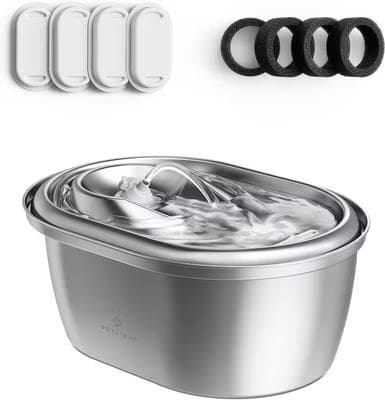
304 food-grade stainless steel pet water fountain, 101 oz. The circulating, filtered water encourages cats to drink more, which supports urinary tract and kidney health.
Webvet may earn a commission when you click through to Chewy, at no extra cost to you.
Two things can tip the balance toward hairballs: more fur going in, or slower movement through the gut. That framing matters, because it explains both the harmless cases and the worrying ones.
Hold onto that two-sided idea, because it runs through the rest of this guide. Almost every question about hairballs, from how many is normal to how to prevent them, comes back to how much fur goes in and how well the gut moves it out.
- More fur in: long coats, shedding season, and overgrooming from itchy skin, fleas, allergies, pain, or stress.
- Slower transit out: chronic gastrointestinal disease such as inflammatory bowel disease, dehydration, and other conditions that reduce gut motility.
A young, healthy shorthair that produces a hairball twice a year sits at one end of that spectrum. A middle-aged cat suddenly producing weekly hairballs sits at the other, and the hairballs are usually the symptom, not the disease.
For most healthy cats, that balance holds, and a hairball shows up once or twice a month at most. It is when the balance tips, in either direction, that the count starts to climb.
How much fur actually goes in
Grooming is not an occasional hobby for a cat. Healthy adults devote a substantial share of their waking hours to it, working the coat in the same tongue-first way every day. Every one of those sessions sends some loose fur down the throat, because a cat has no way to spit it back out.
Intake also swings with the season and the situation. It climbs during spring and fall coat changes, after stressful events that trigger comfort grooming, and whenever skin irritation gives the tongue a target. Many indoor cats shed lightly year-round, because steady light and temperature blur the seasonal signals that regulate coat turnover.
Age shifts the picture too. Kittens rarely produce hairballs, since their coats are short and their grooming is brief. Frequency tends to rise through adulthood as coats thicken and grooming grows more thorough.
In seniors, a change either way is informative: arthritis can reduce grooming, while gut disease can slow the transit that clears swallowed fur.
How a Trichobezoar Forms (and What It Looks Like)
The medical name for a hairball is trichobezoar: a mass of swallowed hair compacted in the stomach. Formation follows a predictable path. Papillae strip loose fur, the fur is swallowed, and strands that fail to leave the stomach tangle with each other and with mucus into a dense, felt-like mat.

From the stomach, the mass has two exits. Small accumulations pass into the intestines and leave in the stool, which is where most swallowed fur quietly goes. Larger mats get vomited back up, squeezed through the esophagus on the way out.
The mat does not form overnight. Strands accumulate across days or weeks, binding with mucus into an increasingly dense felt. Stomach acid does not dissolve hair, so once a mat grows too large to pass through the narrow outlet into the intestine, vomiting becomes the only exit left to it.

A soupy, lickable bisque treat that tempts a cat who has gone off solid food. The high-moisture, aromatic texture is easy to lap up and hard for a picky or recovering cat to resist, and it sneaks in extra hydration.
Webvet may earn a commission when you click through to Chewy, at no extra cost to you.
The squeeze through the esophagus also explains the shape. The stomach mat may be loose and irregular, but the narrow esophagus compresses it into that familiar cigar-shaped tube on the way up. It is why a cat often retches several times before anything appears: moving a felt plug up a narrow tube takes real effort.
What a normal hairball looks like
That trip through the esophagus is why the name misleads people.
Despite the word hairball, what lands on your floor is a tube, not a ball: a slim, damp cylinder of tightly matted fur, usually one to a few inches long, often tinted by stomach fluid or a little food.
Owners regularly mistake one for feces at first glance, which is why the search phrase about hairballs looking like poop is so common. The giveaway is texture and smell: a hairball is felted fur, not stool.
Size and color vary more than owners expect. A hairball can run from under an inch to several inches, and its shade reflects the coat plus any stomach fluid. None of that matters much on its own. What matters is how often they appear and how your cat looks otherwise.
Which cats get the most
Which cats make more of them? The pattern follows the fur-in, transit-out logic, so the heaviest producers are the ones taking in the most fur or clearing it the slowest.
- Long-haired breeds such as Persians and Maine Coons simply swallow more hair per grooming session.
- Fastidious groomers and cats that overgroom from itch, pain, or anxiety ingest fur far faster than average.
- Heavy seasonal shedders load the gut with extra fur in spring and fall.
- Cats with underlying gut disease clear swallowed fur more slowly, so the same intake produces more hairballs.
SponsoredVet care that's always there
Unlimited video calls and messaging with licensed vets for less than a typical vet visit. One membership covers up to five pets.
Use code Pets30
Plans start at $11/month · covers up to 5 pets
- Licensed vets in most states
- Rx for 150+ conditions
- 4.7 on Trustpilot
How Many Hairballs Are Normal? Red Flags to Watch
You should worry about hairballs when they arrive more often than about once or twice a month, when your cat retches repeatedly without producing one, or when hairballs come with other signs: vomiting food or bile, appetite loss, constipation, diarrhea, lethargy, or a coat going thin from overgrooming. Any of those combinations means see your veterinarian.
So are hairballs normal for cats at all? Yes: most healthy cats have an occasional one, and owners who ask how often cats have hairballs can use once or twice a month as the ceiling. Past that, or alongside the symptoms above, treat them as a signal.
That monthly benchmark is a guide, not a law: a long-haired cat in peak shedding season may run slightly higher and still be fine. What matters is the trend and the company the hairballs keep.
The Cornell Feline Health Center's overview of hairball dangers makes the same point: frequent hairballs and unproductive retching are signals to investigate, not quirks to live with.

Use this frequency framework to decide what to do next. It maps how often the hairballs happen, plus any companion signs, to an action.
| Zone | Hairball frequency | Companion signs | Action |
|---|---|---|---|
| Green: normal | Once or twice a month or less | None: eating, drinking, and acting normal | No action needed beyond routine brushing |
| Yellow: monitor | Noticeably rising, or roughly weekly during heavy shedding | Mild: extra grooming, occasional gagging, more fur in stool | Step up brushing and hydration; book a checkup if it does not settle within 2 to 3 weeks |
| Red: vet now | More than one a week, or repeated retching with nothing produced | Vomiting food or bile, appetite loss, lethargy, constipation, diarrhea, coat thinning, or a swollen or painful belly | Call your veterinarian; same-day if your cat cannot keep food down or keeps gagging unproductively |
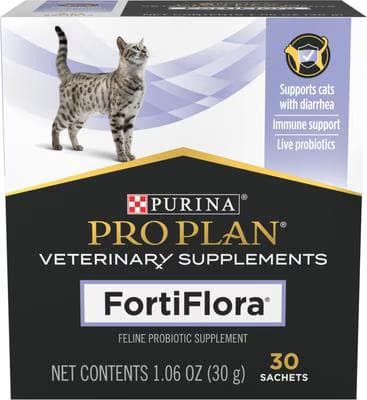
The #1 vet-recommended probiotic for cats. Daily powder sachets support healthy digestion and firmer stools, and can help cats coping with diarrhea or GI upset.
Webvet may earn a commission when you click through to Chewy, at no extra cost to you.
A worked example makes the zones concrete. Say your long-haired cat coughs up one tidy fur tube in April, eats dinner minutes later, and does not do it again for six weeks. That is textbook green: a healthy groomer clearing a seasonal load. No change needed beyond keeping up with the brush.
Now shift the facts. The same cat starts producing a hairball most weeks, you notice a bald patch developing on one flank, and there is more loose fur than usual in the stool.
That is yellow tipping toward red: the overgrooming and the rising count together say something is driving extra fur intake, and it is time to book a visit rather than wait it out.
The red version is unmistakable and urgent. Your cat hunches and retches over and over across an afternoon, brings up nothing, turns away from food, and grows quiet and flat. That combination can mean a hairball is stuck, and it is a same-day call, not a wait-and-see. Frequency stops mattering the moment those emergency signs appear.
Preventing Hairballs: What Actually Works
Prevention targets both halves of the mechanism: reduce the fur swallowed and keep the gut moving. Three habits do most of the work; our full guide to hairball prevention covers routines, tools, and diets in depth.
- Brush regularly. Every strand your brush captures is a strand your cat cannot swallow. Daily for long-haired cats, a few times a week for shorthairs, more during shedding season.
- Support hydration and gut motility. Water keeps swallowed fur moving. Wet food, water fountains, and multiple bowls all help.
- Consider a hairball-control diet. These formulas add fiber that helps carry swallowed fur through the intestines so less accumulates in the stomach. Ask your veterinarian before switching, especially for a cat with other health conditions.
Does wet food help cats pass hairballs? It can, indirectly. Wet food raises total water intake, and a better-hydrated gut moves swallowed fur along more reliably. Wet food alone will not fix a frequent-hairball problem, but as part of brushing plus hydration plus fiber, it earns its place.

A palatable tuna-flavored oral gel that gently lubricates the digestive tract to ease hairballs and mild constipation in cats.
Webvet may earn a commission when you click through to Chewy, at no extra cost to you.
Notice what these habits have in common: two of the three target the transit-out side of the mechanism, and only brushing tackles the fur-in side. That is deliberate.
You cannot stop a cat from grooming, so the realistic goals are capturing loose fur before it is swallowed and keeping the gut moving what does get swallowed.
Consistency beats intensity. A few minutes of brushing several times a week does far more over a shedding season than one marathon session a month, because the loose fur you remove today is fur that never reaches the stomach tonight.
Build the routine into a moment your cat already enjoys, such as a lap session, and it tends to stick.
One caution: petroleum-based hairball gels and hairball-control diets manage the symptom, not the cause. They are reasonable tools for a cat whose hairballs are otherwise well understood, but they should never substitute for a veterinary workup when frequency is climbing or red-flag signs appear.
Treating a hidden skin or gut problem with a lubricant only delays the real fix.
Diet is one lever worth understanding properly, and we cover the evidence behind hairball formulas in our guide to the best cat food for hairballs.
Our cat brush guide explains how to choose a comfortable tool for removing loose hair.
What Your Vet Will Look For if Hairballs Are Frequent
When a cat lands in the red zone, the veterinary visit is a search for the cause behind the hairballs, on both sides of the mechanism. Expect questions about grooming habits, diet, shedding, stress, and exactly how often the hairballs appear, so bring your count.
On the fur-in side, your vet will examine the skin and coat for fleas, flea dirt, thinning patches, barbered fur, and signs of allergy or pain that drive overgrooming.
On the transit-out side, the workup can include a belly palpation, bloodwork, fecal testing, and imaging if chronic gastrointestinal disease or a retained mass of fur is suspected.
That two-sided exam is the point of taking frequency seriously. A flea allergy, a stressful household change, and early inflammatory bowel disease can all present first as more hairballs on the floor. Each has its own fix, and none of them is a hairball remedy.
What to bring to the appointment
The single most useful thing you can bring is a record. Note the date of each hairball, whether anything else came up, and any changes in appetite, energy, grooming, or the litter box. A pattern on paper turns a vague more hairballs lately into the kind of timeline a veterinarian can actually act on.
Where the exam points next depends on what it finds. Itchy, over-groomed skin steers toward parasite control and allergy management. A history of weight loss, soft stool, or long-standing vomiting steers toward the gut, where inflammatory bowel disease and related conditions live. The hairballs were the flag; the diagnosis is whatever was driving them.
Helping a Cat Pass a Hairball
If your cat is actively working on a hairball, the short answer is: comfortable cats can usually manage on their own, and a veterinarian-approved petroleum-based hairball lubricant gel (Laxatone is a common example) can help fur slide through.
For step-by-step guidance, what is safe, what to skip, and how to know it worked, see our full guide on how to help a cat pass a hairball.
Owners hunting for the best hairball treatment for cats keep landing on that same remedy: lubricant gel, dosed as directed. Frequent hairballs, though, deserve a vet conversation rather than a stronger remedy.
If you are weighing up which product to actually buy, we compare the options in the hairball remedies worth buying.
Hairball Blockage: The Emergency to Know About
Rarely, a hairball grows too large to vomit up or pass, and lodges in the stomach or intestines. An intestinal blockage is life-threatening and can require surgery. The classic picture: repeated unproductive retching, refusing food, lethargy, and little or no stool.
Know the full symptom list in our guide to hairball blockage symptoms, and treat any suspicion as a same-day vet call.
Hairball or Vomit? How to Tell
A hairball is a damp tube of matted fur. Vomit is food, foam, liquid, or bile with little or no fur. That distinction matters, because true vomiting has its own list of causes that hairball remedies will not touch.
Our side-by-side guide to hairball or vomit decodes what you find and the sound you heard, and if your cat is vomiting without fur, start with why cats throw up.
Frequently Asked Questions About Cat Hairballs
Frequently Asked Questions
Are hairballs normal for cats?
Occasional hairballs are normal, a byproduct of healthy grooming. Once or twice a month or less, in a cat that is otherwise eating and acting normally, is nothing to worry about. Frequent hairballs are a symptom worth investigating, not a fact of cat life.
What do cat hairballs look like?
A slim, damp tube or cylinder of tightly matted fur, usually one to a few inches long, shaped by its trip up the esophagus. It may be tinted by stomach fluid or carry a little food. Many owners mistake one for feces at first; the felted-fur texture gives it away.
How often do cats have hairballs?
A typical healthy cat produces a hairball about once or twice a month or less. Long-haired cats and heavy seasonal shedders may run a little higher. A clear rise in frequency, or more than one a week, warrants a veterinary visit.
Do long-haired cats get more hairballs?
Yes. Long-haired breeds such as Persians and Maine Coons swallow more fur per grooming session, so more fur reaches the stomach. Daily brushing matters most for these cats, especially during spring and fall shedding.
Do indoor cats get more hairballs than outdoor cats?
They can. Indoor cats often groom more out of boredom or stress, and their shedding cycles can run year-round under artificial light rather than peaking seasonally. Enrichment, play, and regular brushing offset both factors. The frequency benchmark stays the same either way: roughly monthly or less.
Can hairballs make a cat sick?
Yes, in two ways. A large hairball can cause a dangerous blockage in the stomach or intestines, which may need surgery. And frequent hairballs often point to an underlying skin, parasite, or gastrointestinal problem that needs its own diagnosis and treatment.
The Bottom Line
Hairballs sit on a spectrum. At one end is the normal, occasional fur tube from a healthy groomer: unpleasant on the carpet, medically boring. At the other end is a frequency problem hinting at skin disease, overgrooming, or gut disease, and in rare cases an obstruction that cannot wait.
Count them, watch the trend, and trust the traffic-light framework: monthly and otherwise well is green, rising frequency is yellow, and weekly hairballs, unproductive retching, or any sick-cat signs are red. When in doubt, a quick call to your veterinarian costs little and rules out the problems that matter.
The mindset that keeps cats healthiest is simple: treat the occasional hairball as routine, but treat a rising count as a question rather than a chore. Brushing and hydration handle most of the routine cases. The rest is about noticing a change early and letting your vet find the reason behind it.

Editor
The Webvet Editorial Team is the in-house group of pet-care editors and writers behind Webvet, operated by Smart Pet Collective. The team researches, writes, and maintains Webvet's pet health, behavior, and medication content. Every article follows a defined editorial process: research from reputable veterinary and scientific sources, careful drafting, mandatory review of medical content by a credentialed veterinarian, and dated publication. Health and medication articles are medically reviewed by a licensed veterinary professional before they go live and are kept current over time.
Veterinarian · BVMS MRCVS
Dr. Pippa Elliott, BVMS, MRCVS, is a veterinarian with nearly 30 years of experience in companion animal practice. Dr. Elliott earned her Bachelor of Veterinary Medicine and Surgery from the University of Glasgow. She was also designated a Member of the Royal College of Veterinary Surgeons. Married with 2 grown-up kids, Dr. Elliott has a naughty Puggle named Poggle, 3 cats and a bearded dragon.
Related reading

Cat Cremation Cost: Private, Communal, and Additional Charges

Cat Euthanasia Cost: Clinic, At-Home Care, and Aftercare

Dog Microchip Cost: Implantation, Registration, and Ongoing Fees
