Cat Dental Treats: Do They Work and How to Choose
Cat dental treats may help control tartar when the product has evidence and your cat chews it. Learn how to compare claims, calories, feeding fit, and warning signs.

BVMS MRCVS
Medically reviewed by Dr. Pippa Elliott, BVMS MRCVS · Last reviewed

This article contains affiliate links. Webvet may earn a commission when you buy through them, at no extra cost to you.
Cat dental treats can help reduce tartar accumulation when the individual product has appropriate evidence and the cat actually chews it. They are an optional part of home dental care, not a cure for dental disease and not a replacement for brushing, veterinary examinations, or treatment of a painful mouth.
The choice is more specific than finding a bag with the word dental on it. Check the exact product's claim, watch how your cat eats it, count the calories, confirm the life-stage directions, and stop if chewing looks uncomfortable. A treat that is swallowed whole or avoided cannot provide the intended chewing action.
- 1Product-specific evidence is more useful than a broad dental label on the category.
- 2The cat has to chew the treat for its size and texture to create meaningful tooth contact.
- 3Treat calories count, even when the product has a dental purpose.
- 4A dental treat does not replace brushing or professional diagnosis and treatment.
- 5Food dropping, one-sided chewing, or new reluctance to eat calls for a veterinary examination.
Do cat dental treats actually work?
Yes, some cat dental treats can help control tartar, but the benefit is conditional. It depends on the individual product, the claim that was actually evaluated, the cat's chewing behavior, and consistent feeding according to the label. It does not mean every dental treat cleans every tooth or treats disease below the gumline.
Dental treats generally rely on mechanical contact as the cat bites through a larger or differently structured piece. That contact can help disturb material on exposed tooth surfaces. The effect is not the same as a toothbrush being guided along the gumline, and it does not reach a diseased tooth root or painful resorptive lesion.
The Veterinary Oral Health Council accepted-products lists identify individual products that have met its standards for a plaque-control or tartar-control claim. Read the exact species and claim. A feline product accepted for tartar control should not be described as proven to prevent every dental disease, eliminate plaque completely, or validate all products sold by the same company.

What a dental claim does and does not mean
A tartar claim addresses accumulation of hardened mineralized deposits. A plaque claim addresses the soft bacterial film that forms first. Those are related outcomes, but they are not interchangeable. Product descriptions that casually combine them can sound broader than the underlying evidence.
Neither claim means a treat reverses gingivitis, extracts a damaged tooth, treats tooth resorption, or replaces dental radiographs. Cats often hide oral pain, so an apparently normal appetite is not proof that the mouth is comfortable. Some cats continue eating while changing how they chew.
Chewing behavior can make or break the benefit
Watch one full feeding session before deciding that a product fits. A cat who bites several times through a treat is creating more contact than a cat who gulps it intact. Treat size, hardness, shape, and palatability all influence what happens, but bigger and harder are not automatically better.
If the treat is too large, the cat may refuse it. If it is too small, the cat may swallow it whole. If it is very hard, a cat with an unhealthy tooth may experience pain or risk further damage. Use the manufacturer's size and life-stage directions, and ask your veterinarian when your cat has a known dental history.
Dental treats are not the only home-care tool
Treats suit some cats because feeding is already easy and low stress. Other cats do better with gradual toothbrushing, a veterinary dental diet, or another product chosen for a defined claim. Combining products without a plan can add calories and complexity without adding a clear benefit.
The HICC PET Finger Glove Cat & Dog Dental Wipes are an adjacent oral-care tool, not a cat dental treat. A wipe may help an owner introduce brief mouth contact, but wiping is not equivalent to controlled toothbrushing and should not be used on a painful or resistant cat.
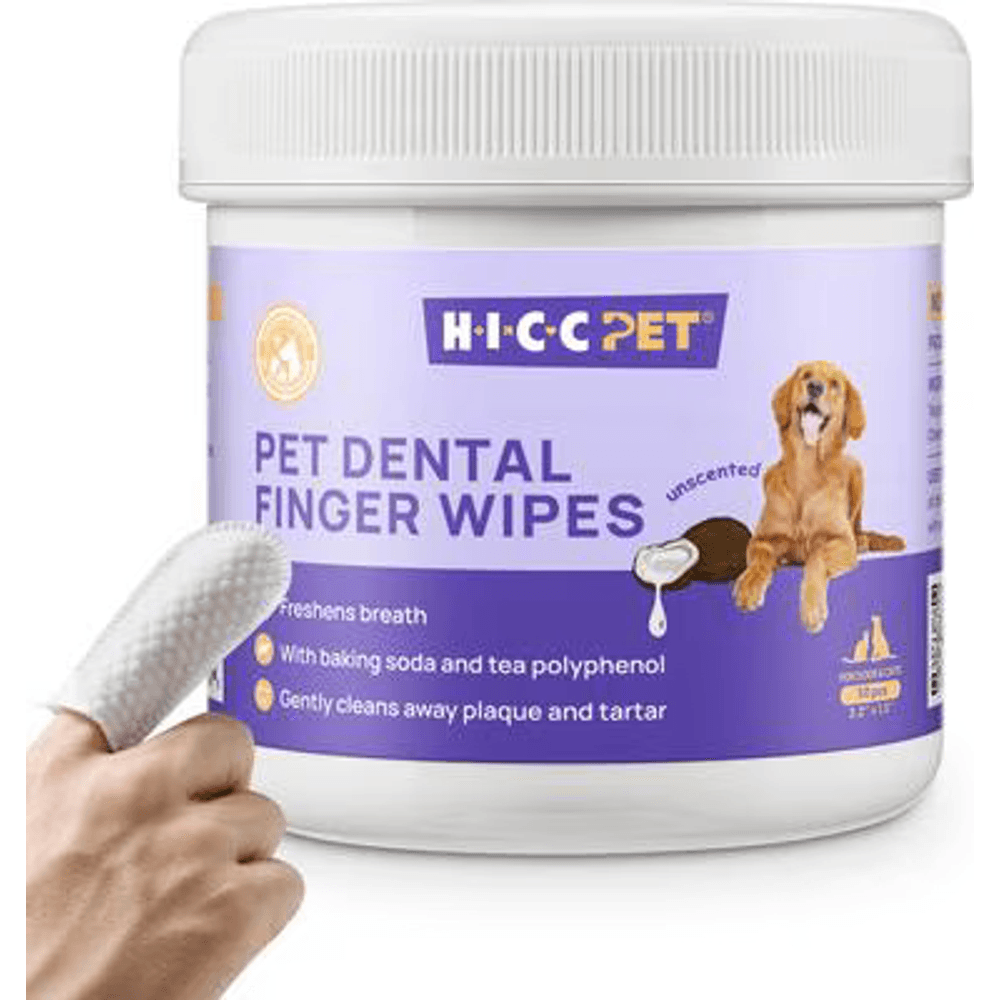
Pre-moistened finger-glove dental wipes with baking soda and tea polyphenol that wipe away plaque and freshen breath. The easiest brushless option for a dog that will not tolerate a toothbrush.
Webvet may earn a commission when you click through to Chewy, at no extra cost to you.
How to choose the best cat dental treats
The best cat dental treats are the ones with a product-specific evidence signal, a safe fit for your cat's age and health, and a texture your cat chews. Use a five-step filter: verify the claim, observe chewing, check calories, confirm life-stage and diet fit, and rule out oral pain.

1. Verify the exact product and claim
Start with the product's complete name, species, and current package. Similar-looking products can differ by size, flavor, formulation, or intended animal. If you use a third-party evidence list, match the exact product rather than assuming the whole brand or dental aisle is covered.
Look for language that states what was measured. Tartar control is not a promise of comprehensive oral health. Breath freshening describes odor, not treatment of its cause. A natural ingredient claim says nothing by itself about mechanical cleaning or clinical effectiveness.
2. Make sure your cat chews it
Offer one treat while you can watch. Note whether your cat bites through it, carries it away, drops it, licks it, or swallows it whole. Repeat the observation on more than one day because novelty can change eating behavior.
A treat should not require an uncomfortable struggle. Stop if your cat repeatedly tilts the head, cries, chatters the jaw, paws at the mouth, drops food, chews only on one side, or approaches food and then backs away. Those signs matter more than finishing the bag.
3. Count the calories
Find the calories per treat and the label's feeding directions. Then compare that amount with your cat's total daily calorie plan. Dental intent does not make calories disappear. Small cats, indoor cats with low energy needs, and cats in a weight-loss program can exceed their allowance quickly.
The WSAVA guide to treats for cats recommends keeping treats to no more than 10% of daily calories so complete and balanced food can supply at least 90%. Ten percent is a ceiling, not a daily target. Some cats need less.
4. Check age, diet, and medical fit
Use the labeled life stage. A product for adult cats is not automatically suitable for kittens. Senior status alone does not forbid a dental treat, but older cats have a higher chance of dental disease or other conditions that make a new treat inappropriate.
Cats on a veterinary therapeutic diet need special care. A few flavored treats can undermine an elimination trial, change the nutrient profile of a urinary diet, or add ingredients the treatment plan intentionally excludes. Ask the veterinarian who prescribed the diet before adding any dental product.
Cats with diabetes, chronic kidney disease, food allergy, gastrointestinal disease, or a history of pancreatitis may also need individualized advice. Do not judge fit from the front label alone.
5. Rule out pain before starting
A dental treat is preventive home care for a cat who can chew comfortably. It is not a test you should use to prove that a painful cat can still eat. If your cat has red gums, visible tooth damage, strong persistent odor, drooling, facial swelling, or changed chewing, arrange an examination first.
| Selection check | What to check | Why it matters |
|---|---|---|
| Is there product-specific evidence? | Exact feline product and exact plaque or tartar claim | One accepted item does not validate an entire brand |
| Does the cat chew it? | Several visible bites rather than gulping whole | Mechanical contact depends on eating behavior |
| Do the calories fit? | Calories per treat and total daily allowance | Dental treats still displace complete food |
| Is it appropriate for this cat? | Life stage, size, medical conditions, and therapeutic diets | A useful product for one cat can be a poor fit for another |
| Is the mouth comfortable? | No food dropping, one-sided chewing, pain, or sudden refusal | Home care should not delay diagnosis of oral disease |
The Oxyfresh Premium Pet Care Solution Cat & Dog Dental Water Additive is another adjacent tool, not a treat. A water additive should be assessed on its own label and evidence. Never use one if it causes a cat to drink less, and do not assume it provides the chewing action discussed in this guide.
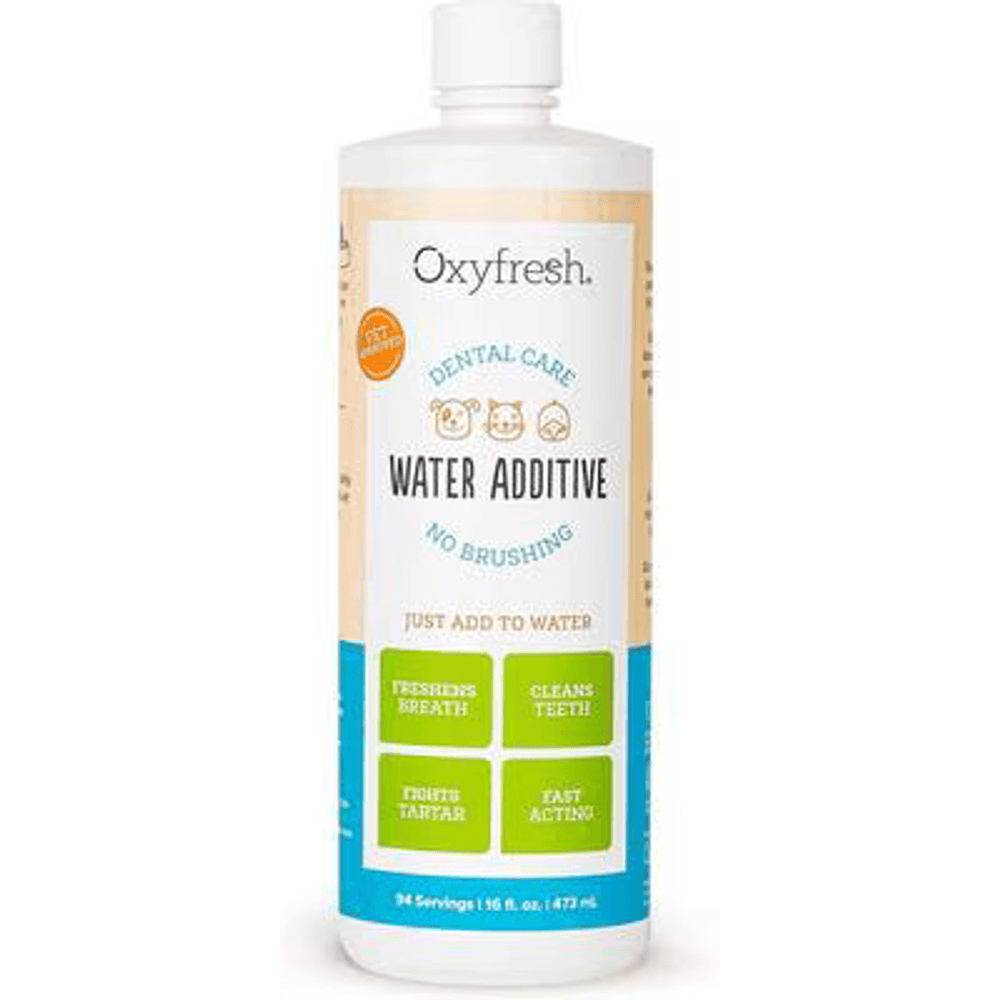
A taste-free, odor-free water additive you pour straight into the bowl. No brushing needed: it freshens breath, helps clean teeth, and fights tartar. About 94 servings per 16-oz bottle.
Webvet may earn a commission when you click through to Chewy, at no extra cost to you.
Ingredients and texture deserve context
An ingredient list helps identify allergens and diet conflicts, but it cannot tell you how well a cat will chew the product or whether a dental claim is supported. Likewise, grain-free, limited-ingredient, natural, and high-protein language does not establish oral-care performance.
Texture must create enough contact to be useful without being an unreasonable challenge. Avoid improvising with bones, antlers, very hard objects, or dog chews. Cat dental treats are designed around feline size and feeding behavior; another species' product is not a substitute.
Flavor is a fit factor, not an efficacy claim
Chicken, salmon, tuna, and catnip-flavored products can improve willingness to eat, but flavor preference varies. A flavor your cat loves may help consistency. It does not broaden the product's evidence or make whole-swallowing effective.
Buy a small package first when possible. That limits waste if the cat refuses the texture and gives you time to observe tolerance before the product becomes an automatic part of the diet.
 $65 · no membership
Have a health question about your cat?
A licensed vet can assess your cat over video and prescribe online when it's appropriate.
 Talk to a vet
- Licensed vets
- All 50 states
- same-day Rx
Webvet may earn a commission if you book.
How often can cats have dental treats?
Feed cat dental treats at the frequency and amount on the current package, then fit those calories inside the cat's daily plan. Many products are designed for daily use, but the label, the individual cat's calorie needs, and veterinary guidance control the answer. More than directed is not better.
Daily use only makes sense when the cat chews the treat, tolerates its ingredients, maintains a healthy weight, and has no medical-diet conflict. A product that causes vomiting, diarrhea, constipation, appetite change, or water avoidance should be stopped while you ask the veterinarian what to do next.
Turn the label into a calorie calculation
Find calories per treat, multiply by the number fed, and compare the result with the cat's daily calorie target. If the treats take calories from the allowance, reduce regular food only with a plan that preserves complete nutrition. Guessing by volume is unreliable because foods have different calorie densities.
For example, if a veterinarian has set a 200-calorie daily plan, the general 10% ceiling would be 20 calories from all treats combined. That includes dental treats, training rewards, pill pockets, table food, and other extras. It is not 20 calories for each category.

Do not use the photograph as a feeding chart
Product size and calorie content vary, so a visual serving in an article cannot replace the package directions. Count or weigh the actual product when the label calls for it. Recheck the directions when you buy a different bag size or formulation because serving instructions can change.
Body-condition trend matters more than one day's perfect arithmetic. Weigh your cat regularly if weight is a concern, and tell the veterinary team about all treats when discussing diet. Owners often remember meals and forget the extras that accumulate between them.
The Virbac C.E.T. Enzymatic Poultry Flavor Dog & Cat Toothpaste is a pet toothpaste, not a dental treat. It belongs in a brushing-based routine when the cat accepts handling and the product's directions fit. Simply owning toothpaste does not create the mechanical benefit of brushing.
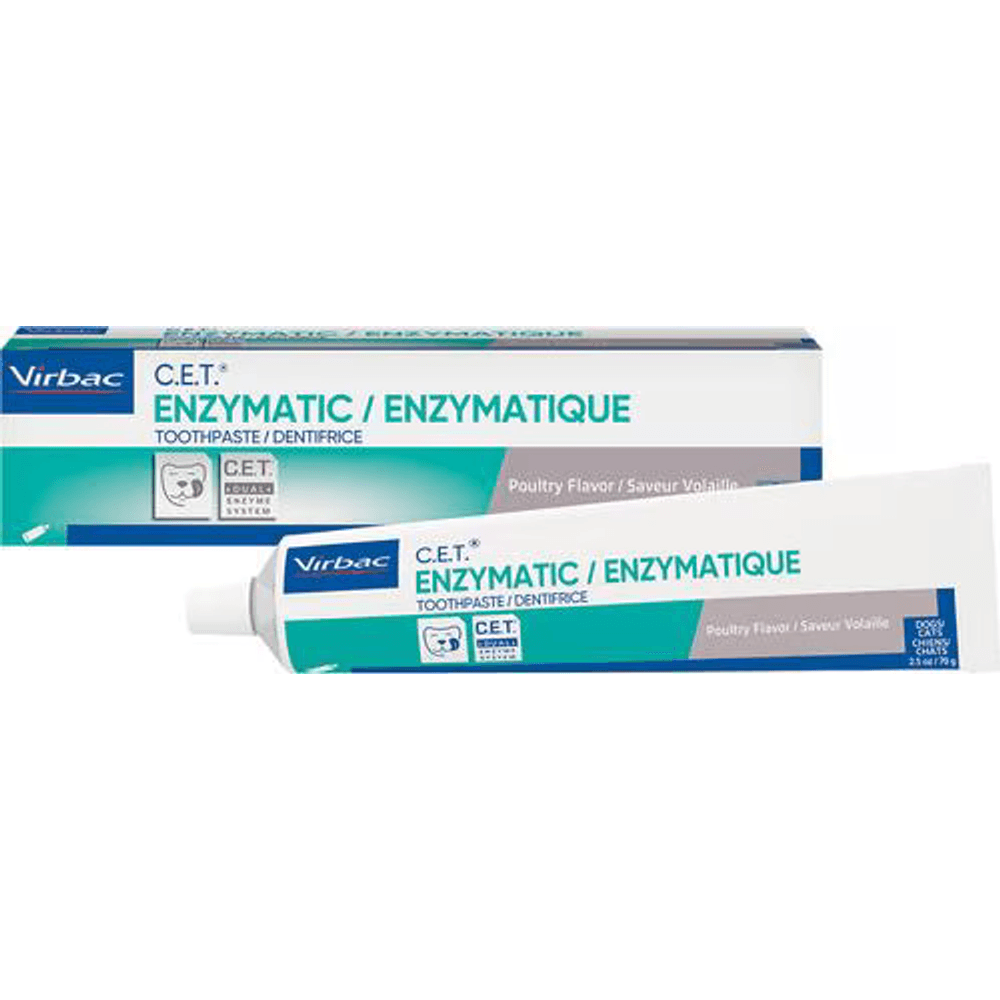
The vet-favorite enzymatic toothpaste. Its dual-enzyme system keeps working between brushings to control plaque and freshen breath, and the poultry flavor makes daily brushing easy.
Webvet may earn a commission when you click through to Chewy, at no extra cost to you.
What if the label's amount is too many calories?
Do not exceed the cat's calorie plan to reach a dental-product target. Ask your veterinarian whether a lower-calorie alternative, a dental diet, brushing, or another approach would be more suitable. Feeding less than the studied label amount may also mean you should not assume the full claimed benefit.
That tradeoff is important: calorie safety and oral-care evidence must both fit. If they cannot, choose a different tool rather than forcing the product into the routine.
Kittens and senior cats need separate judgment
Kittens should receive only products labeled for their age and size. Their calorie requirements, teeth, and chewing behavior differ from those of adults. A small treat that an adult crunches may present a different swallowing or nutrition issue for a kitten.
Senior cats may chew comfortably, but a new preference for soft food, slower eating, or dropping pieces deserves attention. Do not write off those changes as normal aging. Oral pain, tooth resorption, periodontal disease, and other illnesses become more likely with age.
Where treats fit in a complete cat dental routine
Dental treats are one possible layer in a plan that begins with veterinary assessment and includes home care the cat can tolerate. The AAHA dental-care guidelines emphasize individualized home care and professional assessment. Even excellent home care cannot eliminate every need for examinations, dental radiographs, and treatment.
Brushing remains the most direct home method
Toothbrushing places soft bristles where plaque forms along the outer tooth surfaces and gumline. It can be introduced through tiny steps: accepting the owner's hand near the face, allowing a lip lift, tasting pet toothpaste, touching one tooth, and gradually extending the session.
Some cats will not tolerate brushing immediately. That is a reason to use cooperative training and ask for veterinary help, not to force the mouth open. Our full guide to cat teeth cleaning covers toothpaste, brushes, acclimation, professional cleaning, and how the pieces fit together.
A dental diet is not ordinary kibble
A veterinary dental diet is formulated and tested for a particular purpose. Ordinary dry food should not be called tooth-cleaning merely because it is crunchy. Many pieces fracture quickly or are swallowed with limited tooth contact.
If a dental diet is appropriate, it may replace part or all of the complete diet rather than functioning as an extra treat. That changes the calorie calculation and requires the product's feeding instructions. Ask before mixing it with a therapeutic diet prescribed for a different condition.
Wipes, gels, and water additives are adjuncts
A wipe may provide limited surface contact, a gel may carry a product-specific ingredient claim, and a water additive may be easy to administer. None should be described as a treat, and none should be assumed equivalent to brushing without evidence supporting that comparison.
The most practical plan is not necessarily the one with the most products. Choose the tools that address a defined need, fit the cat's health and behavior, and can be used consistently. Record what you use so your veterinarian can evaluate the whole routine.
Professional dental care reaches what home care cannot
Periodontal disease develops below the gumline, where a treat cannot diagnose or treat it. A comprehensive dental procedure under anesthesia allows the veterinary team to examine each tooth, probe around it, take dental radiographs, clean above and below the gumline, and treat diseased teeth.
Anesthesia-free surface scaling may make visible crowns look cleaner but does not provide the same evaluation or treatment below the gumline. Cosmetic improvement should not be confused with comprehensive dental care.
The Greenies Feline Oven Roasted Chicken Flavor Adult Natural Dental Cat Treats are the conventional cat dental treat in this four-offer slate. The feline product appears on the VOHC list with a tartar-control claim. That claim applies to the individual product and still depends on following directions and the cat chewing it.
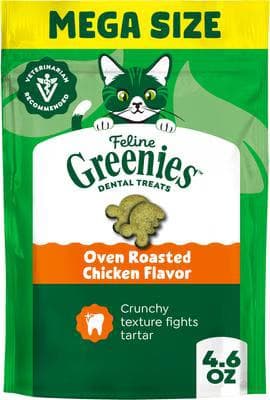
Crunchy dental treats with a texture that helps fight tartar. Oven roasted chicken flavor, veterinarian recommended.
Webvet may earn a commission when you click through to Chewy, at no extra cost to you.
When dental treats should stop and a vet should look
Stop offering a hard or crunchy treat and call your veterinarian if chewing changes, food falls from the mouth, the cat cries or chatters while eating, or a previously eager eater begins avoiding the bowl. Those signs can reflect oral pain even when the cat still consumes some food.
Food dropping while attempting to eat is sometimes called quidding. It is a sign, not a diagnosis. The cause can involve a painful tooth, inflamed gums, a lesion in the mouth, jaw or neurologic problems, or another condition. A treat trial cannot determine which one is present.

Tooth resorption can be easy to miss
Tooth resorption in cats destroys tooth structure and can be intensely painful. Some lesions are hidden below the gumline or hard to see without dental radiographs. A cat may swallow food differently, prefer soft food, or react when a particular area is touched.
The Cornell Feline Health Center's tooth-resorption overview notes eating changes and food falling from the mouth among the possible signs. If you notice them, remove the crunchy dental product from the experiment and arrange an assessment.
Red gums are not a cue to scrub harder
Gingivitis in cats can appear as a red line along the gums, but the visible inflammation may be only part of the problem. Aggressive brushing or hard treats can hurt. Veterinary care should come before a new home routine when the mouth is inflamed.
Bleeding, pus, swelling, a loose or broken tooth, a facial lump, or inability to eat needs prompt attention. Sudden inability to eat, severe swelling, uncontrolled bleeding, breathing difficulty, or major trauma can be urgent.
Bad breath deserves a cause, not just a cover-up
Some dental products include flavors intended to make breath smell fresher. Persistent bad breath in cats can accompany dental disease and sometimes other illness. If odor is strong, new, or quickly returns, investigate rather than increasing the serving.
A normal-smelling product cannot prove that the mouth is healthy. Likewise, a cat who avoids a minty or herbal flavor is not being difficult; feline preferences and smell sensitivity differ from ours.
How to introduce a new cat dental treat
Introduce one product at a time so you can tell what the cat accepts and tolerates. Check the package seal and date, read the feeding directions, and confirm the pieces look and smell normal. Keep the bag in the storage conditions on the label.
- Offer one piece while your cat is calm and you can observe closely.
- Watch whether the cat chews, gulps, drops, or refuses it.
- Check for coughing, gagging, repeated swallowing, or mouth pawing.
- Over the next day, watch appetite, stool, and vomiting.
- If the first piece is tolerated, progress only within the label directions.
Do not disguise a dental treat inside a large handful of regular treats during the first test. You need to see what happens with the actual product. Feeding on a flat mat or shallow dish may make the chewing behavior easier to observe than dropping the piece into a deep bowl.
Keep multiple cats separate for the first servings. Otherwise, one cat may steal the other's portion, and you may not know which animal swallowed a piece whole or developed a digestive reaction.
What if my cat refuses it?
Do not withhold the cat's regular food to create enough hunger to accept a dental treat. The product is optional. Try a different approved flavor or shape only if the mouth appears comfortable and the diet allows it, or ask the veterinarian about a different home-care method.
Cats can form strong aversions after nausea or pain. Repeatedly presenting the same unwanted item can also make the feeding area stressful. Remove it calmly, preserve the normal meal routine, and avoid turning oral care into a contest.
What if my cat swallows it whole?
Stop assuming that product will create the intended chewing contact. Review whether the size is correct for your cat and whether the manufacturer offers another feline format. Do not cut a product into smaller pieces unless the directions allow it, because that could make whole-swallowing even easier.
If the cat coughs, gags, struggles to breathe, or appears distressed, seek urgent veterinary help. For a cat who simply gulps treats without distress, discuss a different oral-care approach at the next appropriate visit.
How to store cat dental treats safely
Keep dental treats in their original package unless the label specifically permits another container. The package preserves the product name, lot code, best-by date, calories, feeding directions, and manufacturer contact information. Those details matter if the texture changes, the cat becomes ill, or a recall is announced.
Close the bag after each use and follow the stated temperature and moisture instructions. Humidity can soften a crunchy product, while heat or poor sealing can affect smell and texture. Do not keep a bag beside a steamy sink, in a hot car, or where the cat can tear it open and eat an uncontrolled amount.

If you use a sealed storage bin to deter pets, place the entire original bag inside it rather than pouring loose treats into the bin. That retains the identifying information and reduces the chance that residue from an older product will mix with a new one.
- Discard pieces that look moldy, unusually oily, crumbled beyond their normal texture, insect-damaged, or different in odor from when the package was opened. A cat refusing one altered batch may be responding to a real change, not suddenly rejecting the whole category.
Keep portions identifiable in a multi-cat home
Record which cat receives the product and how many pieces are offered. Different cats can have different calorie limits, allergies, therapeutic diets, and chewing patterns. Leaving a communal bowl of dental treats makes it impossible to know who ate them or whether the intended cat performed the chewing action.
Store the bag behind a closed cabinet or pet-proof latch. A large accidental intake can cause digestive upset and may be more serious for a cat with a medical condition. If a cat breaks into the package, note the product, estimated amount, time, and any symptoms before calling the veterinary clinic.
Recheck the label when the package changes
Manufacturers can change piece size, calories, ingredients, and feeding directions. Do not assume a redesigned bag contains the identical product you purchased last time. Compare the current label, especially when your cat is on a restricted diet or the serving previously sat close to the calorie ceiling.
This is also why an article should not function as a permanent feeding chart. The label in your hand and the plan from your veterinary team are the current sources for your cat.
Questions to take to your veterinarian
Bring the exact product name or a photograph of the current label, plus the calories per treat and the recommended serving. Explain whether your cat bites each piece several times, swallows it whole, or walks away. Those observations are more useful than saying only that the cat likes or dislikes dental treats.
Ask how the product fits the cat's most recent oral examination. A cat with no visible discomfort may be a candidate for preventive home care, while a cat with gingivitis, a damaged tooth, or suspected resorption may need diagnostics and treatment first. The recommendation should follow the mouth, not the marketing category.
Discuss the complete diet at the same time. Tell the veterinarian about prescription food, supplements, pill pockets, table food, and every other treat. This lets the team judge calories, ingredient conflicts, and whether the dental product might undermine a therapeutic plan.
If brushing is not currently possible
If brushing is not currently possible, ask which intermediate step is safest. The answer may be cooperative handling practice, a different applicator, a product with a defined claim, or waiting until pain has been treated. A dental treat is one option, not the default answer to every handling problem.
Finally, ask when the mouth should be checked again and which changes should trigger an earlier visit. Write those thresholds down. Clear stop rules are especially useful for cats because subtle food dropping, head positioning, or meal hesitation can be easy to miss from day to day.
Comparing dental treats without turning the choice into a ranking
No universal number-one treat exists for every cat. A useful comparison keeps evidence, chewing behavior, calories, and medical fit separate. A product with a recognized tartar claim can still be wrong for a cat who gulps it, cannot spare the calories, or has oral pain.
Start with accepted feline products if available, then compare their current labels. Check serving size, calories, life stage, ingredients relevant to your cat, and whether your cat performs the chewing action. Reassess after a few weeks rather than assuming initial enthusiasm equals long-term fit.
Use reviews and price carefully
Avoid star-rating shortcuts. Retail reviews can reveal palatability patterns or packaging problems, but they do not diagnose your cat, verify that the reviewer followed feeding directions, or establish a clinical claim.
Price per bag can also mislead. Calculate the cost per label-directed day and consider waste if your cat refuses it. The least expensive bag is not economical if it goes unused, while the most expensive product is not automatically more effective.
Cat dental treat questions
Frequently Asked Questions
Do Greenies really clean cat teeth?
Greenies can help clean cat teeth by contributing to tartar control when the individual product is used as directed and the cat chews it. The feline product appears on the Veterinary Oral Health Council list with a VOHC tartar claim. That does not mean the treat brushes every tooth, treats existing dental disease, or proves every Greenies product has the same benefit. The serving must also fit the cat's calorie and health plan.
How many dental treats can a cat have per day?
Follow the feeding directions on the specific package and keep all treats, dental treats included, within about 10 percent of your cat's daily calories. For many products that means only a few pieces a day, with the main ration reduced slightly to compensate. If the label amount would blow past that calorie budget for your cat's size, feed fewer than the label allows or pick a lower-calorie option.
Are dental treats safe for kittens?
Most cat dental treats are formulated and sized for adult cats, and their labels say so. A kitten's teeth, jaw strength, and calorie needs are different, so check the life-stage statement on the package and skip any product without kitten-appropriate directions. Ask your veterinarian before adding a dental product to a kitten's routine, especially while adult teeth are still coming in.
Do dental treats replace brushing or professional cleanings?
No. Dental treats can help slow tartar accumulation when your cat actually chews them, but brushing remains the most direct home method, and only a professional cleaning under anesthesia reaches below the gumline where periodontal disease does its damage. Treat them as one adjunct inside a routine that includes home care and regular veterinary dental checks.
$65 · no membershipHave a health question about your cat?
A licensed vet can assess your cat over video and prescribe online when it's appropriate.
Talk to a vet- Licensed vets
- All 50 states
- same-day Rx
Webvet may earn a commission if you book.

Editor
The Webvet Editorial Team is the in-house group of pet-care editors and writers behind Webvet, operated by Smart Pet Collective. The team researches, writes, and maintains Webvet's pet health, behavior, and medication content. Every article follows a defined editorial process: research from reputable veterinary and scientific sources, careful drafting, mandatory review of medical content by a credentialed veterinarian, and dated publication. Health and medication articles are medically reviewed by a licensed veterinary professional before they go live and are kept current over time.
Veterinarian · BVMS MRCVS
Dr. Pippa Elliott, BVMS, MRCVS, is a veterinarian with nearly 30 years of experience in companion animal practice. Dr. Elliott earned her Bachelor of Veterinary Medicine and Surgery from the University of Glasgow. She was also designated a Member of the Royal College of Veterinary Surgeons. Married with 2 grown-up kids, Dr. Elliott has a naughty Puggle named Poggle, 3 cats and a bearded dragon.


