Flea Shampoo for Cats: Does It Work and What to Use
Flea shampoo for cats kills the adult fleas on the coat during the bath and leaves almost no protection afterward. Here is what that means, which cat-labeled shampoos are worth buying, why a dog product can kill a cat, and how to bathe a cat safely.

BVMS MRCVS
Medically reviewed by Dr. Pippa Elliott, BVMS MRCVS · Last reviewed

This article contains affiliate links. Webvet may earn a commission when you buy through them, at no extra cost to you.
Flea shampoo for cats does one job well and one job only: it kills the adult fleas that are on your cat while the lather is sitting on the coat. Once you rinse and the fur dries, most of these products leave nothing behind to stop the next flea from jumping on. That is the honest starting point, and it is the part the product labels never lead with.
That does not make a flea bath useless. On a cat crawling with fleas, a bath is the fastest way to strip a heavy burden off the coat in one go, and it lifts out the flea dirt and dead insects that no comb reaches. It just cannot end an infestation by itself, because the fleas on your cat are a small fraction of the fleas in your house.
This guide covers what a flea bath genuinely does, which cat-labeled shampoos are worth buying, the ingredient that separates a real product from a scented rinse, and how to bathe a cat without getting shredded or poisoning her.
- 1Flea shampoo kills adult fleas on contact during the bath, then leaves essentially no residual protection once the coat dries.
- 2Only a small share of a flea population lives on the cat, so a bath cannot touch the eggs, larvae, and pupae in your carpet and bedding.
- 3Never put a dog flea shampoo on a cat. Permethrin, common in dog products, causes tremors and seizures in cats and can kill them.
- 4Look for a cat-labeled product that pairs pyrethrins with an insect growth regulator, which is the only combination that does anything about eggs.
- 5A bath is a knockdown, not a plan. Lifecycle-length control comes from a monthly preventive plus treating the home.
 Sponsored
Need flea, tick, or parasite care for your cat?
A licensed vet at Dutch can recommend the right preventive and prescribe it when it's appropriate. Annual members get 20% off their first flea and tick order.
Use code Pets60
Plans start at $12/month · covers up to 5 pets
- Licensed vets in most states
- Rx for 150+ conditions
- 4.7 on Trustpilot
Does flea shampoo actually work on cats?
Yes, in the narrow sense that matters during the bath. Pyrethrin-based cat shampoos kill adult fleas on contact within minutes, and a thorough lather with the right contact time will drop the adult population on the coat close to zero. What they do not do is protect your cat afterward. Once the water and the insecticide go down the drain, the coat is bare, and a flea that hops on an hour later is completely unaffected.
That matters because of where fleas actually live. Adult fleas on the pet make up only a small slice of the total population in an infested home. The overwhelming majority sits in the carpet, the bedding, and the cracks in the floor as eggs, larvae, and pupae, and those stages are untouched by anything happening in your sink. Female fleas start laying within a day or two of their first blood meal, eggs roll off the coat into the environment, and they hatch in as little as one to six days.
Here is the bathe-or-skip rule, before you buy anything:
- Bathe if your cat has a visibly heavy flea burden, is coated in flea dirt, or has a greasy or soiled coat that a comb will not clear.
- Bathe if you need a fast knockdown today and cannot get a prescription preventive until later in the week.
- Skip the bath if the burden is light and your cat tolerates a flea comb, because combing achieves the same knockdown with far less stress.
- Skip the bath if your cat panics in water to the point of injuring you or herself. A stressed cat that has to be restrained is a bite risk, and a bite from a cat needs medical attention. An oral nitenpyram tablet such as Capstar gives you the same adult-flea knockdown without water.
- Skip the bath and call your vet if your cat is a young kitten, elderly, pregnant, nursing, sick, or already on a topical preventive.
| Format | How fast it kills | Residual protection | What it does about eggs |
|---|---|---|---|
| Flea shampoo (rinse-off) | Adults die on contact, within minutes of lathering | Essentially none once the coat dries | Nothing, unless the label includes an insect growth regulator |
| Monthly topical spot-on | Adults die within hours of contact with treated skin | Typically about 30 days per label | Some products carry an IGR that sterilizes eggs |
| Monthly or extended oral | Adults die within hours of the flea biting | 30 days, or up to 12 weeks for extended-duration products | Kills the adults before they lay, breaking the cycle at the source |
| Flea comb | Removes adults mechanically as you comb | None | Removes some eggs and flea dirt physically |
Read that table as a job description rather than a ranking. Shampoo is the only column that clears a filthy coat in ten minutes, and the preventive columns are the only ones that are still working tomorrow. Most cats with an active infestation need both, in that order, on the same day.
The best flea shampoos for cats
Every product below is labeled for cats, which is the first filter and the one that rules out most of what ranks for this search. They are grouped by the job they do rather than by score, because a cat with sensitive skin, a cat that has never tolerated a chemical product, and a cat that just needs the cheapest working option are three different shoppers.
Adams Plus Flea & Tick Shampoo for Cats & Dogs (Sensitive Skin)
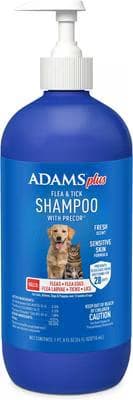
A gentle flea and tick shampoo for cats and dogs that kills ticks on contact and soothes sensitive skin. Handy for washing your dog down after a hike.
Webvet may earn a commission when you click through to Chewy, at no extra cost to you.
This is the pick to reach for first, and the reason is one ingredient. Adams Plus carries Precor, the brand name for (S)-methoprene, an insect growth regulator. Pyrethrins in the formula kill the adult fleas on the coat during the bath, and the IGR interferes with the immature stages so that eggs and larvae exposed to it do not mature into biting adults. Nearly every other flea shampoo on the shelf is adults-only chemistry.
That single addition is what makes this the one flea bath that does anything at all about the part of the problem you cannot see. It is not a substitute for treating the house, because the IGR only goes where the lather goes, but it means the eggs still sitting in your cat's coat at bath time are dealt with rather than rinsed into the floorboards.
Practical notes before you buy:
- Labeled for both cats and dogs, so a multi-pet household can use one bottle instead of two.
- The sensitive-skin formulation adds oatmeal, aloe, coconut extract, and lanolin, which matters on a cat whose skin is already inflamed from flea bites.
- It also kills ticks and lice, which is occasionally relevant for indoor-outdoor cats.
- Follow the label contact time exactly. Rinsing early is the most common reason this product underperforms.
PetArmor Plus Flea & Tick Shampoo for Cats
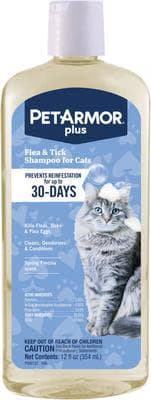
Cat-labeled flea and tick shampoo with an insect growth regulator, so it kills fleas, ticks and flea eggs and helps prevent reinfestation for up to 30 days.
Webvet may earn a commission when you click through to Chewy, at no extra cost to you.
If you would rather not use a shared cats-and-dogs bottle, PetArmor Plus Flea and Tick Shampoo for Cats is the cat-only formulation. Everything in it was mixed for feline use, so there is no question of grabbing the wrong container in a household that has both species, which is a real and preventable failure mode.
It also carries an insect growth regulator, and its label claims prevention of reinfestation for up to 30 days. Treat that claim carefully. The residual effect described applies to the flea stages the product reaches, and it does not turn a shampoo into a monthly preventive or excuse you from treating the environment. What it does mean is that this product is doing more than a plain adulticide wash.
Where it fits:
- The right pick when the treated animal is a cat and you want a bottle you cannot misapply to the wrong species.
- A sensible choice for a cat with a moderate burden that you plan to follow with a monthly preventive.
- Still an insecticidal product, so kitten age and weight limits on the label apply in full.
SimpleSource Flea & Tick Cat Shampoo
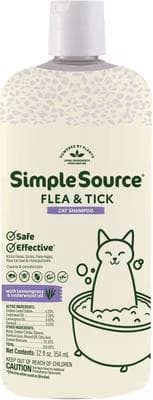
Plant-based cat shampoo using lemongrass and cedarwood oil rather than pyrethrins, for owners who want a gentler rinse-off option. Cat-labeled, so it is formulated for feline sensitivity.
Webvet may earn a commission when you click through to Chewy, at no extra cost to you.
SimpleSource Flea and Tick Cat Shampoo is the plant-based option, built on lemongrass oil and cedarwood oil rather than pyrethrins. It is the pick for owners who have decided they do not want a conventional insecticide on their cat, and it is honest about what it is: a contact product that kills and repels fleas while it is on the coat, with no claim to lifecycle control.
The essential-oil question deserves a straight answer, because it comes up every time a botanical product appears on a cat page. Concentrated essential oils genuinely are dangerous around cats. Cats lack the liver enzyme pathway that other mammals use to clear many plant compounds, which is why undiluted oils applied to the skin, oils added to food, and diffusers running in a closed room are all real poisoning routes. A cat-labeled, rinse-off shampoo formulated at minimum-risk concentrations is a different proposition: the exposure is dilute, brief, and washed off at the end of the bath rather than left sitting on the coat to be groomed and swallowed.
Use it with that distinction in mind:
- Rinse thoroughly. The entire safety case for a botanical cat shampoo rests on it not staying on the coat.
- Never substitute a home mixture of the same oils. Dilution and formulation are the whole difference.
- Do not diffuse, spray, or dose these oils anywhere else in the house because the shampoo worked.
- Expect a knockdown only. There is no IGR here and no residual claim.
Veterinary Formula Clinical Care Flea & Tick Shampoo
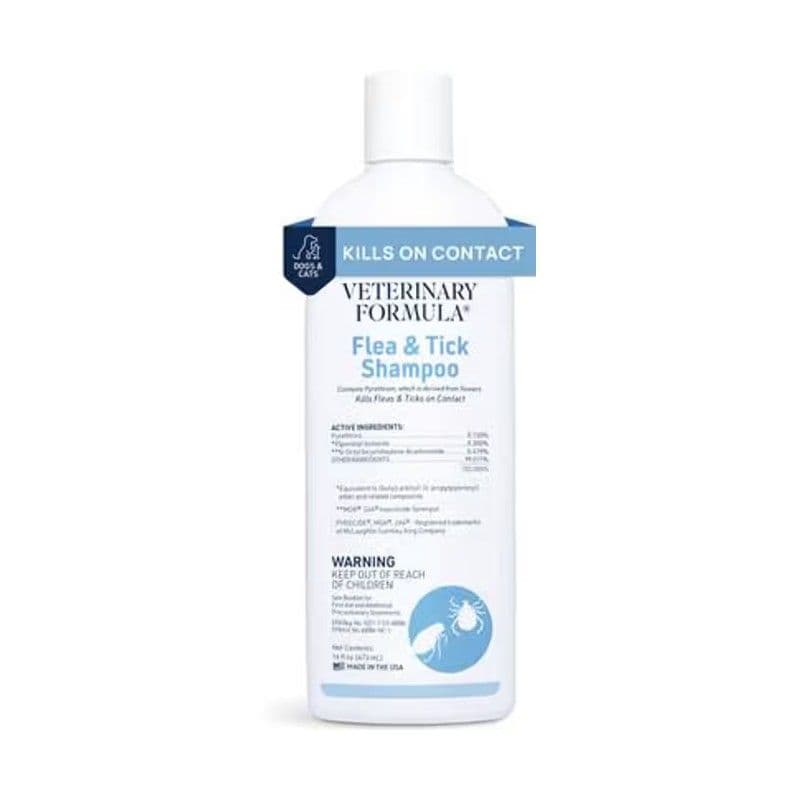
Pyrethrin-based medicated shampoo that kills fleas and ticks on contact, labeled for cats as well as dogs. The budget option in this lineup.
Webvet may earn a commission when you click through to Chewy, at no extra cost to you.
The budget pick, and a perfectly competent one. Veterinary Formula Clinical Care Flea and Tick Shampoo is a pyrethrin shampoo that kills fleas and ticks on contact, labeled for both cats and dogs, and it does the fundamental job of a flea bath without the extras. If your goal is a hard knockdown before you start a real preventive, this is enough product.
What you are giving up is the growth regulator. That means every egg in the coat survives the bath, and it means the residual claim is nothing at all. On a cat with a light burden that is going straight onto a monthly preventive, that trade is fine. On a cat in a heavily infested home, spend the extra few dollars on a formula with an IGR.
 Sponsored
Vet care that's always there
Unlimited video calls and messaging with licensed vets for less than a typical vet visit. One membership covers up to five pets.
Use code Pets60
Plans start at $12/month · covers up to 5 pets
- Licensed vets in most states
- Rx for 150+ conditions
- 4.7 on Trustpilot
How to choose a flea shampoo for cats
Choosing a flea shampoo is really choosing an active ingredient, and there are only a handful in play. Everything else on the front of the bottle is fragrance, conditioner, and marketing. Turn the bottle around, find the active ingredients panel, and check three things: that the label names cats, that the active is one a cat can tolerate, and whether there is a growth regulator in there at all.
| Active ingredient | What it is | What it does on a cat | Cat safety |
|---|---|---|---|
| Pyrethrins | Natural extract of chrysanthemum flowers | Kills adult fleas, ticks, and lice on contact within minutes | Safe on cats at label concentrations in cat-labeled products |
| Piperonyl butoxide | A synergist, not an insecticide | Blocks the flea's ability to break down pyrethrins, so less active is needed | Standard in cat-labeled shampoos at label rates |
| (S)-methoprene or pyriproxyfen | Insect growth regulators | Stop eggs and larvae from developing into biting adults | Very low mammalian toxicity, safe in cat products |
| Lemongrass, cedarwood, and similar plant oils | Minimum-risk botanical actives | Kill and repel fleas on contact while wet, then wash off | Acceptable in a cat-labeled rinse-off product, dangerous as concentrated oils |
| Permethrin | A synthetic pyrethroid used in dog products | Kills fleas and repels ticks on dogs | Toxic to cats. Never apply a permethrin product to a cat. |
Then work through the practical filters:
- Cat on the label, every time. If the label does not name cats, the product is not for your cat, no matter how similar the ingredient list looks.
- An IGR if you can get one. Pyrethrins plus (S)-methoprene or pyriproxyfen is the strongest combination available over the counter for a bath.
- Skin condition. A cat scratched raw from flea allergy needs an oatmeal or aloe formulation, not a stripping degreaser.
- Age and weight limits. These are printed on the label for a reason and they are not suggestions.
- Multi-pet households. A cats-and-dogs bottle simplifies life, but only in the direction of using the cat-safe product on both. Never the reverse.
Vet-approved is a phrase worth being skeptical about on a shelf product, because it is not a regulated claim. The useful version of that question is whether your own veterinarian is happy with the specific product on your specific cat, which is a two-minute phone call and worth making if your cat is very young, very old, or on medication.
For ordinary dirt without a flea-treatment need, compare general cat shampoos instead.
Is flea shampoo safe for cats and kittens?
For a healthy adult cat, a cat-labeled flea shampoo used according to its directions is safe. The risks all come from the same three mistakes: using a dog product, using an insecticidal product on an animal too young or too small for it, and leaving the product on longer than the label allows. Each of those is entirely avoidable, and each has killed cats.
Kittens are the other hard limit. Insecticidal shampoos carry minimum age and weight thresholds, and those thresholds are not the same from product to product, so there is no universal number to quote you. Read the panel on the bottle you actually own, and if your kitten is anywhere near the line, ring your vet before bathing rather than guessing. A very young kitten with fleas is a genuine medical problem in its own right, because flea bite anemia can be life threatening at that size, and the correct answer is often a vet-recommended product rather than a bath at all.
A few more situations that call for a phone call first:
- Pregnant or nursing cats, where some actives are restricted.
- Cats already wearing a flea collar or carrying a spot-on applied in the last few days.
- Cats with broken, raw, or infected skin, where an insecticide will sting and absorb differently.
- Cats on any prescription medication, including seizure medication.
- Any cat that has previously reacted badly to a topical product.
How to bathe a cat with flea shampoo, step by step
Most flea baths fail for one of two reasons: the shampoo goes on in the wrong order and the fleas escape upward, or it gets rinsed off before it has had time to work. The sequence below fixes both. Set everything out before the cat comes into the room, because once you start, you will not have a spare hand.

- Set up first. Two to three inches of lukewarm water in a sink or tub, a rubber mat or towel underfoot for grip, the bottle open, a jug for rinsing, and two dry towels within reach.
- Comb before you wet. A quick pass with a fine-tooth flea comb such as the Frisco flea comb removes loose debris and tells you how heavy the burden is.
- Wet the body, not the head. Work from the shoulders back. Never pour water over the face, and keep shampoo out of the eyes, ears, nose, and mouth.
- Lather a ring at the neck first. This is the step everyone skips. Fleas run away from the wet lather and head for dry ground, which means the face and ears. A soapy collar of shampoo worked right down to the skin around the whole neck cuts off that escape route before you touch the rest of the coat.
- Work backward and down. Shoulders, back, flanks, belly, legs, tail, right to the skin rather than the surface of the fur. The tail base and the belly carry the heaviest flea load, so give them the most attention.
- Hold the contact time. Leave the lather on for the full period the label specifies, commonly around five minutes, and never longer than the maximum stated.
- Rinse from the head down. Rinse in the same direction water naturally runs, using the jug, until the water runs completely clear. Residue left in the coat gets groomed off and swallowed.
- Towel and warm. Wrap the cat in a dry towel, blot rather than rub, swap to a second dry towel, and keep her in a warm draft-free room until the coat is fully dry.

The cat bathing guide covers handling, rinsing, and drying. Follow the flea product's own age limits and contact time.
Waterless and no-rinse flea shampoos for cats
Plenty of cats will not tolerate a sink at any price, and forcing one is how owners end up in urgent care. A waterless or no-rinse flea shampoo, usually a foam or a mousse worked into a dry coat, is the honest alternative for those cats. You massage it in, comb it through, and towel off the excess rather than rinsing.
Be clear about the trade you are making:
- What it gives you: contact kill of adult fleas on the coat with no bath, no restraint in water, and far less stress for a cat that panics.
- What it costs you: less thorough coverage than a full lather, because you cannot reach the skin as evenly through dry fur.
- What it still does not do: provide residual protection or touch the eggs, larvae, and pupae in the house.
- Where it fits best: older cats, cats with heart or respiratory conditions that make restraint risky, and cats who have already told you exactly what they think of water.
Waterless products are still insecticidal or botanical actives on the coat, so the same rules apply. Cat on the label, age and weight limits observed, and no dog product ever. Comb the coat afterward to lift the killed fleas and debris out rather than leaving them to be groomed off and swallowed.
Dawn, natural, and homemade flea shampoos for cats
Is Dawn dish soap good for fleas on cats? It works, partly, and it is not a flea treatment. Dish soap is a surfactant. It breaks the surface tension of water, which strips the waxy coating on a flea's body and lets it get wet, so fleas that would normally shed water and cling to the fur drown instead. That is real, and it is why the trick persists.
Everything else about it argues against making a habit of it:
- Dish soap is not an insecticide and is not registered as one. Nothing about it kills fleas chemically.
- It leaves zero residual protection, exactly like a flea shampoo but without the flea-specific chemistry.
- It strips the natural oils out of a cat's coat and can leave the skin dry, flaky, and itchier than the fleas did.
- It stings badly in the eyes, and a cat with soap in her eyes is a cat that will never let you bathe her again.
- It does nothing to eggs, larvae, or pupae, so the infestation carries on regardless.
There is one situation where dish soap is the right tool, and it is an emergency: washing a dog flea product off a cat while you are on the phone to your vet. Outside that, use a product formulated for the job.
Homemade flea shampoo recipes deserve the same treatment. Vinegar, lemon rinses, salt, and diluted essential oils circulate constantly, and none of them are tested for either efficacy or feline safety. Citrus oils and tea tree oil are actively dangerous to cats. If you want a low-chemical route, a cat-labeled botanical shampoo formulated at minimum-risk concentrations is the version of that idea that has actually been through a formulation process, and our guide to getting rid of fleas on cats covers the non-shampoo options in full. See WebVet’s guide to natural flea remedies for cats and which ones are unsafe.
After the bath: what actually keeps fleas off your cat
The bath is the beginning of the job. A clean, flea-free cat put straight back into an untreated house will be carrying fleas again within days, because the pupae in your carpet keep hatching for weeks and they are waiting for a host to walk past. The follow-through is what turns a knockdown into control.
Do all four of these, not just the first:
- Start a vet-recommended monthly preventive the same week, such as a cat-labeled monthly spot-on like Cheristin, and keep it going for at least three consecutive months so the environmental stages die out. Our comparison of flea treatment options for cats walks through orals, spot-ons, and collars.
- Treat every pet in the home on the same schedule, using a product licensed for that species and weight, including the animals showing no signs.
- Clean the environment. Hot-wash all bedding and soft cat furniture, vacuum floors, rugs, and upholstery thoroughly including under furniture, and empty the canister outside afterward.
- Verify with a comb. Twenty-four hours after the bath, run a fine-tooth flea comb through the coat over a sheet of white paper and read what falls out.

That last check is the only real evidence you have that the bath worked. Tap the comb onto the white paper after each pass and look at what lands. Live fleas moving on the paper mean the bath missed some or your cat has already picked up more. Dark specks that turn rust red when you add a drop of water are flea dirt, which is dried blood rather than live insects, and our guide to flea dirt on cats explains how to read the result. Tiny white ovals that look like salt grains are flea eggs on cats, and finding them tells you the cycle is still running in your home. Check again in 24 hours and again after a week, and track whether what you collect is falling or holding steady.
- 1A flea bath buys you a clean cat today. Only a monthly preventive plus environmental cleanup gives you lifecycle-length control.
- 2Treat the home too, because the majority of the flea population is never on the cat.
- 3Fresh fleas appearing for a few weeks after treatment is normal while pupae in the house keep hatching.
- 4Comb over white paper 24 hours after the bath to confirm the knockdown actually worked.
- 5Call your vet rather than stacking a second flea product on top of the first.
Flea shampoo questions cat owners ask
Frequently Asked Questions
Will flea shampoo kill flea eggs on my cat?
Only if the label names an insect growth regulator such as (S)-methoprene or pyriproxyfen, and even then only the eggs still in the coat when you lather. Standard pyrethrin shampoos kill adults and do nothing to eggs at all. The larger issue is location: flea eggs are smooth and dry and roll straight off the cat within hours of being laid, so most of them are in your carpet, your bedding, and the gaps in your floorboards rather than on the animal you are washing. An IGR in the bottle only reaches the cat, which is why the label claim and the actual solution are different things. Treating the home is what deals with the eggs.
How often can I bathe my cat with flea shampoo?
Follow the repeat interval printed on your bottle, which is commonly no more often than every seven days and sometimes longer. Do not shorten it because fleas came back. Repeat bathing strips the natural oils out of the coat and can leave a cat with dry, irritated skin that itches as badly as the fleas did, and stacking insecticidal products increases the exposure without increasing the benefit. If fleas reappear within days of a bath, that is not a sign you need another bath. It is a sign the house is infested and the cat needs a preventive with real residual activity. Talk to your vet rather than rebathing on a short cycle.
Can I use flea shampoo if my cat is already on a monthly preventive?
Ask your vet before you do. Bathing can strip a topical spot-on, particularly within the first 48 hours of application when it is still spreading through the skin oils, and a degreasing shampoo can reduce how well it works even after that. Oral preventives are unaffected by bathing because they work from the inside. There is also a general principle worth respecting: stacking flea products is one of the more common ways cats get made ill by treatments meant to help them. Your vet can tell you whether the specific combination is safe and whether a bath is worth doing at all given what is already on board.
Can you use flea shampoo for dogs on cats?
No, and this is the single most dangerous mistake on this page. Many dog flea products contain permethrin, a synthetic pyrethroid that dogs metabolize safely and cats cannot. In cats it causes tremors, twitching, drooling, disorientation, high body temperature, and seizures, and it can be fatal. Diluting it does not make it safe, and a small cat is at greater risk, not less. The same warning applies to a cat that grooms or sleeps against a dog that has just been treated. If a dog product has already gone onto a cat, wash her with liquid dish soap and lukewarm water and phone your veterinarian or an animal poison control line straight away.
Is Dawn dish soap good for fleas on cats?
It drowns adult fleas and it is not a flea treatment. The surfactant in dish soap breaks water's surface tension so fleas cannot stay dry and afloat in the coat, which is why a bath in it does knock fleas off. It is not an insecticide, it has no residual action whatsoever, it does nothing to eggs or larvae, and it strips the protective oils out of a cat's coat, leaving skin dry and itchy. It also stings in the eyes. Use a cat-labeled flea shampoo instead. The one exception is an emergency decontamination when a dog flea product has been applied to a cat, where dish soap is exactly the right thing to reach for while you call the vet.
What is the safest flea shampoo for cats?
The safest product is a cat-labeled one used exactly as its label directs, on a healthy adult cat, with the contact time and the rinse done properly. Safety here is much more about the label and the technique than about the brand. Pyrethrins with piperonyl butoxide and an insect growth regulator is a well-established combination in cat products, and a cat-labeled botanical rinse-off shampoo is a reasonable alternative for owners who prefer one. What makes a flea shampoo unsafe is applying a dog formulation, ignoring the age or weight minimum, leaving the lather on past the label maximum, or using it on a kitten, a pregnant cat, or a sick cat without asking a vet first.
Does flea shampoo work on kittens?
Insecticidal flea shampoos carry minimum age and weight limits, and those limits vary between products, so the only reliable answer is the panel on the bottle in front of you. Do not apply an adult product to an underage kitten on the assumption that a smaller amount is proportionate, because it is not how the toxicity works. For a kitten under the limit, the safe route is a fine-tooth flea comb, warm water, and a plain kitten-safe wash to remove flea dirt, followed by a vet-recommended product. Heavy flea burdens on very small kittens can cause anemia from blood loss, which is a same-day veterinary matter rather than something to handle with a bath.
How long does it take flea shampoo to kill fleas on a cat?
Pyrethrin-based shampoos start killing adult fleas within minutes of contact, and you will often see fleas dying in the lather before the contact time is up. That is the entire duration of the effect. There is no ongoing kill once you rinse and dry, so a flea that jumps on that evening survives untouched. If you need something that keeps killing, that is what a monthly preventive is for, and if you need a fast knockdown without a bath, a vet can dispense a fast-acting oral adulticide that starts working within about half an hour. Judge the bath on whether the coat is clear afterward, not on whether fleas ever come back.
Sources
- Merck Veterinary Manual: Fleas and flea allergy dermatitis
- Merck Veterinary Manual: Pyrethrins and pyrethroids toxicosis in animals
- Companion Animal Parasite Council (CAPC): Fleas guidelines
- Cornell Feline Health Center: Fleas
- VCA Animal Hospitals: Flea control in cats
- US Environmental Protection Agency: Minimum risk pesticides
- ASPCA Animal Poison Control Center

Editor
The Webvet Editorial Team is the in-house group of pet-care editors and writers behind Webvet, operated by Smart Pet Collective. The team researches, writes, and maintains Webvet's pet health, behavior, and medication content. Every article follows a defined editorial process: research from reputable veterinary and scientific sources, careful drafting, mandatory review of medical content by a credentialed veterinarian, and dated publication. Health and medication articles are medically reviewed by a licensed veterinary professional before they go live and are kept current over time.
Veterinarian · BVMS MRCVS
Dr. Pippa Elliott, BVMS, MRCVS, is a veterinarian with nearly 30 years of experience in companion animal practice. Dr. Elliott earned her Bachelor of Veterinary Medicine and Surgery from the University of Glasgow. She was also designated a Member of the Royal College of Veterinary Surgeons. Married with 2 grown-up kids, Dr. Elliott has a naughty Puggle named Poggle, 3 cats and a bearded dragon.


